What is Wavelength Selective Switch (WSS)
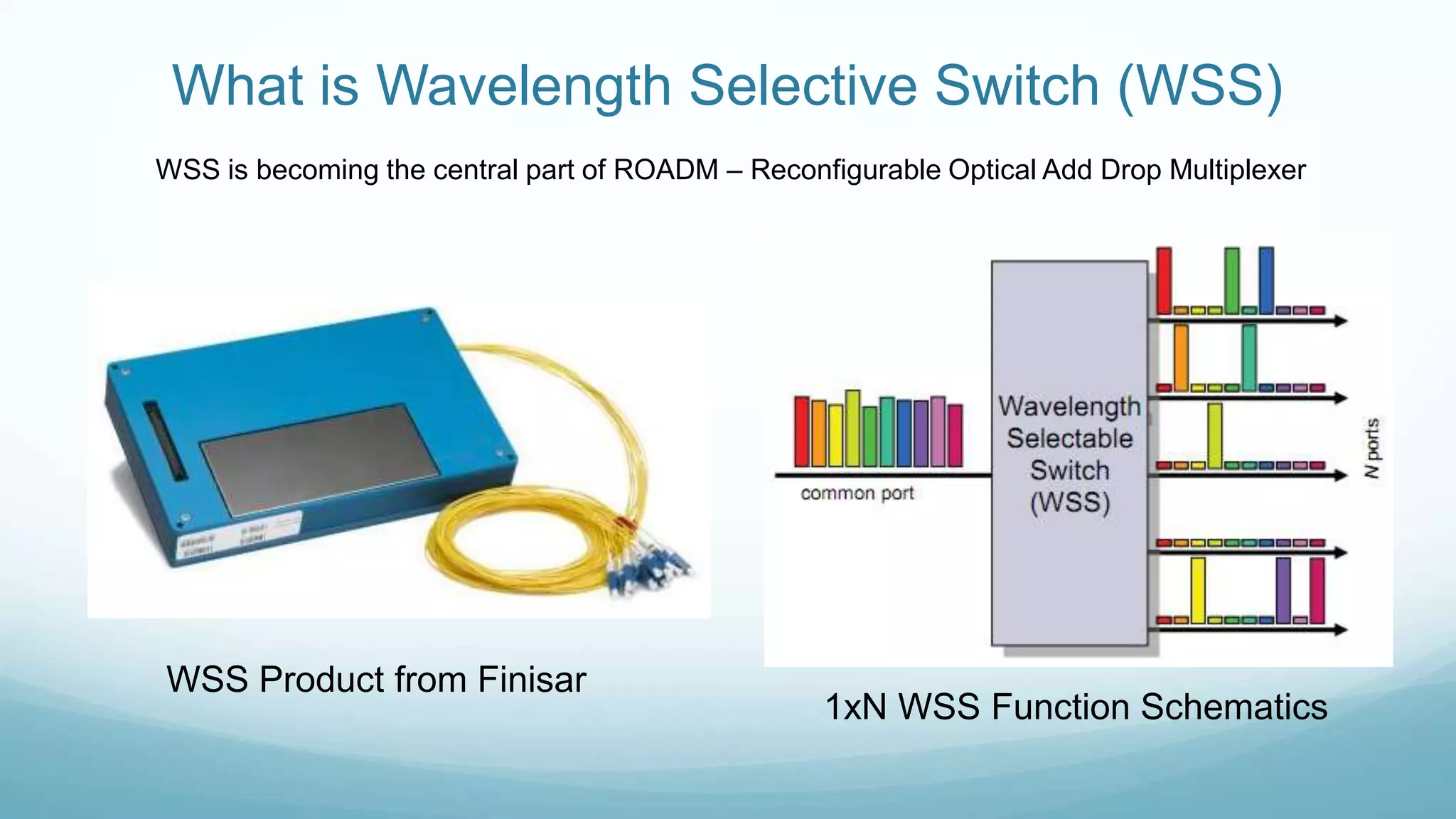
WSS Product from Finisar
1xN WSS Function Schematics
WSS is becoming the central part of ROADM – Reconfigurable Optical Add Drop Multiplexer
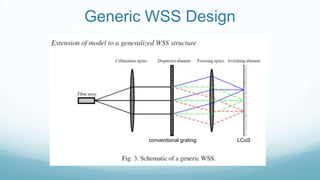
Generic WSS Design
conventional grating LCoS
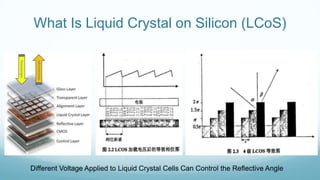
What Is Liquid Crystal on Silicon (LCoS)
Different Voltage Applied to Liquid Crystal Cells Can Control the Reflective Angle
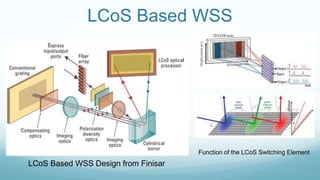
LCoS Based WSS
LCoS Based WSS Design from Finisar
Function of the LCoS Switching Element
More FREE Fiber Optic Tutorials
FO4SALE.com
Don’t Forget to Visit

What is l co s based wavelength selective switch

  • 1.
    What is WavelengthSelective Switch (WSS) WSS Product from Finisar 1xN WSS Function Schematics WSS is becoming the central part of ROADM – Reconfigurable Optical Add Drop Multiplexer
  • 2.
  • 3.
    What Is LiquidCrystal on Silicon (LCoS) Different Voltage Applied to Liquid Crystal Cells Can Control the Reflective Angle
  • 4.
    LCoS Based WSS LCoSBased WSS Design from Finisar Function of the LCoS Switching Element
  • 5.
    More FREE FiberOptic Tutorials FO4SALE.com Don’t Forget to Visit

Editor's Notes

  • #2 Hello, every one. This is Colin from Fiber Optics For Sale.In this video, I will explain what is wavelength selective switch, often just called WSS, and one type of WSS which is based on Liquid Crystal on Silicon.Wavelength selective switch is becoming the central part of ROADM (reconfigurable optical add drop multiplexer). In a WSS, different wavelength channels from the input fiber can be independently switched to different output ports, as shown in the right side picture. The left side picture shows an actual WSS product from Finisar.
  • #3 This illustration shows a generic design of WSS. This optical principle is used on many different WSS designs, such as LCoS or MEMS based WSS switches.Multiple wavelengths come in from the input port. The input port is one port among the fiber array. The fiber array is in the direction of perpendicular to the screen, in other words, the fiber array is in and out of the screen, that is why you only see one port shown in the picture.The light from the input port is first expanded and collimated by the collimation optics. Then the light is projected onto the dispersive element. In a LCoS based WSS, this dispersive element is a conventional grating. The purpose of the dispersive element is to spatially separate these multiple wavelengths. With a conventional grating, the wavelengths are separated into different angles. Blue to the top, green in the middle, and red to the bottom. These lights are still collimated, so next they are focused by the focusing optics and projected onto the switching element. The purpose of the switching element is to direct different wavelengths to different output ports. In a LCoS based WSS, this switching element is a LCoS chip. This time, the switching element directs lights to different perpendicular angles, in other words, in the fiber array’s direction which is perpendicular to the screen. So when the lights trace back, they are focused into different output ports, depending on the switched angle by the switching element.
  • #4 Before we introduce LCoS based WSS, we have to understand what is LCoS and how it redirects light beam to different angles.LCoS was first used for display applications. The structure is that many liquid crystal cells are made on a silicon wafer. As shown in the left picture, a liquid crystal cell layer is sandwiched between an upper transparent electrode layer and a bottom CMOS electrical control layer. There is also a reflective layer to reflect light, this is called a reflective LCoS. The phase delay of reflected light can be controlled by the voltage applied on the liquid crystal cell. When a pattern of phase delays are applied to multiple liquid crystal cells, as shown in the center picture, it begins to function like a reflective grating. Different phase delay patterns correspond to different reflective angles, as shown in the right side picture. Here alpha is the incident angle and beta is the reflective angle.So by controlling applied voltage patterns on multiple liquid crystal cells, we can control reflective angle beta. Each different angle beta corresponds to a particular output fiber port. This is the mechanism behind LCoS based WSS switches.
  • #5 Now let’s take a close look on an actual LCoS based WSS design from Finisar.Keep in mind, in principlethis design works exactly like the generic WSS design we talked about.Multiple wavelength light comes in from the input fiber at the center of the fiber array. Since this fiber is a single mode fiber, the polarization of the light is random. However, the conventional grating is very sensitive to the polarization of the light, so the polarization has to be controlled. Here the purpose of the polarization diversity optics is to transform the polarization of the input light into linearly polarized. In addition, the polarization is transformed into s-polarization relative to the conventional grating, because the conventional grating has the maximum diffraction efficiency at s-polarization.Next the light passes through the first imaging optics and is reflected by the cylindrical mirror, then it passes through the second imaging optics. Here the light is collimated and projected onto the conventional grating. As discussed in the generic WSS design, the purpose of the conventional grating is to separate different wavelengths into different horizontal angles. As shown here, the red light and blue light are diffracted into different angles. The purpose is to project different wavelengths onto different portions of the switching element, which is the LCoS chip. So after passing through the second imaging optics, then reflected by the cylindrical mirror, the light is now focused on the LCoS chip surface. However, different wavelengths are focused on different parts. Each liquid crystal cell is independently controlled. As discussed in the last slide, the LCoS chip reflects light to different vertical angles by applying different voltage patterns to the liquid crystal cells. So blue light is reflected at angle beta one, and red light is reflected at angle beta two. Thus when the light traces back through all the elements, it gets focused into a different output port depending on the reflection angle beta.This whole LCoS switching idea is simplified and summarized in this illustration.
  • #6 So there you have it. You can visit fo4sale.com for more free fiber optic tutorials.I will see you in the next video!