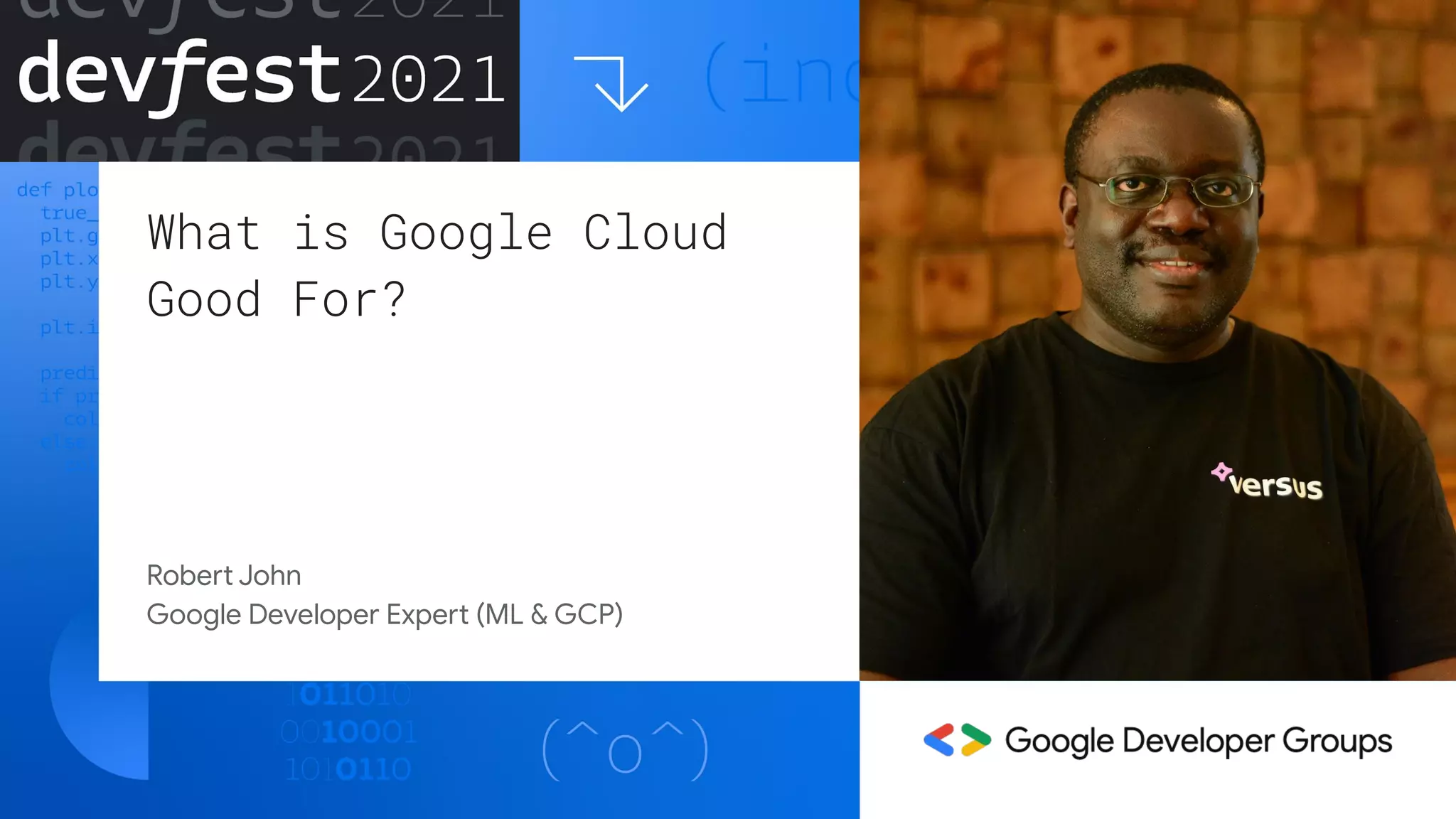
What is Google Cloud
Good For?
Robert John
Google Developer Expert (ML & GCP)
Overview
1. What is Cloud Computing?
2. Compute
3. Security
4. Networking
5. Serverless
6. Storage
7. Databases
8. Operations
9. CI/CD
10. Big Data
11. Artificial Intelligence
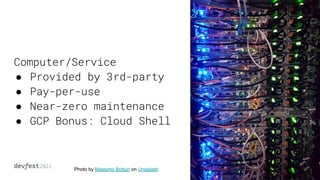
Computer/Service
● Provided by 3rd-party
● Pay-per-use
● Near-zero maintenance
● GCP Bonus: Cloud Shell
Photo by Massimo Botturi on Unsplash
https://4words.dev
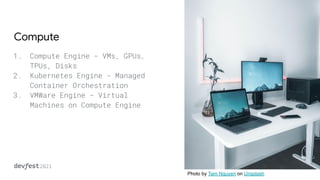
Compute
1. Compute Engine - VMs, GPUs,
TPUs, Disks
2. Kubernetes Engine - Managed
Container Orchestration
3. VMWare Engine - Virtual
Machines on Compute Engine
Photo by Tarn Nguyen on Unsplash
Security
1. Cloud IAM - Resource Access
Control
2. Cloud Identity-Aware Proxy -
Identity-based app access
3. Cloud KMS - Hosted key
management service
4. Cloud Security Scanner - App
Engine security scanner
5. Event Threat Detection - Scan
for suspicious activity
6. Secret Manager - Store and
manage credentials
Photo by Amol Tyagi on Unsplash
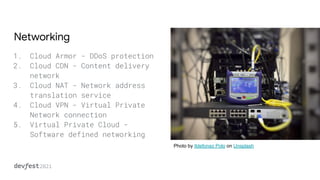
Networking
1. Cloud Armor - DDoS protection
2. Cloud CDN - Content delivery
network
3. Cloud NAT - Network address
translation service
4. Cloud VPN - Virtual Private
Network connection
5. Virtual Private Cloud -
Software defined networking
Photo by Ildefonso Polo on Unsplash
Serverless
1. Cloud Functions -
Event-driven serverless
functions
2. App Engine - Managed web
server
3. Cloud Run - Serverless for
containers
Storage
1. Cloud Filestore - Managed NFS
server
2. Cloud Storage - Multi-class
multi-region object storage
3. Persistent Disk - Block
storage for VMs
4. Local SSD - VM locally
attached SSD
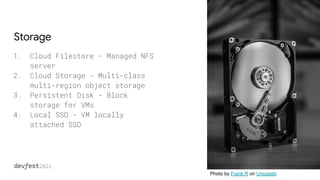
Photo by Frank R on Unsplash
Databases
1. Cloud Bigtable -
Petabyte-scale, low-latency,
non-relational
2. Cloud Firestore - Serverless
NoSQL document DB
3. Cloud Memorystore - Managed
Redis
4. Cloud Spanner - horizontally
scalable relational DB
5. Cloud SQL - Managed
relational DB
Operations
1. Cloud Debugger - Live, production
debugging
2. Error Reporting - App error
reporting
3. Cloud Logging - Centralized
logging
4. Cloud Monitoring - Infrastructure
and app monitoring
5. Cloud Profiler - CPU and heap
profiling
6. Cloud Trace - App performance
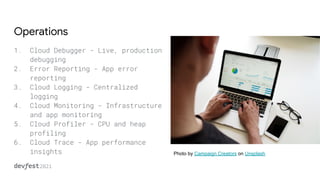
insights Photo by Campaign Creators on Unsplash
CI/CD
1. Cloud Build - CI/CD Platform
2. Cloud Deploy - GKE continuous
deployment
3. Container Registry - Private
container storage
4. Artifact Registry - Universal
package manager
5. Source Repositories - Hosted
private git repos
Big Data
1. Cloud Composer - Managed
workflow orchestration
2. Dataflow - stream/batch data
processing
3. Pub/Sub - realtime
messaging/Apache Kafka
4. Datastream - change data capture
& replication
5. IoT Core - Manage devices,
ingest data
6. BigQuery - petabyte-scale data
warehouse/analytics
7. Dataprep - Visual data wrangling
Artificial Intelligence
1. Notebooks - Managed
Jupyterlab notebook instances
2. Pipelines - Hosted ML
Workflows
3. AutoML - Hosted Neural
Architecture Search
4. ML APIs - Ready-to-use APIs
5. Cloud TPUs - Hardware
acceleration for ML
6. Dialogflow - Create
conversational interfaces
7. Explainable AI - Understand
ML Model Predictions
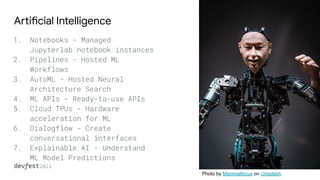
Photo by Maximalfocus on Unsplash
https://cloud.google.com

What is Google Cloud Good For at DevFestInspire 2021

  • 1.
    What is GoogleCloud Good For? Robert John Google Developer Expert (ML & GCP)
  • 2.
    Overview 1. What isCloud Computing? 2. Compute 3. Security 4. Networking 5. Serverless 6. Storage 7. Databases 8. Operations 9. CI/CD 10. Big Data 11. Artificial Intelligence
  • 3.
    Computer/Service ● Provided by3rd-party ● Pay-per-use ● Near-zero maintenance ● GCP Bonus: Cloud Shell Photo by Massimo Botturi on Unsplash
  • 4.
  • 5.
    Compute 1. Compute Engine- VMs, GPUs, TPUs, Disks 2. Kubernetes Engine - Managed Container Orchestration 3. VMWare Engine - Virtual Machines on Compute Engine Photo by Tarn Nguyen on Unsplash
  • 6.
    Security 1. Cloud IAM- Resource Access Control 2. Cloud Identity-Aware Proxy - Identity-based app access 3. Cloud KMS - Hosted key management service 4. Cloud Security Scanner - App Engine security scanner 5. Event Threat Detection - Scan for suspicious activity 6. Secret Manager - Store and manage credentials Photo by Amol Tyagi on Unsplash
  • 7.
    Networking 1. Cloud Armor- DDoS protection 2. Cloud CDN - Content delivery network 3. Cloud NAT - Network address translation service 4. Cloud VPN - Virtual Private Network connection 5. Virtual Private Cloud - Software defined networking Photo by Ildefonso Polo on Unsplash
  • 8.
    Serverless 1. Cloud Functions- Event-driven serverless functions 2. App Engine - Managed web server 3. Cloud Run - Serverless for containers
  • 9.
    Storage 1. Cloud Filestore- Managed NFS server 2. Cloud Storage - Multi-class multi-region object storage 3. Persistent Disk - Block storage for VMs 4. Local SSD - VM locally attached SSD Photo by Frank R on Unsplash
  • 10.
    Databases 1. Cloud Bigtable- Petabyte-scale, low-latency, non-relational 2. Cloud Firestore - Serverless NoSQL document DB 3. Cloud Memorystore - Managed Redis 4. Cloud Spanner - horizontally scalable relational DB 5. Cloud SQL - Managed relational DB
  • 11.
    Operations 1. Cloud Debugger- Live, production debugging 2. Error Reporting - App error reporting 3. Cloud Logging - Centralized logging 4. Cloud Monitoring - Infrastructure and app monitoring 5. Cloud Profiler - CPU and heap profiling 6. Cloud Trace - App performance insights Photo by Campaign Creators on Unsplash
  • 12.
    CI/CD 1. Cloud Build- CI/CD Platform 2. Cloud Deploy - GKE continuous deployment 3. Container Registry - Private container storage 4. Artifact Registry - Universal package manager 5. Source Repositories - Hosted private git repos
  • 13.
    Big Data 1. CloudComposer - Managed workflow orchestration 2. Dataflow - stream/batch data processing 3. Pub/Sub - realtime messaging/Apache Kafka 4. Datastream - change data capture & replication 5. IoT Core - Manage devices, ingest data 6. BigQuery - petabyte-scale data warehouse/analytics 7. Dataprep - Visual data wrangling
  • 14.
    Artificial Intelligence 1. Notebooks- Managed Jupyterlab notebook instances 2. Pipelines - Hosted ML Workflows 3. AutoML - Hosted Neural Architecture Search 4. ML APIs - Ready-to-use APIs 5. Cloud TPUs - Hardware acceleration for ML 6. Dialogflow - Create conversational interfaces 7. Explainable AI - Understand ML Model Predictions Photo by Maximalfocus on Unsplash
  • 15.