PRESENTATION BY
RAHUL SINGH
&
ASHISH SHARMA
Project Guide
Dr. Tanuja Nautiyal
What is global
warming?
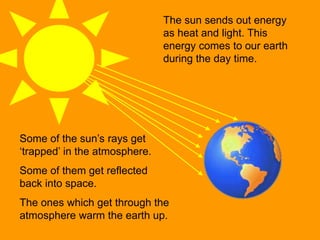
The sun sends out energy
as heat and light. This
energy comes to our earth
during the day time.
Some of the sun’s rays get
‘trapped’ in the atmosphere.
Some of them get reflected
back into space.
The ones which get through the
atmosphere warm the earth up.
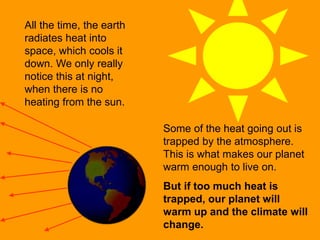
All the time, the earth
radiates heat into
space, which cools it
down. We only really
notice this at night,
when there is no
heating from the sun.
Some of the heat going out is
trapped by the atmosphere.
This is what makes our planet
warm enough to live on.
But if too much heat is
trapped, our planet will
warm up and the climate will
change.
What is the atmosphere and why
does it trap heat?
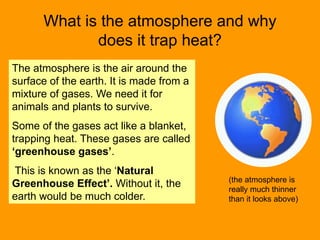
The atmosphere is the air around the
surface of the earth. It is made from a
mixture of gases. We need it for
animals and plants to survive.
Some of the gases act like a blanket,
trapping heat. These gases are called
‘greenhouse gases’.
This is known as the ‘Natural
Greenhouse Effect’. Without it, the
earth would be much colder.
(the atmosphere is
really much thinner
than it looks above)
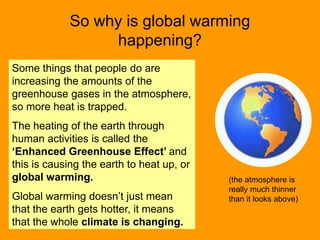
So why is global warming
happening?
(the atmosphere is
really much thinner
than it looks above)
Some things that people do are
increasing the amounts of the
greenhouse gases in the atmosphere,
so more heat is trapped.
The heating of the earth through
human activities is called the
‘Enhanced Greenhouse Effect’ and
this is causing the earth to heat up, or
global warming.
Global warming doesn’t just mean
that the earth gets hotter, it means
that the whole climate is changing.
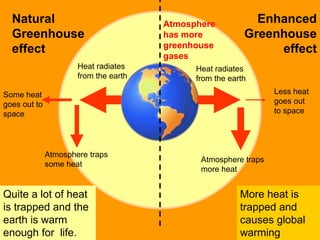
Natural
Greenhouse
effect
More heat is
trapped and
causes global
warming
Atmosphere traps
some heat
Some heat
goes out to
space
Quite a lot of heat
is trapped and the
earth is warm
enough for life.
Enhanced
Greenhouse
effect
Heat radiates
from the earth
Heat radiates
from the earth
Atmosphere
has more
greenhouse
gases
Atmosphere traps
more heat
Less heat
goes out
to space
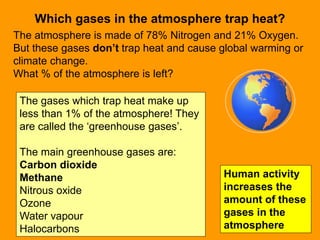
Which gases in the atmosphere trap heat?
The atmosphere is made of 78% Nitrogen and 21% Oxygen.
But these gases don’t trap heat and cause global warming or
climate change.
What % of the atmosphere is left?
The gases which trap heat make up
less than 1% of the atmosphere! They
are called the ‘greenhouse gases’.
The main greenhouse gases are:
Carbon dioxide
Methane
Nitrous oxide
Ozone
Water vapour
Halocarbons
Human activity
increases the
amount of these
gases in the
atmosphere
How do humans increase carbon dioxide levels in
the atmosphere?
Burning fossil fuels
releases the carbon dioxide
stored millions of years
ago. Most of the increased
carbon dioxide comes from
fossil fuels
Deforestation releases the
carbon stored in trees. Less
trees also means less carbon
dioxide can be removed from
the atmosphere.
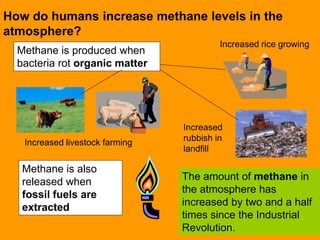
How do humans increase methane levels in the
atmosphere?
The amount of methane in
the atmosphere has
increased by two and a half
times since the Industrial
Revolution.
Increased
rubbish in
landfill
Increased livestock farming
Increased rice growing
Methane is also
released when
fossil fuels are
extracted
Methane is produced when
bacteria rot organic matter
We humans are thought to be the
main cause of global warming and
climate change……..
but we still have the chance to do
something about it.
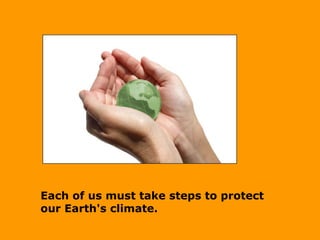
Each of us must take steps to protect
our Earth's climate.
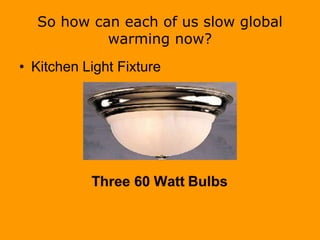
So how can each of us slow global
warming now?
• Kitchen Light Fixture
Reduce our consumption of fossil fuels
Because greenhouse gas emissions are tied very closely to our
energy consumption, using less fossil fuel based energy puts
fewer greenhouse gases into the atmosphere.
This will help slow global warming.
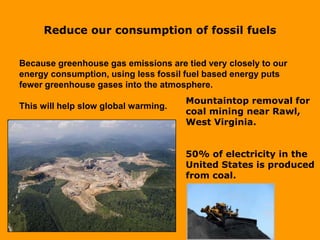
Mountaintop removal for
coal mining near Rawl,
West Virginia.
50% of electricity in the
United States is produced
from coal.
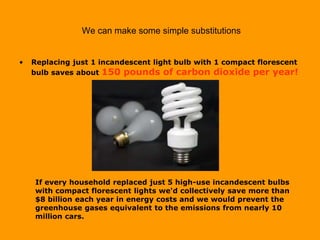
We can make some simple substitutions
• Replacing just 1 incandescent light bulb with 1 compact florescent
bulb saves about 150 pounds of carbon dioxide per year!
If every household replaced just 5 high-use incandescent bulbs
with compact florescent lights we'd collectively save more than
$8 billion each year in energy costs and we would prevent the
greenhouse gases equivalent to the emissions from nearly 10
million cars.
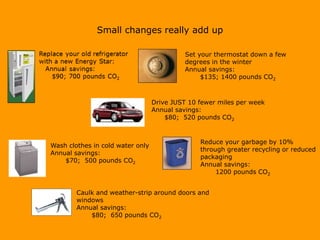
Small changes really add up
Set your thermostat down a few
degrees in the winter
Annual savings:
$135; 1400 pounds CO2
Drive JUST 10 fewer miles per week
Annual savings:
$80; 520 pounds CO2
Wash clothes in cold water only
Annual savings:
$70; 500 pounds CO2
Reduce your garbage by 10%
through greater recycling or reduced
packaging
Annual savings:
1200 pounds CO2
Caulk and weather-strip around doors and
windows
Annual savings:
$80; 650 pounds CO2
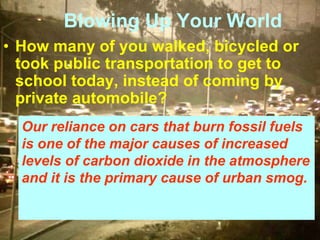
Blowing Up Your World
• How many of you walked, bicycled or
took public transportation to get to
school today, instead of coming by
private automobile?
Our reliance on cars that burn fossil fuels
is one of the major causes of increased
levels of carbon dioxide in the atmosphere
and it is the primary cause of urban smog.
Blowing Up Your World
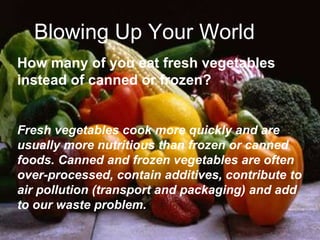
How many of you eat fresh vegetables
instead of canned or frozen?
Fresh vegetables cook more quickly and are
usually more nutritious than frozen or canned
foods. Canned and frozen vegetables are often
over-processed, contain additives, contribute to
air pollution (transport and packaging) and add
to our waste problem.
Blowing Up Your World
How many of you carry your lunch to
school in a lunch box or reusable
container?
Making paper and plastic bags uses
energy and resources.
Blowing Up Your World
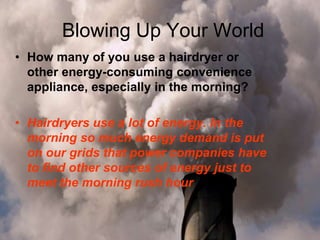
• How many of you use a hairdryer or
other energy-consuming convenience
appliance, especially in the morning?
• Hairdryers use a lot of energy. In the
morning so much energy demand is put
on our grids that power companies have
to find other sources of energy just to
meet the morning rush hour 2 pts d
Blowing Up Your World
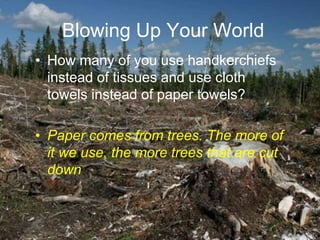
• How many of you use handkerchiefs
instead of tissues and use cloth
towels instead of paper towels?
• Paper comes from trees. The more of
it we use, the more trees that are cut
down
Blowing Up Your World
• How many of you eat take-out or cafeteria
food that is served in foam or plastic
containers?
• Polystyrene and other plastic containers
are made from precious petrochemicals,
do not decompose in landfills, and
release toxic gases when they are
burned in incinerators.
Go! And protect the Earth

What is global_warming

  • 1.
    PRESENTATION BY RAHUL SINGH & ASHISHSHARMA Project Guide Dr. Tanuja Nautiyal
  • 2.
  • 3.
    The sun sendsout energy as heat and light. This energy comes to our earth during the day time. Some of the sun’s rays get ‘trapped’ in the atmosphere. Some of them get reflected back into space. The ones which get through the atmosphere warm the earth up.
  • 4.
    All the time,the earth radiates heat into space, which cools it down. We only really notice this at night, when there is no heating from the sun. Some of the heat going out is trapped by the atmosphere. This is what makes our planet warm enough to live on. But if too much heat is trapped, our planet will warm up and the climate will change.
  • 5.
    What is theatmosphere and why does it trap heat? The atmosphere is the air around the surface of the earth. It is made from a mixture of gases. We need it for animals and plants to survive. Some of the gases act like a blanket, trapping heat. These gases are called ‘greenhouse gases’. This is known as the ‘Natural Greenhouse Effect’. Without it, the earth would be much colder. (the atmosphere is really much thinner than it looks above)
  • 6.
    So why isglobal warming happening? (the atmosphere is really much thinner than it looks above) Some things that people do are increasing the amounts of the greenhouse gases in the atmosphere, so more heat is trapped. The heating of the earth through human activities is called the ‘Enhanced Greenhouse Effect’ and this is causing the earth to heat up, or global warming. Global warming doesn’t just mean that the earth gets hotter, it means that the whole climate is changing.
  • 7.
    Natural Greenhouse effect More heat is trappedand causes global warming Atmosphere traps some heat Some heat goes out to space Quite a lot of heat is trapped and the earth is warm enough for life. Enhanced Greenhouse effect Heat radiates from the earth Heat radiates from the earth Atmosphere has more greenhouse gases Atmosphere traps more heat Less heat goes out to space
  • 8.
    Which gases inthe atmosphere trap heat? The atmosphere is made of 78% Nitrogen and 21% Oxygen. But these gases don’t trap heat and cause global warming or climate change. What % of the atmosphere is left? The gases which trap heat make up less than 1% of the atmosphere! They are called the ‘greenhouse gases’. The main greenhouse gases are: Carbon dioxide Methane Nitrous oxide Ozone Water vapour Halocarbons Human activity increases the amount of these gases in the atmosphere
  • 9.
    How do humansincrease carbon dioxide levels in the atmosphere? Burning fossil fuels releases the carbon dioxide stored millions of years ago. Most of the increased carbon dioxide comes from fossil fuels Deforestation releases the carbon stored in trees. Less trees also means less carbon dioxide can be removed from the atmosphere.
  • 10.
    How do humansincrease methane levels in the atmosphere? The amount of methane in the atmosphere has increased by two and a half times since the Industrial Revolution. Increased rubbish in landfill Increased livestock farming Increased rice growing Methane is also released when fossil fuels are extracted Methane is produced when bacteria rot organic matter
  • 11.
    We humans arethought to be the main cause of global warming and climate change…….. but we still have the chance to do something about it.
  • 12.
    Each of usmust take steps to protect our Earth's climate.
  • 13.
    So how caneach of us slow global warming now? • Kitchen Light Fixture
  • 14.
    Reduce our consumptionof fossil fuels Because greenhouse gas emissions are tied very closely to our energy consumption, using less fossil fuel based energy puts fewer greenhouse gases into the atmosphere. This will help slow global warming. Mountaintop removal for coal mining near Rawl, West Virginia. 50% of electricity in the United States is produced from coal.
  • 15.
    We can makesome simple substitutions • Replacing just 1 incandescent light bulb with 1 compact florescent bulb saves about 150 pounds of carbon dioxide per year! If every household replaced just 5 high-use incandescent bulbs with compact florescent lights we'd collectively save more than $8 billion each year in energy costs and we would prevent the greenhouse gases equivalent to the emissions from nearly 10 million cars.
  • 16.
    Small changes reallyadd up Set your thermostat down a few degrees in the winter Annual savings: $135; 1400 pounds CO2 Drive JUST 10 fewer miles per week Annual savings: $80; 520 pounds CO2 Wash clothes in cold water only Annual savings: $70; 500 pounds CO2 Reduce your garbage by 10% through greater recycling or reduced packaging Annual savings: 1200 pounds CO2 Caulk and weather-strip around doors and windows Annual savings: $80; 650 pounds CO2
  • 17.
  • 18.
    Blowing Up YourWorld • How many of you walked, bicycled or took public transportation to get to school today, instead of coming by private automobile? Our reliance on cars that burn fossil fuels is one of the major causes of increased levels of carbon dioxide in the atmosphere and it is the primary cause of urban smog.
  • 19.
    Blowing Up YourWorld How many of you eat fresh vegetables instead of canned or frozen? Fresh vegetables cook more quickly and are usually more nutritious than frozen or canned foods. Canned and frozen vegetables are often over-processed, contain additives, contribute to air pollution (transport and packaging) and add to our waste problem.
  • 20.
    Blowing Up YourWorld How many of you carry your lunch to school in a lunch box or reusable container? Making paper and plastic bags uses energy and resources.
  • 21.
    Blowing Up YourWorld • How many of you use a hairdryer or other energy-consuming convenience appliance, especially in the morning? • Hairdryers use a lot of energy. In the morning so much energy demand is put on our grids that power companies have to find other sources of energy just to meet the morning rush hour 2 pts d
  • 22.
    Blowing Up YourWorld • How many of you use handkerchiefs instead of tissues and use cloth towels instead of paper towels? • Paper comes from trees. The more of it we use, the more trees that are cut down
  • 23.
    Blowing Up YourWorld • How many of you eat take-out or cafeteria food that is served in foam or plastic containers? • Polystyrene and other plastic containers are made from precious petrochemicals, do not decompose in landfills, and release toxic gases when they are burned in incinerators.
  • 24.
    Go! And protectthe Earth