Head and Shoulders Gestures:
Exploring User-Defined Gestures with Upper Body
HCI International ‘2019 (Orlando, FL, July 26th-31st, 2019)
Head and Shoulders Gestures:
Exploring User-Defined Gestures with Upper Body
HCI International ‘2019 (Orlando, FL, July 26th-31st, 2019)
Jean Vanderdonckt1, Nathan Magrofuoco1, Suzanne Kieffer2,
Jorge Luis Perez-Medina1,3, Paolo Roselli4, Ysabelle Rase1,
Santiago Villarreal1
1LouRIM, Université catholique de Louvain, Belgium
2IL&C, Université catholique de Louvain, Belgium
3Universidad de Las Américas, Quito, Ecuador
4Università degli Studi di Roma “Tor Vergata”, Roma, Italy
3
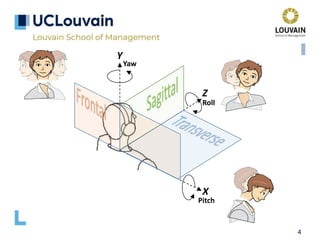
What are head and shoulders gestures?
• A head gesture is any movement of the head leaving the rest
of the body unaffected (stationary)
• A head gesture could occur in any plane (sagittal, transverse,
frontal)
• A shoulder gesture is any movement of the shoulder joint that
leaves the rest of the arm unaffected (stationary).
• A shoulder gesture occurs in any plane of motion (sagittal,
transverse, frontal) or direction (forward, backward, or circular)
4
Y
Yaw
Z
Roll
X
Pitch
5
Why are head and shoulders gestures interesting?
• Hands-free interaction is made possible
• Fixed-Gaze Head Movement is appropriate when
• No device needed
• Both hands should be free
• No need to move the gaze
• Capability to trigger actions from a moderate set
• Medium command duration
• Accurate recognizers for head and shoulders gestures start to
appear
M13 M31
M65M56
M42
M24
[Qinjie et al., 2019]
6
Why are head and shoulders gestures interesting?
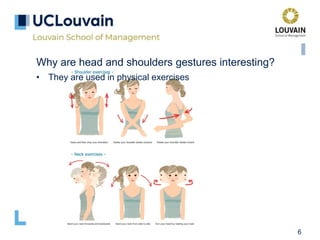
• They are used in physical exercises
7
Why are head and shoulders gestures interesting?
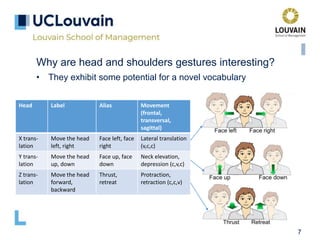
• They exhibit some potential for a novel vocabulary
Head Label Alias Movement
(frontal,
transversal,
sagittal)
X trans-
lation
Move the head
left, right
Face left, face
right
Lateral translation
(v,c,c)
Y trans-
lation
Move the head
up, down
Face up, face
down
Neck elevation,
depression (c,v,c)
Z trans-
lation
Move the head
forward,
backward
Thrust,
retreat
Protraction,
retraction (c,c,v)
8
Why are head and shoulders gestures interesting?
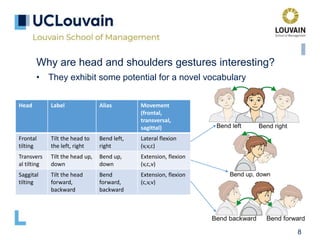
• They exhibit some potential for a novel vocabulary
Head Label Alias Movement
(frontal,
transversal,
sagittal)
Frontal
tilting
Tilt the head to
the left, right
Bend left,
right
Lateral flexion
(v,v,c)
Transvers
al tilting
Tilt the head up,
down
Bend up,
down
Extension, flexion
(v,c,v)
Saggital
tilting
Tilt the head
forward,
backward
Bend
forward,
backward
Extension, flexion
(c,v,v)
9
Why are head and shoulders gestures interesting?
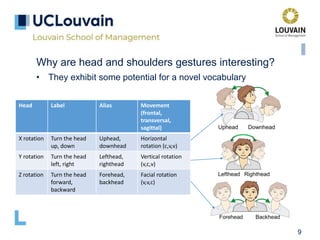
• They exhibit some potential for a novel vocabulary
Head Label Alias Movement
(frontal,
transversal,
sagittal)
X rotation Turn the head
up, down
Uphead,
downhead
Horizontal
rotation (c,v,v)
Y rotation Turn the head
left, right
Lefthead,
righthead
Vertical rotation
(v,c,v)
Z rotation Turn the head
forward,
backward
Forehead,
backhead
Facial rotation
(v,v,c)
10
Why are head and shoulders gestures interesting?
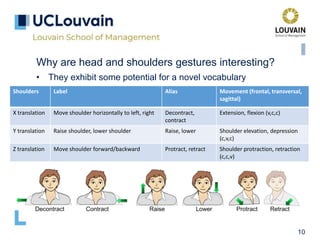
• They exhibit some potential for a novel vocabulary
Shoulders Label Alias Movement (frontal, transversal,
sagittal)
X translation Move shoulder horizontally to left, right Decontract,
contract
Extension, flexion (v,c,c)
Y translation Raise shoulder, lower shoulder Raise, lower Shoulder elevation, depression
(c,v,c)
Z translation Move shoulder forward/backward Protract, retract Shoulder protraction, retraction
(c,c,v)
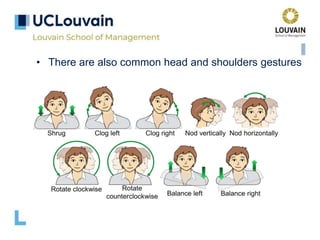
• There are also common head and shoulders gestures
12
Experiment: Gesture Elicitation Study (GES)
• Participants
• 10 females + 12 males = 22 participants
• Aged from 18 to 62y (M=29, SD=13)
• Various occupations: secretary, teacher, employee,...
• Device usage frequencies
• Creativity score
y = 0.1467x + 52.482
R² = 0.0775
0
10
20
30
40
50
60
70
80
18 28 38 48 58
Creativity[score]
Age [years]
6.09 6.05
2.68
1.73
1.05
0.00
0.00
1.00
2.00
3.00
4.00
5.00
6.00
7.00
Computer
Smartphone
Tablet
Gameconsole
MSKinect
Studieddevice
Averagefequencyofusage
Device
13
Experiment: Gesture Elicitation Study (GES)
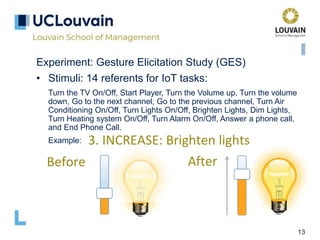
• Stimuli: 14 referents for IoT tasks:
Turn the TV On/Off, Start Player, Turn the Volume up, Turn the volume
down, Go to the next channel, Go to the previous channel, Turn Air
Conditioning On/Off, Turn Lights On/Off, Brighten Lights, Dim Lights,
Turn Heating system On/Off, Turn Alarm On/Off, Answer a phone call,
and End Phone Call.
Example: 3. INCREASE: Brighten lights
Before After
14
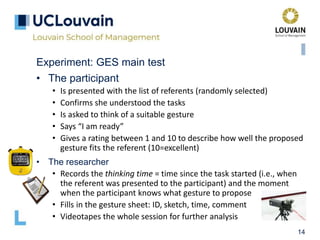
Experiment: GES main test
• The participant
• Is presented with the list of referents (randomly selected)
• Confirms she understood the tasks
• Is asked to think of a suitable gesture
• Says “I am ready”
• Gives a rating between 1 and 10 to describe how well the proposed
gesture fits the referent (10=excellent)
• The researcher
• Records the thinking time = time since the task started (i.e., when
the referent was presented to the participant) and the moment
when the participant knows what gesture to propose
• Fills in the gesture sheet: ID, sketch, time, comment
• Videotapes the whole session for further analysis
15
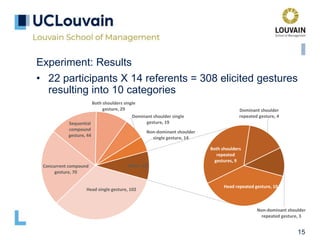
Experiment: Results
• 22 participants X 14 referents = 308 elicited gestures
resulting into 10 categories
Head single gesture, 102
Concurrent compound
gesture, 70
Sequential
compound
gesture, 44
Both shoulders single
gesture, 29
Dominant shoulder single
gesture, 19
Non-dominant shoulder
single gesture, 14
Head repeated gesture, 10
Both shoulders
repeated
gestures, 9
Dominant shoulder
repeated gesture, 4
Non-dominant shoulder
repeated gesture, 3
Other, 26
16
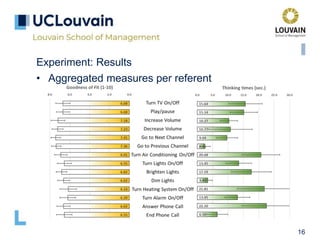
Experiment: Results
• Aggregated measures per referent
17
Experiment: Results
• Evolution of aggregated measures per referent
0.00
1.00
2.00
3.00
4.00
5.00
6.00
7.00
8.00
0.00
5.00
10.00
15.00
20.00
25.00
Value
Time[Sec]
Referent
Average thinking time Goodness-of-fit
Linear (Average thinking time) Linear (Goodness-of-fit)
18
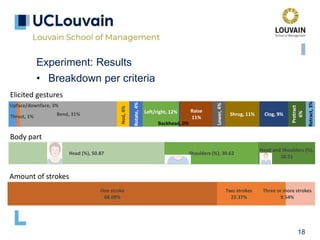
Experiment: Results
• Breakdown per criteria
Upface/downface, 3%
Thrust, 1% Bend, 31%
Nod,4%
Rotate,4%
Left/right, 12%
Backhead, 0%
Raise
11%
Lower,4%
Shrug, 11% Clog, 9%
Protract
6%
Retract,3%
Head (%), 50.87 Shoulders (%), 30.62
Head and Shoulders (%),
18.51
One stroke
68.09%
Two strokes
22.37%
Three or more strokes
9.54%
Body part
Elicited gestures
Amount of strokes
0.390 0.390
0.316
0.283
0.267 0.260
0.263
0.250 0.250 0.250 0.248
0.229
0.215
0.188
0.138
0.368 0.368
0.286
0.251
0.238 0.234
0.232
0.221 0.221 0.216 0.215
0.195
0.182
0.156
0.104
0.00
0.05
0.10
0.15
0.20
0.25
0.30
0.35
0.40
0.45
0.50
Go to Next
Channel
Go to
Previous
Channel
Answer
Phone Call
End Phone
Call
Play/pause Turn TV
On/Off
Average Turn Lights
On/Off
Turn Alarm
On/Off
Decrease
Volume
Brighten
Lights
Increase
Volume
Dim Lights Turn Air
Conditioning
On/Off
Turn Heating
System
On/Off
High Medium
19
Experiment: 14 Consensus gestures
Agreement score [Vatavu & Wobbrock, 2015]
Agreement rate [Vatavu & Wobbrock, 2016]
20
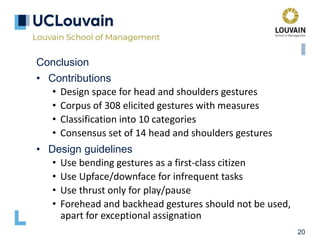
Conclusion
• Contributions
• Design space for head and shoulders gestures
• Corpus of 308 elicited gestures with measures
• Classification into 10 categories
• Consensus set of 14 head and shoulders gestures
• Design guidelines
• Use bending gestures as a first-class citizen
• Use Upface/downface for infrequent tasks
• Use thrust only for play/pause
• Forehead and backhead gestures should not be used,
apart for exceptional assignation
Thank you very much
for your attention

Head and Shoulders Gestures: Exploring User-De fined Gestures with Upper Body

  • 1.
    Head and ShouldersGestures: Exploring User-Defined Gestures with Upper Body HCI International ‘2019 (Orlando, FL, July 26th-31st, 2019)
  • 2.
    Head and ShouldersGestures: Exploring User-Defined Gestures with Upper Body HCI International ‘2019 (Orlando, FL, July 26th-31st, 2019) Jean Vanderdonckt1, Nathan Magrofuoco1, Suzanne Kieffer2, Jorge Luis Perez-Medina1,3, Paolo Roselli4, Ysabelle Rase1, Santiago Villarreal1 1LouRIM, Université catholique de Louvain, Belgium 2IL&C, Université catholique de Louvain, Belgium 3Universidad de Las Américas, Quito, Ecuador 4Università degli Studi di Roma “Tor Vergata”, Roma, Italy
  • 3.
    3 What are headand shoulders gestures? • A head gesture is any movement of the head leaving the rest of the body unaffected (stationary) • A head gesture could occur in any plane (sagittal, transverse, frontal) • A shoulder gesture is any movement of the shoulder joint that leaves the rest of the arm unaffected (stationary). • A shoulder gesture occurs in any plane of motion (sagittal, transverse, frontal) or direction (forward, backward, or circular)
  • 4.
  • 5.
    5 Why are headand shoulders gestures interesting? • Hands-free interaction is made possible • Fixed-Gaze Head Movement is appropriate when • No device needed • Both hands should be free • No need to move the gaze • Capability to trigger actions from a moderate set • Medium command duration • Accurate recognizers for head and shoulders gestures start to appear M13 M31 M65M56 M42 M24 [Qinjie et al., 2019]
  • 6.
    6 Why are headand shoulders gestures interesting? • They are used in physical exercises
  • 7.
    7 Why are headand shoulders gestures interesting? • They exhibit some potential for a novel vocabulary Head Label Alias Movement (frontal, transversal, sagittal) X trans- lation Move the head left, right Face left, face right Lateral translation (v,c,c) Y trans- lation Move the head up, down Face up, face down Neck elevation, depression (c,v,c) Z trans- lation Move the head forward, backward Thrust, retreat Protraction, retraction (c,c,v)
  • 8.
    8 Why are headand shoulders gestures interesting? • They exhibit some potential for a novel vocabulary Head Label Alias Movement (frontal, transversal, sagittal) Frontal tilting Tilt the head to the left, right Bend left, right Lateral flexion (v,v,c) Transvers al tilting Tilt the head up, down Bend up, down Extension, flexion (v,c,v) Saggital tilting Tilt the head forward, backward Bend forward, backward Extension, flexion (c,v,v)
  • 9.
    9 Why are headand shoulders gestures interesting? • They exhibit some potential for a novel vocabulary Head Label Alias Movement (frontal, transversal, sagittal) X rotation Turn the head up, down Uphead, downhead Horizontal rotation (c,v,v) Y rotation Turn the head left, right Lefthead, righthead Vertical rotation (v,c,v) Z rotation Turn the head forward, backward Forehead, backhead Facial rotation (v,v,c)
  • 10.
    10 Why are headand shoulders gestures interesting? • They exhibit some potential for a novel vocabulary Shoulders Label Alias Movement (frontal, transversal, sagittal) X translation Move shoulder horizontally to left, right Decontract, contract Extension, flexion (v,c,c) Y translation Raise shoulder, lower shoulder Raise, lower Shoulder elevation, depression (c,v,c) Z translation Move shoulder forward/backward Protract, retract Shoulder protraction, retraction (c,c,v)
  • 11.
    • There arealso common head and shoulders gestures
  • 12.
    12 Experiment: Gesture ElicitationStudy (GES) • Participants • 10 females + 12 males = 22 participants • Aged from 18 to 62y (M=29, SD=13) • Various occupations: secretary, teacher, employee,... • Device usage frequencies • Creativity score y = 0.1467x + 52.482 R² = 0.0775 0 10 20 30 40 50 60 70 80 18 28 38 48 58 Creativity[score] Age [years] 6.09 6.05 2.68 1.73 1.05 0.00 0.00 1.00 2.00 3.00 4.00 5.00 6.00 7.00 Computer Smartphone Tablet Gameconsole MSKinect Studieddevice Averagefequencyofusage Device
  • 13.
    13 Experiment: Gesture ElicitationStudy (GES) • Stimuli: 14 referents for IoT tasks: Turn the TV On/Off, Start Player, Turn the Volume up, Turn the volume down, Go to the next channel, Go to the previous channel, Turn Air Conditioning On/Off, Turn Lights On/Off, Brighten Lights, Dim Lights, Turn Heating system On/Off, Turn Alarm On/Off, Answer a phone call, and End Phone Call. Example: 3. INCREASE: Brighten lights Before After
  • 14.
    14 Experiment: GES maintest • The participant • Is presented with the list of referents (randomly selected) • Confirms she understood the tasks • Is asked to think of a suitable gesture • Says “I am ready” • Gives a rating between 1 and 10 to describe how well the proposed gesture fits the referent (10=excellent) • The researcher • Records the thinking time = time since the task started (i.e., when the referent was presented to the participant) and the moment when the participant knows what gesture to propose • Fills in the gesture sheet: ID, sketch, time, comment • Videotapes the whole session for further analysis
  • 15.
    15 Experiment: Results • 22participants X 14 referents = 308 elicited gestures resulting into 10 categories Head single gesture, 102 Concurrent compound gesture, 70 Sequential compound gesture, 44 Both shoulders single gesture, 29 Dominant shoulder single gesture, 19 Non-dominant shoulder single gesture, 14 Head repeated gesture, 10 Both shoulders repeated gestures, 9 Dominant shoulder repeated gesture, 4 Non-dominant shoulder repeated gesture, 3 Other, 26
  • 16.
  • 17.
    17 Experiment: Results • Evolutionof aggregated measures per referent 0.00 1.00 2.00 3.00 4.00 5.00 6.00 7.00 8.00 0.00 5.00 10.00 15.00 20.00 25.00 Value Time[Sec] Referent Average thinking time Goodness-of-fit Linear (Average thinking time) Linear (Goodness-of-fit)
  • 18.
    18 Experiment: Results • Breakdownper criteria Upface/downface, 3% Thrust, 1% Bend, 31% Nod,4% Rotate,4% Left/right, 12% Backhead, 0% Raise 11% Lower,4% Shrug, 11% Clog, 9% Protract 6% Retract,3% Head (%), 50.87 Shoulders (%), 30.62 Head and Shoulders (%), 18.51 One stroke 68.09% Two strokes 22.37% Three or more strokes 9.54% Body part Elicited gestures Amount of strokes
  • 19.
    0.390 0.390 0.316 0.283 0.267 0.260 0.263 0.2500.250 0.250 0.248 0.229 0.215 0.188 0.138 0.368 0.368 0.286 0.251 0.238 0.234 0.232 0.221 0.221 0.216 0.215 0.195 0.182 0.156 0.104 0.00 0.05 0.10 0.15 0.20 0.25 0.30 0.35 0.40 0.45 0.50 Go to Next Channel Go to Previous Channel Answer Phone Call End Phone Call Play/pause Turn TV On/Off Average Turn Lights On/Off Turn Alarm On/Off Decrease Volume Brighten Lights Increase Volume Dim Lights Turn Air Conditioning On/Off Turn Heating System On/Off High Medium 19 Experiment: 14 Consensus gestures Agreement score [Vatavu & Wobbrock, 2015] Agreement rate [Vatavu & Wobbrock, 2016]
  • 20.
    20 Conclusion • Contributions • Designspace for head and shoulders gestures • Corpus of 308 elicited gestures with measures • Classification into 10 categories • Consensus set of 14 head and shoulders gestures • Design guidelines • Use bending gestures as a first-class citizen • Use Upface/downface for infrequent tasks • Use thrust only for play/pause • Forehead and backhead gestures should not be used, apart for exceptional assignation
  • 21.
    Thank you verymuch for your attention