Russell Jeide & Scott Cromar
Thursday,February 28, 2013
TVE2 IP Series
Class 1: Intellectual Property andYour Startup
2© 2013 Knobbe, Martens, Olson & Bear, LLP all rights reserved.
TVE2 Intellectual Property (IP) Series
• Class 1: "What intellectual property is, and why it may
be important to your startup"
• Class 2: "How to enter the patent world strategically
and economically"
• Class 3: "How to file for a patent"
• Class 4: "The meaning of patent infringement and
patent litigation"
• Class 5: "How to use copyrights, trademarks, and
trade secrets to your advantage"
• Class 6: TBA (probably continuation of Class 5)
3© 2013 Knobbe, Martens, Olson & Bear, LLP all rights reserved.
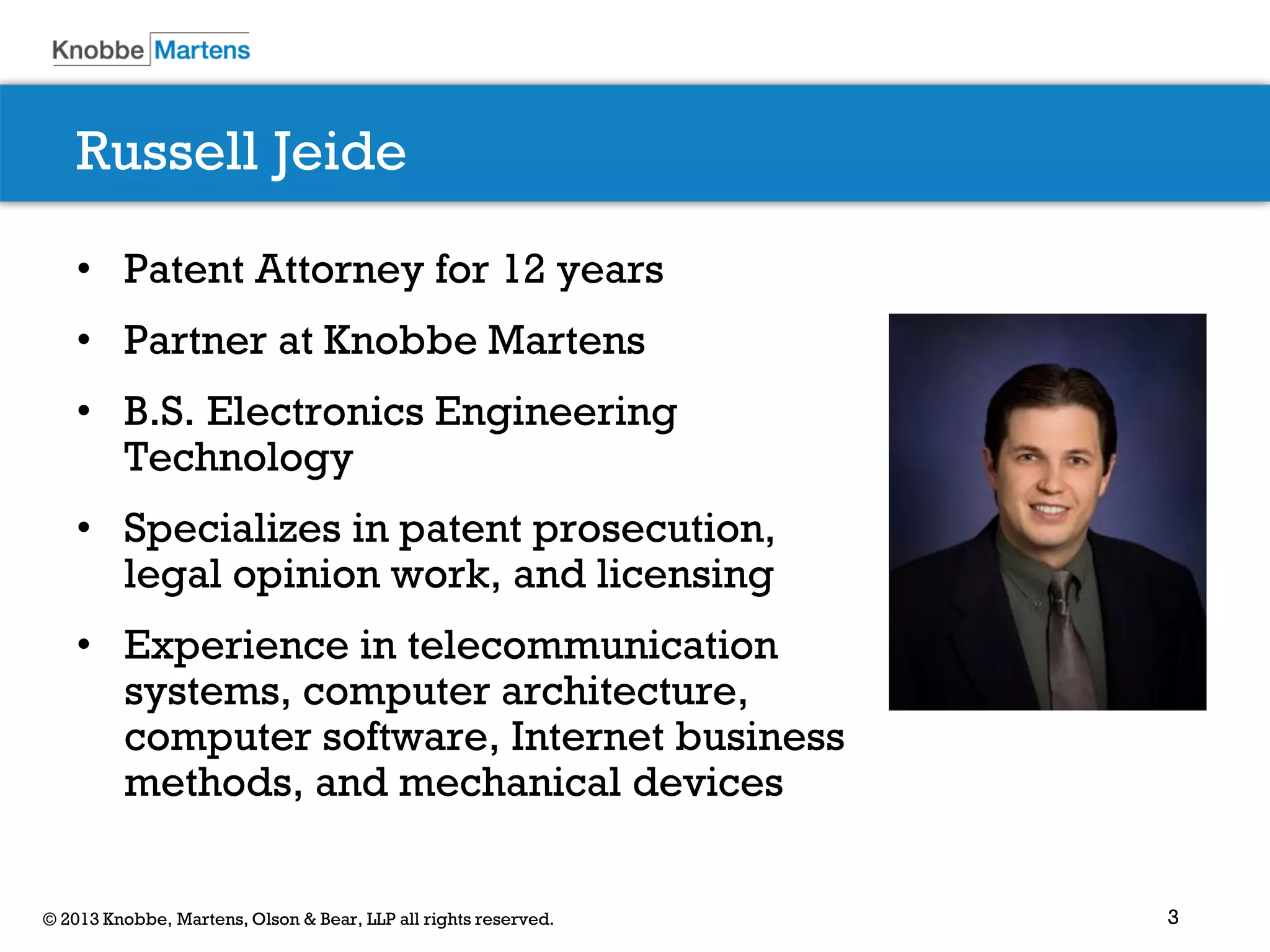
Russell Jeide
• Patent Attorney for 12 years
• Partner at Knobbe Martens
• B.S. Electronics Engineering
Technology
• Specializes in patent prosecution,
legal opinion work, and licensing
• Experience in telecommunication
systems, computer architecture,
computer software, Internet business
methods, and mechanical devices
4© 2013 Knobbe, Martens, Olson & Bear, LLP all rights reserved.
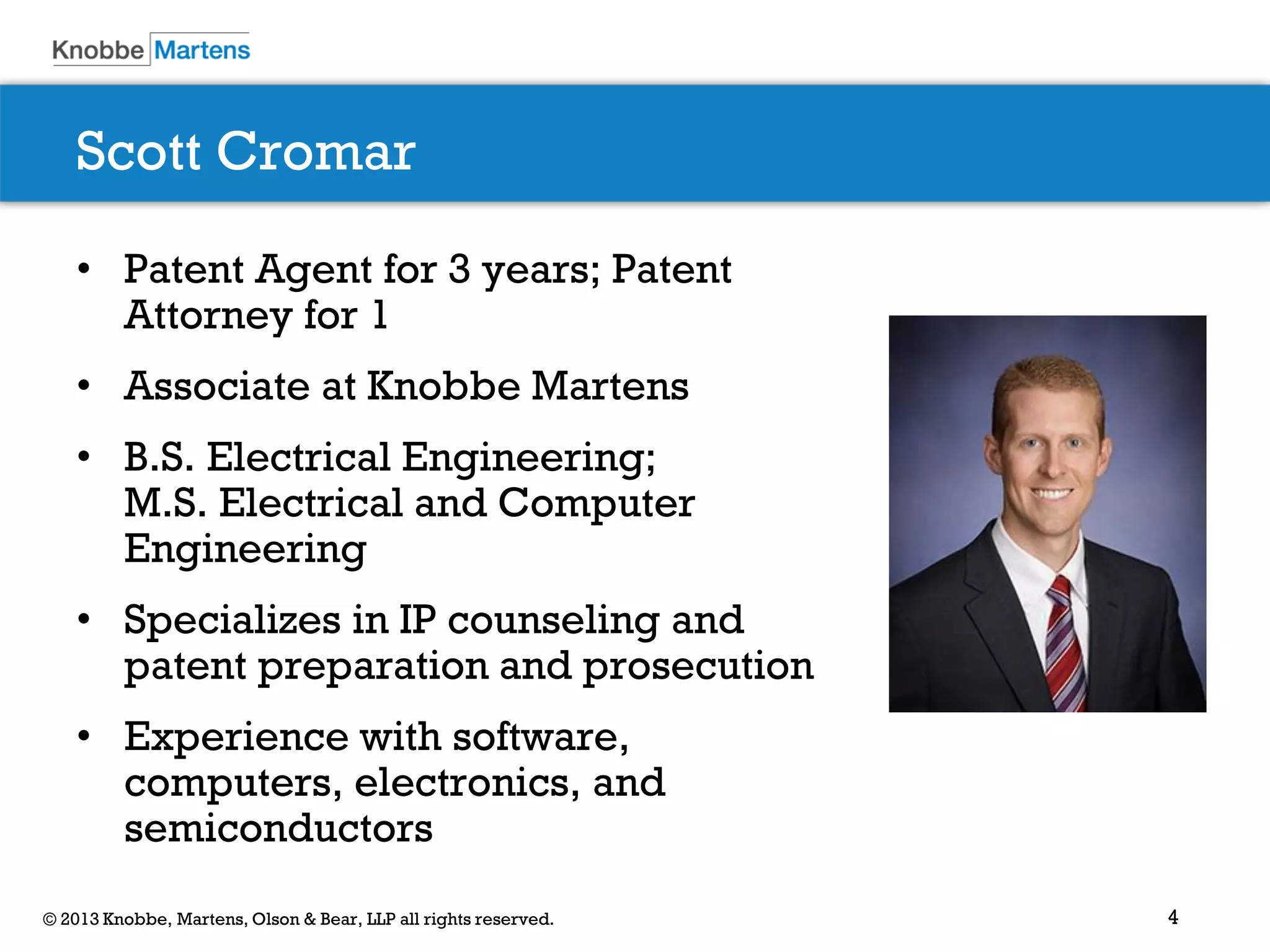
Scott Cromar
• Patent Agent for 3 years; Patent
Attorney for 1
• Associate at Knobbe Martens
• B.S. Electrical Engineering;
M.S. Electrical and Computer
Engineering
• Specializes in IP counseling and
patent preparation and prosecution
• Experience with software,
computers, electronics, and
semiconductors
5© 2013 Knobbe, Martens, Olson & Bear, LLP all rights reserved.
Disclaimer
• This presentation is for information purposes only and
does not constitute legal advice.
• This presentation does not establish any form of
attorney-client relationship.
6© 2013 Knobbe, Martens, Olson & Bear, LLP all rights reserved.
Today:
– What Is IP?
– Quick Overview of the Primary Types Of IP
• Copyrights, Trademarks, Trade Secrets
• Utility & Design Patents
– Why File for a Patent?
– Evaluating the Importance of IP to Your Startup
– IP Hygiene
©2012 Knobbe Martens, Olson & Bear, LLP all rights reserved.©2013 Knobbe, Martens, Olson & Bear, LLP all rights reserved. 7
What Is Intellectual Property (IP)?
8© 2013 Knobbe, Martens, Olson & Bear, LLP all rights reserved.
Intellectual Property (IP)
• Refers to a category of exclusive rights created by
statute, including:
– Copyrights
– Trademarks
– Trade Secrets
– Utility Patents
– Design Patents
• Others: Trade Dress, Mask Works, …
9© 2013 Knobbe, Martens, Olson & Bear, LLP all rights reserved.
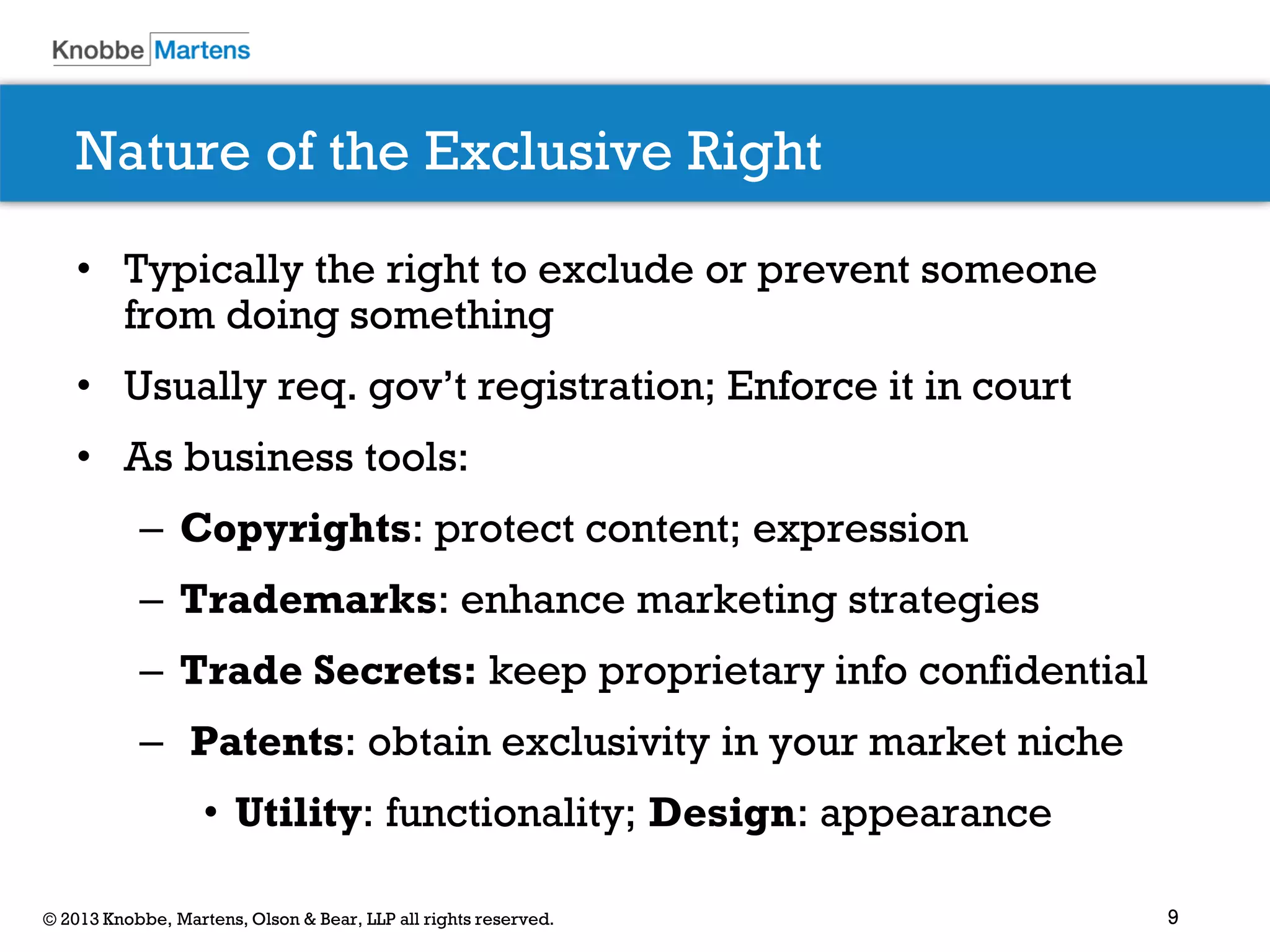
Nature of the Exclusive Right
• Typically the right to exclude or prevent someone
from doing something
• Usually req. gov’t registration; Enforce it in court
• As business tools:
– Copyrights: protect content; expression
– Trademarks: enhance marketing strategies
– Trade Secrets: keep proprietary info confidential
– Patents: obtain exclusivity in your market niche
• Utility: functionality; Design: appearance
©2012 Knobbe Martens, Olson & Bear, LLP all rights reserved.©2013 Knobbe, Martens, Olson & Bear, LLP all rights reserved. 10
Quick Overview of the Primary Types of IP
11© 2013 Knobbe, Martens, Olson & Bear, LLP all rights reserved.
Copyrights
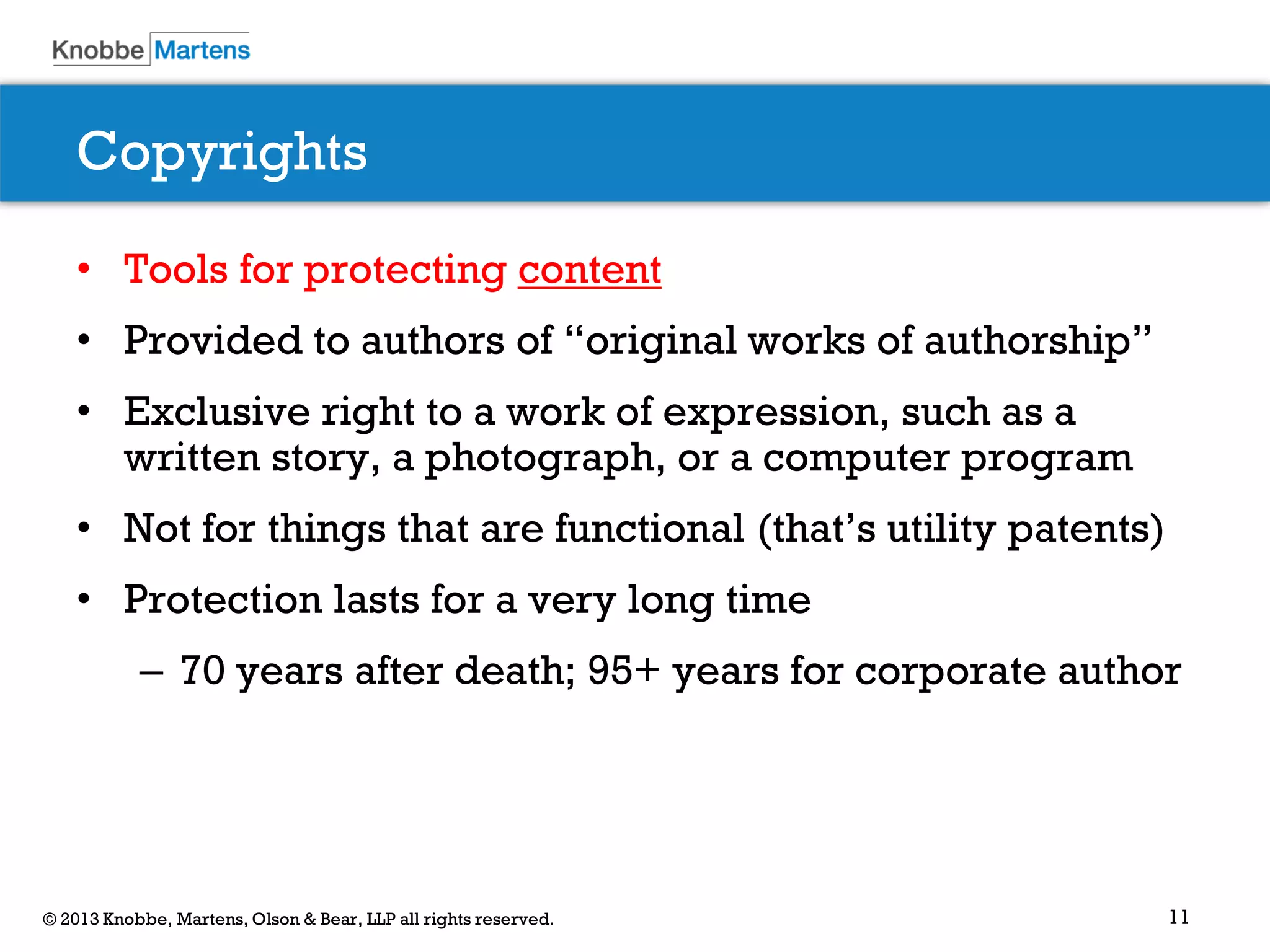
• Tools for protecting content
• Provided to authors of “original works of authorship”
• Exclusive right to a work of expression, such as a
written story, a photograph, or a computer program
• Not for things that are functional (that’s utility patents)
• Protection lasts for a very long time
– 70 years after death; 95+ years for corporate author
12© 2013 Knobbe, Martens, Olson & Bear, LLP all rights reserved.
Copyrights
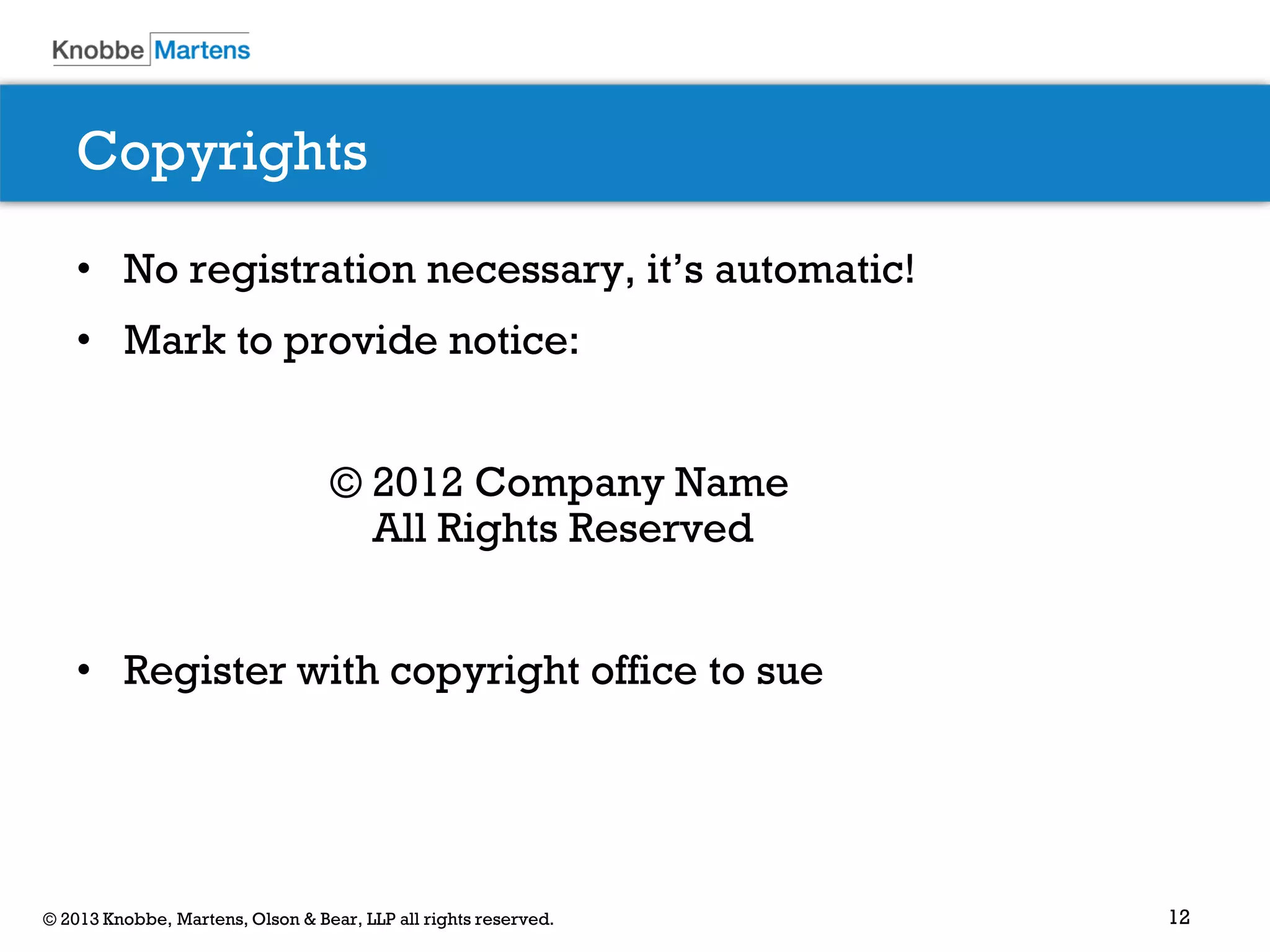
• No registration necessary, it’s automatic!
• Mark to provide notice:
© 2012 Company Name
All Rights Reserved
• Register with copyright office to sue
13© 2013 Knobbe, Martens, Olson & Bear, LLP all rights reserved.
Trademarks
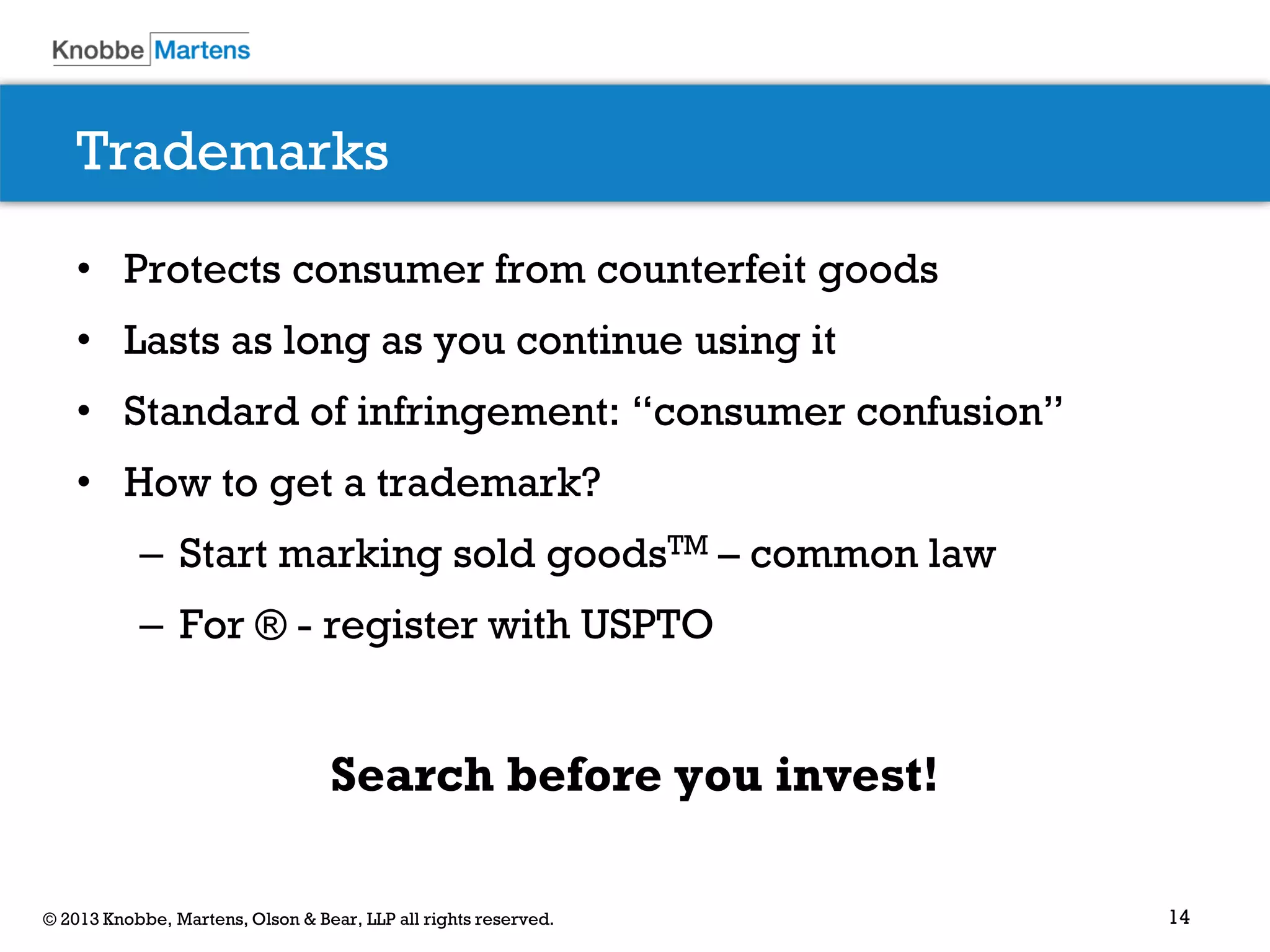
• Tools that can greatly enhance marketing strategies
• Is any symbol capable of identifying and
distinguishing its owner’s products from those of
others
14© 2013 Knobbe, Martens, Olson & Bear, LLP all rights reserved.
Trademarks
• Protects consumer from counterfeit goods
• Lasts as long as you continue using it
• Standard of infringement: “consumer confusion”
• How to get a trademark?
– Start marking sold goodsTM – common law
– For ® - register with USPTO
Search before you invest!
15© 2013 Knobbe, Martens, Olson & Bear, LLP all rights reserved.
Trade Secrets
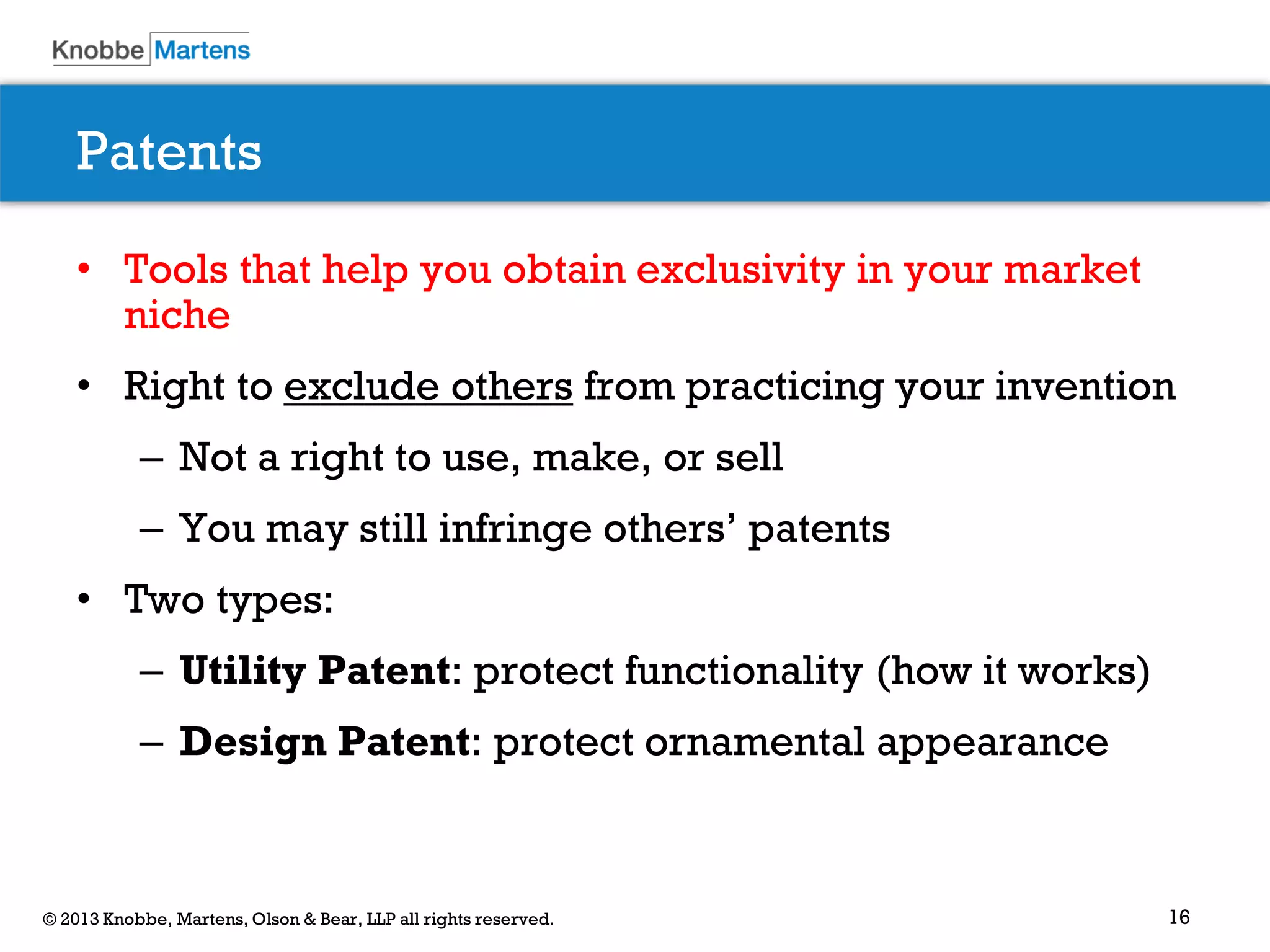
• Tools for keeping proprietary information confidential
• Just keeping it secret
– NDAs, confidentiality agreements
• Make sure you can keep it secret!
– Once the cat is out of the bag…
16© 2013 Knobbe, Martens, Olson & Bear, LLP all rights reserved.
Patents
• Tools that help you obtain exclusivity in your market
niche
• Right to exclude others from practicing your invention
– Not a right to use, make, or sell
– You may still infringe others’ patents
• Two types:
– Utility Patent: protect functionality (how it works)
– Design Patent: protect ornamental appearance
17© 2013 Knobbe, Martens, Olson & Bear, LLP all rights reserved.
Utility Patents
• Protection for functionality, how something works
• Invention must be useful and novel and nonobvious
(e.g., not an obvious variation on something)
• Examined by USPTO
• Last for 20 years from data of priority (usually the filing
date)
• Takes 3-5 years to issue typically, but…
– Faster tracks available for a fee
• Example
18© 2013 Knobbe, Martens, Olson & Bear, LLP all rights reserved.
Design Patents
• Protect ornamental appearance of an industrial article
• Must be novel and nonobvious (i.e., not an obvious
variation on something)
• Examined by USPTO, but issue quickly
• Lasts 14 years (soon to be 15 years)
• Differ from copyrights
– Different standards for grant and infringement
(independent creation not an issue)
– Presumption of validity
• Example
19© 2013 Knobbe, Martens, Olson & Bear, LLP all rights reserved.
Side Note: Provisional Patent Applications
• An inexpensive, informal filing at USPTO
• Not examined
• Kept secret
• Turn into regular application within a year
• Gets you a priority date
©2012 Knobbe Martens, Olson & Bear, LLP all rights reserved.©2013 Knobbe, Martens, Olson & Bear, LLP all rights reserved. 20
Why File for a Patent?
21© 2013 Knobbe, Martens, Olson & Bear, LLP all rights reserved.
Why File for a Patent?
• Attract Capital
• Licensing Revenue
• Enhance Company Value
• Reduce Likelihood/Impact of Employee Theft
• Stop Competition
• Protect Your Niche By Excluding Competition
– Stop others from making, using, selling, importing
• Support Sales
– After filing = “Patent Pending”
©2012 Knobbe Martens, Olson & Bear, LLP all rights reserved.©2013 Knobbe, Martens, Olson & Bear, LLP all rights reserved. 22
Evaluating the Importance of IP
to Your Startup (or Business)
23© 2013 Knobbe, Martens, Olson & Bear, LLP all rights reserved.
Considerations
• Your budget
– Early stage = provisional application (usually)
• Your technology area
– Ease of copying
– Types of protection available
• Speed of innovation
• Who are your customers?
– TM may be more valuable if selling directly to consumers
• Where are your customers?
©2012 Knobbe Martens, Olson & Bear, LLP all rights reserved.©2013 Knobbe, Martens, Olson & Bear, LLP all rights reserved. 24
IP Hygiene
25© 2013 Knobbe, Martens, Olson & Bear, LLP all rights reserved.
Protect Your Company’s Value
• Establish a legal entity
– Iron out partnership/corporate agreement
• Searching (much more on this in coming months)
– Name: not trademarked
– Product: Freedom to Operate
26© 2013 Knobbe, Martens, Olson & Bear, LLP all rights reserved.
Protect Your Technology
• Myth: I paid for it, therefore I own it.
• Employee Agreements & IP Assignments/Licenses
• NDAs & Confidentiality Agreements
• Independent Consultant Agreements
• Patents vs. Trade Secrets
27© 2013 Knobbe, Martens, Olson & Bear, LLP all rights reserved.
Beware – Bar Dates – First-to-File
• AIA changes the game a little on March 16, 2013
– First to file generally entitled to patent
– Uncertain 1 year grace period for filing in U.S.
• If you disclose your invention before filing…
– Lose all foreign rights
– Maybe lose U.S. rights
• Best course of action = file before you disclose
Russell Jeide
Scott Cromar
russell.jeide@knobbe.com
scott.cromar@knobbe.com

What Intellectual Property Is, and Why It May Be Important To Your Startup

  • 1.
    Russell Jeide &Scott Cromar Thursday,February 28, 2013 TVE2 IP Series Class 1: Intellectual Property andYour Startup
  • 2.
    2© 2013 Knobbe,Martens, Olson & Bear, LLP all rights reserved. TVE2 Intellectual Property (IP) Series • Class 1: "What intellectual property is, and why it may be important to your startup" • Class 2: "How to enter the patent world strategically and economically" • Class 3: "How to file for a patent" • Class 4: "The meaning of patent infringement and patent litigation" • Class 5: "How to use copyrights, trademarks, and trade secrets to your advantage" • Class 6: TBA (probably continuation of Class 5)
  • 3.
    3© 2013 Knobbe,Martens, Olson & Bear, LLP all rights reserved. Russell Jeide • Patent Attorney for 12 years • Partner at Knobbe Martens • B.S. Electronics Engineering Technology • Specializes in patent prosecution, legal opinion work, and licensing • Experience in telecommunication systems, computer architecture, computer software, Internet business methods, and mechanical devices
  • 4.
    4© 2013 Knobbe,Martens, Olson & Bear, LLP all rights reserved. Scott Cromar • Patent Agent for 3 years; Patent Attorney for 1 • Associate at Knobbe Martens • B.S. Electrical Engineering; M.S. Electrical and Computer Engineering • Specializes in IP counseling and patent preparation and prosecution • Experience with software, computers, electronics, and semiconductors
  • 5.
    5© 2013 Knobbe,Martens, Olson & Bear, LLP all rights reserved. Disclaimer • This presentation is for information purposes only and does not constitute legal advice. • This presentation does not establish any form of attorney-client relationship.
  • 6.
    6© 2013 Knobbe,Martens, Olson & Bear, LLP all rights reserved. Today: – What Is IP? – Quick Overview of the Primary Types Of IP • Copyrights, Trademarks, Trade Secrets • Utility & Design Patents – Why File for a Patent? – Evaluating the Importance of IP to Your Startup – IP Hygiene
  • 7.
    ©2012 Knobbe Martens,Olson & Bear, LLP all rights reserved.©2013 Knobbe, Martens, Olson & Bear, LLP all rights reserved. 7 What Is Intellectual Property (IP)?
  • 8.
    8© 2013 Knobbe,Martens, Olson & Bear, LLP all rights reserved. Intellectual Property (IP) • Refers to a category of exclusive rights created by statute, including: – Copyrights – Trademarks – Trade Secrets – Utility Patents – Design Patents • Others: Trade Dress, Mask Works, …
  • 9.
    9© 2013 Knobbe,Martens, Olson & Bear, LLP all rights reserved. Nature of the Exclusive Right • Typically the right to exclude or prevent someone from doing something • Usually req. gov’t registration; Enforce it in court • As business tools: – Copyrights: protect content; expression – Trademarks: enhance marketing strategies – Trade Secrets: keep proprietary info confidential – Patents: obtain exclusivity in your market niche • Utility: functionality; Design: appearance
  • 10.
    ©2012 Knobbe Martens,Olson & Bear, LLP all rights reserved.©2013 Knobbe, Martens, Olson & Bear, LLP all rights reserved. 10 Quick Overview of the Primary Types of IP
  • 11.
    11© 2013 Knobbe,Martens, Olson & Bear, LLP all rights reserved. Copyrights • Tools for protecting content • Provided to authors of “original works of authorship” • Exclusive right to a work of expression, such as a written story, a photograph, or a computer program • Not for things that are functional (that’s utility patents) • Protection lasts for a very long time – 70 years after death; 95+ years for corporate author
  • 12.
    12© 2013 Knobbe,Martens, Olson & Bear, LLP all rights reserved. Copyrights • No registration necessary, it’s automatic! • Mark to provide notice: © 2012 Company Name All Rights Reserved • Register with copyright office to sue
  • 13.
    13© 2013 Knobbe,Martens, Olson & Bear, LLP all rights reserved. Trademarks • Tools that can greatly enhance marketing strategies • Is any symbol capable of identifying and distinguishing its owner’s products from those of others
  • 14.
    14© 2013 Knobbe,Martens, Olson & Bear, LLP all rights reserved. Trademarks • Protects consumer from counterfeit goods • Lasts as long as you continue using it • Standard of infringement: “consumer confusion” • How to get a trademark? – Start marking sold goodsTM – common law – For ® - register with USPTO Search before you invest!
  • 15.
    15© 2013 Knobbe,Martens, Olson & Bear, LLP all rights reserved. Trade Secrets • Tools for keeping proprietary information confidential • Just keeping it secret – NDAs, confidentiality agreements • Make sure you can keep it secret! – Once the cat is out of the bag…
  • 16.
    16© 2013 Knobbe,Martens, Olson & Bear, LLP all rights reserved. Patents • Tools that help you obtain exclusivity in your market niche • Right to exclude others from practicing your invention – Not a right to use, make, or sell – You may still infringe others’ patents • Two types: – Utility Patent: protect functionality (how it works) – Design Patent: protect ornamental appearance
  • 17.
    17© 2013 Knobbe,Martens, Olson & Bear, LLP all rights reserved. Utility Patents • Protection for functionality, how something works • Invention must be useful and novel and nonobvious (e.g., not an obvious variation on something) • Examined by USPTO • Last for 20 years from data of priority (usually the filing date) • Takes 3-5 years to issue typically, but… – Faster tracks available for a fee • Example
  • 18.
    18© 2013 Knobbe,Martens, Olson & Bear, LLP all rights reserved. Design Patents • Protect ornamental appearance of an industrial article • Must be novel and nonobvious (i.e., not an obvious variation on something) • Examined by USPTO, but issue quickly • Lasts 14 years (soon to be 15 years) • Differ from copyrights – Different standards for grant and infringement (independent creation not an issue) – Presumption of validity • Example
  • 19.
    19© 2013 Knobbe,Martens, Olson & Bear, LLP all rights reserved. Side Note: Provisional Patent Applications • An inexpensive, informal filing at USPTO • Not examined • Kept secret • Turn into regular application within a year • Gets you a priority date
  • 20.
    ©2012 Knobbe Martens,Olson & Bear, LLP all rights reserved.©2013 Knobbe, Martens, Olson & Bear, LLP all rights reserved. 20 Why File for a Patent?
  • 21.
    21© 2013 Knobbe,Martens, Olson & Bear, LLP all rights reserved. Why File for a Patent? • Attract Capital • Licensing Revenue • Enhance Company Value • Reduce Likelihood/Impact of Employee Theft • Stop Competition • Protect Your Niche By Excluding Competition – Stop others from making, using, selling, importing • Support Sales – After filing = “Patent Pending”
  • 22.
    ©2012 Knobbe Martens,Olson & Bear, LLP all rights reserved.©2013 Knobbe, Martens, Olson & Bear, LLP all rights reserved. 22 Evaluating the Importance of IP to Your Startup (or Business)
  • 23.
    23© 2013 Knobbe,Martens, Olson & Bear, LLP all rights reserved. Considerations • Your budget – Early stage = provisional application (usually) • Your technology area – Ease of copying – Types of protection available • Speed of innovation • Who are your customers? – TM may be more valuable if selling directly to consumers • Where are your customers?
  • 24.
    ©2012 Knobbe Martens,Olson & Bear, LLP all rights reserved.©2013 Knobbe, Martens, Olson & Bear, LLP all rights reserved. 24 IP Hygiene
  • 25.
    25© 2013 Knobbe,Martens, Olson & Bear, LLP all rights reserved. Protect Your Company’s Value • Establish a legal entity – Iron out partnership/corporate agreement • Searching (much more on this in coming months) – Name: not trademarked – Product: Freedom to Operate
  • 26.
    26© 2013 Knobbe,Martens, Olson & Bear, LLP all rights reserved. Protect Your Technology • Myth: I paid for it, therefore I own it. • Employee Agreements & IP Assignments/Licenses • NDAs & Confidentiality Agreements • Independent Consultant Agreements • Patents vs. Trade Secrets
  • 27.
    27© 2013 Knobbe,Martens, Olson & Bear, LLP all rights reserved. Beware – Bar Dates – First-to-File • AIA changes the game a little on March 16, 2013 – First to file generally entitled to patent – Uncertain 1 year grace period for filing in U.S. • If you disclose your invention before filing… – Lose all foreign rights – Maybe lose U.S. rights • Best course of action = file before you disclose
  • 28.