Russell Jeide & Scott Cromar
Thursday,July 25, 2013
TVE2 IP Series
Class 6: How to Avoid Losing Patent Rights
2© 2013 Knobbe, Martens, Olson & Bear, LLP all rights reserved.
TVE2 Intellectual Property (IP) Series
• Class 1: "What intellectual property is, and why it
may be important to your startup"
• Class 2: "How to enter the patent world strategically
and economically"
• Class 3: "How to file for a patent"
• Class 4: "The meaning of patent infringement and
patent litigation"
• Class 5: "How to use copyrights, trademarks, and
trade secrets to your advantage"
• Class 6: "How to avoid losing patent rights"
3© 2013 Knobbe, Martens, Olson & Bear, LLP all rights reserved.
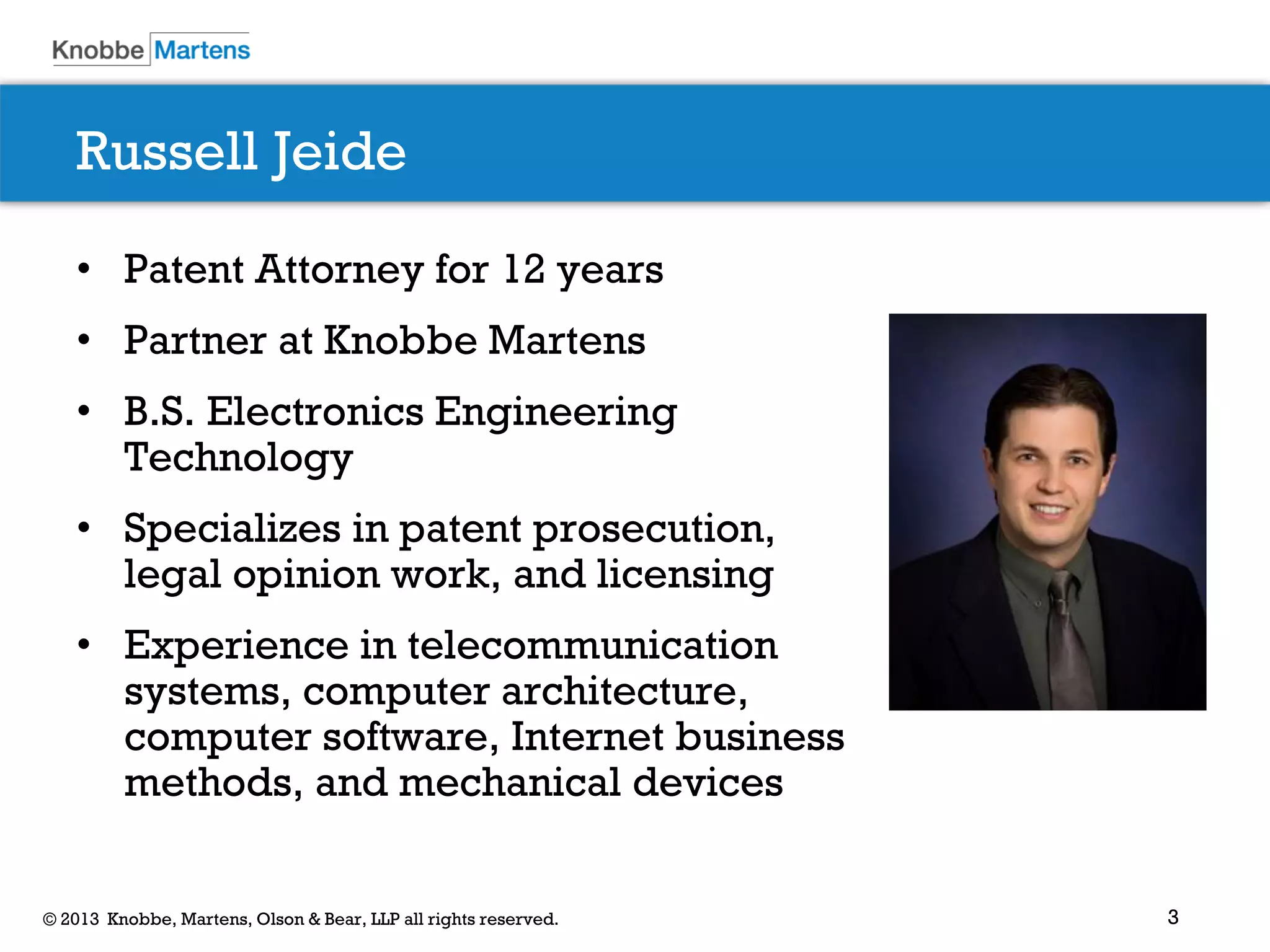
Russell Jeide
• Patent Attorney for 12 years
• Partner at Knobbe Martens
• B.S. Electronics Engineering
Technology
• Specializes in patent prosecution,
legal opinion work, and licensing
• Experience in telecommunication
systems, computer architecture,
computer software, Internet business
methods, and mechanical devices
4© 2013 Knobbe, Martens, Olson & Bear, LLP all rights reserved.
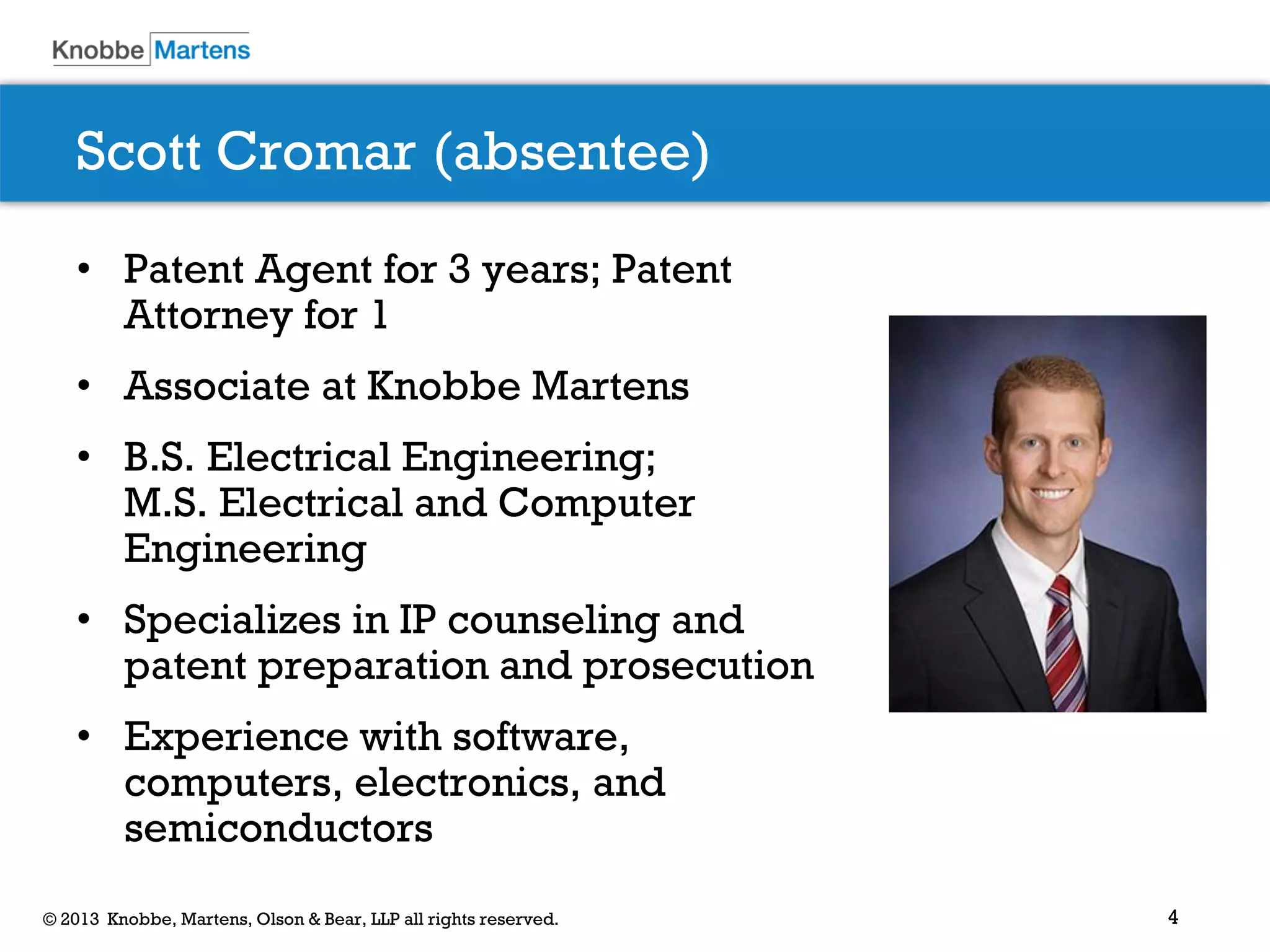
Scott Cromar (absentee)
• Patent Agent for 3 years; Patent
Attorney for 1
• Associate at Knobbe Martens
• B.S. Electrical Engineering;
M.S. Electrical and Computer
Engineering
• Specializes in IP counseling and
patent preparation and prosecution
• Experience with software,
computers, electronics, and
semiconductors
5© 2013 Knobbe, Martens, Olson & Bear, LLP all rights reserved.
Disclaimer
• This presentation is for information purposes only and
does not constitute legal advice.
• This presentation does not establish any form of
attorney-client relationship.
6© 2013 Knobbe, Martens, Olson & Bear, LLP all rights reserved.
Today:
• Today’s Main Topic:
– How to Avoid Losing Patent Rights
• May Cover:
– What is Intellectual Property (Class 1 Redux)?
– Making Use of Trade Secrets (Catch-up from Class
5)
©2012 Knobbe Martens, Olson & Bear, LLP all rights reserved.© 2013 Knobbe, Martens, Olson & Bear, LLP all rights reserved. 7
What Is Intellectual Property (IP)?
(Class 1 Redux)
8© 2013 Knobbe, Martens, Olson & Bear, LLP all rights reserved.
Intellectual Property (IP)
• Refers to a category of exclusive rights created by
statute, including:
– Copyrights
– Trademarks
– Trade Secrets
– Utility Patents
– Design Patents
• Others: Trade Dress, Mask Works, …
9© 2013 Knobbe, Martens, Olson & Bear, LLP all rights reserved.
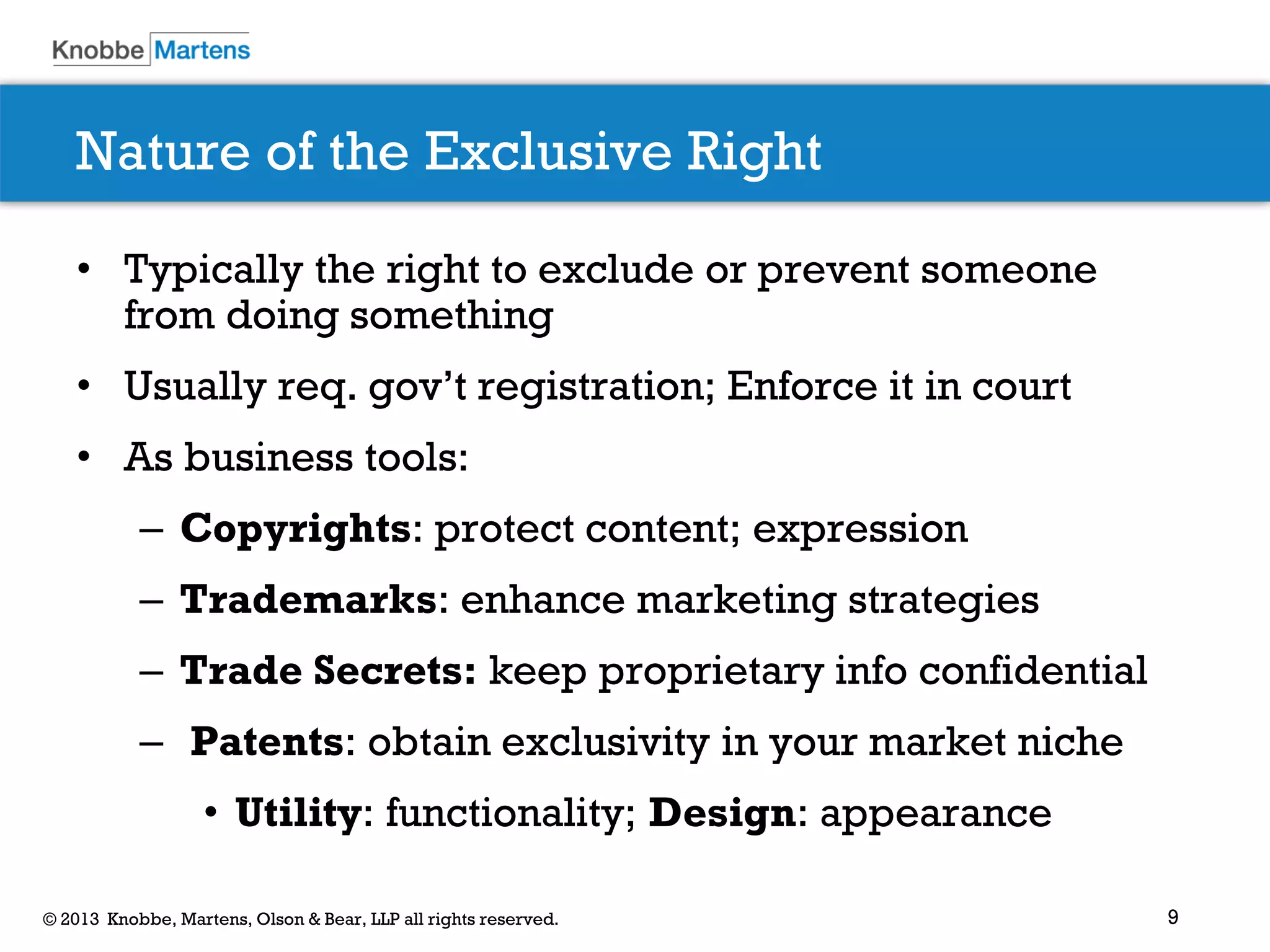
Nature of the Exclusive Right
• Typically the right to exclude or prevent someone
from doing something
• Usually req. gov’t registration; Enforce it in court
• As business tools:
– Copyrights: protect content; expression
– Trademarks: enhance marketing strategies
– Trade Secrets: keep proprietary info confidential
– Patents: obtain exclusivity in your market niche
• Utility: functionality; Design: appearance
©2012 Knobbe Martens, Olson & Bear, LLP all rights reserved.© 2013 Knobbe, Martens, Olson & Bear, LLP all rights reserved. 10
How to Avoid Losing Patent Rights
11© 2013 Knobbe, Martens, Olson & Bear, LLP all rights reserved.
How Patent Rights Are Lost
• Premature disclosure
• Failure to recognize invention
• Problems with joint development agreement
• Employee disputes over IP
12© 2013 Knobbe, Martens, Olson & Bear, LLP all rights reserved.
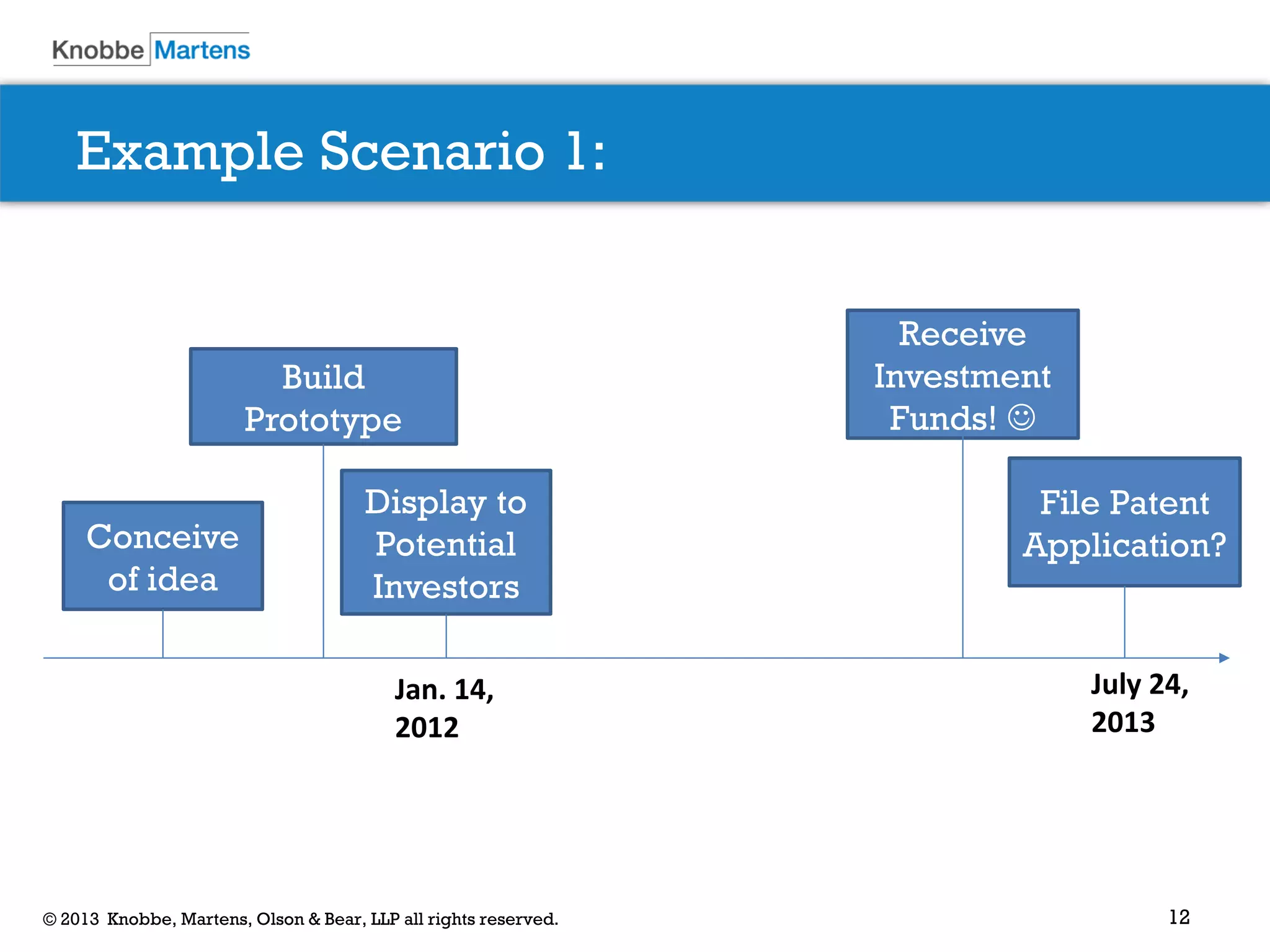
Example Scenario 1:
Conceive
of idea
Build
Prototype
Display to
Potential
Investors
Receive
Investment
Funds! 
File Patent
Application?
July 24,
2013
Jan. 14,
2012
13© 2013 Knobbe, Martens, Olson & Bear, LLP all rights reserved.
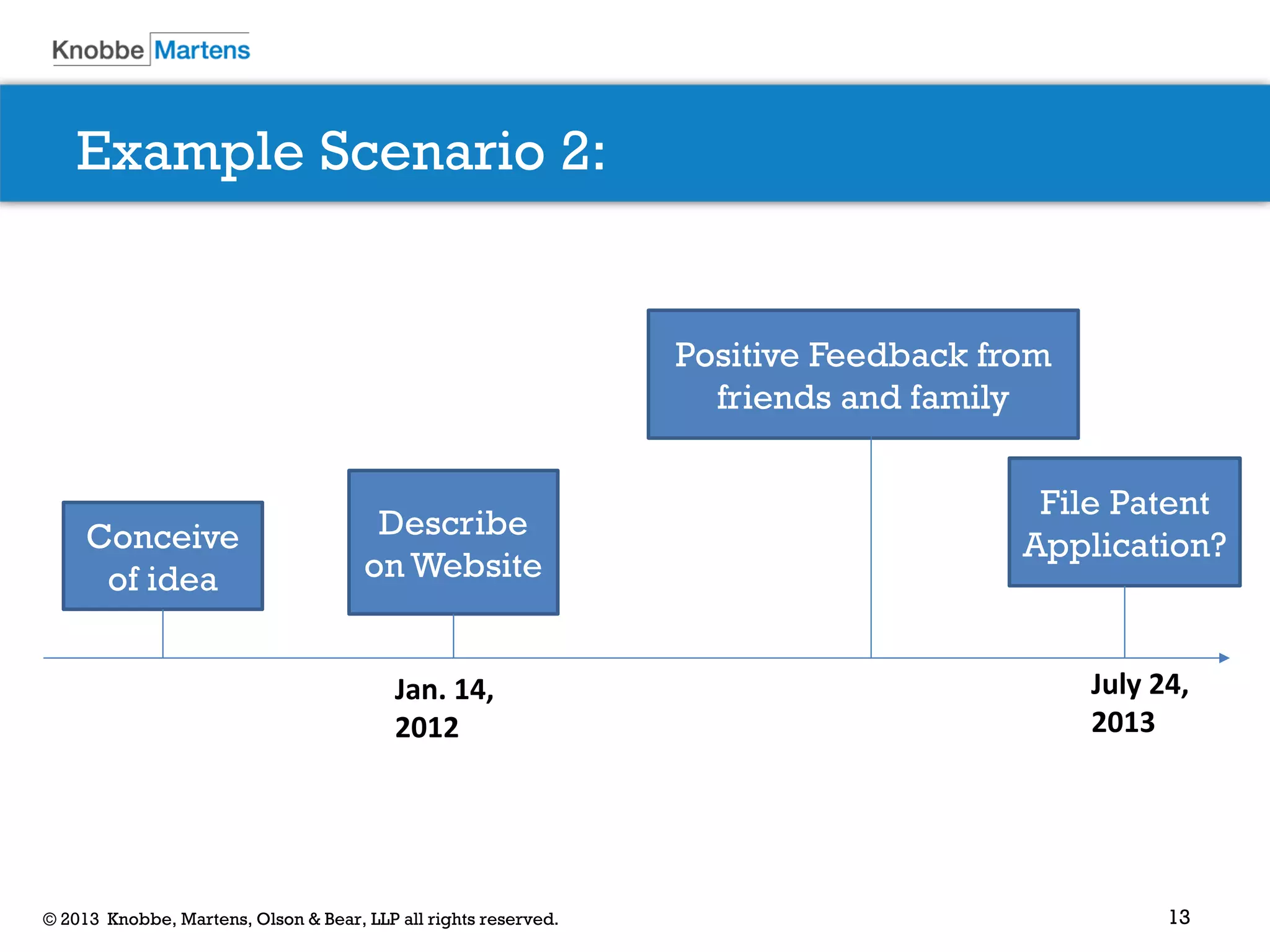
Example Scenario 2:
Conceive
of idea
Describe
on Website
Positive Feedback from
friends and family
File Patent
Application?
July 24,
2013
Jan. 14,
2012
14© 2013 Knobbe, Martens, Olson & Bear, LLP all rights reserved.
Accidental Disclosure
• If you disclose your invention before filing…
– Lose most (or all) foreign rights!
– Maybe lose U.S. rights!
15© 2013 Knobbe, Martens, Olson & Bear, LLP all rights reserved.
Accidental Disclosure (cont.)
• As of March 16, 2013
– First to file generally entitled to patent
• Must file before first sale, offer for sale,
publication, or public use of the invention by
others, anywhere in world
– Uncertain 1 year grace period for filing in U.S.
• Must file within one year of first sale, offer for
sale, publication, or public use of the invention
by inventors, anywhere in world
• Must be same subject matter!
16© 2013 Knobbe, Martens, Olson & Bear, LLP all rights reserved.
Accidental Disclosure (cont.)
• Company or inventors “accidentally” disclose product
details before patent application filed
• Examples:
– Marketing department discloses details of new
product to potential customers
– Inventor includes invention in academic paper or in
a public presentation
– Company releases beta version of product without
NDA
– Invention is disclosed to potential investors without
an NDA (See sample NDA)
17© 2013 Knobbe, Martens, Olson & Bear, LLP all rights reserved.
Accidental Disclosure (cont.)
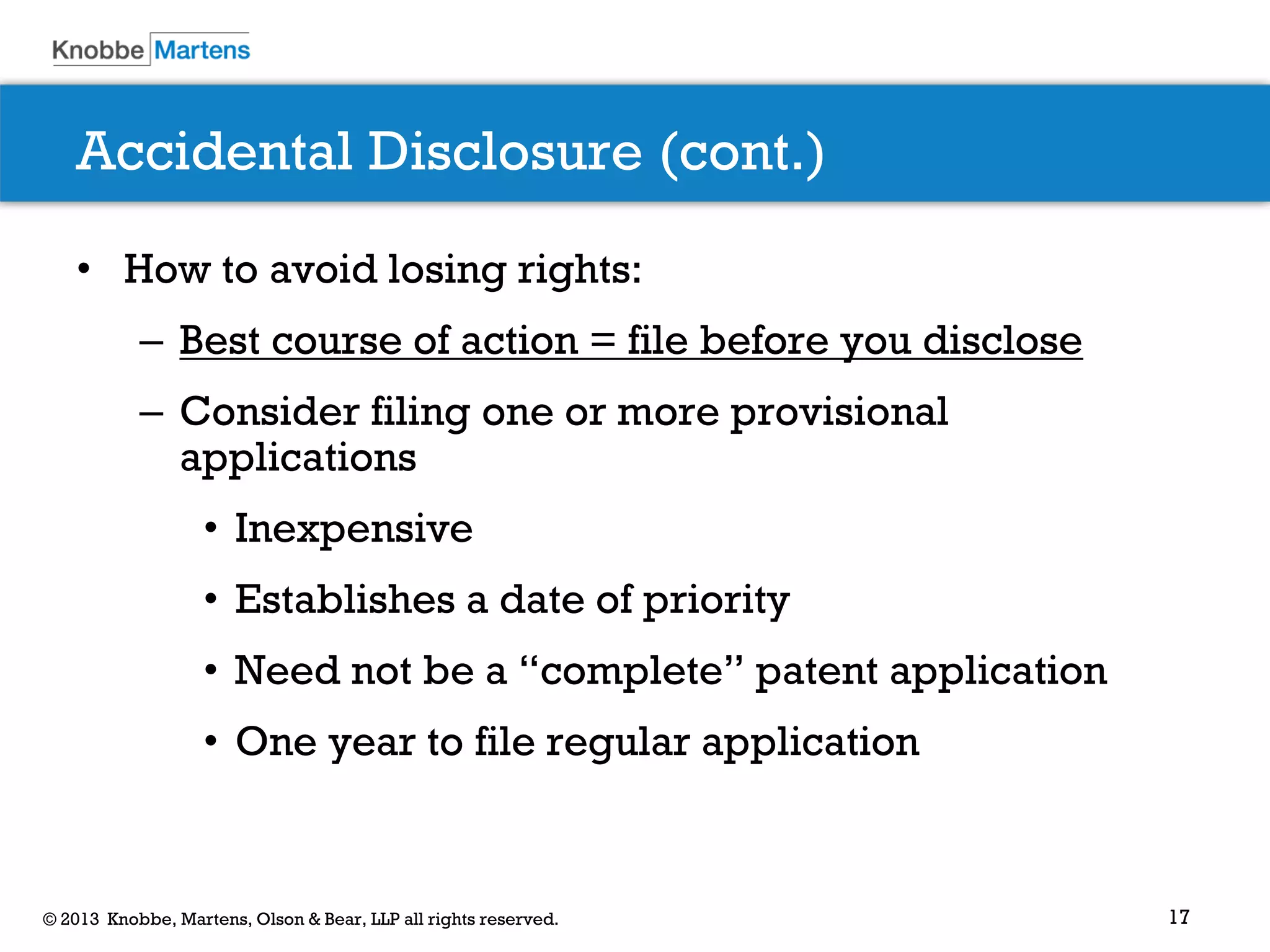
• How to avoid losing rights:
– Best course of action = file before you disclose
– Consider filing one or more provisional
applications
• Inexpensive
• Establishes a date of priority
• Need not be a “complete” patent application
• One year to file regular application
18© 2013 Knobbe, Martens, Olson & Bear, LLP all rights reserved.
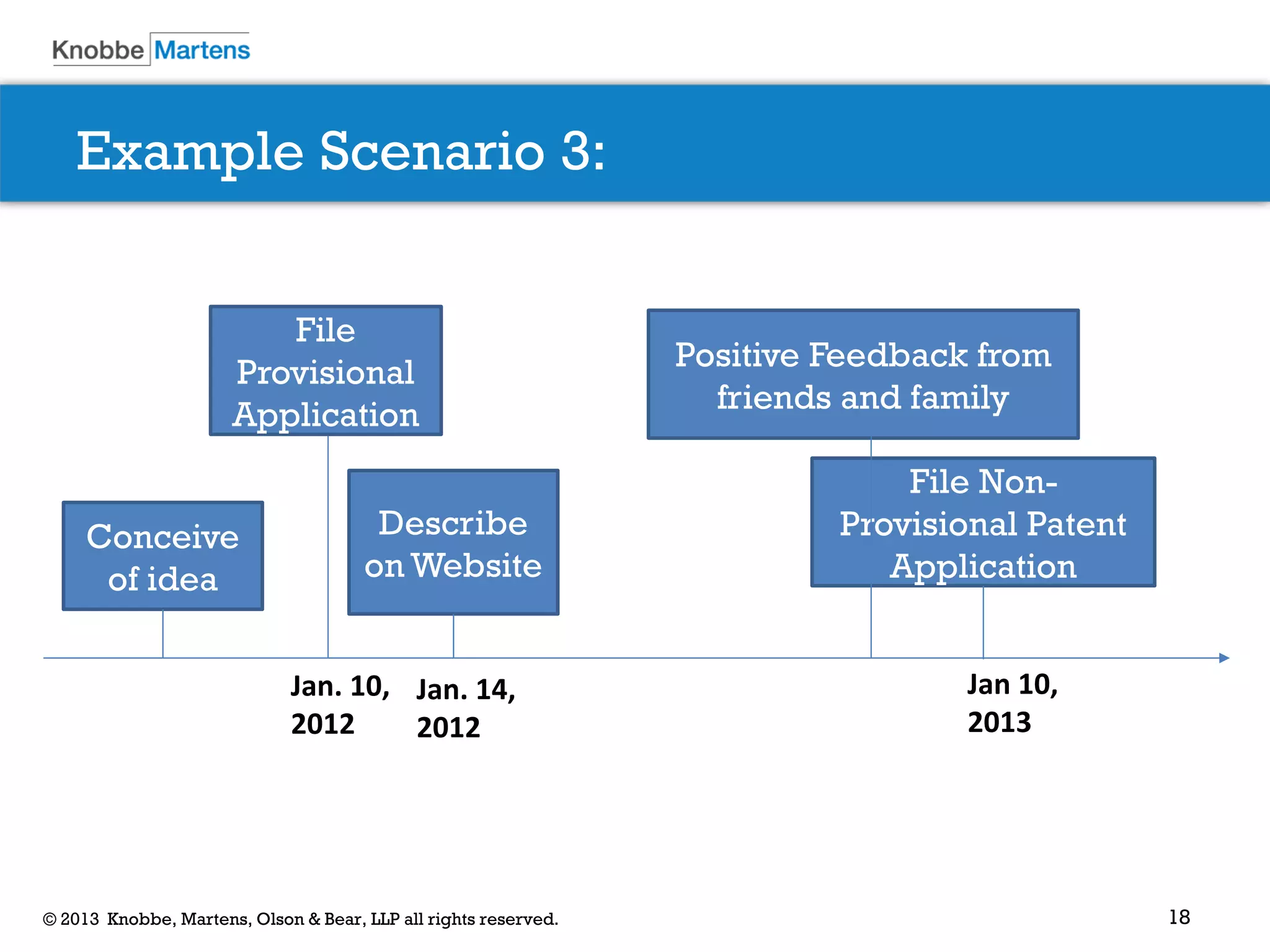
Example Scenario 3:
Conceive
of idea
Describe
on Website
Positive Feedback from
friends and family
File Non-
Provisional Patent
Application
Jan 10,
2013
Jan. 14,
2012
File
Provisional
Application
Jan. 10,
2012
19© 2013 Knobbe, Martens, Olson & Bear, LLP all rights reserved.
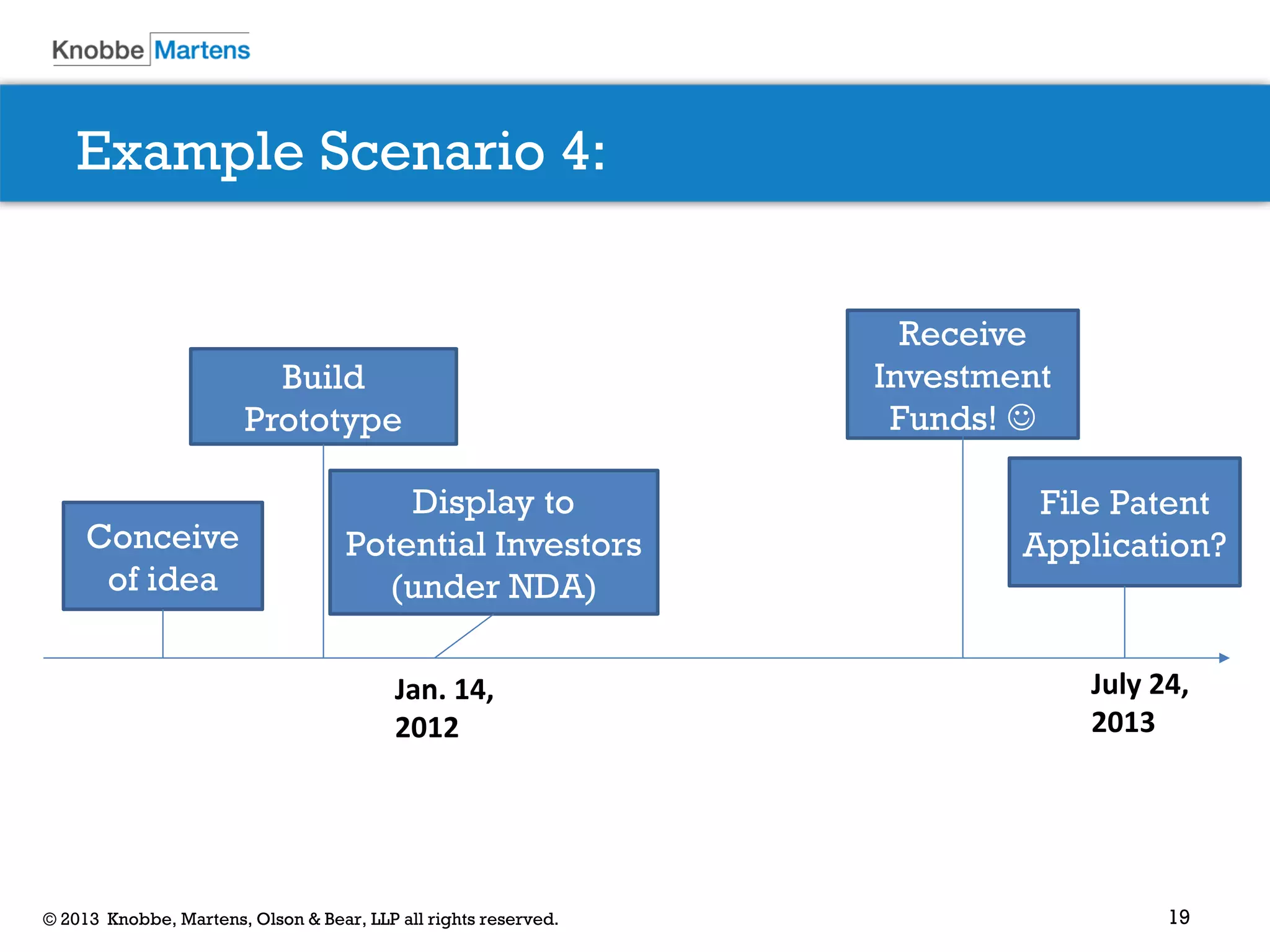
Example Scenario 4:
Conceive
of idea
Build
Prototype
Display to
Potential Investors
(under NDA)
Receive
Investment
Funds! 
File Patent
Application?
July 24,
2013
Jan. 14,
2012
20© 2013 Knobbe, Martens, Olson & Bear, LLP all rights reserved.
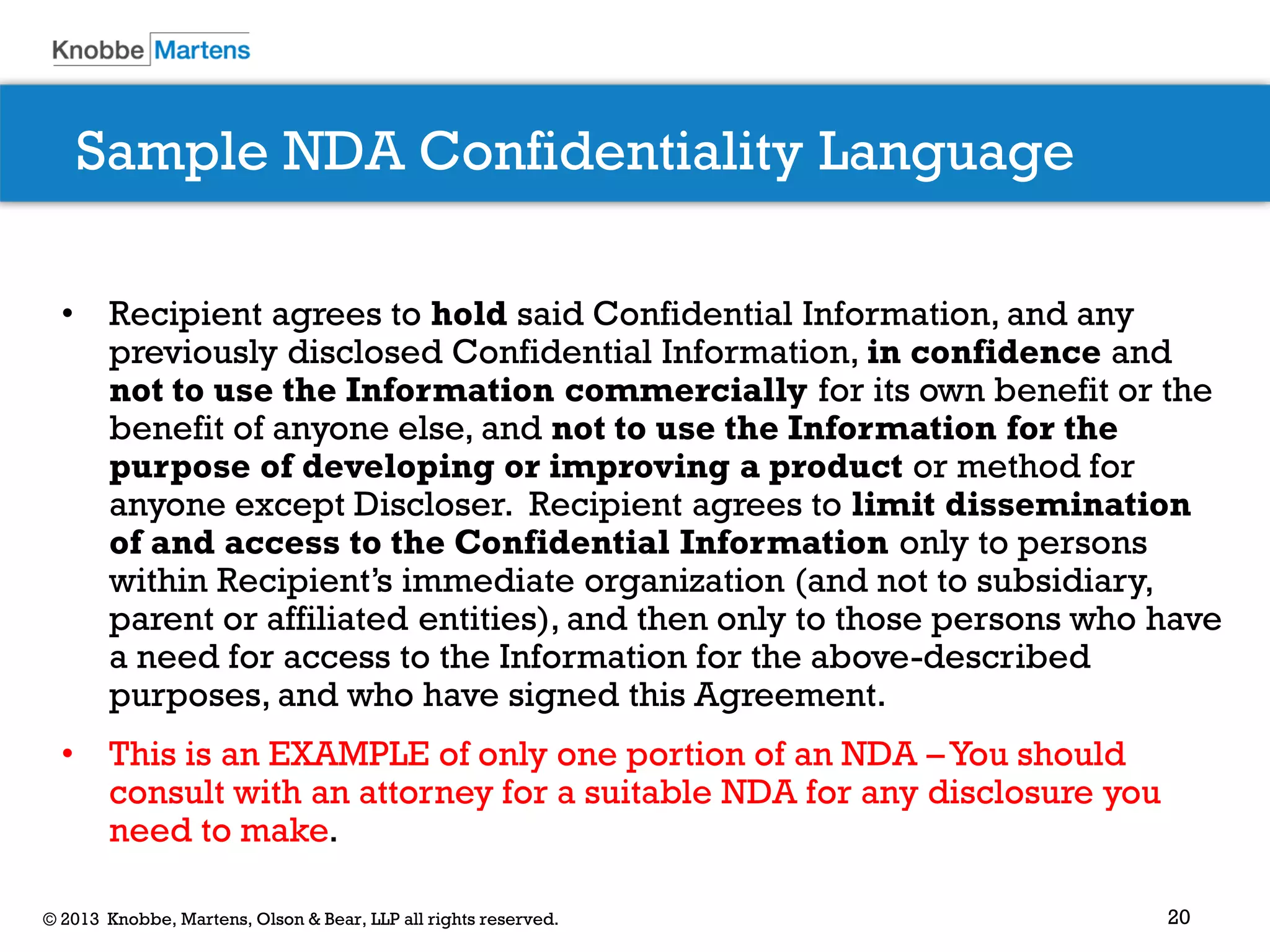
Sample NDA Confidentiality Language
• Recipient agrees to hold said Confidential Information, and any
previously disclosed Confidential Information, in confidence and
not to use the Information commercially for its own benefit or the
benefit of anyone else, and not to use the Information for the
purpose of developing or improving a product or method for
anyone except Discloser. Recipient agrees to limit dissemination
of and access to the Confidential Information only to persons
within Recipient’s immediate organization (and not to subsidiary,
parent or affiliated entities), and then only to those persons who have
a need for access to the Information for the above-described
purposes, and who have signed this Agreement.
• This is an EXAMPLE of only one portion of an NDA –You should
consult with an attorney for a suitable NDA for any disclosure you
need to make.
21© 2013 Knobbe, Martens, Olson & Bear, LLP all rights reserved.
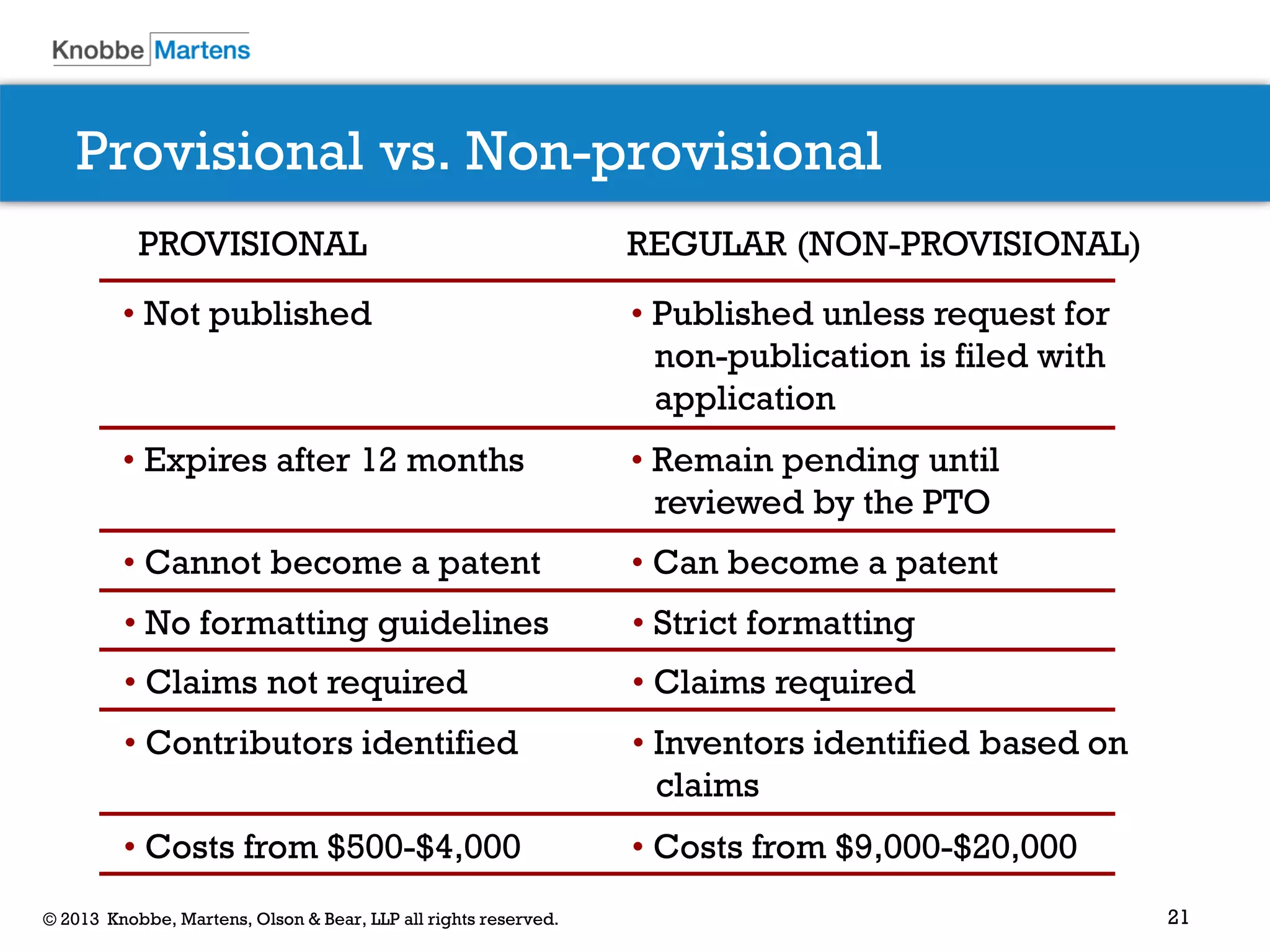
Provisional vs. Non-provisional
PROVISIONAL REGULAR (NON-PROVISIONAL)
• Not published • Published unless request for
non-publication is filed with
application
• Expires after 12 months • Remain pending until
reviewed by the PTO
• Cannot become a patent • Can become a patent
• No formatting guidelines • Strict formatting
• Claims not required • Claims required
• Costs from $500-$4,000 • Costs from $9,000-$20,000
• Contributors identified • Inventors identified based on
claims
22© 2013 Knobbe, Martens, Olson & Bear, LLP all rights reserved.
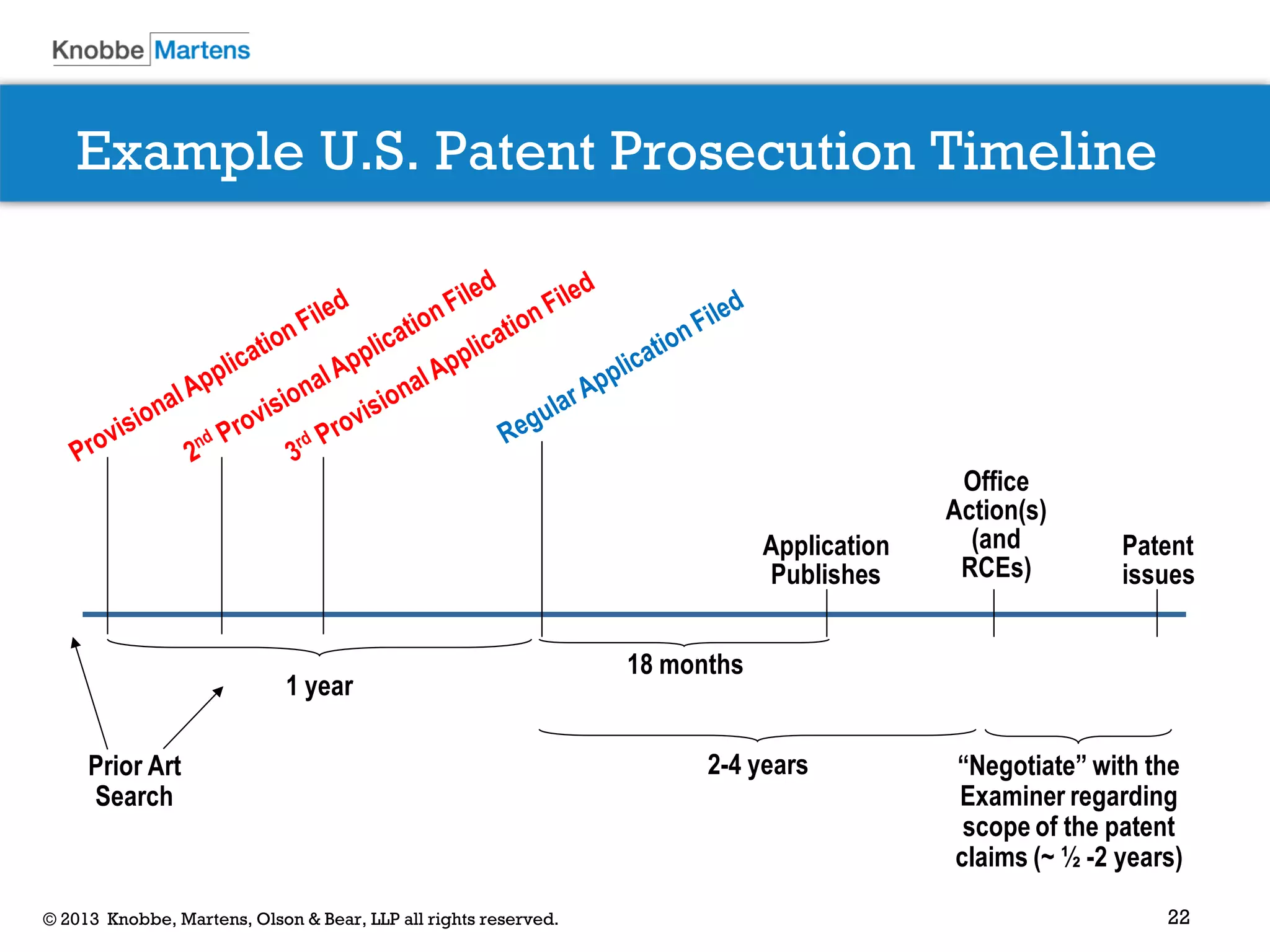
Example U.S. Patent Prosecution Timeline
“Negotiate” with the
Examiner regarding
scope of the patent
claims (~ ½ -2 years)
Patent
issues
2-4 years
Application
Publishes
Office
Action(s)
(and
RCEs)
18 months
1 year
Prior Art
Search
23© 2013 Knobbe, Martens, Olson & Bear, LLP all rights reserved.
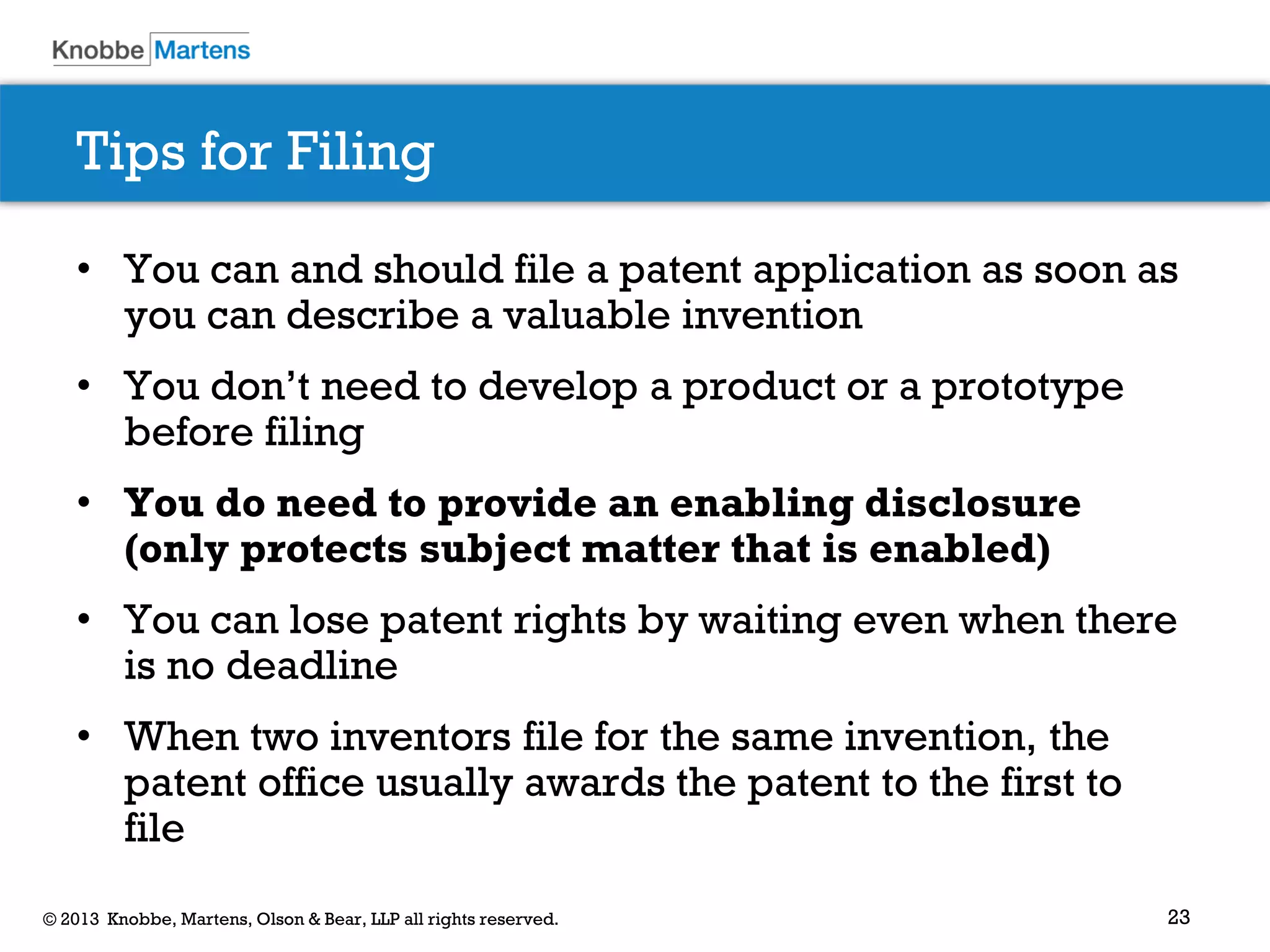
Tips for Filing
• You can and should file a patent application as soon as
you can describe a valuable invention
• You don’t need to develop a product or a prototype
before filing
• You do need to provide an enabling disclosure
(only protects subject matter that is enabled)
• You can lose patent rights by waiting even when there
is no deadline
• When two inventors file for the same invention, the
patent office usually awards the patent to the first to
file
24© 2013 Knobbe, Martens, Olson & Bear, LLP all rights reserved.
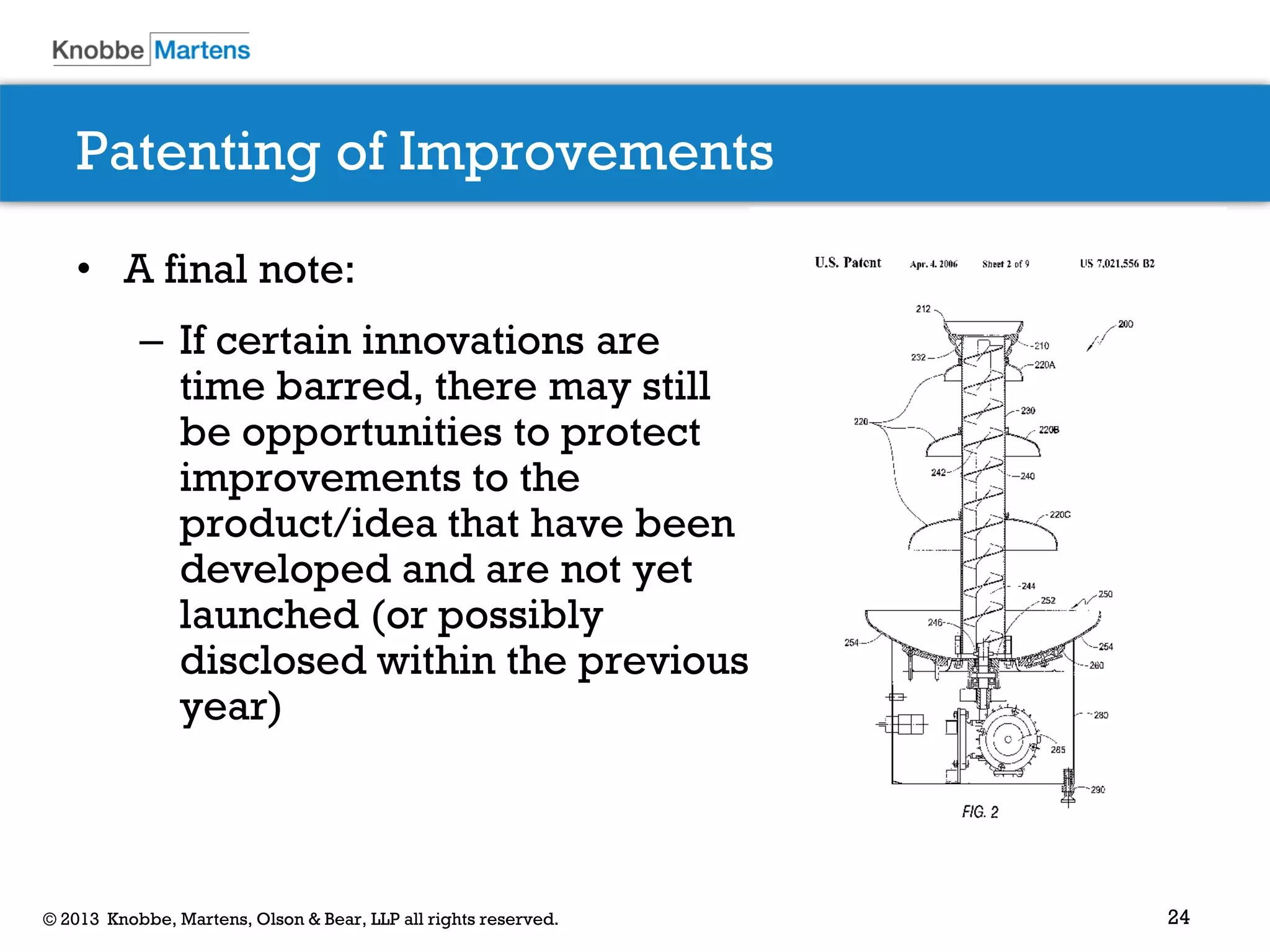
Patenting of Improvements
• A final note:
– If certain innovations are
time barred, there may still
be opportunities to protect
improvements to the
product/idea that have been
developed and are not yet
launched (or possibly
disclosed within the previous
year)
25© 2013 Knobbe, Martens, Olson & Bear, LLP all rights reserved.
How Patent Rights Are Lost
• Accidental disclosure
• Failure to recognize invention
• Problems with joint development agreement
• Employee disputes over IP
26© 2013 Knobbe, Martens, Olson & Bear, LLP all rights reserved.
Failure to Recognize Invention
• Valuable patent rights may be lost if inventions are not
identified
• What can you do about it?
27© 2013 Knobbe, Martens, Olson & Bear, LLP all rights reserved.
Failure to Recognize Invention (cont.)
• Be aware of the value of “minor” improvements on
existing technology
– These improvements are often patentable
– Patentability searches may help identify patentable
improvements
• Consider brainstorming sessions
• Consider using an invention “scorecard” to decide
what patents to pursue
28© 2013 Knobbe, Martens, Olson & Bear, LLP all rights reserved.
How Patent Rights Are Lost
• Accidental disclosure
• Failure to recognize invention
• Problems with joint development agreement
• Employee disputes over IP
29© 2013 Knobbe, Martens, Olson & Bear, LLP all rights reserved.
Problems with Joint Development Agreement
• Joint development agreement may lack favorable IP
ownership terms
– May not address IP at all
• May not be an issue until company/product has some
positive track record…
– But then it can be very expensive (legal fees to
resolve dispute & possible loss of royalties to a joint
owner)
30© 2013 Knobbe, Martens, Olson & Bear, LLP all rights reserved.
Problems with Joint Development Agreement
• How to avoid problems:
– Make the ownership clear in agreement
– Assign everything early
31© 2013 Knobbe, Martens, Olson & Bear, LLP all rights reserved.
Problems with Joint Development Agreement
• Examples:
1. One party owns everything developed by both/all
parties
2. Parties jointly own any jointly developed IP
• Important terms: sublicensing; royalty sharing;
transferability; etc.
3. Each party owns IP developed by its employees;
jointly developed IP is jointly owned
• May be difficult to determine inventorship
• Could result in dispute down the road
32© 2013 Knobbe, Martens, Olson & Bear, LLP all rights reserved.
How Patent Rights Are Lost
• Accidental disclosure
• Failure to recognize invention
• Problems with joint development agreement
• Employee disputes over IP
33© 2013 Knobbe, Martens, Olson & Bear, LLP all rights reserved.
Employee Disputes Over IP
• Myth: I paid for it, therefore I own it
• Make sure employee agreements have clauses
assigning inventions made for employer, to employer
• Make use of
– Employee Agreements & IP Assignments/Licenses
– NDAs & Confidentiality Agreements
– Independent Consultant Agreements
34© 2013 Knobbe, Martens, Olson & Bear, LLP all rights reserved.
Russell Jeide
Scott Cromar
• russell.jeide@knobbe.com
• scott.cromar@knobbe.com
©2012 Knobbe Martens, Olson & Bear, LLP all rights reserved.© 2013 Knobbe, Martens, Olson & Bear, LLP all rights reserved. 35
Trade Secrets
(Catch-up from Class 5)
36© 2013 Knobbe, Martens, Olson & Bear, LLP all rights reserved.
Trade Secrets
• Tools for keeping proprietary information confidential
• Just keeping it secret
– NDAs, confidentiality agreements
• Make sure you can keep it secret!
– Once the cat is out of the bag…
37© 2013 Knobbe, Martens, Olson & Bear, LLP all rights reserved.
Trade Secrets
• Any formula, pattern, device, or compilation of
information which is used in one’s business and gives
competitive advantage
• Comparison with other forms of protection:
– Trade secrets are immediately protectable.
– Uniqueness is not important; only competitive
advantage.
– Patent/copyrightable protection requires
disclosure of confidential information.
38© 2013 Knobbe, Martens, Olson & Bear, LLP all rights reserved.
Requirements of a Trade Secret
• Have Value in your Business
• Not Generally Known
• Subject to Reasonable Measures to Maintain Secrecy
39© 2013 Knobbe, Martens, Olson & Bear, LLP all rights reserved.
Creating Rights in a Trade Secret
• Did the owner take reasonable precautions to keep the
information secret?
– Notification: Imperative the program be written and
all key employees know. A Non-Disclosure
Agreement can serve as the basis for recovery.
– Identification
– Security
– Exit Interviews
40© 2013 Knobbe, Martens, Olson & Bear, LLP all rights reserved.
Trade Secrets vs. Patents
• Considerations:
– Independent Development
– Reverse Engineering
– Duration
– Employees’ General Knowledge and Skill
– Federal Remedies
– Cost
41© 2013 Knobbe, Martens, Olson & Bear, LLP all rights reserved.
Trade Secrets vs. Patents (cont.)
• Disadvantages of Patents
– Cost
– Publication
• 18 Months from Filing Date
• Can be prevented
42© 2013 Knobbe, Martens, Olson & Bear, LLP all rights reserved.
Trade Secrets vs. Patents (cont.)
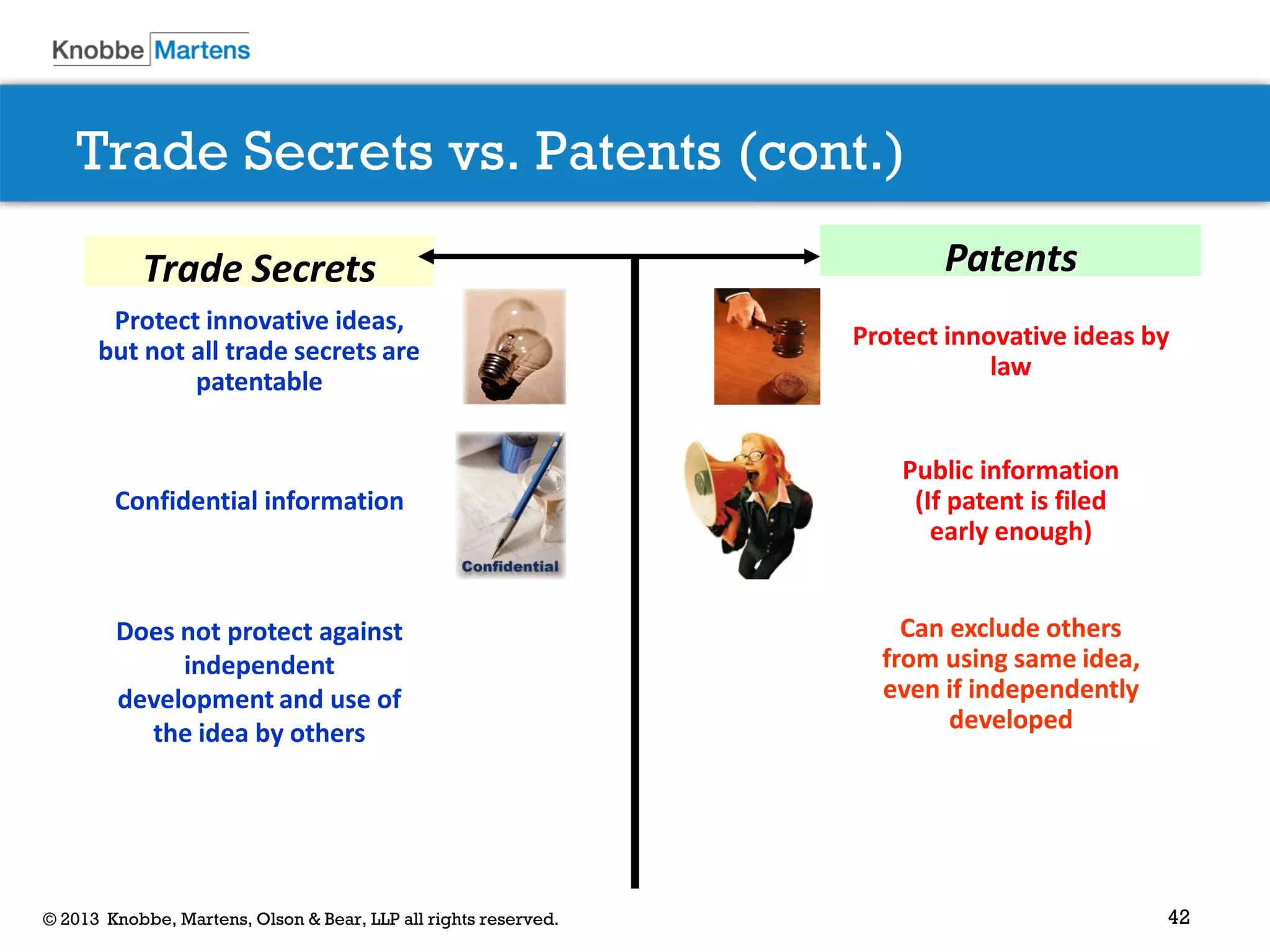
Protect innovative ideas,
but not all trade secrets are
patentable
Protect innovative ideas by
law
Confidential information
Public information
(If patent is filed
early enough)
Does not protect against
independent
development and use of
the idea by others
Can exclude others
from using same idea,
even if independently
developed
Trade Secrets Patents
43© 2013 Knobbe, Martens, Olson & Bear, LLP all rights reserved.
General Recommendations
• Patent Technology of Any Value
• Use Trade Secret Laws to Protect Against Disloyal
Employees
• Use NDAs, Consultant Agreements (confidentiality &
assignment of IP)
• Combine Aggressive Marking and Use of NDAs with
Aggressive Patent Portfolio
44© 2013 Knobbe, Martens, Olson & Bear, LLP all rights reserved.
Avoiding Liability for Misappropriation
• Situations:
– Hiring Employees from Competitors
– Leaving Employment and Starting a Competitive
Business
• General Principles:
– An Employee Can Take His or Her General
Knowledge, Skill, Experience
– Cannot Take Anything Tangible Belonging to the
Employer

How to Avoid Losing Patent Rights

  • 1.
    Russell Jeide &Scott Cromar Thursday,July 25, 2013 TVE2 IP Series Class 6: How to Avoid Losing Patent Rights
  • 2.
    2© 2013 Knobbe,Martens, Olson & Bear, LLP all rights reserved. TVE2 Intellectual Property (IP) Series • Class 1: "What intellectual property is, and why it may be important to your startup" • Class 2: "How to enter the patent world strategically and economically" • Class 3: "How to file for a patent" • Class 4: "The meaning of patent infringement and patent litigation" • Class 5: "How to use copyrights, trademarks, and trade secrets to your advantage" • Class 6: "How to avoid losing patent rights"
  • 3.
    3© 2013 Knobbe,Martens, Olson & Bear, LLP all rights reserved. Russell Jeide • Patent Attorney for 12 years • Partner at Knobbe Martens • B.S. Electronics Engineering Technology • Specializes in patent prosecution, legal opinion work, and licensing • Experience in telecommunication systems, computer architecture, computer software, Internet business methods, and mechanical devices
  • 4.
    4© 2013 Knobbe,Martens, Olson & Bear, LLP all rights reserved. Scott Cromar (absentee) • Patent Agent for 3 years; Patent Attorney for 1 • Associate at Knobbe Martens • B.S. Electrical Engineering; M.S. Electrical and Computer Engineering • Specializes in IP counseling and patent preparation and prosecution • Experience with software, computers, electronics, and semiconductors
  • 5.
    5© 2013 Knobbe,Martens, Olson & Bear, LLP all rights reserved. Disclaimer • This presentation is for information purposes only and does not constitute legal advice. • This presentation does not establish any form of attorney-client relationship.
  • 6.
    6© 2013 Knobbe,Martens, Olson & Bear, LLP all rights reserved. Today: • Today’s Main Topic: – How to Avoid Losing Patent Rights • May Cover: – What is Intellectual Property (Class 1 Redux)? – Making Use of Trade Secrets (Catch-up from Class 5)
  • 7.
    ©2012 Knobbe Martens,Olson & Bear, LLP all rights reserved.© 2013 Knobbe, Martens, Olson & Bear, LLP all rights reserved. 7 What Is Intellectual Property (IP)? (Class 1 Redux)
  • 8.
    8© 2013 Knobbe,Martens, Olson & Bear, LLP all rights reserved. Intellectual Property (IP) • Refers to a category of exclusive rights created by statute, including: – Copyrights – Trademarks – Trade Secrets – Utility Patents – Design Patents • Others: Trade Dress, Mask Works, …
  • 9.
    9© 2013 Knobbe,Martens, Olson & Bear, LLP all rights reserved. Nature of the Exclusive Right • Typically the right to exclude or prevent someone from doing something • Usually req. gov’t registration; Enforce it in court • As business tools: – Copyrights: protect content; expression – Trademarks: enhance marketing strategies – Trade Secrets: keep proprietary info confidential – Patents: obtain exclusivity in your market niche • Utility: functionality; Design: appearance
  • 10.
    ©2012 Knobbe Martens,Olson & Bear, LLP all rights reserved.© 2013 Knobbe, Martens, Olson & Bear, LLP all rights reserved. 10 How to Avoid Losing Patent Rights
  • 11.
    11© 2013 Knobbe,Martens, Olson & Bear, LLP all rights reserved. How Patent Rights Are Lost • Premature disclosure • Failure to recognize invention • Problems with joint development agreement • Employee disputes over IP
  • 12.
    12© 2013 Knobbe,Martens, Olson & Bear, LLP all rights reserved. Example Scenario 1: Conceive of idea Build Prototype Display to Potential Investors Receive Investment Funds!  File Patent Application? July 24, 2013 Jan. 14, 2012
  • 13.
    13© 2013 Knobbe,Martens, Olson & Bear, LLP all rights reserved. Example Scenario 2: Conceive of idea Describe on Website Positive Feedback from friends and family File Patent Application? July 24, 2013 Jan. 14, 2012
  • 14.
    14© 2013 Knobbe,Martens, Olson & Bear, LLP all rights reserved. Accidental Disclosure • If you disclose your invention before filing… – Lose most (or all) foreign rights! – Maybe lose U.S. rights!
  • 15.
    15© 2013 Knobbe,Martens, Olson & Bear, LLP all rights reserved. Accidental Disclosure (cont.) • As of March 16, 2013 – First to file generally entitled to patent • Must file before first sale, offer for sale, publication, or public use of the invention by others, anywhere in world – Uncertain 1 year grace period for filing in U.S. • Must file within one year of first sale, offer for sale, publication, or public use of the invention by inventors, anywhere in world • Must be same subject matter!
  • 16.
    16© 2013 Knobbe,Martens, Olson & Bear, LLP all rights reserved. Accidental Disclosure (cont.) • Company or inventors “accidentally” disclose product details before patent application filed • Examples: – Marketing department discloses details of new product to potential customers – Inventor includes invention in academic paper or in a public presentation – Company releases beta version of product without NDA – Invention is disclosed to potential investors without an NDA (See sample NDA)
  • 17.
    17© 2013 Knobbe,Martens, Olson & Bear, LLP all rights reserved. Accidental Disclosure (cont.) • How to avoid losing rights: – Best course of action = file before you disclose – Consider filing one or more provisional applications • Inexpensive • Establishes a date of priority • Need not be a “complete” patent application • One year to file regular application
  • 18.
    18© 2013 Knobbe,Martens, Olson & Bear, LLP all rights reserved. Example Scenario 3: Conceive of idea Describe on Website Positive Feedback from friends and family File Non- Provisional Patent Application Jan 10, 2013 Jan. 14, 2012 File Provisional Application Jan. 10, 2012
  • 19.
    19© 2013 Knobbe,Martens, Olson & Bear, LLP all rights reserved. Example Scenario 4: Conceive of idea Build Prototype Display to Potential Investors (under NDA) Receive Investment Funds!  File Patent Application? July 24, 2013 Jan. 14, 2012
  • 20.
    20© 2013 Knobbe,Martens, Olson & Bear, LLP all rights reserved. Sample NDA Confidentiality Language • Recipient agrees to hold said Confidential Information, and any previously disclosed Confidential Information, in confidence and not to use the Information commercially for its own benefit or the benefit of anyone else, and not to use the Information for the purpose of developing or improving a product or method for anyone except Discloser. Recipient agrees to limit dissemination of and access to the Confidential Information only to persons within Recipient’s immediate organization (and not to subsidiary, parent or affiliated entities), and then only to those persons who have a need for access to the Information for the above-described purposes, and who have signed this Agreement. • This is an EXAMPLE of only one portion of an NDA –You should consult with an attorney for a suitable NDA for any disclosure you need to make.
  • 21.
    21© 2013 Knobbe,Martens, Olson & Bear, LLP all rights reserved. Provisional vs. Non-provisional PROVISIONAL REGULAR (NON-PROVISIONAL) • Not published • Published unless request for non-publication is filed with application • Expires after 12 months • Remain pending until reviewed by the PTO • Cannot become a patent • Can become a patent • No formatting guidelines • Strict formatting • Claims not required • Claims required • Costs from $500-$4,000 • Costs from $9,000-$20,000 • Contributors identified • Inventors identified based on claims
  • 22.
    22© 2013 Knobbe,Martens, Olson & Bear, LLP all rights reserved. Example U.S. Patent Prosecution Timeline “Negotiate” with the Examiner regarding scope of the patent claims (~ ½ -2 years) Patent issues 2-4 years Application Publishes Office Action(s) (and RCEs) 18 months 1 year Prior Art Search
  • 23.
    23© 2013 Knobbe,Martens, Olson & Bear, LLP all rights reserved. Tips for Filing • You can and should file a patent application as soon as you can describe a valuable invention • You don’t need to develop a product or a prototype before filing • You do need to provide an enabling disclosure (only protects subject matter that is enabled) • You can lose patent rights by waiting even when there is no deadline • When two inventors file for the same invention, the patent office usually awards the patent to the first to file
  • 24.
    24© 2013 Knobbe,Martens, Olson & Bear, LLP all rights reserved. Patenting of Improvements • A final note: – If certain innovations are time barred, there may still be opportunities to protect improvements to the product/idea that have been developed and are not yet launched (or possibly disclosed within the previous year)
  • 25.
    25© 2013 Knobbe,Martens, Olson & Bear, LLP all rights reserved. How Patent Rights Are Lost • Accidental disclosure • Failure to recognize invention • Problems with joint development agreement • Employee disputes over IP
  • 26.
    26© 2013 Knobbe,Martens, Olson & Bear, LLP all rights reserved. Failure to Recognize Invention • Valuable patent rights may be lost if inventions are not identified • What can you do about it?
  • 27.
    27© 2013 Knobbe,Martens, Olson & Bear, LLP all rights reserved. Failure to Recognize Invention (cont.) • Be aware of the value of “minor” improvements on existing technology – These improvements are often patentable – Patentability searches may help identify patentable improvements • Consider brainstorming sessions • Consider using an invention “scorecard” to decide what patents to pursue
  • 28.
    28© 2013 Knobbe,Martens, Olson & Bear, LLP all rights reserved. How Patent Rights Are Lost • Accidental disclosure • Failure to recognize invention • Problems with joint development agreement • Employee disputes over IP
  • 29.
    29© 2013 Knobbe,Martens, Olson & Bear, LLP all rights reserved. Problems with Joint Development Agreement • Joint development agreement may lack favorable IP ownership terms – May not address IP at all • May not be an issue until company/product has some positive track record… – But then it can be very expensive (legal fees to resolve dispute & possible loss of royalties to a joint owner)
  • 30.
    30© 2013 Knobbe,Martens, Olson & Bear, LLP all rights reserved. Problems with Joint Development Agreement • How to avoid problems: – Make the ownership clear in agreement – Assign everything early
  • 31.
    31© 2013 Knobbe,Martens, Olson & Bear, LLP all rights reserved. Problems with Joint Development Agreement • Examples: 1. One party owns everything developed by both/all parties 2. Parties jointly own any jointly developed IP • Important terms: sublicensing; royalty sharing; transferability; etc. 3. Each party owns IP developed by its employees; jointly developed IP is jointly owned • May be difficult to determine inventorship • Could result in dispute down the road
  • 32.
    32© 2013 Knobbe,Martens, Olson & Bear, LLP all rights reserved. How Patent Rights Are Lost • Accidental disclosure • Failure to recognize invention • Problems with joint development agreement • Employee disputes over IP
  • 33.
    33© 2013 Knobbe,Martens, Olson & Bear, LLP all rights reserved. Employee Disputes Over IP • Myth: I paid for it, therefore I own it • Make sure employee agreements have clauses assigning inventions made for employer, to employer • Make use of – Employee Agreements & IP Assignments/Licenses – NDAs & Confidentiality Agreements – Independent Consultant Agreements
  • 34.
    34© 2013 Knobbe,Martens, Olson & Bear, LLP all rights reserved. Russell Jeide Scott Cromar • russell.jeide@knobbe.com • scott.cromar@knobbe.com
  • 35.
    ©2012 Knobbe Martens,Olson & Bear, LLP all rights reserved.© 2013 Knobbe, Martens, Olson & Bear, LLP all rights reserved. 35 Trade Secrets (Catch-up from Class 5)
  • 36.
    36© 2013 Knobbe,Martens, Olson & Bear, LLP all rights reserved. Trade Secrets • Tools for keeping proprietary information confidential • Just keeping it secret – NDAs, confidentiality agreements • Make sure you can keep it secret! – Once the cat is out of the bag…
  • 37.
    37© 2013 Knobbe,Martens, Olson & Bear, LLP all rights reserved. Trade Secrets • Any formula, pattern, device, or compilation of information which is used in one’s business and gives competitive advantage • Comparison with other forms of protection: – Trade secrets are immediately protectable. – Uniqueness is not important; only competitive advantage. – Patent/copyrightable protection requires disclosure of confidential information.
  • 38.
    38© 2013 Knobbe,Martens, Olson & Bear, LLP all rights reserved. Requirements of a Trade Secret • Have Value in your Business • Not Generally Known • Subject to Reasonable Measures to Maintain Secrecy
  • 39.
    39© 2013 Knobbe,Martens, Olson & Bear, LLP all rights reserved. Creating Rights in a Trade Secret • Did the owner take reasonable precautions to keep the information secret? – Notification: Imperative the program be written and all key employees know. A Non-Disclosure Agreement can serve as the basis for recovery. – Identification – Security – Exit Interviews
  • 40.
    40© 2013 Knobbe,Martens, Olson & Bear, LLP all rights reserved. Trade Secrets vs. Patents • Considerations: – Independent Development – Reverse Engineering – Duration – Employees’ General Knowledge and Skill – Federal Remedies – Cost
  • 41.
    41© 2013 Knobbe,Martens, Olson & Bear, LLP all rights reserved. Trade Secrets vs. Patents (cont.) • Disadvantages of Patents – Cost – Publication • 18 Months from Filing Date • Can be prevented
  • 42.
    42© 2013 Knobbe,Martens, Olson & Bear, LLP all rights reserved. Trade Secrets vs. Patents (cont.) Protect innovative ideas, but not all trade secrets are patentable Protect innovative ideas by law Confidential information Public information (If patent is filed early enough) Does not protect against independent development and use of the idea by others Can exclude others from using same idea, even if independently developed Trade Secrets Patents
  • 43.
    43© 2013 Knobbe,Martens, Olson & Bear, LLP all rights reserved. General Recommendations • Patent Technology of Any Value • Use Trade Secret Laws to Protect Against Disloyal Employees • Use NDAs, Consultant Agreements (confidentiality & assignment of IP) • Combine Aggressive Marking and Use of NDAs with Aggressive Patent Portfolio
  • 44.
    44© 2013 Knobbe,Martens, Olson & Bear, LLP all rights reserved. Avoiding Liability for Misappropriation • Situations: – Hiring Employees from Competitors – Leaving Employment and Starting a Competitive Business • General Principles: – An Employee Can Take His or Her General Knowledge, Skill, Experience – Cannot Take Anything Tangible Belonging to the Employer