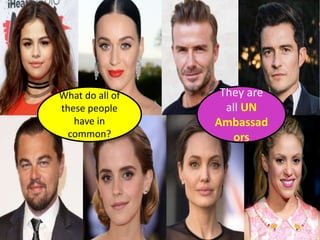
What do all of
these people
have in
common?
They are
all UN
Ambassad
ors
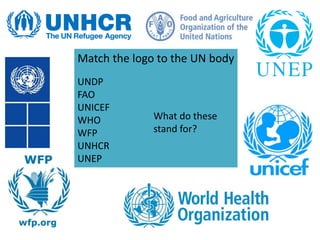
Match the logo to the UN body
UNDP
FAO
UNICEF
WHO
WFP
UNHCR
UNEP
What do these
stand for?
What does the United Nations do?
Aims
To understand why the UN was established
To know how the UN operates
Lesson 14
Key definitions
Inter-Governmental Organisation (IGO) - An IGO is an
organisation composed primarily of sovereign states, or of
other intergovernmental organizations. IGOs are established
by treaty or other agreement that acts as a charter creating
the group.
Global governance – governance suggests broader notions of
steering or piloting rather than the direct form of control
associated with government. Global governance therefore
describes the steering rules, norms, codes and regulations
used to regulate human activity at an international level. At
this scale, regulation and laws can be tough to enforce.
The birth of the United Nations
24th October 1945 - The United Nations officially
comes into existence
In 1945, representatives of 50 countries met in San
Francisco at the United Nations Conference on
International Organization to draw up the United
Nations Charter.
https://www.youtube.com/watch?v=gCOkMWv5TB0
The Purposes of the United Nations are:
1.To maintain international peace and security, and to that end:
to take effective collective measures for the prevention and
removal of threats to the peace, and for the suppression of acts
of aggression or other breaches of the peace, and to bring about
by peaceful means, and in conformity with the principles of
justice and international law, adjustment or settlement of
international disputes or situations which might lead to a breach
of the peace
2.To develop friendly relations among nations based on respect
for the principle of equal rights and self-determination of
peoples, and to take other appropriate measures to strengthen
universal peace
3.To achieve international co-operation in solving international
problems of an economic, social, cultural, or humanitarian
character, and in promoting and encouraging respect for human
rights and for fundamental freedoms for all without distinction as
to race, sex, language, or religion
Timeline
Key roles of the United Nations
• Maintaining international peace and security
• Promoting sustainable development
• Protecting human rights
• Upholding international law
• Delivering humanitarian aid
Read through the timeline and colour code the key events
according to the roles of the UN.
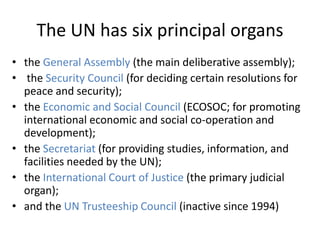
The UN has six principal organs
• the General Assembly (the main deliberative assembly);
• the Security Council (for deciding certain resolutions for
peace and security);
• the Economic and Social Council (ECOSOC; for promoting
international economic and social co-operation and
development);
• the Secretariat (for providing studies, information, and
facilities needed by the UN);
• the International Court of Justice (the primary judicial
organ);
• and the UN Trusteeship Council (inactive since 1994)
Task - In small groups (2s) research the
work of one social or environmental
organisation e.g. UNICEF, UNESCO, UNHCR
Find out about the following:
a. Its aims and core work
b. Where it focusses its efforts in the world
c. Examples of its successful work
Use the links on ebsb
https://www.t
heguardian.co
m/world/video
/2015/sep/08/
how-did-the-
un-get-so-big-
rachel-weisz-
video
- watch the
clip.
- An
overview
of the UN
and looking
into the
future.
Plenary
Write a one sentence summary of each of the
bodies you have looked at today.
Without naming the body, read your sentences
out and your neighbour has to identify them.
Organs of the UN

What does the_united_nations_do

  • 1.
    What do allof these people have in common? They are all UN Ambassad ors
  • 2.
    Match the logoto the UN body UNDP FAO UNICEF WHO WFP UNHCR UNEP What do these stand for?
  • 3.
    What does theUnited Nations do? Aims To understand why the UN was established To know how the UN operates Lesson 14
  • 4.
    Key definitions Inter-Governmental Organisation(IGO) - An IGO is an organisation composed primarily of sovereign states, or of other intergovernmental organizations. IGOs are established by treaty or other agreement that acts as a charter creating the group. Global governance – governance suggests broader notions of steering or piloting rather than the direct form of control associated with government. Global governance therefore describes the steering rules, norms, codes and regulations used to regulate human activity at an international level. At this scale, regulation and laws can be tough to enforce.
  • 5.
    The birth ofthe United Nations 24th October 1945 - The United Nations officially comes into existence In 1945, representatives of 50 countries met in San Francisco at the United Nations Conference on International Organization to draw up the United Nations Charter. https://www.youtube.com/watch?v=gCOkMWv5TB0
  • 6.
    The Purposes ofthe United Nations are: 1.To maintain international peace and security, and to that end: to take effective collective measures for the prevention and removal of threats to the peace, and for the suppression of acts of aggression or other breaches of the peace, and to bring about by peaceful means, and in conformity with the principles of justice and international law, adjustment or settlement of international disputes or situations which might lead to a breach of the peace 2.To develop friendly relations among nations based on respect for the principle of equal rights and self-determination of peoples, and to take other appropriate measures to strengthen universal peace 3.To achieve international co-operation in solving international problems of an economic, social, cultural, or humanitarian character, and in promoting and encouraging respect for human rights and for fundamental freedoms for all without distinction as to race, sex, language, or religion
  • 7.
    Timeline Key roles ofthe United Nations • Maintaining international peace and security • Promoting sustainable development • Protecting human rights • Upholding international law • Delivering humanitarian aid Read through the timeline and colour code the key events according to the roles of the UN.
  • 8.
    The UN hassix principal organs • the General Assembly (the main deliberative assembly); • the Security Council (for deciding certain resolutions for peace and security); • the Economic and Social Council (ECOSOC; for promoting international economic and social co-operation and development); • the Secretariat (for providing studies, information, and facilities needed by the UN); • the International Court of Justice (the primary judicial organ); • and the UN Trusteeship Council (inactive since 1994)
  • 9.
    Task - Insmall groups (2s) research the work of one social or environmental organisation e.g. UNICEF, UNESCO, UNHCR Find out about the following: a. Its aims and core work b. Where it focusses its efforts in the world c. Examples of its successful work Use the links on ebsb
  • 10.
  • 11.
    Plenary Write a onesentence summary of each of the bodies you have looked at today. Without naming the body, read your sentences out and your neighbour has to identify them.
  • 12.

Editor's Notes