Attribution Modelling & AI, © 2018 Dimitris Parapadakis, University of Westminster Slide 2
Attribution modelling
…meets Artificial Intelligence
Dimitris Parapadakis
ATTRIBUTING RANDOM
CHOICES?
Attribution Modelling and AI, © 2018 D.Parapadakis, University of Westminster Slide 4
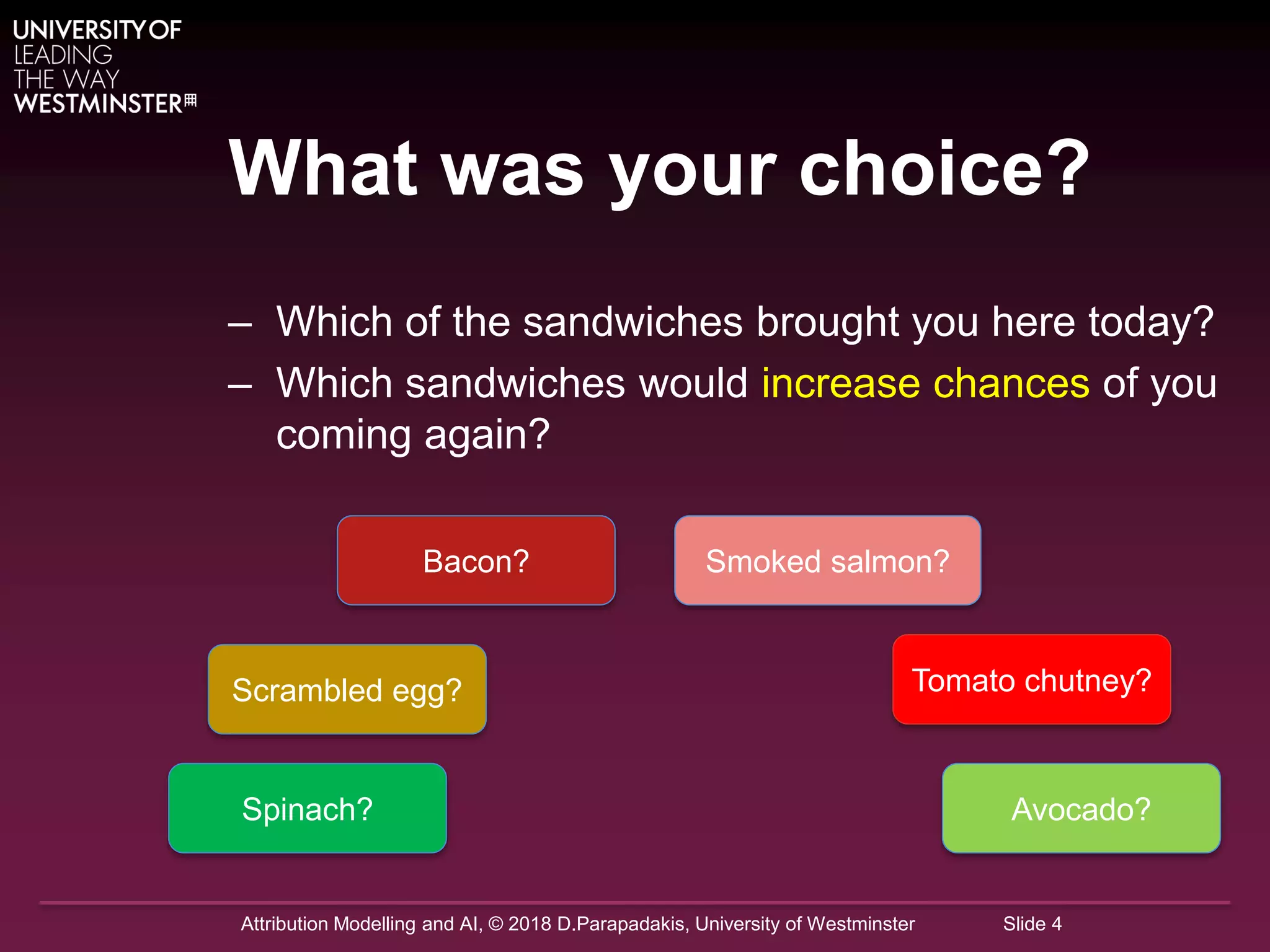
What was your choice?
– Which of the sandwiches brought you here today?
– Which sandwiches would increase chances of you
coming again?
Bacon?
Scrambled egg?
Smoked salmon?
Spinach?
Tomato chutney?
Avocado?
Attribution Modelling and AI, © 2018 D.Parapadakis, University of Westminster Slide 5
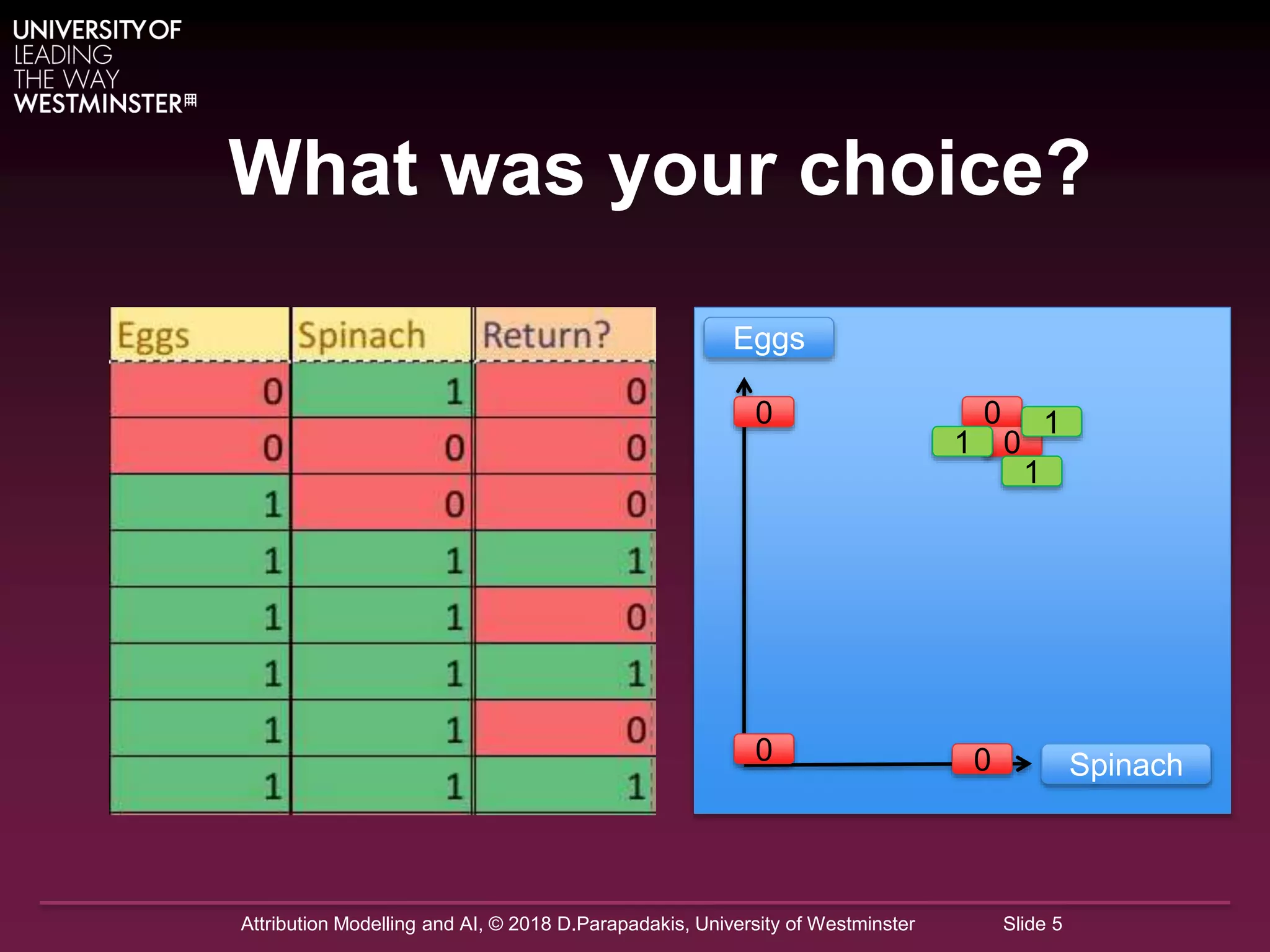
What was your choice?
Eggs
Spinach0 0
0 0
01
1
1
Attribution Modelling and AI, © 2018 D.Parapadakis, University of Westminster Slide 6
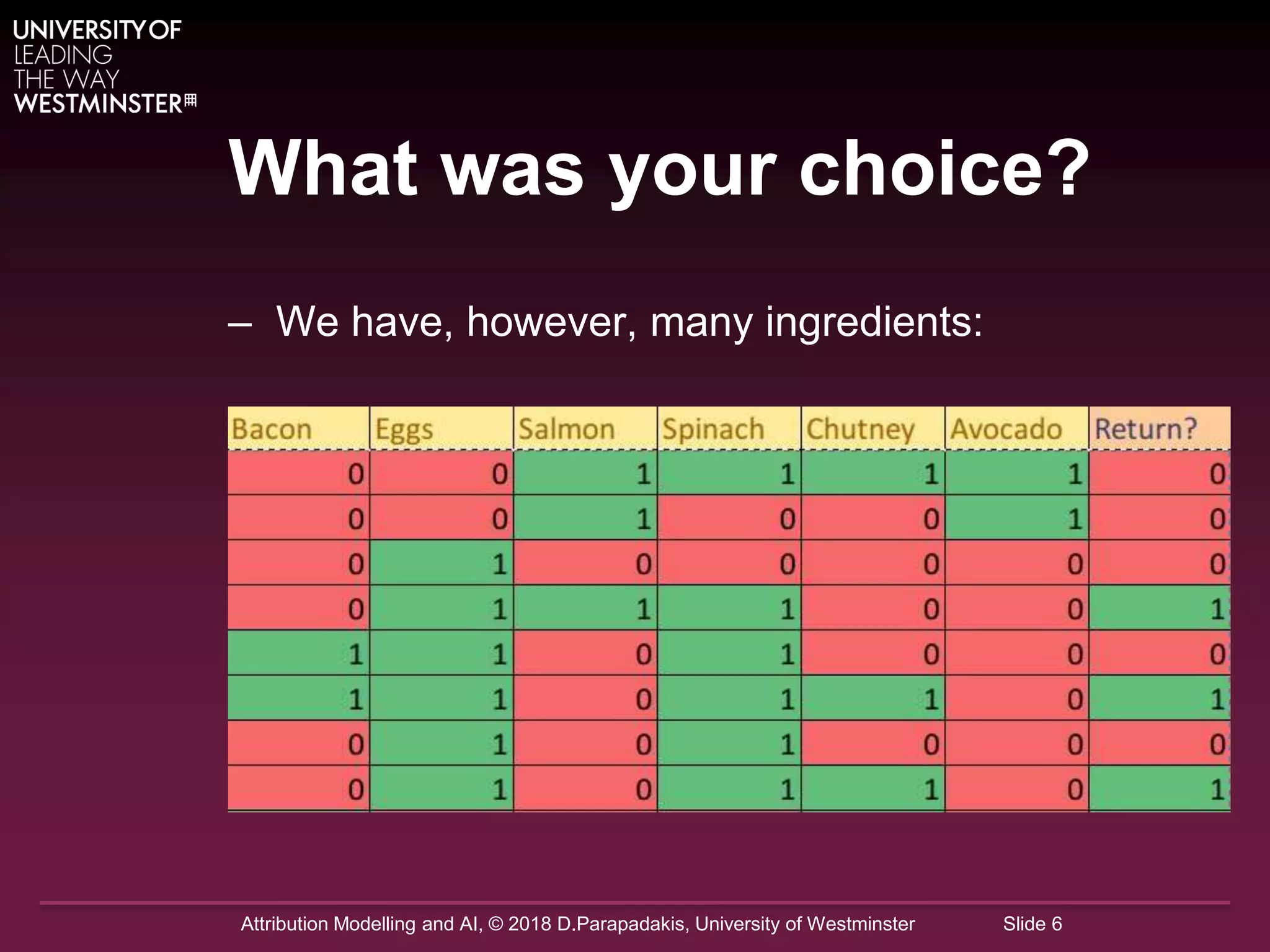
What was your choice?
– We have, however, many ingredients:
Attribution Modelling and AI, © 2018 D.Parapadakis, University of Westminster Slide 7
What was your choice?
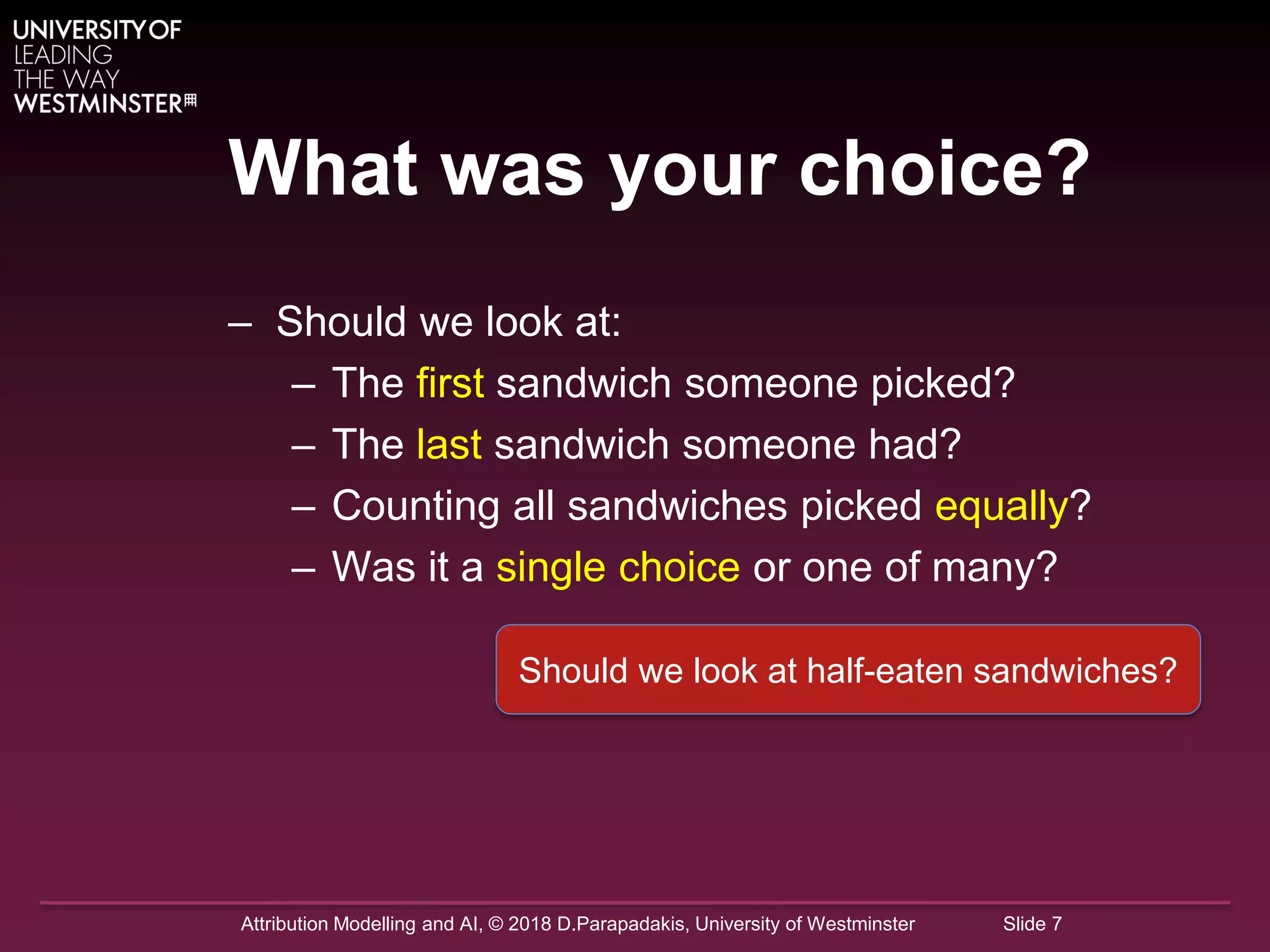
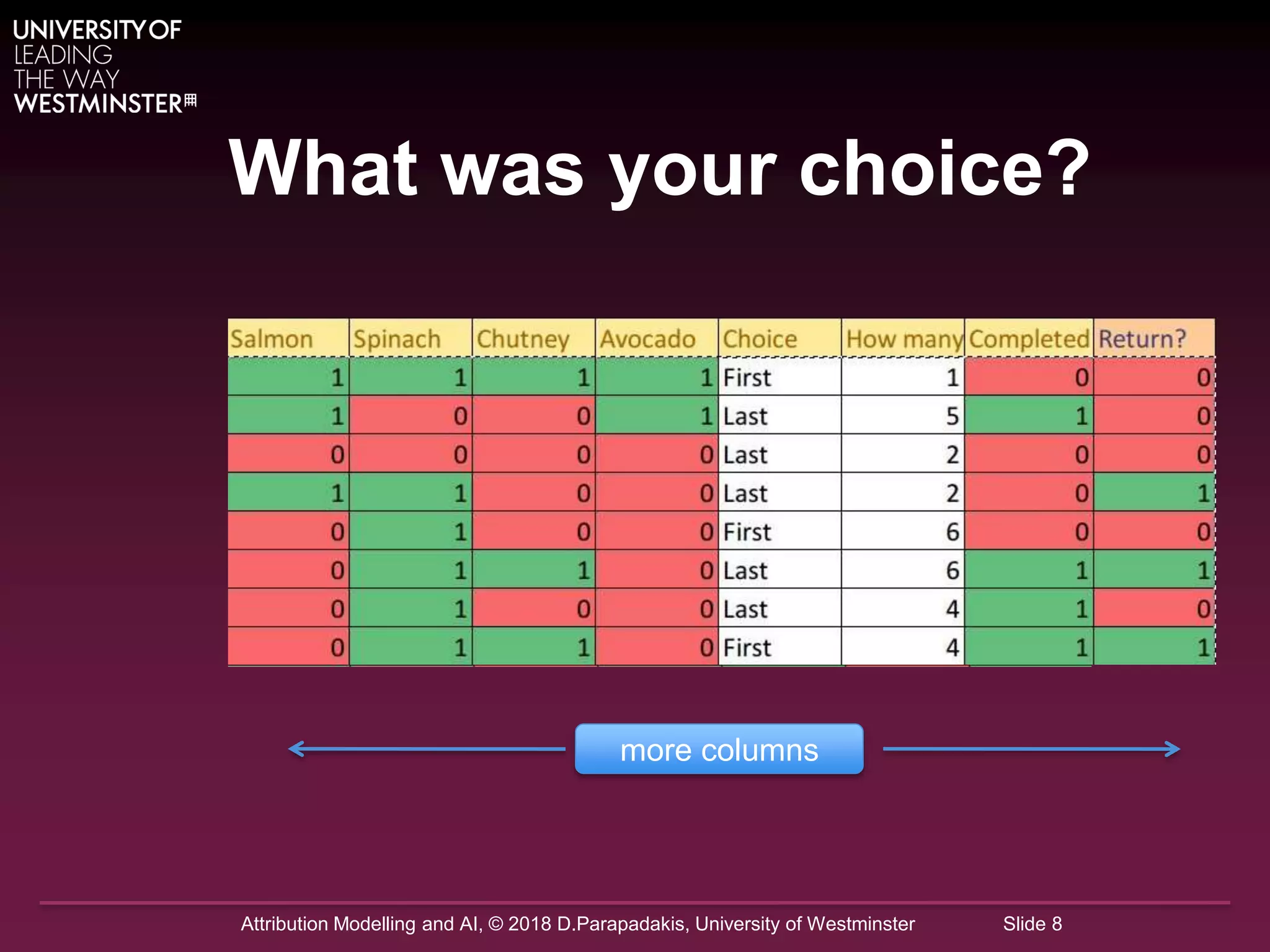
– Should we look at:
– The first sandwich someone picked?
– The last sandwich someone had?
– Counting all sandwiches picked equally?
– Was it a single choice or one of many?
Should we look at half-eaten sandwiches?
Attribution Modelling and AI, © 2018 D.Parapadakis, University of Westminster Slide 8
What was your choice?
more columns
Attribution Modelling and AI, © 2018 D.Parapadakis, University of Westminster Slide 9
What was your choice?
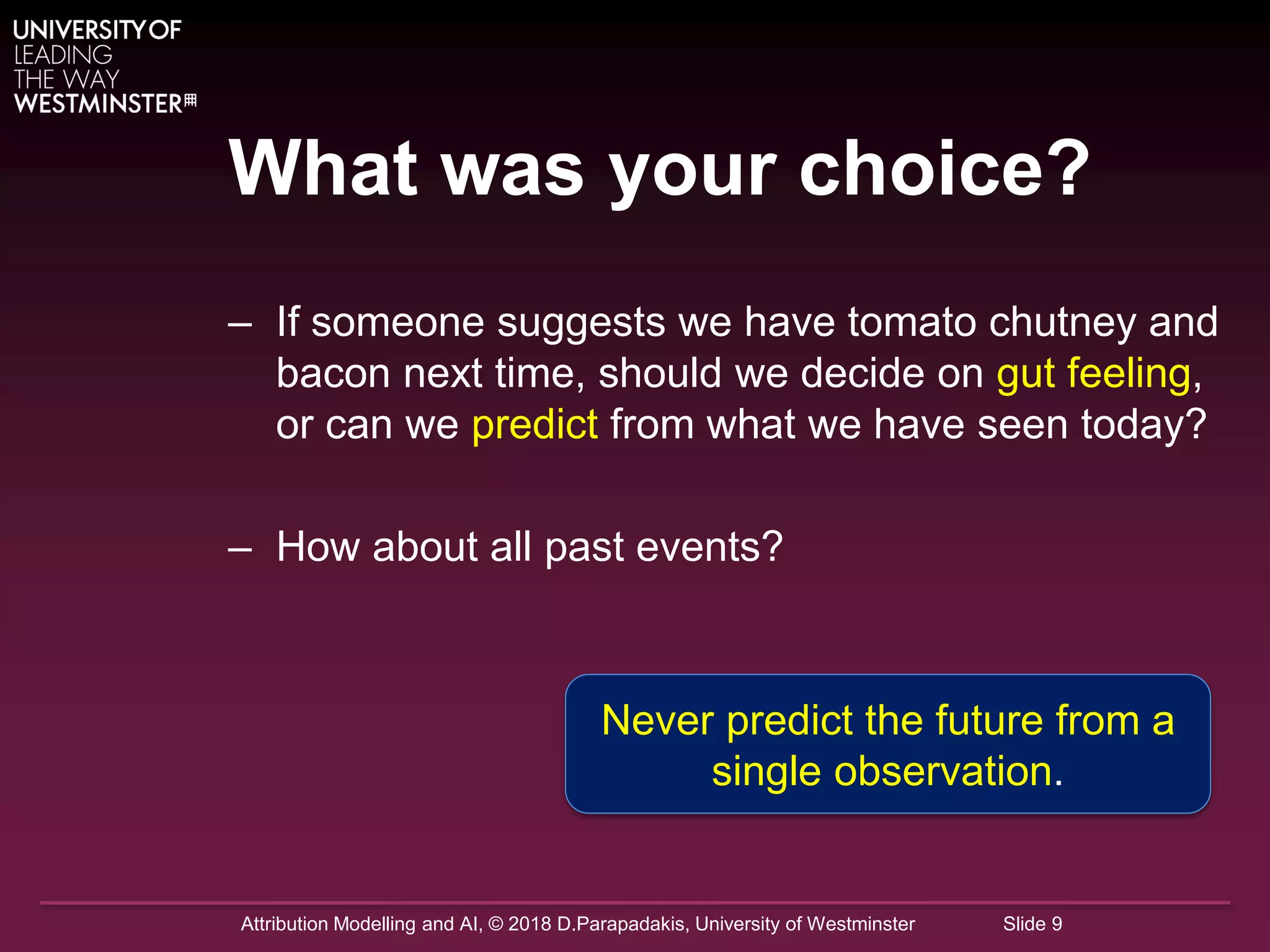
– If someone suggests we have tomato chutney and
bacon next time, should we decide on gut feeling,
or can we predict from what we have seen today?
– How about all past events?
Never predict the future from a
single observation.
Attribution Modelling and AI, © 2018 D.Parapadakis, University of Westminster Slide 10
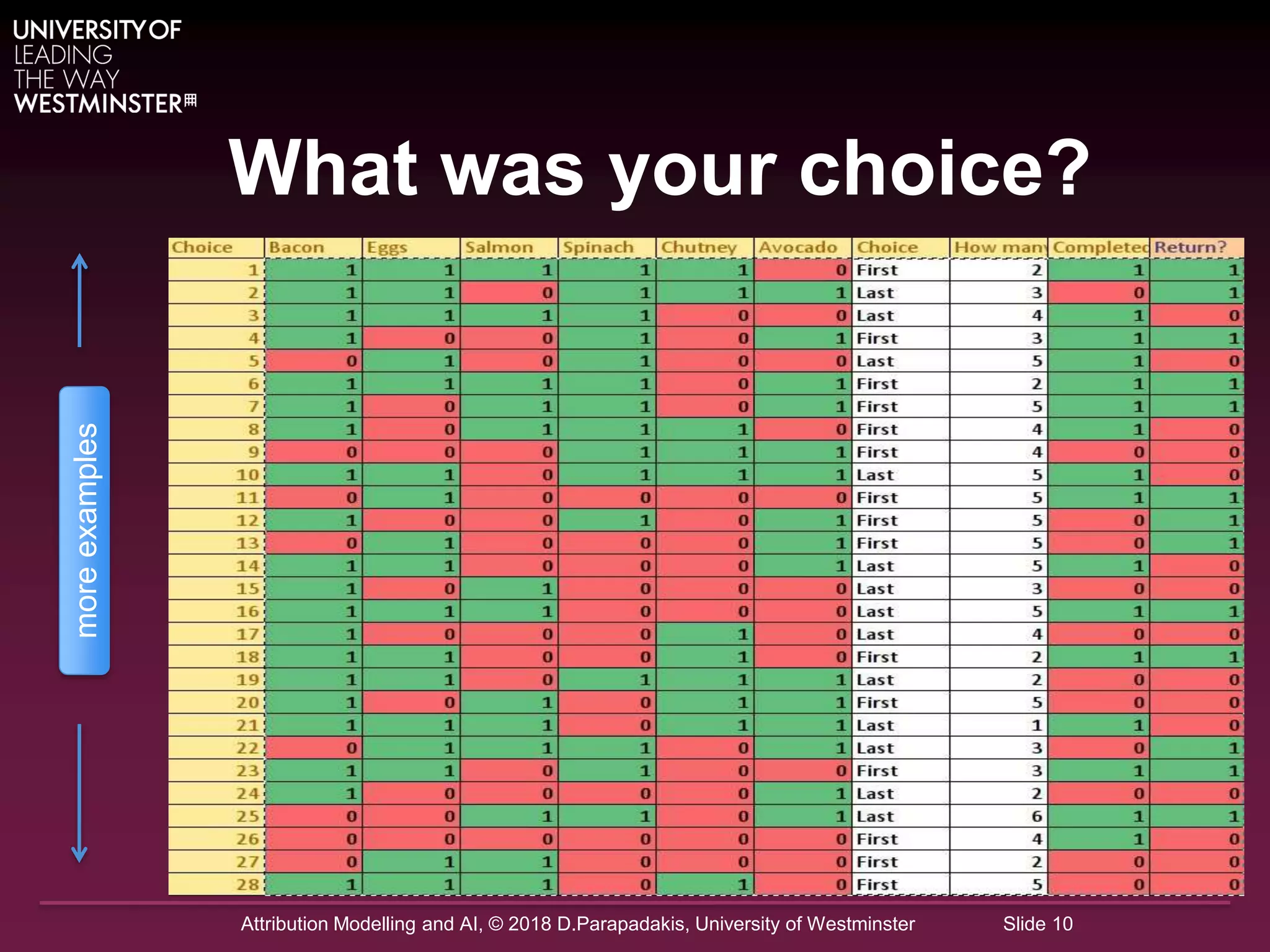
What was your choice?
– C
moreexamples
Attribution Modelling and AI, © 2018 D.Parapadakis, University of Westminster Slide 11
What was your choice?
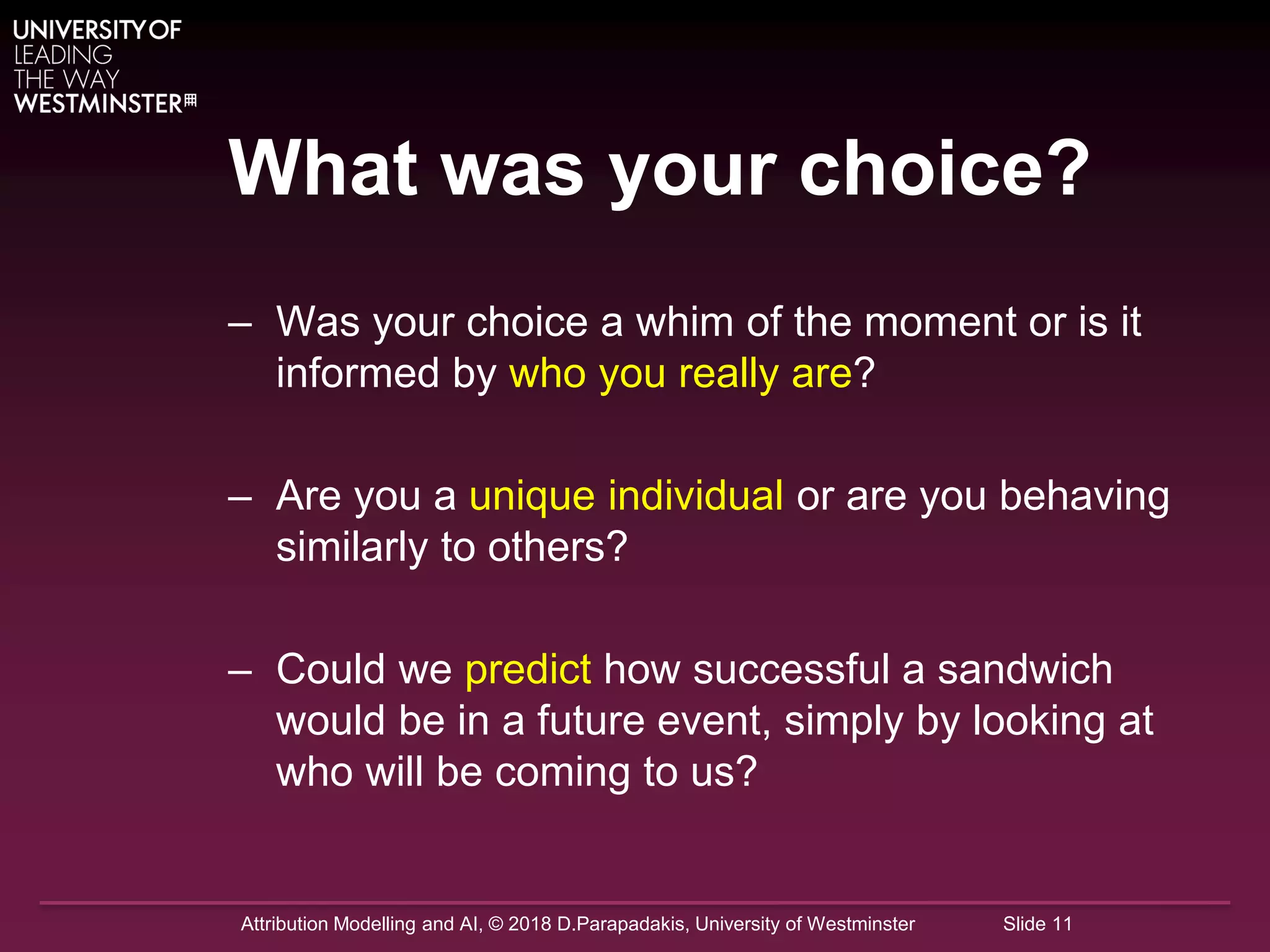
– Was your choice a whim of the moment or is it
informed by who you really are?
– Are you a unique individual or are you behaving
similarly to others?
– Could we predict how successful a sandwich
would be in a future event, simply by looking at
who will be coming to us?
Attribution Modelling and AI, © 2018 D.Parapadakis, University of Westminster Slide 12
What was your choice?
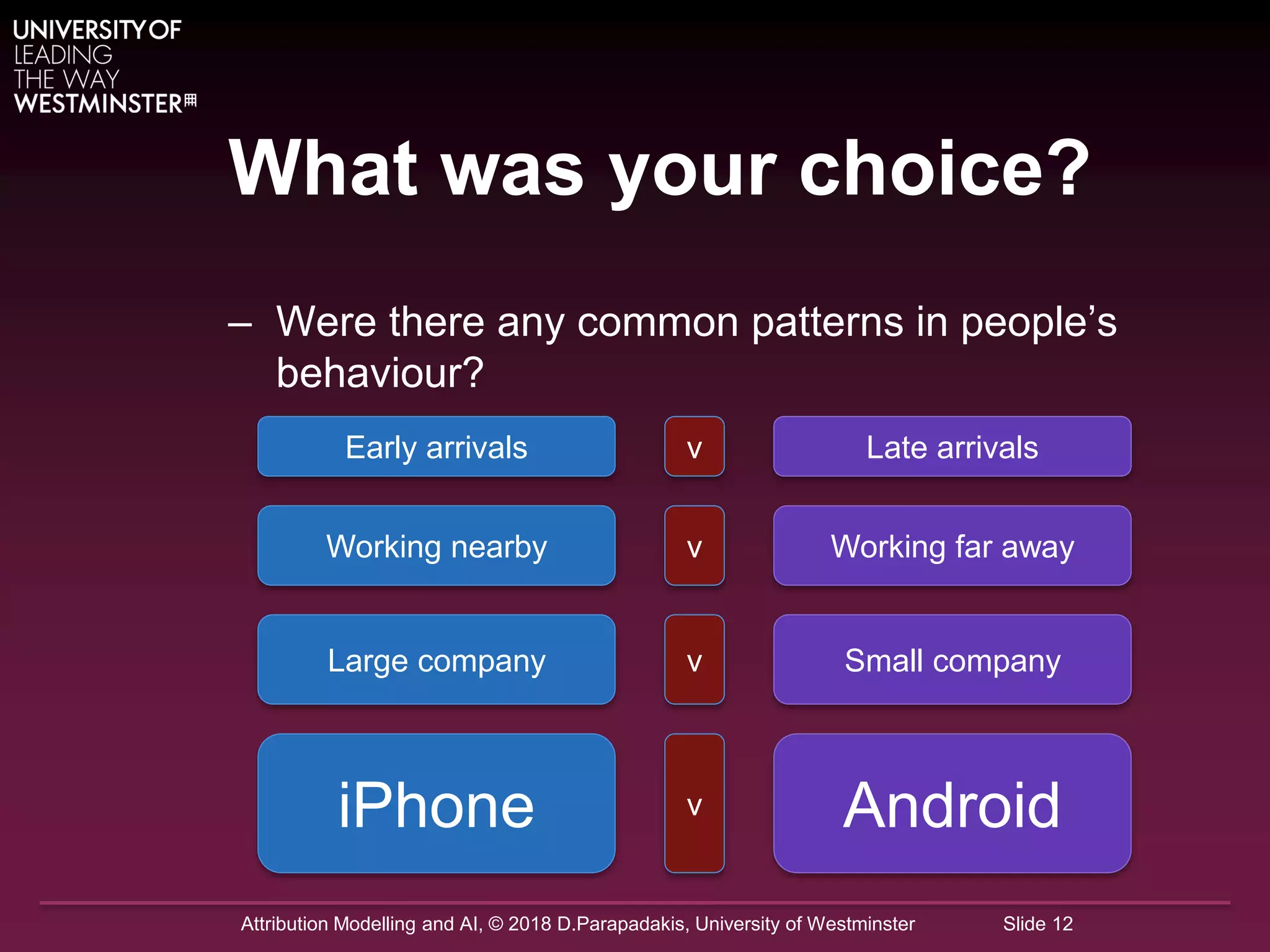
– Were there any common patterns in people’s
behaviour?
Early arrivals Late arrivalsv
Working nearby Working far awayv
Large company Small companyv
iPhone Androidv
Attribution Modelling and AI, © 2018 D.Parapadakis, University of Westminster Slide 13
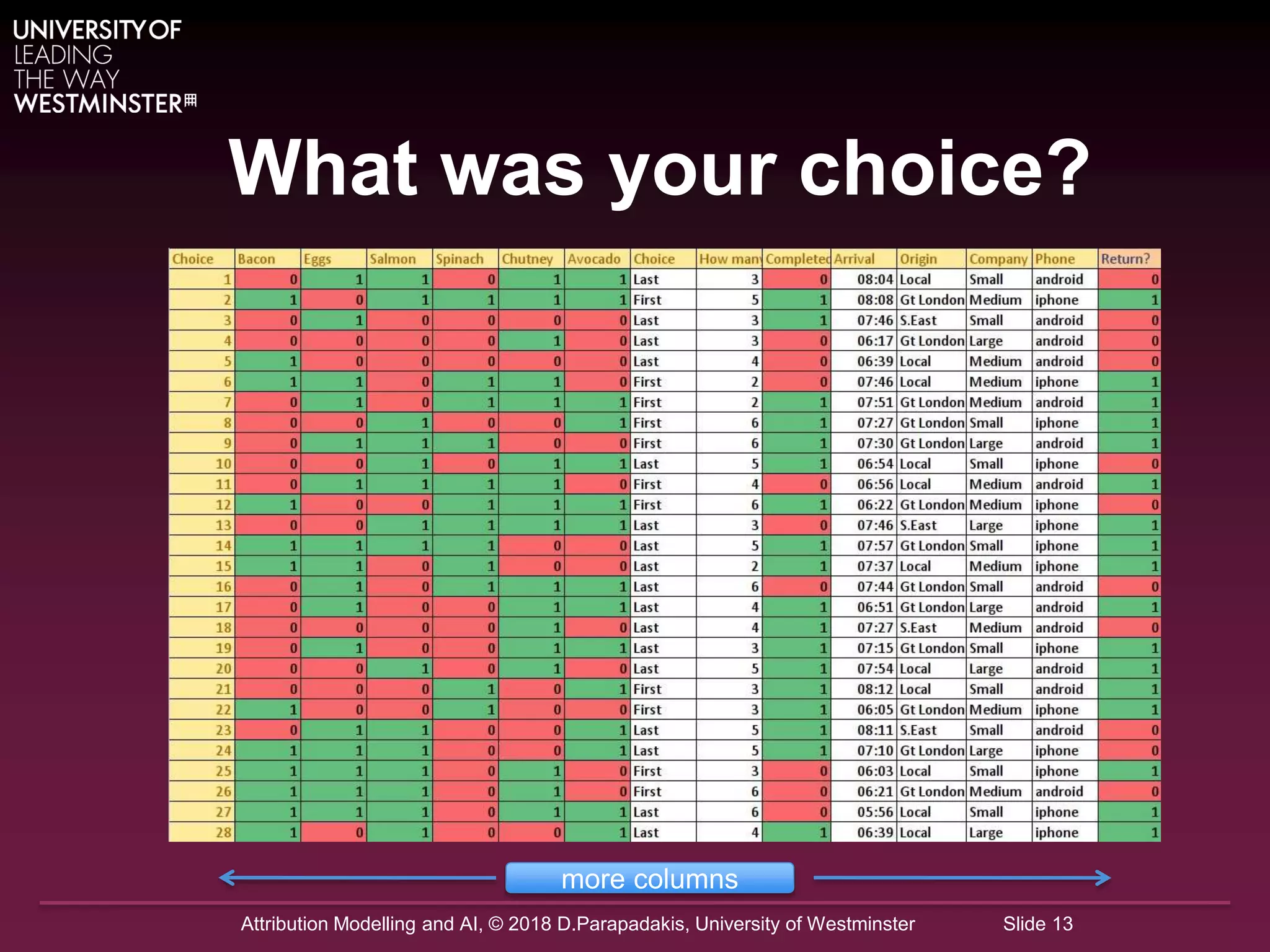
What was your choice?
more columns
Attribution Modelling and AI, © 2018 D.Parapadakis, University of Westminster Slide 14
What was your choice?
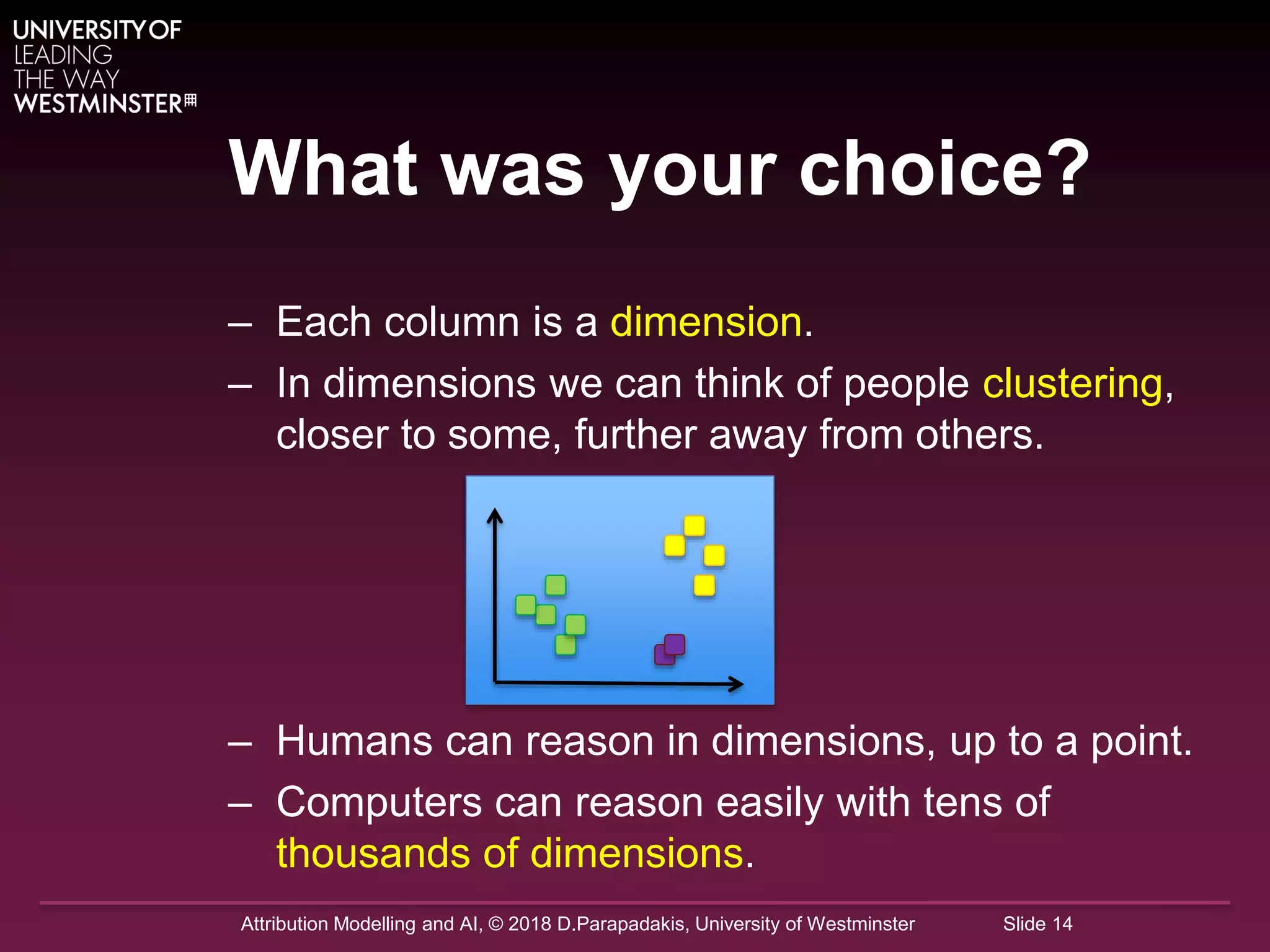
– Each column is a dimension.
– In dimensions we can think of people clustering,
closer to some, further away from others.
– Humans can reason in dimensions, up to a point.
– Computers can reason easily with tens of
thousands of dimensions.
Attribution Modelling and AI, © 2018 D.Parapadakis, University of Westminster Slide 15
Attribution modelling and AI
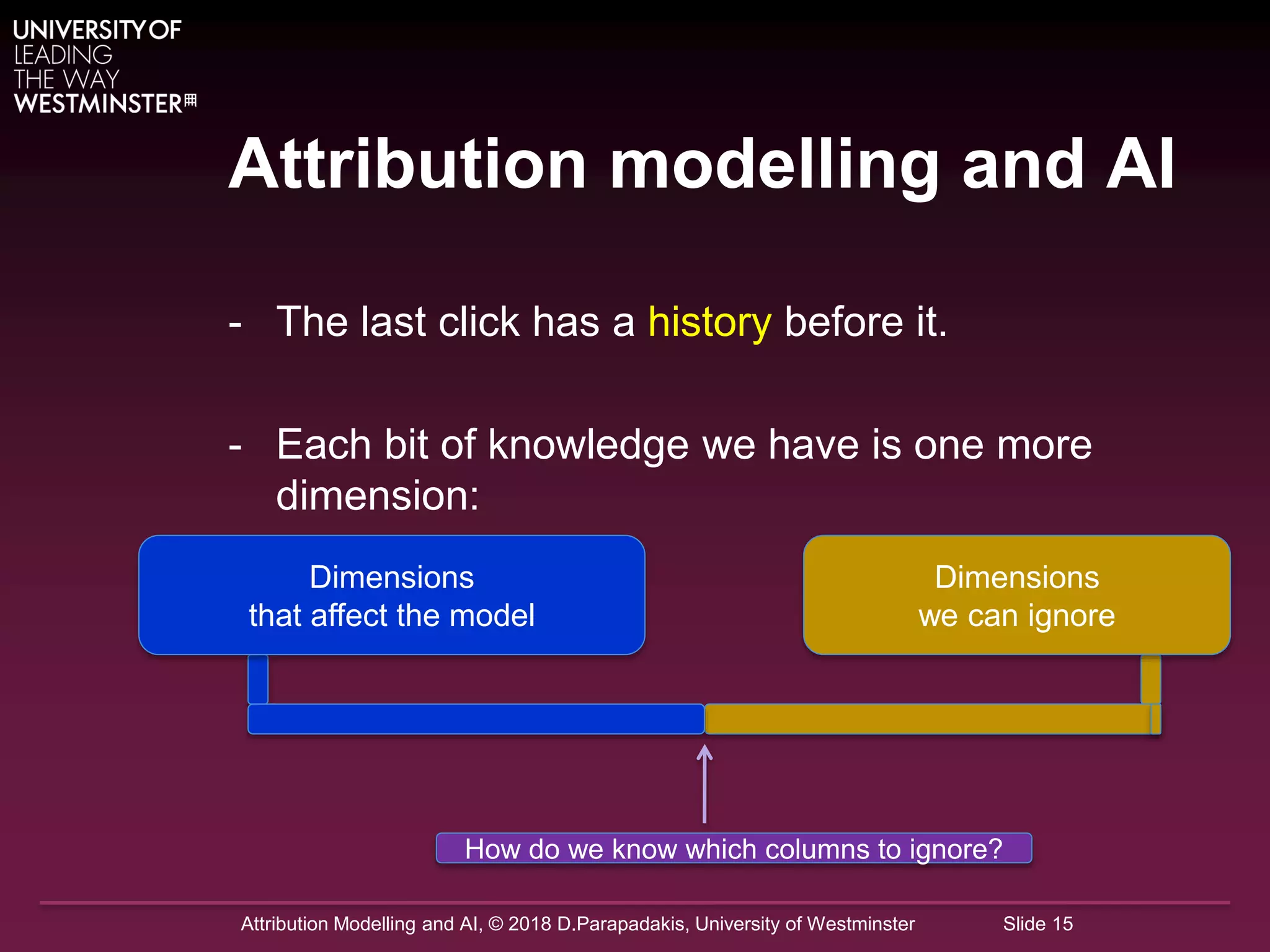
- The last click has a history before it.
- Each bit of knowledge we have is one more
dimension:
Dimensions
that affect the model
Dimensions
we can ignore
How do we know which columns to ignore?
Attribution Modelling and AI, © 2018 D.Parapadakis, University of Westminster Slide 16
Attribution modelling and AI
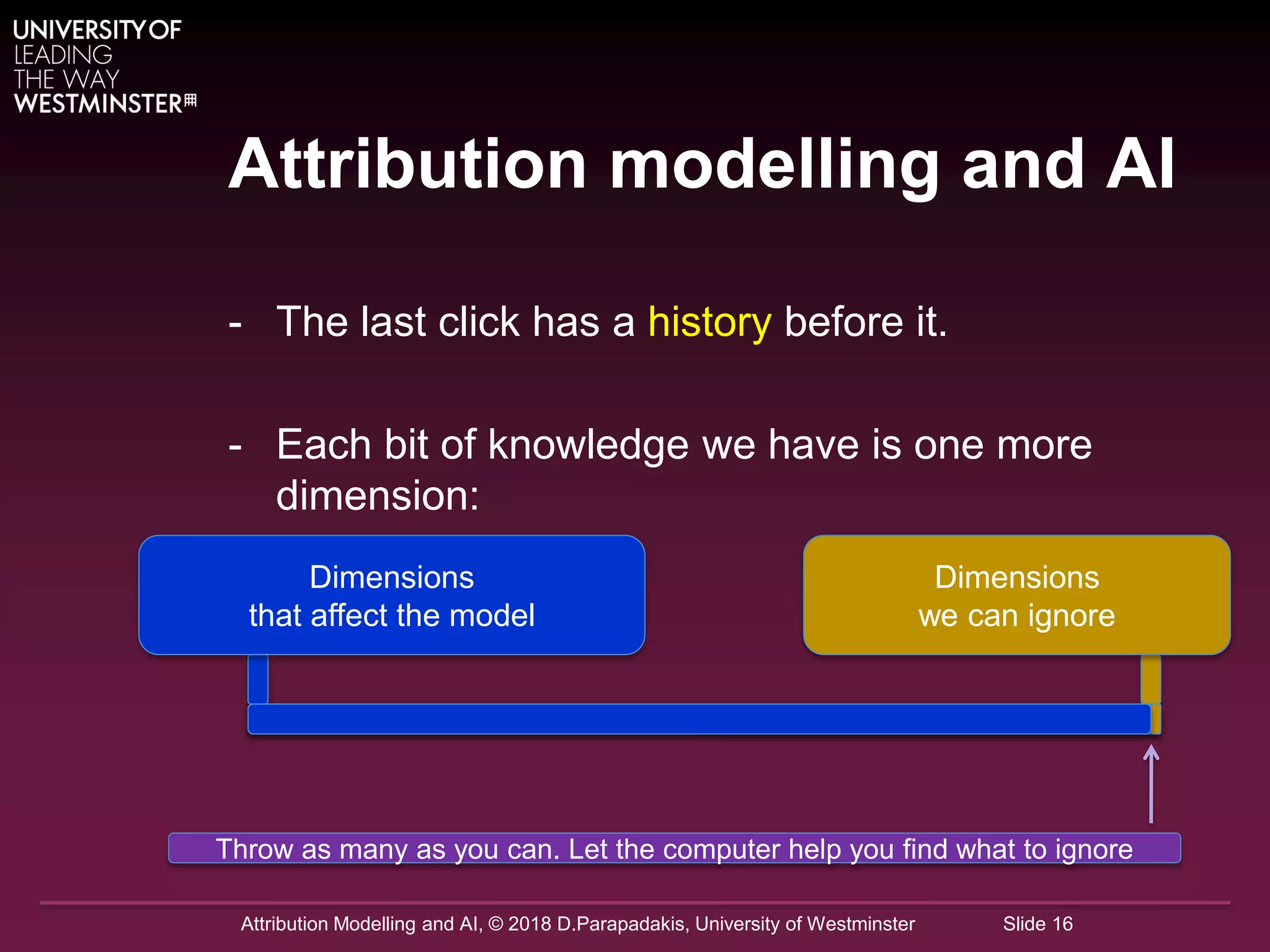
- The last click has a history before it.
- Each bit of knowledge we have is one more
dimension:
Dimensions
that affect the model
Dimensions
we can ignore
Throw as many as you can. Let the computer help you find what to ignore
Attribution Modelling and AI, © 2018 D.Parapadakis, University of Westminster Slide 17
Attribution modelling and AI
Artificial Intelligence: soft AI v hard AI
Machine Learning: find hidden behaviours
find patterns in logs
find rules in data
find order in chaos
Attribution Modelling and AI, © 2018 D.Parapadakis, University of Westminster Slide 18
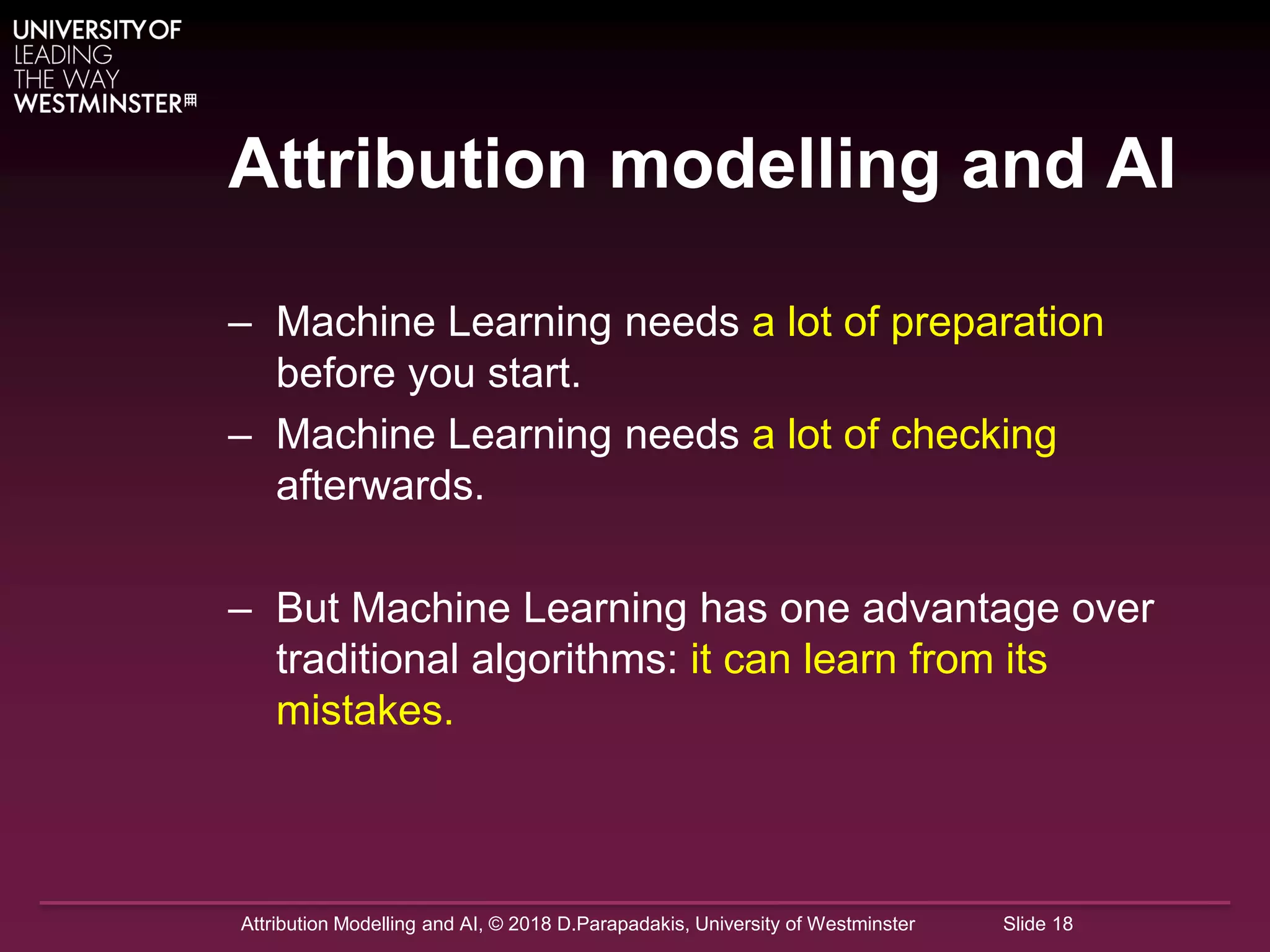
Attribution modelling and AI
– Machine Learning needs a lot of preparation
before you start.
– Machine Learning needs a lot of checking
afterwards.
– But Machine Learning has one advantage over
traditional algorithms: it can learn from its
mistakes.
Attribution Modelling and AI, © 2018 D.Parapadakis, University of Westminster Slide 19
Attribution modelling and AI
Issue 1: Bias
“No, no, only look at THAT part of the
data.
I KNOW where the answers will be.”
Attribution Modelling and AI, © 2018 D.Parapadakis, University of Westminster Slide 20
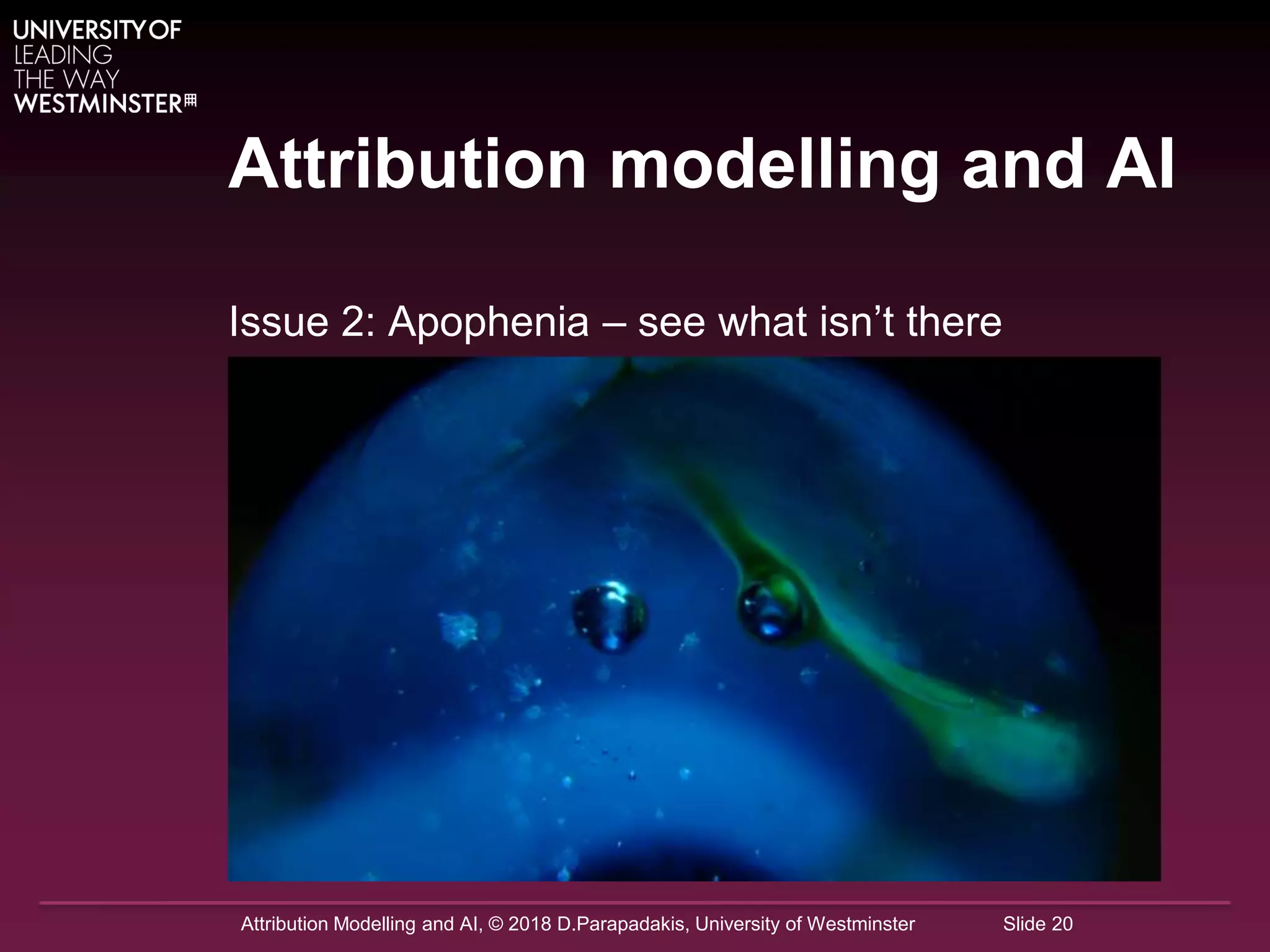
Attribution modelling and AI
Issue 2: Apophenia – see what isn’t there
Attribution Modelling and AI, © 2018 D.Parapadakis, University of Westminster Slide 21
Attribution modelling and AI
Issue 3: Confidence
How confident are we that Machine Learning will give
us the right answer?
How confident do we need to be?
Attribution Modelling and AI, © 2018 D.Parapadakis, University of Westminster Slide 22
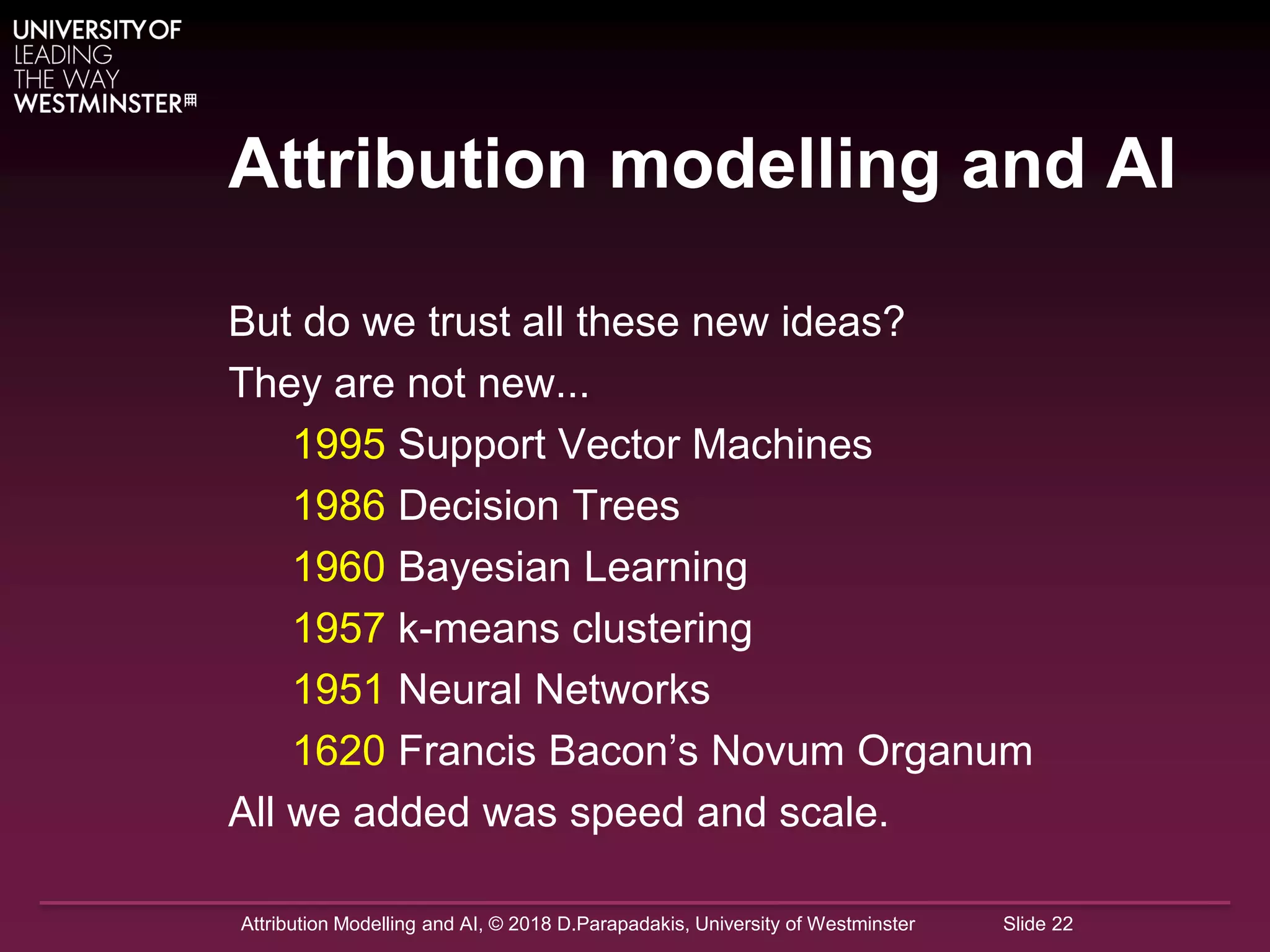
Attribution modelling and AI
But do we trust all these new ideas?
They are not new...
1995 Support Vector Machines
1986 Decision Trees
1960 Bayesian Learning
1957 k-means clustering
1951 Neural Networks
1620 Francis Bacon’s Novum Organum
All we added was speed and scale.
Attribution Modelling and AI, © 2018 D.Parapadakis, University of Westminster Slide 23
Finally…
– Next time you pick a sandwich from a table, check
if someone is keeping notes behind you.
– But if you pick a sandwich online….
THANK YOU
– ANY QUESTIONS?

What can Artificial Intelligence (AI) offer to Attribution Modelling? - Dimitris Parapadakis

  • 2.
    Attribution Modelling &AI, © 2018 Dimitris Parapadakis, University of Westminster Slide 2 Attribution modelling …meets Artificial Intelligence Dimitris Parapadakis
  • 3.
  • 4.
    Attribution Modelling andAI, © 2018 D.Parapadakis, University of Westminster Slide 4 What was your choice? – Which of the sandwiches brought you here today? – Which sandwiches would increase chances of you coming again? Bacon? Scrambled egg? Smoked salmon? Spinach? Tomato chutney? Avocado?
  • 5.
    Attribution Modelling andAI, © 2018 D.Parapadakis, University of Westminster Slide 5 What was your choice? Eggs Spinach0 0 0 0 01 1 1
  • 6.
    Attribution Modelling andAI, © 2018 D.Parapadakis, University of Westminster Slide 6 What was your choice? – We have, however, many ingredients:
  • 7.
    Attribution Modelling andAI, © 2018 D.Parapadakis, University of Westminster Slide 7 What was your choice? – Should we look at: – The first sandwich someone picked? – The last sandwich someone had? – Counting all sandwiches picked equally? – Was it a single choice or one of many? Should we look at half-eaten sandwiches?
  • 8.
    Attribution Modelling andAI, © 2018 D.Parapadakis, University of Westminster Slide 8 What was your choice? more columns
  • 9.
    Attribution Modelling andAI, © 2018 D.Parapadakis, University of Westminster Slide 9 What was your choice? – If someone suggests we have tomato chutney and bacon next time, should we decide on gut feeling, or can we predict from what we have seen today? – How about all past events? Never predict the future from a single observation.
  • 10.
    Attribution Modelling andAI, © 2018 D.Parapadakis, University of Westminster Slide 10 What was your choice? – C moreexamples
  • 11.
    Attribution Modelling andAI, © 2018 D.Parapadakis, University of Westminster Slide 11 What was your choice? – Was your choice a whim of the moment or is it informed by who you really are? – Are you a unique individual or are you behaving similarly to others? – Could we predict how successful a sandwich would be in a future event, simply by looking at who will be coming to us?
  • 12.
    Attribution Modelling andAI, © 2018 D.Parapadakis, University of Westminster Slide 12 What was your choice? – Were there any common patterns in people’s behaviour? Early arrivals Late arrivalsv Working nearby Working far awayv Large company Small companyv iPhone Androidv
  • 13.
    Attribution Modelling andAI, © 2018 D.Parapadakis, University of Westminster Slide 13 What was your choice? more columns
  • 14.
    Attribution Modelling andAI, © 2018 D.Parapadakis, University of Westminster Slide 14 What was your choice? – Each column is a dimension. – In dimensions we can think of people clustering, closer to some, further away from others. – Humans can reason in dimensions, up to a point. – Computers can reason easily with tens of thousands of dimensions.
  • 15.
    Attribution Modelling andAI, © 2018 D.Parapadakis, University of Westminster Slide 15 Attribution modelling and AI - The last click has a history before it. - Each bit of knowledge we have is one more dimension: Dimensions that affect the model Dimensions we can ignore How do we know which columns to ignore?
  • 16.
    Attribution Modelling andAI, © 2018 D.Parapadakis, University of Westminster Slide 16 Attribution modelling and AI - The last click has a history before it. - Each bit of knowledge we have is one more dimension: Dimensions that affect the model Dimensions we can ignore Throw as many as you can. Let the computer help you find what to ignore
  • 17.
    Attribution Modelling andAI, © 2018 D.Parapadakis, University of Westminster Slide 17 Attribution modelling and AI Artificial Intelligence: soft AI v hard AI Machine Learning: find hidden behaviours find patterns in logs find rules in data find order in chaos
  • 18.
    Attribution Modelling andAI, © 2018 D.Parapadakis, University of Westminster Slide 18 Attribution modelling and AI – Machine Learning needs a lot of preparation before you start. – Machine Learning needs a lot of checking afterwards. – But Machine Learning has one advantage over traditional algorithms: it can learn from its mistakes.
  • 19.
    Attribution Modelling andAI, © 2018 D.Parapadakis, University of Westminster Slide 19 Attribution modelling and AI Issue 1: Bias “No, no, only look at THAT part of the data. I KNOW where the answers will be.”
  • 20.
    Attribution Modelling andAI, © 2018 D.Parapadakis, University of Westminster Slide 20 Attribution modelling and AI Issue 2: Apophenia – see what isn’t there
  • 21.
    Attribution Modelling andAI, © 2018 D.Parapadakis, University of Westminster Slide 21 Attribution modelling and AI Issue 3: Confidence How confident are we that Machine Learning will give us the right answer? How confident do we need to be?
  • 22.
    Attribution Modelling andAI, © 2018 D.Parapadakis, University of Westminster Slide 22 Attribution modelling and AI But do we trust all these new ideas? They are not new... 1995 Support Vector Machines 1986 Decision Trees 1960 Bayesian Learning 1957 k-means clustering 1951 Neural Networks 1620 Francis Bacon’s Novum Organum All we added was speed and scale.
  • 23.
    Attribution Modelling andAI, © 2018 D.Parapadakis, University of Westminster Slide 23 Finally… – Next time you pick a sandwich from a table, check if someone is keeping notes behind you. – But if you pick a sandwich online….
  • 24.