Exploring Artificial
Intelligence: Concepts,
Applications, and
Future Prospects
Use these slides as a starting point for
customizing your presentation.
Open the Plus add-on for more options.
Learn more about Plus.
Plus tip:
December 15, 2023
• Introduction to Artificial Intelligence
• Core Concepts of Artificial Intelligence
• Applications of Artificial Intelligence
• Latest Trends in Different Domains
• Challenges and Ethical Considerations
• Future Outlook
• Conclusion
• Definition of Artificial Intelligence (AI)
• Importance of AI
• AI in Everyday Life
Agenda
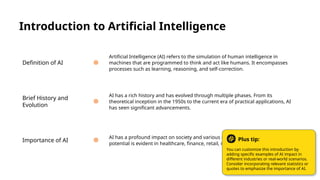
Introduction to Artificial Intelligence
Artificial Intelligence (AI) refers to the simulation of human intelligence in
machines that are programmed to think and act like humans. It encompasses
processes such as learning, reasoning, and self-correction.
AI has a rich history and has evolved through multiple phases. From its
theoretical inception in the 1950s to the current era of practical applications, AI
has seen significant advancements.
Definition of AI
Brief History and
Evolution
Importance of AI
AI has a profound impact on society and various industries. Its transformative
potential is evident in healthcare, finance, retail, manufacturing, and more.
You can customize this introduction by
adding specific examples of AI impact in
different industries or real-world scenarios.
Consider incorporating relevant statistics or
quotes to emphasize the importance of AI.
Plus tip:
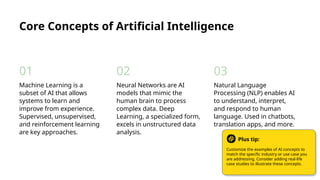
Natural Language
Processing (NLP) enables AI
to understand, interpret,
and respond to human
language. Used in chatbots,
translation apps, and more.
Neural Networks are AI
models that mimic the
human brain to process
complex data. Deep
Learning, a specialized form,
excels in unstructured data
analysis.
Machine Learning is a
subset of AI that allows
systems to learn and
improve from experience.
Supervised, unsupervised,
and reinforcement learning
are key approaches.
Core Concepts of Artificial Intelligence
Customize the examples of AI concepts to
match the specific industry or use case you
are addressing. Consider adding real-life
case studies to illustrate these concepts.
Plus tip:
02 03
01
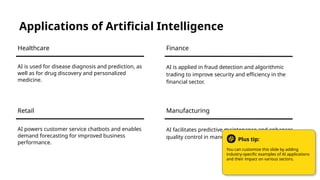
AI powers customer service chatbots and enables
demand forecasting for improved business
performance.
Retail Manufacturing
AI facilitates predictive maintenance and enhances
quality control in manufacturing processes.
AI is used for disease diagnosis and prediction, as
well as for drug discovery and personalized
medicine.
Healthcare Finance
AI is applied in fraud detection and algorithmic
trading to improve security and efficiency in the
financial sector.
Applications of Artificial Intelligence
You can customize this slide by adding
industry-specific examples of AI applications
and their impact on various sectors.
Plus tip:
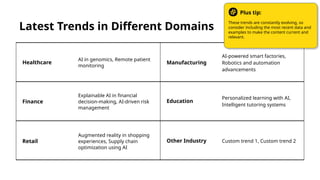
Latest Trends in Different Domains
AI in genomics, Remote patient
monitoring
Explainable AI in financial
decision-making, AI-driven risk
management
Healthcare
Finance
Retail
Augmented reality in shopping
experiences, Supply chain
optimization using AI
AI-powered smart factories,
Robotics and automation
advancements
Personalized learning with AI,
Intelligent tutoring systems
Manufacturing
Education
Other Industry Custom trend 1, Custom trend 2
These trends are constantly evolving, so
consider including the most recent data and
examples to make the content current and
relevant.
Plus tip:
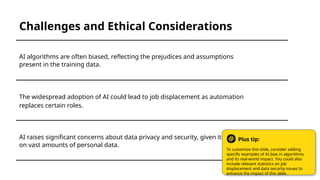
AI raises significant concerns about data privacy and security, given its reliance
on vast amounts of personal data.
The widespread adoption of AI could lead to job displacement as automation
replaces certain roles.
AI algorithms are often biased, reflecting the prejudices and assumptions
present in the training data.
Challenges and Ethical Considerations
To customize this slide, consider adding
specific examples of AI bias in algorithms
and its real-world impact. You could also
include relevant statistics on job
displacement and data security issues to
enhance the impact of this slide.
Plus tip:
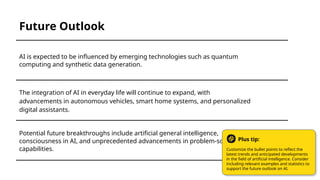
Potential future breakthroughs include artificial general intelligence,
consciousness in AI, and unprecedented advancements in problem-solving
capabilities.
The integration of AI in everyday life will continue to expand, with
advancements in autonomous vehicles, smart home systems, and personalized
digital assistants.
AI is expected to be influenced by emerging technologies such as quantum
computing and synthetic data generation.
Future Outlook
Customize the bullet points to reflect the
latest trends and anticipated developments
in the field of artificial intelligence. Consider
including relevant examples and statistics to
support the future outlook on AI.
Plus tip:
Closing statement highlighting the transformative potential of AI and expressing
optimism about the future advancements.
Encouragement for the audience to further explore and learn about artificial intelligence
and its applications in various domains.
Recap of the key points discussed throughout the presentation, emphasizing the
importance and impact of artificial intelligence.
Conclusion
Customize the recap of key points based on
the content of your presentation. Encourage
the audience to engage in discussions about
AI and its impact after the presentation. End
with a positive and forward-looking
statement about the future of AI.
Plus tip:
Definition of Artificial Intelligence (AI)
● Artificial Intelligence, or AI, refers to the
simulation of human intelligence in machines
that are programmed to think and act like
humans.
● It encompasses a broad range of techniques that
enable computers to perform tasks that typically
require human intelligence.
● AI has evolved over time, with its roots in early
computing and mathematical theory.
● Recent advancements in AI have been fueled by
increases in data volumes, advanced algorithms,
and improvements in computing power.
What is AI? Evolution
Include examples of AI applications to
illustrate the definition and evolution of AI
for a comprehensive understanding.
Plus tip:
Importance of AI
● Discuss how AI has impacted various aspects of
society, such as healthcare, transportation, and
communication.
● Highlight specific examples of AI applications and
their social impact.
● Provide examples of industries that have been
significantly impacted by AI, such as healthcare,
finance, and retail.
● Discuss how AI has transformed processes and
business models in these industries.
Impact on Society Transformative Potential in Industries
Customize the examples of AI impact on
industries to suit the specific focus of your
presentation. You can also add local
examples of AI impact on society.
Plus tip:
AI in Everyday Life
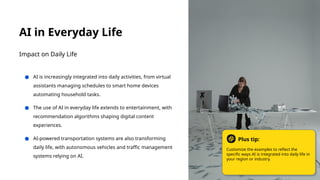
● AI is increasingly integrated into daily activities, from virtual
assistants managing schedules to smart home devices
automating household tasks.
● The use of AI in everyday life extends to entertainment, with
recommendation algorithms shaping digital content
experiences.
● AI-powered transportation systems are also transforming
daily life, with autonomous vehicles and traffic management
systems relying on AI.
Impact on Daily Life
Customize the examples to reflect the
specific ways AI is integrated into daily life in
your region or industry.
Plus tip:
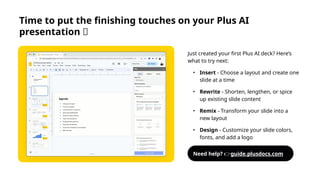
Time to put the finishing touches on your Plus AI
presentation ✨
Just created your first Plus AI deck? Here’s
what to try next:
• Insert - Choose a layout and create one
slide at a time
• Rewrite - Shorten, lengthen, or spice
up existing slide content
• Remix - Transform your slide into a
new layout
• Design - Customize your slide colors,
fonts, and add a logo
Need help? 👉guide.plusdocs.com

Artificial_intelligence_Introduction.pptx

  • 1.
    Exploring Artificial Intelligence: Concepts, Applications,and Future Prospects Use these slides as a starting point for customizing your presentation. Open the Plus add-on for more options. Learn more about Plus. Plus tip: December 15, 2023
  • 2.
    • Introduction toArtificial Intelligence • Core Concepts of Artificial Intelligence • Applications of Artificial Intelligence • Latest Trends in Different Domains • Challenges and Ethical Considerations • Future Outlook • Conclusion • Definition of Artificial Intelligence (AI) • Importance of AI • AI in Everyday Life Agenda
  • 3.
    Introduction to ArtificialIntelligence Artificial Intelligence (AI) refers to the simulation of human intelligence in machines that are programmed to think and act like humans. It encompasses processes such as learning, reasoning, and self-correction. AI has a rich history and has evolved through multiple phases. From its theoretical inception in the 1950s to the current era of practical applications, AI has seen significant advancements. Definition of AI Brief History and Evolution Importance of AI AI has a profound impact on society and various industries. Its transformative potential is evident in healthcare, finance, retail, manufacturing, and more. You can customize this introduction by adding specific examples of AI impact in different industries or real-world scenarios. Consider incorporating relevant statistics or quotes to emphasize the importance of AI. Plus tip:
  • 4.
    Natural Language Processing (NLP)enables AI to understand, interpret, and respond to human language. Used in chatbots, translation apps, and more. Neural Networks are AI models that mimic the human brain to process complex data. Deep Learning, a specialized form, excels in unstructured data analysis. Machine Learning is a subset of AI that allows systems to learn and improve from experience. Supervised, unsupervised, and reinforcement learning are key approaches. Core Concepts of Artificial Intelligence Customize the examples of AI concepts to match the specific industry or use case you are addressing. Consider adding real-life case studies to illustrate these concepts. Plus tip: 02 03 01
  • 5.
    AI powers customerservice chatbots and enables demand forecasting for improved business performance. Retail Manufacturing AI facilitates predictive maintenance and enhances quality control in manufacturing processes. AI is used for disease diagnosis and prediction, as well as for drug discovery and personalized medicine. Healthcare Finance AI is applied in fraud detection and algorithmic trading to improve security and efficiency in the financial sector. Applications of Artificial Intelligence You can customize this slide by adding industry-specific examples of AI applications and their impact on various sectors. Plus tip:
  • 6.
    Latest Trends inDifferent Domains AI in genomics, Remote patient monitoring Explainable AI in financial decision-making, AI-driven risk management Healthcare Finance Retail Augmented reality in shopping experiences, Supply chain optimization using AI AI-powered smart factories, Robotics and automation advancements Personalized learning with AI, Intelligent tutoring systems Manufacturing Education Other Industry Custom trend 1, Custom trend 2 These trends are constantly evolving, so consider including the most recent data and examples to make the content current and relevant. Plus tip:
  • 7.
    AI raises significantconcerns about data privacy and security, given its reliance on vast amounts of personal data. The widespread adoption of AI could lead to job displacement as automation replaces certain roles. AI algorithms are often biased, reflecting the prejudices and assumptions present in the training data. Challenges and Ethical Considerations To customize this slide, consider adding specific examples of AI bias in algorithms and its real-world impact. You could also include relevant statistics on job displacement and data security issues to enhance the impact of this slide. Plus tip:
  • 8.
    Potential future breakthroughsinclude artificial general intelligence, consciousness in AI, and unprecedented advancements in problem-solving capabilities. The integration of AI in everyday life will continue to expand, with advancements in autonomous vehicles, smart home systems, and personalized digital assistants. AI is expected to be influenced by emerging technologies such as quantum computing and synthetic data generation. Future Outlook Customize the bullet points to reflect the latest trends and anticipated developments in the field of artificial intelligence. Consider including relevant examples and statistics to support the future outlook on AI. Plus tip:
  • 9.
    Closing statement highlightingthe transformative potential of AI and expressing optimism about the future advancements. Encouragement for the audience to further explore and learn about artificial intelligence and its applications in various domains. Recap of the key points discussed throughout the presentation, emphasizing the importance and impact of artificial intelligence. Conclusion Customize the recap of key points based on the content of your presentation. Encourage the audience to engage in discussions about AI and its impact after the presentation. End with a positive and forward-looking statement about the future of AI. Plus tip:
  • 10.
    Definition of ArtificialIntelligence (AI) ● Artificial Intelligence, or AI, refers to the simulation of human intelligence in machines that are programmed to think and act like humans. ● It encompasses a broad range of techniques that enable computers to perform tasks that typically require human intelligence. ● AI has evolved over time, with its roots in early computing and mathematical theory. ● Recent advancements in AI have been fueled by increases in data volumes, advanced algorithms, and improvements in computing power. What is AI? Evolution Include examples of AI applications to illustrate the definition and evolution of AI for a comprehensive understanding. Plus tip:
  • 11.
    Importance of AI ●Discuss how AI has impacted various aspects of society, such as healthcare, transportation, and communication. ● Highlight specific examples of AI applications and their social impact. ● Provide examples of industries that have been significantly impacted by AI, such as healthcare, finance, and retail. ● Discuss how AI has transformed processes and business models in these industries. Impact on Society Transformative Potential in Industries Customize the examples of AI impact on industries to suit the specific focus of your presentation. You can also add local examples of AI impact on society. Plus tip:
  • 12.
    AI in EverydayLife ● AI is increasingly integrated into daily activities, from virtual assistants managing schedules to smart home devices automating household tasks. ● The use of AI in everyday life extends to entertainment, with recommendation algorithms shaping digital content experiences. ● AI-powered transportation systems are also transforming daily life, with autonomous vehicles and traffic management systems relying on AI. Impact on Daily Life Customize the examples to reflect the specific ways AI is integrated into daily life in your region or industry. Plus tip:
  • 13.
    Time to putthe finishing touches on your Plus AI presentation ✨ Just created your first Plus AI deck? Here’s what to try next: • Insert - Choose a layout and create one slide at a time • Rewrite - Shorten, lengthen, or spice up existing slide content • Remix - Transform your slide into a new layout • Design - Customize your slide colors, fonts, and add a logo Need help? 👉guide.plusdocs.com