TYPES OF CLOUDS
Presented By: Babita Radwal
Assistant Professor, USCS
Uttaranchal University
PUBLIC CLOUD
• Public Cloud provides a shared platform that is accessible to the general
public through an Internet connection.
• Public cloud operated on the pay-as-per-use model and administrated by the third
party, i.e., Cloud service provider.
• In the Public cloud, the same storage is being used by multiple users at the same
time.
• Public cloud is owned, managed, and operated by businesses, universities,
government organizations, or a combination of them.
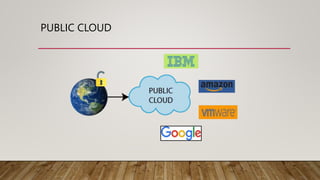
• Amazon Elastic Compute Cloud (EC2), Microsoft Azure, IBM's Blue Cloud, Sun Cloud,
and Google Cloud are examples of the public cloud.
PUBLIC CLOUD
ADVANTAGES OF PUBLIC CLOUD
• Low Cost: Public cloud has a lower cost than private, or hybrid cloud, as
it shares the same resources with a large number of consumers.
• Location Independent: Public cloud is location independent because its
services are offered through the internet.
• Save Time: In Public cloud, the cloud service provider is responsible for
the manage and maintain data centers in which data is stored, so the
cloud user can save their time to establish connectivity, deploying new
products, release product updates, configure, and assemble servers.
ADVANTAGES OF PUBLIC CLOUD
• Quickly and easily set up: Organizations can easily buy public cloud on
the internet and deployed and configured it remotely through the cloud
service provider within a few hours.
• Business Agility: Public cloud provides an ability to elastically re-size
computer resources based on the organization's requirements.
• Scalability and reliability: Public cloud offers scalable (easy to add and
remove) and reliable (24*7 available) services to the users at an affordable
cost.
DISADVANTAGES OF PUBLIC CLOUD
• Low Security: Public Cloud is less secure because resources are shared
publicly.
• Performance: In the public cloud, performance depends upon the speed
of internet connectivity.
• Less customizable: Public cloud is less customizable than the private
cloud.
PRIVATE CLOUD
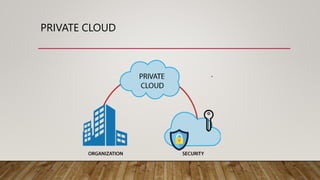
• Private cloud is also known as an internal cloud or corporate cloud.
• Private cloud provides computing services to a private internal network (within
the organization) and selected users instead of the general public.
• Private cloud provides a high level of security and privacy to data through
firewalls and internal hosting. It also ensures that operational and sensitive data
are not accessible to third-party providers.
• HP Data Centers, Microsoft, Elastra-private cloud, and Ubuntu are the example of
a private cloud.
PRIVATE CLOUD
ADVANTAGES OF PRIVATE CLOUD
• More Control: Private clouds have more control over their resources and
hardware than public clouds because it is only accessed by selected users.
• Security & privacy: Security & privacy are one of the big advantages of
cloud computing. Private cloud improved the security level as compared
to the public cloud.
• Improved performance: Private cloud offers better performance with
improved speed and space capacity.
DISADVANTAGES OF PRIVATE CLOUD
• High cost: The cost is higher than a public cloud because set up and
maintain hardware resources are costly.
• Restricted area of operations: As we know, private cloud is accessible
within the organization, so the area of operations is limited.
• Limited scalability: Private clouds are scaled only within the capacity of
internal hosted resources.
• Skilled people: Skilled people are required to manage and operate cloud
services.
HYBRID CLOUD
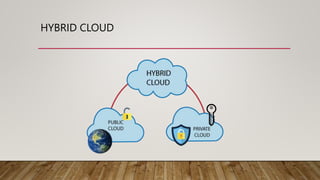
• Hybrid cloud is a combination of public and private clouds.
Hybrid cloud = public cloud + private cloud
• The main aim to combine these cloud (Public and Private) is to create a
unified, automated, and well-managed computing environment.
• In the Hybrid cloud, non-critical activities are performed by the public
cloud and critical activities are performed by the private cloud.
• Mainly, a hybrid cloud is used in finance, healthcare, and Universities.
• The best hybrid cloud provider companies are Amazon, Microsoft, Google,
Cisco, and NetApp.
HYBRID CLOUD
ADVANTAGES OF HYBRID CLOUD
• Flexible and secure: It provides flexible resources because of the
public cloud and secure resources because of the private cloud.
• Cost effective: Hybrid cloud costs less than the private cloud. It helps
organizations to save costs for both infrastructure and application
support.
• Cost effective: It offers the features of both the public as well as the
private cloud. A hybrid cloud is capable of adapting to the demands
that each company needs for space, memory, and system.
ADVANTAGES OF HYBRID CLOUD
• Security: Hybrid cloud is secure because critical activities are
performed by the private cloud.
• Risk Management: Hybrid cloud provides an excellent way for
companies to manage the risk.
DISADVANTAGES OF HYBRID CLOUD
• Networking issues: In the Hybrid Cloud, networking becomes complex
because of the private and the public cloud.
• Infrastructure Compatibility: Infrastructure compatibility is the major
issue in a hybrid cloud. With dual-levels of infrastructure, a private cloud
controls the company, and a public cloud does not, so there is a
possibility that they are running in separate stacks.
• Reliability: The reliability of the services depends on cloud service
providers.
COMMUNITY CLOUD
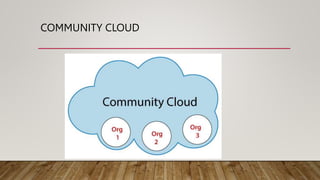
• Community cloud is a cloud infrastructure that allows systems and
services to be accessible by a group of several organizations to
share the information. It is owned, managed, and operated by one
or more organizations in the community, a third party, or a
combination of them.
• Example: Our government organization within India may share
computing infrastructure in the cloud to manage data
COMMUNITY CLOUD
ADVANTAGES OF COMMUNITY CLOUD
• Cost effective: Community cloud is cost effective because the whole cloud is shared
between several organizations or a community.
• Flexible and Scalable: The community cloud is flexible and scalable because it is
compatible with every user. It allows the users to modify the documents as per their
needs and requirement.
• Security: Community cloud is more secure than the public cloud but less secure than the
private cloud.
• Sharing infrastructure: Community cloud allows us to share cloud resources,
infrastructure, and other capabilities among various organizations.
DISADVANTAGES OF COMMUNITY CLOUD
• Community cloud is not a good choice for every organization.
• Slow adoption to data
• The fixed amount of data storage and bandwidth is shared among all
community members.
• Community Cloud is costly than the public cloud.
• Sharing responsibilities among organizations is difficult.
THANK YOU

types of cloud.pptx

  • 1.
    TYPES OF CLOUDS PresentedBy: Babita Radwal Assistant Professor, USCS Uttaranchal University
  • 2.
    PUBLIC CLOUD • PublicCloud provides a shared platform that is accessible to the general public through an Internet connection. • Public cloud operated on the pay-as-per-use model and administrated by the third party, i.e., Cloud service provider. • In the Public cloud, the same storage is being used by multiple users at the same time. • Public cloud is owned, managed, and operated by businesses, universities, government organizations, or a combination of them. • Amazon Elastic Compute Cloud (EC2), Microsoft Azure, IBM's Blue Cloud, Sun Cloud, and Google Cloud are examples of the public cloud.
  • 3.
  • 4.
    ADVANTAGES OF PUBLICCLOUD • Low Cost: Public cloud has a lower cost than private, or hybrid cloud, as it shares the same resources with a large number of consumers. • Location Independent: Public cloud is location independent because its services are offered through the internet. • Save Time: In Public cloud, the cloud service provider is responsible for the manage and maintain data centers in which data is stored, so the cloud user can save their time to establish connectivity, deploying new products, release product updates, configure, and assemble servers.
  • 5.
    ADVANTAGES OF PUBLICCLOUD • Quickly and easily set up: Organizations can easily buy public cloud on the internet and deployed and configured it remotely through the cloud service provider within a few hours. • Business Agility: Public cloud provides an ability to elastically re-size computer resources based on the organization's requirements. • Scalability and reliability: Public cloud offers scalable (easy to add and remove) and reliable (24*7 available) services to the users at an affordable cost.
  • 6.
    DISADVANTAGES OF PUBLICCLOUD • Low Security: Public Cloud is less secure because resources are shared publicly. • Performance: In the public cloud, performance depends upon the speed of internet connectivity. • Less customizable: Public cloud is less customizable than the private cloud.
  • 7.
    PRIVATE CLOUD • Privatecloud is also known as an internal cloud or corporate cloud. • Private cloud provides computing services to a private internal network (within the organization) and selected users instead of the general public. • Private cloud provides a high level of security and privacy to data through firewalls and internal hosting. It also ensures that operational and sensitive data are not accessible to third-party providers. • HP Data Centers, Microsoft, Elastra-private cloud, and Ubuntu are the example of a private cloud.
  • 8.
  • 9.
    ADVANTAGES OF PRIVATECLOUD • More Control: Private clouds have more control over their resources and hardware than public clouds because it is only accessed by selected users. • Security & privacy: Security & privacy are one of the big advantages of cloud computing. Private cloud improved the security level as compared to the public cloud. • Improved performance: Private cloud offers better performance with improved speed and space capacity.
  • 10.
    DISADVANTAGES OF PRIVATECLOUD • High cost: The cost is higher than a public cloud because set up and maintain hardware resources are costly. • Restricted area of operations: As we know, private cloud is accessible within the organization, so the area of operations is limited. • Limited scalability: Private clouds are scaled only within the capacity of internal hosted resources. • Skilled people: Skilled people are required to manage and operate cloud services.
  • 11.
    HYBRID CLOUD • Hybridcloud is a combination of public and private clouds. Hybrid cloud = public cloud + private cloud • The main aim to combine these cloud (Public and Private) is to create a unified, automated, and well-managed computing environment. • In the Hybrid cloud, non-critical activities are performed by the public cloud and critical activities are performed by the private cloud. • Mainly, a hybrid cloud is used in finance, healthcare, and Universities. • The best hybrid cloud provider companies are Amazon, Microsoft, Google, Cisco, and NetApp.
  • 12.
  • 13.
    ADVANTAGES OF HYBRIDCLOUD • Flexible and secure: It provides flexible resources because of the public cloud and secure resources because of the private cloud. • Cost effective: Hybrid cloud costs less than the private cloud. It helps organizations to save costs for both infrastructure and application support. • Cost effective: It offers the features of both the public as well as the private cloud. A hybrid cloud is capable of adapting to the demands that each company needs for space, memory, and system.
  • 14.
    ADVANTAGES OF HYBRIDCLOUD • Security: Hybrid cloud is secure because critical activities are performed by the private cloud. • Risk Management: Hybrid cloud provides an excellent way for companies to manage the risk.
  • 15.
    DISADVANTAGES OF HYBRIDCLOUD • Networking issues: In the Hybrid Cloud, networking becomes complex because of the private and the public cloud. • Infrastructure Compatibility: Infrastructure compatibility is the major issue in a hybrid cloud. With dual-levels of infrastructure, a private cloud controls the company, and a public cloud does not, so there is a possibility that they are running in separate stacks. • Reliability: The reliability of the services depends on cloud service providers.
  • 16.
    COMMUNITY CLOUD • Communitycloud is a cloud infrastructure that allows systems and services to be accessible by a group of several organizations to share the information. It is owned, managed, and operated by one or more organizations in the community, a third party, or a combination of them. • Example: Our government organization within India may share computing infrastructure in the cloud to manage data
  • 17.
  • 18.
    ADVANTAGES OF COMMUNITYCLOUD • Cost effective: Community cloud is cost effective because the whole cloud is shared between several organizations or a community. • Flexible and Scalable: The community cloud is flexible and scalable because it is compatible with every user. It allows the users to modify the documents as per their needs and requirement. • Security: Community cloud is more secure than the public cloud but less secure than the private cloud. • Sharing infrastructure: Community cloud allows us to share cloud resources, infrastructure, and other capabilities among various organizations.
  • 19.
    DISADVANTAGES OF COMMUNITYCLOUD • Community cloud is not a good choice for every organization. • Slow adoption to data • The fixed amount of data storage and bandwidth is shared among all community members. • Community Cloud is costly than the public cloud. • Sharing responsibilities among organizations is difficult.
  • 20.