Crash Barrier
What are the Crash Barrier types?
With the emerging products to keep the commuters in the safety zone,
crash barrier is one such product that goes a step ahead in providing a
safe and secured transport. While barriers are normally designed to
minimize injury to vehicle occupants, injuries do occur in collisions
with traffic barriers.
They should only be installed where a collision with the barrier is
likely to be less severe than a collision with the hazard behind it.
Wherever possible, it is preferable to remove, relocate or modify a
hazard, rather than shield it with a barrier.
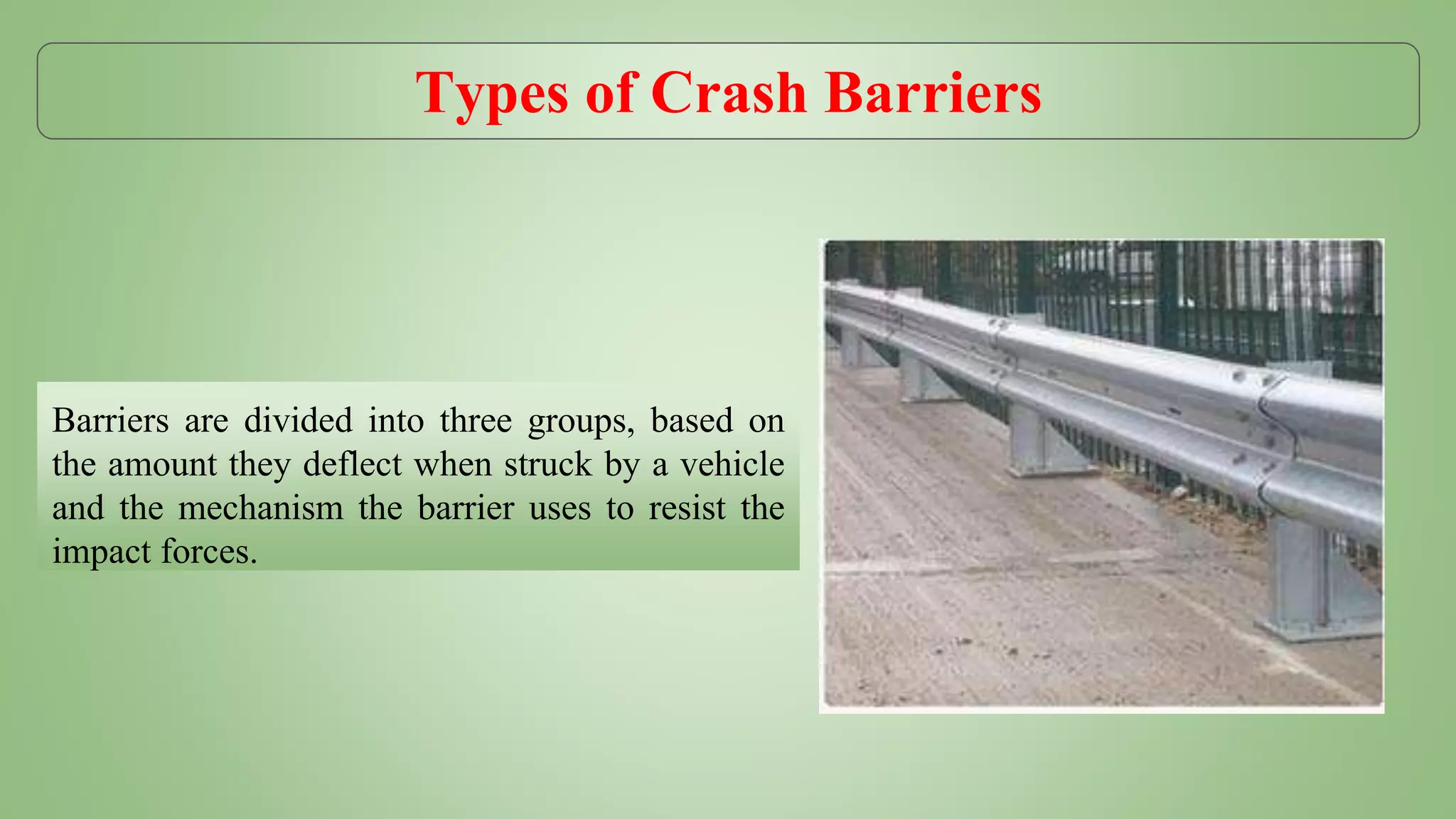
Types of Crash Barriers
Barriers are divided into three groups, based on
the amount they deflect when struck by a vehicle
and the mechanism the barrier uses to resist the
impact forces.
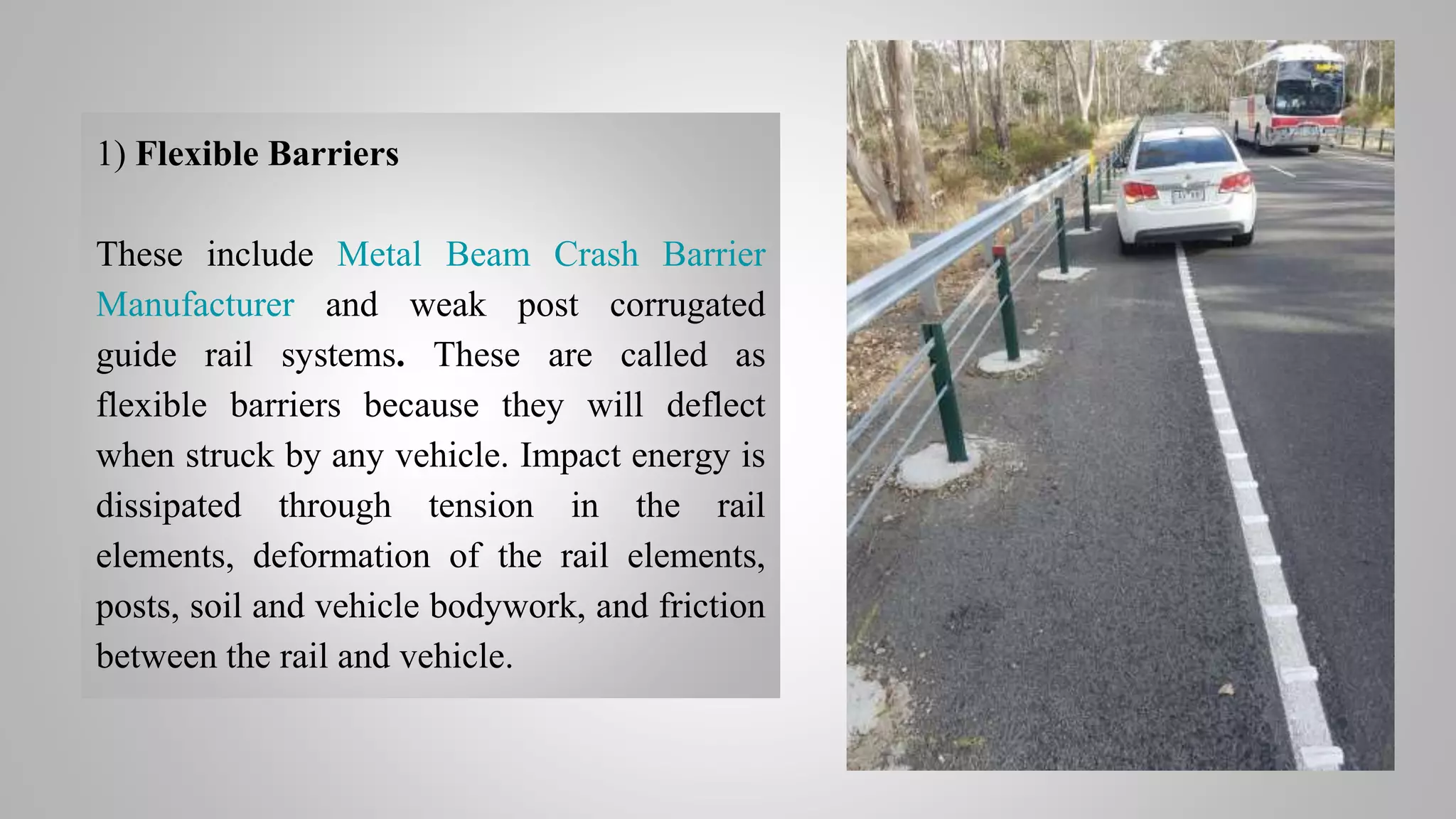
1) Flexible Barriers
These include Metal Beam Crash Barrier
Manufacturer and weak post corrugated
guide rail systems. These are called as
flexible barriers because they will deflect
when struck by any vehicle. Impact energy is
dissipated through tension in the rail
elements, deformation of the rail elements,
posts, soil and vehicle bodywork, and friction
between the rail and vehicle.
2) Semi-rigid barriers
These include box beam guide rail,
heavy post blocked out corrugated
guide rail and thrie-beam guide rail
from W Beam Highway Crash
Barrier Suppliers. They deflect
more than rigid barriers, but less
than flexible barriers. Impact
energy is dissipated through
deformation of the rail elements,
posts, soil and vehicle bodywork,
and friction between the rail and
vehicle.
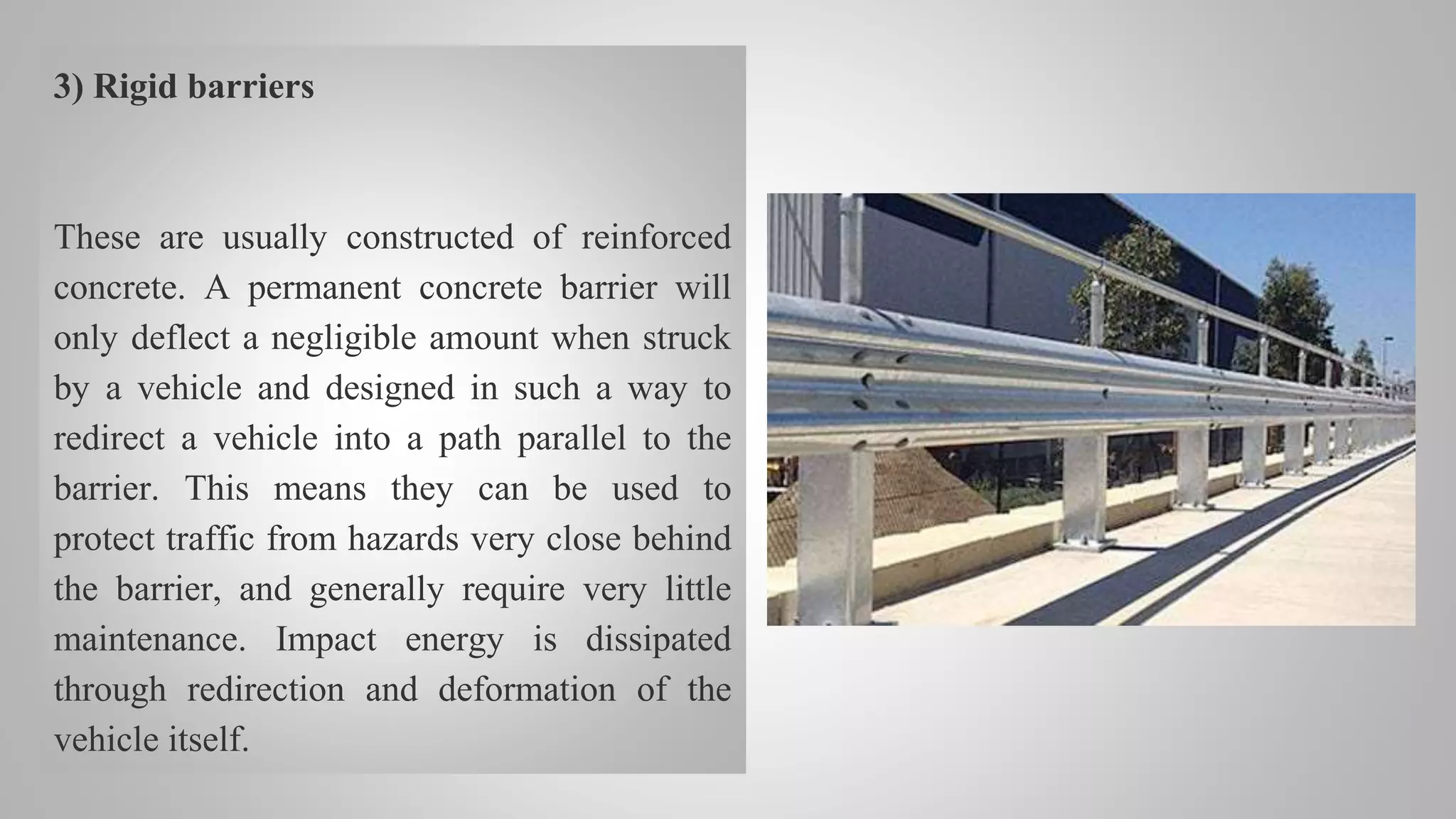
3) Rigid barriers
These are usually constructed of reinforced
concrete. A permanent concrete barrier will
only deflect a negligible amount when struck
by a vehicle and designed in such a way to
redirect a vehicle into a path parallel to the
barrier. This means they can be used to
protect traffic from hazards very close behind
the barrier, and generally require very little
maintenance. Impact energy is dissipated
through redirection and deformation of the
vehicle itself.
OM WIRE & WIRE PRODUCTS INDUSTRIES
Contact Person : Mr. Hitesh Lunia
Adress : 26/1/1b Strand Road,4th Floor,Room No. 6, Kolkata - 700001, West Bengal, India
Phone Number : +91-9830777188 / 9007817770
Email : omwireproducts@gmail.com , sales@omwireproducts.com
Website : http://www.wbeamhighwaycrashbarrier.com

What are the Crash Barrier types?

  • 1.
  • 2.
    What are theCrash Barrier types? With the emerging products to keep the commuters in the safety zone, crash barrier is one such product that goes a step ahead in providing a safe and secured transport. While barriers are normally designed to minimize injury to vehicle occupants, injuries do occur in collisions with traffic barriers. They should only be installed where a collision with the barrier is likely to be less severe than a collision with the hazard behind it. Wherever possible, it is preferable to remove, relocate or modify a hazard, rather than shield it with a barrier.
  • 3.
    Types of CrashBarriers Barriers are divided into three groups, based on the amount they deflect when struck by a vehicle and the mechanism the barrier uses to resist the impact forces.
  • 4.
    1) Flexible Barriers Theseinclude Metal Beam Crash Barrier Manufacturer and weak post corrugated guide rail systems. These are called as flexible barriers because they will deflect when struck by any vehicle. Impact energy is dissipated through tension in the rail elements, deformation of the rail elements, posts, soil and vehicle bodywork, and friction between the rail and vehicle.
  • 5.
    2) Semi-rigid barriers Theseinclude box beam guide rail, heavy post blocked out corrugated guide rail and thrie-beam guide rail from W Beam Highway Crash Barrier Suppliers. They deflect more than rigid barriers, but less than flexible barriers. Impact energy is dissipated through deformation of the rail elements, posts, soil and vehicle bodywork, and friction between the rail and vehicle.
  • 6.
    3) Rigid barriers Theseare usually constructed of reinforced concrete. A permanent concrete barrier will only deflect a negligible amount when struck by a vehicle and designed in such a way to redirect a vehicle into a path parallel to the barrier. This means they can be used to protect traffic from hazards very close behind the barrier, and generally require very little maintenance. Impact energy is dissipated through redirection and deformation of the vehicle itself.
  • 7.
    OM WIRE &WIRE PRODUCTS INDUSTRIES Contact Person : Mr. Hitesh Lunia Adress : 26/1/1b Strand Road,4th Floor,Room No. 6, Kolkata - 700001, West Bengal, India Phone Number : +91-9830777188 / 9007817770 Email : omwireproducts@gmail.com , sales@omwireproducts.com Website : http://www.wbeamhighwaycrashbarrier.com