WHATARE
PGHD?
Patient-generatedhealthdata
Health-relateddatacreatedandrecorded
byorfrompatientsoutsideoftheclinical
settingtohelpaddressahealthconcern
EXAMPLES OF
PGHD
SOURCES
EXAMPLES OF
PGHD
ACTIVITY
LEVEL
BIOMETRIC
DATA
SYMPTOMS
MEDICATION
EFFECTS
WEARABLE
DEVICES
REGISTERED
MEDICAL
DEVICES
MOBILE
APPLICATIONS
SURVEYS AND
QUESTIONNAIRES
EXAMPLES
&SOURCES
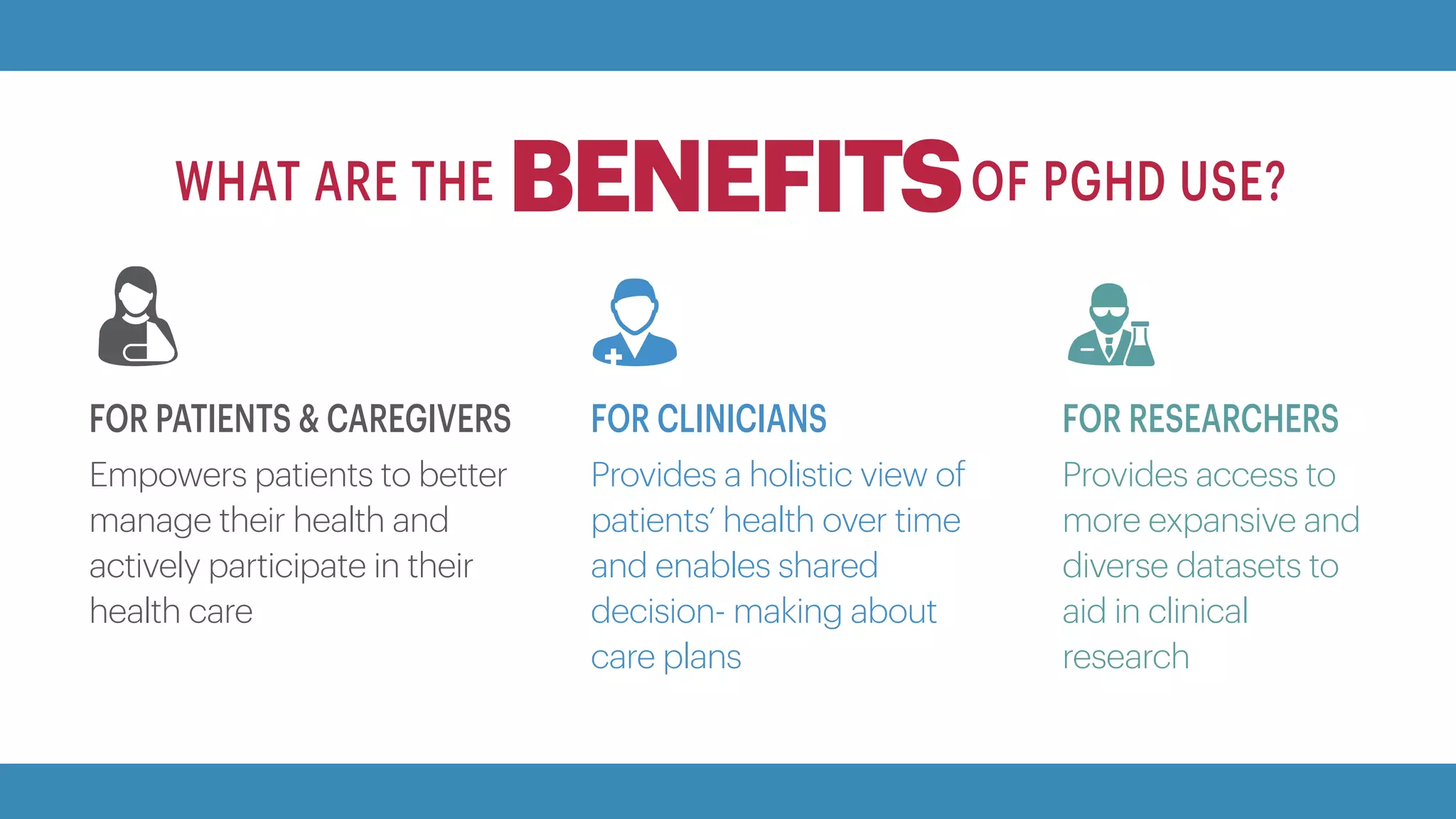
FOR PATIENTS & CAREGIVERS
Empowers patients to better
manage their health and
actively participate in their
health care
FOR CLINICIANS
Provides a holistic view of
patients’ health over time
and enables shared
decision- making about
care plans
FOR RESEARCHERS
Provides access to
more expansive and
diverse datasets to
aid in clinical
research
WHAT ARE THE BENEFITSOF PGHD USE?
WHAT ARE THE DRIVERSOF PGHD USE?
Regulations that
incentivize the
capture and use of
data from
non-clinical
settings
Desire to gain a
more holistic and
longitudinal view
of patients’ health
Increased care
coordination
for
chronic
conditions
2024
2017
• Seamlessly and electronically capture and share PGHD among patients, clinicians,
and researchers, as well as support interoperability across communities and
non-clinical settings
• Insufficient data storage and technical architecture, including standards
• Uncertainty about the accuracy of PGHD devices
• Problematic data curation when merging data from disparate sources
• Continually-evolving security threats and inconsistent or insufficient privacy solutions
• Clinicians make decisions based on data they collect in clinical care settings,
reflecting intermittent, discrete points in time
• Researchers and clinicians often don’t have real-time access to information about
patients’ lives outside of clinical setting
FUTURE STATE
CURRENT STATE
TECHNICAL&WORKFLOWCHALLENGES
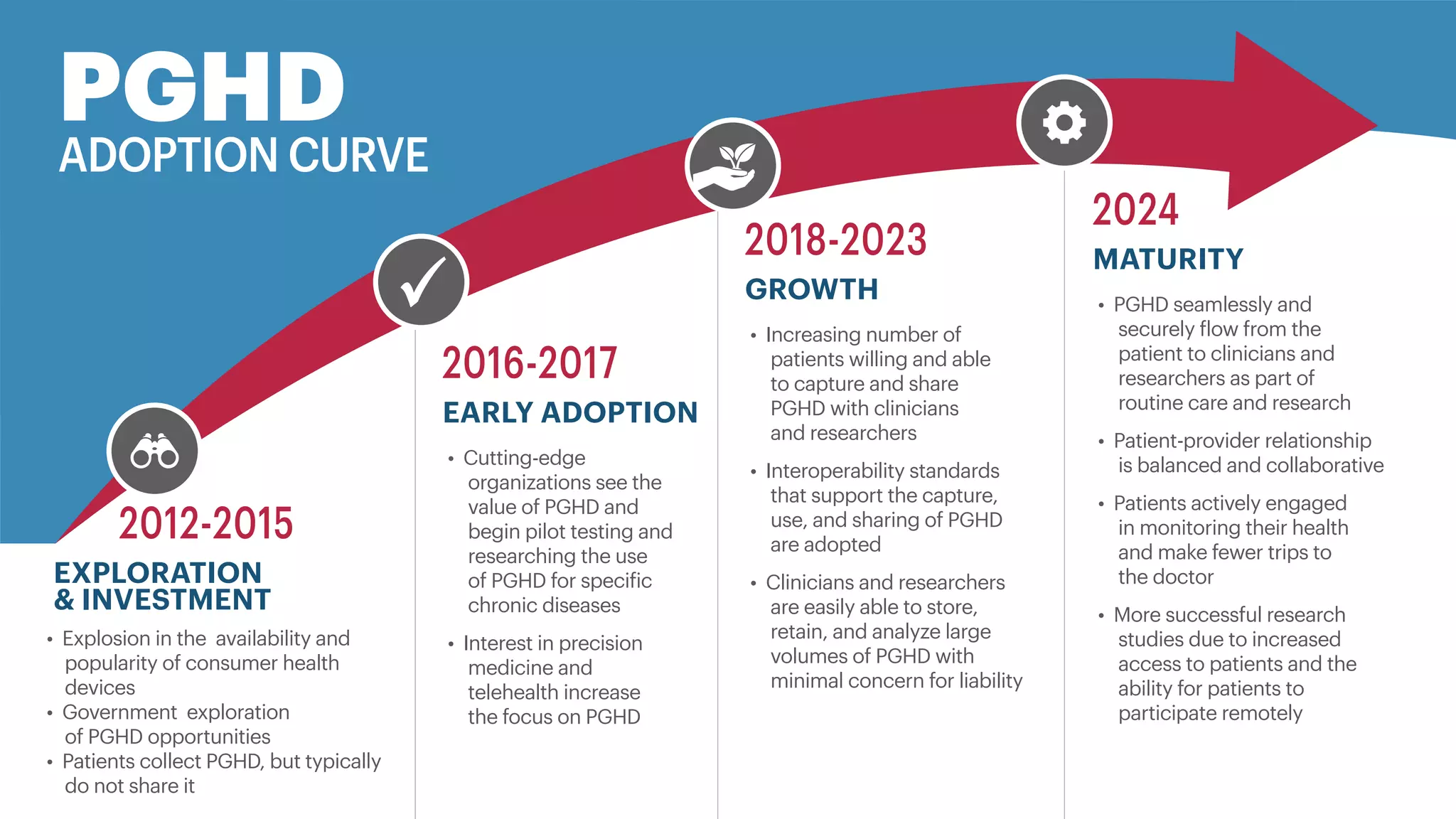
2012-2015
EXPLORATION
& INVESTMENT
2016-2017
EARLY ADOPTION
• Cutting-edge
organizations see the
value of PGHD and
begin pilot testing and
researching the use
of PGHD for specific
chronic diseases
• Interest in precision
medicine and
telehealth increase
the focus on PGHD
2018-2023
GROWTH
• Increasing number of
patients willing and able
to capture and share
PGHD with clinicians
and researchers
• Interoperability standards
that support the capture,
use, and sharing of PGHD
are adopted
• Clinicians and researchers
are easily able to store,
retain, and analyze large
volumes of PGHD with
minimal concern for liability
2024
MATURITY
• PGHD seamlessly and
securely flow from the
patient to clinicians and
researchers as part of
routine care and research
• Patient-provider relationship
is balanced and collaborative
• Patients actively engaged
in monitoring their health
and make fewer trips to
the doctor
• More successful research
studies due to increased
access to patients and the
ability for patients to
participate remotely
PGHD
ADOPTION CURVE
• Explosion in the availability and
popularity of consumer health
devices
• Government exploration
of PGHD opportunities
• Patients collect PGHD, but typically
do not share it
RESEARCHERS CLINICIANS
PATIENTS
Collaborative
Health IT
Ecosystem
Technology
Stakeholders
Policymakers
Payers and
Employers
COLLABORATION
AMONG
STAKEHOLDERS IS
NECESSARY TO
INCREASE PGHD
ADOPTION
• Support clinicians who work within and
across organizations to incorporate
prioritized PGHD use cases into their
workflows.
• Foster collaboration between clinicians and
developers to advance technologies
supporting PGHD use.
• Identify and communicate benefits,
challenges, and best practices of PGHD use
to help strengthen the evidence for clinical
value and business case.
• Encourage clinicians to use PGHD to support
patient data donation in research.
CLINICIANS
• Call for increased funding for studies
that investigate the benefits,
challenges, and best practices of using
PGHD in care delivery and research.
• Motivate researchers to design
and develop studies that incorporate
PGHD.
• Expand methods for data donation to
research studies.
• Strengthen patients’ understanding of
consent and data use.
RESEARCHERS
PATIENTS AND
CAREGIVERS
• Encourage patients and caregivers to
collaborate with clinicians and
researchers to determine how
capturing, using, and sharing PGHD can
be valuable for managing their health.
• Support active patient participation in
testing the functionality and usability of
devices and in reporting feedback
directly to manufacturers.
The future PGHD policy
framework should consider
the following enabling actions:
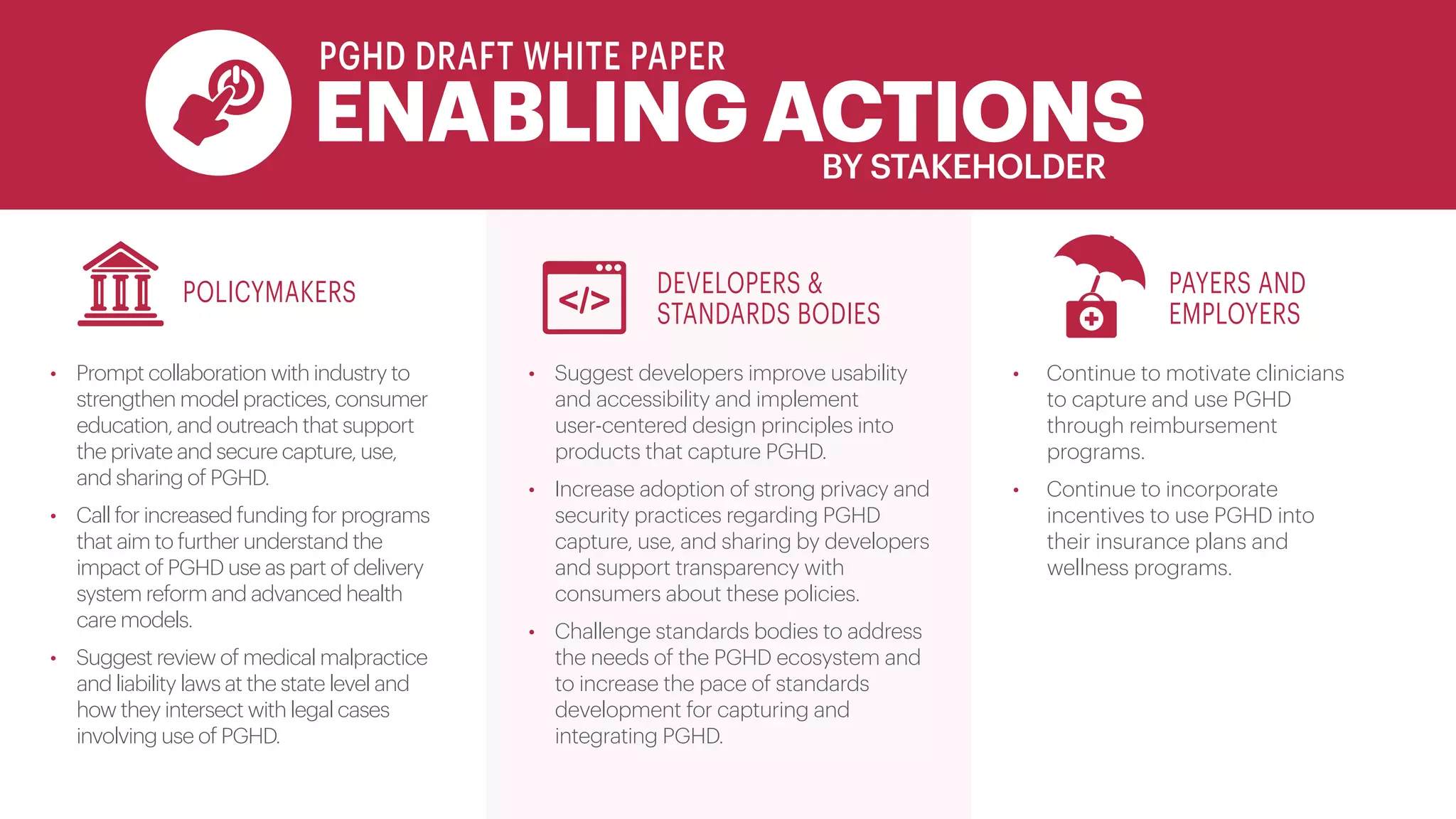
ENABLING
ACTIONSBY STAKEHOLDER
PGHD DRAFT WHITE PAPER
• Suggest developers improve usability
and accessibility and implement
user-centered design principles into
products that capture PGHD.
• Increase adoption of strong privacy and
security practices regarding PGHD
capture, use, and sharing by developers
and support transparency with
consumers about these policies.
• Challenge standards bodies to address
the needs of the PGHD ecosystem and
to increase the pace of standards
development for capturing and
integrating PGHD.
• Continue to motivate clinicians
to capture and use PGHD
through reimbursement
programs.
• Continue to incorporate
incentives to use PGHD into
their insurance plans and
wellness programs.
POLICYMAKERS PAYERS AND
EMPLOYERS
DEVELOPERS &
STANDARDS BODIES
• Prompt collaboration with industry to
strengthen model practices, consumer
education, and outreach that support
the private and secure capture, use,
and sharing of PGHD.
• Call for increased funding for programs
that aim to further understand the
impact of PGHD use as part of delivery
system reform and advanced health
care models.
• Suggest review of medical malpractice
and liability laws at the state level and
how they intersect with legal cases
involving use of PGHD.
ENABLINGACTIONSBY STAKEHOLDER
PGHD DRAFT WHITE PAPER

What are PGHD?

  • 1.
  • 2.
  • 3.
    FOR PATIENTS &CAREGIVERS Empowers patients to better manage their health and actively participate in their health care FOR CLINICIANS Provides a holistic view of patients’ health over time and enables shared decision- making about care plans FOR RESEARCHERS Provides access to more expansive and diverse datasets to aid in clinical research WHAT ARE THE BENEFITSOF PGHD USE?
  • 4.
    WHAT ARE THEDRIVERSOF PGHD USE? Regulations that incentivize the capture and use of data from non-clinical settings Desire to gain a more holistic and longitudinal view of patients’ health Increased care coordination for chronic conditions
  • 5.
    2024 2017 • Seamlessly andelectronically capture and share PGHD among patients, clinicians, and researchers, as well as support interoperability across communities and non-clinical settings • Insufficient data storage and technical architecture, including standards • Uncertainty about the accuracy of PGHD devices • Problematic data curation when merging data from disparate sources • Continually-evolving security threats and inconsistent or insufficient privacy solutions • Clinicians make decisions based on data they collect in clinical care settings, reflecting intermittent, discrete points in time • Researchers and clinicians often don’t have real-time access to information about patients’ lives outside of clinical setting FUTURE STATE CURRENT STATE TECHNICAL&WORKFLOWCHALLENGES
  • 6.
    2012-2015 EXPLORATION & INVESTMENT 2016-2017 EARLY ADOPTION •Cutting-edge organizations see the value of PGHD and begin pilot testing and researching the use of PGHD for specific chronic diseases • Interest in precision medicine and telehealth increase the focus on PGHD 2018-2023 GROWTH • Increasing number of patients willing and able to capture and share PGHD with clinicians and researchers • Interoperability standards that support the capture, use, and sharing of PGHD are adopted • Clinicians and researchers are easily able to store, retain, and analyze large volumes of PGHD with minimal concern for liability 2024 MATURITY • PGHD seamlessly and securely flow from the patient to clinicians and researchers as part of routine care and research • Patient-provider relationship is balanced and collaborative • Patients actively engaged in monitoring their health and make fewer trips to the doctor • More successful research studies due to increased access to patients and the ability for patients to participate remotely PGHD ADOPTION CURVE • Explosion in the availability and popularity of consumer health devices • Government exploration of PGHD opportunities • Patients collect PGHD, but typically do not share it
  • 7.
    RESEARCHERS CLINICIANS PATIENTS Collaborative Health IT Ecosystem Technology Stakeholders Policymakers Payersand Employers COLLABORATION AMONG STAKEHOLDERS IS NECESSARY TO INCREASE PGHD ADOPTION
  • 8.
    • Support clinicianswho work within and across organizations to incorporate prioritized PGHD use cases into their workflows. • Foster collaboration between clinicians and developers to advance technologies supporting PGHD use. • Identify and communicate benefits, challenges, and best practices of PGHD use to help strengthen the evidence for clinical value and business case. • Encourage clinicians to use PGHD to support patient data donation in research. CLINICIANS • Call for increased funding for studies that investigate the benefits, challenges, and best practices of using PGHD in care delivery and research. • Motivate researchers to design and develop studies that incorporate PGHD. • Expand methods for data donation to research studies. • Strengthen patients’ understanding of consent and data use. RESEARCHERS PATIENTS AND CAREGIVERS • Encourage patients and caregivers to collaborate with clinicians and researchers to determine how capturing, using, and sharing PGHD can be valuable for managing their health. • Support active patient participation in testing the functionality and usability of devices and in reporting feedback directly to manufacturers. The future PGHD policy framework should consider the following enabling actions: ENABLING ACTIONSBY STAKEHOLDER PGHD DRAFT WHITE PAPER
  • 9.
    • Suggest developersimprove usability and accessibility and implement user-centered design principles into products that capture PGHD. • Increase adoption of strong privacy and security practices regarding PGHD capture, use, and sharing by developers and support transparency with consumers about these policies. • Challenge standards bodies to address the needs of the PGHD ecosystem and to increase the pace of standards development for capturing and integrating PGHD. • Continue to motivate clinicians to capture and use PGHD through reimbursement programs. • Continue to incorporate incentives to use PGHD into their insurance plans and wellness programs. POLICYMAKERS PAYERS AND EMPLOYERS DEVELOPERS & STANDARDS BODIES • Prompt collaboration with industry to strengthen model practices, consumer education, and outreach that support the private and secure capture, use, and sharing of PGHD. • Call for increased funding for programs that aim to further understand the impact of PGHD use as part of delivery system reform and advanced health care models. • Suggest review of medical malpractice and liability laws at the state level and how they intersect with legal cases involving use of PGHD. ENABLINGACTIONSBY STAKEHOLDER PGHD DRAFT WHITE PAPER