What are National Parks? Lesson objectives: To identify what a National Park is. To locate the National Parks in England and Wales. To identify land ownership within the National Parks.
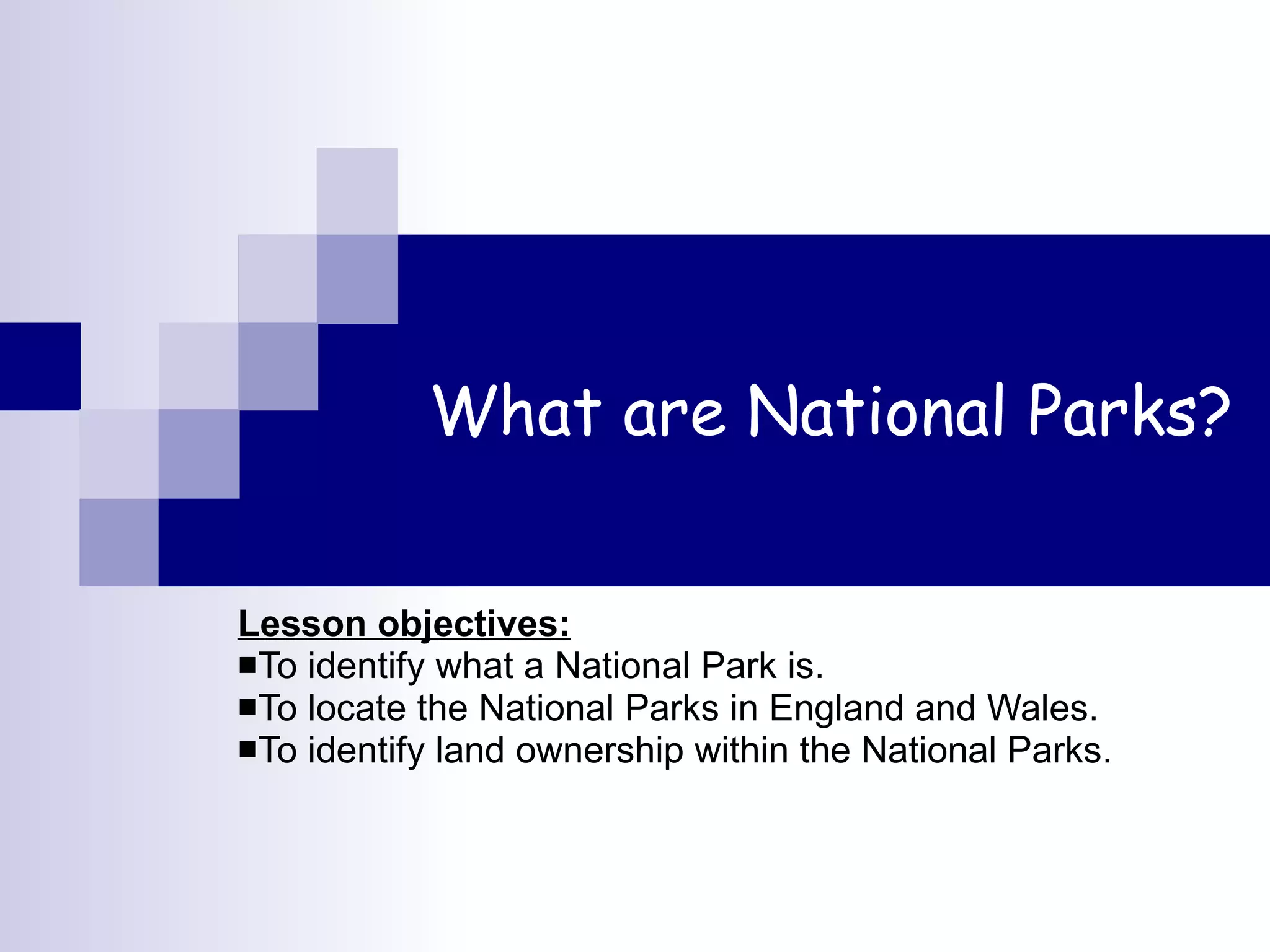
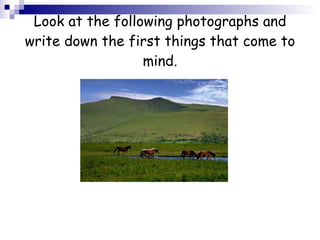
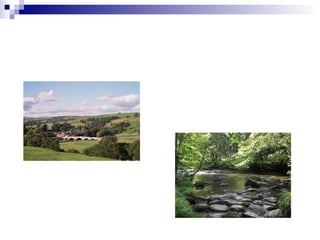
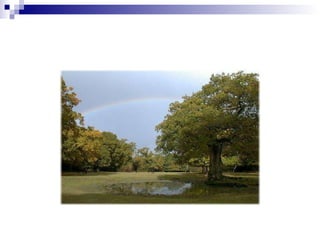
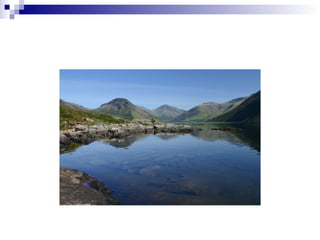
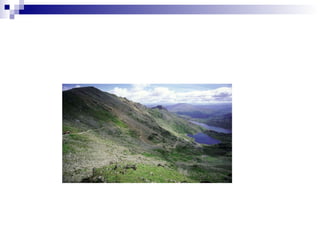
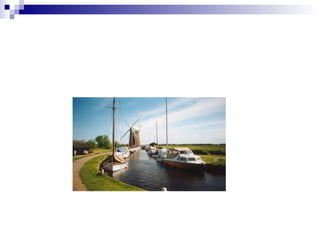
Look at the following photographs and write down the first things that come to mind.


What are National Parks? National Parks are located in some of the country’s most beautiful and remote areas. They are areas of protected land. This means you cannot build on the land or use the land without special permission. Some of the land in the National Parks are used for forestry, farming, army training and even industry e.g.limestone quarries.  National Parks also have small towns and villages where over a quarter of a million people live and work.
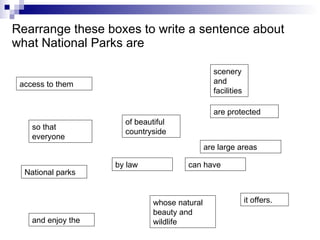
Rearrange these boxes to write a sentence about what National Parks are National parks  are large areas  of beautiful countryside whose natural beauty and wildlife are protected by law so that everyone can have access to them  and enjoy the  scenery and facilities it offers.
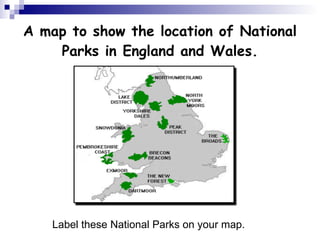
A map to show the location of National Parks in England and Wales. Label these National Parks on your map.
When were the National Parks set up? The National Parks were set up by an Act of Parliament in 1949.  The first parks to be set up after this act were the Peak District, the Lake District, Snowdonia and Dartmoor in 1951.  There are now 12 National Parks.
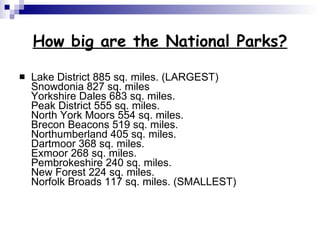
How big are the National Parks? Lake District 885 sq. miles. (LARGEST) Snowdonia 827 sq. miles Yorkshire Dales 683 sq. miles. Peak District 555 sq. miles. North York Moors 554 sq. miles. Brecon Beacons 519 sq. miles. Northumberland 405 sq. miles. Dartmoor 368 sq. miles. Exmoor 268 sq. miles. Pembrokeshire 240 sq. miles. New Forest 224 sq. miles. Norfolk Broads 117 sq. miles. (SMALLEST)
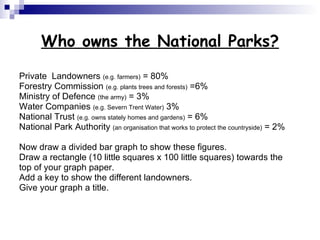
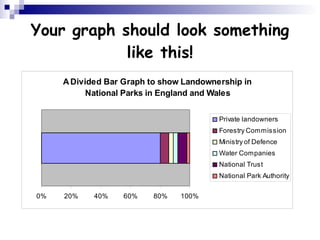
Who owns the National Parks? Private  Landowners  (e.g. farmers)  = 80% Forestry Commission  (e.g. plants trees and forests)  =6%  Ministry of Defence  (the army)  = 3% Water Companies  (e.g. Severn Trent Water)  3% National Trust  (e.g. owns stately homes and gardens)  = 6% National Park Authority  (an organisation that works to protect the countryside)  = 2% Now draw a divided bar graph to show these figures.  Draw a rectangle (10 little squares x 100 little squares) towards the  top of your graph paper. Add a key to show the different landowners. Give your graph a title.
Your graph should look something like this!
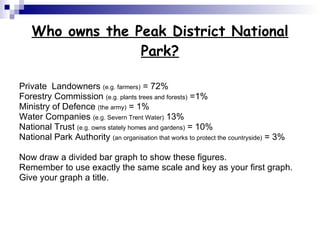
Who owns the Peak District National Park? Private  Landowners  (e.g. farmers)  = 72% Forestry Commission  (e.g. plants trees and forests)  =1%  Ministry of Defence  (the army)  = 1% Water Companies  (e.g. Severn Trent Water)  13% National Trust  (e.g. owns stately homes and gardens)  = 10% National Park Authority  (an organisation that works to protect the countryside)  = 3% Now draw a divided bar graph to show these figures.  Remember to use exactly the same scale and key as your first graph. Give your graph a title.
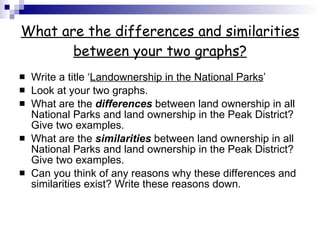
What are the differences and similarities between your two graphs? Write a title ‘ Landownership in the National Parks ’ Look at your two graphs.  What are the  differences  between land ownership in all National Parks and land ownership in the Peak District? Give two examples. What are the  similarities  between land ownership in all National Parks and land ownership in the Peak District? Give two examples. Can you think of any reasons why these differences and similarities exist? Write these reasons down.

What Are National Parks

  • 1.
    What are NationalParks? Lesson objectives: To identify what a National Park is. To locate the National Parks in England and Wales. To identify land ownership within the National Parks.
  • 2.
    Look at thefollowing photographs and write down the first things that come to mind.
  • 3.
  • 4.
  • 5.
  • 6.
  • 7.
  • 8.
    What are NationalParks? National Parks are located in some of the country’s most beautiful and remote areas. They are areas of protected land. This means you cannot build on the land or use the land without special permission. Some of the land in the National Parks are used for forestry, farming, army training and even industry e.g.limestone quarries. National Parks also have small towns and villages where over a quarter of a million people live and work.
  • 9.
    Rearrange these boxesto write a sentence about what National Parks are National parks are large areas of beautiful countryside whose natural beauty and wildlife are protected by law so that everyone can have access to them and enjoy the scenery and facilities it offers.
  • 10.
    A map toshow the location of National Parks in England and Wales. Label these National Parks on your map.
  • 11.
    When were theNational Parks set up? The National Parks were set up by an Act of Parliament in 1949. The first parks to be set up after this act were the Peak District, the Lake District, Snowdonia and Dartmoor in 1951. There are now 12 National Parks.
  • 12.
    How big arethe National Parks? Lake District 885 sq. miles. (LARGEST) Snowdonia 827 sq. miles Yorkshire Dales 683 sq. miles. Peak District 555 sq. miles. North York Moors 554 sq. miles. Brecon Beacons 519 sq. miles. Northumberland 405 sq. miles. Dartmoor 368 sq. miles. Exmoor 268 sq. miles. Pembrokeshire 240 sq. miles. New Forest 224 sq. miles. Norfolk Broads 117 sq. miles. (SMALLEST)
  • 13.
    Who owns theNational Parks? Private Landowners (e.g. farmers) = 80% Forestry Commission (e.g. plants trees and forests) =6% Ministry of Defence (the army) = 3% Water Companies (e.g. Severn Trent Water) 3% National Trust (e.g. owns stately homes and gardens) = 6% National Park Authority (an organisation that works to protect the countryside) = 2% Now draw a divided bar graph to show these figures. Draw a rectangle (10 little squares x 100 little squares) towards the top of your graph paper. Add a key to show the different landowners. Give your graph a title.
  • 14.
    Your graph shouldlook something like this!
  • 15.
    Who owns thePeak District National Park? Private Landowners (e.g. farmers) = 72% Forestry Commission (e.g. plants trees and forests) =1% Ministry of Defence (the army) = 1% Water Companies (e.g. Severn Trent Water) 13% National Trust (e.g. owns stately homes and gardens) = 10% National Park Authority (an organisation that works to protect the countryside) = 3% Now draw a divided bar graph to show these figures. Remember to use exactly the same scale and key as your first graph. Give your graph a title.
  • 16.
    What are thedifferences and similarities between your two graphs? Write a title ‘ Landownership in the National Parks ’ Look at your two graphs. What are the differences between land ownership in all National Parks and land ownership in the Peak District? Give two examples. What are the similarities between land ownership in all National Parks and land ownership in the Peak District? Give two examples. Can you think of any reasons why these differences and similarities exist? Write these reasons down.