WFUMB
Slide Series
World Federation for Ultrasound
in Medicine & Biology
Liver: Diffuse changes - Role of ultrasound
October 2017
1
The information contained in these slides is intended for health professionals and is for
general information only. Whilst care is taken by WFUMB to ensure the material is up to
date WFUMB does not guarantee the accuracy of the information contained in them
and the opinions expressed are those of the author and not of WFUMB.
The slides may be used for presentations in whole or in part but the author and
WFUMB shall be acknowledged and identified as the source of the material.
Liver: Diffuse changes-Role of ultrasound
Prof. Ioan Sporea, MD, PhD
Department of Gastroenterology and Hepatology
University of Medicine and Pharmacy
WFUMB Center of Education
EFSUMB Ultrasound Learning Center
Timişoara, Romania
US evaluation of the liver structure
Usually, normal liver texture is homogenous, with hepatic and
portal veins very well seen;
In pathological conditions, we look for steatosis (“bright liver”
with posterior attenuation) or for advanced fibrosis
(inhomogeneous liver, irregular surface, signs of portal
hypertension, size of caudate lobe).
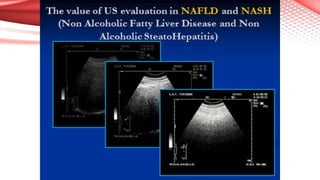
Steatosis and severity of steatosis
• “Bright liver” with posterior attenuation (different degree) and
hepatorenal index (in steatosis, liver is brighter than right kidney).
• This evaluation is subjective, experience play a role, but the accuracy of
ultrasound for steatosis detection and quantification can reach 80-85%
(1,2).
• 1.Palmentieri B et al - Dig Liver Dis 2006; 38: 485
• 2. Mathiesen UL et al: - Dig Liver Dis. 2002; 34: 516-522
 “Bright liver echo pattern” with posterior attenuation on ultrasound is
commonly considered a sign of hepatic steatosis, but interference with liver
fibrosis makes this sign more difficult to be used.
 In a study Palmentieri and al (1) compared bright liver echo pattern to the liver
biopsy. The study showed in 235 patients that the bright liver echo pattern was
found in 67% of patients with steatosis of any degree and in 89% of patients
with steatosis ≥ 30%.
 In this study the sensitivity, specificity, positive predictive value and negative
predictive value of “bright liver” echo pattern and posterior attenuation for
steatosis were 64%, 97%, 96% and 65%, respectively.
 Among the subgroup of patients who had steatosis of ≥ 30% the same
parameters were: 91%, 93%, 89% and 94%, respectively.
 1.Palmentieri B et al - Dig Liver Dis 2006; 38: 485
Mathiesen et al (1) compared US with hepatic histology for steatosis in a series of
165 patients.
Steatosis was graded as none, mild, moderate or severe.
In patients with increased echogenicity, 86.7% had liver steatosis at least
moderate. For the detection of steatosis, US had a sensitivity of 0.90, specificity
0.82, positive predictive value - 0.87 and negative predictive value - 0.87.
1.Mathiesen UL et al: - Dig Liver Dis. 2002; 34: 516-522
CAD for the evaluation of steatosis
• CAD (Computer Assisted Diagnosis) was used for the increasing of the
accuracy of US for the detection and evaluation of the severity of
steatosis (1).
• In a study performed by our group (2), in 120 subjects, CAD was able to
make a correct classification of the degree of steatosis with an accuracy
of 82.2%.
• 1.Gaitini D et al: Feasibility study of ultrasonic fatty liver biopsy: texture vs. attenuation and backscatter. Ultrasound Med Biol. 2004 ;30(10):1321-7.
• 2. Mihailescu DM, ...Sporea I. - Computer aided diagnosis method for steatosis rating in ultrasound images using random forests. Med Ultrason. 2013 Sep;15(3):184-90.
Limits of US in liver steatosis
• NAFLD and NASH can not be differentiated by US (steatosis vs.
steatohepatitis) :
– Ataseven et al (1): “ultrasonography findings do not reflect the histopathological
severity in patients with NASH” (but the results appear the same for CT);
– Saadeh et al (2): “differences between NASH and nonprogressive NAFLD were not
apparent with any radiological modality (US, CT, MRI)”
– Conclusion: for the diagnosis of NASH, only the severity of steatosis was reflected
by the radiological methods (2)
1.Ataseven H et al - Acta Gastroenterol Belg. 2005; 68: 221-225
2.Saadeh S et al - Gastroenterology 2002; 123: 745-750
How can we use ultrasound waves for the
evaluation of liver fibrosis?
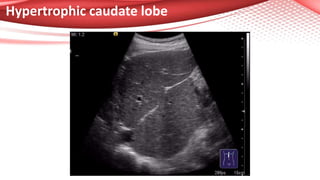
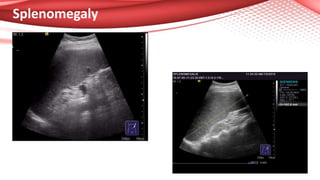
1. Using the classic ultrasound evaluation of the liver (assessment of
liver structure, hepatic margins, splenomegaly, caudate lobe dimensions
or signs of portal hypertension);
Or
2. Modern methods of liver stiffness assessment-Ultrasound
based Liver Elastography (Transient Elastography, point
SWE, 2D-SWE, RT-E)
Hypertrophic caudate lobe
Splenomegaly
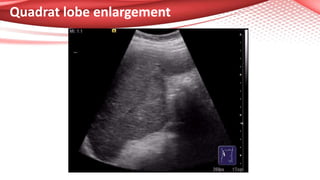
Quadrat lobe enlargement
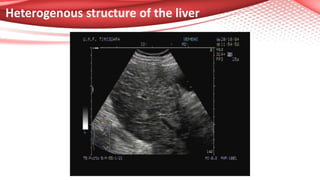
Heterogenous structure of the liver
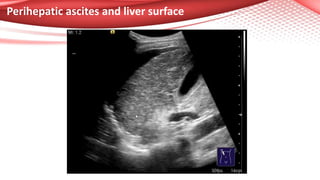
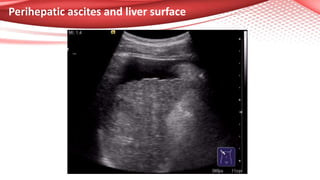
Perihepatic ascites and liver surface
ACCURACY OF ULTRASOUND FOR THE DETECTION OF
LIVER FIBROSIS IN CHRONIC VIRAL HEPATITIS
• D’Onofrio and al (1) performed a prospective study on 105 patients with
chronic hepatitis and compared the results of US to the liver biopsy for
the evaluation of hepatic fibrosis. The author evaluated the following US
parameters: liver margins, parenchymal echotexture, portal vein caliber
and spleen diameter.
• US diagnosis of liver fibrosis in chronic liver disease is possible with 25%
sensitivity, 100% specificity, 100% positive predictive value and 79%
negative predictive value, with a total diagnostic accuracy of 80%.
1.D’Onofrio M et al - Radiol Med 2005; 110: 341-348
Advanced fibrosis (cirrhosis)
• Shen et al (1) evaluated the liver fibrosis in 324 patients with chronic viral
hepatitis (the vast majority with HBV infection), both by needle biopsy and
US (description of the liver surface and parenchyma, diameter of vessels,
blood flow velocity and spleen size).
• A single parameter has limited sensitivity and specificity for the diagnosis
of early cirrhosis (for ex: the cut-off value of > 12 cm for the spleen’s
length had 0.60 sensitivity and 0.75 specificity for the diagnosis of liver
cirrhosis). But by using 2 or 3 parameters for the US diagnosis of cirrhosis
(especially the length of spleen, the diameter of splenic vein and the echo
pattern of the liver) the negative predictive value of these parameters
was close to 0.95.
1.Shen and al - World J Gastroenterol 2006;12:1292-1295
Advanced fibrosis (cirrhosis)
• Zheng et al (1) studied the value of US for the evaluation of liver fibrosis in
comparison with histology in 225 patients with chronic viral
hepatopathies.
• They found that the hepatic parenchymal echo-pattern, the liver surface
and the thickness of the gallbladder wall are independent predictors of
liver fibrosis.
• In this study, the diagnostic accuracy of US for compensated cirrhosis was
80.7%.
1.Zheng R-Q et al - World J Gastroenterol 2003; 9: 2484-2489
Can Doppler Sonography Grade the Severity of
Hepatitis C–Related Liver Disease? (1)
• CONCLUSION : “Doppler-derived indexes, which have previously been
recommended for the assessment of severity in chronic liver disease, are
difficult to reproduce reliably and therefore have a limited clinical role in
the non-invasive assessment of hepatic fibrosis or inflammation” (1).
1. Lim AKP,... David O. Cosgrove D et al: Can Doppler Sonography Grade the Severity of Hepatitis C–Related Liver Disease? AJR 2005;184:1848–1853
Diagnosis of liver cirrhosis with contrast-enhanced
ultrasound (CEUS)
• Hepatic vein arrival time and enhancement level of liver parenchyma in
late phase (in comparison with normal liver) may be valuable clues for the
diagnosis of liver cirrhosis with CEUS.
• Some studies shown also that the hepatic vein arrival time correlated
with the severity of liver fibrosis.
1.Liu GJ et al: Diagnosis of liver cirrhosis with contrast-enhanced ultrasound. World J Radiol 2010 :28; 2(1): 32-36
2.Kaneko T et al: Signal intensity of the liver parenchyma in microbubble contrast agent in the late liver phase reflects advanced fibrosis of
the liver. Liver Int 2005; 25: 288-293
Liver CEUS for the evaluation of liver fibrosis:
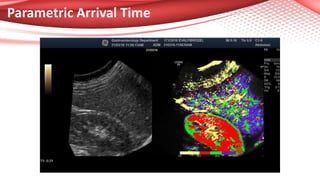
Parametric Arrival Time
• In this study, 60 patients with liver disease in chronic hepatitis C infection were
examined and compared with 10 healthy volunteers who served as controls.
• Sonographic contrast agent Sonazoid was intravenously infused,
• and the S5 or S6 region of the liver and right kidney were observed concurrently while
movies of the procedure were saved.
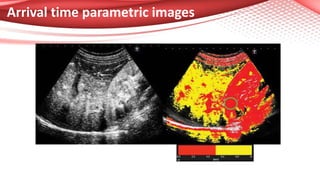
• Parametric Arrival Time of liver parenchymal blood flow were created, with red pixels
to indicate an arrival time of 0 to 5 seconds and yellow pixels to indicate an arrival time
of 5 to 10 seconds.
• From the obtained images, the ratio of the red area to the entire enhanced area of the
liver was calculated using image-processing software.
• Wakui N, , Ryuji Takayama R, Takenori Kanekawa T et al. Usefulness of Arrival Time Parametric Imaging in Evaluating the Degree of Liver Disease Progression in Chronic Hepatitis C
Infection. J Ultrasound Med 2012; 31:373–382
Arrival time parametric images
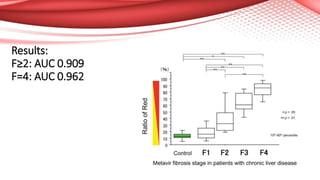
Results:
F≥2: AUC 0.909
F=4: AUC 0.962
Parametric Arrival Time
Ultrasound based Liver Elastography
• Shear Wave Elastography (SWE) methods are implemented in ultrasound
machines.
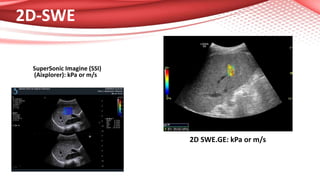
• Point SWE (VTQ-Siemens and ElastPQ-Philips) or 2D-SWE (SSI-Aixplorer, 2D-
SWE.GE-General Electric, Toshiba, Philips and others) can perform numeric
evaluation of liver stiffness in less than 5 minute.
• Results are expressed in kilopascals or meters/second.
• Good clinical results for all this systems!
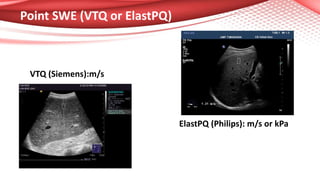
Point SWE (VTQ or ElastPQ)
VTQ (Siemens):m/s
ElastPQ (Philips): m/s or kPa
2D-SWE
SuperSonic Imagine (SSI)
(Aixplorer): kPa or m/s
2D SWE.GE: kPa or m/s
Ultrasound: “one stop shop”
• Using ultrasound, we can obtain in short time information about:
• The structure of the liver (homogeneous or inhomogeneous);
• The presence of steatosis and quantification of the severity;
• The presence and volume of ascites;
• The presence of the focal lesions and using CEUS to characterize;
• using ultrasound based elastography, to assess the severity of fibrosis.
In conclusion
• Regarding the use of (classical) US for the evaluation of fibrosis, this method has
low sensitivity, a quite good specificity (for cirrhosis), with a total diagnostic
accuracy of 80% (1).
• Liver steatosis (at least moderate) can be quite well evaluated with US (sensitivity
75-85%) or maybe can be improved with CAD.
• At the same time, US is useful for the evaluation of liver cirrhosis (quite good
accuracy)(including HCC screening).
• Ultrasound based Elastography is implemented in daily practice.
• Parametric Arrival Time (using CEUS) can be a promising method for fibrosis
evaluation.
Last Slide
31
WFUMB
Slide Series
Liver: Diffuse changes-Role of ultrasound
Prepared by Prof. Ioan Sporea, MD, PhD

Wfumb slideseries liver diffuse changes 2017

  • 1.
    WFUMB Slide Series World Federationfor Ultrasound in Medicine & Biology Liver: Diffuse changes - Role of ultrasound October 2017 1 The information contained in these slides is intended for health professionals and is for general information only. Whilst care is taken by WFUMB to ensure the material is up to date WFUMB does not guarantee the accuracy of the information contained in them and the opinions expressed are those of the author and not of WFUMB. The slides may be used for presentations in whole or in part but the author and WFUMB shall be acknowledged and identified as the source of the material.
  • 2.
    Liver: Diffuse changes-Roleof ultrasound Prof. Ioan Sporea, MD, PhD Department of Gastroenterology and Hepatology University of Medicine and Pharmacy WFUMB Center of Education EFSUMB Ultrasound Learning Center Timişoara, Romania
  • 3.
    US evaluation ofthe liver structure Usually, normal liver texture is homogenous, with hepatic and portal veins very well seen; In pathological conditions, we look for steatosis (“bright liver” with posterior attenuation) or for advanced fibrosis (inhomogeneous liver, irregular surface, signs of portal hypertension, size of caudate lobe).
  • 4.
    Steatosis and severityof steatosis • “Bright liver” with posterior attenuation (different degree) and hepatorenal index (in steatosis, liver is brighter than right kidney). • This evaluation is subjective, experience play a role, but the accuracy of ultrasound for steatosis detection and quantification can reach 80-85% (1,2). • 1.Palmentieri B et al - Dig Liver Dis 2006; 38: 485 • 2. Mathiesen UL et al: - Dig Liver Dis. 2002; 34: 516-522
  • 6.
     “Bright liverecho pattern” with posterior attenuation on ultrasound is commonly considered a sign of hepatic steatosis, but interference with liver fibrosis makes this sign more difficult to be used.  In a study Palmentieri and al (1) compared bright liver echo pattern to the liver biopsy. The study showed in 235 patients that the bright liver echo pattern was found in 67% of patients with steatosis of any degree and in 89% of patients with steatosis ≥ 30%.  In this study the sensitivity, specificity, positive predictive value and negative predictive value of “bright liver” echo pattern and posterior attenuation for steatosis were 64%, 97%, 96% and 65%, respectively.  Among the subgroup of patients who had steatosis of ≥ 30% the same parameters were: 91%, 93%, 89% and 94%, respectively.  1.Palmentieri B et al - Dig Liver Dis 2006; 38: 485
  • 7.
    Mathiesen et al(1) compared US with hepatic histology for steatosis in a series of 165 patients. Steatosis was graded as none, mild, moderate or severe. In patients with increased echogenicity, 86.7% had liver steatosis at least moderate. For the detection of steatosis, US had a sensitivity of 0.90, specificity 0.82, positive predictive value - 0.87 and negative predictive value - 0.87. 1.Mathiesen UL et al: - Dig Liver Dis. 2002; 34: 516-522
  • 8.
    CAD for theevaluation of steatosis • CAD (Computer Assisted Diagnosis) was used for the increasing of the accuracy of US for the detection and evaluation of the severity of steatosis (1). • In a study performed by our group (2), in 120 subjects, CAD was able to make a correct classification of the degree of steatosis with an accuracy of 82.2%. • 1.Gaitini D et al: Feasibility study of ultrasonic fatty liver biopsy: texture vs. attenuation and backscatter. Ultrasound Med Biol. 2004 ;30(10):1321-7. • 2. Mihailescu DM, ...Sporea I. - Computer aided diagnosis method for steatosis rating in ultrasound images using random forests. Med Ultrason. 2013 Sep;15(3):184-90.
  • 9.
    Limits of USin liver steatosis • NAFLD and NASH can not be differentiated by US (steatosis vs. steatohepatitis) : – Ataseven et al (1): “ultrasonography findings do not reflect the histopathological severity in patients with NASH” (but the results appear the same for CT); – Saadeh et al (2): “differences between NASH and nonprogressive NAFLD were not apparent with any radiological modality (US, CT, MRI)” – Conclusion: for the diagnosis of NASH, only the severity of steatosis was reflected by the radiological methods (2) 1.Ataseven H et al - Acta Gastroenterol Belg. 2005; 68: 221-225 2.Saadeh S et al - Gastroenterology 2002; 123: 745-750
  • 10.
    How can weuse ultrasound waves for the evaluation of liver fibrosis? 1. Using the classic ultrasound evaluation of the liver (assessment of liver structure, hepatic margins, splenomegaly, caudate lobe dimensions or signs of portal hypertension); Or 2. Modern methods of liver stiffness assessment-Ultrasound based Liver Elastography (Transient Elastography, point SWE, 2D-SWE, RT-E)
  • 11.
  • 12.
  • 13.
  • 14.
  • 15.
  • 16.
  • 17.
    ACCURACY OF ULTRASOUNDFOR THE DETECTION OF LIVER FIBROSIS IN CHRONIC VIRAL HEPATITIS • D’Onofrio and al (1) performed a prospective study on 105 patients with chronic hepatitis and compared the results of US to the liver biopsy for the evaluation of hepatic fibrosis. The author evaluated the following US parameters: liver margins, parenchymal echotexture, portal vein caliber and spleen diameter. • US diagnosis of liver fibrosis in chronic liver disease is possible with 25% sensitivity, 100% specificity, 100% positive predictive value and 79% negative predictive value, with a total diagnostic accuracy of 80%. 1.D’Onofrio M et al - Radiol Med 2005; 110: 341-348
  • 18.
    Advanced fibrosis (cirrhosis) •Shen et al (1) evaluated the liver fibrosis in 324 patients with chronic viral hepatitis (the vast majority with HBV infection), both by needle biopsy and US (description of the liver surface and parenchyma, diameter of vessels, blood flow velocity and spleen size). • A single parameter has limited sensitivity and specificity for the diagnosis of early cirrhosis (for ex: the cut-off value of > 12 cm for the spleen’s length had 0.60 sensitivity and 0.75 specificity for the diagnosis of liver cirrhosis). But by using 2 or 3 parameters for the US diagnosis of cirrhosis (especially the length of spleen, the diameter of splenic vein and the echo pattern of the liver) the negative predictive value of these parameters was close to 0.95. 1.Shen and al - World J Gastroenterol 2006;12:1292-1295
  • 19.
    Advanced fibrosis (cirrhosis) •Zheng et al (1) studied the value of US for the evaluation of liver fibrosis in comparison with histology in 225 patients with chronic viral hepatopathies. • They found that the hepatic parenchymal echo-pattern, the liver surface and the thickness of the gallbladder wall are independent predictors of liver fibrosis. • In this study, the diagnostic accuracy of US for compensated cirrhosis was 80.7%. 1.Zheng R-Q et al - World J Gastroenterol 2003; 9: 2484-2489
  • 20.
    Can Doppler SonographyGrade the Severity of Hepatitis C–Related Liver Disease? (1) • CONCLUSION : “Doppler-derived indexes, which have previously been recommended for the assessment of severity in chronic liver disease, are difficult to reproduce reliably and therefore have a limited clinical role in the non-invasive assessment of hepatic fibrosis or inflammation” (1). 1. Lim AKP,... David O. Cosgrove D et al: Can Doppler Sonography Grade the Severity of Hepatitis C–Related Liver Disease? AJR 2005;184:1848–1853
  • 21.
    Diagnosis of livercirrhosis with contrast-enhanced ultrasound (CEUS) • Hepatic vein arrival time and enhancement level of liver parenchyma in late phase (in comparison with normal liver) may be valuable clues for the diagnosis of liver cirrhosis with CEUS. • Some studies shown also that the hepatic vein arrival time correlated with the severity of liver fibrosis. 1.Liu GJ et al: Diagnosis of liver cirrhosis with contrast-enhanced ultrasound. World J Radiol 2010 :28; 2(1): 32-36 2.Kaneko T et al: Signal intensity of the liver parenchyma in microbubble contrast agent in the late liver phase reflects advanced fibrosis of the liver. Liver Int 2005; 25: 288-293
  • 22.
    Liver CEUS forthe evaluation of liver fibrosis: Parametric Arrival Time • In this study, 60 patients with liver disease in chronic hepatitis C infection were examined and compared with 10 healthy volunteers who served as controls. • Sonographic contrast agent Sonazoid was intravenously infused, • and the S5 or S6 region of the liver and right kidney were observed concurrently while movies of the procedure were saved. • Parametric Arrival Time of liver parenchymal blood flow were created, with red pixels to indicate an arrival time of 0 to 5 seconds and yellow pixels to indicate an arrival time of 5 to 10 seconds. • From the obtained images, the ratio of the red area to the entire enhanced area of the liver was calculated using image-processing software. • Wakui N, , Ryuji Takayama R, Takenori Kanekawa T et al. Usefulness of Arrival Time Parametric Imaging in Evaluating the Degree of Liver Disease Progression in Chronic Hepatitis C Infection. J Ultrasound Med 2012; 31:373–382
  • 23.
  • 24.
  • 25.
  • 26.
    Ultrasound based LiverElastography • Shear Wave Elastography (SWE) methods are implemented in ultrasound machines. • Point SWE (VTQ-Siemens and ElastPQ-Philips) or 2D-SWE (SSI-Aixplorer, 2D- SWE.GE-General Electric, Toshiba, Philips and others) can perform numeric evaluation of liver stiffness in less than 5 minute. • Results are expressed in kilopascals or meters/second. • Good clinical results for all this systems!
  • 27.
    Point SWE (VTQor ElastPQ) VTQ (Siemens):m/s ElastPQ (Philips): m/s or kPa
  • 28.
    2D-SWE SuperSonic Imagine (SSI) (Aixplorer):kPa or m/s 2D SWE.GE: kPa or m/s
  • 29.
    Ultrasound: “one stopshop” • Using ultrasound, we can obtain in short time information about: • The structure of the liver (homogeneous or inhomogeneous); • The presence of steatosis and quantification of the severity; • The presence and volume of ascites; • The presence of the focal lesions and using CEUS to characterize; • using ultrasound based elastography, to assess the severity of fibrosis.
  • 30.
    In conclusion • Regardingthe use of (classical) US for the evaluation of fibrosis, this method has low sensitivity, a quite good specificity (for cirrhosis), with a total diagnostic accuracy of 80% (1). • Liver steatosis (at least moderate) can be quite well evaluated with US (sensitivity 75-85%) or maybe can be improved with CAD. • At the same time, US is useful for the evaluation of liver cirrhosis (quite good accuracy)(including HCC screening). • Ultrasound based Elastography is implemented in daily practice. • Parametric Arrival Time (using CEUS) can be a promising method for fibrosis evaluation.
  • 31.
    Last Slide 31 WFUMB Slide Series Liver:Diffuse changes-Role of ultrasound Prepared by Prof. Ioan Sporea, MD, PhD