© The Calm Monkey Co. 2018
April 14, 2018
How to bring Mindfulness
into your workplace
(with no ongoing operating costs)
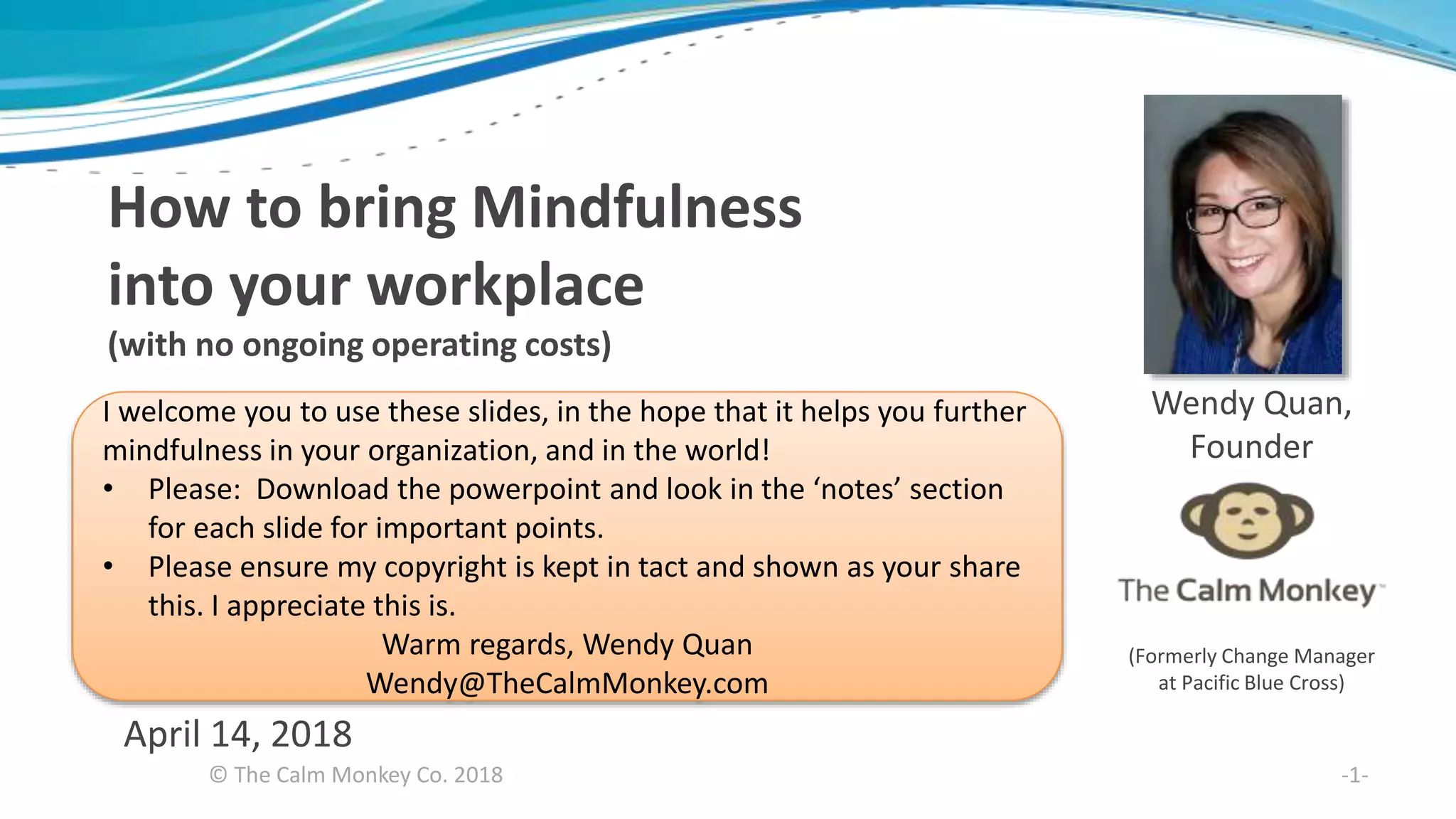
Wendy Quan,
Founder
-1-
(Formerly Change Manager
at Pacific Blue Cross)
I welcome you to use these slides, in the hope that it helps you further
mindfulness in your organization, and in the world!
• Please: Download the powerpoint and look in the ‘notes’ section
for each slide for important points.
• Please ensure my copyright is kept in tact and shown as your share
this. I appreciate this is.
Warm regards, Wendy Quan
Wendy@TheCalmMonkey.com
© The Calm Monkey Co. 2018
Slide Title Here
• Bullet Here
• XXX
• XXX
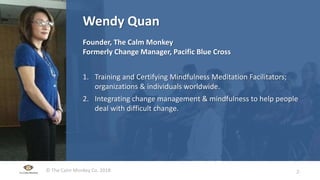
Wendy Quan
Founder, The Calm Monkey
Formerly Change Manager, Pacific Blue Cross
1. Training and Certifying Mindfulness Meditation Facilitators;
organizations & individuals worldwide.
2. Integrating change management & mindfulness to help people
deal with difficult change.
2-
© The Calm Monkey Co. 2018
Why:
How to:
Bonus: Integrating change management + mindfulness
bring mindfulness
into your workplace
Why:
3
© The Calm Monkey Co. 2018 4Credit: Auey Santos for the Greater Good Science Center
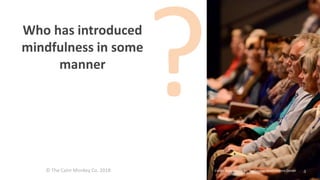
Who has introduced
mindfulness in some
manner
4
© The Calm Monkey Co. 2018 5
Who has an ongoing
mindfulness practice
at work
Credit: Auey Santos for the Greater Good Science Center 5
© The Calm Monkey Co. 2018 6-
Go beyond
the novelty
Make it last
Self-sustain
© The Calm Monkey Co. 2018
My personal story
7
© The Calm Monkey Co. 2018 8
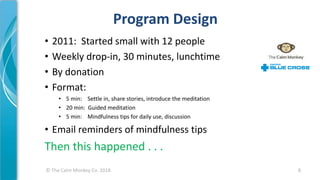
Program Design
• 2011: Started small with 12 people
• Weekly drop-in, 30 minutes, lunchtime
• By donation
• Format:
• 5 min: Settle in, share stories, introduce the meditation
• 20 min: Guided meditation
• 5 min: Mindfulness tips for daily use, discussion
• Email reminders of mindfulness tips
Then this happened . . .
© The Calm Monkey Co. 2018 9-
© The Calm Monkey Co. 2018 10-
© The Calm Monkey Co. 2018 -11-
© The Calm Monkey Co. 2018
Next: Is your organization
ready for this?
12
© The Calm Monkey Co. 2018
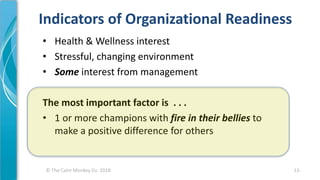
Indicators of Organizational Readiness
• Health & Wellness interest
• Stressful, changing environment
• Some interest from management
The most important factor is . . .
• 1 or more champions with fire in their bellies to
make a positive difference for others
13-
© The Calm Monkey Co. 2018
Next: How to implement
self-sustaining mindfulness
at work
-14-
© The Calm Monkey Co. 2018
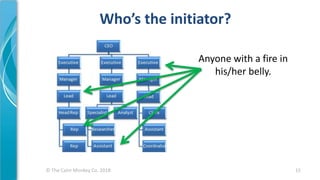
Who’s the initiator?
Anyone with a fire in
his/her belly.
15
© The Calm Monkey Co. 2018
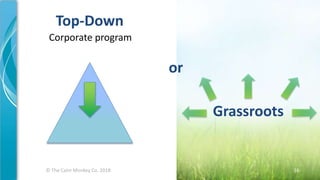
Top-Down
16-
Corporate program
or
Grassroots
© The Calm Monkey Co. 2018
How to start the conversation
• Gather relevant data, research & articles.
• Socialize and build a coalition.
• Get support from a few senior leaders; talk about
business benefits.
• State it’s not religious.
• Use the term ‘mindfulness’ more than ‘meditation’.
• Approach HR? What is HR’s role?
– To run the ‘program’, assist, consent or a simple FYI?
17
© The Calm Monkey Co. 2018
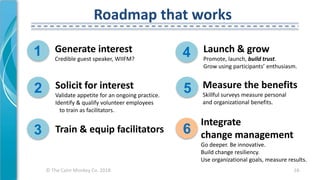
Roadmap that works
18-
1 Generate interest
Credible guest speaker, WIIFM?
Solicit for interest
Validate appetite for an ongoing practice.
Identify & qualify volunteer employees
to train as facilitators.
Train & equip facilitators
Launch & grow
Promote, launch, build trust.
Grow using participants’ enthusiasm.
Measure the benefits
Skillful surveys measure personal
and organizational benefits.
Integrate
change management
Go deeper. Be innovative.
Build change resiliency.
Use organizational goals, measure results.
2
3
4
5
6
© The Calm Monkey Co. 2018
Next: Mistakes to Avoid
19
© The Calm Monkey Co. 2018
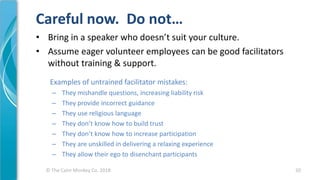
Careful now. Do not…
• Bring in a speaker who doesn’t suit your culture.
• Assume eager volunteer employees can be good facilitators
without training & support.
Examples of untrained facilitator mistakes:
– They mishandle questions, increasing liability risk
– They provide incorrect guidance
– They use religious language
– They don’t know how to build trust
– They don’t know how to increase participation
– They are unskilled in delivering a relaxing experience
– They allow their ego to disenchant participants
20
© The Calm Monkey Co. 2018
21
Next: Integrating
change management
with meditation
Successful change begins with conscious awareness
21-
© The Calm Monkey Co. 2018
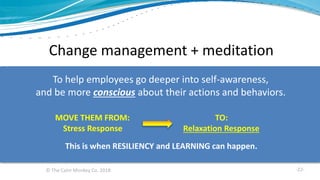
Change management + meditation
To help employees go deeper into self-awareness,
and be more conscious about their actions and behaviors.
MOVE THEM FROM: TO:
Stress Response Relaxation Response
This is when RESILIENCY and LEARNING can happen.
-22-
© The Calm Monkey Co. 2018
Dealing with Change
Meditation study
February 2018
83 participants
23
© The Calm Monkey Co. 2018
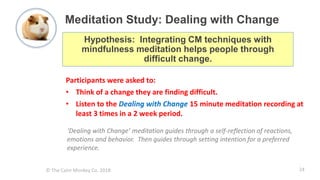
Meditation Study: Dealing with Change
Participants were asked to:
• Think of a change they are finding difficult.
• Listen to the Dealing with Change 15 minute meditation recording at
least 3 times in a 2 week period.
Hypothesis: Integrating CM techniques with
mindfulness meditation helps people through
difficult change.
‘Dealing with Change’ meditation guides through a self-reflection of reactions,
emotions and behavior. Then guides through setting intention for a preferred
experience.
24
© The Calm Monkey Co. 2018 -25-
© The Calm Monkey Co. 2018 26
© The Calm Monkey Co. 2018
“I feel calmer and more in control. Able to choose my thoughts &
influence my feelings.”
“I can now reflect on this change without feeling torn by it.”
“This is great for any organization or individual going
through hard changes.”
“I worked through my resentment – it was liberating!”
“I now see what I need to do to have a more
positive experience.”
27
© The Calm Monkey Co. 2018 28
© The Calm Monkey Co. 2018 29-
© The Calm Monkey Co. 2018 30
Go beyond
the novelty
Make it last
Self-sustain
© The Calm Monkey Co. 2018
Wendy@TheCalmMonkey.com
linkedin.com/in/wendyquan
facebook.com/TheCalmMonkeyCo
@wquan
Wendy Quan,
Founder
Contact
www.TheCalmMonkey.com
Facilitator Training & Certification (toolkit & free preview)
Resources
White Paper: ‘Meditation – a Powerful Change Management Tool’
Research Paper: ‘Dealing with Change meditation study’
Newsletter sign-up: Upcoming Dealing with Change Toolkit, facilitation tips . . .

How To Bring Mindfulness Into Your Workplace

  • 1.
    © The CalmMonkey Co. 2018 April 14, 2018 How to bring Mindfulness into your workplace (with no ongoing operating costs) Wendy Quan, Founder -1- (Formerly Change Manager at Pacific Blue Cross) I welcome you to use these slides, in the hope that it helps you further mindfulness in your organization, and in the world! • Please: Download the powerpoint and look in the ‘notes’ section for each slide for important points. • Please ensure my copyright is kept in tact and shown as your share this. I appreciate this is. Warm regards, Wendy Quan Wendy@TheCalmMonkey.com
  • 2.
    © The CalmMonkey Co. 2018 Slide Title Here • Bullet Here • XXX • XXX Wendy Quan Founder, The Calm Monkey Formerly Change Manager, Pacific Blue Cross 1. Training and Certifying Mindfulness Meditation Facilitators; organizations & individuals worldwide. 2. Integrating change management & mindfulness to help people deal with difficult change. 2-
  • 3.
    © The CalmMonkey Co. 2018 Why: How to: Bonus: Integrating change management + mindfulness bring mindfulness into your workplace Why: 3
  • 4.
    © The CalmMonkey Co. 2018 4Credit: Auey Santos for the Greater Good Science Center Who has introduced mindfulness in some manner 4
  • 5.
    © The CalmMonkey Co. 2018 5 Who has an ongoing mindfulness practice at work Credit: Auey Santos for the Greater Good Science Center 5
  • 6.
    © The CalmMonkey Co. 2018 6- Go beyond the novelty Make it last Self-sustain
  • 7.
    © The CalmMonkey Co. 2018 My personal story 7
  • 8.
    © The CalmMonkey Co. 2018 8 Program Design • 2011: Started small with 12 people • Weekly drop-in, 30 minutes, lunchtime • By donation • Format: • 5 min: Settle in, share stories, introduce the meditation • 20 min: Guided meditation • 5 min: Mindfulness tips for daily use, discussion • Email reminders of mindfulness tips Then this happened . . .
  • 9.
    © The CalmMonkey Co. 2018 9-
  • 10.
    © The CalmMonkey Co. 2018 10-
  • 11.
    © The CalmMonkey Co. 2018 -11-
  • 12.
    © The CalmMonkey Co. 2018 Next: Is your organization ready for this? 12
  • 13.
    © The CalmMonkey Co. 2018 Indicators of Organizational Readiness • Health & Wellness interest • Stressful, changing environment • Some interest from management The most important factor is . . . • 1 or more champions with fire in their bellies to make a positive difference for others 13-
  • 14.
    © The CalmMonkey Co. 2018 Next: How to implement self-sustaining mindfulness at work -14-
  • 15.
    © The CalmMonkey Co. 2018 Who’s the initiator? Anyone with a fire in his/her belly. 15
  • 16.
    © The CalmMonkey Co. 2018 Top-Down 16- Corporate program or Grassroots
  • 17.
    © The CalmMonkey Co. 2018 How to start the conversation • Gather relevant data, research & articles. • Socialize and build a coalition. • Get support from a few senior leaders; talk about business benefits. • State it’s not religious. • Use the term ‘mindfulness’ more than ‘meditation’. • Approach HR? What is HR’s role? – To run the ‘program’, assist, consent or a simple FYI? 17
  • 18.
    © The CalmMonkey Co. 2018 Roadmap that works 18- 1 Generate interest Credible guest speaker, WIIFM? Solicit for interest Validate appetite for an ongoing practice. Identify & qualify volunteer employees to train as facilitators. Train & equip facilitators Launch & grow Promote, launch, build trust. Grow using participants’ enthusiasm. Measure the benefits Skillful surveys measure personal and organizational benefits. Integrate change management Go deeper. Be innovative. Build change resiliency. Use organizational goals, measure results. 2 3 4 5 6
  • 19.
    © The CalmMonkey Co. 2018 Next: Mistakes to Avoid 19
  • 20.
    © The CalmMonkey Co. 2018 Careful now. Do not… • Bring in a speaker who doesn’t suit your culture. • Assume eager volunteer employees can be good facilitators without training & support. Examples of untrained facilitator mistakes: – They mishandle questions, increasing liability risk – They provide incorrect guidance – They use religious language – They don’t know how to build trust – They don’t know how to increase participation – They are unskilled in delivering a relaxing experience – They allow their ego to disenchant participants 20
  • 21.
    © The CalmMonkey Co. 2018 21 Next: Integrating change management with meditation Successful change begins with conscious awareness 21-
  • 22.
    © The CalmMonkey Co. 2018 Change management + meditation To help employees go deeper into self-awareness, and be more conscious about their actions and behaviors. MOVE THEM FROM: TO: Stress Response Relaxation Response This is when RESILIENCY and LEARNING can happen. -22-
  • 23.
    © The CalmMonkey Co. 2018 Dealing with Change Meditation study February 2018 83 participants 23
  • 24.
    © The CalmMonkey Co. 2018 Meditation Study: Dealing with Change Participants were asked to: • Think of a change they are finding difficult. • Listen to the Dealing with Change 15 minute meditation recording at least 3 times in a 2 week period. Hypothesis: Integrating CM techniques with mindfulness meditation helps people through difficult change. ‘Dealing with Change’ meditation guides through a self-reflection of reactions, emotions and behavior. Then guides through setting intention for a preferred experience. 24
  • 25.
    © The CalmMonkey Co. 2018 -25-
  • 26.
    © The CalmMonkey Co. 2018 26
  • 27.
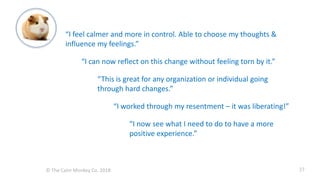
    © The CalmMonkey Co. 2018 “I feel calmer and more in control. Able to choose my thoughts & influence my feelings.” “I can now reflect on this change without feeling torn by it.” “This is great for any organization or individual going through hard changes.” “I worked through my resentment – it was liberating!” “I now see what I need to do to have a more positive experience.” 27
  • 28.
    © The CalmMonkey Co. 2018 28
  • 29.
    © The CalmMonkey Co. 2018 29-
  • 30.
    © The CalmMonkey Co. 2018 30 Go beyond the novelty Make it last Self-sustain
  • 31.
    © The CalmMonkey Co. 2018 Wendy@TheCalmMonkey.com linkedin.com/in/wendyquan facebook.com/TheCalmMonkeyCo @wquan Wendy Quan, Founder Contact www.TheCalmMonkey.com Facilitator Training & Certification (toolkit & free preview) Resources White Paper: ‘Meditation – a Powerful Change Management Tool’ Research Paper: ‘Dealing with Change meditation study’ Newsletter sign-up: Upcoming Dealing with Change Toolkit, facilitation tips . . .

Editor's Notes

  • #2 This is a successful model I’ve used with many individuals and organizations – using your own employees to create and self-sustain a long-term practice.
  • #3 From Vancouver, British Columbia, Canada. My background is a long corporate career in many organizations in IT, HR and Change Management. Facilitator training and certification is online, with a quickstart toolkit of communication templates, meditation scripts you can use when leading live guided meditations, and recordings for when you are unable to lead live. Certification gives you the credentials. Doing both only takes 17-25 hours. To be clear, this is not teacher training - this is the practical and programmatic side of starting and growing an ongoing practice that lasts. Even if you already have a practice growing, this can help boost it’s growth, or expand facilitation capacity so others can be trained as facilitators too.
  • #4 This is about the practical ‘how-to’, not about the ‘why’.
  • #7 Maybe you’ve brought in a great course, or a MF challenge. Enthusiasm & intrigue in the air – but 1 or 2 years down the road, what’s going to happen? This is about Making It Last.
  • #8 Living a very stressed out life, I got cancer in 2010. Mindfulness became my anchor. Returning to Pacific Blue Cross as the change manager, my friends asked me to teach them what I knew about mindfulness meditation. Started small with 12 people, and the benefit they got was fast and amazing.
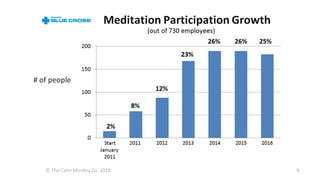
  • #10 185 people were coming to my weekly class on a drop-in basis. I then began to offer mindfulness to other organizations in Vancouver. My life’s purpose became: “To help as many people as possible create a better experience of life through mindfulness meditation.” I cannot do this alone, so I started The Calm Monkey so I could train others in the practical, programmatic way to bring this to the world.
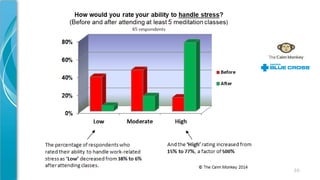
  • #11 This is one of the key charts I produced from my engaged group while at Pacific Blue Cross. Look at LOW self-rating: before taking classes, 38% (red) said their ability to handle stress was LOW. This reduced dramatically to 6% (green) after 5 classes. Look at HIGH self-rating: before taking classes, only 15% (red) said their ability to handle stress was HIGH. This increased dramatically to 77% (green) after 5 classes. That’s a 500% increase.
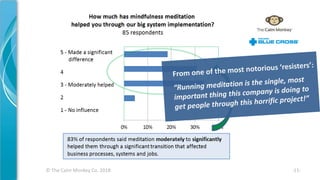
  • #12 I was the change manager for a massive 7 year transformation project at Pacific Blue Cross. Very over budget, delayed, stressful. I asked permission from my meditation group if I could experiment with them by combining change management with meditation to see how it helps them through change. I surveyed them 5 months post-implementation. Executives deemed this a change management success because people were calm, committed, and worked together to problem-solve as the project had a lot of technological difficulties. I write a write paper about my case study of Pacific Blue Cross and it won as the winning white paper with the global Association of Change Management professions. Please get the white paper from www.TheCalmMonkey.com as it helps many get approval to begin this at work.
  • #14 Some interest by key mgmt. You don’t need across-the-board active support. As long as you don’t have an active blocker, you can do this. Are you ready to drive this? Do you have the courage?
  • #15 You want to create a practice that’s engaging, respected, long-term that employees trust – be careful that they don’t think this is only for the benefit of the organization and not really for them. This model is NOT med teacher training. Facilitation not same as Teaching. Facilitators share own experience, create safe space, lead live meds & discussions, administer the program. Fac Training is online and takes 7-10 hours to complete, equipped w toolkit. Certification takes 10-12 hours. This teaches the practical & programmatic side of how get support, promote, grow, trust, results. My students have all sorts of roles: mgrs, CMs, HR, admin asst, coaches, counselors, yoga instuctors, etc. Some are employees within an organization, some are consultants offering mindfulness services to their clients and some provide services to their community.
  • #17 There are 2 main approaches to implement – there is no ‘right’ way. Depends heavily on many factors: size of organization, formality of processes, HR, etc. Starting small, even with a top-down approach is great – facilitators can get the experience, confidence, collect the benefits in data form and grow from there. Growing from a grassroots perspective seems to result in more buy-in and trust from an employee population. Give it time to grow; don’t expect a huge uptake at the start.
  • #19 Step 2: you will get people interested in having an ongoing practice AND people who would love to facilitate. Even if you have 5 people interested in being participants, do it, it’s great to start small. Step 3: Facilitators need to be properly trained - don’t expect them to start from scratch or know how to skillfully run a program or lead live guided meditations. Avoid the mistakes that can kill a program. Step 6: as an innovative idea, once you are up and running, consider helping people through difficult change. (see later slides)
  • #22 Change management is about helping people and organizations through change.
  • #23 People are living in survival mode, major monkey mind, auto-pilot interacting, reacting, behaving. We can help them discover what experience they want to have through difficult change, even if their circumstances remain difficult around them.
  • #24 I recently ran a public meditation study with my specialized change management meditation recording. Results exceeded expectations! I just posted my research paper on this on my website days ago. www.TheCalmMonkey.com.
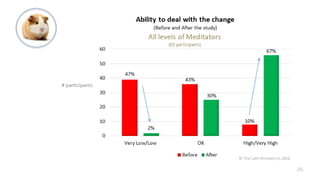
  • #26 This shows how their ability to deal with the chg shifted from before & after the study. Look at VERY LOW/LOW: RED is BEFORE the study: 47% (39 ppl) rated their Ability to Deal w Chg as VERY LOW/LOW. After the study, in GREEN, a dramatic drop to only 2% (2 ppl) saying Ability to Deal w Chg is VERY LOW/LOW. Look at HIGH/VERY HIGH: BEFORE the study, only 10% (8 ppl) rated their Ability to Deal w Chg as High. AFTER THE STUDY, a dramatic jump to 67% (56 ppl) rating their Ability at High.
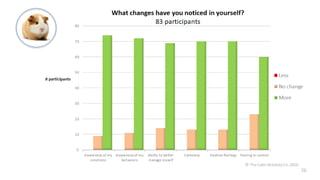
  • #27 Green shows that most of the participants noticed ‘more’ in each of these areas.
  • #28 People’s comments were incredible – plentiful, enthusiastic, and wanting to share this with their co-workers and friends. I asked them ‘if The Calm Monkey were to continue taking this further, what would help you?’ I received in-depth, amazing responses, which is fueling my development of an upcoming Dealing with Change Toolkit.
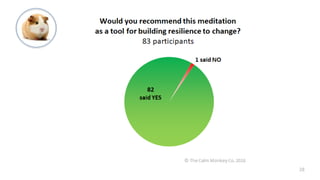
  • #29 The one person who said No, interestingly received positive benefit herself. She had meditation experience and felt that someone with no meditation experience at all may have trouble listening to a meditation. However, the data showed that everyone received benefit.
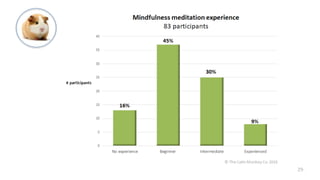
  • #30 Participants were distributed with regards to their level of meditation experience. All participants showed positive benefits. 2 major outcomes from this study: Research Paper - available on The Calm Monkey’s website. ‘Dealing with Change toolkit’ is being developed and will be available this summer. This is will be for individuals to buy or for organizations to distribute to their employees to help them through difficult change. It will be a quick, practical toolkit to teach them a little about how people go through difficult change, provide them with the Dealing with Change meditation plus other complementary meditations.
  • #31 Don’t let this be a fad, use these techniques to keep it going long-term and show the benefits.
  • #32 Please use my email to contact me, and use the resources to further your mission. If you are curious about Facilitator Training & Certification, try the free preview. Signing up for my newsletter will ensure you hear about The Calm Monkey’s news as more develops!