Basic of Welding 1
Welding and Related Processes
Session-I
By Rahul S.
Basic of Welding 2
Content:
• Introduction
• Weldability
• Types of welding
• Classification of welding processes
• Metallurgy of weld
• Gas welding
– Oxy-Acetylene Welding
• Welding Equipment
Basic of Welding 3
Introduction
• Welding is process of joining similar metals by application of
heat
• Fabrication industry depends on the welding
• Deriving new material depends on its weldability
Basic of Welding 4
Weldability
• Capacity of being welded having specific properties as weld strength,
proper structure
• Weld quality and the ease it can be done
• Weldabilty depends on
– melting point
– thermal conductivity
– thermal expansion
– surface condition
– change in microstructure
• Metallurgical, chemical, physical and thermal characteristics can be
controlled by,
– proper shielding atmosphere
– proper fluxing material
– proper filler material
– proper welding procedure
– proper heat treatment of the metal before and after deposition
Basic of Welding 5
Types of Welding
• Plastic welding
– Pressure welding
– Metal heated upto plastic state and then forced together by external pressure
– e.g. forge welding, resistance welidng.
• Fusion welding
– nonpressure welding
– metal is heated to molten state and the allowed to solidify
– e.g. gas welding, thermit welding.
• Cold-welding
– Without application of heat
– parts are joined by application of pressure, by bonding of inter surface
molecular structure
– used for nonferous materials like aluminium and its alloys.
Basic of Welding 6
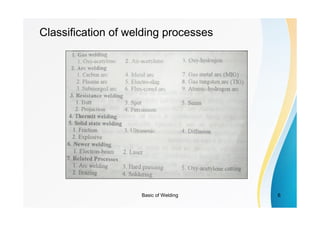
Classification of welding processes
Basic of Welding 7
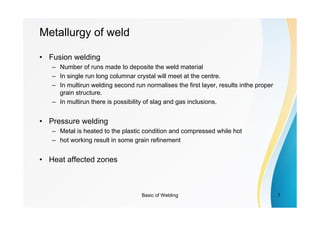
Metallurgy of weld
• Fusion welding
– Number of runs made to deposite the weld material
– In single run long columnar crystal will meet at the centre.
– In multirun welding second run normalises the first layer, results inthe proper
grain structure.
– In multirun there is possibility of slag and gas inclusions.
• Pressure welding
– Metal is heated to the plastic condition and compressed while hot
– hot working result in some grain refinement
• Heat affected zones
Basic of Welding 8
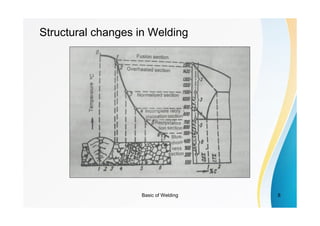
Structural changes in Welding
Basic of Welding 9
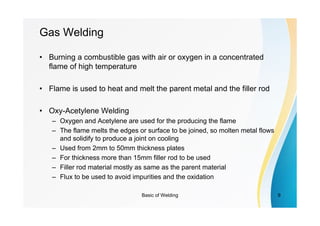
Gas Welding
• Burning a combustible gas with air or oxygen in a concentrated
flame of high temperature
• Flame is used to heat and melt the parent metal and the filler rod
• Oxy-Acetylene Welding
– Oxygen and Acetylene are used for the producing the flame
– The flame melts the edges or surface to be joined, so molten metal flows
and solidify to produce a joint on cooling
– Used from 2mm to 50mm thickness plates
– For thickness more than 15mm filler rod to be used
– Filler rod material mostly as same as the parent material
– Flux to be used to avoid impurities and the oxidation
Basic of Welding 10
Oxy-Acetylene Welding
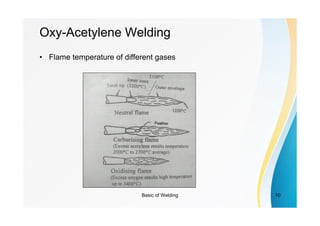
• Flame temperature of different gases
Basic of Welding 11
Oxy-Acetylene Welding
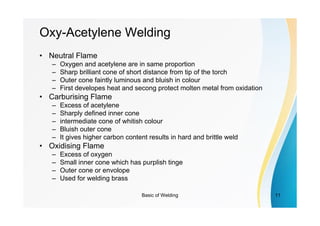
• Neutral Flame
– Oxygen and acetylene are in same proportion
– Sharp brilliant cone of short distance from tip of the torch
– Outer cone faintly luminous and bluish in colour
– First developes heat and secong protect molten metal from oxidation
• Carburising Flame
– Excess of acetylene
– Sharply defined inner cone
– intermediate cone of whitish colour
– Bluish outer cone
– It gives higher carbon content results in hard and brittle weld
• Oxidising Flame
– Excess of oxygen
– Small inner cone which has purplish tinge
– Outer cone or envolope
– Used for welding brass
Basic of Welding 12
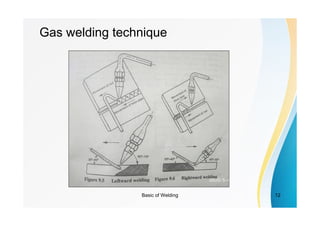
Gas welding technique
Basic of Welding 13
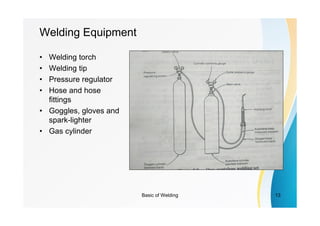
Welding Equipment
• Welding torch
• Welding tip
• Pressure regulator
• Hose and hose
fittings
• Goggles, gloves and
spark-lighter
• Gas cylinder
Basic of Welding 14
• Thank you...
– Next session will be on other welding processes as arc welding,
resistance welding, thermit welding etc

Welding and related processes

  • 1.
    Basic of Welding1 Welding and Related Processes Session-I By Rahul S.
  • 2.
    Basic of Welding2 Content: • Introduction • Weldability • Types of welding • Classification of welding processes • Metallurgy of weld • Gas welding – Oxy-Acetylene Welding • Welding Equipment
  • 3.
    Basic of Welding3 Introduction • Welding is process of joining similar metals by application of heat • Fabrication industry depends on the welding • Deriving new material depends on its weldability
  • 4.
    Basic of Welding4 Weldability • Capacity of being welded having specific properties as weld strength, proper structure • Weld quality and the ease it can be done • Weldabilty depends on – melting point – thermal conductivity – thermal expansion – surface condition – change in microstructure • Metallurgical, chemical, physical and thermal characteristics can be controlled by, – proper shielding atmosphere – proper fluxing material – proper filler material – proper welding procedure – proper heat treatment of the metal before and after deposition
  • 5.
    Basic of Welding5 Types of Welding • Plastic welding – Pressure welding – Metal heated upto plastic state and then forced together by external pressure – e.g. forge welding, resistance welidng. • Fusion welding – nonpressure welding – metal is heated to molten state and the allowed to solidify – e.g. gas welding, thermit welding. • Cold-welding – Without application of heat – parts are joined by application of pressure, by bonding of inter surface molecular structure – used for nonferous materials like aluminium and its alloys.
  • 6.
    Basic of Welding6 Classification of welding processes
  • 7.
    Basic of Welding7 Metallurgy of weld • Fusion welding – Number of runs made to deposite the weld material – In single run long columnar crystal will meet at the centre. – In multirun welding second run normalises the first layer, results inthe proper grain structure. – In multirun there is possibility of slag and gas inclusions. • Pressure welding – Metal is heated to the plastic condition and compressed while hot – hot working result in some grain refinement • Heat affected zones
  • 8.
    Basic of Welding8 Structural changes in Welding
  • 9.
    Basic of Welding9 Gas Welding • Burning a combustible gas with air or oxygen in a concentrated flame of high temperature • Flame is used to heat and melt the parent metal and the filler rod • Oxy-Acetylene Welding – Oxygen and Acetylene are used for the producing the flame – The flame melts the edges or surface to be joined, so molten metal flows and solidify to produce a joint on cooling – Used from 2mm to 50mm thickness plates – For thickness more than 15mm filler rod to be used – Filler rod material mostly as same as the parent material – Flux to be used to avoid impurities and the oxidation
  • 10.
    Basic of Welding10 Oxy-Acetylene Welding • Flame temperature of different gases
  • 11.
    Basic of Welding11 Oxy-Acetylene Welding • Neutral Flame – Oxygen and acetylene are in same proportion – Sharp brilliant cone of short distance from tip of the torch – Outer cone faintly luminous and bluish in colour – First developes heat and secong protect molten metal from oxidation • Carburising Flame – Excess of acetylene – Sharply defined inner cone – intermediate cone of whitish colour – Bluish outer cone – It gives higher carbon content results in hard and brittle weld • Oxidising Flame – Excess of oxygen – Small inner cone which has purplish tinge – Outer cone or envolope – Used for welding brass
  • 12.
    Basic of Welding12 Gas welding technique
  • 13.
    Basic of Welding13 Welding Equipment • Welding torch • Welding tip • Pressure regulator • Hose and hose fittings • Goggles, gloves and spark-lighter • Gas cylinder
  • 14.
    Basic of Welding14 • Thank you... – Next session will be on other welding processes as arc welding, resistance welding, thermit welding etc