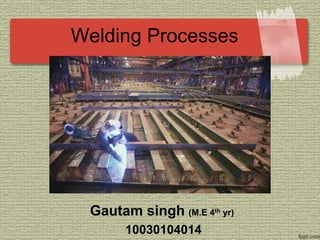
Welding Processes
Gautam singh (M.E 4th yr)
10030104014
WELDING
– Welding is a materials joining process which
produces coalescence of materials by heating
them to suitable temperatures with or without the
application of pressure or by the application of
pressure alone, and with or without the use of filler
material.
– Welding is used for making permanent joints.
– It is used in the manufacture of automobile bodies, aircraft
frames, railway wagons, machine frames, structural works,
tanks, furniture, boilers, general repair work and ship
building.
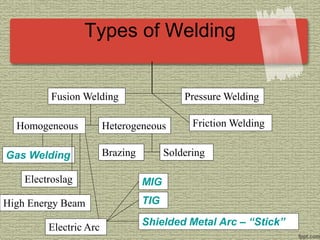
Types of Welding
Fusion Welding Pressure Welding
Homogeneous Heterogeneous
Brazing Soldering
Gas Welding
Electroslag
High Energy Beam
Electric Arc
MIG
TIG
Shielded Metal Arc – “Stick”
Friction Welding
Fusion Welding Principles
• Base metal is melted
• Filler metal may be added
• Heat is supplied by various means
– Oxyacetylene gas
– Electric Arc
– Plasma Arc
– Laser
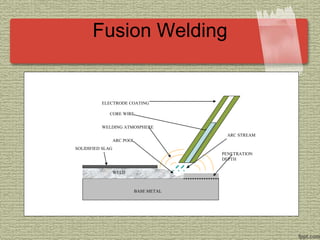
Fusion Welding
BASE METAL
WELD
SOLIDIFIED SLAG
ARC POOL
WELDING ATMOSPHERE
CORE WIRE
ELECTRODE COATING
ARC STREAM
PENETRATION
DEPTH
Weld Fluxes
• Typical fluxes
– SiO2, TiO2, FeO, MgO, Al2O3
– Produces a gaseous shield to prevent
contamination
– Act as scavengers to reduce oxides
– Add alloying elements to the weld
– Influence shape of weld bead during
solidification
Inert Gases
• Argon, helium, nitrogen, and carbon
dioxide
• Form a protective envelope around the
weld area
• Used in
– MIG
– TIG
– Shield Metal Arc
Types of Fusion Welding
• Oxyacetylene Cutting/Welding
• Shielded Metal Arc (“Stick”)
• Metal Inert Gas (MIG)
• Tungsten Inert Gas (TIG)
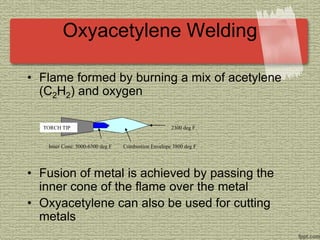
Oxyacetylene Welding
• Flame formed by burning a mix of acetylene
(C2H2) and oxygen
• Fusion of metal is achieved by passing the
inner cone of the flame over the metal
• Oxyacetylene can also be used for cutting
metals
Inner Cone: 5000-6300 deg F Combustion Envelope 3800 deg F
2300 deg F
TORCH TIP
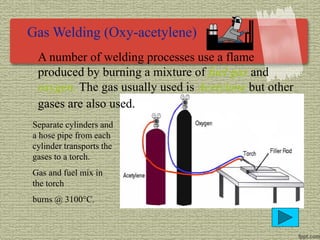
Gas Welding (Oxy-acetylene)
A number of welding processes use a flame
produced by burning a mixture of fuel gas and
oxygen. The gas usually used is Acetylene but other
gases are also used.
Separate cylinders and
a hose pipe from each
cylinder transports the
gases to a torch.
Gas and fuel mix in
the torch
burns @ 3100°C.
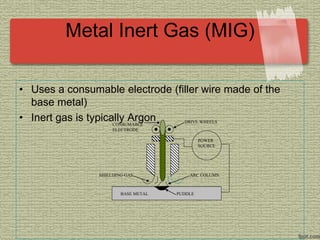
Metal Inert Gas (MIG)
• Uses a consumable electrode (filler wire made of the
base metal)
• Inert gas is typically Argon
BASE METAL PUDDLE
POWER
SOURCE
DRIVE WHEELS
CONSUMABLE
ELECTRODE
ARC COLUMN
SHIELDING GAS
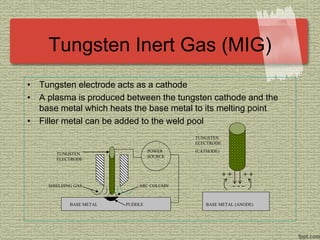
Tungsten Inert Gas (MIG)
• Tungsten electrode acts as a cathode
• A plasma is produced between the tungsten cathode and the
base metal which heats the base metal to its melting point
• Filler metal can be added to the weld pool
BASE METAL PUDDLE
POWER
SOURCE
ARC COLUMN
SHIELDING GAS
TUNGSTEN
ELECTRODE
+ +
BASE METAL (ANODE)
TUNGSTEN
ELECTRODE
(CATHODE)
- - -
+ +
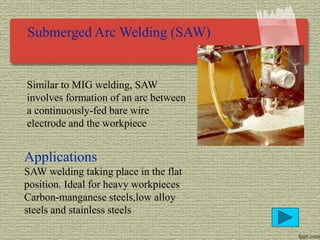
Submerged Arc Welding (SAW)
Similar to MIG welding, SAW
involves formation of an arc between
a continuously-fed bare wire
electrode and the workpiece
Applications
SAW welding taking place in the flat
position. Ideal for heavy workpieces
Carbon-manganese steels,low alloy
steels and stainless steels
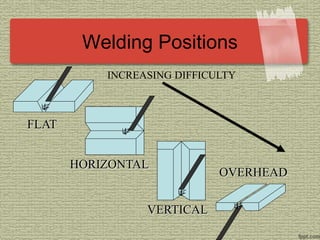
Welding Positions
FLAT
HORIZONTAL
VERTICAL
OVERHEAD
INCREASING DIFFICULTY
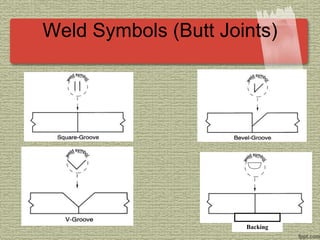
Weld Symbols (Butt Joints)
Backing
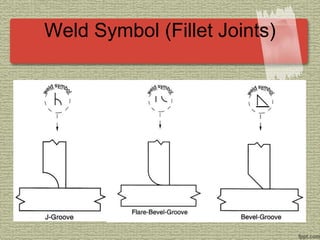
Weld Symbol (Fillet Joints)
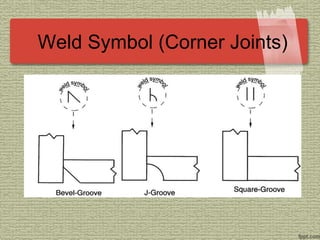
Weld Symbol (Corner Joints)

Welding Processes education power point ppt

  • 1.
    Welding Processes Gautam singh(M.E 4th yr) 10030104014
  • 2.
    WELDING – Welding isa materials joining process which produces coalescence of materials by heating them to suitable temperatures with or without the application of pressure or by the application of pressure alone, and with or without the use of filler material. – Welding is used for making permanent joints. – It is used in the manufacture of automobile bodies, aircraft frames, railway wagons, machine frames, structural works, tanks, furniture, boilers, general repair work and ship building.
  • 3.
    Types of Welding FusionWelding Pressure Welding Homogeneous Heterogeneous Brazing Soldering Gas Welding Electroslag High Energy Beam Electric Arc MIG TIG Shielded Metal Arc – “Stick” Friction Welding
  • 4.
    Fusion Welding Principles •Base metal is melted • Filler metal may be added • Heat is supplied by various means – Oxyacetylene gas – Electric Arc – Plasma Arc – Laser
  • 5.
    Fusion Welding BASE METAL WELD SOLIDIFIEDSLAG ARC POOL WELDING ATMOSPHERE CORE WIRE ELECTRODE COATING ARC STREAM PENETRATION DEPTH
  • 6.
    Weld Fluxes • Typicalfluxes – SiO2, TiO2, FeO, MgO, Al2O3 – Produces a gaseous shield to prevent contamination – Act as scavengers to reduce oxides – Add alloying elements to the weld – Influence shape of weld bead during solidification
  • 7.
    Inert Gases • Argon,helium, nitrogen, and carbon dioxide • Form a protective envelope around the weld area • Used in – MIG – TIG – Shield Metal Arc
  • 8.
    Types of FusionWelding • Oxyacetylene Cutting/Welding • Shielded Metal Arc (“Stick”) • Metal Inert Gas (MIG) • Tungsten Inert Gas (TIG)
  • 9.
    Oxyacetylene Welding • Flameformed by burning a mix of acetylene (C2H2) and oxygen • Fusion of metal is achieved by passing the inner cone of the flame over the metal • Oxyacetylene can also be used for cutting metals Inner Cone: 5000-6300 deg F Combustion Envelope 3800 deg F 2300 deg F TORCH TIP
  • 10.
    Gas Welding (Oxy-acetylene) Anumber of welding processes use a flame produced by burning a mixture of fuel gas and oxygen. The gas usually used is Acetylene but other gases are also used. Separate cylinders and a hose pipe from each cylinder transports the gases to a torch. Gas and fuel mix in the torch burns @ 3100°C.
  • 11.
    Metal Inert Gas(MIG) • Uses a consumable electrode (filler wire made of the base metal) • Inert gas is typically Argon BASE METAL PUDDLE POWER SOURCE DRIVE WHEELS CONSUMABLE ELECTRODE ARC COLUMN SHIELDING GAS
  • 12.
    Tungsten Inert Gas(MIG) • Tungsten electrode acts as a cathode • A plasma is produced between the tungsten cathode and the base metal which heats the base metal to its melting point • Filler metal can be added to the weld pool BASE METAL PUDDLE POWER SOURCE ARC COLUMN SHIELDING GAS TUNGSTEN ELECTRODE + + BASE METAL (ANODE) TUNGSTEN ELECTRODE (CATHODE) - - - + +
  • 13.
    Submerged Arc Welding(SAW) Similar to MIG welding, SAW involves formation of an arc between a continuously-fed bare wire electrode and the workpiece Applications SAW welding taking place in the flat position. Ideal for heavy workpieces Carbon-manganese steels,low alloy steels and stainless steels
  • 14.
  • 15.
    Weld Symbols (ButtJoints) Backing
  • 16.
  • 17.