Welcome - Bienvenue to CATaC’10 in  Vancouver , Canada diffusion 2.0: computing, mobility, and the next generation
Our seventh conference CATaC’98 – London, UK CATaC’00 – Perth, Australia  CATaC’02 – Montreal, Canada CATaC’04 – Karlstad, Sweden CATaC’06 – Tartu, Estonia CATaC’08 – N î mes, France CATaC’10 – Vancouver, Canada CATaC’12 –  Aarhus, Denmark
Why CATaC conferences? extended network of interested people  current database of 800 focus on discussions and future directions further publications special issues of journals, books Excellence in Research in Australia (ERA)  approved first and second looks serious issues – preserving cultural diversity
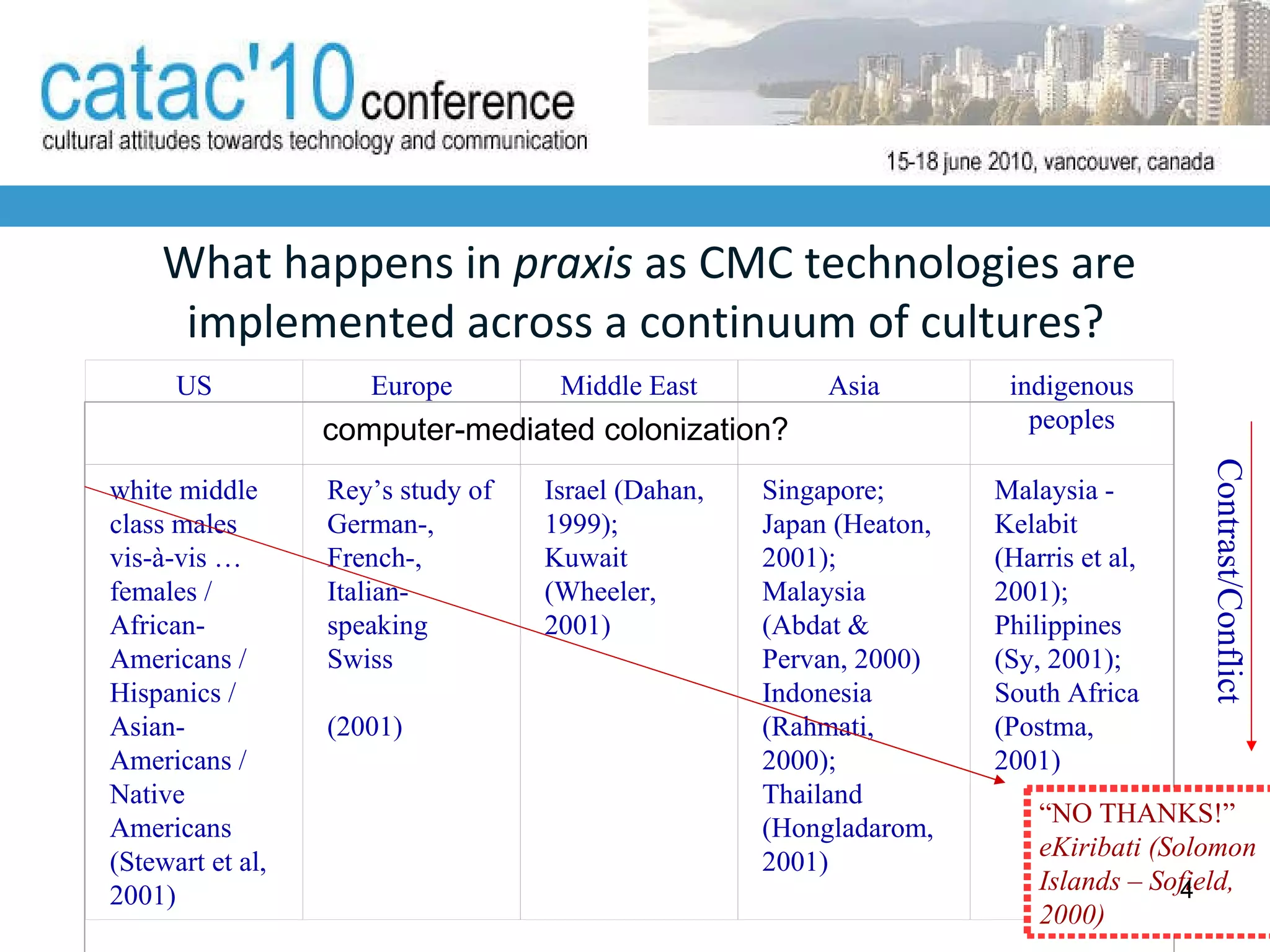
    W hat happens in  praxis  as CMC technologies are implemented across a continuum of cultures? “ NO THANKS!”  eKiribati (Solomon Islands – Sofield, 2000) computer-mediated colonization? US Europe Middle East Asia indigenous peoples white middle class males vis-à-vis … females /  African-Americans /  Hispanics /  Asian-Americans / Native Americans (Stewart et al, 2001) Rey’s study of German-, French-, Italian-speaking Swiss (2001) Israel (Dahan, 1999); Kuwait (Wheeler, 2001) Singapore; Japan (Heaton, 2001); Malaysia (Abdat & Pervan, 2000) Indonesia (Rahmati, 2000); Thailand (Hongladarom, 2001) Malaysia - Kelabit (Harris et al, 2001); Philippines (Sy, 2001); South Africa (Postma, 2001) Contrast/Conflict
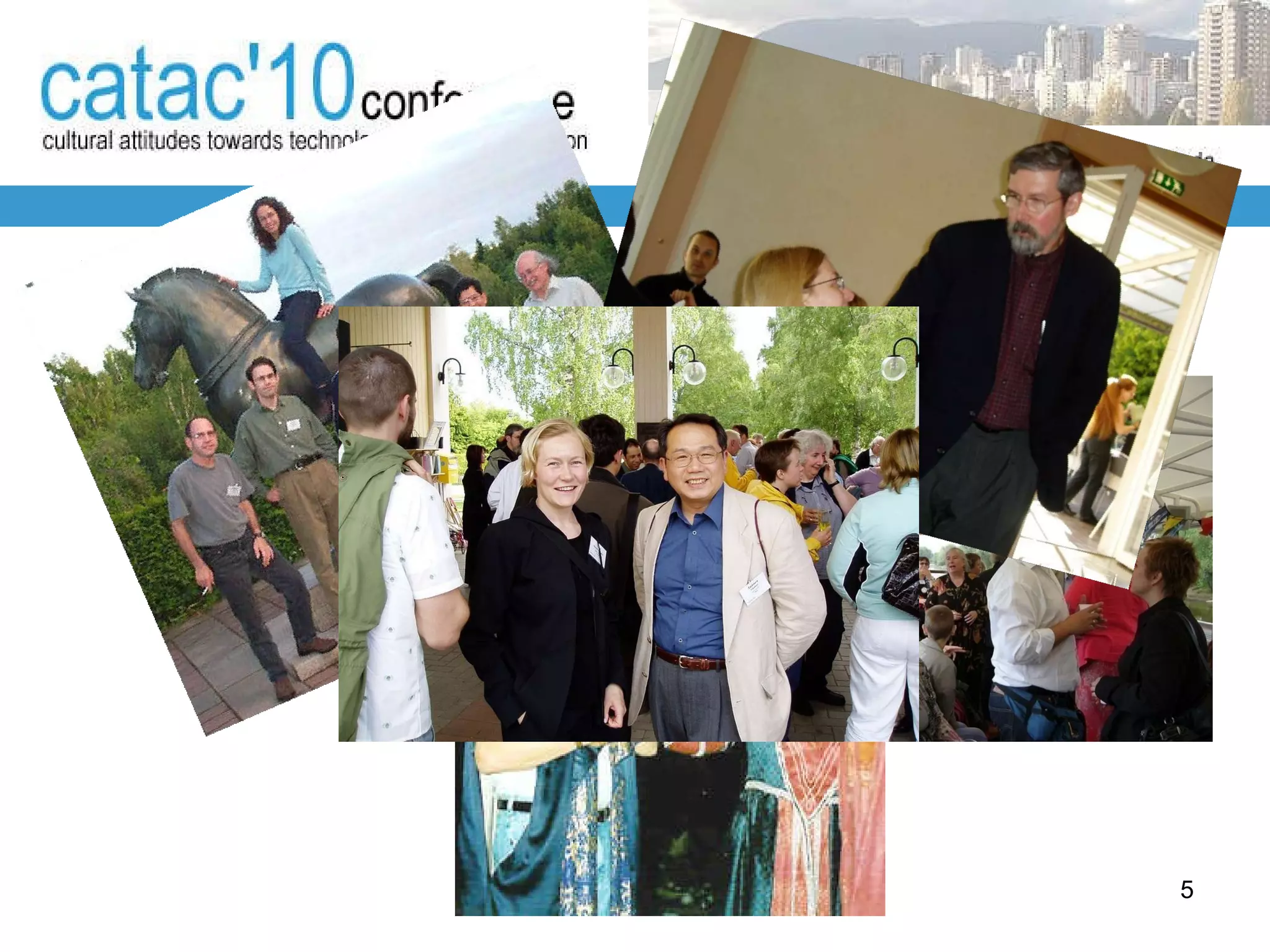
Why CATaC conferences? fun conferences
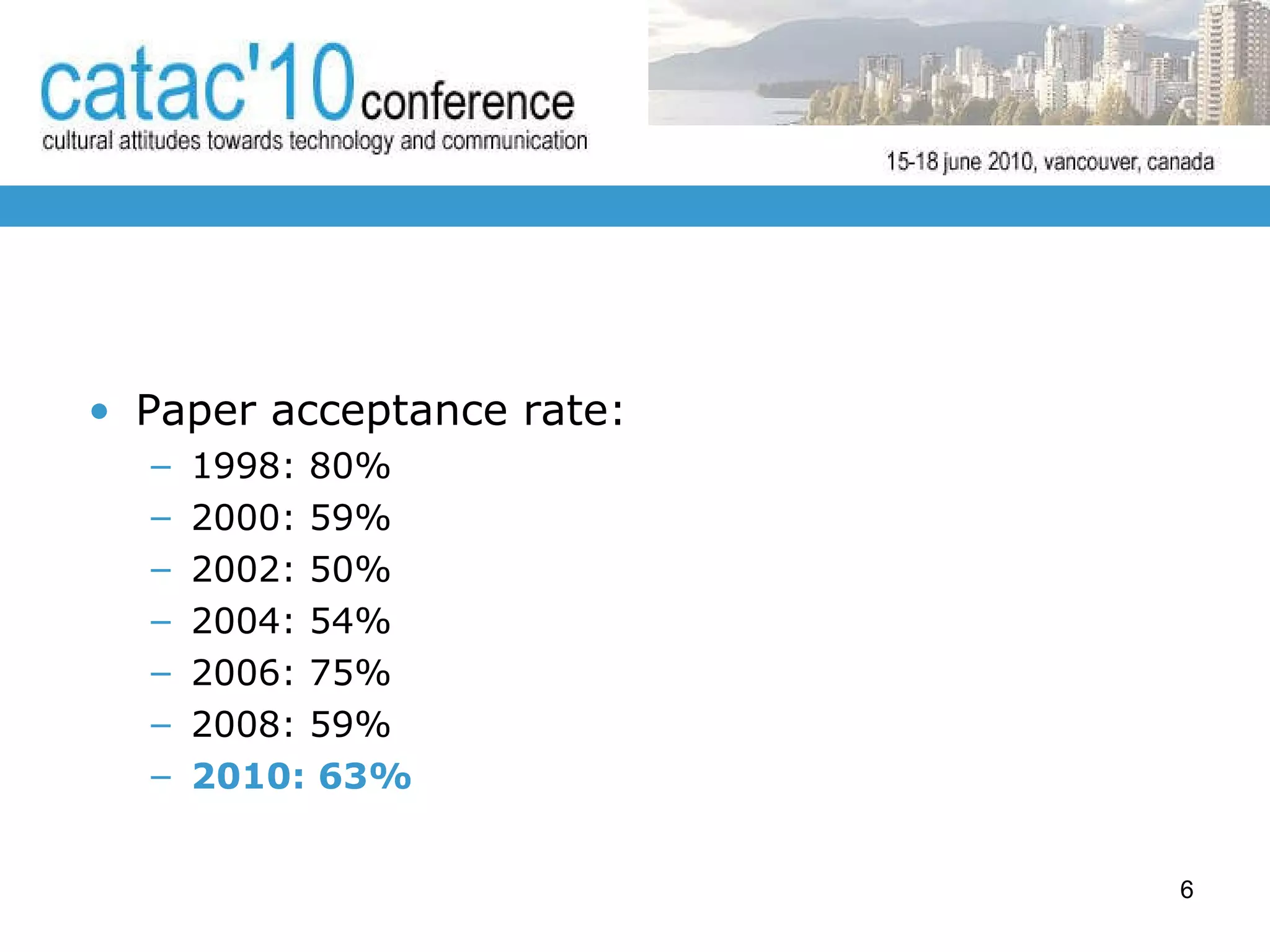
Paper acceptance rate:  1998: 80% 2000: 59% 2002: 50% 2004: 54% 2006: 75% 2008: 59% 2010: 63%
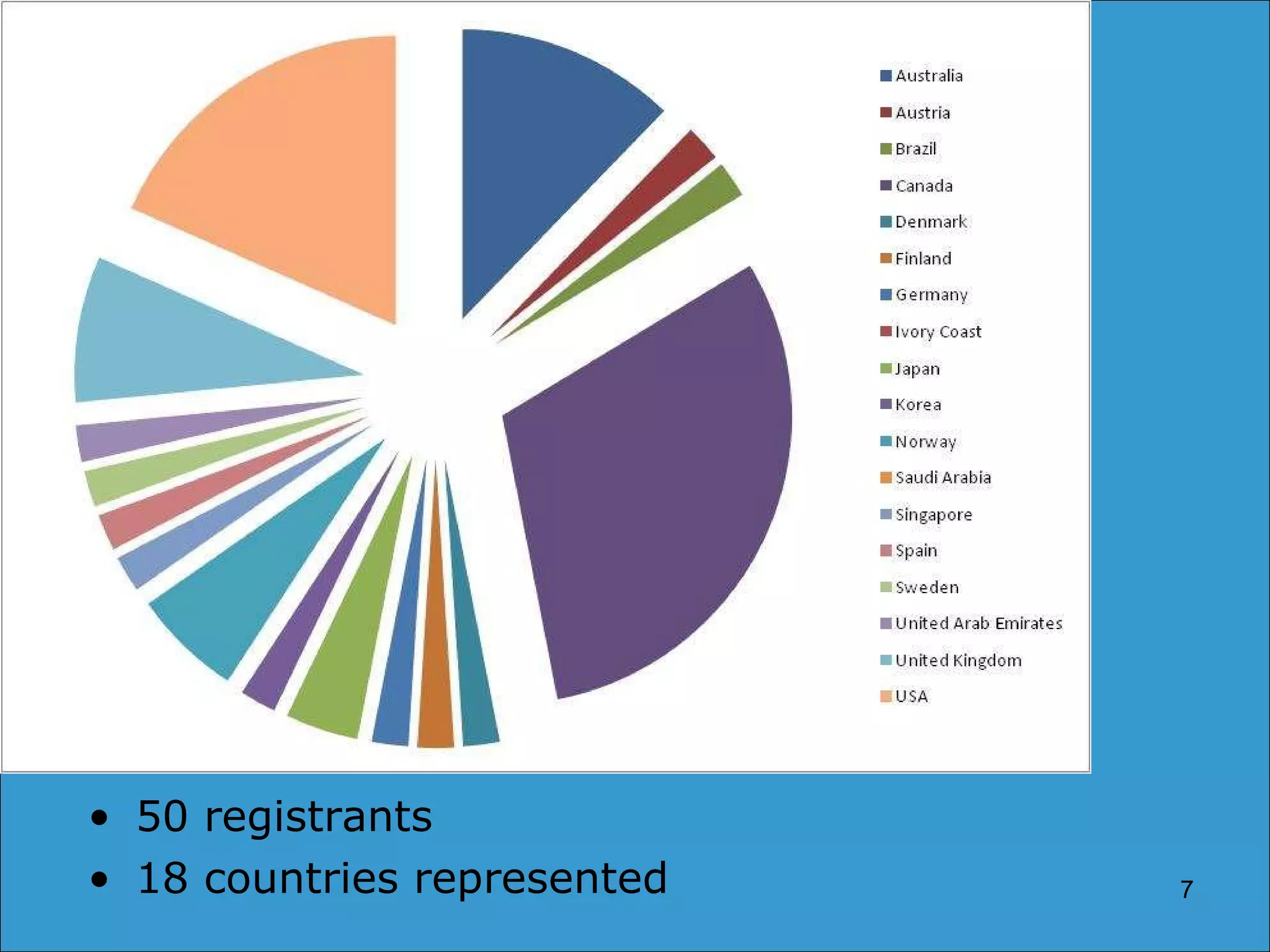
50 registrants 18 countries represented
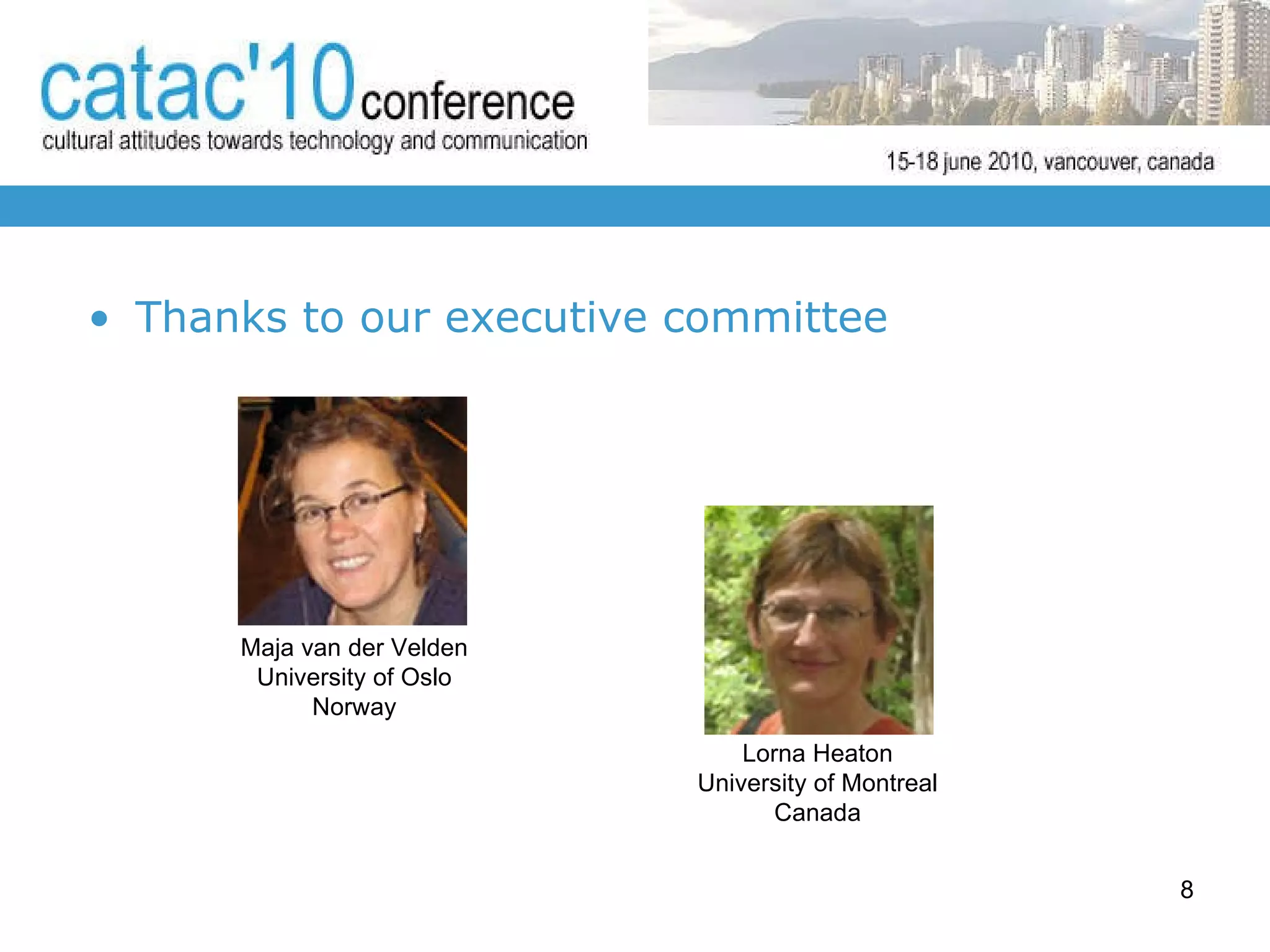
Thanks to our executive committee Lorna Heaton University of Montreal Canada Maja van der Velden University of Oslo Norway
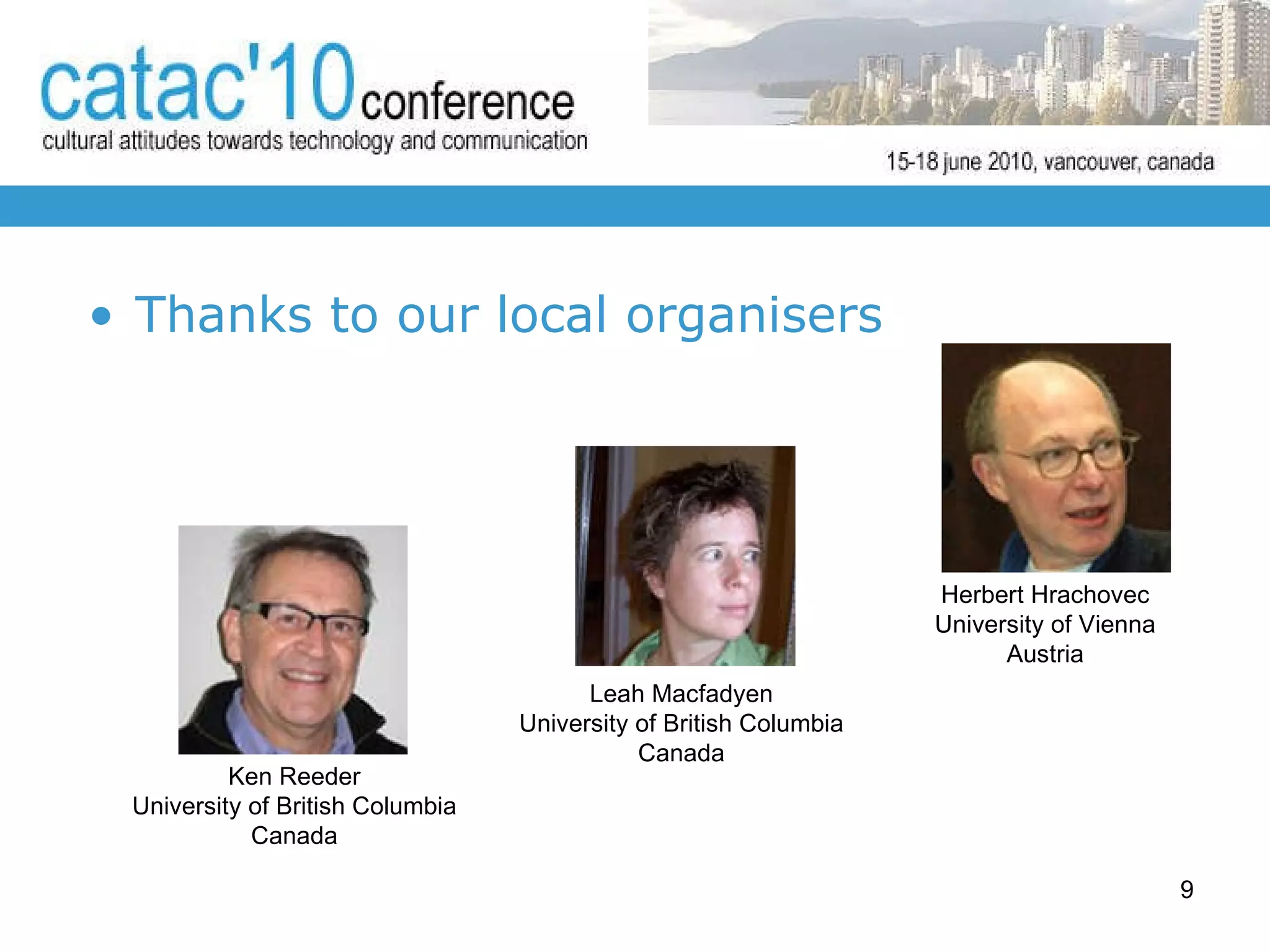
Thanks to our local organisers Herbert Hrachovec University of Vienna Austria Ken Reeder University of British Columbia Canada Leah Macfadyen University of British Columbia Canada
Thanks to our keynote speaker Linc Kesler Associate Professor, The University of British Columbia Director, First Nations Studies Program Director, First Nations House of Learning Senior Advisor to the President on Aboriginal Affairs
Thanks to our sponsors: University of British Columbia: Department of Language and Literacy Education Office of the Dean, Faculty of Education Office of Graduate Programs and Research, Faculty of Education Centre for Intercultural Language Studies Library Office of Learning Technology Department of Information and Media Studies, Aarhus University, Denmark Drury University, Missouri, USA  School of Information Technology, Murdoch University, Australia
Thanks to you: Program Review Committee (68 members) Session chairs Presenters  Participants
First First Looks on-going critique  of the assumptions, categories, methodologies, and theories frequently used to analyze these basic concepts and categories.  (We like the word – and practice of – “critique”…) e.g.,  critiques  of design practice (van der Velden, Nocera & Camara) critique  of the commodification process of Cyworld users, because Cyworld is  engaged in the commodification of what can be understood as free labor. (Jin) an emerging concern in CMC research: cf. Kendall, Baym, others in Consalvo & Ess, 2010. critical inquiry:  Don Krug and Jenny Arntzen  We argue that an integrated and negotiated approach to critical inquiry linking ecological justice through education can help researchers, teachers, and students analyze conditions of culture(s) within the contexts of complex political and social conditions that are prevalent in most societies.
First First Looks “ nodal points” among the intersections of ‘culture,’ technology, communication:  the ethical and cultural dimensions of ICT design  (Session3) ; culture and website design  (Session4A); the potentials of – and real-world limitations on – ICTs for empowerment  in diverse manifestations and countries (Session 5A);  specific attention to ethical issues evoked by developing ICTs  (Session 6A); culture and learning  (Session 7A); and  culture and teaching  (Session 7B).
First First Looks on-going attention to  ICTs among and (ideally) for indigenous peoples  (CATaC’98: indigenous peoples in Uganda (McConnell), Australia (Turk & Trees); thematic attention in Stander …) In addition to welcome from Elder Grant, opening address by Dr. Linc Kesler -  first plenary session on Indigenous Knowledge.  Overall, CATaC’10 includes research and reflection in the distinctive cultural contexts of indigenous peoples in North and South America, Africa, Scandinavia, and Australia
First First Looks increasing attention  to mobile technologies … new categories for CATaC – including attention to media spaces (Sessions 5B and 6B)…  and  the “ones of a kind” (Session 4B) –  at least three of which, however, share an interest in  power  as understood one way or another, i.e.: commodification in Cyworld (Jin); reformation, if not revolution, in the Middle East (Hofheinz); sexuality, Foucault, and chatroulette (Kreps) “ photo bombing ” (Fletcher & Greenhill) may have to do with power in some way – but will at least provide for some comic relief? Empowerment  as the thematic of 5A    role of  power  vis-à-vis diverse models of  literacy  – Andema, Kendrick, & Norton
Second First Looks Shared thematics …  1. Though not always using the terms familiar from Innis-Eisenstein-McLuhan-Ong (and: Naomi Baron [2008] and Zsuzsanna Kondor [2009]) – efforts to consider indigenous knowledges consistently point out their distinctive characteristics as   relational, performative, and dynamic  – and involving the non-articulate, non-discursive dimensions of  tacit  knowledge (from Polanyi: van der Velden)  i.e., among other things,  oral  – so Charnley & McLean, Brady & Dyson    increasing recognition in CMC scholarship more broadly of the role of embodied co-presence, in contrast with “cognitivist” accounts of knowledge as abstract, representational, etc.  (Consalvo & Ess, 2010; Ess & Thorseth, 2010)
Second First Looks Shared thematics … 2. Though not always explicit – interest in the crucial topic of  how new media interact with our sense of self/identity , e.g.  C. Lloyd – mobile phone use and identity formation among young Australians  A. Hofheinz - the rise of individualism in the Arab world Contra  1990s / Sherry Turkle / post-modernist / post-structuralist celebrations of anonymity + identity-play online – at least in Saudi Arabia - Y. Al-Saggaf, J. Weckert, 2010, 254) in terms of (gender and) impression management +  relational self :  We need to start looking at impression management not only as a set of projection choices, but also a system of suppression of self and others.  A key question should be how users understand their own right and ability to shape not only their own identity, but the identity of others online.  (Strano and Wattai 2010, 296f.) Western individualism, scientific method vs. collectivism – Iitaka youth and ICTs as a “relationship revolution” (Schrage in Miller)
Second First Looks Shared thematics  (2. how new media interact with our sense of self/identity , continued) Understanding how identity is defined and managed on social networking sites is central to understanding the culture negotiated by users of these sites. We need to start looking at impression management not only as a set of projection choices, but also a system of suppression of self and others.  A key question should be how users understand their own right and ability to shape not only their own identity, but the identity of others online.  (Strano and Wattai 2010, 296f.) relational self facilitated through affordances of online communication?    cf. Ess, 2010, Ess & Thorseth, 2010
Second First Looks From CATaC’98 onward:  Methodological issues  – how to get at what we’re studying? Lloyd’s use of Discourse Analysis ((cf. Susan Herring’s development of “computer-mediated discourse analysis”) virtual ethnography and online communities (L. Uridge, D. Rodan and L. Green) grounded theory (Y. Al-Saggaf, J. Weckert) articulations as counter-methodologies (Krug & Arntzen) Goffman on impression management – and beyond (Strano & Wattai) content analysis – Cyr, Nakada “ contextual inquiries” and card sorting – Camara & Nocera cf. discussion by Birkland & Kaarst-Brown Vygotsky (+ social constructivism) – Miller, Kim & Anderson, Kinasevych New Literacy Studies perspective of viewing literacy as a social practice situated in a specific sociocultural context (Andema, Kendrick and Norton)
Second First Looks ‘ Culture’ both  for  and  against  ICT adoption, diffusion There is a fit between the multimedia features of mobile devices and the traditional strengths in Aboriginal culture, namely  oral and audio practices (song, music, storytelling and ceremony)  and also pictorial expression (painting, sculpture and carving). This would explain the greater uptake of the multimedia functions of mobile phones by Aboriginal people. (emphasis added, CE) BUT The personal nature of the devices allows the owner to decide whether they will share it with others. This permits Aboriginal people to control costs by  circumventing culture , that is by avoiding the norm of reciprocity which typically encourages sharing. (Brady & Dyson, 81)
Second First Looks Making progress on the matter of ‘culture,’ technology, and communication? Sorta … certainly greater recognition, sophistication of what ‘culture’ might mean vis-à-vis design and implementation of ICTs, including ICTs for development BUT also strong recognition of how even the best current efforts remain inadequate, e.g., van der Velden, Nocera & Camara, among others.
Second First Looks So what does ‘culture’ mean? First of all, language -  Norton, Early & Tembe; Andersen & van der Velden; Hewling & Sesan; Lloyd; Lim  And: Hofstede is alive and well –  To understand how national culture is related to social psychological phenomena such as trust, researchers (Cyr et al., 2005; Cyr, 2008a; Dawar et al., 1996; Jarvenpaa et al., 1999; Simon, 2001; Yamagishi and Yamagishi, 1994) refer to Hofstede’s (1984) cultural dimensions of individualism-collectivism, uncertainty avoidance, power distance, and femininity-masculinity.  In the research documented in this article, Hofstede’s dimensions are used as a proxy to determine cultural differences or similarities among countries. However, it is recognized and expected that individual value differences also occur within countries.  (Cyr, 2010, 137) HCI researchers have used national cultural dimensions, such as power distance or collectivism (Hofstede, 1991), as independent variables in the study of the usability of systems (del Galdo, 1996; Smith, Dunckley, French, Minocha, & Chang, 2004). This type of research into cross-cultural user interface design has established the existence of a cultural effect in the use of ICT that goes beyond language differences . (Nocera & Camara, 2010, 152)
Second First Looks So what does ‘culture’ mean? Hofstede is alive and well –  Cf.  Y. Al-Saggaf, J. Weckert: power distance in Saudi Arabia Camara & Nocera: collectivism in Africa Iitaka: collectivism and Japanese  seken  (cf. Nakada) among the five culture dimensions, …power distance, long term orientation, and individualism have effects on students  Lee, Sudweeks, Cheng & Tang, 2010, 400; O. Kinasevych At the same time, critique of Hofstede also manifest: …  the predominate way put forward of relating to culture through nationally derived value dimensions is increasingly receiving critique as not sufficient to guide improvement endeavors such as the ones at World Maritime University.  This short paper puts forward an alternative methodological approach based on an ethnographic research cycle  Bolmsten, 2010, 109f.  
Second First Looks So what does ‘culture’ mean?    both/and approach:  (1) as „software of the mind‟ that controls user behaviours and responses, which then can be measured and analysed in order to produce high level predictive models;  (2) as meanings and discourse that cannot necessarily be measured, but which is richer and more detailed about users’ practices and expectations. (Nocera & Camara, 2010, 158)
Second First Looks What is happening to “thick” cultures in the “thin” culture of the Internet / Web? On the one hand: The results show that there is a higher possibility for a “world wide web culture”  than a “world wide web of cultures” for the kinds of users characterised by participants in this study (Turk, 2000), having significant exposure to web sites. (Lim, 2010, 133; cf. Hongladarom, 2008) On the other hand:  In research in which design characteristics were considered across cultures different user preferences were found  (Cyr et al., 2009a; del Galdo and Nielsen, 1996; Marcus and Gould, 2000). Singh et al. (2003) employed content analysis of 40 American-based companies to compare their domestic and Chinese websites . Significant differences in cultural characteristics were found for all major categories tested . The authors concluded that,  “[T]he web is not a culturally neutral medium” (p. 63). (Cyr, 2010, 136)
Second First Looks What is happening to “thick” cultures in the “thin” culture of the Internet / Web? On the third hand: there were large differences between the Japanese and Americans, Canadians or Germans.  Contrary to expectations, Japanese respondents trusted their local website least, while Germans trusted their local site most. Similar results were found for users viewing the  foreign version of the  website. (Cyr, 2010, 139) And : Despite the fact that a tendency to act according to [Bulgarian and Lithuanian] cultural dispositions can be shown  those influences were not found to be statistically significant . (Roche & Todorova) Finally: the danger of “computer-mediated colonization” remains, e.g. the transformative potential of ICTs, especially in non-Western contexts, may not be fully realized if local cultural knowledge is underestimated, especially in the field of education. (Andema, Kendrick and Norton)
Second First Looks New(er) theoretical approaches ‘ intra-action’  (Borad, Suchman – van der Velden) “ Whereas the construct of interaction suggests two entities, given in advance, that come together and engage in some kind of exchange,  intra-action  underscores the sense in which subjects and objects emerge through their encounters with each other”. In this perspective, the characteristics, properties, and meanings of technologies emerge from the intra-actions with other artifacts and with humans. The culture of an artifact is the effect of a particular configuration of humans and things. Artifacts do have culture, but not as an intrinsic characteristic, neither as something given by its users. intersubjectivity  (as based on neuroscience + phenomenology) - A. López-Varela Azcárate the sharing of experiences is not only, not even primarily, on a cognitive level, but also and more basically, on the level of affect, perceptual processes and conative (action-oriented) engagements. Such sharing and understanding is based on embodied interaction (e.g. empathic perception, imitation, gesture and practical collaboration). Crucial cognitive capacities are initially social and interactional and are only later understood in private or representational terms. Cf. Susan Stuart, “enactivism” (2008) All of the above as  anti- Cartesian     relational  conceptions,  embodiment
Second First Looks Even ethics!  (beyond sessions 3, 6A) …  of design: van der Velden invokes Brigham and Introna (2007) who in turn “call upon the ethical philosophy of Levinas, whose ethics of the Other addresses our responsibility for the Other and the relationship between our Self and the unique, unknowable Other” (van der Velden 2008, 2009). …  surrounding issues of freedom of expression – in Saudi Arabia (Y. Al-Saggaf, J. Weckert)
Second First Looks Intersecting (intra-acting?) thematics, interests, topoi Do new communication technologies offer the possibility of revolution / reformation / empowerment?  in the Middle East / Arabic world: Hofheinz, Y. Al-Saggaf, J. Weckert  for women: Z. Laizu, J. Armarego, F. Sudweeks;  for academics with “English as an Other Language (EOL)” but who need / want to publish in English?: Carey for the poor in the U.S. – Obama’s campaign (McQueen & Green) for Japanese students learning to negotiate Canadian culture - McMichael
Second First Looks You got problems?  We got solutions … Professional learning communities for online instructors (Elder & Padover) Selected technology and best practices from various disciplines were outlined as examples of how leaders can bring about positive change and focus on cutting edge techniques for classroom and business applications (Cunniff)
Second First Looks “ Conspicuous by their absence” – or at least, their comparatively reduced presence …. Enthusiasm for Open Source – but see: Carey on Open Courseware, Iitaka on open source and (Japanese) collectivism Extensive concern for “the Digital Divide” (tacit?) On the other hand – ongoing / new research opportunities, directions: Our recent bibliographic work has suggested that  less than 0.01% (7:75,860 articles) of literature in the top information systems journals addresses older users (or non-users) of ICT s. ( Birkland & Kaarst-Brown, 2010, 343) While there is little research on media-supported language learning in general  there is hardly any reliable research on the impact of the cultural disposition of language learners on media-based language learning and instruction in particular  (cf. Macfadyen et al., 2004 and the volume edited by Zhang and Barber 2008).  (Roche & Todorova, 2010, 437)
Second First Looks Preliminary concluding reflections 1.  Among many other things that can be said here – McLuhan and Parker appear to have been correct:  computers and data banks will lead to an age of co-presence, an  implosion  in which “everybody is involved with everybody” (McLuhan and Parker 1968, p 35).  At the same time, as Miller reminds us (echoing Ong and, more recently, Klaus Bruhn Jensen [2010]): The expansion of literacy to include modes of meaning-making beyond the configuration of the printed text and the page does not mean the end of print literacy. (2010, 377) On the contrary: print books might afford greater opportunity for labeling than do digital books. Labeling is considered especially important for young children in that it is a mechanism for helping children learn to attend to salient features of books and their world (Ninio and Bruner, 1976) and to encourage the development of word meaning (Laura, 2002). Kim & Anderson, 2010, 398.
Second First Looks 2. While the emergence of new technologies, including communication technologies, tends to attract our focus / attention to these devices, their affordances, etc. - it is salutary to remember that we are interested more fundamentally in  human beings  and their communicative engagements via the technologies the need for refreshing / revising our “philosophical anthropologies,” e.g. Human beings are reflexive agents who embody repertoires of social and cultural meanings and practices (Bourdieu‟s „habitus‟) which they appropriate, transform, and resist for particular goals and purposes. ( López-Varela Azcárate, 2010, 433)
Second First Looks 3. And while such human beings clearly remain “cultural” animals (however much we struggle to discern / define what ‘culture’ might mean …) – we are not fully determined by ‘culture,’ e.g., While the cultural disposition initially guides the students in what to expect of and how to approach a media-based programme such as the one used for the study - students act more autonomously and across cultural specific preferences when the program offers them a meaningful access to alternative learning routes. (Roche & Todorova, 2010, 443)  Cf. Hewling;  Gunawardena et al’s use of “idioculture” (2008)
Second First Looks Many thanks! Tusind tak! Enjoy! God fornøjelse!

Welcome-Firstlooks

  • 1.
    Welcome - Bienvenueto CATaC’10 in Vancouver , Canada diffusion 2.0: computing, mobility, and the next generation
  • 2.
    Our seventh conferenceCATaC’98 – London, UK CATaC’00 – Perth, Australia CATaC’02 – Montreal, Canada CATaC’04 – Karlstad, Sweden CATaC’06 – Tartu, Estonia CATaC’08 – N î mes, France CATaC’10 – Vancouver, Canada CATaC’12 – Aarhus, Denmark
  • 3.
    Why CATaC conferences?extended network of interested people current database of 800 focus on discussions and future directions further publications special issues of journals, books Excellence in Research in Australia (ERA) approved first and second looks serious issues – preserving cultural diversity
  • 4.
     W hat happens in praxis as CMC technologies are implemented across a continuum of cultures? “ NO THANKS!” eKiribati (Solomon Islands – Sofield, 2000) computer-mediated colonization? US Europe Middle East Asia indigenous peoples white middle class males vis-à-vis … females / African-Americans / Hispanics / Asian-Americans / Native Americans (Stewart et al, 2001) Rey’s study of German-, French-, Italian-speaking Swiss (2001) Israel (Dahan, 1999); Kuwait (Wheeler, 2001) Singapore; Japan (Heaton, 2001); Malaysia (Abdat & Pervan, 2000) Indonesia (Rahmati, 2000); Thailand (Hongladarom, 2001) Malaysia - Kelabit (Harris et al, 2001); Philippines (Sy, 2001); South Africa (Postma, 2001) Contrast/Conflict
  • 5.
    Why CATaC conferences?fun conferences
  • 6.
    Paper acceptance rate: 1998: 80% 2000: 59% 2002: 50% 2004: 54% 2006: 75% 2008: 59% 2010: 63%
  • 7.
    50 registrants 18countries represented
  • 8.
    Thanks to ourexecutive committee Lorna Heaton University of Montreal Canada Maja van der Velden University of Oslo Norway
  • 9.
    Thanks to ourlocal organisers Herbert Hrachovec University of Vienna Austria Ken Reeder University of British Columbia Canada Leah Macfadyen University of British Columbia Canada
  • 10.
    Thanks to ourkeynote speaker Linc Kesler Associate Professor, The University of British Columbia Director, First Nations Studies Program Director, First Nations House of Learning Senior Advisor to the President on Aboriginal Affairs
  • 11.
    Thanks to oursponsors: University of British Columbia: Department of Language and Literacy Education Office of the Dean, Faculty of Education Office of Graduate Programs and Research, Faculty of Education Centre for Intercultural Language Studies Library Office of Learning Technology Department of Information and Media Studies, Aarhus University, Denmark Drury University, Missouri, USA School of Information Technology, Murdoch University, Australia
  • 12.
    Thanks to you:Program Review Committee (68 members) Session chairs Presenters Participants
  • 13.
    First First Lookson-going critique of the assumptions, categories, methodologies, and theories frequently used to analyze these basic concepts and categories. (We like the word – and practice of – “critique”…) e.g., critiques of design practice (van der Velden, Nocera & Camara) critique of the commodification process of Cyworld users, because Cyworld is engaged in the commodification of what can be understood as free labor. (Jin) an emerging concern in CMC research: cf. Kendall, Baym, others in Consalvo & Ess, 2010. critical inquiry: Don Krug and Jenny Arntzen We argue that an integrated and negotiated approach to critical inquiry linking ecological justice through education can help researchers, teachers, and students analyze conditions of culture(s) within the contexts of complex political and social conditions that are prevalent in most societies.
  • 14.
    First First Looks“ nodal points” among the intersections of ‘culture,’ technology, communication: the ethical and cultural dimensions of ICT design (Session3) ; culture and website design (Session4A); the potentials of – and real-world limitations on – ICTs for empowerment in diverse manifestations and countries (Session 5A); specific attention to ethical issues evoked by developing ICTs (Session 6A); culture and learning (Session 7A); and culture and teaching (Session 7B).
  • 15.
    First First Lookson-going attention to ICTs among and (ideally) for indigenous peoples (CATaC’98: indigenous peoples in Uganda (McConnell), Australia (Turk & Trees); thematic attention in Stander …) In addition to welcome from Elder Grant, opening address by Dr. Linc Kesler - first plenary session on Indigenous Knowledge. Overall, CATaC’10 includes research and reflection in the distinctive cultural contexts of indigenous peoples in North and South America, Africa, Scandinavia, and Australia
  • 16.
    First First Looksincreasing attention to mobile technologies … new categories for CATaC – including attention to media spaces (Sessions 5B and 6B)… and the “ones of a kind” (Session 4B) – at least three of which, however, share an interest in power as understood one way or another, i.e.: commodification in Cyworld (Jin); reformation, if not revolution, in the Middle East (Hofheinz); sexuality, Foucault, and chatroulette (Kreps) “ photo bombing ” (Fletcher & Greenhill) may have to do with power in some way – but will at least provide for some comic relief? Empowerment as the thematic of 5A  role of power vis-à-vis diverse models of literacy – Andema, Kendrick, & Norton
  • 17.
    Second First LooksShared thematics … 1. Though not always using the terms familiar from Innis-Eisenstein-McLuhan-Ong (and: Naomi Baron [2008] and Zsuzsanna Kondor [2009]) – efforts to consider indigenous knowledges consistently point out their distinctive characteristics as relational, performative, and dynamic – and involving the non-articulate, non-discursive dimensions of tacit knowledge (from Polanyi: van der Velden) i.e., among other things, oral – so Charnley & McLean, Brady & Dyson  increasing recognition in CMC scholarship more broadly of the role of embodied co-presence, in contrast with “cognitivist” accounts of knowledge as abstract, representational, etc. (Consalvo & Ess, 2010; Ess & Thorseth, 2010)
  • 18.
    Second First LooksShared thematics … 2. Though not always explicit – interest in the crucial topic of how new media interact with our sense of self/identity , e.g. C. Lloyd – mobile phone use and identity formation among young Australians A. Hofheinz - the rise of individualism in the Arab world Contra 1990s / Sherry Turkle / post-modernist / post-structuralist celebrations of anonymity + identity-play online – at least in Saudi Arabia - Y. Al-Saggaf, J. Weckert, 2010, 254) in terms of (gender and) impression management + relational self : We need to start looking at impression management not only as a set of projection choices, but also a system of suppression of self and others. A key question should be how users understand their own right and ability to shape not only their own identity, but the identity of others online. (Strano and Wattai 2010, 296f.) Western individualism, scientific method vs. collectivism – Iitaka youth and ICTs as a “relationship revolution” (Schrage in Miller)
  • 19.
    Second First LooksShared thematics (2. how new media interact with our sense of self/identity , continued) Understanding how identity is defined and managed on social networking sites is central to understanding the culture negotiated by users of these sites. We need to start looking at impression management not only as a set of projection choices, but also a system of suppression of self and others. A key question should be how users understand their own right and ability to shape not only their own identity, but the identity of others online. (Strano and Wattai 2010, 296f.) relational self facilitated through affordances of online communication?  cf. Ess, 2010, Ess & Thorseth, 2010
  • 20.
    Second First LooksFrom CATaC’98 onward: Methodological issues – how to get at what we’re studying? Lloyd’s use of Discourse Analysis ((cf. Susan Herring’s development of “computer-mediated discourse analysis”) virtual ethnography and online communities (L. Uridge, D. Rodan and L. Green) grounded theory (Y. Al-Saggaf, J. Weckert) articulations as counter-methodologies (Krug & Arntzen) Goffman on impression management – and beyond (Strano & Wattai) content analysis – Cyr, Nakada “ contextual inquiries” and card sorting – Camara & Nocera cf. discussion by Birkland & Kaarst-Brown Vygotsky (+ social constructivism) – Miller, Kim & Anderson, Kinasevych New Literacy Studies perspective of viewing literacy as a social practice situated in a specific sociocultural context (Andema, Kendrick and Norton)
  • 21.
    Second First Looks‘ Culture’ both for and against ICT adoption, diffusion There is a fit between the multimedia features of mobile devices and the traditional strengths in Aboriginal culture, namely oral and audio practices (song, music, storytelling and ceremony) and also pictorial expression (painting, sculpture and carving). This would explain the greater uptake of the multimedia functions of mobile phones by Aboriginal people. (emphasis added, CE) BUT The personal nature of the devices allows the owner to decide whether they will share it with others. This permits Aboriginal people to control costs by circumventing culture , that is by avoiding the norm of reciprocity which typically encourages sharing. (Brady & Dyson, 81)
  • 22.
    Second First LooksMaking progress on the matter of ‘culture,’ technology, and communication? Sorta … certainly greater recognition, sophistication of what ‘culture’ might mean vis-à-vis design and implementation of ICTs, including ICTs for development BUT also strong recognition of how even the best current efforts remain inadequate, e.g., van der Velden, Nocera & Camara, among others.
  • 23.
    Second First LooksSo what does ‘culture’ mean? First of all, language - Norton, Early & Tembe; Andersen & van der Velden; Hewling & Sesan; Lloyd; Lim And: Hofstede is alive and well – To understand how national culture is related to social psychological phenomena such as trust, researchers (Cyr et al., 2005; Cyr, 2008a; Dawar et al., 1996; Jarvenpaa et al., 1999; Simon, 2001; Yamagishi and Yamagishi, 1994) refer to Hofstede’s (1984) cultural dimensions of individualism-collectivism, uncertainty avoidance, power distance, and femininity-masculinity. In the research documented in this article, Hofstede’s dimensions are used as a proxy to determine cultural differences or similarities among countries. However, it is recognized and expected that individual value differences also occur within countries. (Cyr, 2010, 137) HCI researchers have used national cultural dimensions, such as power distance or collectivism (Hofstede, 1991), as independent variables in the study of the usability of systems (del Galdo, 1996; Smith, Dunckley, French, Minocha, & Chang, 2004). This type of research into cross-cultural user interface design has established the existence of a cultural effect in the use of ICT that goes beyond language differences . (Nocera & Camara, 2010, 152)
  • 24.
    Second First LooksSo what does ‘culture’ mean? Hofstede is alive and well – Cf. Y. Al-Saggaf, J. Weckert: power distance in Saudi Arabia Camara & Nocera: collectivism in Africa Iitaka: collectivism and Japanese seken (cf. Nakada) among the five culture dimensions, …power distance, long term orientation, and individualism have effects on students Lee, Sudweeks, Cheng & Tang, 2010, 400; O. Kinasevych At the same time, critique of Hofstede also manifest: … the predominate way put forward of relating to culture through nationally derived value dimensions is increasingly receiving critique as not sufficient to guide improvement endeavors such as the ones at World Maritime University. This short paper puts forward an alternative methodological approach based on an ethnographic research cycle Bolmsten, 2010, 109f.  
  • 25.
    Second First LooksSo what does ‘culture’ mean?  both/and approach: (1) as „software of the mind‟ that controls user behaviours and responses, which then can be measured and analysed in order to produce high level predictive models; (2) as meanings and discourse that cannot necessarily be measured, but which is richer and more detailed about users’ practices and expectations. (Nocera & Camara, 2010, 158)
  • 26.
    Second First LooksWhat is happening to “thick” cultures in the “thin” culture of the Internet / Web? On the one hand: The results show that there is a higher possibility for a “world wide web culture” than a “world wide web of cultures” for the kinds of users characterised by participants in this study (Turk, 2000), having significant exposure to web sites. (Lim, 2010, 133; cf. Hongladarom, 2008) On the other hand: In research in which design characteristics were considered across cultures different user preferences were found (Cyr et al., 2009a; del Galdo and Nielsen, 1996; Marcus and Gould, 2000). Singh et al. (2003) employed content analysis of 40 American-based companies to compare their domestic and Chinese websites . Significant differences in cultural characteristics were found for all major categories tested . The authors concluded that, “[T]he web is not a culturally neutral medium” (p. 63). (Cyr, 2010, 136)
  • 27.
    Second First LooksWhat is happening to “thick” cultures in the “thin” culture of the Internet / Web? On the third hand: there were large differences between the Japanese and Americans, Canadians or Germans. Contrary to expectations, Japanese respondents trusted their local website least, while Germans trusted their local site most. Similar results were found for users viewing the foreign version of the website. (Cyr, 2010, 139) And : Despite the fact that a tendency to act according to [Bulgarian and Lithuanian] cultural dispositions can be shown those influences were not found to be statistically significant . (Roche & Todorova) Finally: the danger of “computer-mediated colonization” remains, e.g. the transformative potential of ICTs, especially in non-Western contexts, may not be fully realized if local cultural knowledge is underestimated, especially in the field of education. (Andema, Kendrick and Norton)
  • 28.
    Second First LooksNew(er) theoretical approaches ‘ intra-action’ (Borad, Suchman – van der Velden) “ Whereas the construct of interaction suggests two entities, given in advance, that come together and engage in some kind of exchange, intra-action underscores the sense in which subjects and objects emerge through their encounters with each other”. In this perspective, the characteristics, properties, and meanings of technologies emerge from the intra-actions with other artifacts and with humans. The culture of an artifact is the effect of a particular configuration of humans and things. Artifacts do have culture, but not as an intrinsic characteristic, neither as something given by its users. intersubjectivity (as based on neuroscience + phenomenology) - A. López-Varela Azcárate the sharing of experiences is not only, not even primarily, on a cognitive level, but also and more basically, on the level of affect, perceptual processes and conative (action-oriented) engagements. Such sharing and understanding is based on embodied interaction (e.g. empathic perception, imitation, gesture and practical collaboration). Crucial cognitive capacities are initially social and interactional and are only later understood in private or representational terms. Cf. Susan Stuart, “enactivism” (2008) All of the above as anti- Cartesian  relational conceptions, embodiment
  • 29.
    Second First LooksEven ethics! (beyond sessions 3, 6A) … of design: van der Velden invokes Brigham and Introna (2007) who in turn “call upon the ethical philosophy of Levinas, whose ethics of the Other addresses our responsibility for the Other and the relationship between our Self and the unique, unknowable Other” (van der Velden 2008, 2009). … surrounding issues of freedom of expression – in Saudi Arabia (Y. Al-Saggaf, J. Weckert)
  • 30.
    Second First LooksIntersecting (intra-acting?) thematics, interests, topoi Do new communication technologies offer the possibility of revolution / reformation / empowerment? in the Middle East / Arabic world: Hofheinz, Y. Al-Saggaf, J. Weckert for women: Z. Laizu, J. Armarego, F. Sudweeks; for academics with “English as an Other Language (EOL)” but who need / want to publish in English?: Carey for the poor in the U.S. – Obama’s campaign (McQueen & Green) for Japanese students learning to negotiate Canadian culture - McMichael
  • 31.
    Second First LooksYou got problems? We got solutions … Professional learning communities for online instructors (Elder & Padover) Selected technology and best practices from various disciplines were outlined as examples of how leaders can bring about positive change and focus on cutting edge techniques for classroom and business applications (Cunniff)
  • 32.
    Second First Looks“ Conspicuous by their absence” – or at least, their comparatively reduced presence …. Enthusiasm for Open Source – but see: Carey on Open Courseware, Iitaka on open source and (Japanese) collectivism Extensive concern for “the Digital Divide” (tacit?) On the other hand – ongoing / new research opportunities, directions: Our recent bibliographic work has suggested that less than 0.01% (7:75,860 articles) of literature in the top information systems journals addresses older users (or non-users) of ICT s. ( Birkland & Kaarst-Brown, 2010, 343) While there is little research on media-supported language learning in general there is hardly any reliable research on the impact of the cultural disposition of language learners on media-based language learning and instruction in particular (cf. Macfadyen et al., 2004 and the volume edited by Zhang and Barber 2008). (Roche & Todorova, 2010, 437)
  • 33.
    Second First LooksPreliminary concluding reflections 1. Among many other things that can be said here – McLuhan and Parker appear to have been correct: computers and data banks will lead to an age of co-presence, an implosion in which “everybody is involved with everybody” (McLuhan and Parker 1968, p 35). At the same time, as Miller reminds us (echoing Ong and, more recently, Klaus Bruhn Jensen [2010]): The expansion of literacy to include modes of meaning-making beyond the configuration of the printed text and the page does not mean the end of print literacy. (2010, 377) On the contrary: print books might afford greater opportunity for labeling than do digital books. Labeling is considered especially important for young children in that it is a mechanism for helping children learn to attend to salient features of books and their world (Ninio and Bruner, 1976) and to encourage the development of word meaning (Laura, 2002). Kim & Anderson, 2010, 398.
  • 34.
    Second First Looks2. While the emergence of new technologies, including communication technologies, tends to attract our focus / attention to these devices, their affordances, etc. - it is salutary to remember that we are interested more fundamentally in human beings and their communicative engagements via the technologies the need for refreshing / revising our “philosophical anthropologies,” e.g. Human beings are reflexive agents who embody repertoires of social and cultural meanings and practices (Bourdieu‟s „habitus‟) which they appropriate, transform, and resist for particular goals and purposes. ( López-Varela Azcárate, 2010, 433)
  • 35.
    Second First Looks3. And while such human beings clearly remain “cultural” animals (however much we struggle to discern / define what ‘culture’ might mean …) – we are not fully determined by ‘culture,’ e.g., While the cultural disposition initially guides the students in what to expect of and how to approach a media-based programme such as the one used for the study - students act more autonomously and across cultural specific preferences when the program offers them a meaningful access to alternative learning routes. (Roche & Todorova, 2010, 443)  Cf. Hewling; Gunawardena et al’s use of “idioculture” (2008)
  • 36.
    Second First LooksMany thanks! Tusind tak! Enjoy! God fornøjelse!