By Joselyn Espinoza
http://blog.espol.edu.ec/jostespi/
Visit my blog for more information
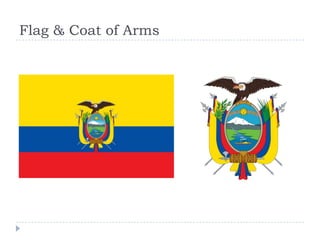
Flag & Coat of Arms
Location
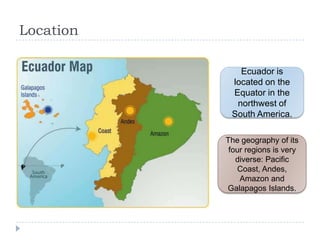
Ecuador is
located on the
Equator in the
northwest of
South America.
The geography of its
four regions is very
diverse: Pacific
Coast, Andes,
Amazon and
Galapagos Islands.
Language
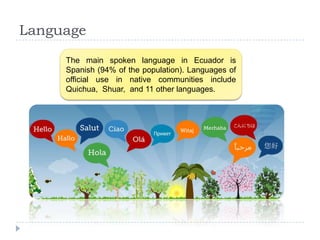
The main spoken language in Ecuador is
Spanish (94% of the population). Languages of
official use in native communities include
Quichua, Shuar, and 11 other languages.
Culture
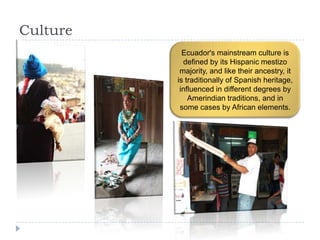
Ecuador's mainstream culture is
defined by its Hispanic mestizo
majority, and like their ancestry, it
is traditionally of Spanish heritage,
influenced in different degrees by
Amerindian traditions, and in
some cases by African elements.
Cuisine
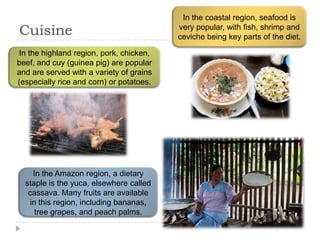
In the highland region, pork, chicken,
beef, and cuy (guinea pig) are popular
and are served with a variety of grains
(especially rice and corn) or potatoes.
In the coastal region, seafood is
very popular, with fish, shrimp and
ceviche being key parts of the diet.
In the Amazon region, a dietary
staple is the yuca, elsewhere called
cassava. Many fruits are available
in this region, including bananas,
tree grapes, and peach palms.
Religion
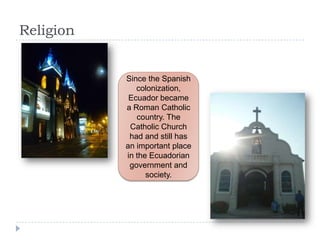
Since the Spanish
colonization,
Ecuador became
a Roman Catholic
country. The
Catholic Church
had and still has
an important place
in the Ecuadorian
government and
society.
Climate
The Coast, and the Amazon
jungle region have tropical
weather with temperatures
averaging about 30°C, with
occasional highs around 40°C
and lows of 20°C.
Galapagos Islands experience
temperatures ranging from
20°C to 35°C .
Ecuador does not have
seasons. In Quito, and the rest
of the Andean highlands, the
weather tends to be cool,
though it varies significantly in a
single 24 hour period.
Temperature may rise to 24°C
at noon, and drop to 10°C or
less at night.
Biodiversity
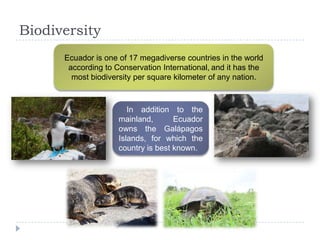
In addition to the
mainland, Ecuador
owns the Galápagos
Islands, for which the
country is best known.
Ecuador is one of 17 megadiverse countries in the world
according to Conservation International, and it has the
most biodiversity per square kilometer of any nation.
Currency
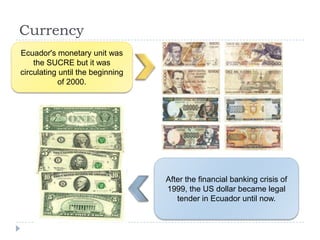
Ecuador's monetary unit was
the SUCRE but it was
circulating until the beginning
of 2000.
After the financial banking crisis of
1999, the US dollar became legal
tender in Ecuador until now.
Economy
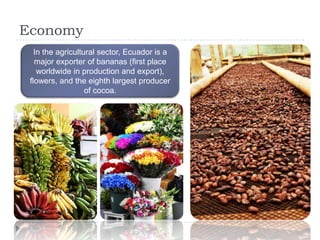
In the agricultural sector, Ecuador is a
major exporter of bananas (first place
worldwide in production and export),
flowers, and the eighth largest producer
of cocoa.
Tips for Travelers
VISAS: Citizens of most countries can stay
a maximum of 90 days without a visa.
HEALTH RISKS: Dengue fever, hepatitis,
malaria, typhoid, and a minor risk of
cholera, rabies and diphtheria. Get a
yellow fever vaccination if you plan to visit
the rainforests of the Amazon Jungle.
TOURISM: http://visitaguayaquil.com/
http://www.quito-turismo.gob.ec/
http://www.parquehistorico.gob.ec/
http://www.turismo.gob.ec/

Ecuador

  • 1.
  • 2.
    Flag & Coatof Arms
  • 3.
    Location Ecuador is located onthe Equator in the northwest of South America. The geography of its four regions is very diverse: Pacific Coast, Andes, Amazon and Galapagos Islands.
  • 4.
    Language The main spokenlanguage in Ecuador is Spanish (94% of the population). Languages of official use in native communities include Quichua, Shuar, and 11 other languages.
  • 5.
    Culture Ecuador's mainstream cultureis defined by its Hispanic mestizo majority, and like their ancestry, it is traditionally of Spanish heritage, influenced in different degrees by Amerindian traditions, and in some cases by African elements.
  • 6.
    Cuisine In the highlandregion, pork, chicken, beef, and cuy (guinea pig) are popular and are served with a variety of grains (especially rice and corn) or potatoes. In the coastal region, seafood is very popular, with fish, shrimp and ceviche being key parts of the diet. In the Amazon region, a dietary staple is the yuca, elsewhere called cassava. Many fruits are available in this region, including bananas, tree grapes, and peach palms.
  • 7.
    Religion Since the Spanish colonization, Ecuadorbecame a Roman Catholic country. The Catholic Church had and still has an important place in the Ecuadorian government and society.
  • 8.
    Climate The Coast, andthe Amazon jungle region have tropical weather with temperatures averaging about 30°C, with occasional highs around 40°C and lows of 20°C. Galapagos Islands experience temperatures ranging from 20°C to 35°C . Ecuador does not have seasons. In Quito, and the rest of the Andean highlands, the weather tends to be cool, though it varies significantly in a single 24 hour period. Temperature may rise to 24°C at noon, and drop to 10°C or less at night.
  • 9.
    Biodiversity In addition tothe mainland, Ecuador owns the Galápagos Islands, for which the country is best known. Ecuador is one of 17 megadiverse countries in the world according to Conservation International, and it has the most biodiversity per square kilometer of any nation.
  • 10.
    Currency Ecuador's monetary unitwas the SUCRE but it was circulating until the beginning of 2000. After the financial banking crisis of 1999, the US dollar became legal tender in Ecuador until now.
  • 11.
    Economy In the agriculturalsector, Ecuador is a major exporter of bananas (first place worldwide in production and export), flowers, and the eighth largest producer of cocoa.
  • 12.
    Tips for Travelers VISAS:Citizens of most countries can stay a maximum of 90 days without a visa. HEALTH RISKS: Dengue fever, hepatitis, malaria, typhoid, and a minor risk of cholera, rabies and diphtheria. Get a yellow fever vaccination if you plan to visit the rainforests of the Amazon Jungle. TOURISM: http://visitaguayaquil.com/ http://www.quito-turismo.gob.ec/ http://www.parquehistorico.gob.ec/ http://www.turismo.gob.ec/