
Data Mining Input: Concepts, Instances, and Attributes
Input takes the following forms:Concept: The thing that is to be learned is called the concept. Concept  should be :
Intelligible in that it can be understood
Operational in that it can be applied to actual examples
Instances: The data present consists of various instances of the class. E.g. the table below consists of 2 instances
Attributes: Each instance of the class has various attributes. E.g. the table bellow consists of two attributes {Name, Age}Types of learning in data miningClassification learning:
Learning scheme is presented with a set of classified examples from which it is expected to learn a way of classifying unseen examples
Also called supervised learning
E.g. Classification rules for the weather forecasting problem      If outlook = sunny and humidity = high then play = no      If outlook = rainy and windy = true         then play = no      If outlook = overcast                                   then play =  yes
Numeric prediction
Same as classification learning but the outcome to be predicted is not a discreet class but a numeric quantity
Clustering
Groups of examples that belong together are sought and clubbed together in a cluster
E.g. based on the data with a bank the following relation between debt and income was seen:Association rules
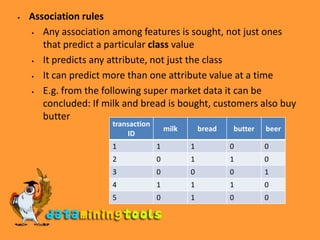
Any association among features is sought, not just ones that predict a particular class value
It predicts any attribute, not just the class
It can predict more than one attribute value at a time
E.g. from the following super market data it can be concluded: If milk and bread is bought, customers also buy butterFew important terms…Concept description: Output produced by a learning scheme

WEKA: Data Mining Input Concepts Instances And Attributes

  • 1.
    Data Mining Input:Concepts, Instances, and Attributes
  • 2.
    Input takes thefollowing forms:Concept: The thing that is to be learned is called the concept. Concept should be :
  • 3.
    Intelligible in thatit can be understood
  • 4.
    Operational in thatit can be applied to actual examples
  • 5.
    Instances: The datapresent consists of various instances of the class. E.g. the table below consists of 2 instances
  • 6.
    Attributes: Each instanceof the class has various attributes. E.g. the table bellow consists of two attributes {Name, Age}Types of learning in data miningClassification learning:
  • 7.
    Learning scheme ispresented with a set of classified examples from which it is expected to learn a way of classifying unseen examples
  • 8.
  • 9.
    E.g. Classification rulesfor the weather forecasting problem If outlook = sunny and humidity = high then play = no If outlook = rainy and windy = true then play = no If outlook = overcast then play = yes
  • 10.
  • 11.
    Same as classificationlearning but the outcome to be predicted is not a discreet class but a numeric quantity
  • 12.
  • 13.
    Groups of examplesthat belong together are sought and clubbed together in a cluster
  • 14.
    E.g. based onthe data with a bank the following relation between debt and income was seen:Association rules
  • 15.
    Any association amongfeatures is sought, not just ones that predict a particular class value
  • 16.
    It predicts anyattribute, not just the class
  • 17.
    It can predictmore than one attribute value at a time
  • 18.
    E.g. from thefollowing super market data it can be concluded: If milk and bread is bought, customers also buy butterFew important terms…Concept description: Output produced by a learning scheme