Chapter 17
Reframing Leadership
 The Idea of Leadership
 The Context of Leadership
 What Do We Know About Good Leadership?
 Gender and Leadership
 Reframing Leadership
Coping with leadership crisis: Queen
Elizabeth II & Rudy Giuliani
 Queen Elizabeth
 In the face of Princess Diana’s death, the Queen
stayed on vacation and issued short, tight-lipped
statement
 She almost disappeared when constituents most
wanted her to be present and reassuring
 Rudy Giuliani
 Went immediately to 9-11 scene and plunged in, at
personal risk
 Took charge of disaster efforts
 Was continually visible: appeared on television, gave
tours, etc.
The Idea of Leadership
 Leadership often viewed as panacea: fix for whatever
is wrong in organization or society
 Leadership not the same thing as power
 Leaders expected to persuade, inspire, not coerce or
manipulate
 Leadership is distinct from authority
 Authority produces obedience because legitimated to
make certain decisions
 Leadership vs. management
 Leaders think long-term, look outside as well as in,
influence beyond their formal jurisdiction, have political
skills, emphasize vision and renewal,
The Context of Leadership
 Leaders make things happen, but things also
make leaders happen
 What leaders can do always influenced by the
stage on which they play their role
 Leadership is a relationship, a subtle process
of mutual influence
 Leaders are not independent actors: they both
shape and are shaped by circumstances and
their constituents
 Leadership is distinct from position – you can
lead from anywhere
What Do We Know About Good
Leadership?
 One Best Way
 Good leaders have certain characteristics in
common
 Contingency Theories
 Good leadership depends on the situation
One Best Way: Qualities of Highly
Effective Leaders
 Vision and focus
 Image of future
 Standards for performance
 Clear direction
 Passion
 Deep personal, emotional commitment to the
work and the people who do it
 Ability to inspire trust and build relationships
 Honesty is the trait followers say they admire
most in a leader
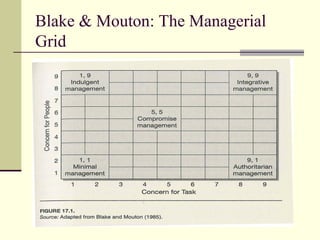
Blake & Mouton: The Managerial
Grid
Contingency Theories
 Leadership varies by situation, but there is no
consensus on the nature of the key
situational variables and how they influence
leadership
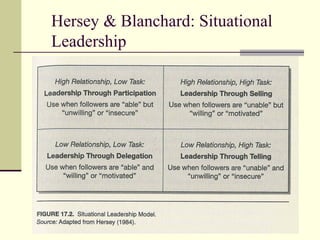
 Hersey/Blanchard “Situational Leadership”
model is popular, but research support is
weak
Hersey & Blanchard: Situational
Leadership
Gender and Leadership
 Do Men and Women Lead Differently?
 Karren Brady, Carly Fiorina, and Margaret Thatcher
 Do women have a “female advantage”?
 Research has found few consistent leadership differences
between men and women
 Why the Glass Ceiling?
 Stereotypes linking leadership to maleness
 Women walk tightrope of conflicting expectations
 Discrimination
 Women pay a higher price
 Women may put higher premium on balancing work and family
 Women still do majority of housework and child-rearing in dual-
career families
 Fast-track women less likely to marry, more likely to divorce than
similar men
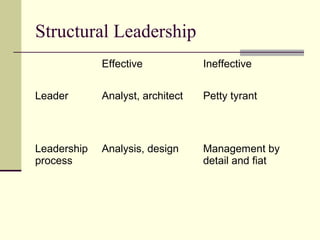
Structural Leadership
Effective Ineffective
Leader Analyst, architect Petty tyrant
Leadership
process
Analysis, design Management by
detail and fiat
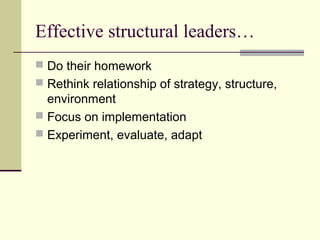
Effective structural leaders…
 Do their homework
 Rethink relationship of strategy, structure,
environment
 Focus on implementation
 Experiment, evaluate, adapt
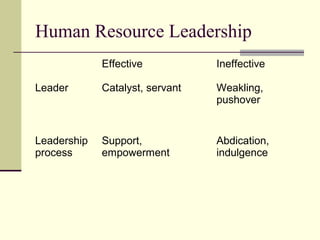
Human Resource Leadership
Effective Ineffective
Leader Catalyst, servant Weakling,
pushover
Leadership
process
Support,
empowerment
Abdication,
indulgence
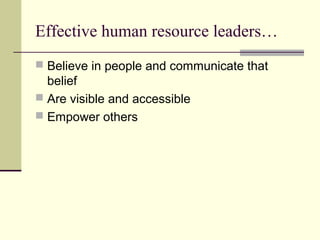
Effective human resource leaders…
 Believe in people and communicate that
belief
 Are visible and accessible
 Empower others
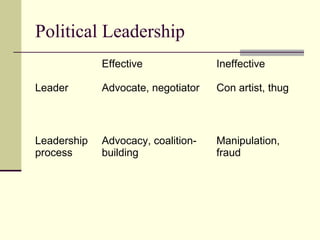
Political Leadership
Effective Ineffective
Leader Advocate, negotiator Con artist, thug
Leadership
process
Advocacy, coalition-
building
Manipulation,
fraud
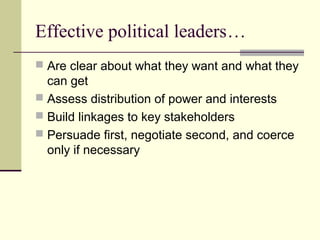
Effective political leaders…
 Are clear about what they want and what they
can get
 Assess distribution of power and interests
 Build linkages to key stakeholders
 Persuade first, negotiate second, and coerce
only if necessary
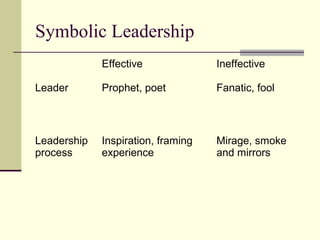
Symbolic Leadership
Effective Ineffective
Leader Prophet, poet Fanatic, fool
Leadership
process
Inspiration, framing
experience
Mirage, smoke
and mirrors
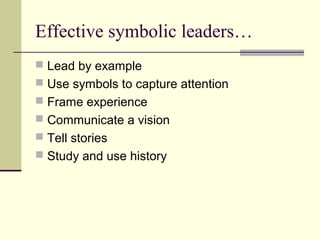
Effective symbolic leaders…
 Lead by example
 Use symbols to capture attention
 Frame experience
 Communicate a vision
 Tell stories
 Study and use history
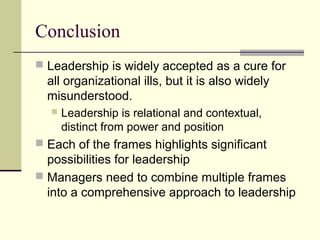
Conclusion
 Leadership is widely accepted as a cure for
all organizational ills, but it is also widely
misunderstood.
 Leadership is relational and contextual,
distinct from power and position
 Each of the frames highlights significant
possibilities for leadership
 Managers need to combine multiple frames
into a comprehensive approach to leadership

Week9 bolman deal_chap 17

  • 1.
  • 2.
    Reframing Leadership  TheIdea of Leadership  The Context of Leadership  What Do We Know About Good Leadership?  Gender and Leadership  Reframing Leadership
  • 3.
    Coping with leadershipcrisis: Queen Elizabeth II & Rudy Giuliani  Queen Elizabeth  In the face of Princess Diana’s death, the Queen stayed on vacation and issued short, tight-lipped statement  She almost disappeared when constituents most wanted her to be present and reassuring  Rudy Giuliani  Went immediately to 9-11 scene and plunged in, at personal risk  Took charge of disaster efforts  Was continually visible: appeared on television, gave tours, etc.
  • 4.
    The Idea ofLeadership  Leadership often viewed as panacea: fix for whatever is wrong in organization or society  Leadership not the same thing as power  Leaders expected to persuade, inspire, not coerce or manipulate  Leadership is distinct from authority  Authority produces obedience because legitimated to make certain decisions  Leadership vs. management  Leaders think long-term, look outside as well as in, influence beyond their formal jurisdiction, have political skills, emphasize vision and renewal,
  • 5.
    The Context ofLeadership  Leaders make things happen, but things also make leaders happen  What leaders can do always influenced by the stage on which they play their role  Leadership is a relationship, a subtle process of mutual influence  Leaders are not independent actors: they both shape and are shaped by circumstances and their constituents  Leadership is distinct from position – you can lead from anywhere
  • 6.
    What Do WeKnow About Good Leadership?  One Best Way  Good leaders have certain characteristics in common  Contingency Theories  Good leadership depends on the situation
  • 7.
    One Best Way:Qualities of Highly Effective Leaders  Vision and focus  Image of future  Standards for performance  Clear direction  Passion  Deep personal, emotional commitment to the work and the people who do it  Ability to inspire trust and build relationships  Honesty is the trait followers say they admire most in a leader
  • 8.
    Blake & Mouton:The Managerial Grid
  • 9.
    Contingency Theories  Leadershipvaries by situation, but there is no consensus on the nature of the key situational variables and how they influence leadership  Hersey/Blanchard “Situational Leadership” model is popular, but research support is weak
  • 10.
    Hersey & Blanchard:Situational Leadership
  • 11.
    Gender and Leadership Do Men and Women Lead Differently?  Karren Brady, Carly Fiorina, and Margaret Thatcher  Do women have a “female advantage”?  Research has found few consistent leadership differences between men and women  Why the Glass Ceiling?  Stereotypes linking leadership to maleness  Women walk tightrope of conflicting expectations  Discrimination  Women pay a higher price  Women may put higher premium on balancing work and family  Women still do majority of housework and child-rearing in dual- career families  Fast-track women less likely to marry, more likely to divorce than similar men
  • 12.
    Structural Leadership Effective Ineffective LeaderAnalyst, architect Petty tyrant Leadership process Analysis, design Management by detail and fiat
  • 13.
    Effective structural leaders… Do their homework  Rethink relationship of strategy, structure, environment  Focus on implementation  Experiment, evaluate, adapt
  • 14.
    Human Resource Leadership EffectiveIneffective Leader Catalyst, servant Weakling, pushover Leadership process Support, empowerment Abdication, indulgence
  • 15.
    Effective human resourceleaders…  Believe in people and communicate that belief  Are visible and accessible  Empower others
  • 16.
    Political Leadership Effective Ineffective LeaderAdvocate, negotiator Con artist, thug Leadership process Advocacy, coalition- building Manipulation, fraud
  • 17.
    Effective political leaders… Are clear about what they want and what they can get  Assess distribution of power and interests  Build linkages to key stakeholders  Persuade first, negotiate second, and coerce only if necessary
  • 18.
    Symbolic Leadership Effective Ineffective LeaderProphet, poet Fanatic, fool Leadership process Inspiration, framing experience Mirage, smoke and mirrors
  • 19.
    Effective symbolic leaders… Lead by example  Use symbols to capture attention  Frame experience  Communicate a vision  Tell stories  Study and use history
  • 20.
    Conclusion  Leadership iswidely accepted as a cure for all organizational ills, but it is also widely misunderstood.  Leadership is relational and contextual, distinct from power and position  Each of the frames highlights significant possibilities for leadership  Managers need to combine multiple frames into a comprehensive approach to leadership