Electrical Basics
Generation and Distribution
Terms
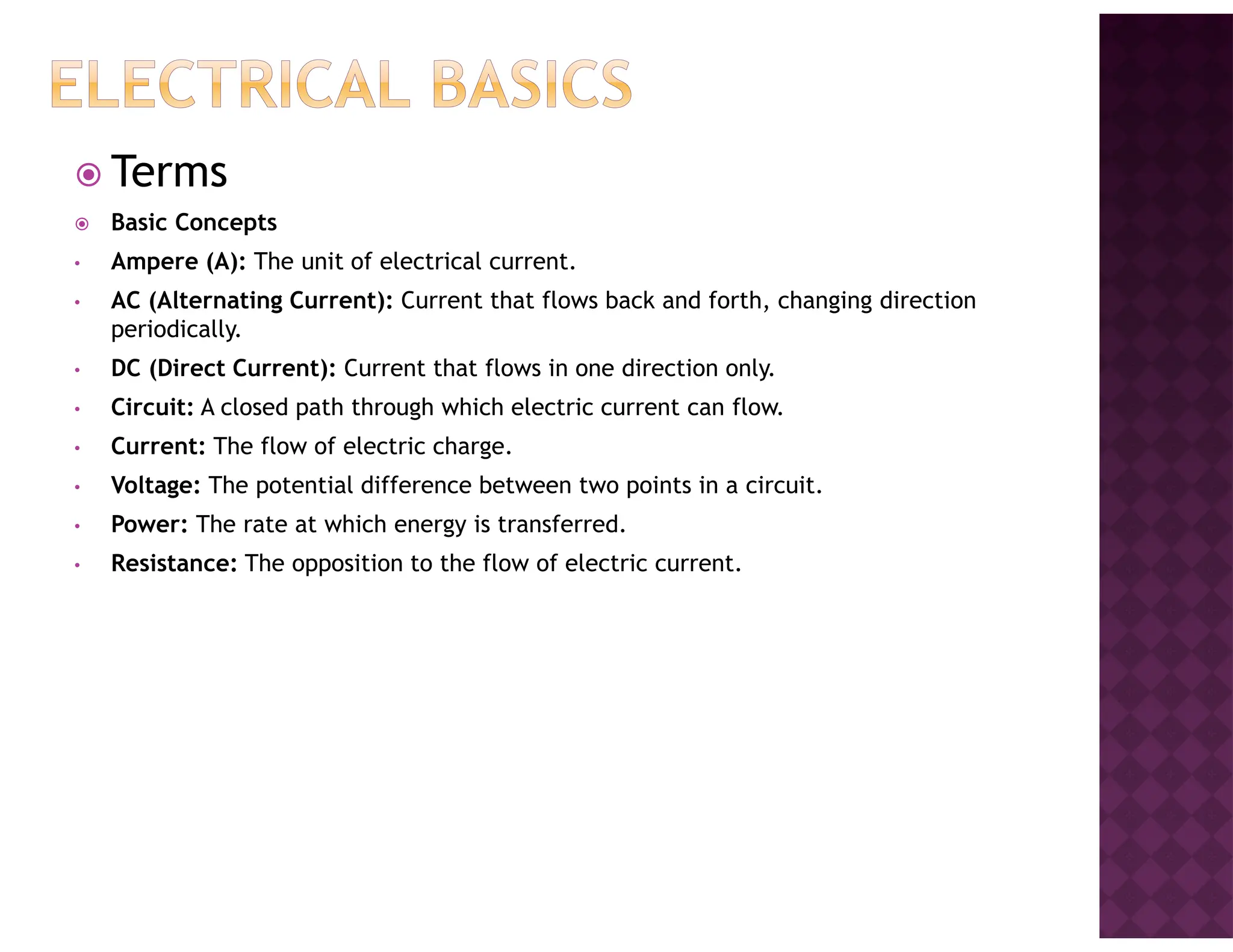
Basic Concepts
• Ampere (A): The unit of electrical current.
• AC (Alternating Current): Current that flows back and forth, changing direction
periodically.
• DC (Direct Current): Current that flows in one direction only.
• Circuit: A closed path through which electric current can flow.
• Current: The flow of electric charge.
• Voltage: The potential difference between two points in a circuit.
• Power: The rate at which energy is transferred.
• Resistance: The opposition to the flow of electric current.
Terms
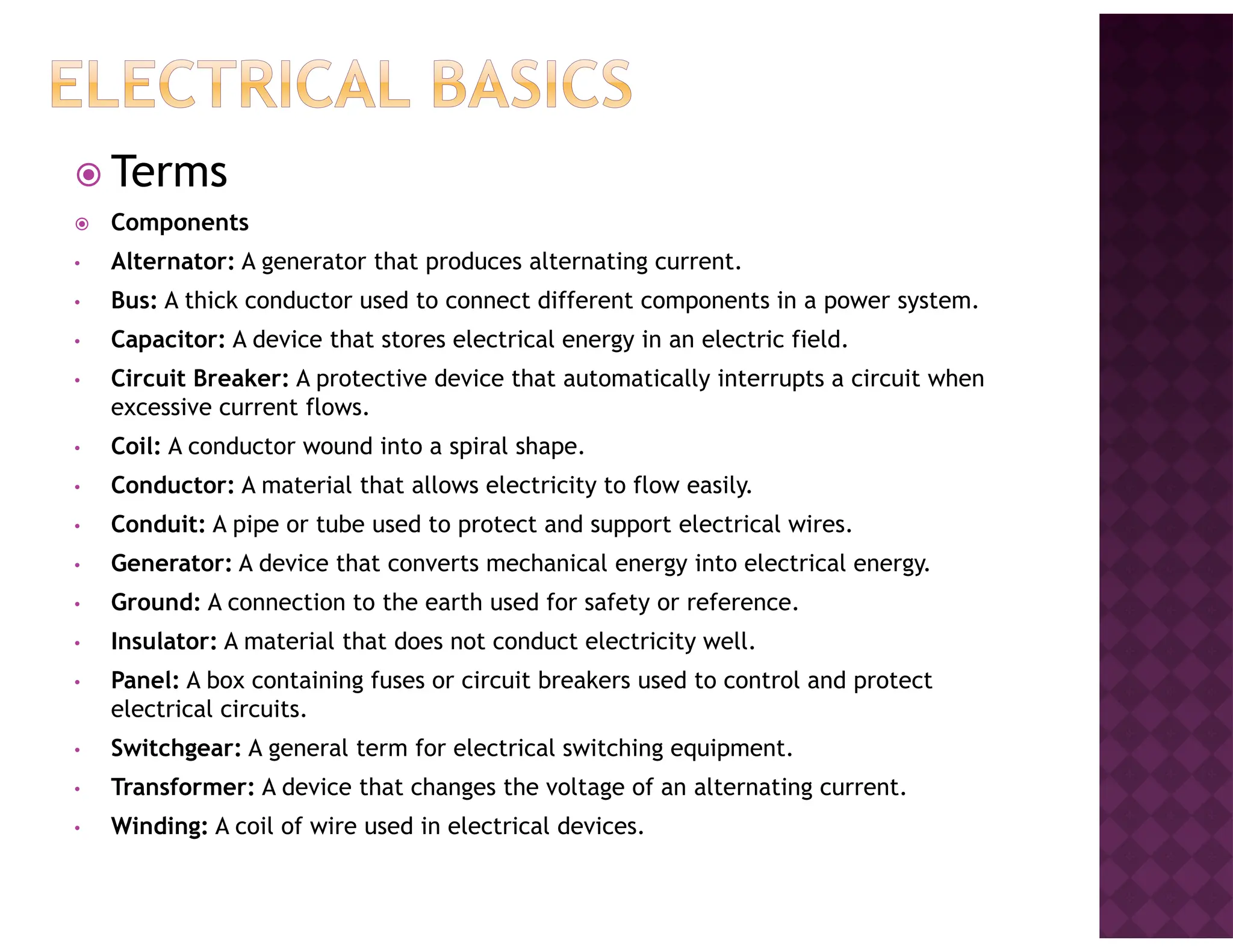
Components
• Alternator: A generator that produces alternating current.
• Bus: A thick conductor used to connect different components in a power system.
• Capacitor: A device that stores electrical energy in an electric field.
• Circuit Breaker: A protective device that automatically interrupts a circuit when
excessive current flows.
• Coil: A conductor wound into a spiral shape.
• Conductor: A material that allows electricity to flow easily.
• Conduit: A pipe or tube used to protect and support electrical wires.
• Generator: A device that converts mechanical energy into electrical energy.
• Ground: A connection to the earth used for safety or reference.
• Insulator: A material that does not conduct electricity well.
• Panel: A box containing fuses or circuit breakers used to control and protect
electrical circuits.
• Switchgear: A general term for electrical switching equipment.
• Transformer: A device that changes the voltage of an alternating current.
• Winding: A coil of wire used in electrical devices.
Terms
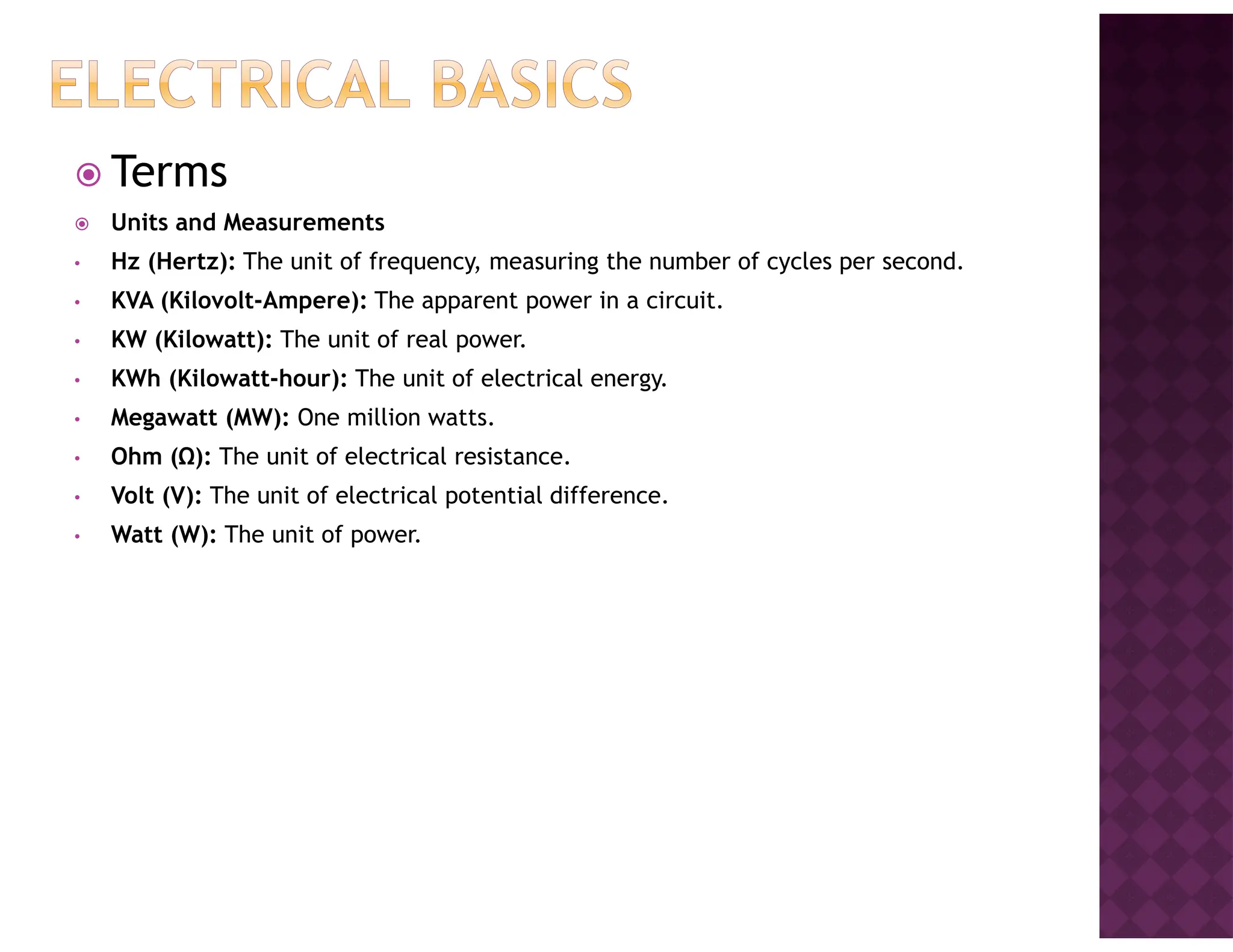
Units and Measurements
• Hz (Hertz): The unit of frequency, measuring the number of cycles per second.
• KVA (Kilovolt-Ampere): The apparent power in a circuit.
• KW (Kilowatt): The unit of real power.
• KWh (Kilowatt-hour): The unit of electrical energy.
• Megawatt (MW): One million watts.
• Ohm (Ω): The unit of electrical resistance.
• Volt (V): The unit of electrical potential difference.
• Watt (W): The unit of power.
Terms
Concepts
• Demand: The maximum rate of power consumption over a specified period.
• EMT (Electrical Metallic Tubing): A type of conduit used for wiring.
• Feeders: Conductors that carry electricity from the source to the distribution
points.
• GFCI (Ground Fault Circuit Interrupter): A type of circuit breaker that protects
against electrical shock.
• Reactance: The opposition to the flow of alternating current due to inductance or
capacitance.
• Ohm's Law: A law stating that the current in a circuit is directly proportional to the
voltage and inversely proportional to the resistance.
Terms
Concepts
• Series Circuit: A circuit where the components are connected in series, so the same
current flows through all of them.
• Parallel Circuit: A circuit where the components are connected in parallel, so each
component has the same voltage across it.
• Voltage Drop: The decrease in voltage along a conductor due to resistance.
• Service: The electrical connection between the utility company and a building.
• Strip Heat: A type of electric heater.
• NEC (National Electrical Code): A set of standards for the safe installation of
electrical wiring in the United States.
• NEMA (National Electrical Manufacturers Association): An organization that sets
standards for electrical equipment.
• Wye (Y): A type of three-phase connection where the three windings are connected
in a star configuration, with one end of each winding connected to a common
neutral point.
• Delta (Δ): A type of three-phase connection where the three windings are connected
in a triangle configuration, with the ends of the windings connected in a closed
loop. There is no neutral point in a delta connection.
Electricity is the flow of electrons. Materials
that promote the flow of electrons are called
conductors. Metals are typically good
conductors. Materials that prohibit the flow
of electrons are called insulators. Rubber,
wood, glass, and most plastics are good
insulators.
The bulk of electric energy utilized today is
in the form of alternating current (AC),
produced by AC generators commonly called
alternators.
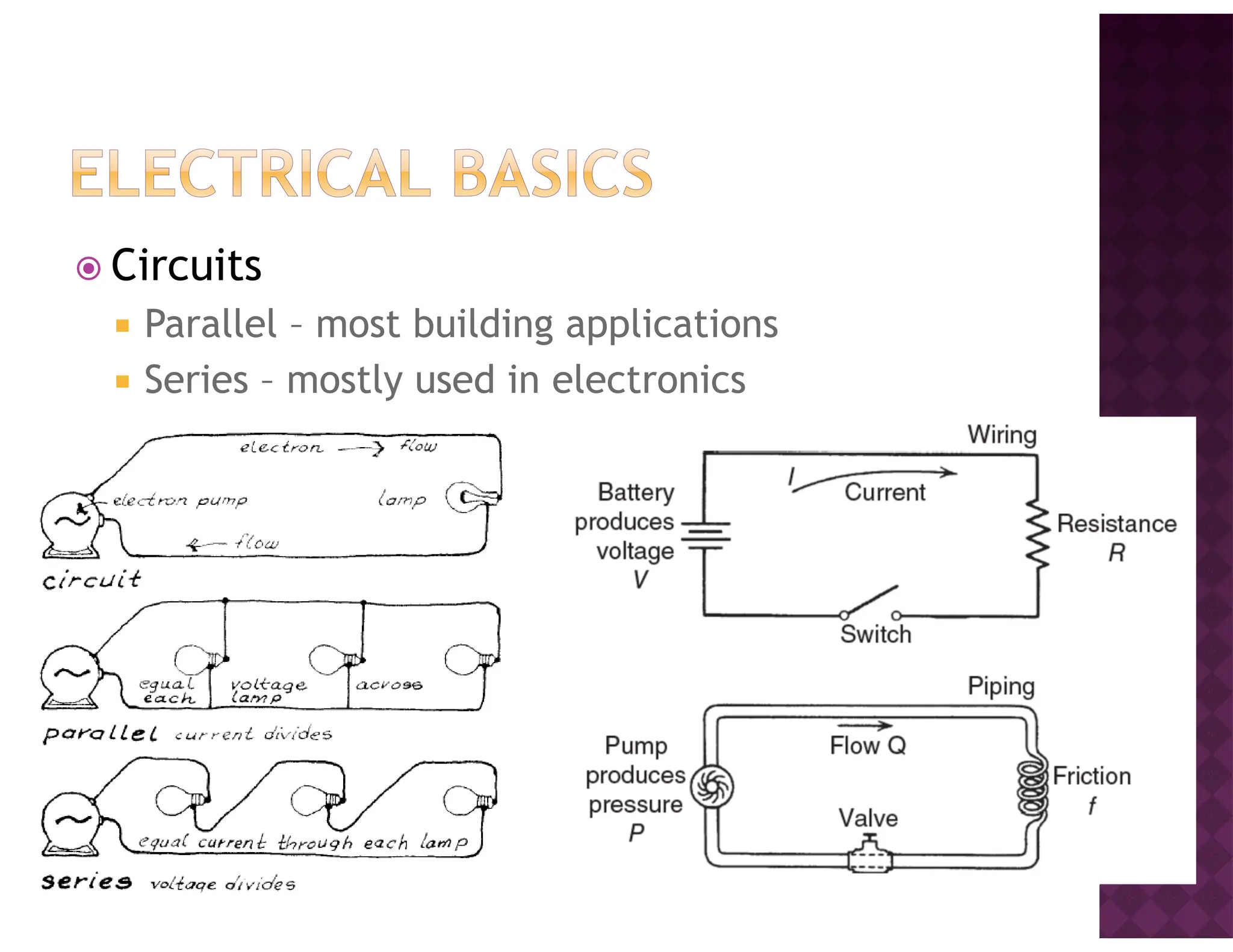
Circuits
Parallel – most building applications
Series – mostly used in electronics
Magnetism – flow of electrons in a conductor
will create a magnetic field. Moving a
conductor through a magnetic field will
cause electrons to flow in the conductor,
which is how we generate most of the
electricity we us. This is how generators
work.
Electrical Units
Volts – the driving force to cause electrons to
flow. Analogous to pressure that causes fluids to
flow and to temperature that causes heat to
flow.
Current – the quantity of electrons flowing.
Analogous to fluid flow and heat flow.
Ohms – the resistance to flow. Analogous to
friction.
1 amp is defined as the flow of electrons through
a resistance of 1 ohm at a driving force of 1 volt.
Watts – energy consumed or produced by
electrical systems. Analogous to horsepower.
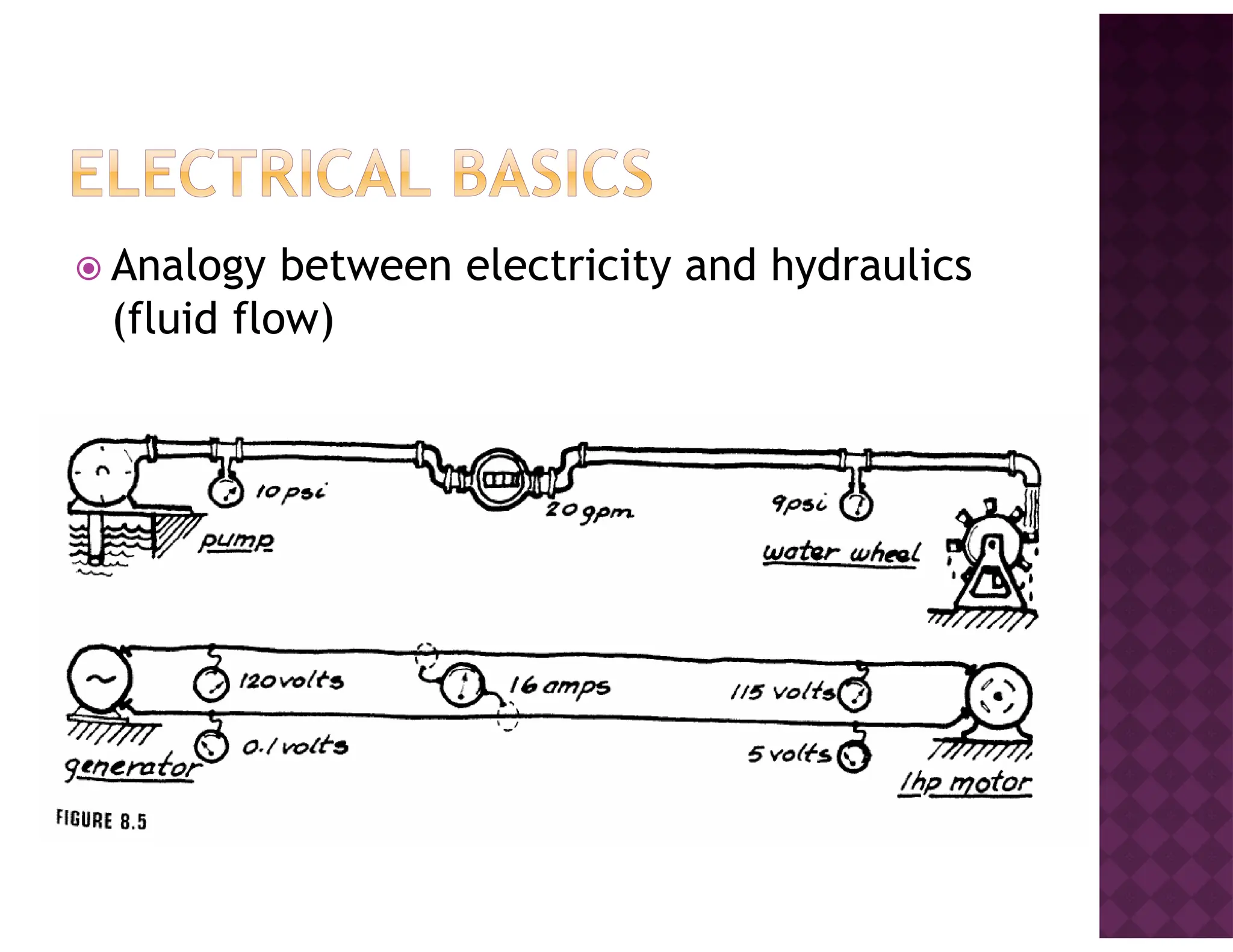
Analogy between electricity and hydraulics
(fluid flow)
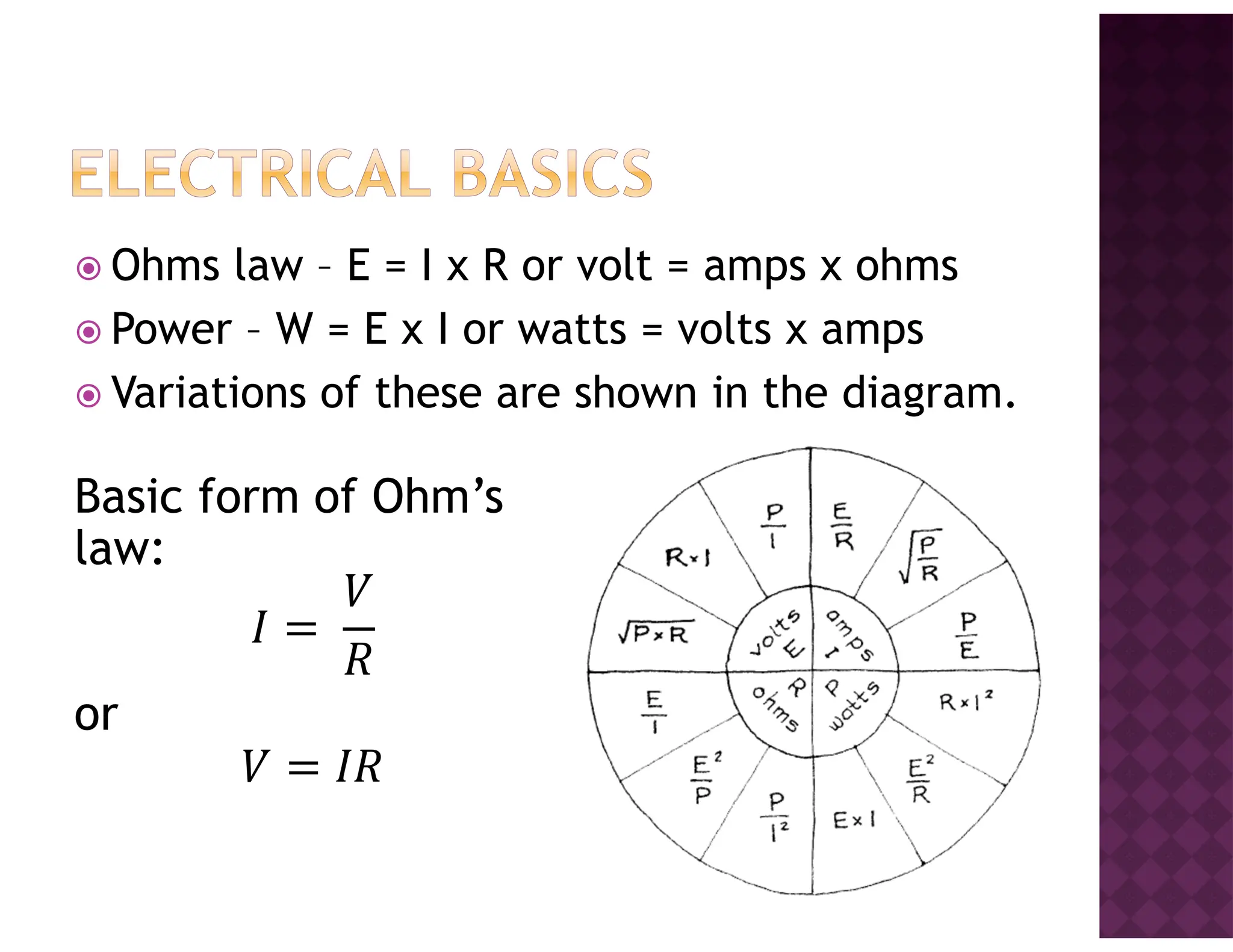
Ohms law – E = I x R or volt = amps x ohms
Power – W = E x I or watts = volts x amps
Variations of these are shown in the diagram.
Basic form of Ohm’s
law:
or
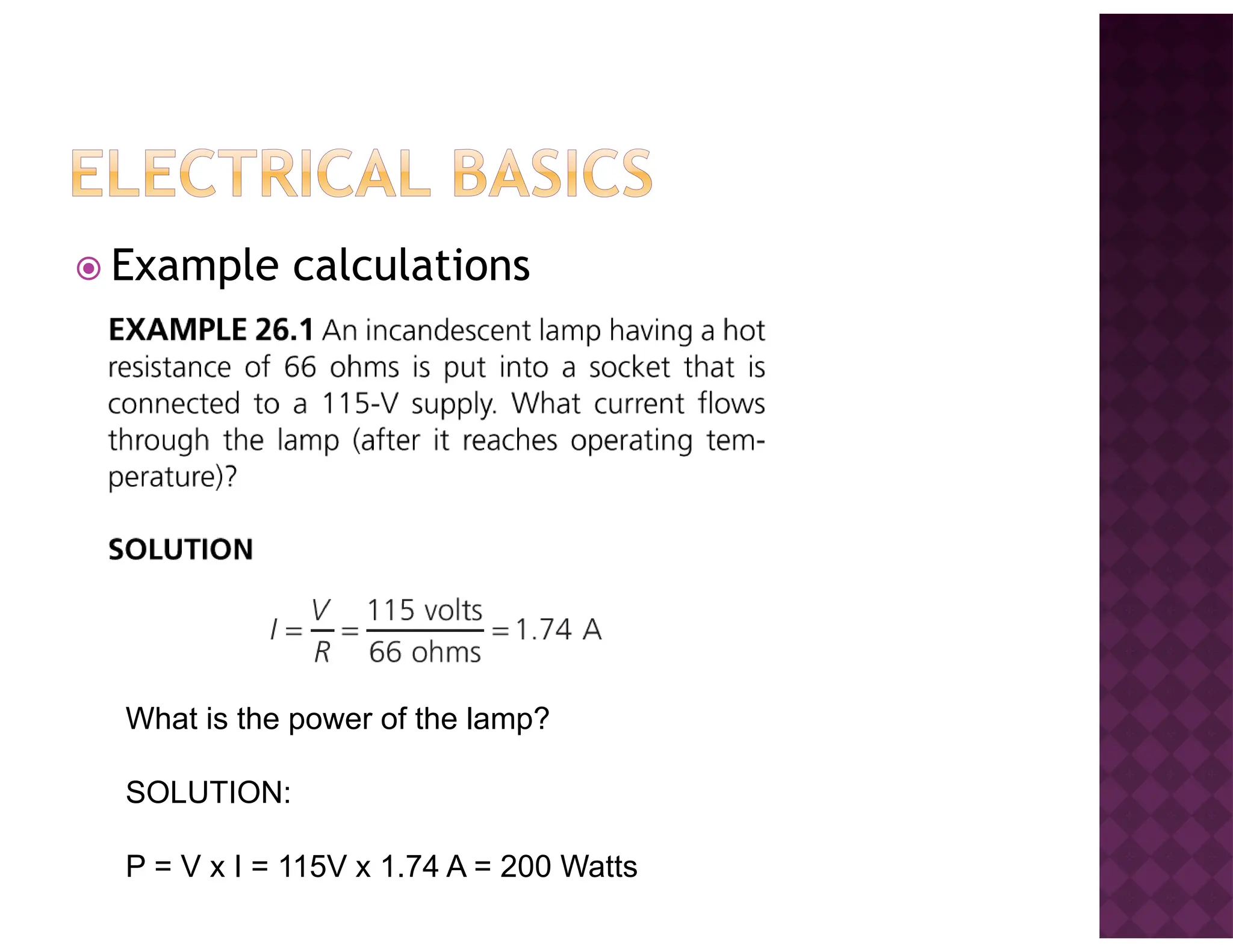
Example calculations
What is the power of the lamp?
SOLUTION:
P = V x I = 115V x 1.74 A = 200 Watts
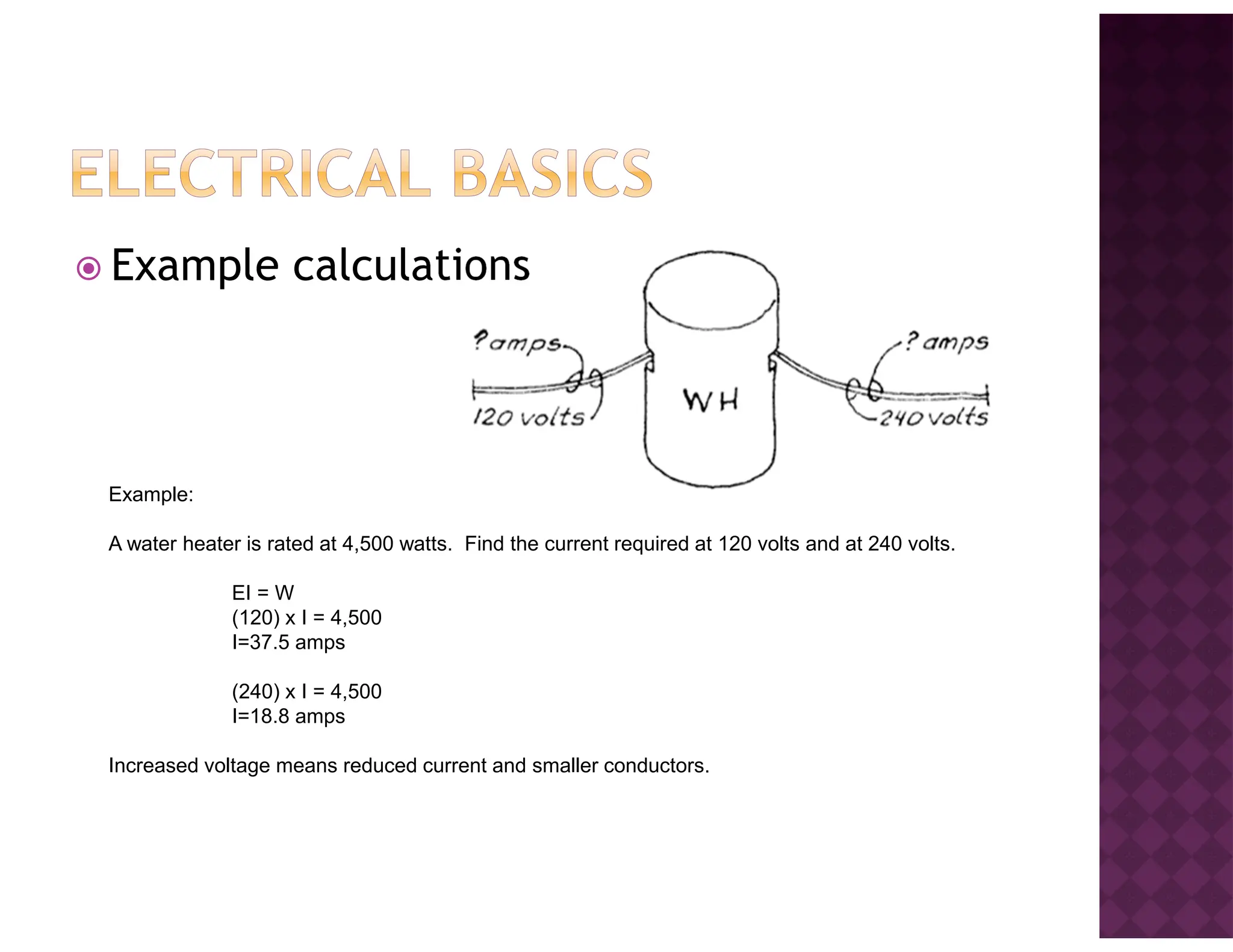
Example calculations
Example:
A water heater is rated at 4,500 watts. Find the current required at 120 volts and at 240 volts.
EI = W
(120) x I = 4,500
I=37.5 amps
(240) x I = 4,500
I=18.8 amps
Increased voltage means reduced current and smaller conductors.
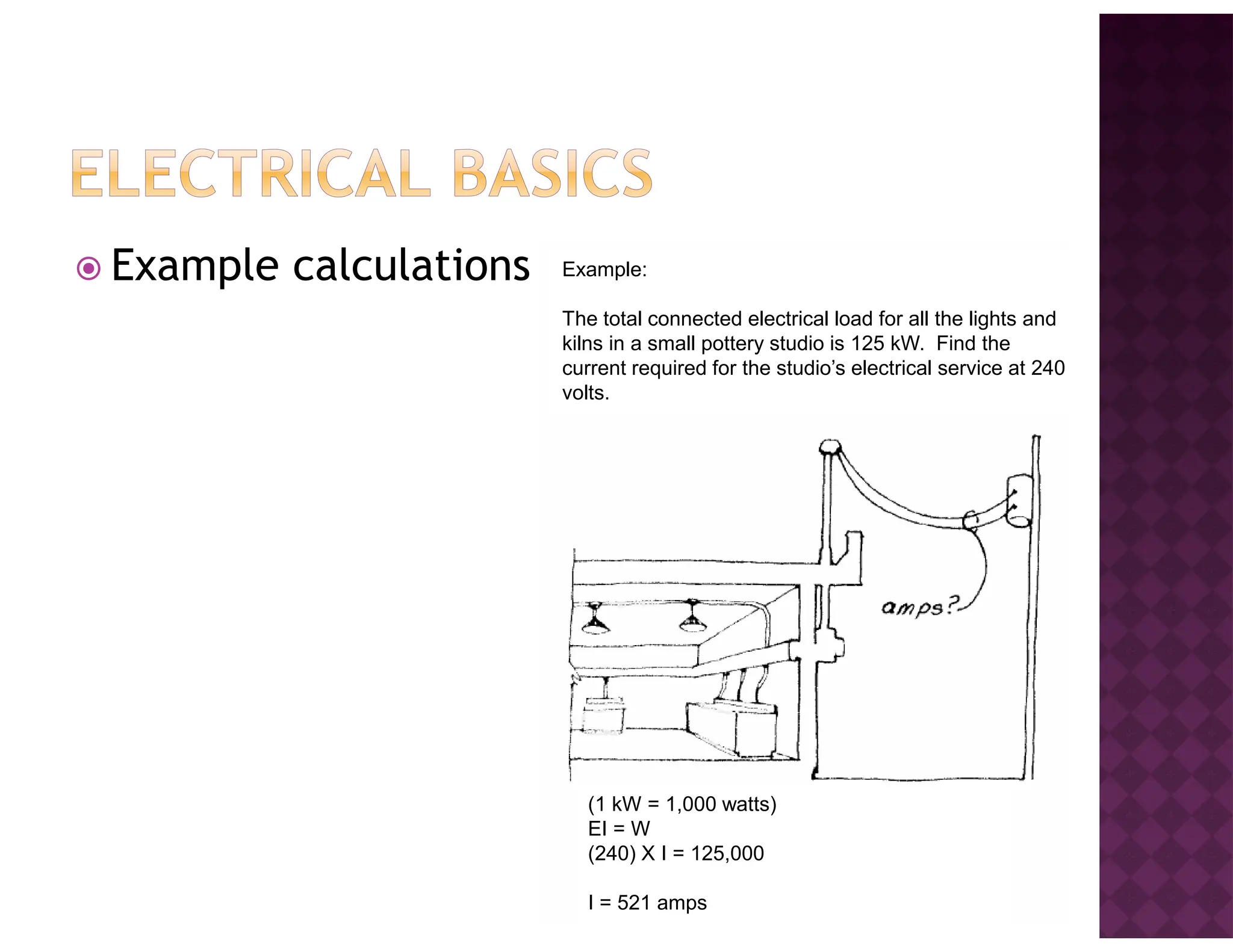
Example calculations Example:
The total connected electrical load for all the lights and
kilns in a small pottery studio is 125 kW. Find the
current required for the studio’s electrical service at 240
volts.
(1 kW = 1,000 watts)
EI = W
(240) X I = 125,000
I = 521 amps
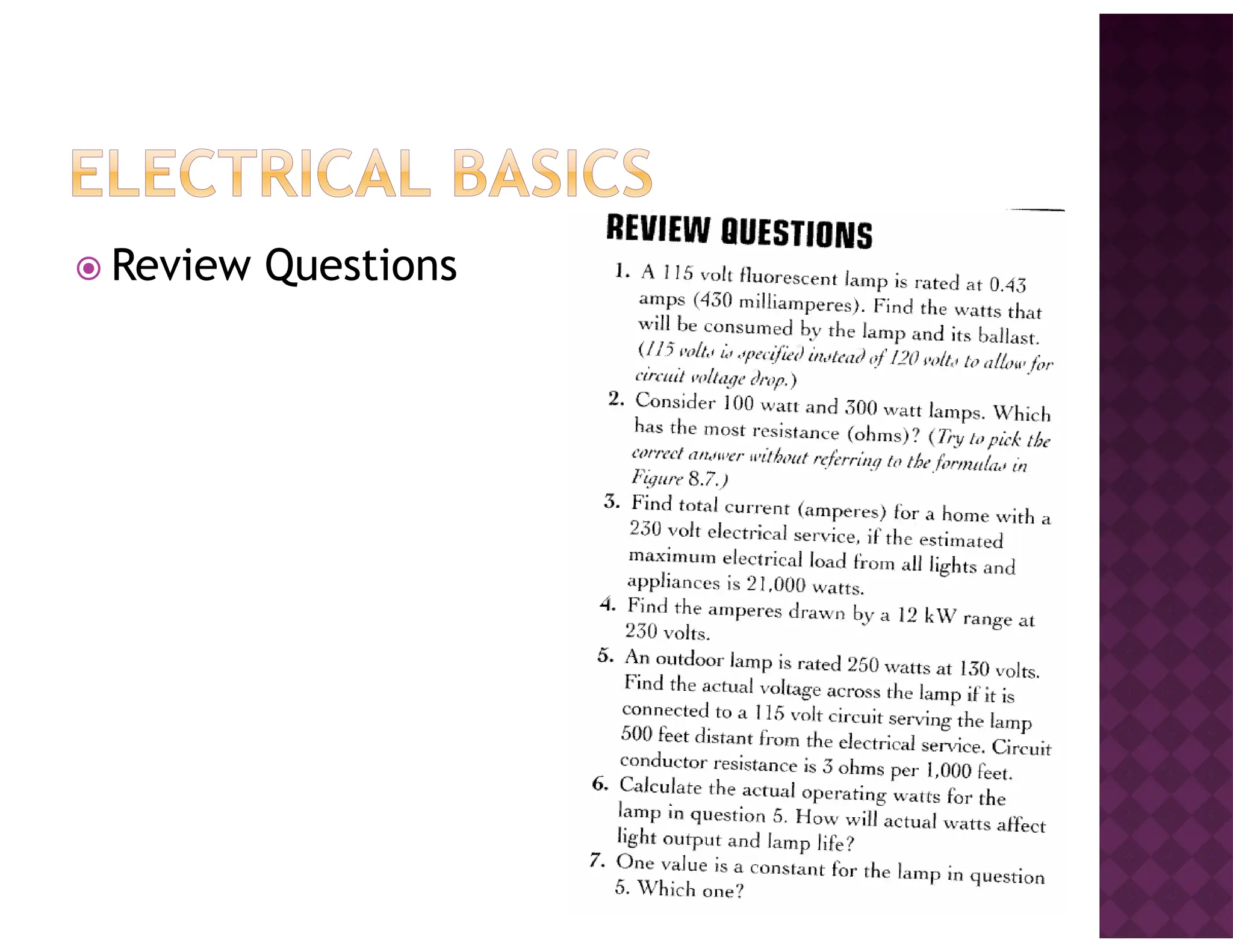
Review Questions
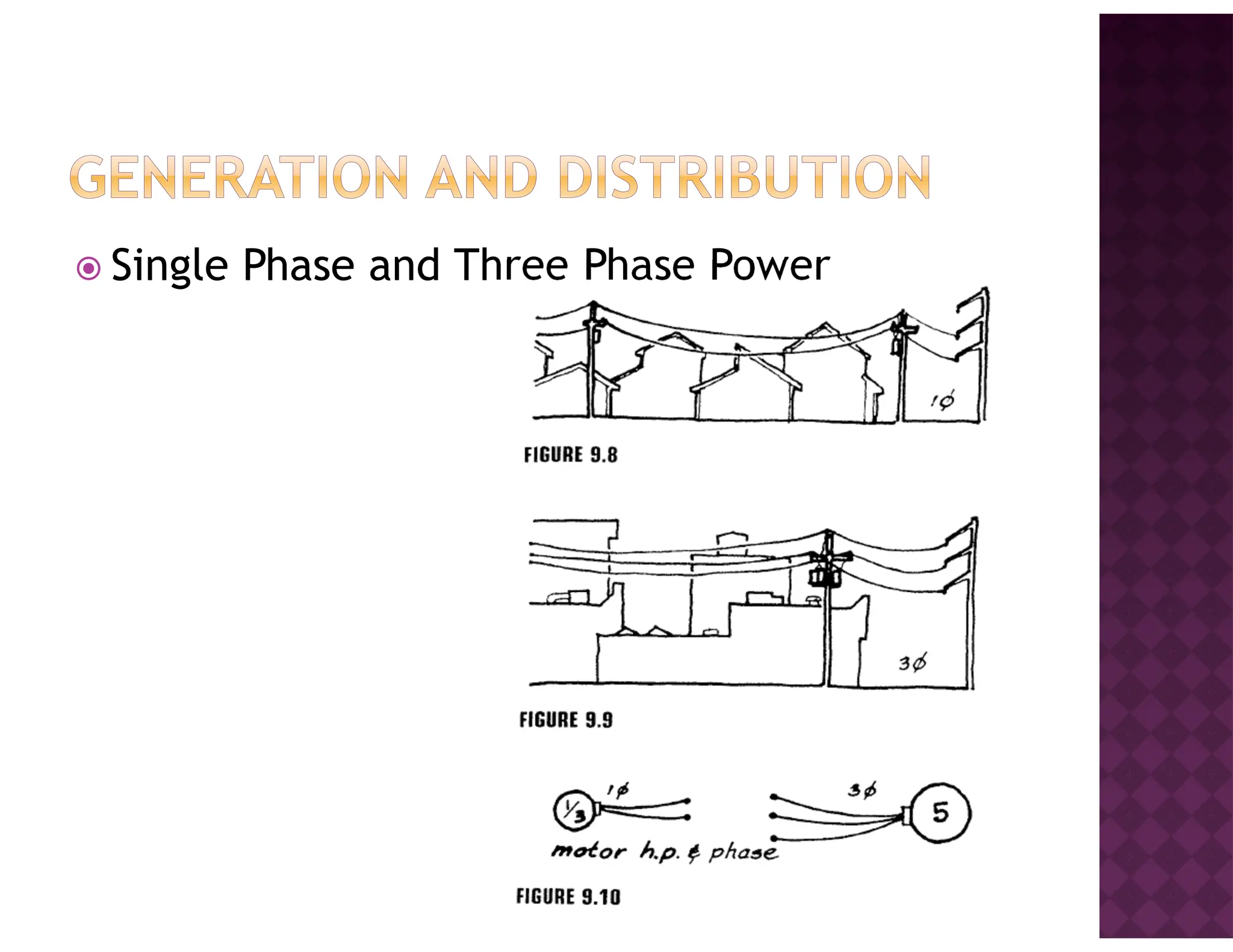
Single Phase and Three Phase Power
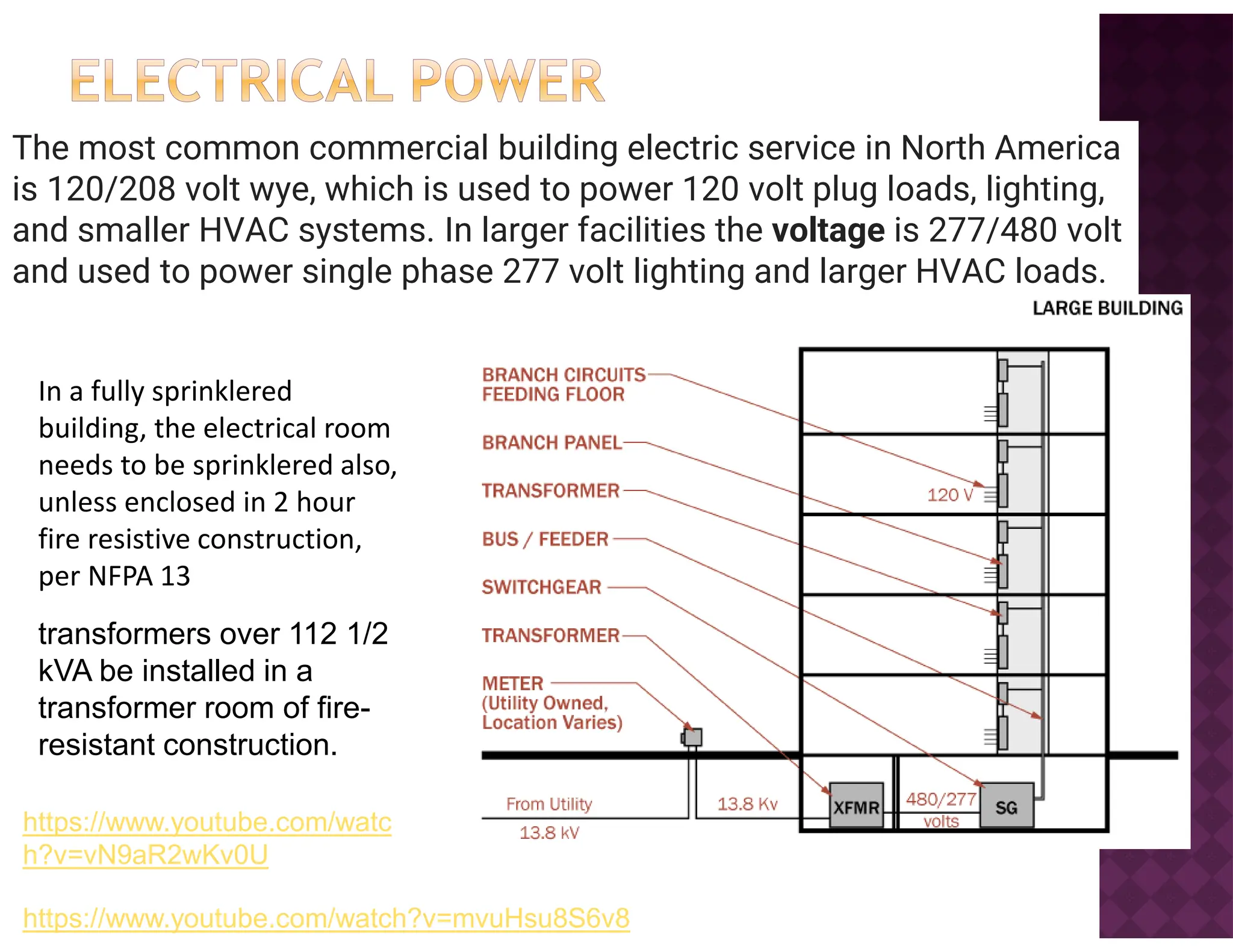
The most common commercial building electric service in North America
is 120/208 volt wye, which is used to power 120 volt plug loads, lighting,
and smaller HVAC systems. In larger facilities the voltage is 277/480 volt
and used to power single phase 277 volt lighting and larger HVAC loads.
In a fully sprinklered
building, the electrical room
needs to be sprinklered also,
unless enclosed in 2 hour
fire resistive construction,
per NFPA 13
transformers over 112 1/2
kVA be installed in a
transformer room of fire-
resistant construction.
https://www.youtube.com/watc
h?v=vN9aR2wKv0U
https://www.youtube.com/watch?v=mvuHsu8S6v8
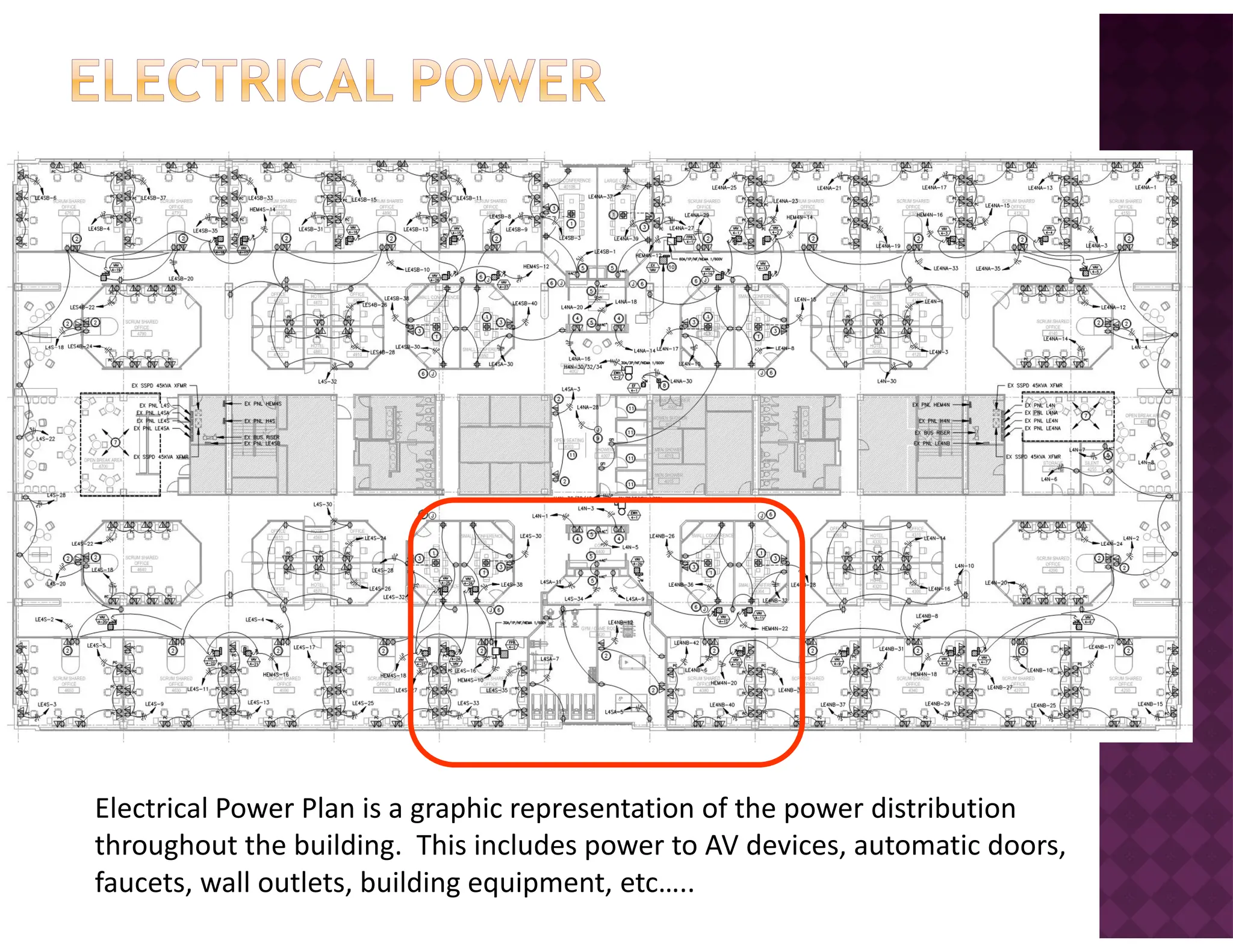
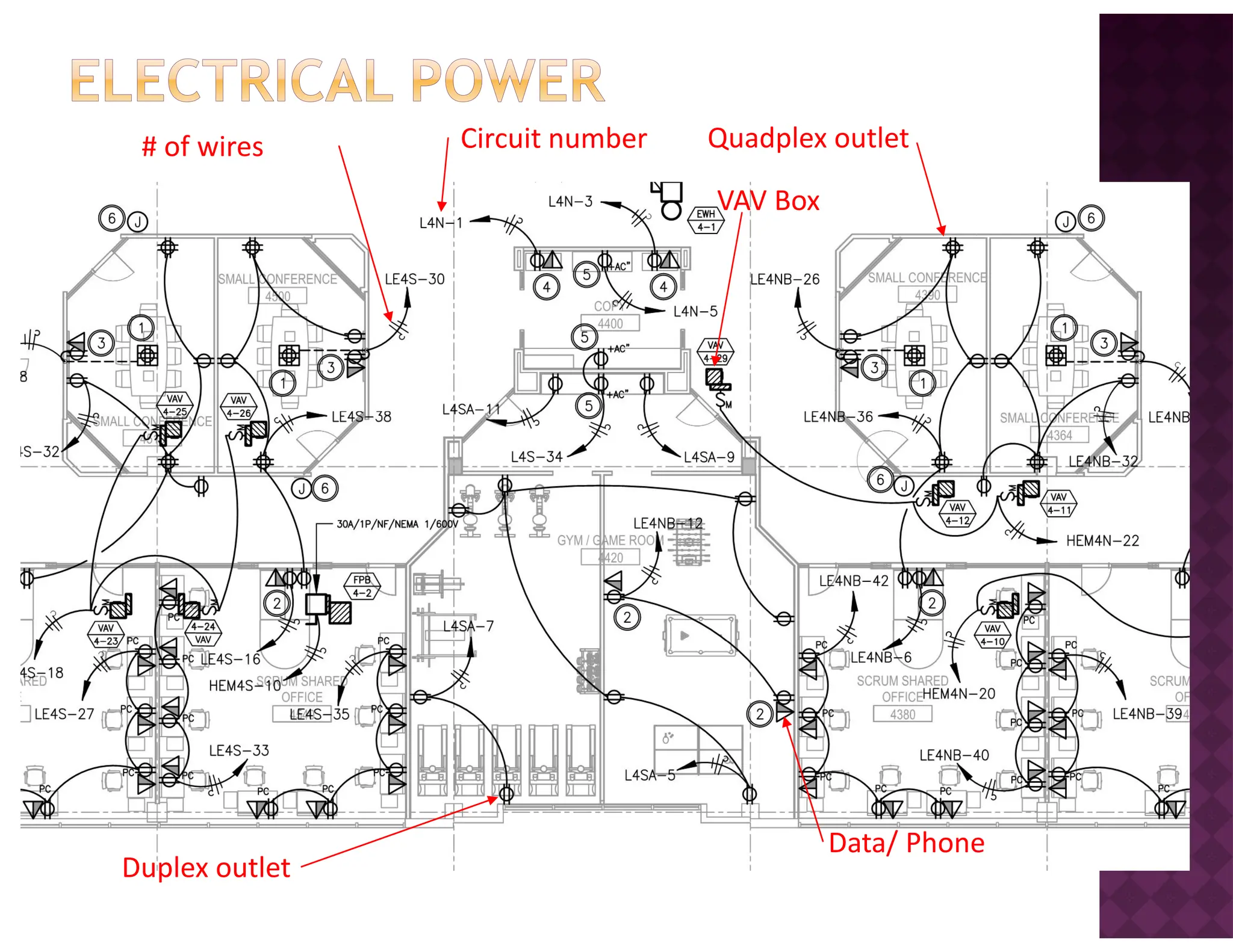
Electrical Power Plan is a graphic representation of the power distribution
throughout the building. This includes power to AV devices, automatic doors,
faucets, wall outlets, building equipment, etc…..
Duplex outlet
# of wires
Data/ Phone
Quadplex outlet
Circuit number
VAV Box
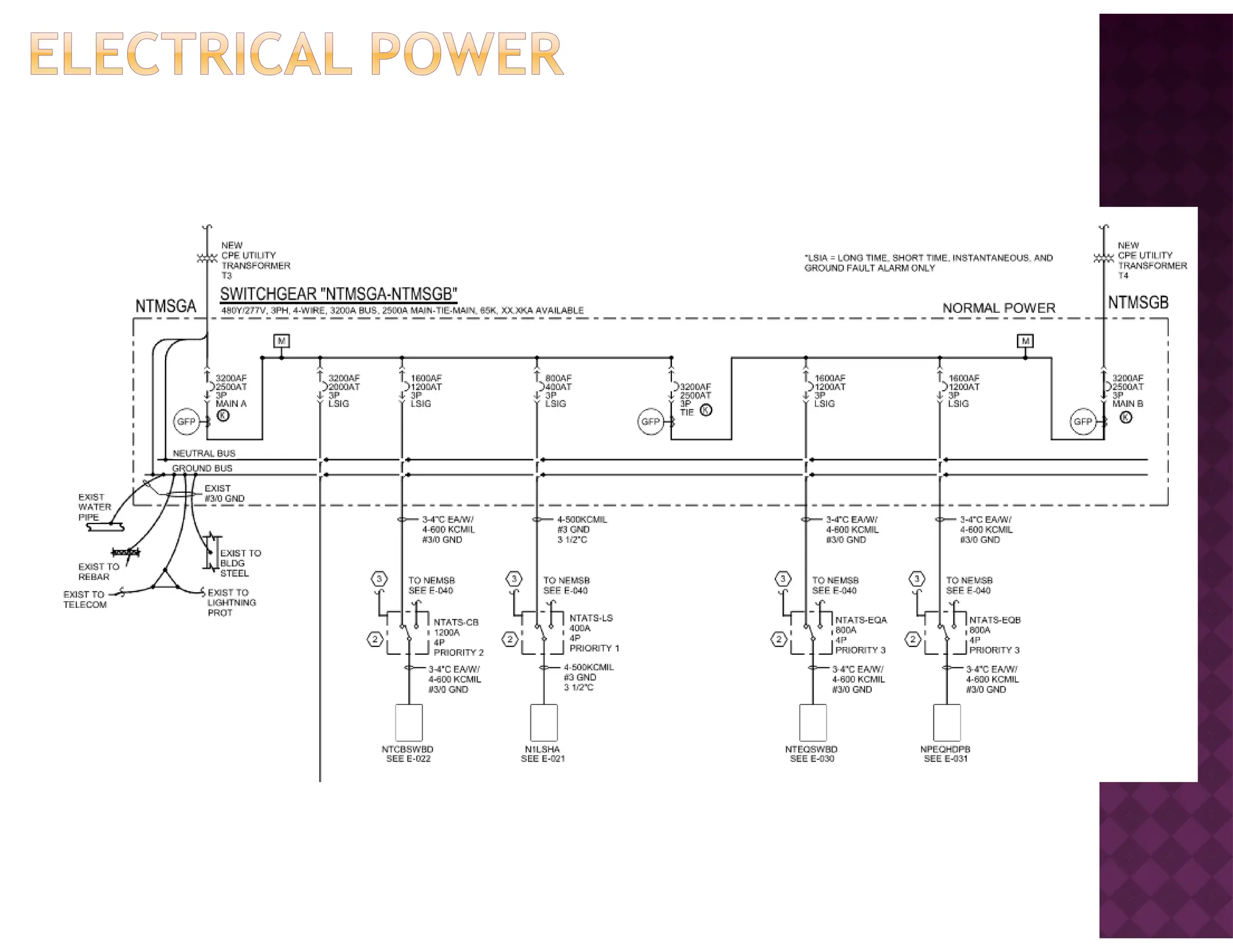
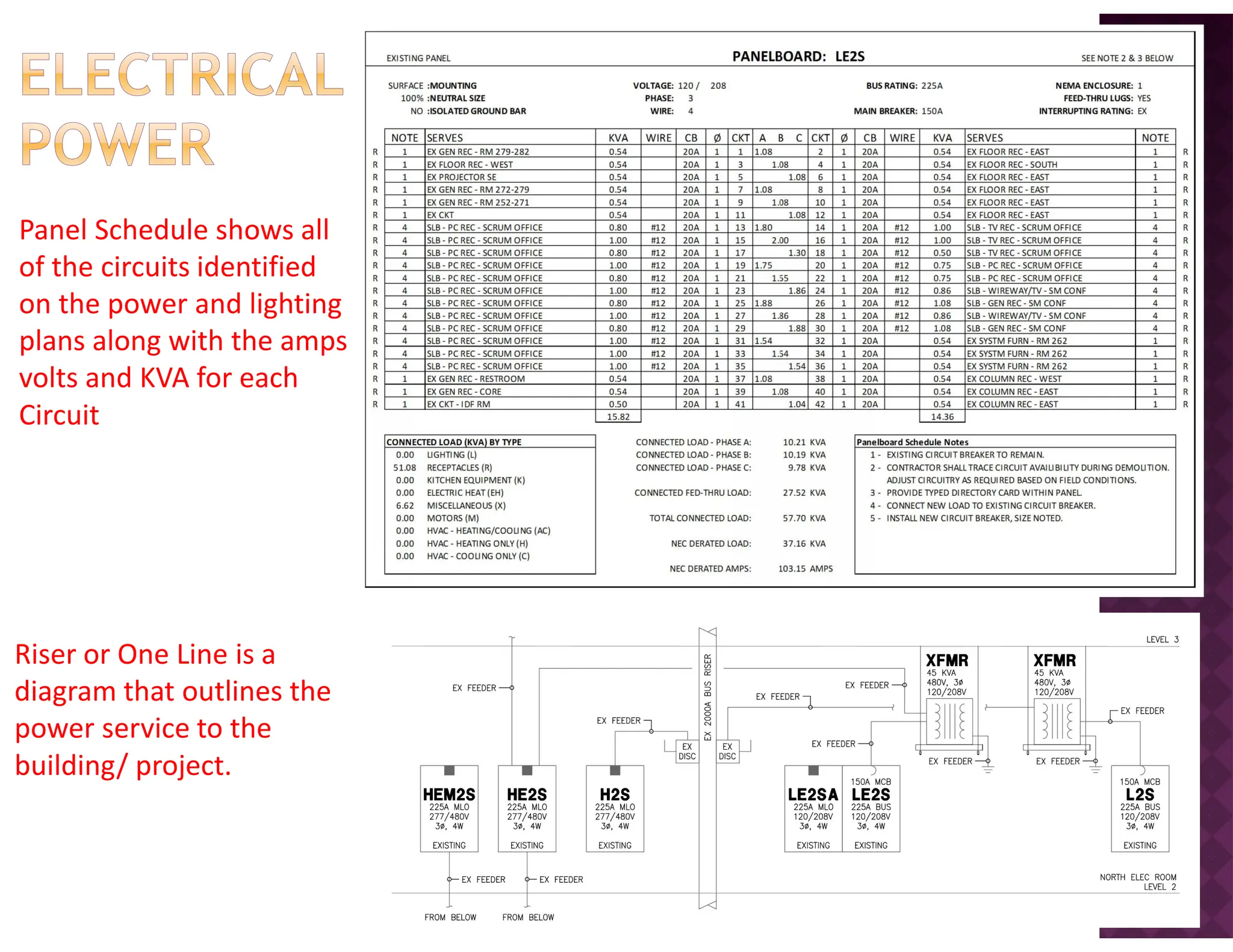
Riser or One Line is a
diagram that outlines the
power service to the
building/ project.
Panel Schedule shows all
of the circuits identified
on the power and lighting
plans along with the amps
volts and KVA for each
Circuit
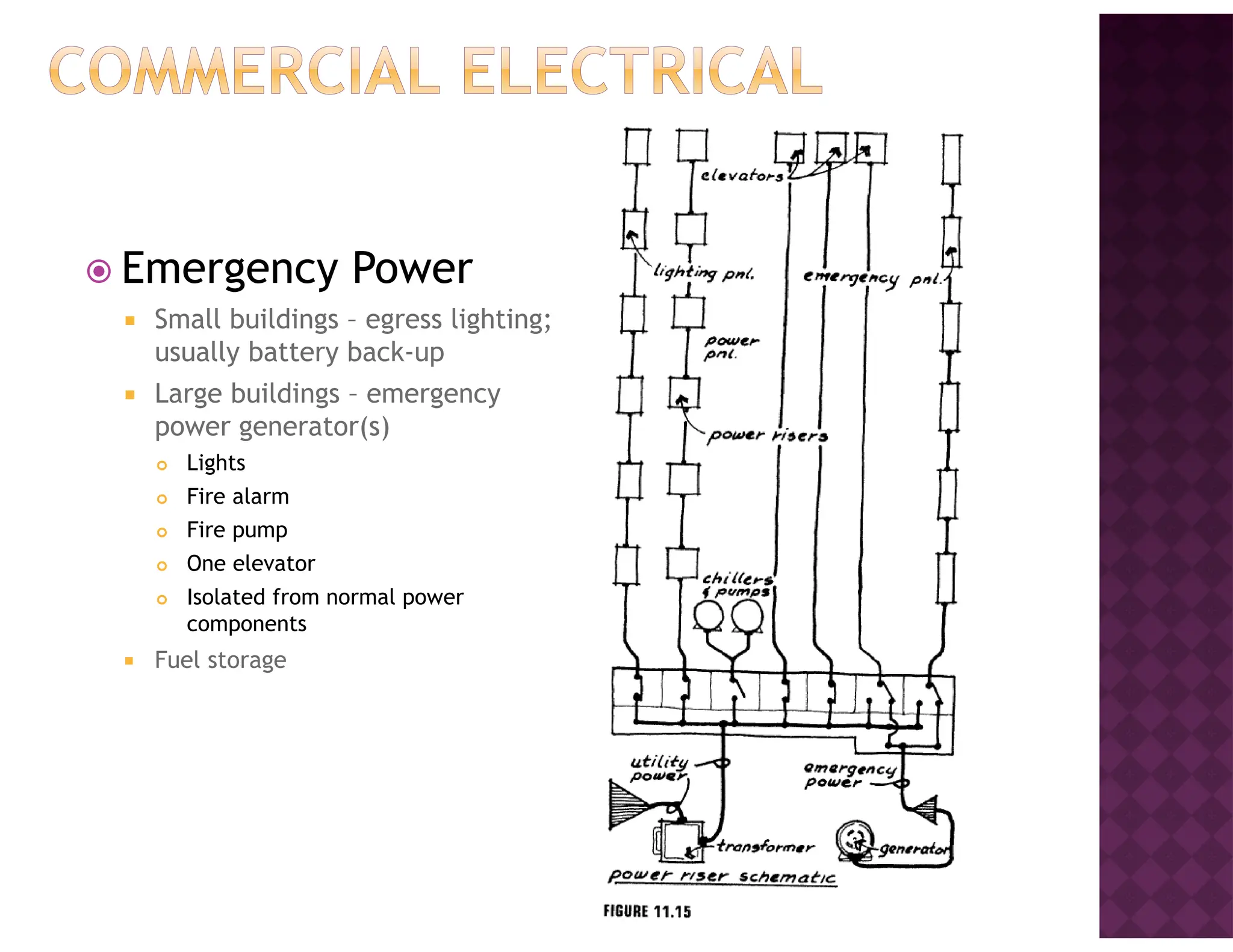
Emergency Power
Small buildings – egress lighting;
usually battery back-up
Large buildings – emergency
power generator(s)
 Lights
 Fire alarm
 Fire pump
 One elevator
 Isolated from normal power
components
Fuel storage
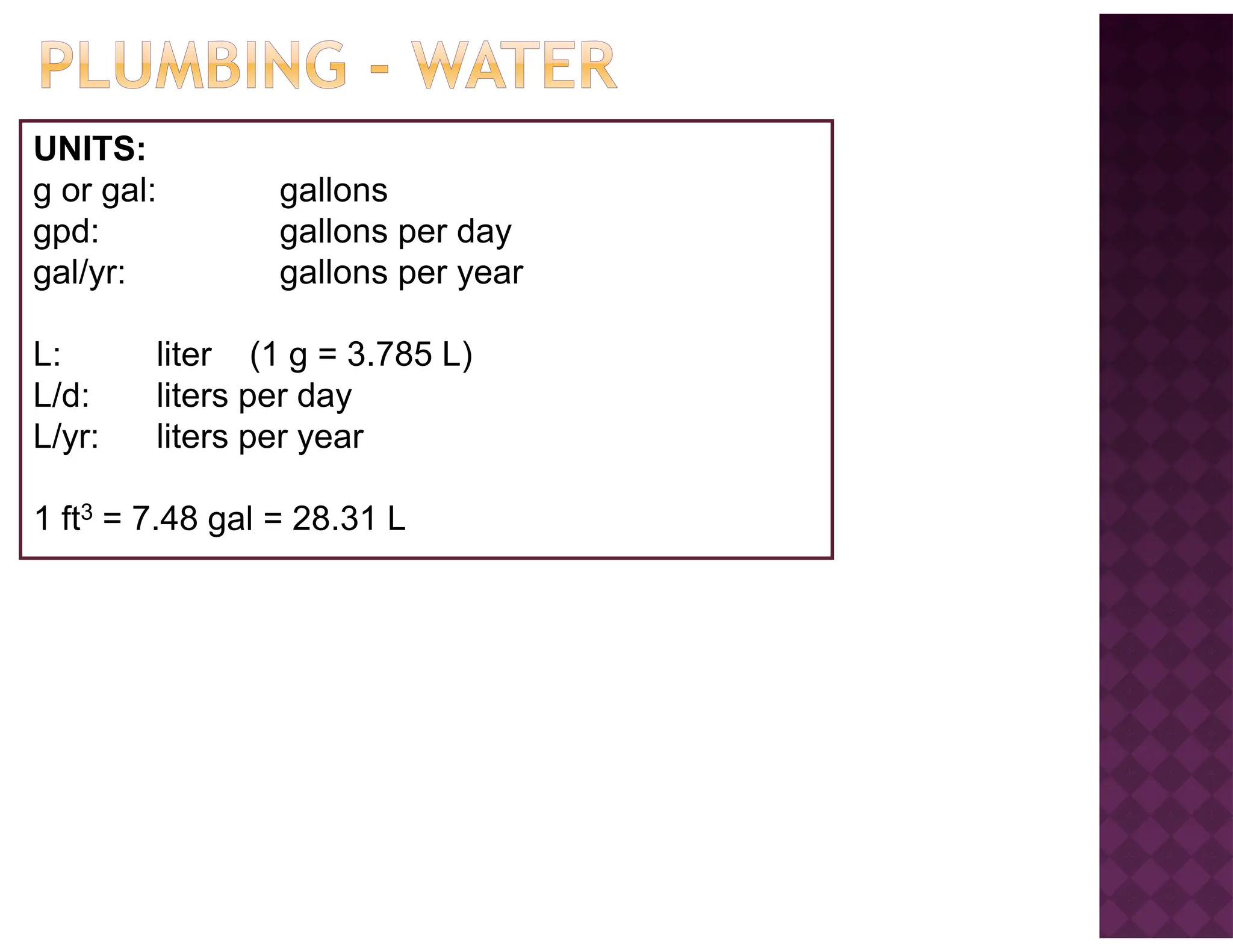
UNITS:
g or gal: gallons
gpd: gallons per day
gal/yr: gallons per year
L: liter (1 g = 3.785 L)
L/d: liters per day
L/yr: liters per year
1 ft3 = 7.48 gal = 28.31 L
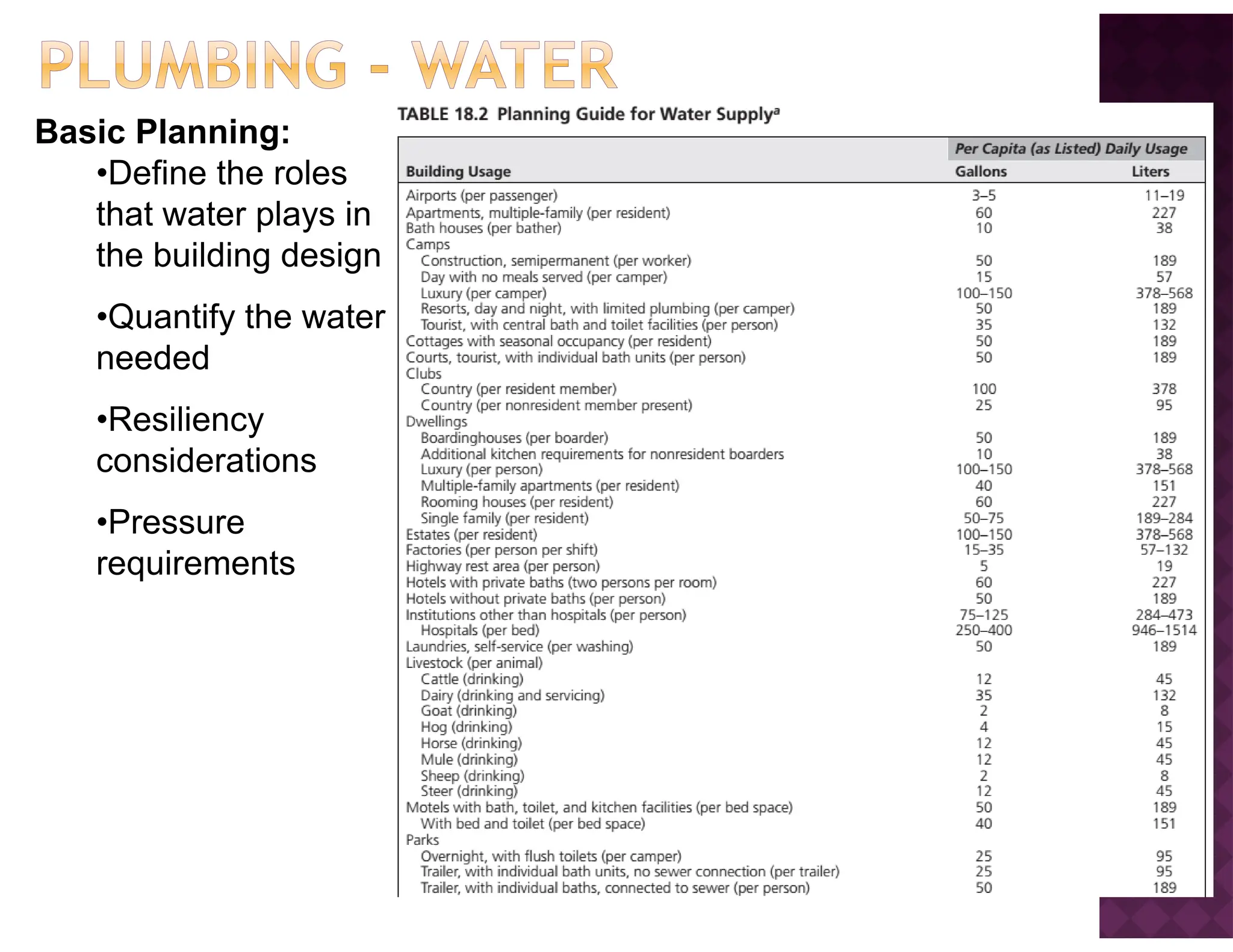
Basic Planning:
•Define the roles
that water plays in
the building design
•Quantify the water
needed
•Resiliency
considerations
•Pressure
requirements
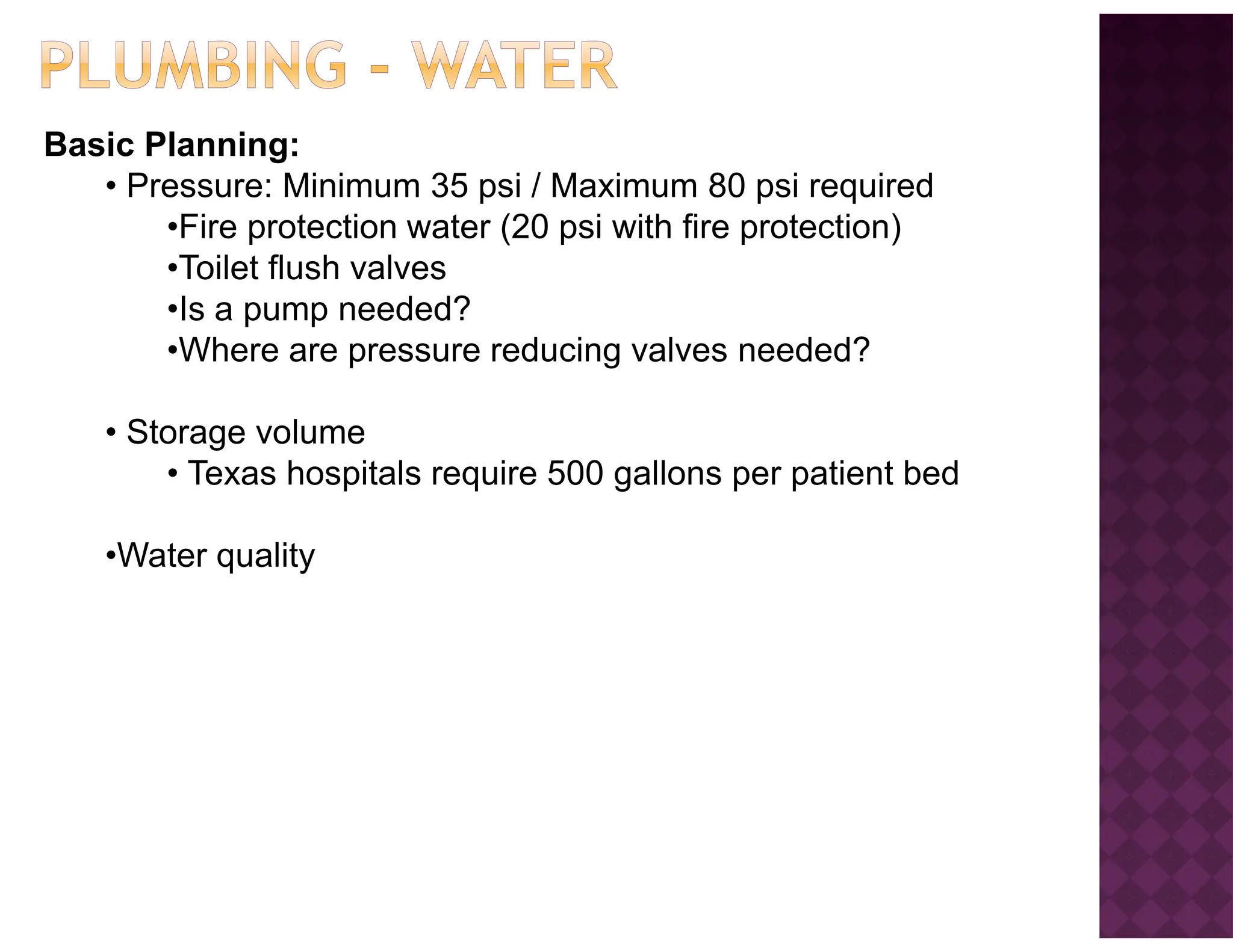
Basic Planning:
• Pressure: Minimum 35 psi / Maximum 80 psi required
•Fire protection water (20 psi with fire protection)
•Toilet flush valves
•Is a pump needed?
•Where are pressure reducing valves needed?
• Storage volume
• Texas hospitals require 500 gallons per patient bed
•Water quality
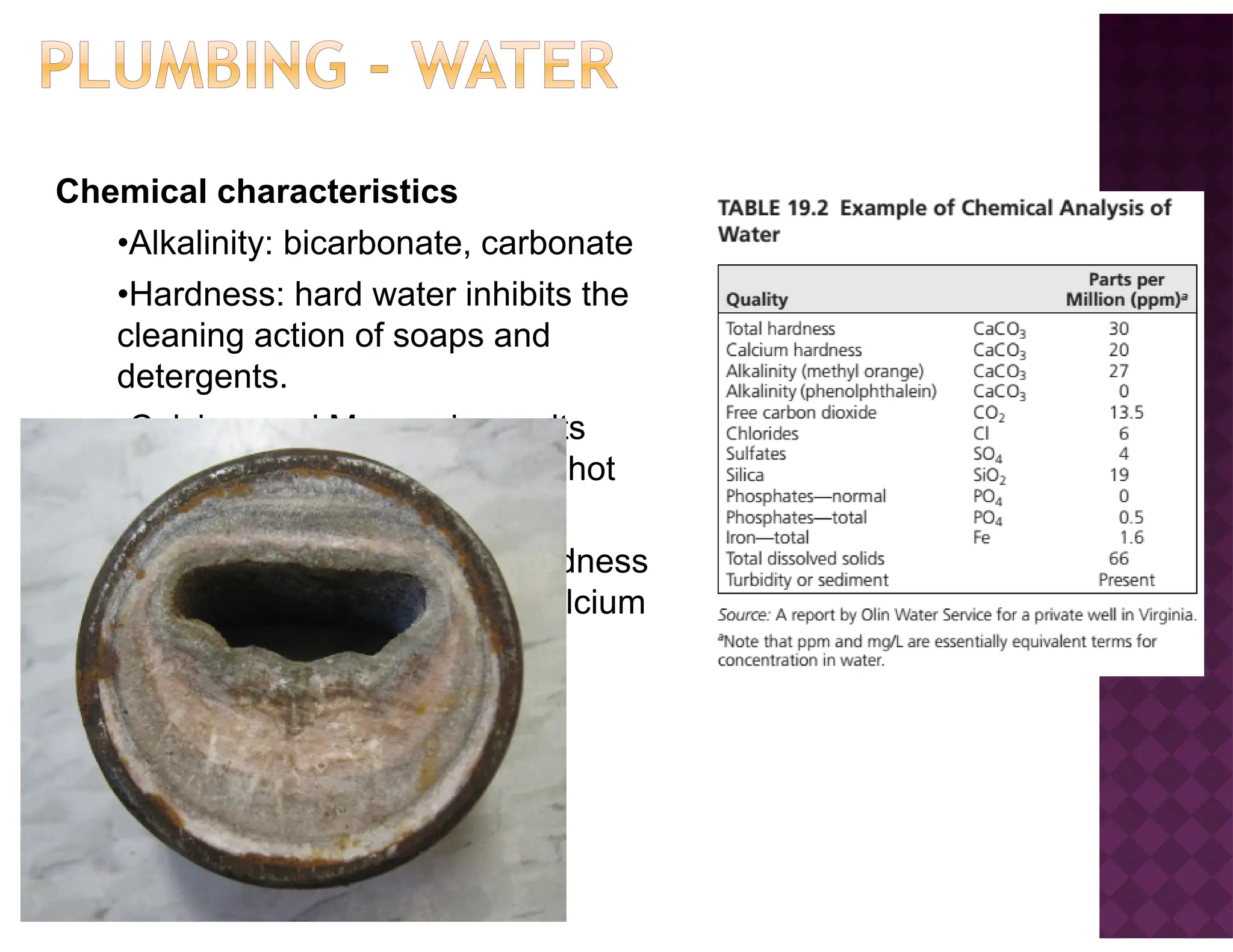
Chemical characteristics
•Alkalinity: bicarbonate, carbonate
•Hardness: hard water inhibits the
cleaning action of soaps and
detergents.
•Calcium and Magnesium salts
deposit scale on the inside of hot
water pipes and utensils.
•Water Softeners remove hardness
by exchanging Sodium for Calcium
and Magnesium
https://www.youtube.com/watch?v=0_ZcCqqpS2o
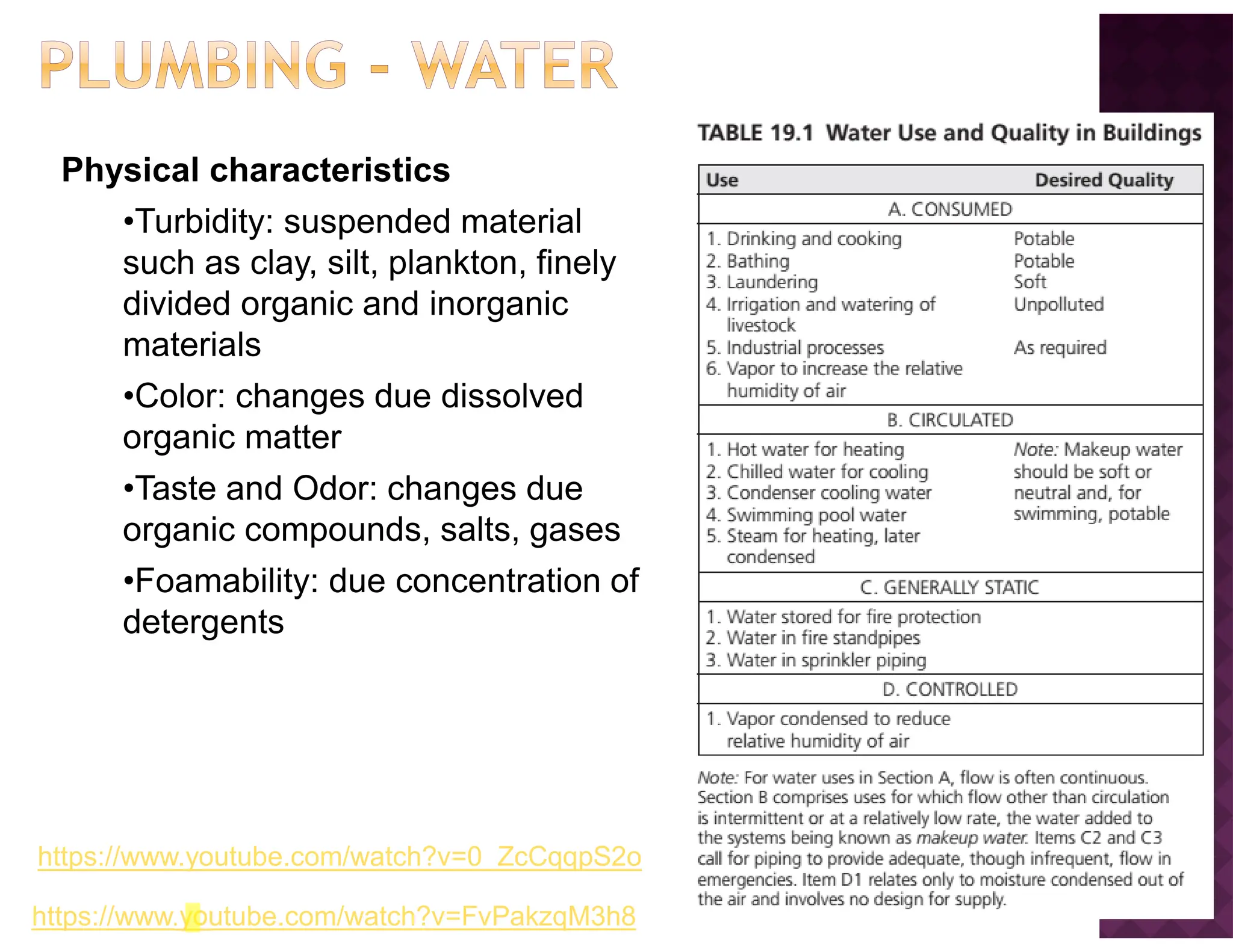
Physical characteristics
•Turbidity: suspended material
such as clay, silt, plankton, finely
divided organic and inorganic
materials
•Color: changes due dissolved
organic matter
•Taste and Odor: changes due
organic compounds, salts, gases
•Foamability: due concentration of
detergents
https://www.youtube.com/watch?v=FvPakzqM3h8
https://www.youtube.co
m/watch?v=pNXooT2FV
XM
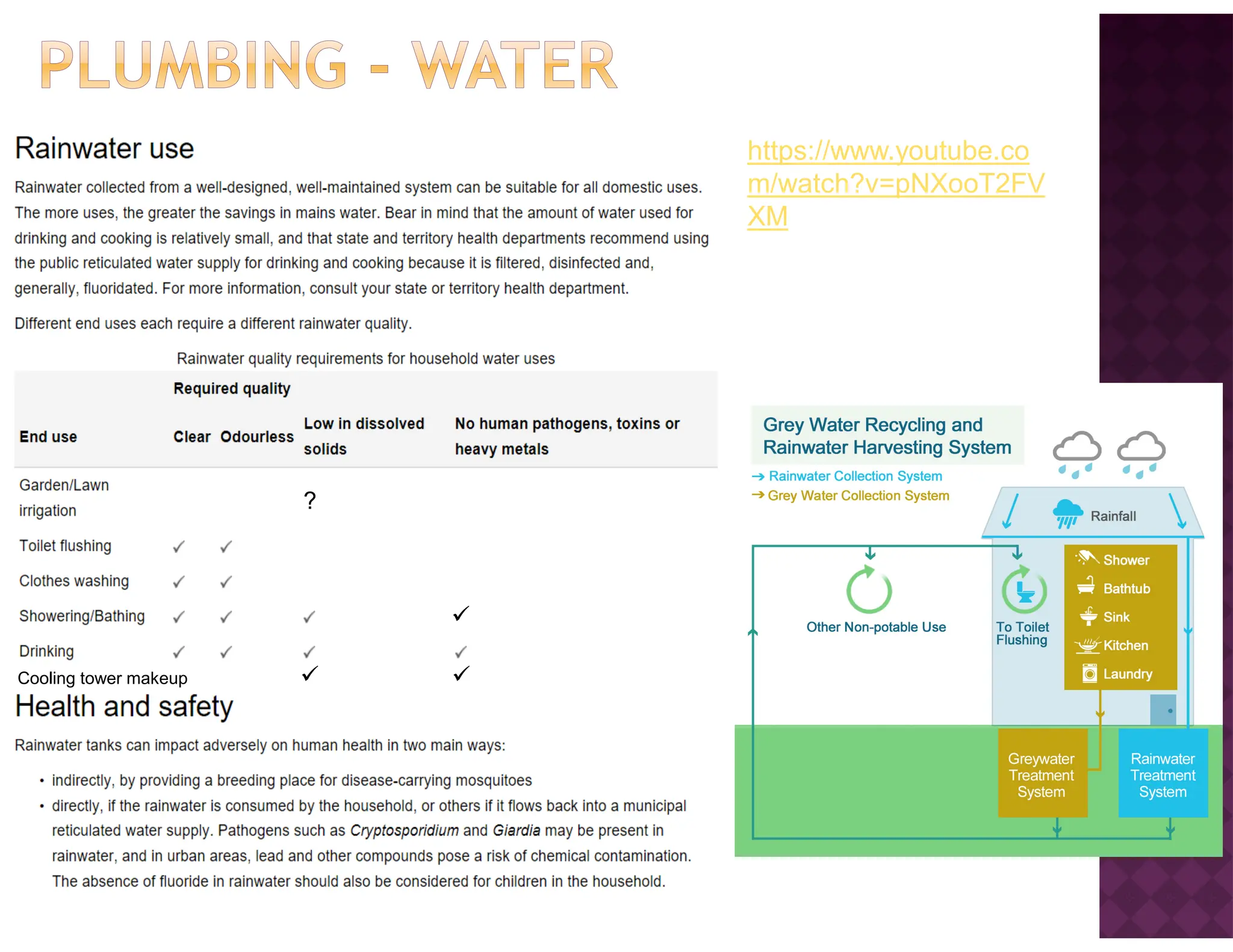

?
Cooling tower makeup  
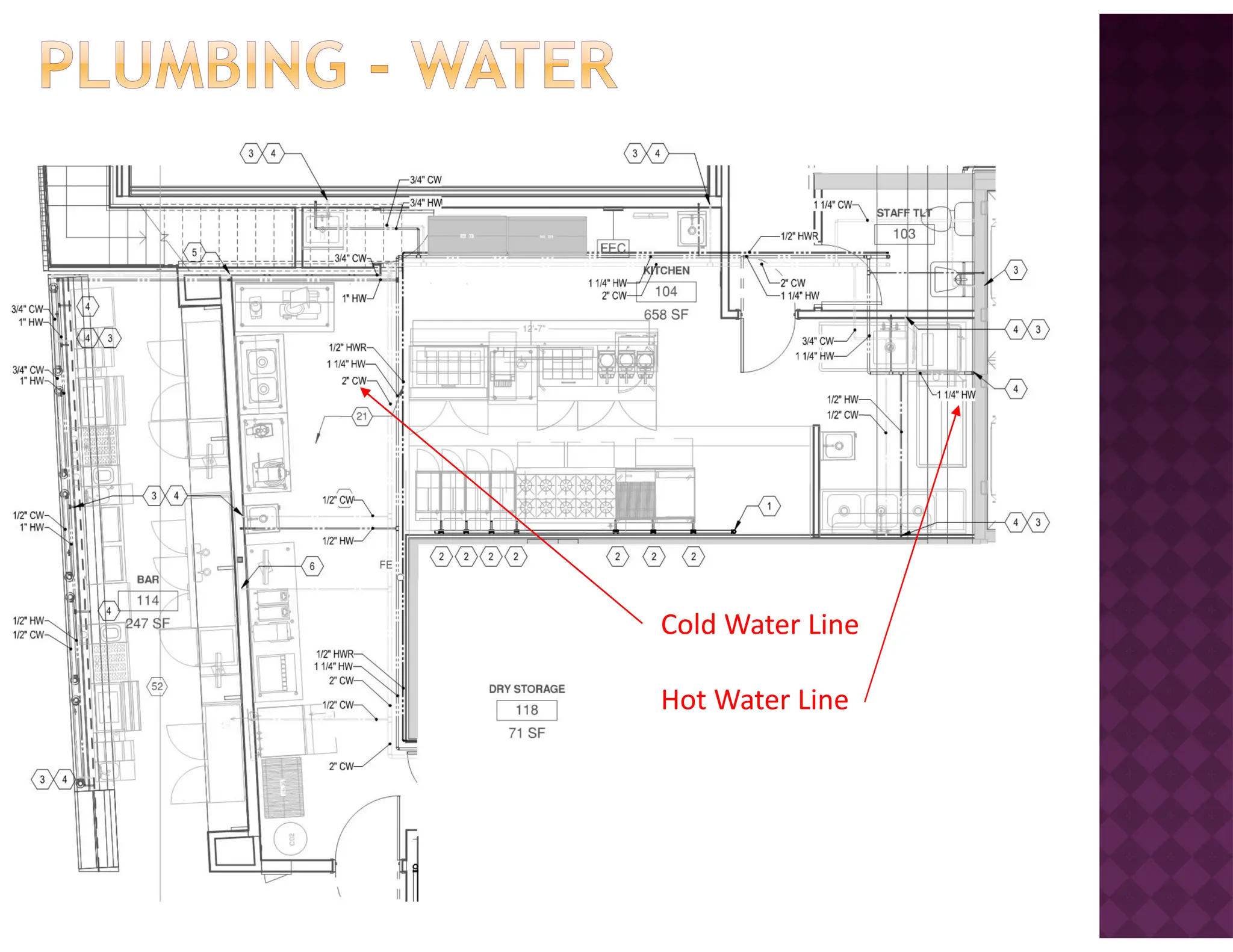
Cold Water Line
Hot Water Line
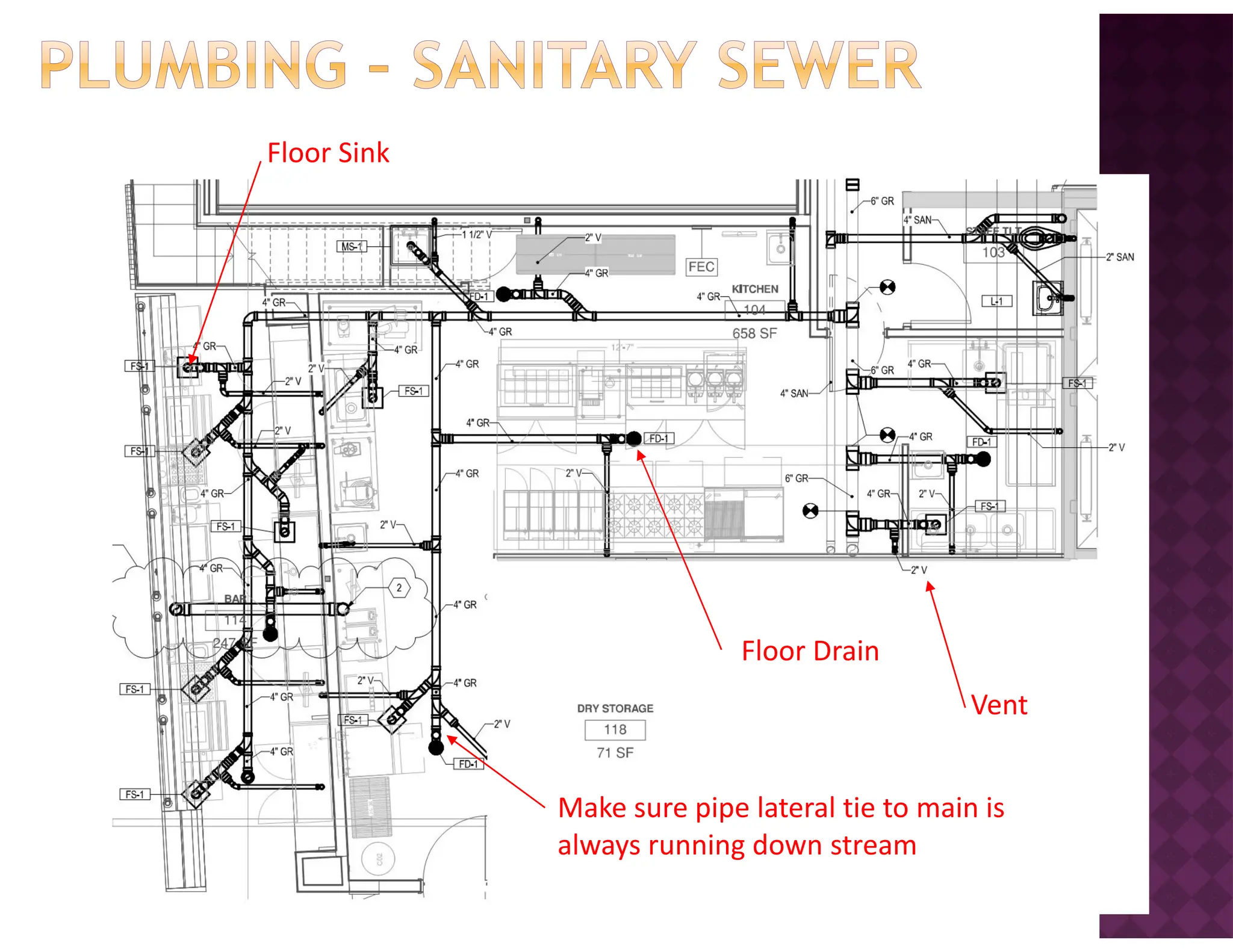
Floor Drain
Floor Sink
Vent
Make sure pipe lateral tie to main is
always running down stream
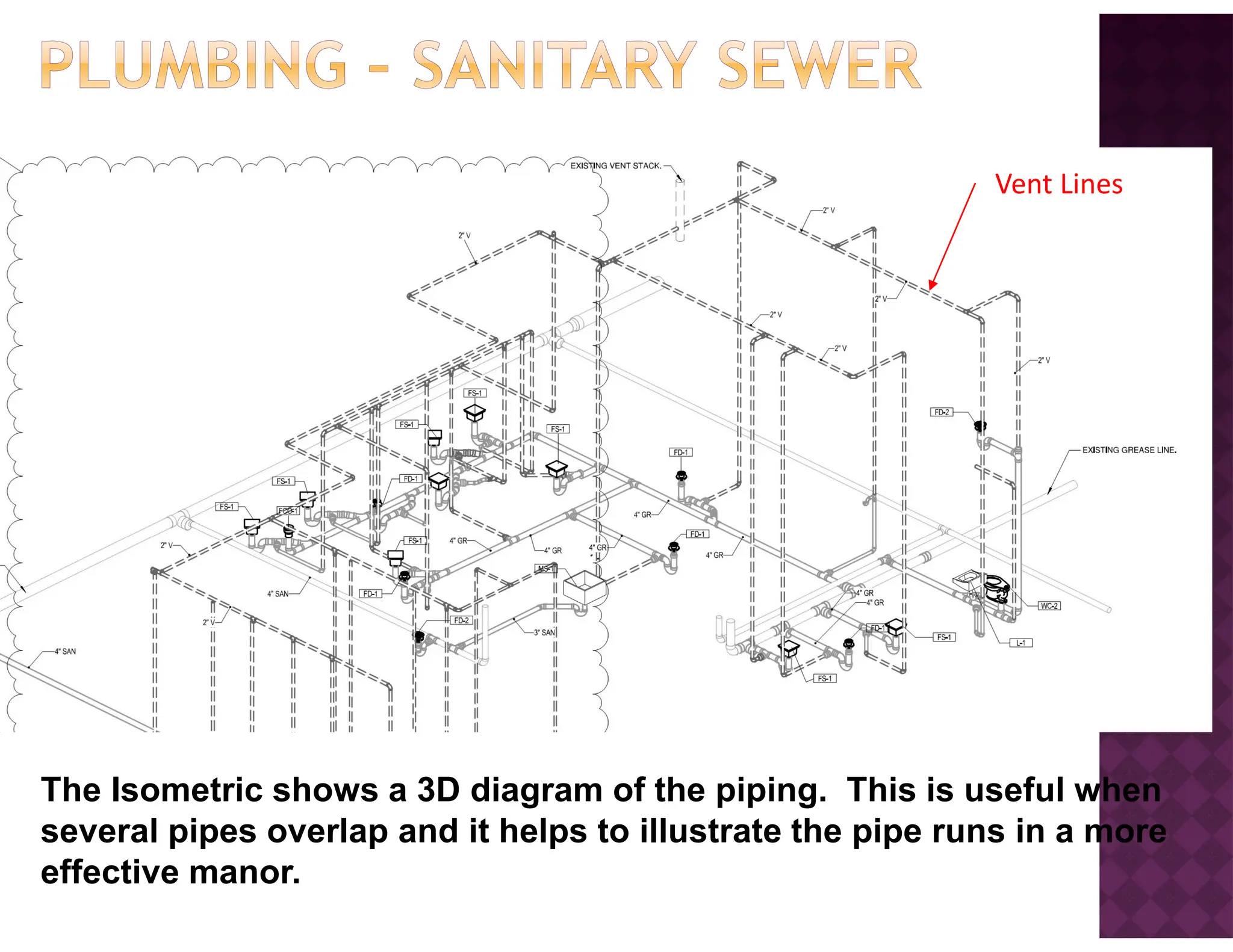
Vent Lines
The Isometric shows a 3D diagram of the piping. This is useful when
several pipes overlap and it helps to illustrate the pipe runs in a more
effective manor.
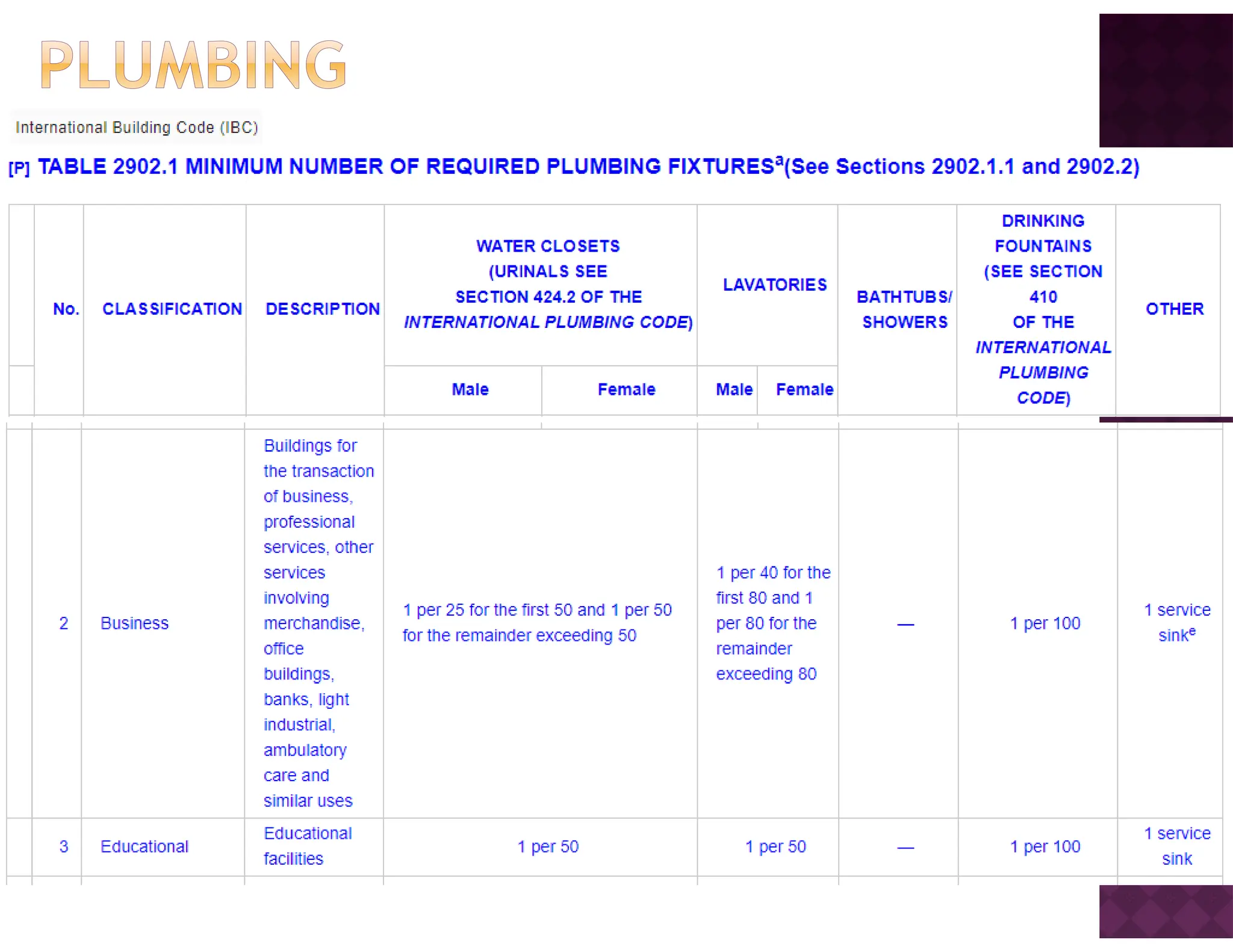
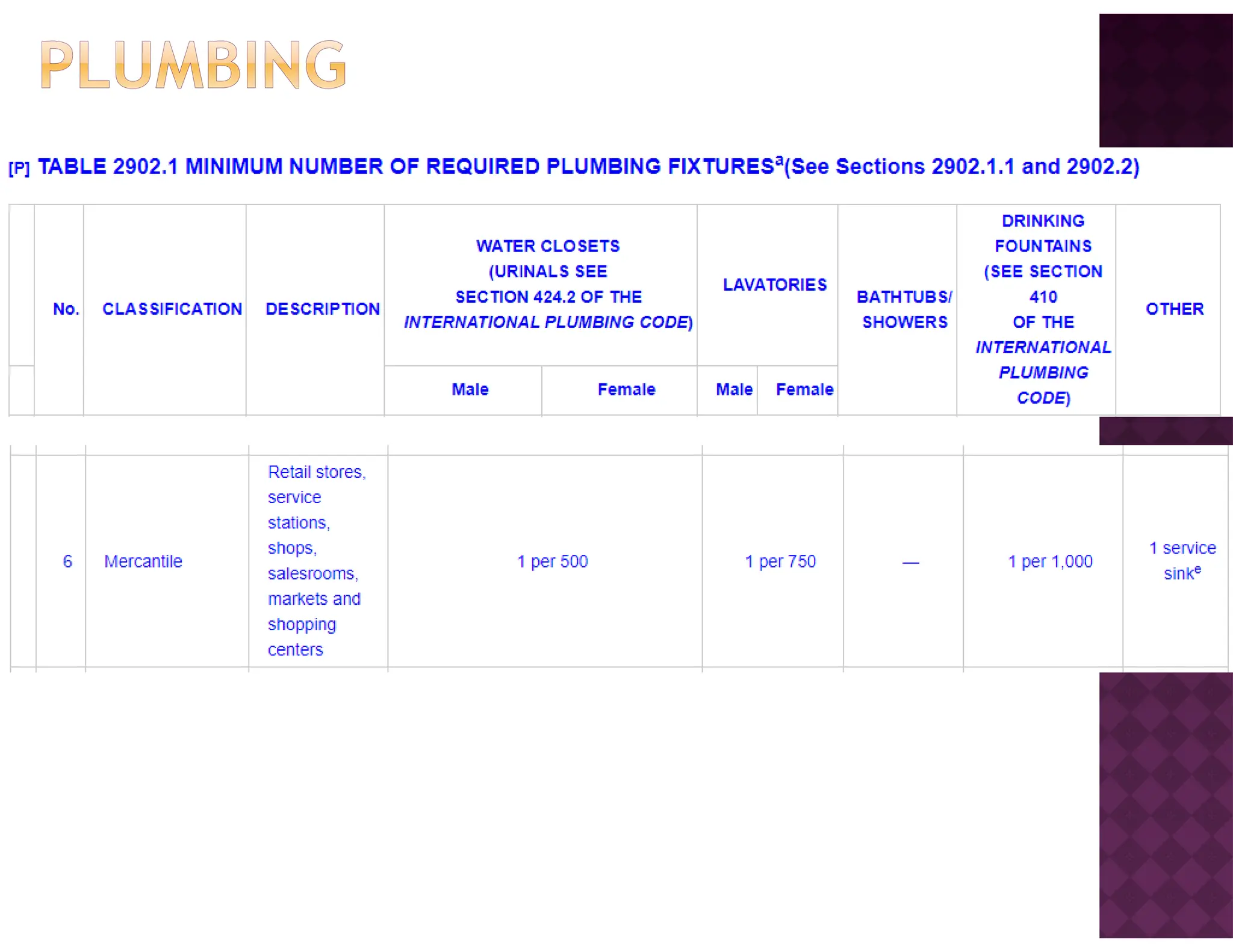
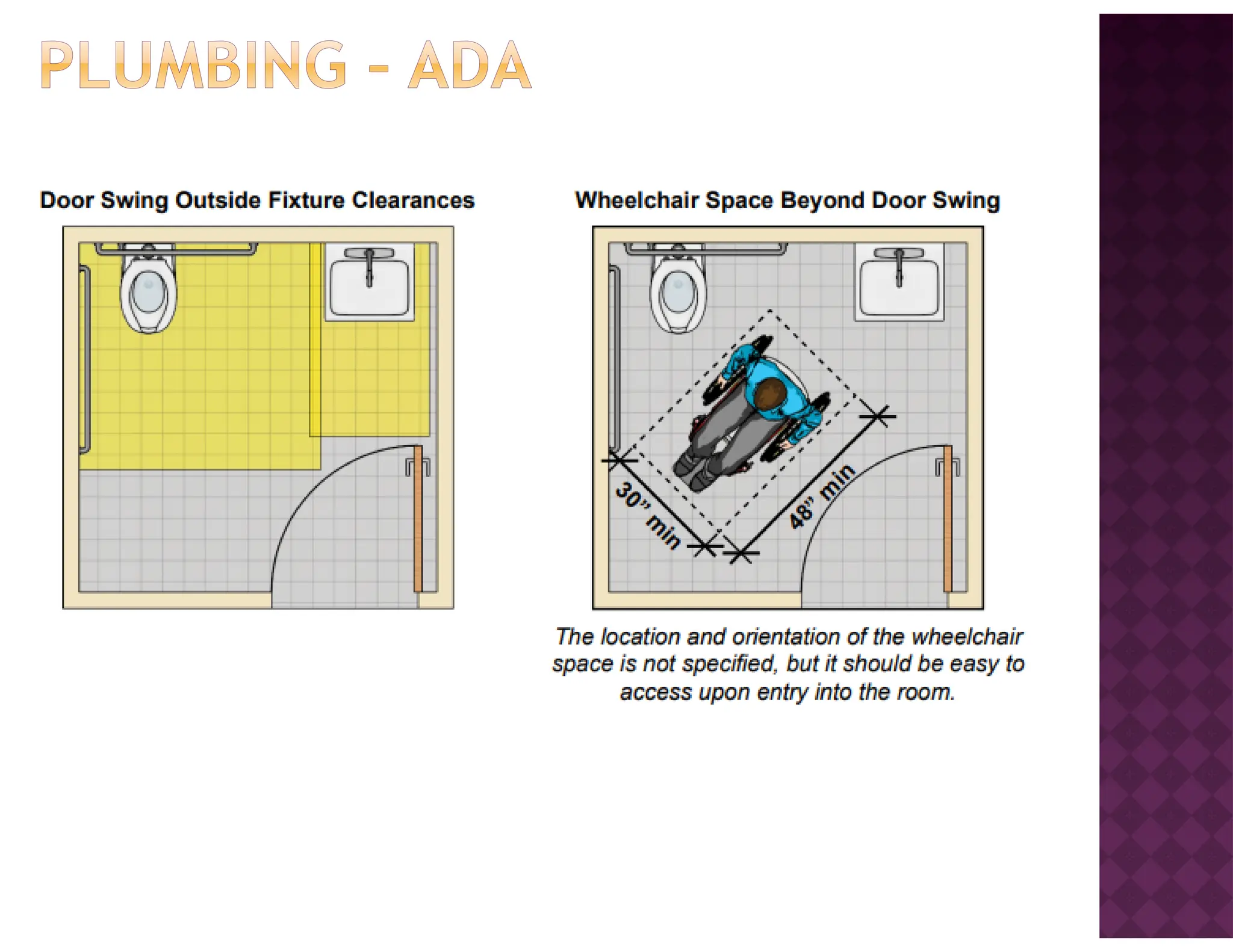
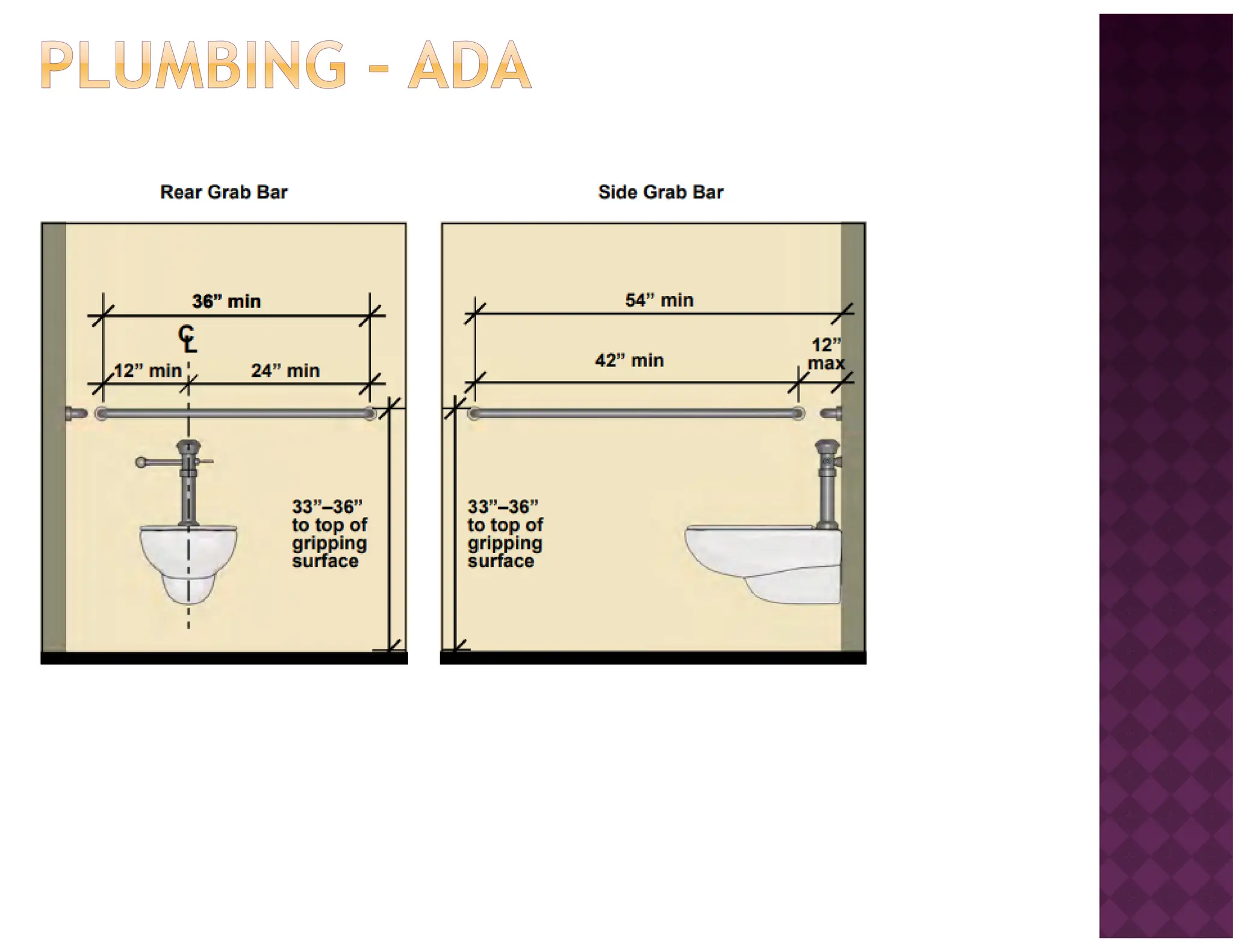
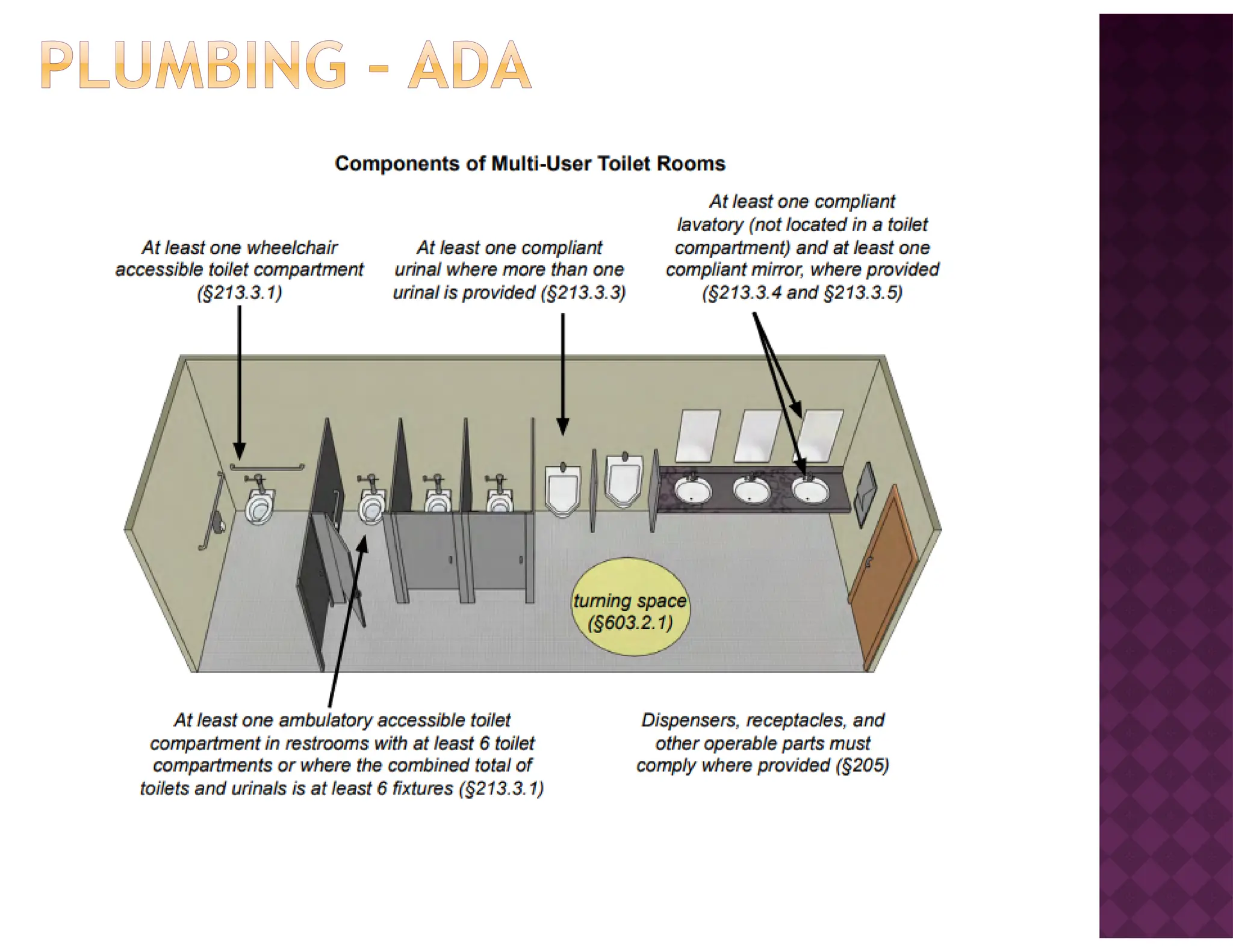
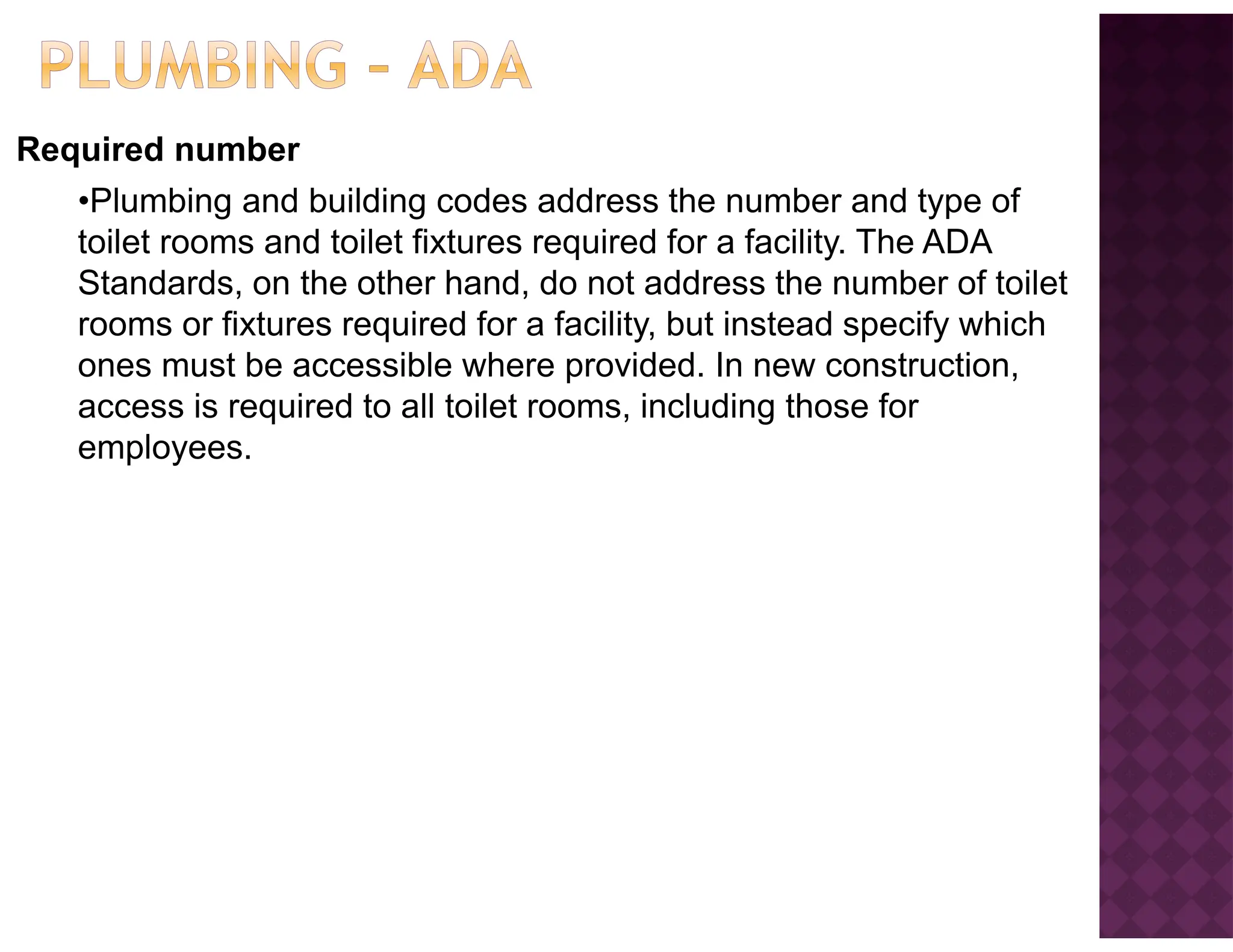
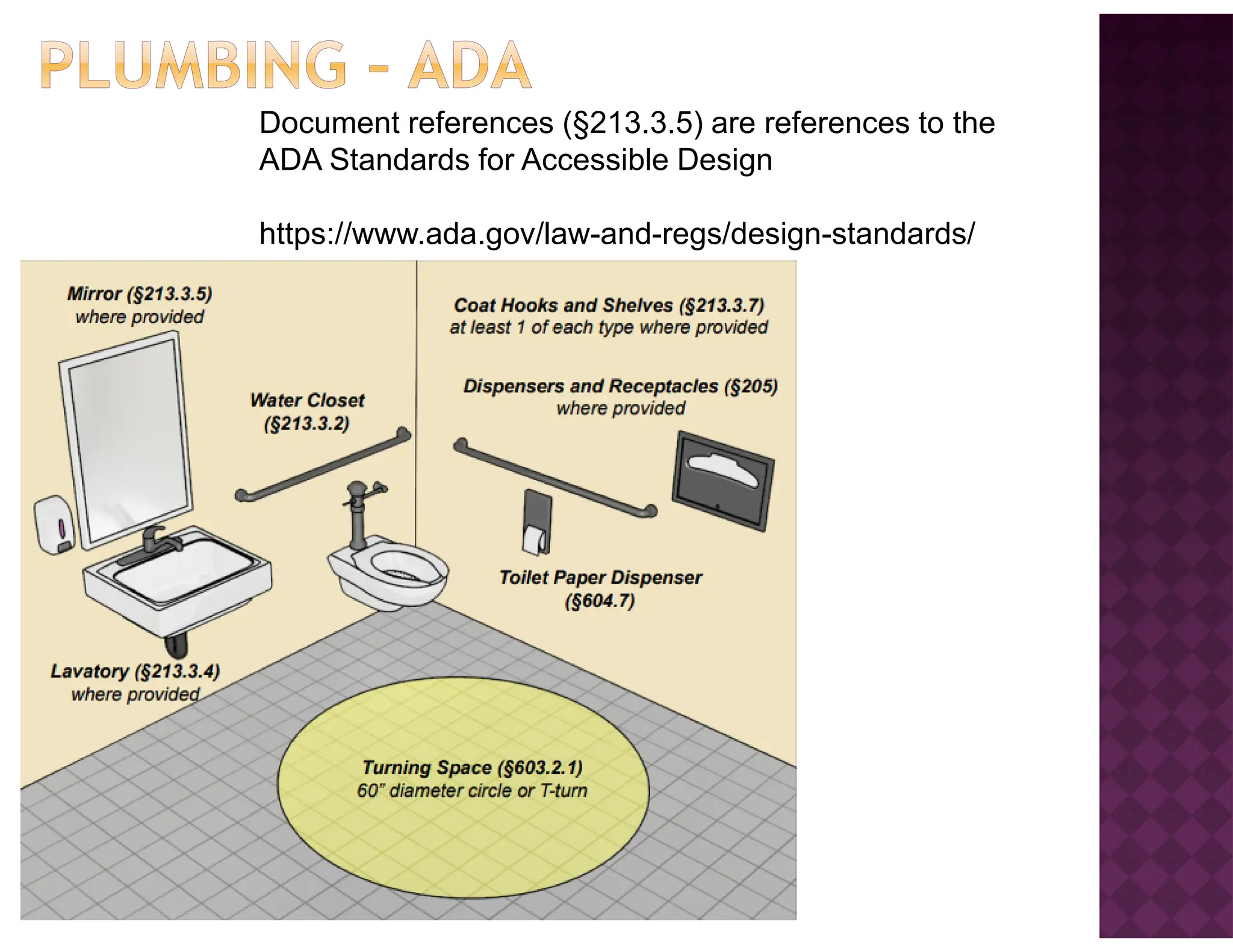
Required number
•Plumbing and building codes address the number and type of
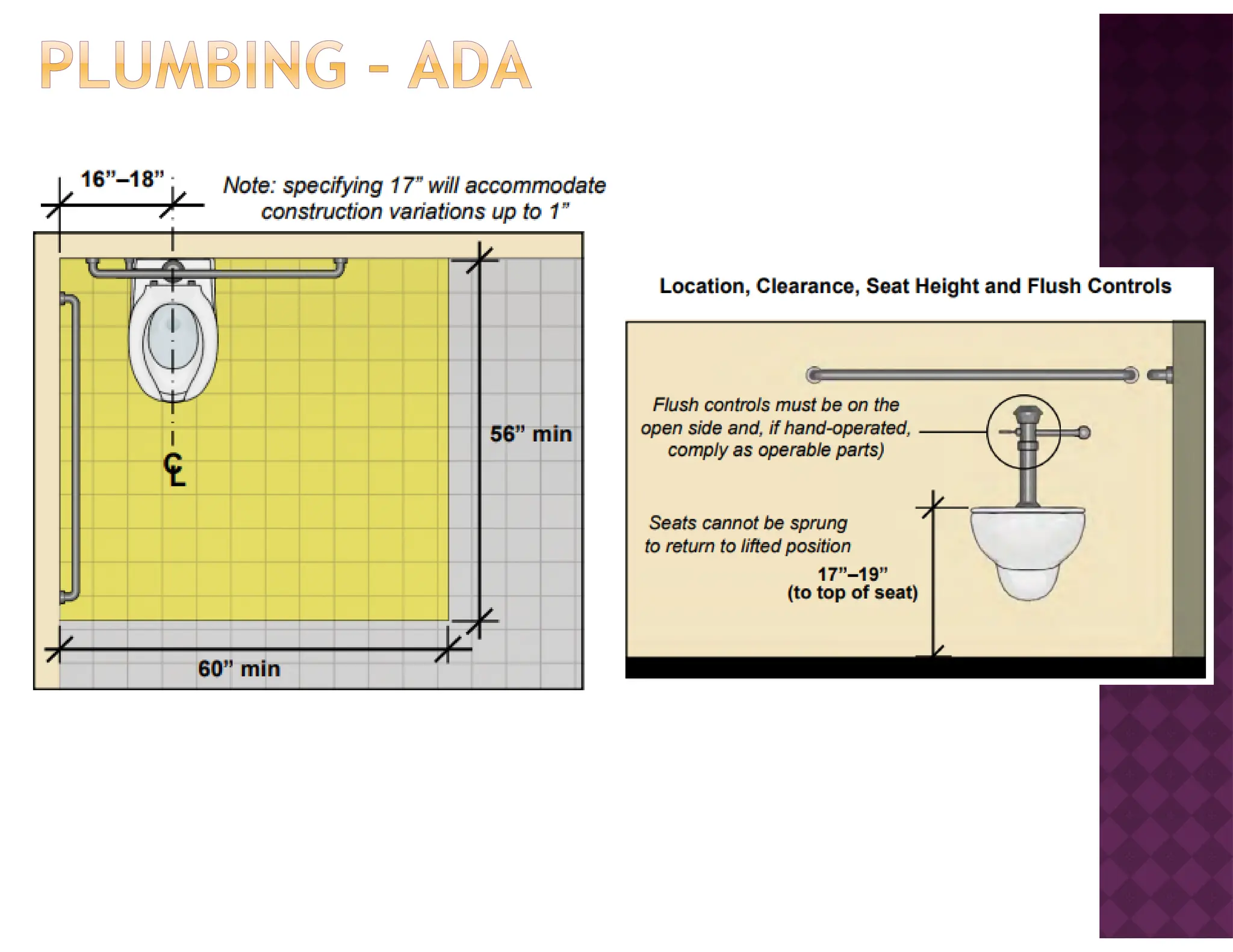
toilet rooms and toilet fixtures required for a facility. The ADA
Standards, on the other hand, do not address the number of toilet
rooms or fixtures required for a facility, but instead specify which
ones must be accessible where provided. In new construction,
access is required to all toilet rooms, including those for
employees.
Document references (§213.3.5) are references to the
ADA Standards for Accessible Design
https://www.ada.gov/law-and-regs/design-standards/
Week7 pvamu study topics understand electrical

Week7 pvamu study topics understand electrical

  • 2.
  • 3.
    Terms Basic Concepts • Ampere(A): The unit of electrical current. • AC (Alternating Current): Current that flows back and forth, changing direction periodically. • DC (Direct Current): Current that flows in one direction only. • Circuit: A closed path through which electric current can flow. • Current: The flow of electric charge. • Voltage: The potential difference between two points in a circuit. • Power: The rate at which energy is transferred. • Resistance: The opposition to the flow of electric current.
  • 4.
    Terms Components • Alternator: Agenerator that produces alternating current. • Bus: A thick conductor used to connect different components in a power system. • Capacitor: A device that stores electrical energy in an electric field. • Circuit Breaker: A protective device that automatically interrupts a circuit when excessive current flows. • Coil: A conductor wound into a spiral shape. • Conductor: A material that allows electricity to flow easily. • Conduit: A pipe or tube used to protect and support electrical wires. • Generator: A device that converts mechanical energy into electrical energy. • Ground: A connection to the earth used for safety or reference. • Insulator: A material that does not conduct electricity well. • Panel: A box containing fuses or circuit breakers used to control and protect electrical circuits. • Switchgear: A general term for electrical switching equipment. • Transformer: A device that changes the voltage of an alternating current. • Winding: A coil of wire used in electrical devices.
  • 5.
    Terms Units and Measurements •Hz (Hertz): The unit of frequency, measuring the number of cycles per second. • KVA (Kilovolt-Ampere): The apparent power in a circuit. • KW (Kilowatt): The unit of real power. • KWh (Kilowatt-hour): The unit of electrical energy. • Megawatt (MW): One million watts. • Ohm (Ω): The unit of electrical resistance. • Volt (V): The unit of electrical potential difference. • Watt (W): The unit of power.
  • 6.
    Terms Concepts • Demand: Themaximum rate of power consumption over a specified period. • EMT (Electrical Metallic Tubing): A type of conduit used for wiring. • Feeders: Conductors that carry electricity from the source to the distribution points. • GFCI (Ground Fault Circuit Interrupter): A type of circuit breaker that protects against electrical shock. • Reactance: The opposition to the flow of alternating current due to inductance or capacitance. • Ohm's Law: A law stating that the current in a circuit is directly proportional to the voltage and inversely proportional to the resistance.
  • 7.
    Terms Concepts • Series Circuit:A circuit where the components are connected in series, so the same current flows through all of them. • Parallel Circuit: A circuit where the components are connected in parallel, so each component has the same voltage across it. • Voltage Drop: The decrease in voltage along a conductor due to resistance. • Service: The electrical connection between the utility company and a building. • Strip Heat: A type of electric heater. • NEC (National Electrical Code): A set of standards for the safe installation of electrical wiring in the United States. • NEMA (National Electrical Manufacturers Association): An organization that sets standards for electrical equipment. • Wye (Y): A type of three-phase connection where the three windings are connected in a star configuration, with one end of each winding connected to a common neutral point. • Delta (Δ): A type of three-phase connection where the three windings are connected in a triangle configuration, with the ends of the windings connected in a closed loop. There is no neutral point in a delta connection.
  • 8.
    Electricity is theflow of electrons. Materials that promote the flow of electrons are called conductors. Metals are typically good conductors. Materials that prohibit the flow of electrons are called insulators. Rubber, wood, glass, and most plastics are good insulators. The bulk of electric energy utilized today is in the form of alternating current (AC), produced by AC generators commonly called alternators.
  • 9.
    Circuits Parallel – mostbuilding applications Series – mostly used in electronics
  • 10.
    Magnetism – flowof electrons in a conductor will create a magnetic field. Moving a conductor through a magnetic field will cause electrons to flow in the conductor, which is how we generate most of the electricity we us. This is how generators work.
  • 11.
    Electrical Units Volts –the driving force to cause electrons to flow. Analogous to pressure that causes fluids to flow and to temperature that causes heat to flow. Current – the quantity of electrons flowing. Analogous to fluid flow and heat flow. Ohms – the resistance to flow. Analogous to friction. 1 amp is defined as the flow of electrons through a resistance of 1 ohm at a driving force of 1 volt. Watts – energy consumed or produced by electrical systems. Analogous to horsepower.
  • 12.
    Analogy between electricityand hydraulics (fluid flow)
  • 13.
    Ohms law –E = I x R or volt = amps x ohms Power – W = E x I or watts = volts x amps Variations of these are shown in the diagram. Basic form of Ohm’s law: or
  • 14.
    Example calculations What isthe power of the lamp? SOLUTION: P = V x I = 115V x 1.74 A = 200 Watts
  • 15.
    Example calculations Example: A waterheater is rated at 4,500 watts. Find the current required at 120 volts and at 240 volts. EI = W (120) x I = 4,500 I=37.5 amps (240) x I = 4,500 I=18.8 amps Increased voltage means reduced current and smaller conductors.
  • 16.
    Example calculations Example: Thetotal connected electrical load for all the lights and kilns in a small pottery studio is 125 kW. Find the current required for the studio’s electrical service at 240 volts. (1 kW = 1,000 watts) EI = W (240) X I = 125,000 I = 521 amps
  • 17.
  • 18.
    Single Phase andThree Phase Power
  • 19.
    The most commoncommercial building electric service in North America is 120/208 volt wye, which is used to power 120 volt plug loads, lighting, and smaller HVAC systems. In larger facilities the voltage is 277/480 volt and used to power single phase 277 volt lighting and larger HVAC loads. In a fully sprinklered building, the electrical room needs to be sprinklered also, unless enclosed in 2 hour fire resistive construction, per NFPA 13 transformers over 112 1/2 kVA be installed in a transformer room of fire- resistant construction. https://www.youtube.com/watc h?v=vN9aR2wKv0U https://www.youtube.com/watch?v=mvuHsu8S6v8
  • 21.
    Electrical Power Planis a graphic representation of the power distribution throughout the building. This includes power to AV devices, automatic doors, faucets, wall outlets, building equipment, etc…..
  • 22.
    Duplex outlet # ofwires Data/ Phone Quadplex outlet Circuit number VAV Box
  • 23.
    Riser or OneLine is a diagram that outlines the power service to the building/ project. Panel Schedule shows all of the circuits identified on the power and lighting plans along with the amps volts and KVA for each Circuit
  • 24.
    Emergency Power Small buildings– egress lighting; usually battery back-up Large buildings – emergency power generator(s)  Lights  Fire alarm  Fire pump  One elevator  Isolated from normal power components Fuel storage
  • 26.
    UNITS: g or gal:gallons gpd: gallons per day gal/yr: gallons per year L: liter (1 g = 3.785 L) L/d: liters per day L/yr: liters per year 1 ft3 = 7.48 gal = 28.31 L
  • 27.
    Basic Planning: •Define theroles that water plays in the building design •Quantify the water needed •Resiliency considerations •Pressure requirements
  • 28.
    Basic Planning: • Pressure:Minimum 35 psi / Maximum 80 psi required •Fire protection water (20 psi with fire protection) •Toilet flush valves •Is a pump needed? •Where are pressure reducing valves needed? • Storage volume • Texas hospitals require 500 gallons per patient bed •Water quality
  • 29.
    Chemical characteristics •Alkalinity: bicarbonate,carbonate •Hardness: hard water inhibits the cleaning action of soaps and detergents. •Calcium and Magnesium salts deposit scale on the inside of hot water pipes and utensils. •Water Softeners remove hardness by exchanging Sodium for Calcium and Magnesium
  • 30.
    https://www.youtube.com/watch?v=0_ZcCqqpS2o Physical characteristics •Turbidity: suspendedmaterial such as clay, silt, plankton, finely divided organic and inorganic materials •Color: changes due dissolved organic matter •Taste and Odor: changes due organic compounds, salts, gases •Foamability: due concentration of detergents https://www.youtube.com/watch?v=FvPakzqM3h8
  • 31.
  • 32.
  • 34.
    Floor Drain Floor Sink Vent Makesure pipe lateral tie to main is always running down stream
  • 35.
    Vent Lines The Isometricshows a 3D diagram of the piping. This is useful when several pipes overlap and it helps to illustrate the pipe runs in a more effective manor.
  • 38.
    Required number •Plumbing andbuilding codes address the number and type of toilet rooms and toilet fixtures required for a facility. The ADA Standards, on the other hand, do not address the number of toilet rooms or fixtures required for a facility, but instead specify which ones must be accessible where provided. In new construction, access is required to all toilet rooms, including those for employees.
  • 39.
    Document references (§213.3.5)are references to the ADA Standards for Accessible Design https://www.ada.gov/law-and-regs/design-standards/