CARBON AND HYDROCARBONS
• ABUNDANCE AND IMPORTANCE OF CARBON
• ORGANIC COMPOUNDS
• SATURATED HYDROCARBONS
• UNSATURATED HYDROCARBONS
DANNY O. ALFONSO
SUBJECT INSTRUCTOR
STRUCTURE AND BONDING OF CARBON
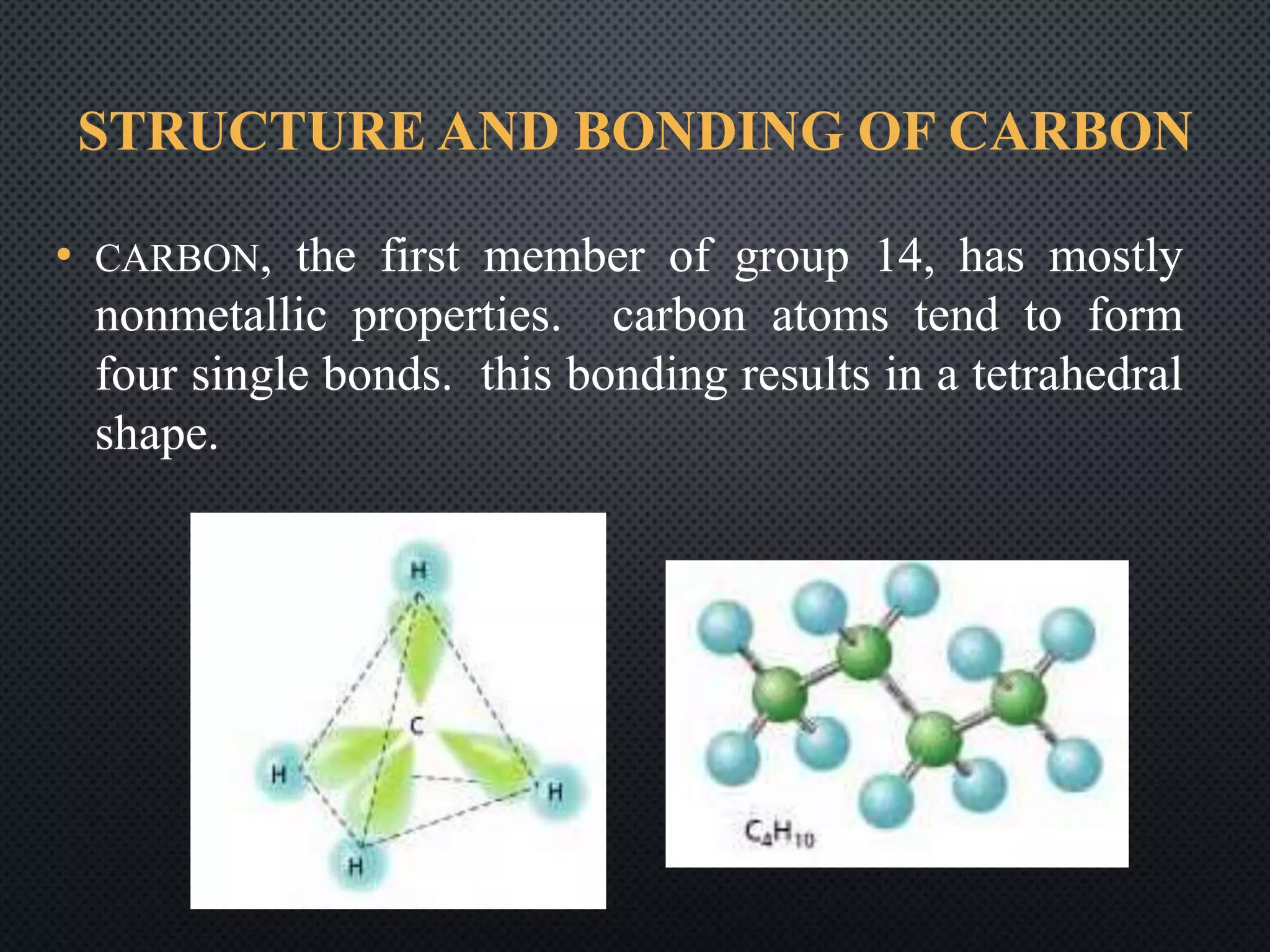
• CARBON, the first member of group 14, has mostly
nonmetallic properties. carbon atoms tend to form
four single bonds. this bonding results in a tetrahedral
shape.
ALLOTROPES OF CARBON
• Carbon occurs in several solid allotropic
forms that have dramatically different
properties.
• Diamond – Colorless, crystalline, solid form
of carbon
• Graphite – soft, black, crystalline form of
carbon that is a fair conductor of electricity.
• Fullerenes – dark colored solids made of
spherically networked carbon atom cages
ALLOTROPES OF CARBON - DIAMOND
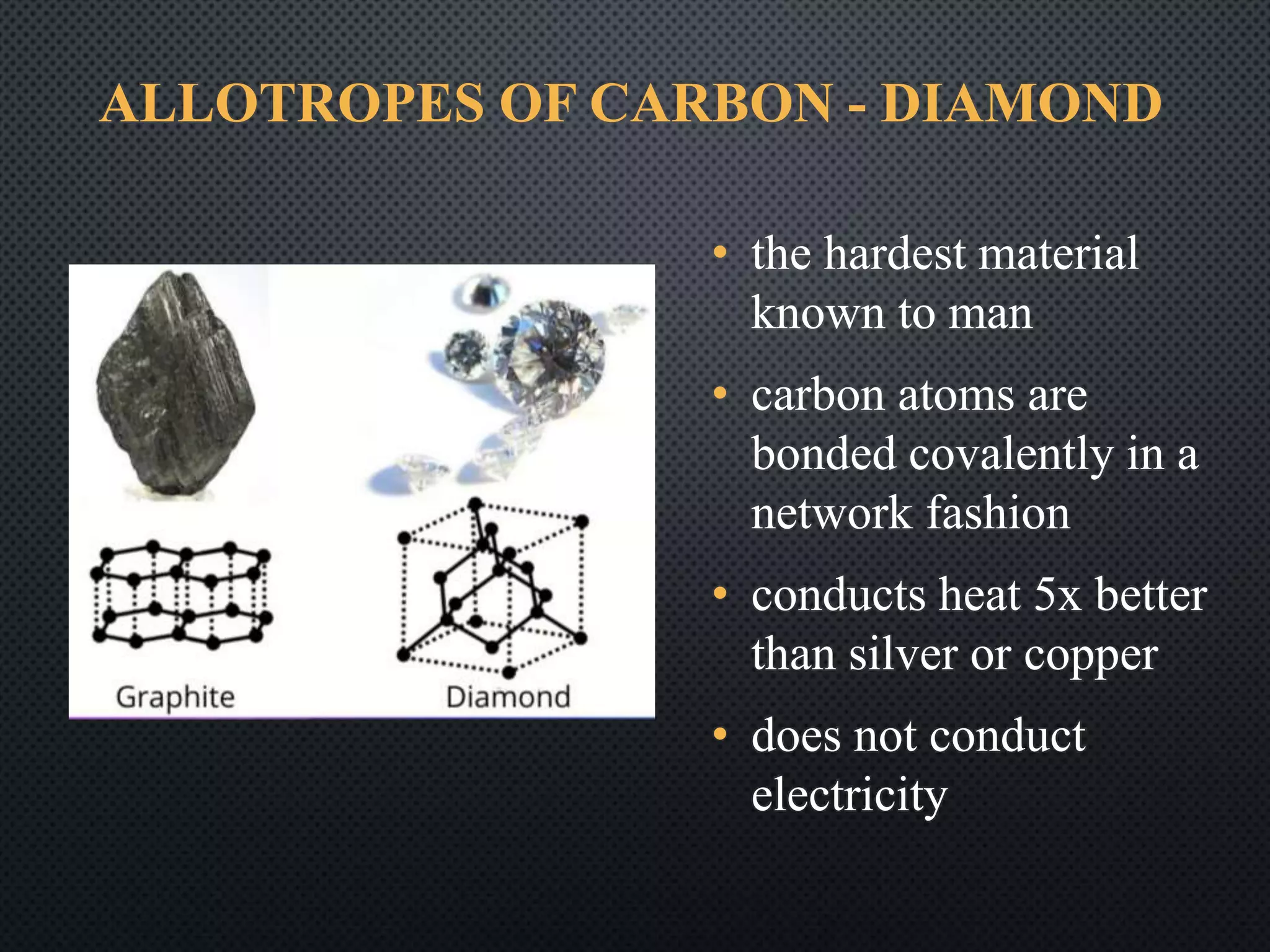
• the hardest material
known to man
• carbon atoms are
bonded covalently in a
network fashion
• conducts heat 5x better
than silver or copper
• does not conduct
electricity
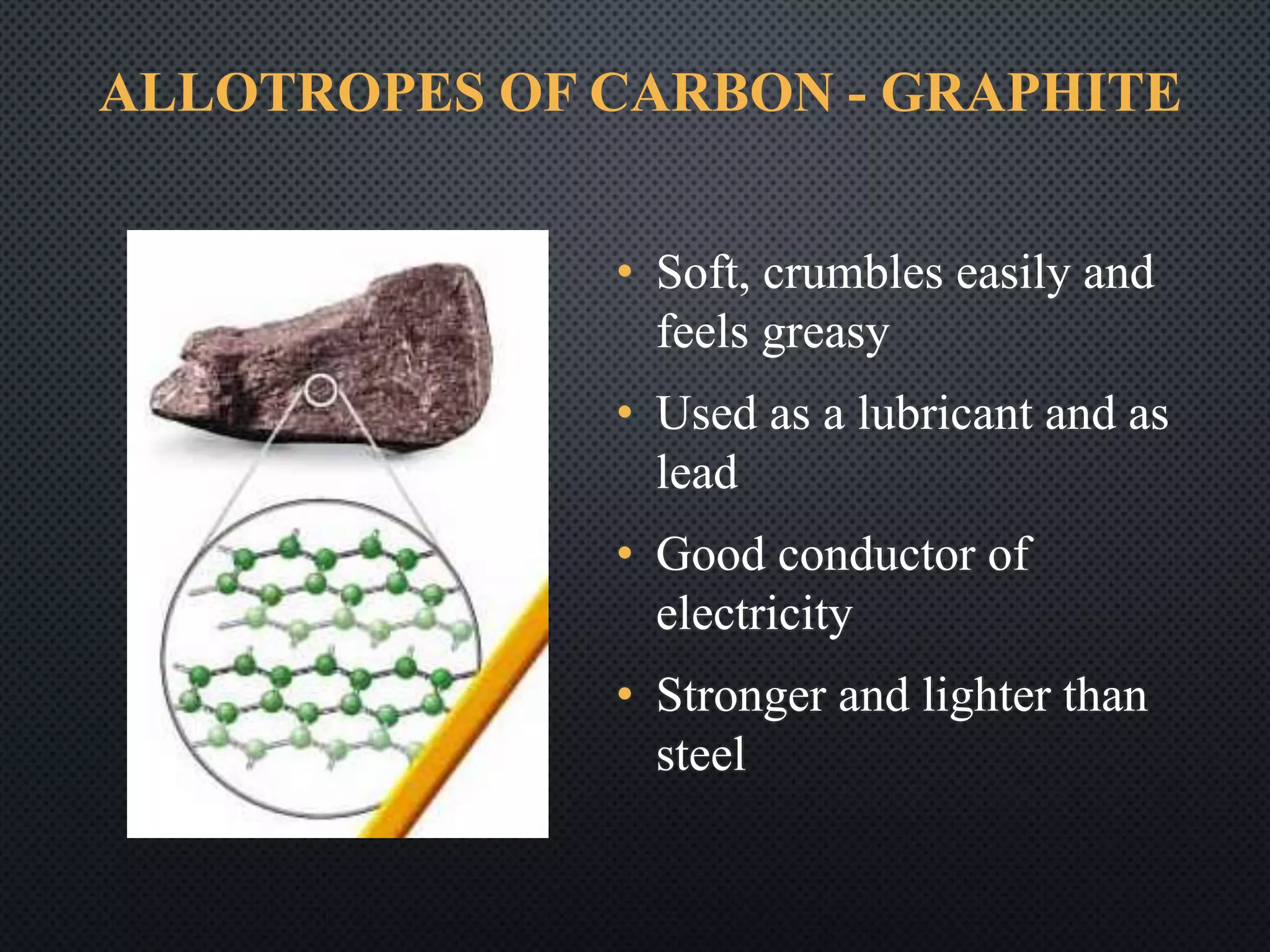
ALLOTROPES OF CARBON - GRAPHITE
• Soft, crumbles easily and
feels greasy
• Used as a lubricant and as
lead
• Good conductor of
electricity
• Stronger and lighter than
steel
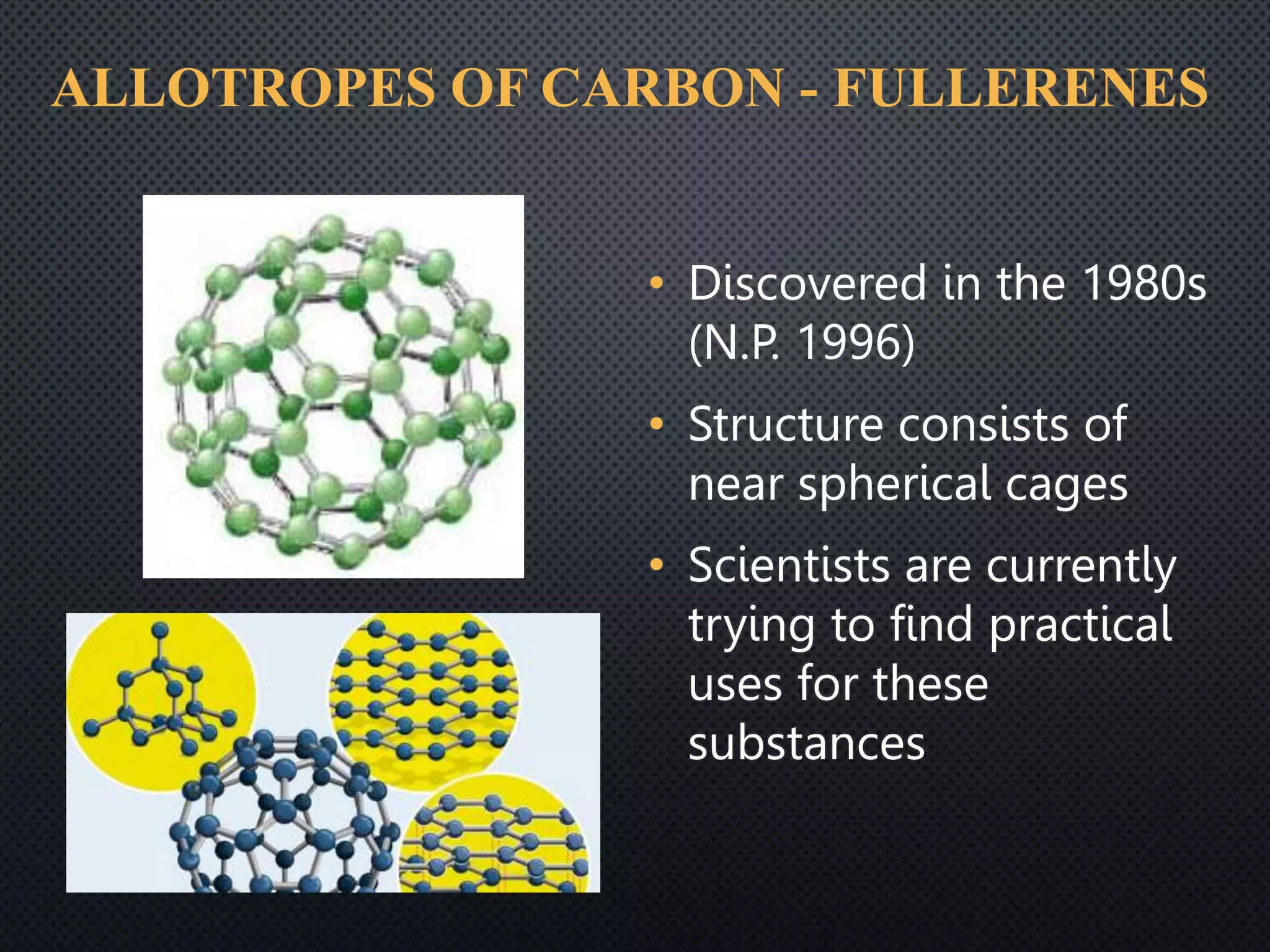
ALLOTROPES OF CARBON - FULLERENES
• Discovered in the 1980s
(N.P. 1996)
• Structure consists of
near spherical cages
• Scientists are currently
trying to find practical
uses for these
substances
ORGANIC COMPOUNDS
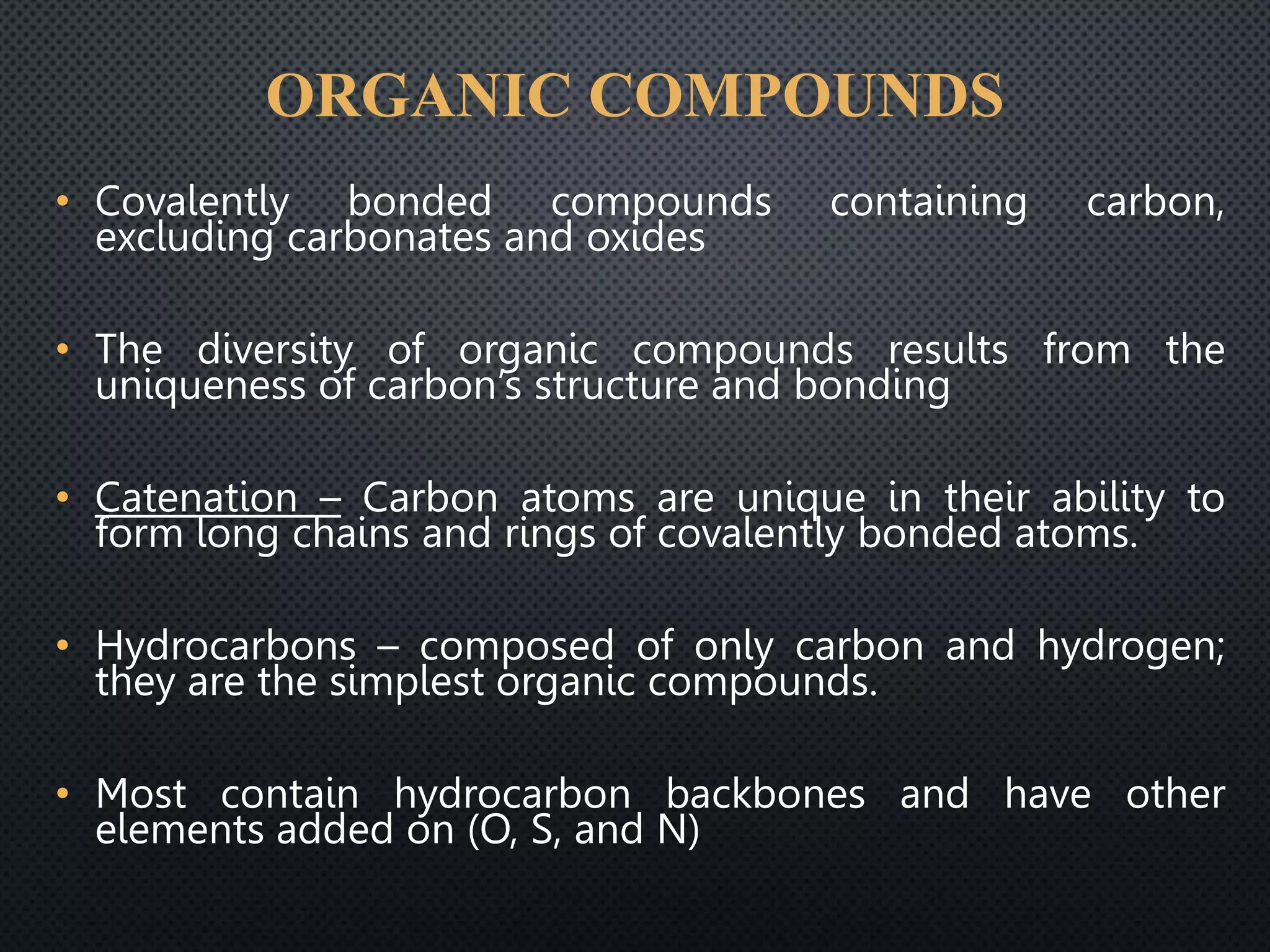
• Covalently bonded compounds containing carbon,
excluding carbonates and oxides
• The diversity of organic compounds results from the
uniqueness of carbon’s structure and bonding
• Catenation – Carbon atoms are unique in their ability to
form long chains and rings of covalently bonded atoms.
• Hydrocarbons – composed of only carbon and hydrogen;
they are the simplest organic compounds.
• Most contain hydrocarbon backbones and have other
elements added on (O, S, and N)
ARRANGEMENT OF ATOMS
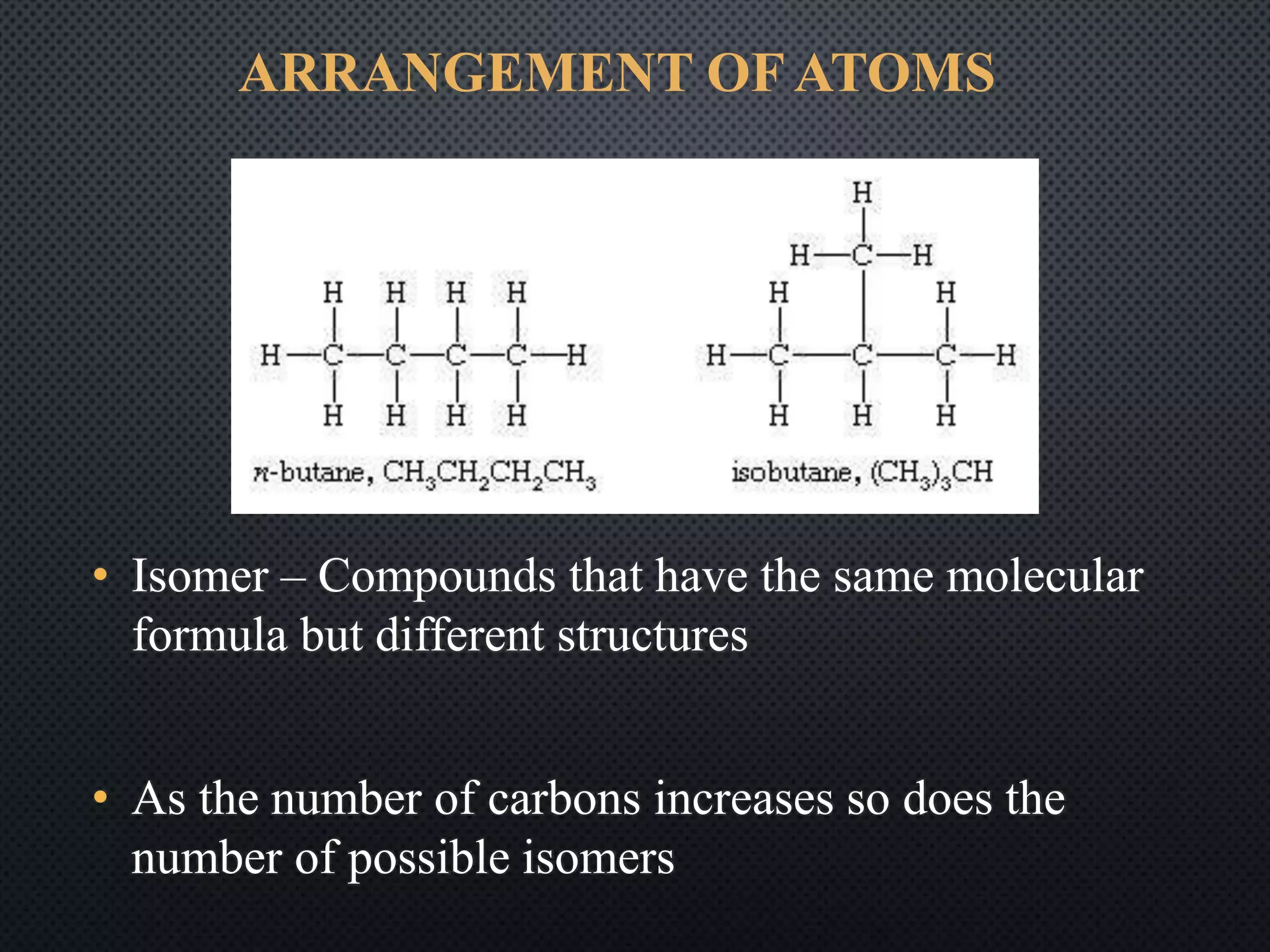
• Isomer – Compounds that have the same molecular
formula but different structures
• As the number of carbons increases so does the
number of possible isomers
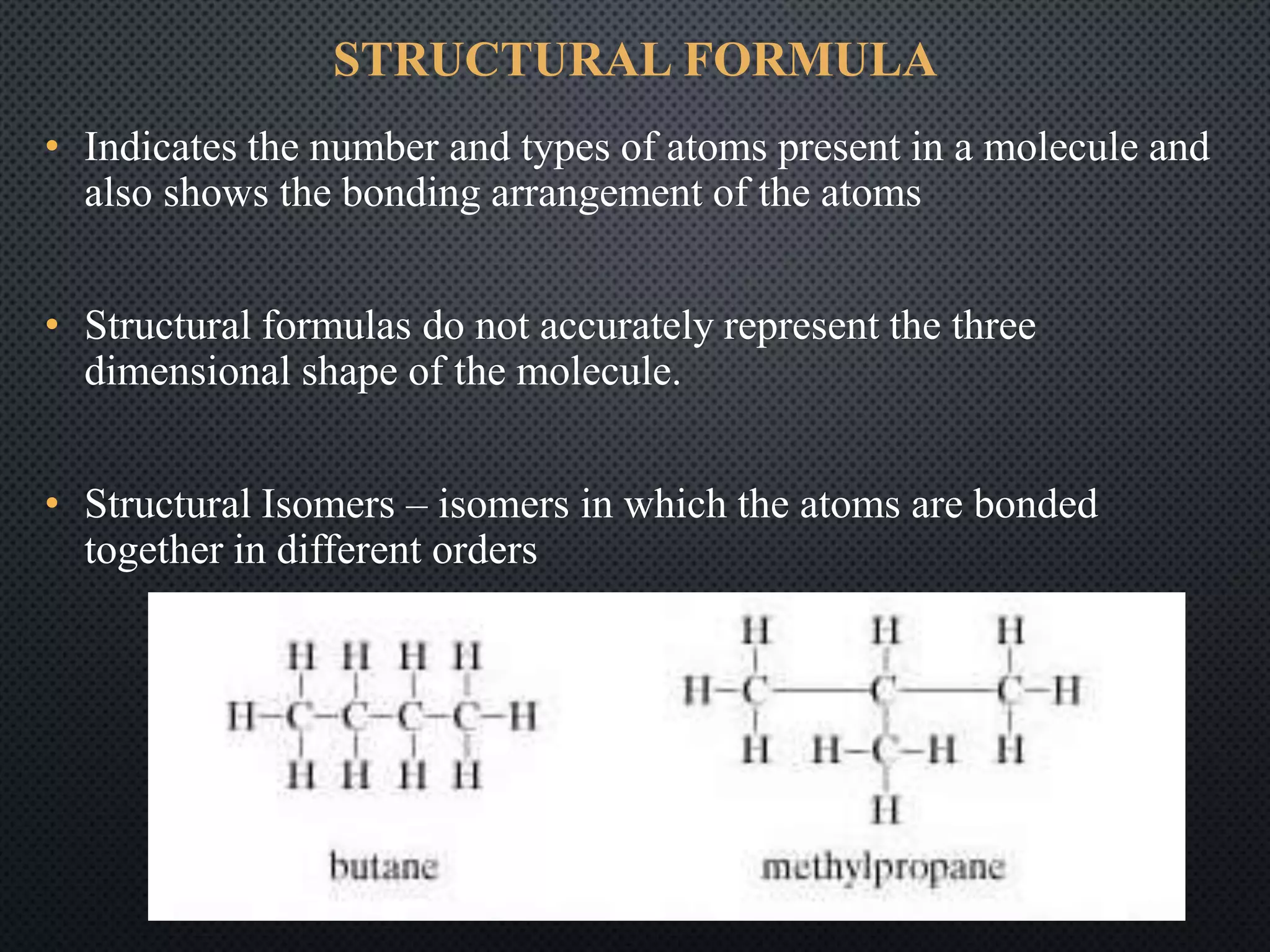
STRUCTURAL FORMULA
• Indicates the number and types of atoms present in a molecule and
also shows the bonding arrangement of the atoms
• Structural formulas do not accurately represent the three
dimensional shape of the molecule.
• Structural Isomers – isomers in which the atoms are bonded
together in different orders
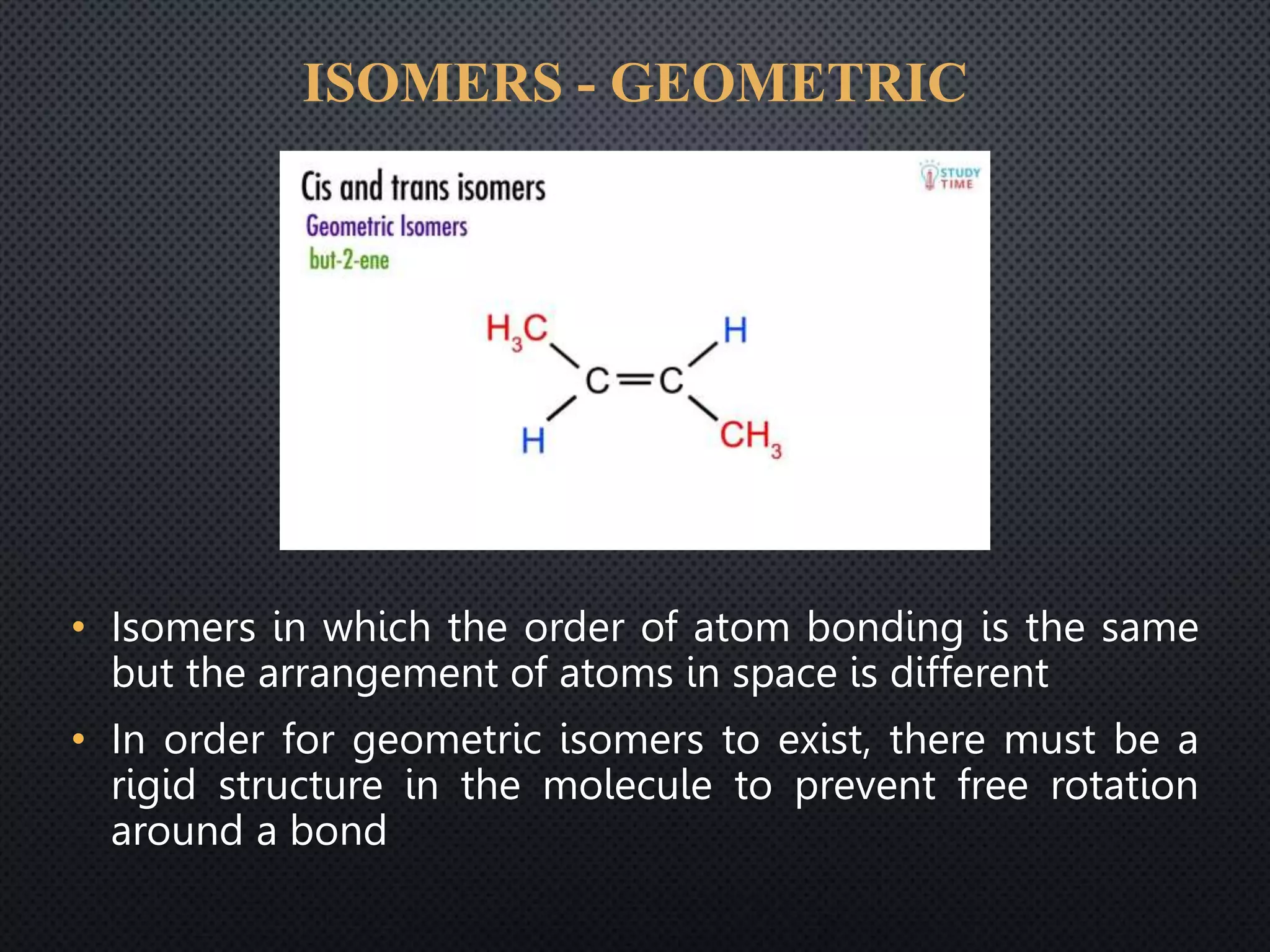
ISOMERS - GEOMETRIC
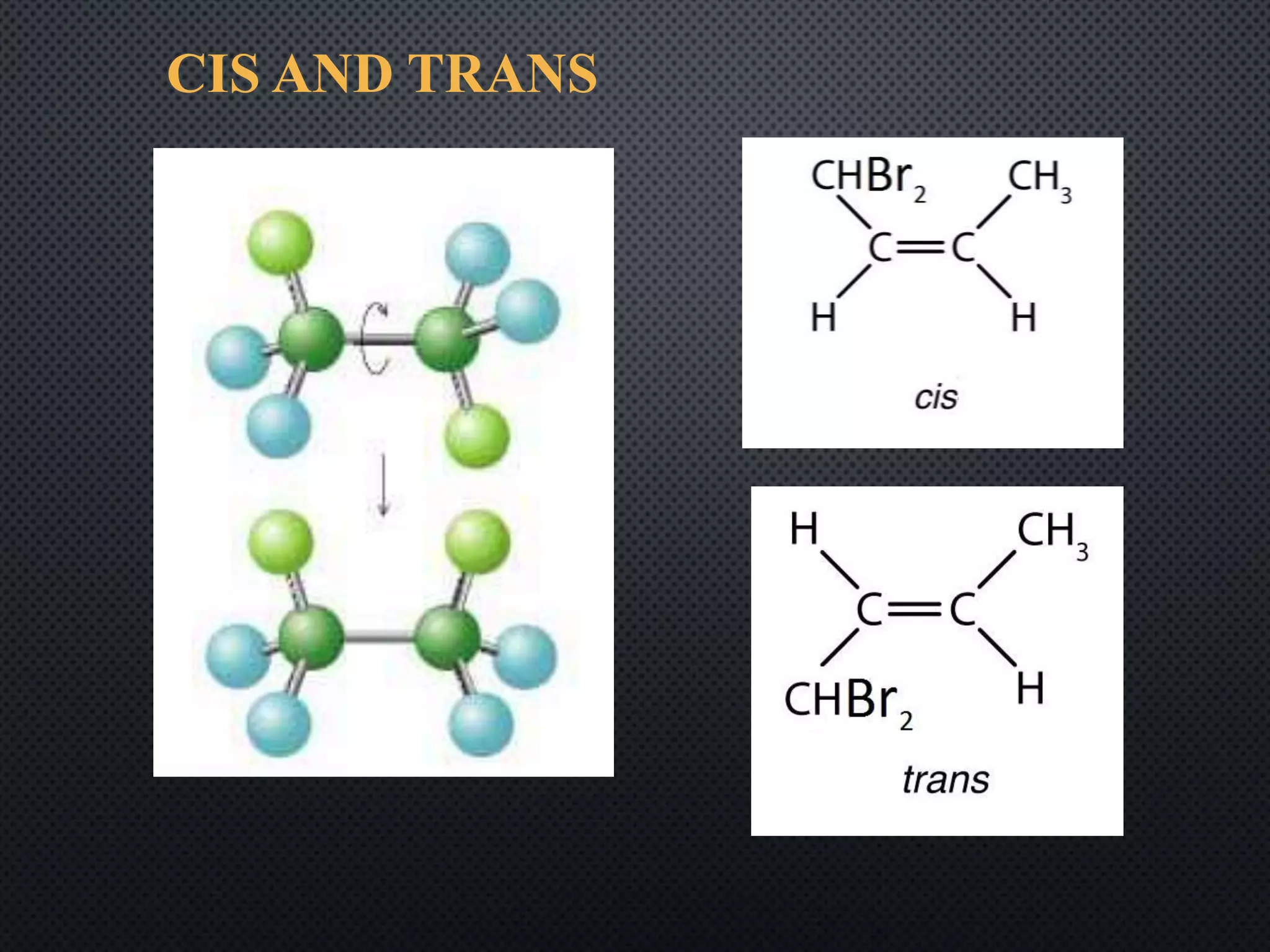
• Isomers in which the order of atom bonding is the same
but the arrangement of atoms in space is different
• In order for geometric isomers to exist, there must be a
rigid structure in the molecule to prevent free rotation
around a bond
CIS AND TRANS
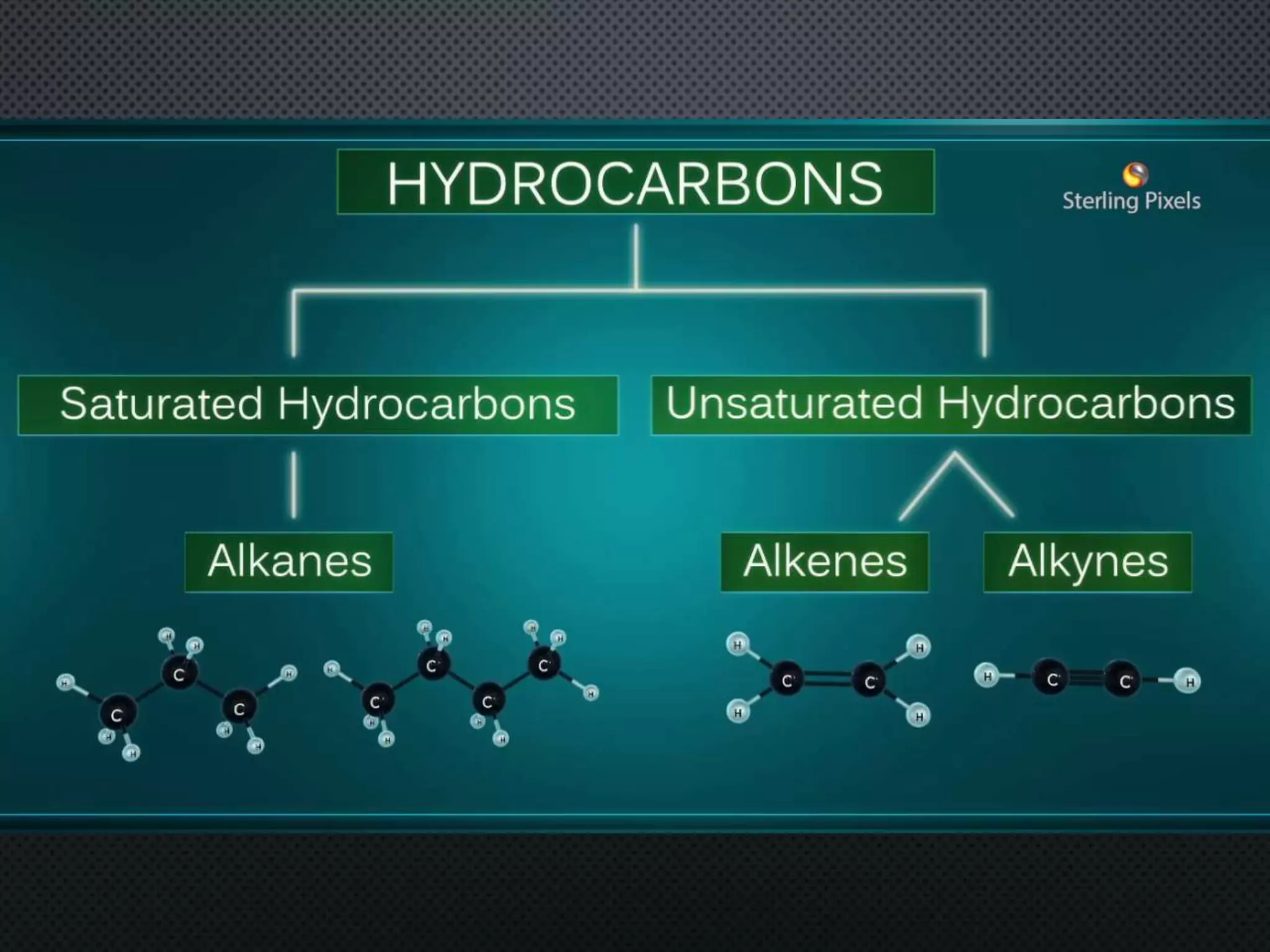
HYDROCARBONS
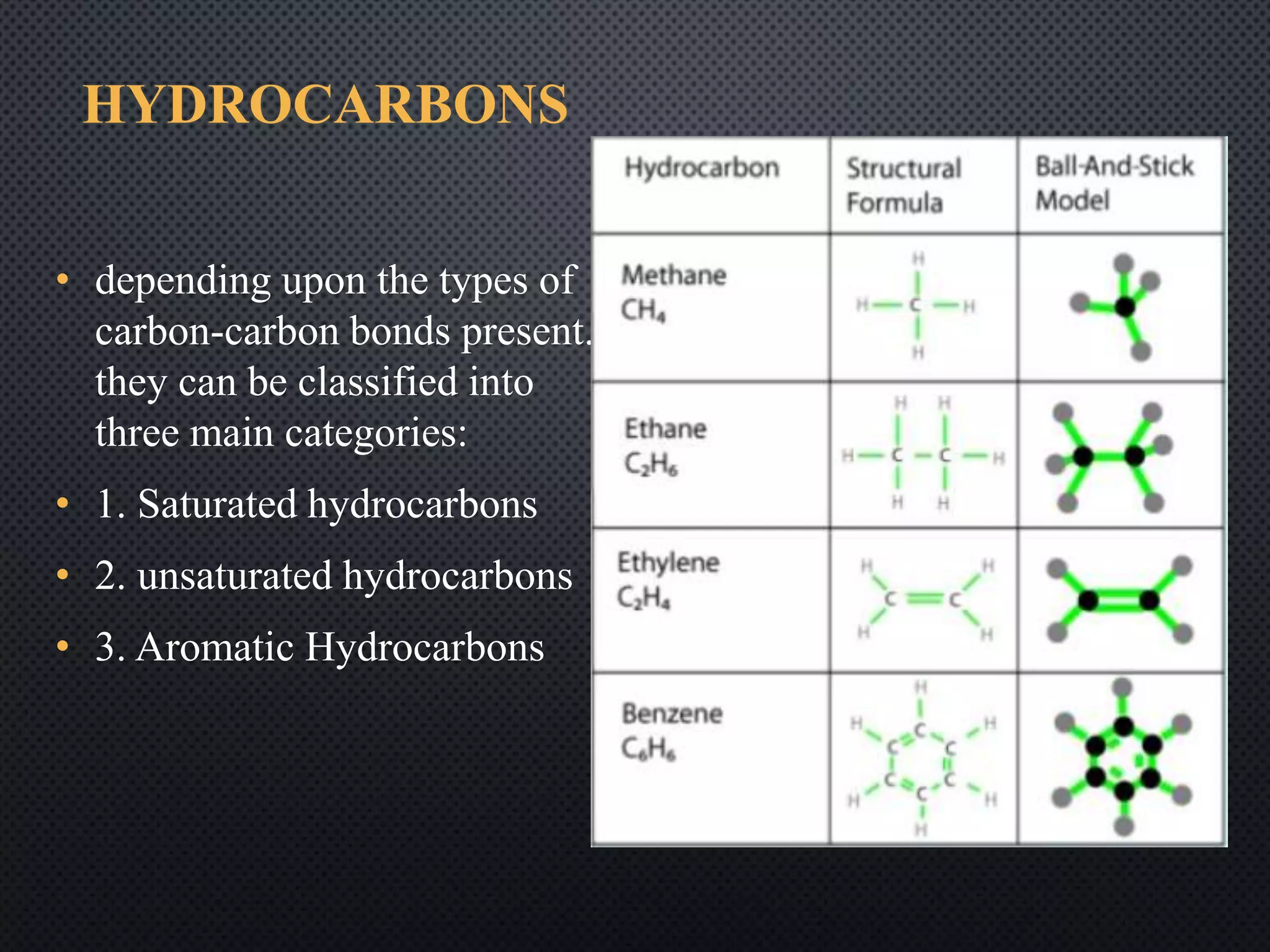
• depending upon the types of
carbon-carbon bonds present.
they can be classified into
three main categories:
• 1. Saturated hydrocarbons
• 2. unsaturated hydrocarbons
• 3. Aromatic Hydrocarbons
SATURATED HYDROCARBONS
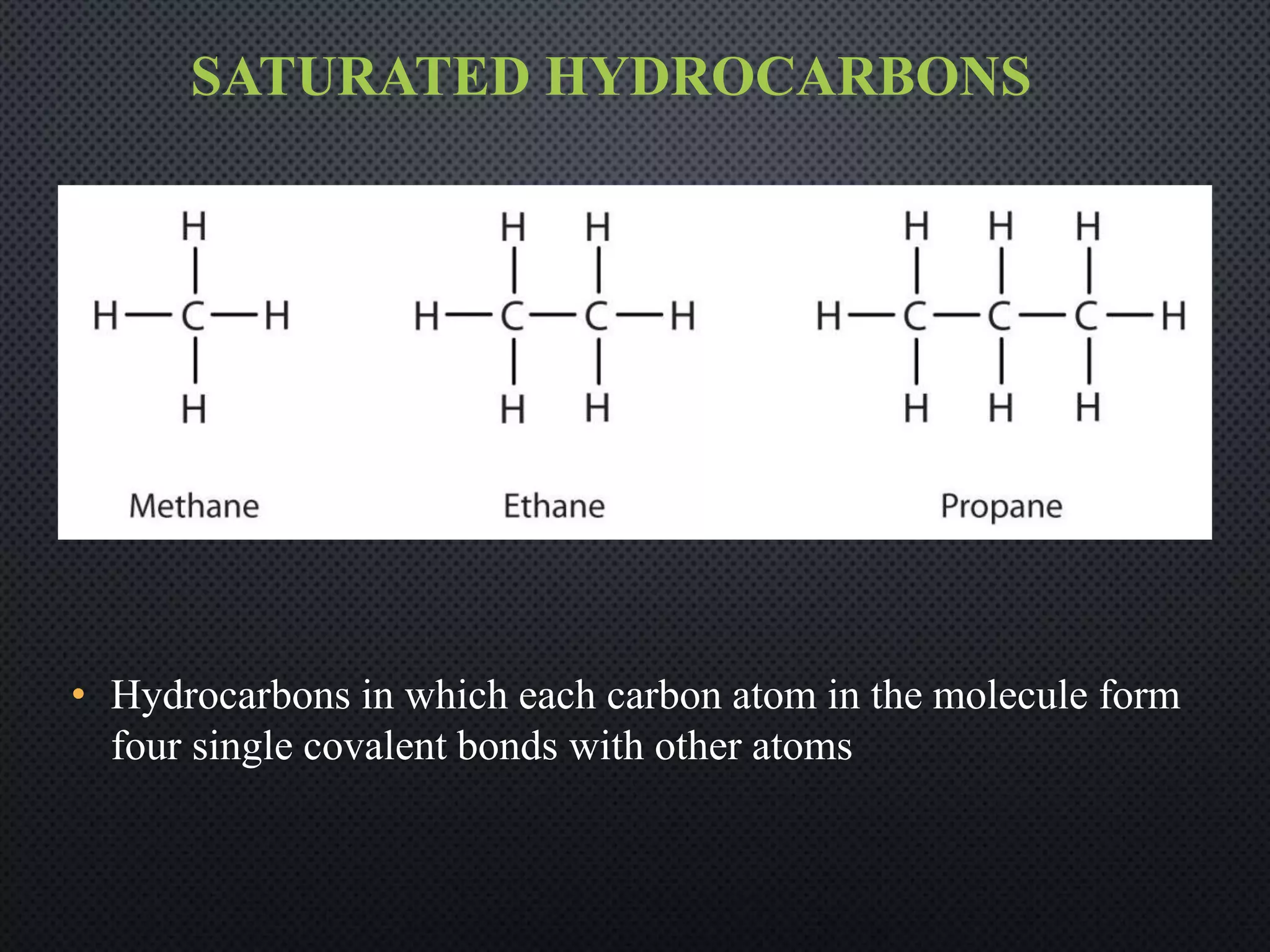
• Hydrocarbons in which each carbon atom in the molecule form
four single covalent bonds with other atoms
SATURATED HYDROCARBONS
• Hydrocarbons that contain only carbon-carbon
single bond
• Includes open chain and closed chain
hydrocarbons
• Called saturated because they have maximum
number of bonded hydrogen
ALKANES CNH2N+2
• Hydrocarbons that contain only single bonds
• Homologous series – one in which adjacent members
differ by a constant unit.
• Alkyl groups- groups of atoms that are formed when
one hydrogen atom is removed from an alkane molecule
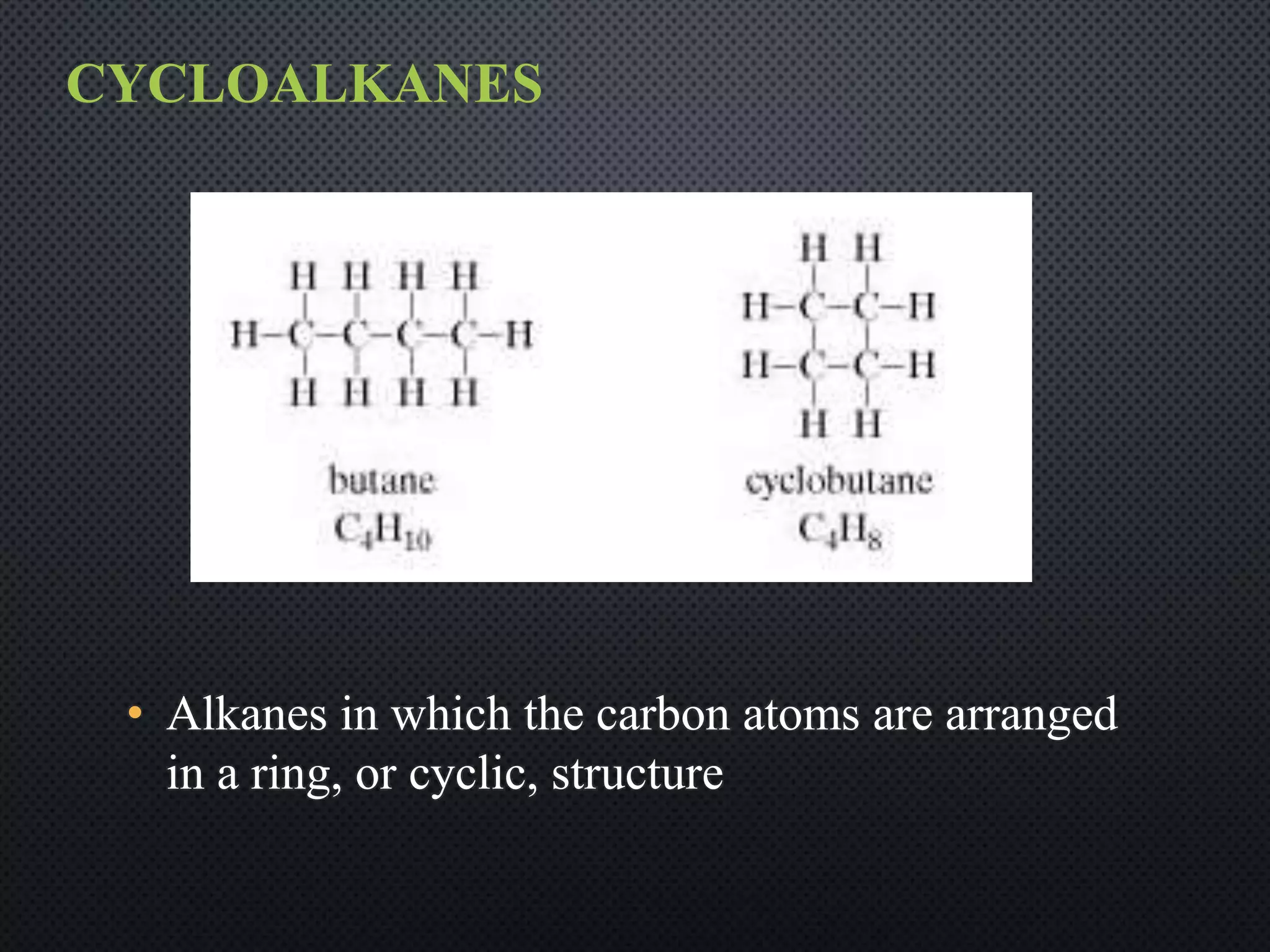
CYCLOALKANES
• Alkanes in which the carbon atoms are arranged
in a ring, or cyclic, structure
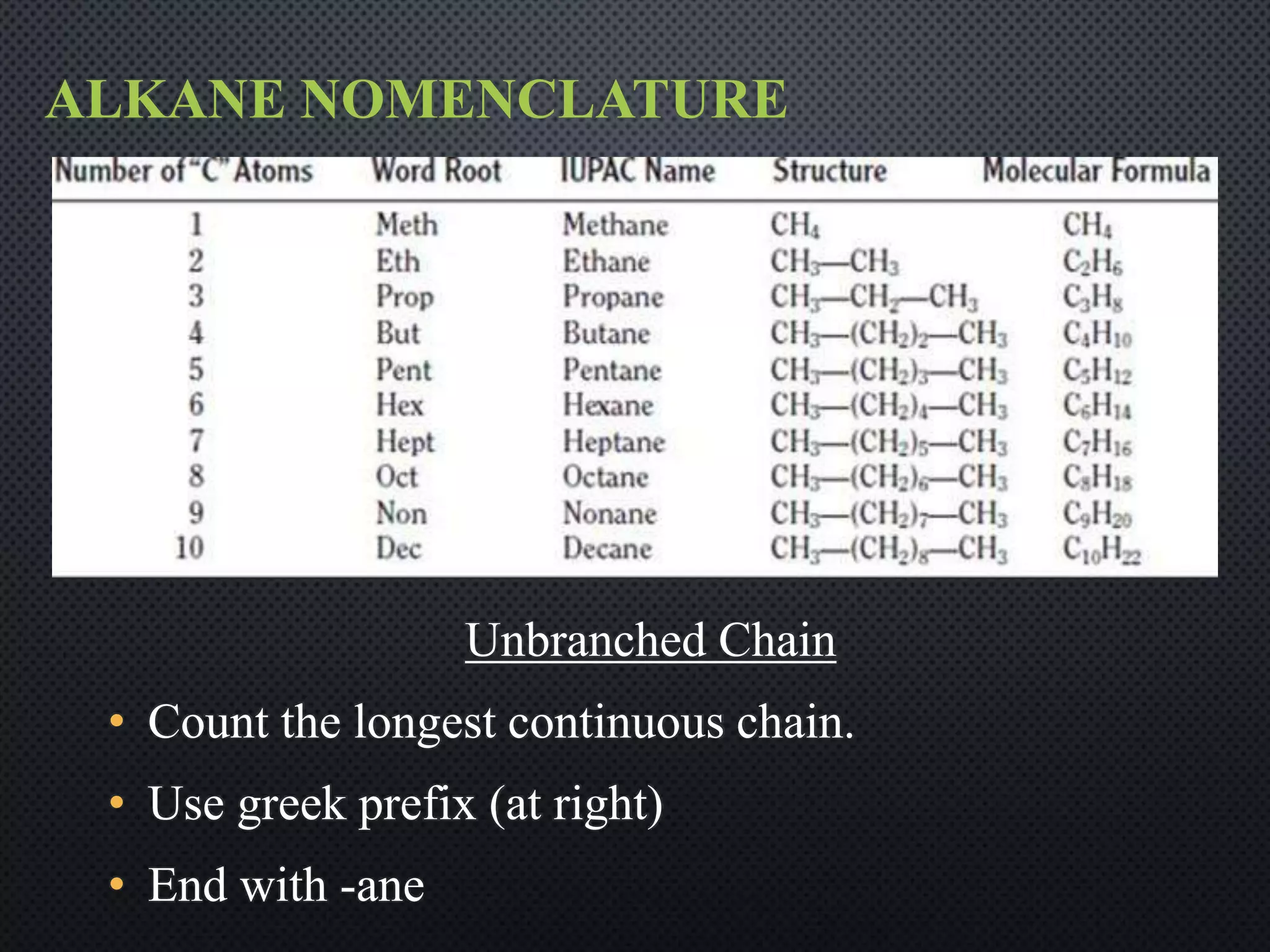
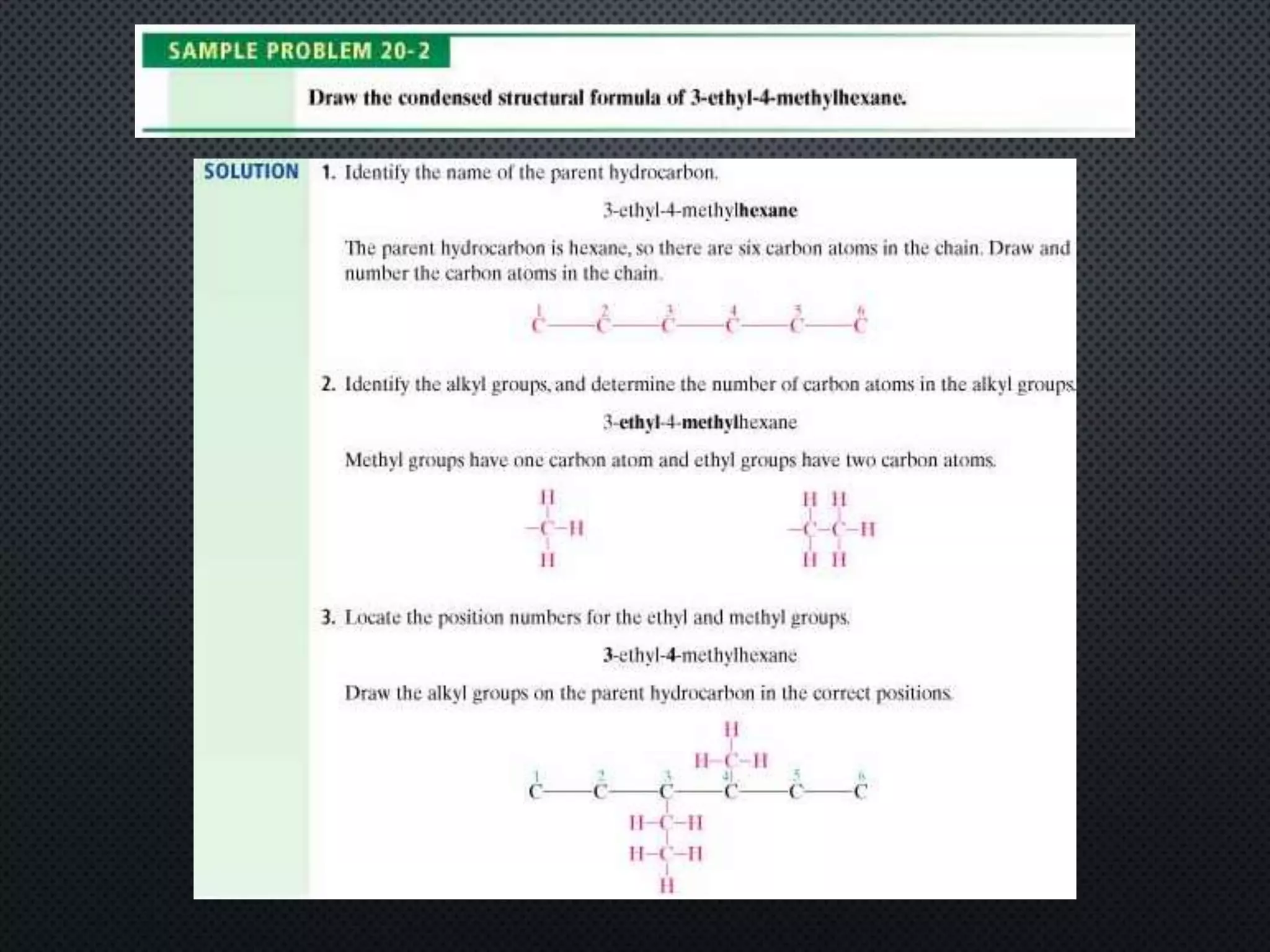
ALKANE NOMENCLATURE
Unbranched Chain
• Count the longest continuous chain.
• Use greek prefix (at right)
• End with -ane
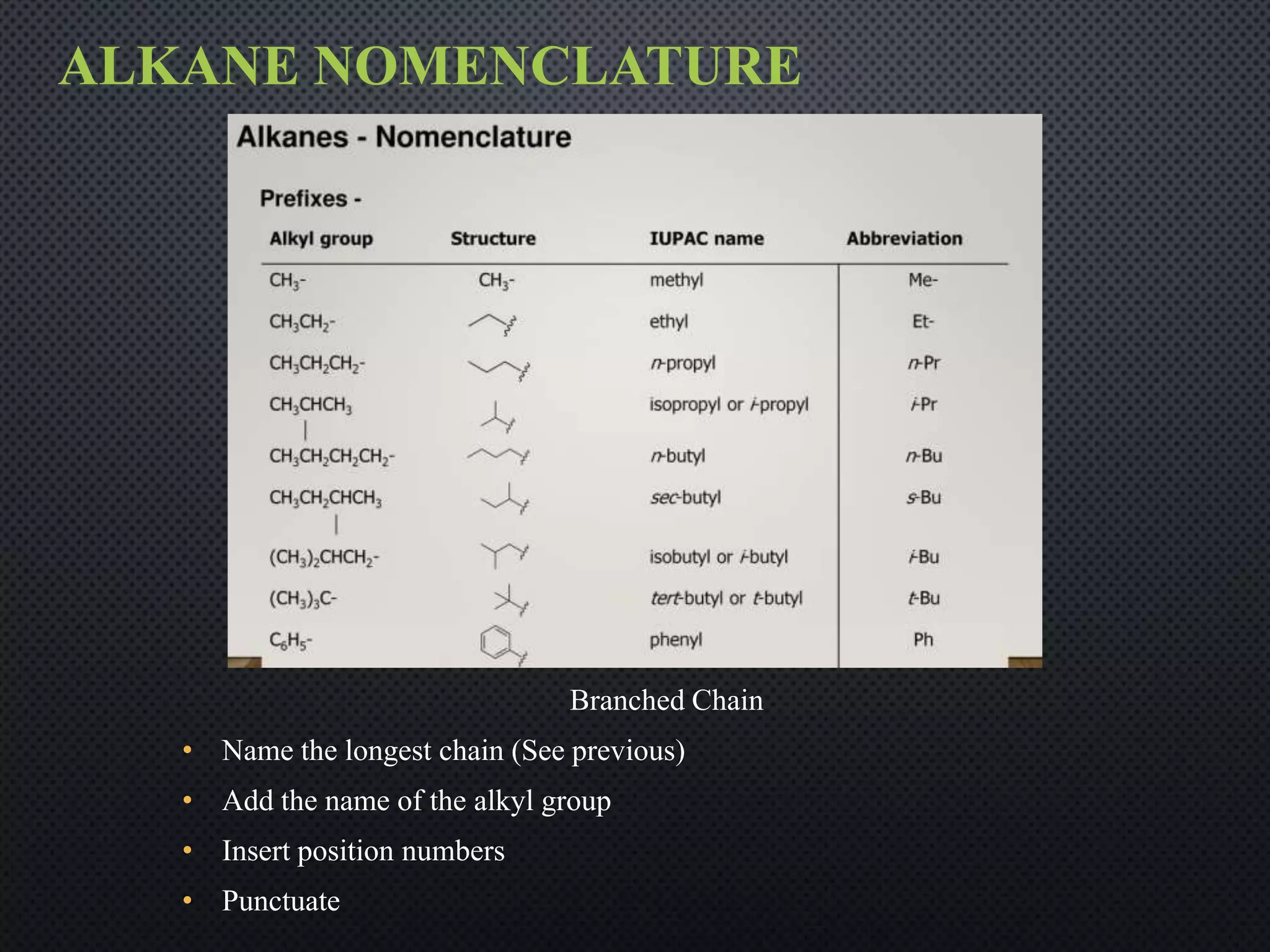
ALKANE NOMENCLATURE
Branched Chain
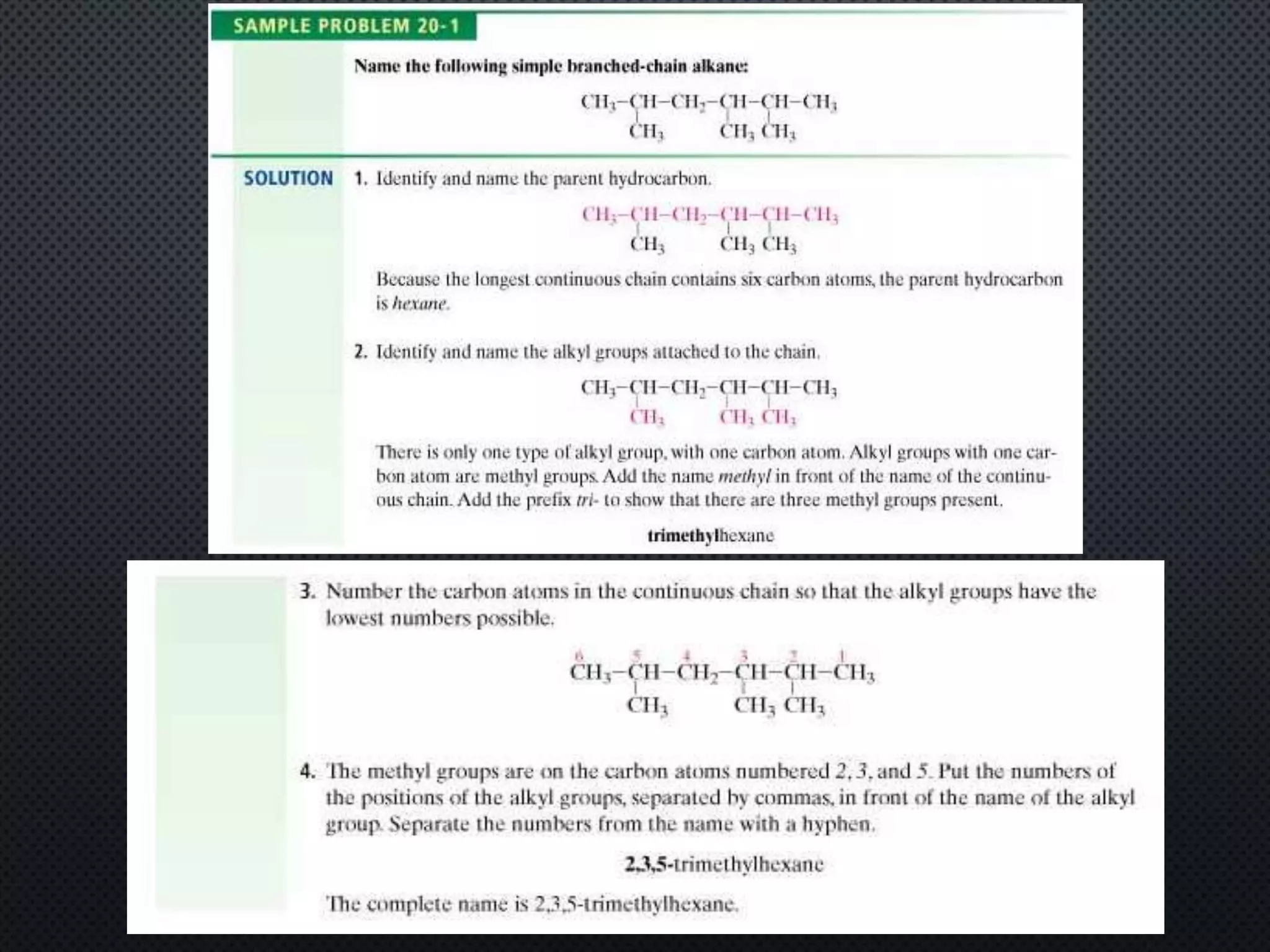
• Name the longest chain (See previous)
• Add the name of the alkyl group
• Insert position numbers
• Punctuate
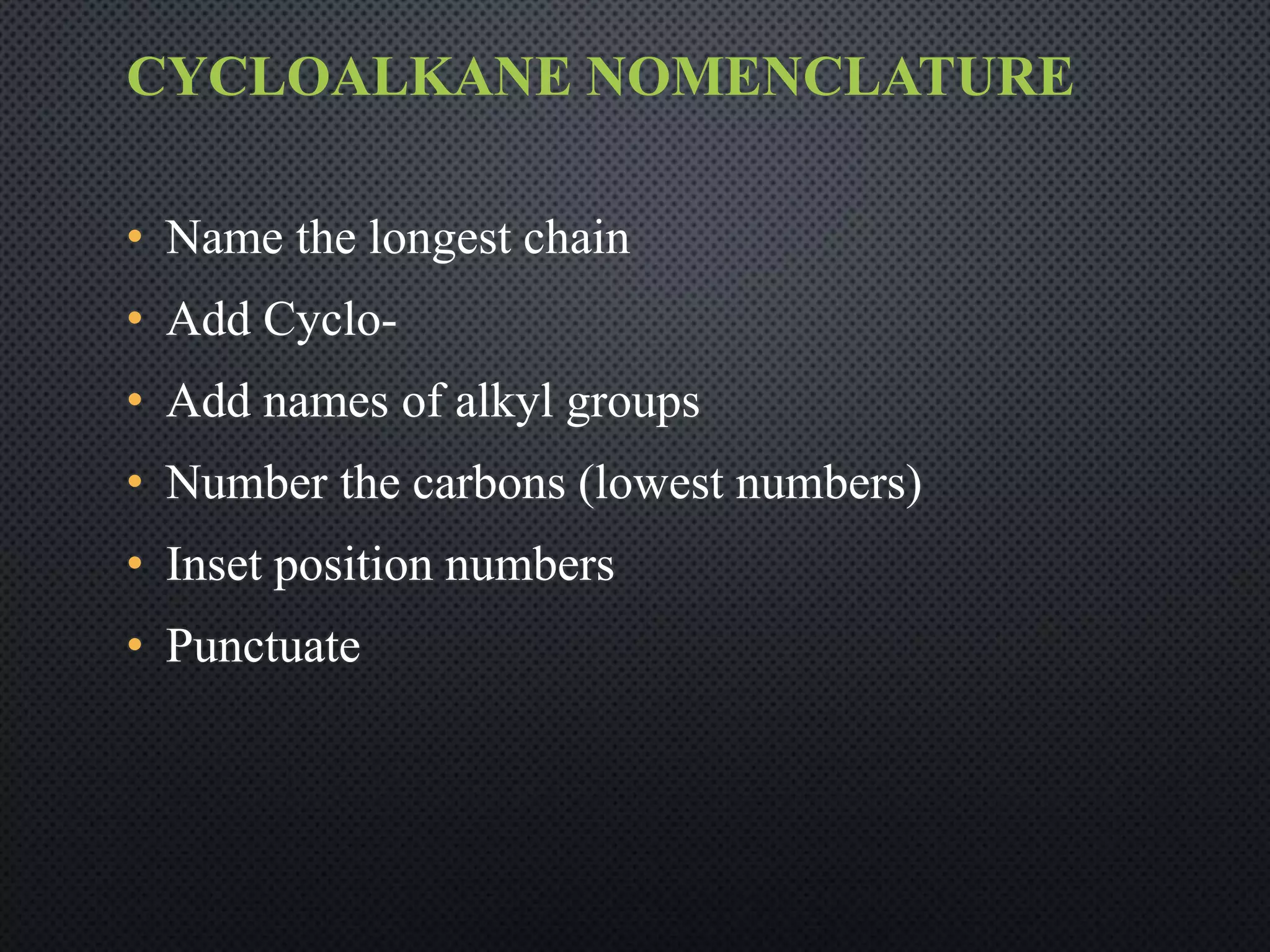
CYCLOALKANE NOMENCLATURE
• Name the longest chain
• Add Cyclo-
• Add names of alkyl groups
• Number the carbons (lowest numbers)
• Inset position numbers
• Punctuate
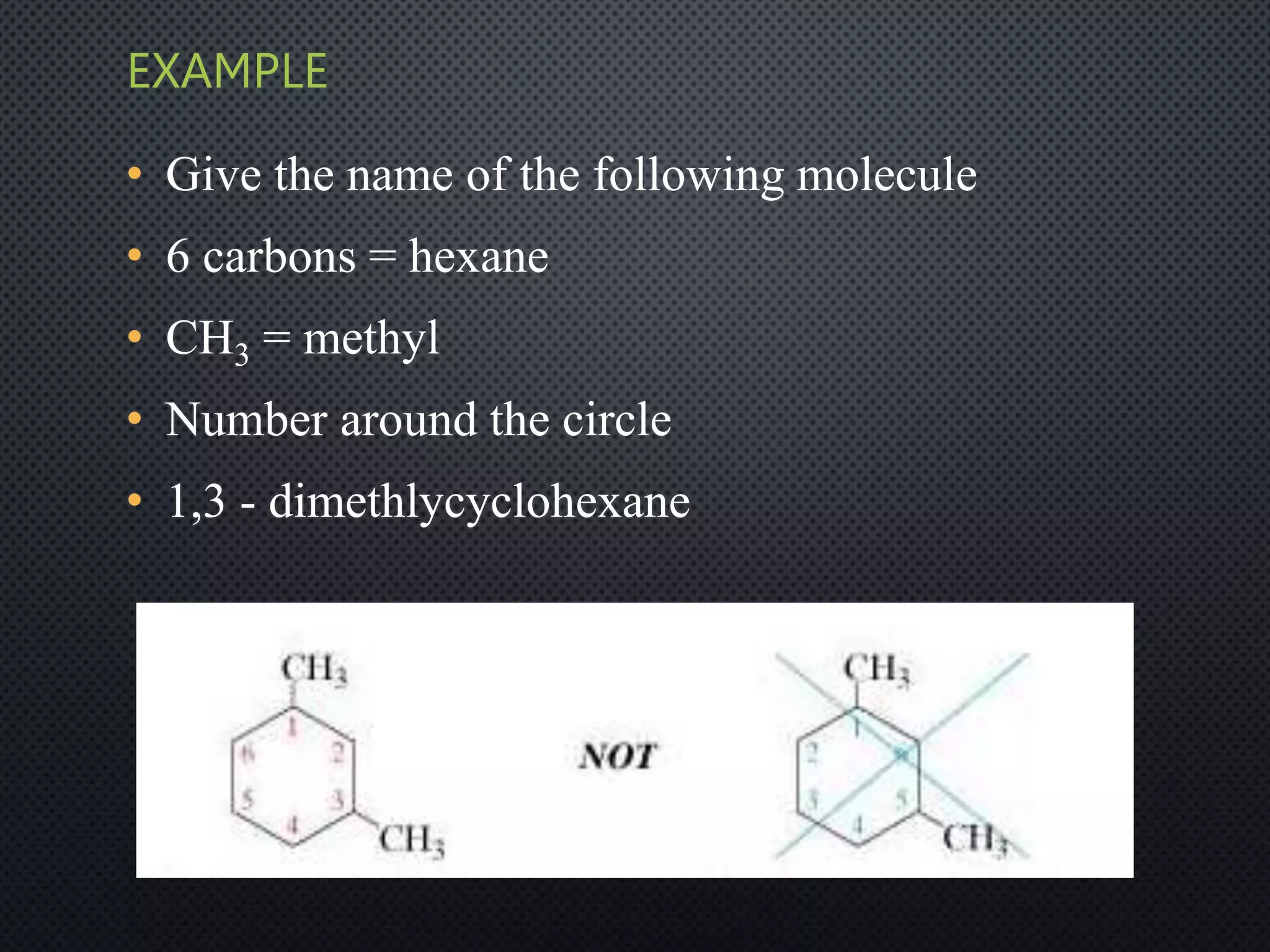
EXAMPLE
• Give the name of the following molecule
• 6 carbons = hexane
• CH3 = methyl
• Number around the circle
• 1,3 - dimethlycyclohexane
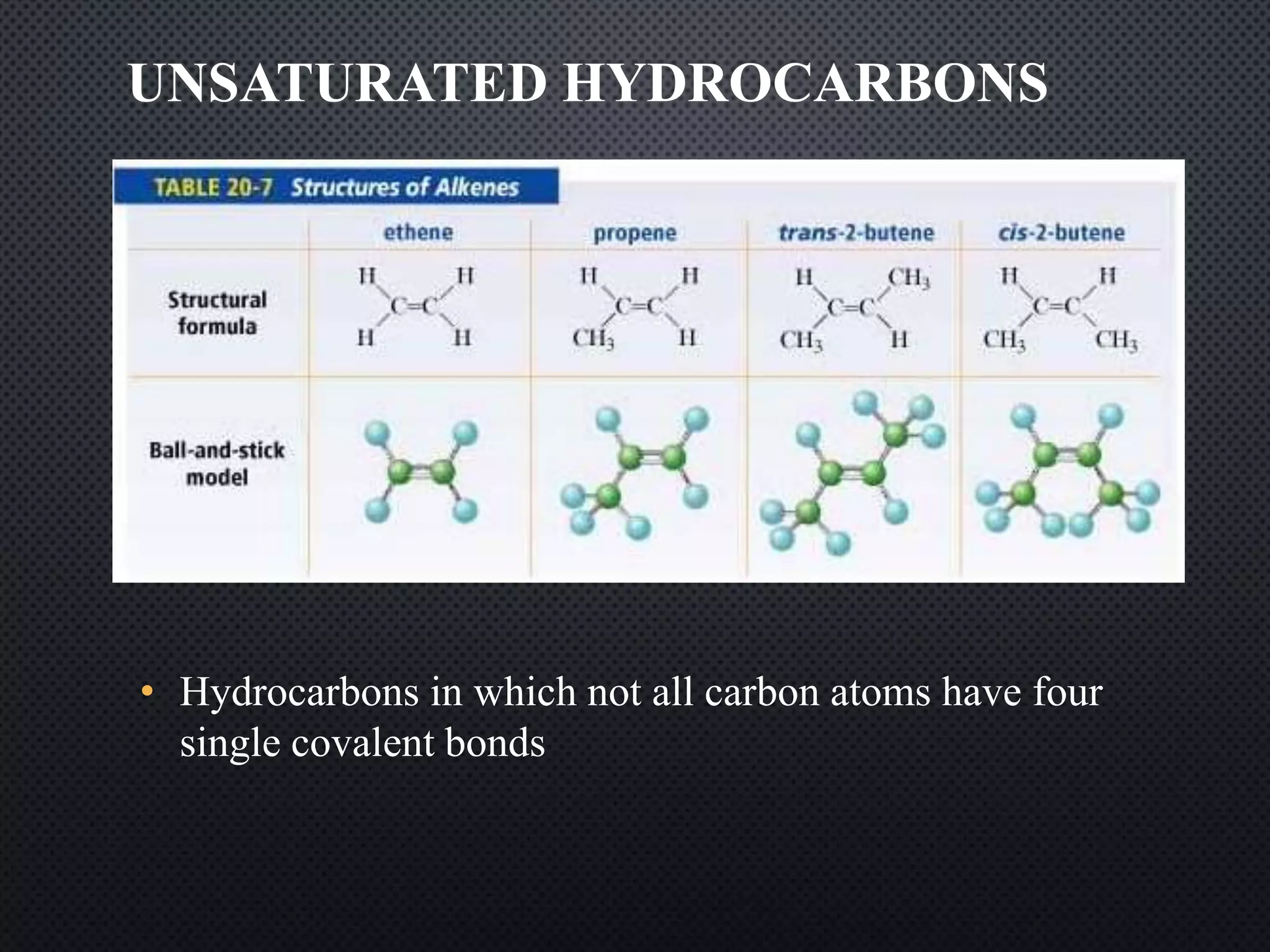
UNSATURATED HYDROCARBONS
• Hydrocarbons in which not all carbon atoms have four
single covalent bonds
• Hydrocarbons which contain carbon-carbon
multiple bond (double bonds or triple bond) are
called unsaturated hydrocarbon
• Depending upon multiple bond they are further
classified as alkenes and alkynes
UNSATURATED HYDROCARBONS
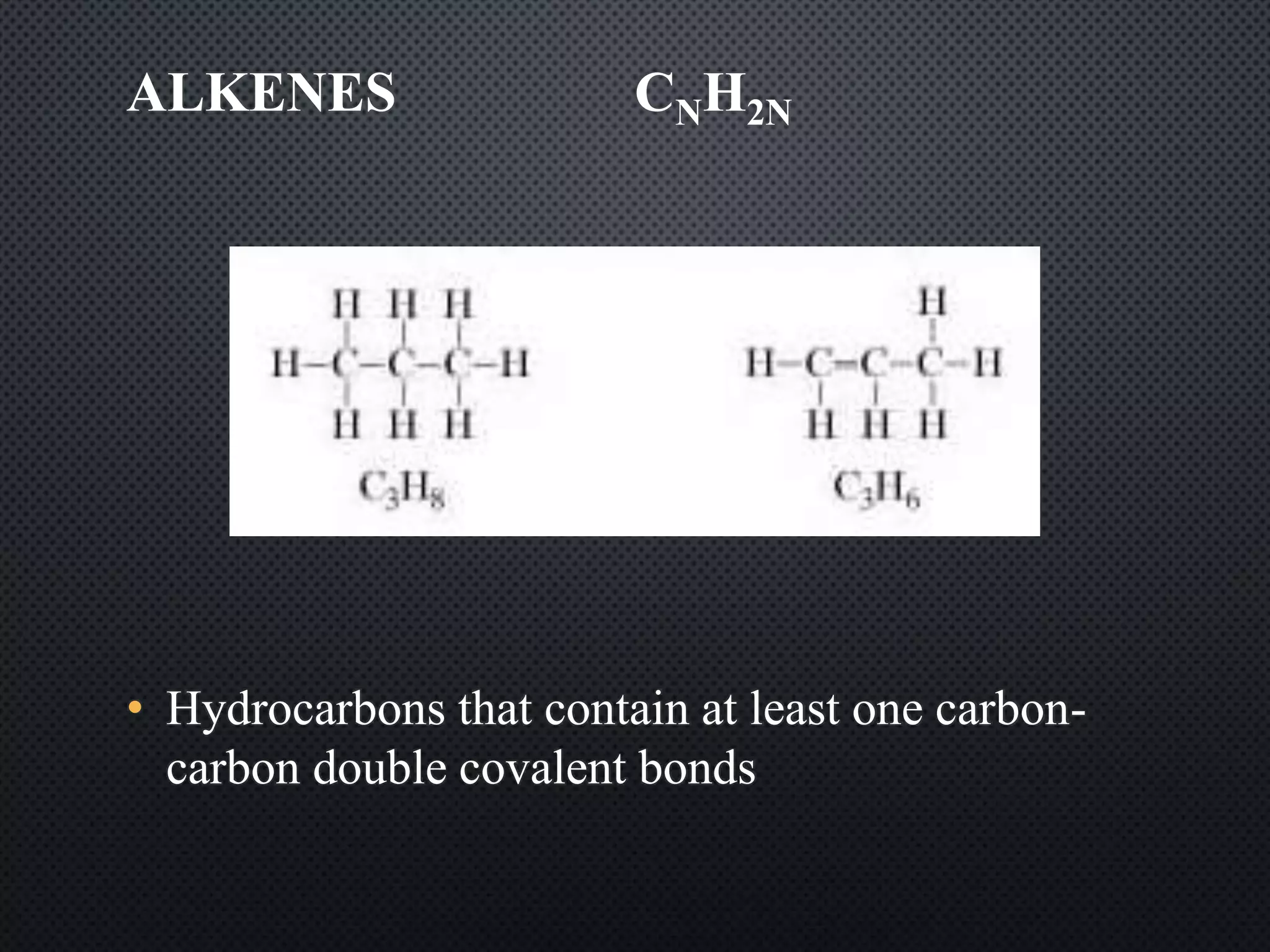
ALKENES CNH2N
• Hydrocarbons that contain at least one carbon-
carbon double covalent bonds
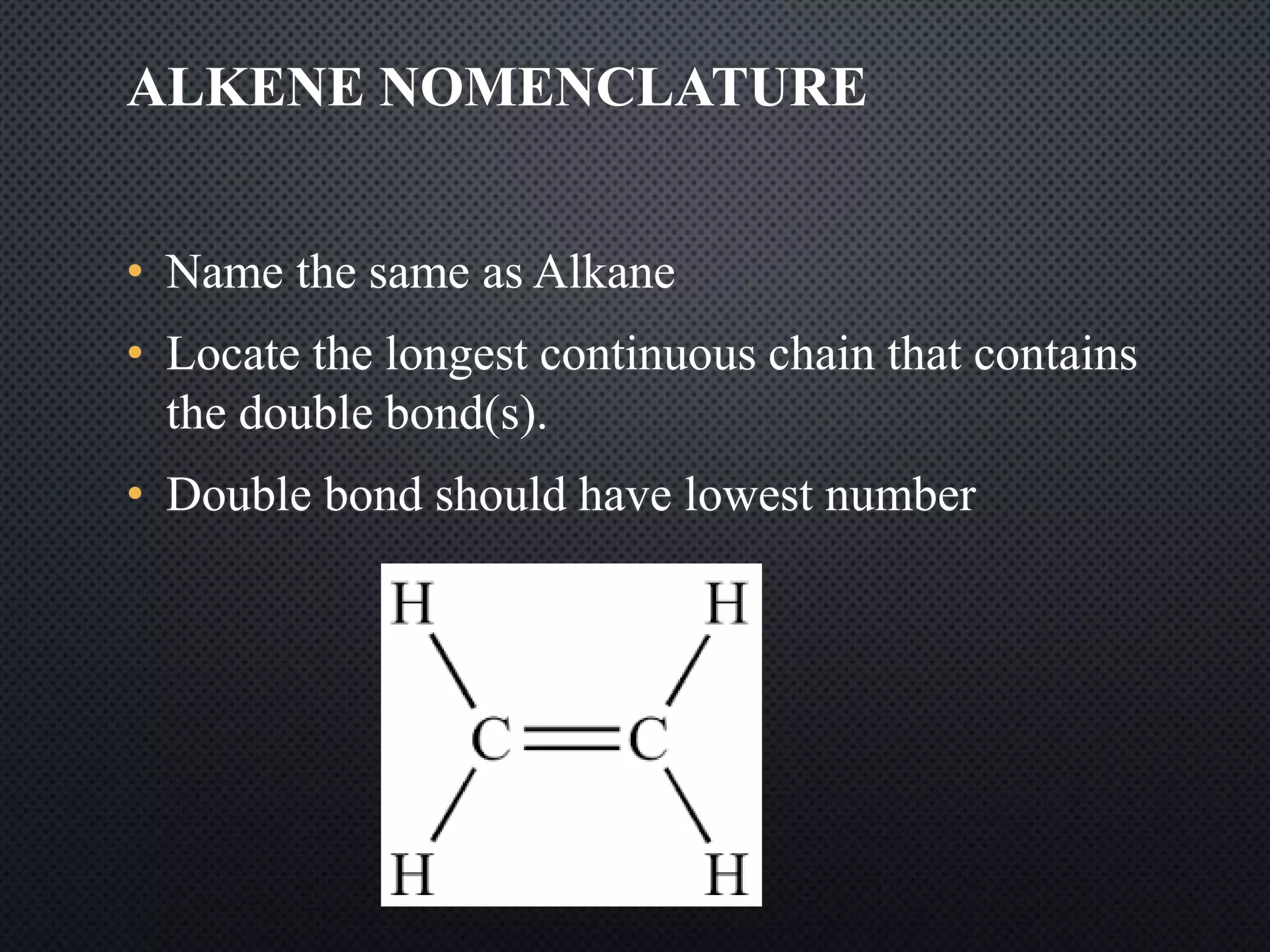
ALKENE NOMENCLATURE
• Name the same as Alkane
• Locate the longest continuous chain that contains
the double bond(s).
• Double bond should have lowest number
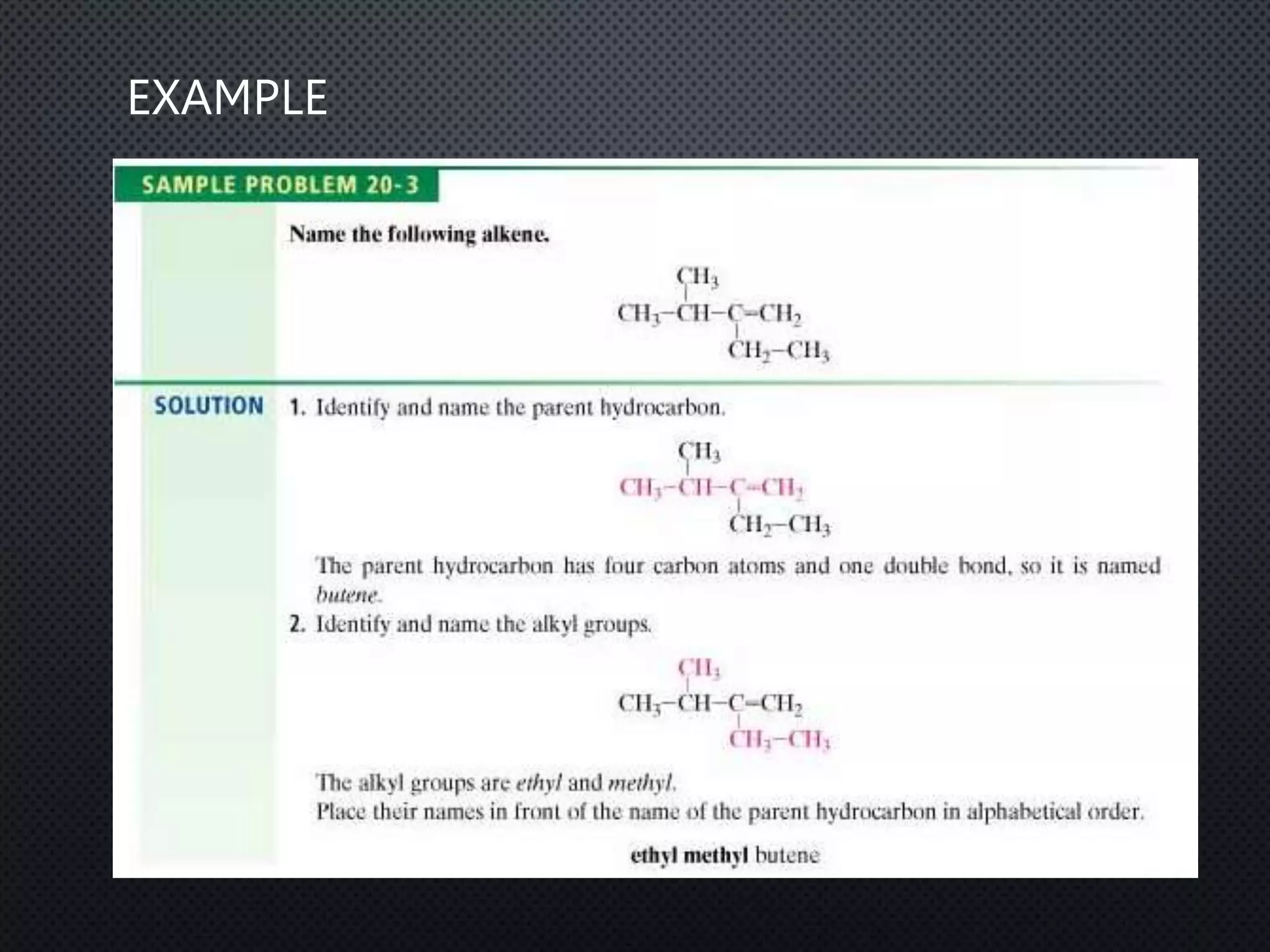
EXAMPLE
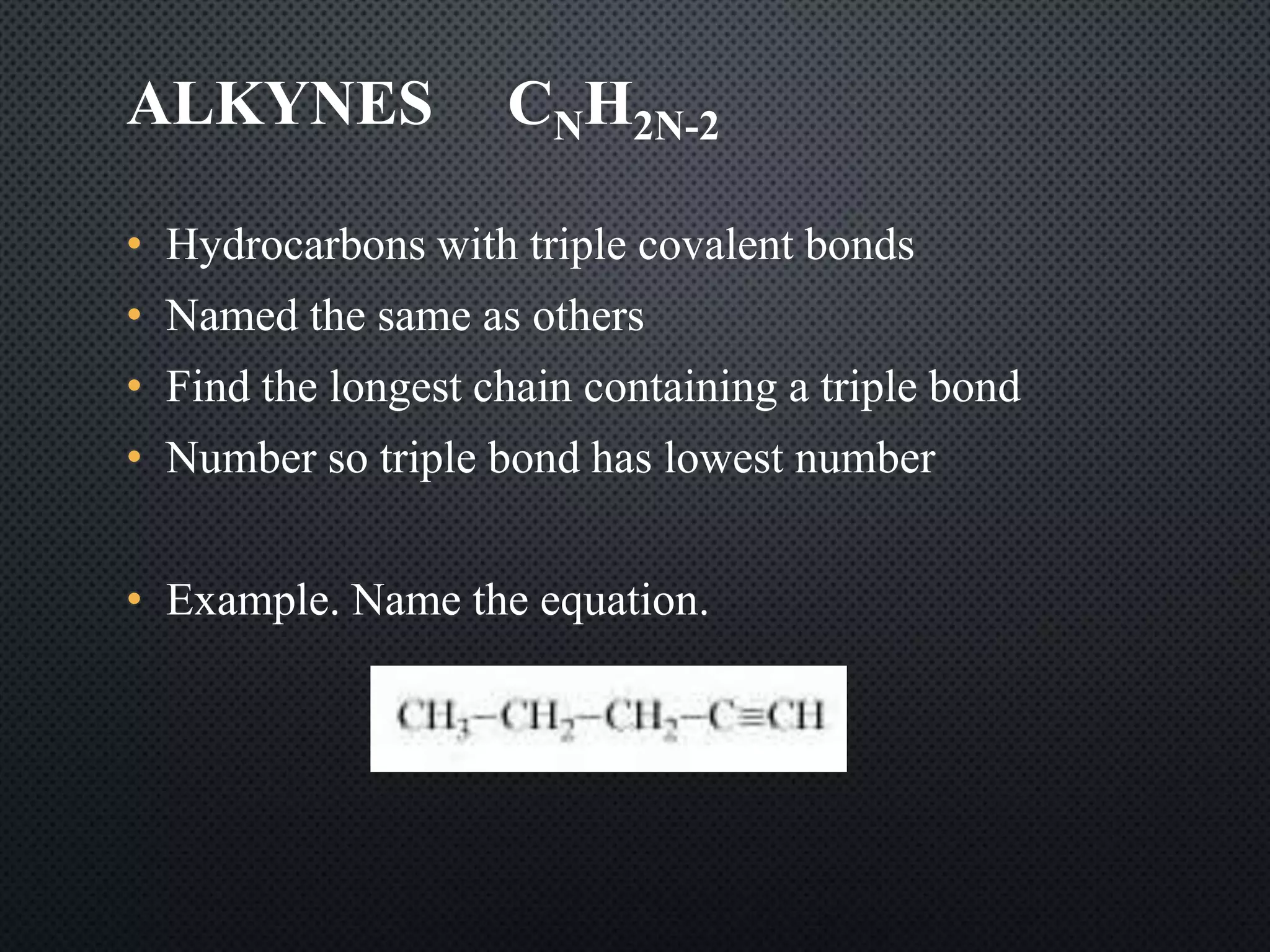
ALKYNES CNH2N-2
• Hydrocarbons with triple covalent bonds
• Named the same as others
• Find the longest chain containing a triple bond
• Number so triple bond has lowest number
• Example. Name the equation.
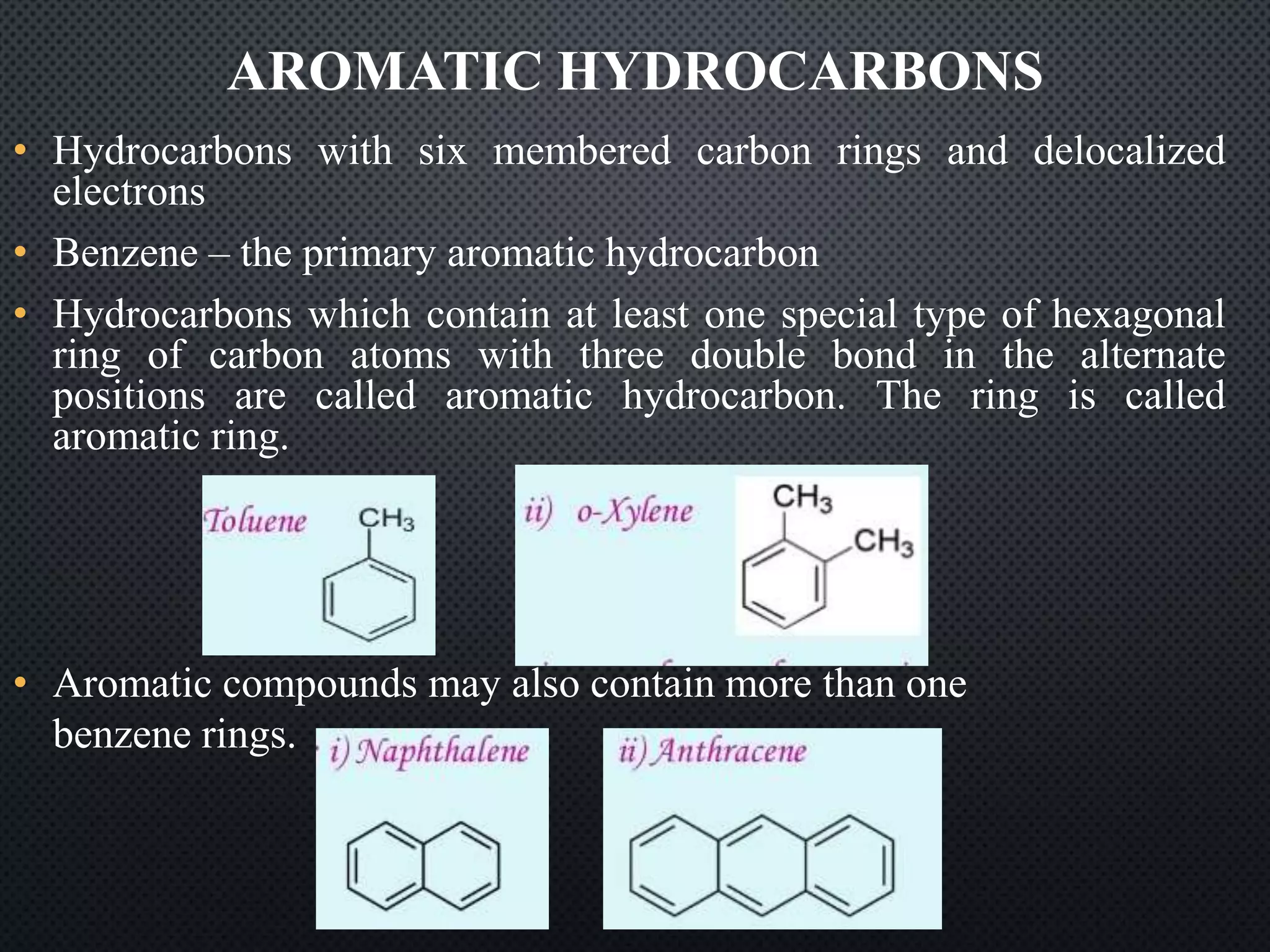
AROMATIC HYDROCARBONS
• Hydrocarbons with six membered carbon rings and delocalized
electrons
• Benzene – the primary aromatic hydrocarbon
• Hydrocarbons which contain at least one special type of hexagonal
ring of carbon atoms with three double bond in the alternate
positions are called aromatic hydrocarbon. The ring is called
aromatic ring.
• Aromatic compounds may also contain more than one
benzene rings.
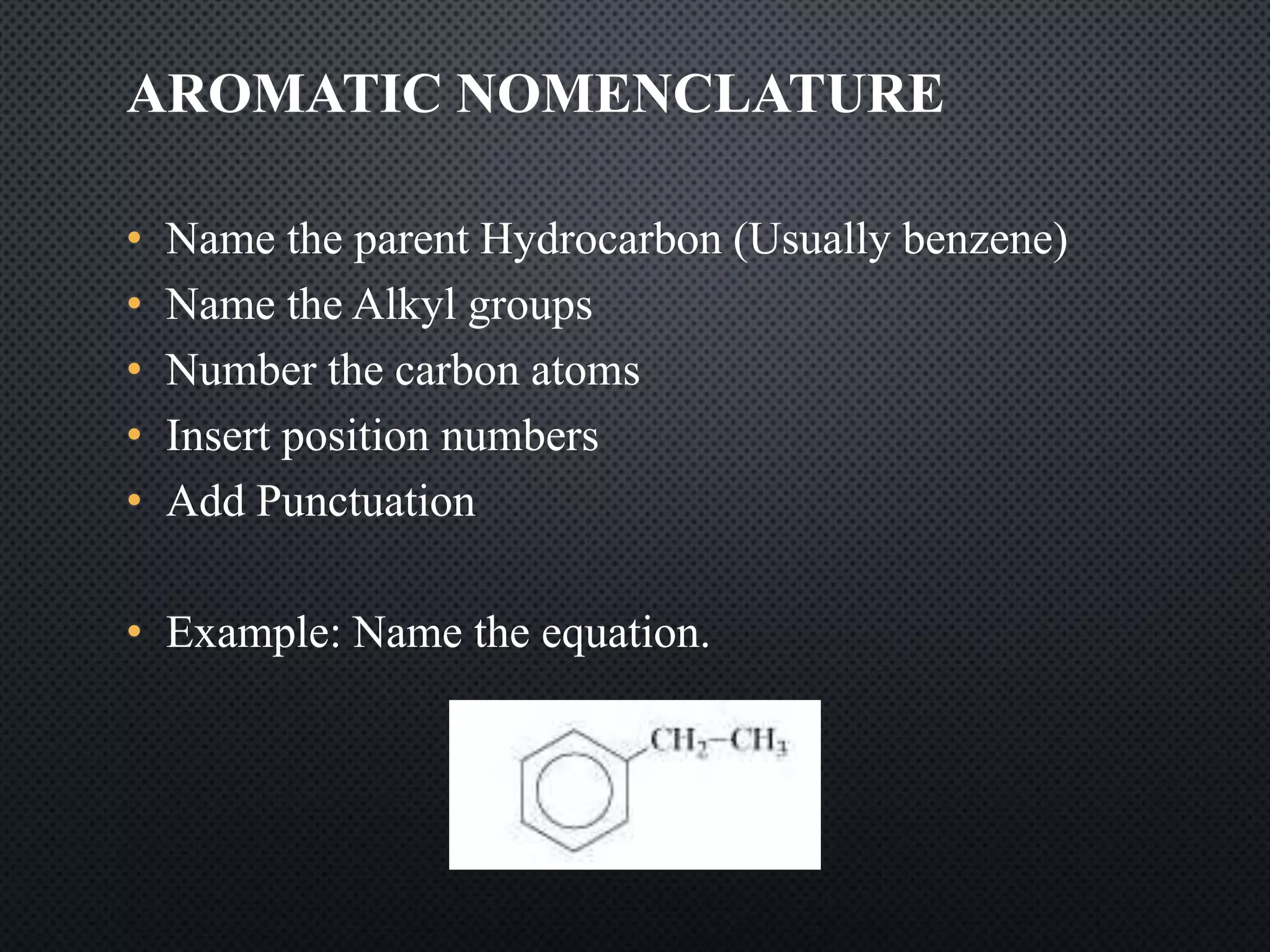
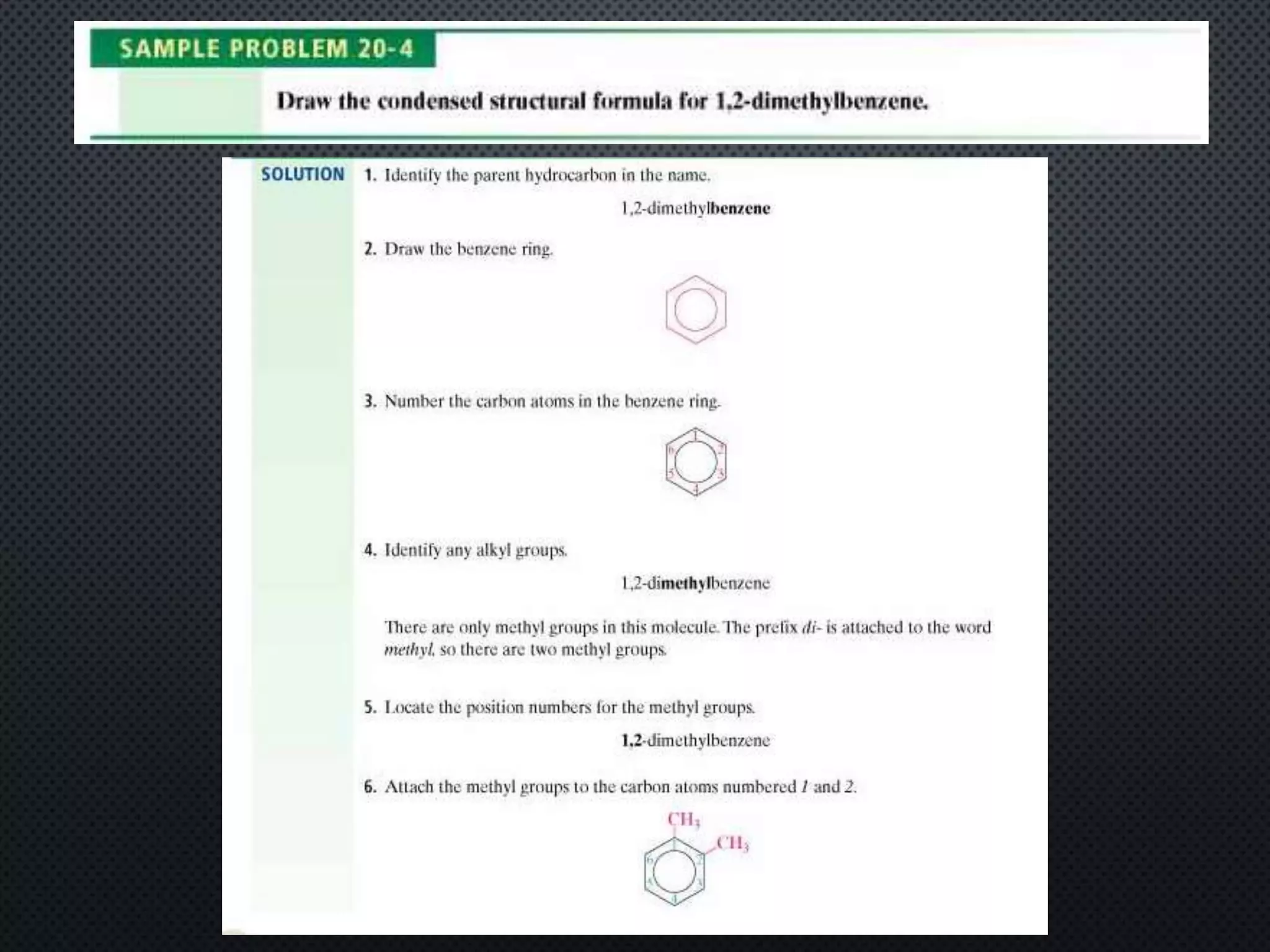
AROMATIC NOMENCLATURE
• Name the parent Hydrocarbon (Usually benzene)
• Name the Alkyl groups
• Number the carbon atoms
• Insert position numbers
• Add Punctuation
• Example: Name the equation.
week-3-4-2.ppt

week-3-4-2.ppt

  • 1.
    CARBON AND HYDROCARBONS •ABUNDANCE AND IMPORTANCE OF CARBON • ORGANIC COMPOUNDS • SATURATED HYDROCARBONS • UNSATURATED HYDROCARBONS DANNY O. ALFONSO SUBJECT INSTRUCTOR
  • 2.
    STRUCTURE AND BONDINGOF CARBON • CARBON, the first member of group 14, has mostly nonmetallic properties. carbon atoms tend to form four single bonds. this bonding results in a tetrahedral shape.
  • 3.
    ALLOTROPES OF CARBON •Carbon occurs in several solid allotropic forms that have dramatically different properties. • Diamond – Colorless, crystalline, solid form of carbon • Graphite – soft, black, crystalline form of carbon that is a fair conductor of electricity. • Fullerenes – dark colored solids made of spherically networked carbon atom cages
  • 4.
    ALLOTROPES OF CARBON- DIAMOND • the hardest material known to man • carbon atoms are bonded covalently in a network fashion • conducts heat 5x better than silver or copper • does not conduct electricity
  • 5.
    ALLOTROPES OF CARBON- GRAPHITE • Soft, crumbles easily and feels greasy • Used as a lubricant and as lead • Good conductor of electricity • Stronger and lighter than steel
  • 6.
    ALLOTROPES OF CARBON- FULLERENES • Discovered in the 1980s (N.P. 1996) • Structure consists of near spherical cages • Scientists are currently trying to find practical uses for these substances
  • 7.
    ORGANIC COMPOUNDS • Covalentlybonded compounds containing carbon, excluding carbonates and oxides • The diversity of organic compounds results from the uniqueness of carbon’s structure and bonding • Catenation – Carbon atoms are unique in their ability to form long chains and rings of covalently bonded atoms. • Hydrocarbons – composed of only carbon and hydrogen; they are the simplest organic compounds. • Most contain hydrocarbon backbones and have other elements added on (O, S, and N)
  • 8.
    ARRANGEMENT OF ATOMS •Isomer – Compounds that have the same molecular formula but different structures • As the number of carbons increases so does the number of possible isomers
  • 9.
    STRUCTURAL FORMULA • Indicatesthe number and types of atoms present in a molecule and also shows the bonding arrangement of the atoms • Structural formulas do not accurately represent the three dimensional shape of the molecule. • Structural Isomers – isomers in which the atoms are bonded together in different orders
  • 10.
    ISOMERS - GEOMETRIC •Isomers in which the order of atom bonding is the same but the arrangement of atoms in space is different • In order for geometric isomers to exist, there must be a rigid structure in the molecule to prevent free rotation around a bond
  • 11.
  • 13.
    HYDROCARBONS • depending uponthe types of carbon-carbon bonds present. they can be classified into three main categories: • 1. Saturated hydrocarbons • 2. unsaturated hydrocarbons • 3. Aromatic Hydrocarbons
  • 14.
    SATURATED HYDROCARBONS • Hydrocarbonsin which each carbon atom in the molecule form four single covalent bonds with other atoms
  • 15.
    SATURATED HYDROCARBONS • Hydrocarbonsthat contain only carbon-carbon single bond • Includes open chain and closed chain hydrocarbons • Called saturated because they have maximum number of bonded hydrogen
  • 16.
    ALKANES CNH2N+2 • Hydrocarbonsthat contain only single bonds • Homologous series – one in which adjacent members differ by a constant unit. • Alkyl groups- groups of atoms that are formed when one hydrogen atom is removed from an alkane molecule
  • 17.
    CYCLOALKANES • Alkanes inwhich the carbon atoms are arranged in a ring, or cyclic, structure
  • 18.
    ALKANE NOMENCLATURE Unbranched Chain •Count the longest continuous chain. • Use greek prefix (at right) • End with -ane
  • 19.
    ALKANE NOMENCLATURE Branched Chain •Name the longest chain (See previous) • Add the name of the alkyl group • Insert position numbers • Punctuate
  • 22.
    CYCLOALKANE NOMENCLATURE • Namethe longest chain • Add Cyclo- • Add names of alkyl groups • Number the carbons (lowest numbers) • Inset position numbers • Punctuate
  • 23.
    EXAMPLE • Give thename of the following molecule • 6 carbons = hexane • CH3 = methyl • Number around the circle • 1,3 - dimethlycyclohexane
  • 24.
    UNSATURATED HYDROCARBONS • Hydrocarbonsin which not all carbon atoms have four single covalent bonds
  • 25.
    • Hydrocarbons whichcontain carbon-carbon multiple bond (double bonds or triple bond) are called unsaturated hydrocarbon • Depending upon multiple bond they are further classified as alkenes and alkynes UNSATURATED HYDROCARBONS
  • 26.
    ALKENES CNH2N • Hydrocarbonsthat contain at least one carbon- carbon double covalent bonds
  • 27.
    ALKENE NOMENCLATURE • Namethe same as Alkane • Locate the longest continuous chain that contains the double bond(s). • Double bond should have lowest number
  • 28.
  • 29.
    ALKYNES CNH2N-2 • Hydrocarbonswith triple covalent bonds • Named the same as others • Find the longest chain containing a triple bond • Number so triple bond has lowest number • Example. Name the equation.
  • 30.
    AROMATIC HYDROCARBONS • Hydrocarbonswith six membered carbon rings and delocalized electrons • Benzene – the primary aromatic hydrocarbon • Hydrocarbons which contain at least one special type of hexagonal ring of carbon atoms with three double bond in the alternate positions are called aromatic hydrocarbon. The ring is called aromatic ring. • Aromatic compounds may also contain more than one benzene rings.
  • 31.
    AROMATIC NOMENCLATURE • Namethe parent Hydrocarbon (Usually benzene) • Name the Alkyl groups • Number the carbon atoms • Insert position numbers • Add Punctuation • Example: Name the equation.