Week 8
Vegetables, Grain
and Pasta
. 2248 email: tpavit@wu.ac.th        1
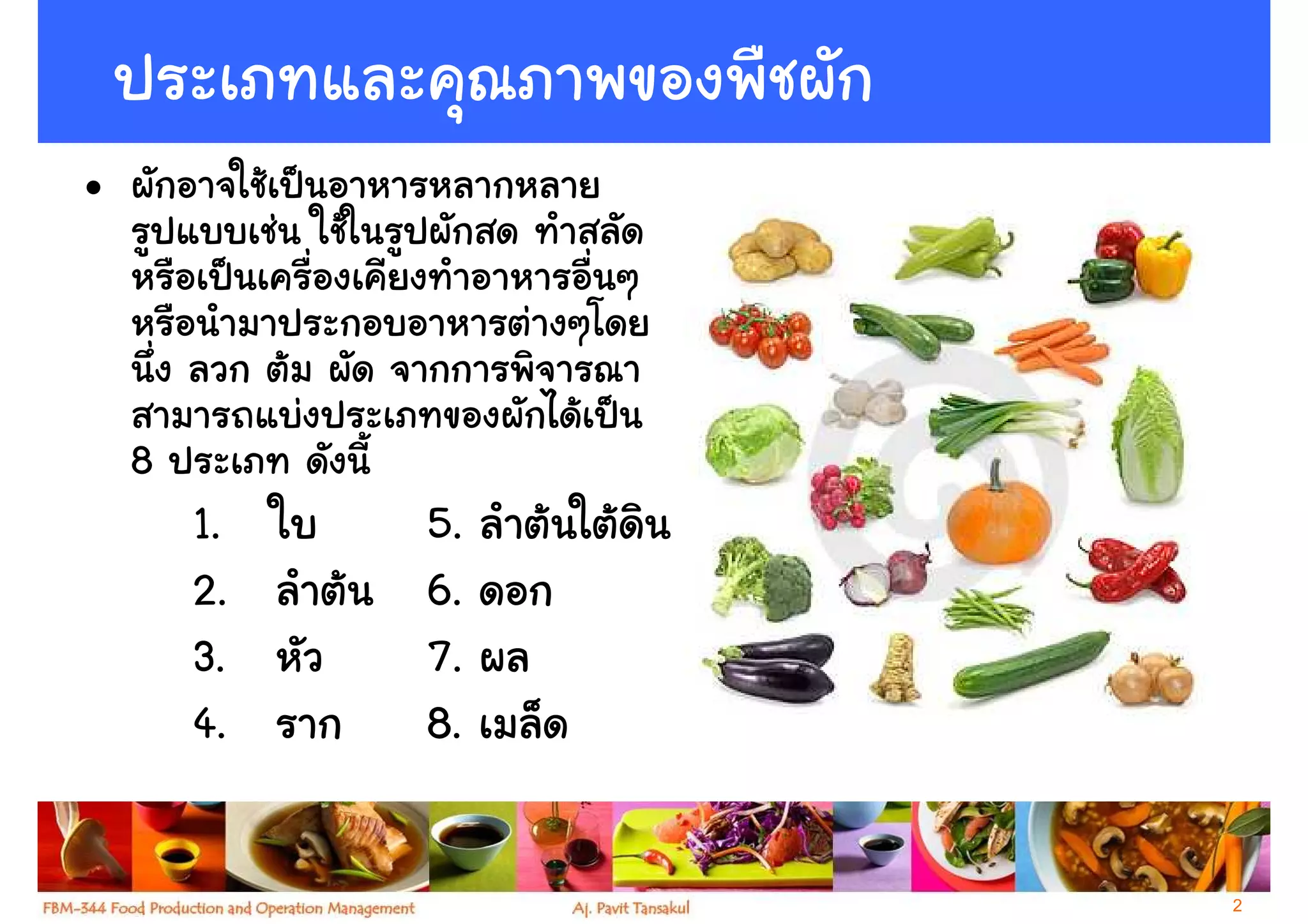
•


    8
        1.   5.
        2.   6.
        3.   7.
        4.   8.

                  2
•

    1.
    2.


         3
1.
               3
1.
     Texture
2.
     Color
3.
     Flavor


                   4
1.1   Texture
•


•

•


                5
Texture
FIBER
• Fiber is made Fiber by ACID and SUGAR
• Fiber is Softened by HEAT and ALKALIS (Baking Soda)
STARCH
• Dry Starchy food – Dried Legumes, rice, macaroni must be
   cooked in enough water
• Moist Starchy vegetable – potatoes must cooked until starch
   granules soften
DONESS
• vegetable is done when it reached the desired degree of
   tenderness. Most vegetables are best cooked very briefly, until
   they are crisp-tender or Al dente (firm to the bite)
• At this stage of tenderness, they not only have the most pleasing
   texture but also retain maximum flavor, color, and nutrients.


                                                                      6
1.2 color
•


      1.            Carotenoid
           (       )
      2.            Chlorophyll ( )
      3.               Anthocyanin
           (   )

                                      7
Vegetable Color Changes During Cooking
                                                        cooked with   Cooked with
  Color              Examples of vegetables                                           Overcooked
                                                           Acid          Alkali
White      Potatoes,turnips,cauliflower,onions,white    White         White         Yellowish, gray
           cabbage
Red        Beets,red cabbage (not tomatoes, whose       Red           Blue or       Greenish blue,
           pigment is like that in yellow vegetables)                 Blue-green
                                                                      Blue-         faded
Green      Asparagus,green beans, lima                  Olive green   Bright-
                                                                      Bright-green Olive green
           beans,broccoli,Brussels,
           beans,broccoli,Brussels,
           sprouts,peas,spinach,green,
           sprouts,peas,spinach,green,
           peppers,artichokes,okra

Yellow     Carrots,tomatoes,rutabagas,
           Carrots,tomatoes,rutabagas, sweet            Little        Little Change Slightly faded
(Orange)   potatoes,squash,corn                         Change


                                                                                                      8
1.3          Flavor
Cooking procedures flavor loss
  1. Cook for as short a time
     possible
  2. Using boiling salted water,
     salt helps reduce flavor
     loss
  3. Use just enough water to
     cover to minimize leaching
  4. Steam vegetables whenever
     appropriate


                                   9
2.
•


     1.

     2.

     3.


          10
Six Factors are responsible for nutrient loss:
1.   High Temperature
2.   Long Cooking
3.   Leaching (Drain)
4.   Alkalis (Baking Soda)
5.   Plant enzymes
6.   Oxygen


                                                 11
General Rules of Vegetable Cookery
                   • Now that you
                     understand how
                     vegetables change as
                     they cook, let’s
                     summarize that in
                     formation in some
                     general rules.
                   • You should now be able
                     to explain the reasons
                     for each of these rules.

                                           12
General Rules of Vegetable Cookery
1. Don’t overcook
2. Cook as close to service time as possible and
   in small quantities. Avoid holding for long
   periods on a steam table.
3. If the vegetable must be cooked ahead,
   undercook slightly and chill rapidly. Reheat at
   service time.
4. Never use baking soda with green vegetables.
5. Cut vegetables uniformly for even cooking.

                                                     13
General Rules of Vegetable Cookery
6.   Start with boiling, salted water when boiling green
     vegetables and other vegetables that grow above the
     ground. Roots and tubers are started in cold, salted
     water for more even cooking.
7.   Cook green vegetables and strong-flavored vegetables
     uncovered.
8.   To preserve color, cook red and white vegetables in a
     slightly acid (not strongly acid) liquid. Cook green
     vegetables in a neutral liquid.
9.   Do not mix a batch of freshly cooked vegetables with
     a batch of the same vegetables that has been cooked
     earlier and kept hot in a steam table.

                                                             14
Standard of Quality in Cooked Vegetables
1. Color.
• Bright, natural colors.
• Green vegetables, in particular, should be a fresh,
   bright green, not olive green.
2. Appearance on plate.
• Cut neatly and uniformly. Not broken up.
• Attractively arranged or mounded on plate or dish.
• Not swimming in cooking water.
• Imaginative and appropriate combinations and
   garnishes are always well received.

                                                        15
Standard of Quality in Cooked Vegetables
3. Texture.
• Cooked to the right degree of doneness.
• Most vegetables should be crisp-tender, not
   overcooked and mushy, but not tough or
   woody either
• Vegetables intended to be sofe (potatoes,
   squash,sweet,tomatoes,vegetables purees)
   should be cooked through, with a
   pleasant,smooth texture.


                                                16
Standard of Quality in Cooked Vegetables
4. Flavor.
• Full, natural flavor and sweetness, sometime
   called garden-fresh flavor. Strong – flavored
   vegetables should be pleasantly mild, with no
   off flavors or bitterness.
5. Seasonings.
• Lightly and appropriately seasoned. Seasoning
   should not be too strong and not mask the
   natural garden flavors.


                                                   17
Standard of Quality in Cooked Vegetables
6. Vegetable combinations.
• Interesting combinations attract customers.
• Flavors, colors, and shapes should be pleasing in
   combination.
• Vegetables should be cooked separately and then
   combined to allow for different cooking times.
• Acid vegetables (like tomatoes) added to green
   vegetables will discolor them. Combine just before
   service.


                                                        18
Handling Vegetables
•   Washing
•   Soaking
•   Peeling and Cutting
•   Trimming Loss
       • AP (as purchased weight)
       • EP (edible portion weight)


                                      19
Calculating Yield
              Example
              • 10 lb cabbage.
              • Yield after trimming is 80
                percent.
              • What will your weight be?
                Multiply the decimal by
                your AP weight to get EP
                yield.
              • 10 lb x 0.80 = 8 lb

                                             20
Vegetables
1.   Avocado –
                                              dip
2.                 -                                -
     Savoy              Kohlrabi
3.           (Spinach) –
4.            /          (Cucumber) –
5.                  (Zucchini/ Courgette) –
6.            (Pumpkin) –
7.               (Aubergine)-
8.              (Tomatoes) –


                                                        21
Vegetables
9.       /        (Lettuce) –        Iceberg, Butterhead,
    Romain/Coz, Leaf/Oakleaf Endive Rocket, Watercress
10.    (Mushroom) –                           ,       ,        ,
                         Chanterelles Morel Cepe Truffle
11.           –             - (Onion),          (Pearl Onion),
           (Shallot),        (spring Onion),        (Garlic),
               (Leek)
12.         /         (Bell Pepper) –

13.           /          -                       /
14.               –
15.                   – Artichoke                Fennel


                                                                   22
Cauliflower     Brussels Sprouts      Broccoli


Green Cabbage    Savoy Cabbage
                                   Chinese Cabbage


                                     Kohlrabi
White Cabbage     Red Cabbage
                                                     23
Avocado


                         Butternut Squash

               Pumpkin


    Cucumber
                                 Zucchini

                                            24
Aubergine           Purple Aubergine
                                                    White Aubergine


Beefsteak Tomato   Plum Tomato      Cherry Tomato       Tomatillo

                                                                      25
Iceberg Lettuce

Butterhead Lettuce


                 Romaine Lettuce
                                                     26
Chicory Endive
   Curly Endive

             Rocket


Watercress
                                       27
Spinach        Red Lettuce


Radicchio
                      Red Oak Leaf Lettuce
                                             28
Oyster Mushroom

Radish


         Champignons
                            29
Morels


Chanterelles


                        30
Truffles


Ceps


                  31
Chives
 Onion
          Red Onion


                      Leek
Garlic   Shallots
                                  32
Bell Pepper   Garden Peas


Snow Peas     Sugar-snap Peas
                                33
Baby Corn


Haricot vert / French Beans


        Runner/ Snake Beans
                                          34
Turnips
                      Daikon Radish


Carrot     Beetroot
                       Parsnips       35
Celery


             Fennel


                      Asparagus
         Artichoke
                                  36

Week 8 Vegetables, Grain And Pasta

  • 1.
    Week 8 Vegetables, Grain andPasta . 2248 email: tpavit@wu.ac.th 1
  • 2.
    8 1. 5. 2. 6. 3. 7. 4. 8. 2
  • 3.
    1. 2. 3
  • 4.
    1. 3 1. Texture 2. Color 3. Flavor 4
  • 5.
    1.1 Texture • • • 5
  • 6.
    Texture FIBER • Fiber ismade Fiber by ACID and SUGAR • Fiber is Softened by HEAT and ALKALIS (Baking Soda) STARCH • Dry Starchy food – Dried Legumes, rice, macaroni must be cooked in enough water • Moist Starchy vegetable – potatoes must cooked until starch granules soften DONESS • vegetable is done when it reached the desired degree of tenderness. Most vegetables are best cooked very briefly, until they are crisp-tender or Al dente (firm to the bite) • At this stage of tenderness, they not only have the most pleasing texture but also retain maximum flavor, color, and nutrients. 6
  • 7.
    1.2 color • 1. Carotenoid ( ) 2. Chlorophyll ( ) 3. Anthocyanin ( ) 7
  • 8.
    Vegetable Color ChangesDuring Cooking cooked with Cooked with Color Examples of vegetables Overcooked Acid Alkali White Potatoes,turnips,cauliflower,onions,white White White Yellowish, gray cabbage Red Beets,red cabbage (not tomatoes, whose Red Blue or Greenish blue, pigment is like that in yellow vegetables) Blue-green Blue- faded Green Asparagus,green beans, lima Olive green Bright- Bright-green Olive green beans,broccoli,Brussels, beans,broccoli,Brussels, sprouts,peas,spinach,green, sprouts,peas,spinach,green, peppers,artichokes,okra Yellow Carrots,tomatoes,rutabagas, Carrots,tomatoes,rutabagas, sweet Little Little Change Slightly faded (Orange) potatoes,squash,corn Change 8
  • 9.
    1.3 Flavor Cooking procedures flavor loss 1. Cook for as short a time possible 2. Using boiling salted water, salt helps reduce flavor loss 3. Use just enough water to cover to minimize leaching 4. Steam vegetables whenever appropriate 9
  • 10.
    2. • 1. 2. 3. 10
  • 11.
    Six Factors areresponsible for nutrient loss: 1. High Temperature 2. Long Cooking 3. Leaching (Drain) 4. Alkalis (Baking Soda) 5. Plant enzymes 6. Oxygen 11
  • 12.
    General Rules ofVegetable Cookery • Now that you understand how vegetables change as they cook, let’s summarize that in formation in some general rules. • You should now be able to explain the reasons for each of these rules. 12
  • 13.
    General Rules ofVegetable Cookery 1. Don’t overcook 2. Cook as close to service time as possible and in small quantities. Avoid holding for long periods on a steam table. 3. If the vegetable must be cooked ahead, undercook slightly and chill rapidly. Reheat at service time. 4. Never use baking soda with green vegetables. 5. Cut vegetables uniformly for even cooking. 13
  • 14.
    General Rules ofVegetable Cookery 6. Start with boiling, salted water when boiling green vegetables and other vegetables that grow above the ground. Roots and tubers are started in cold, salted water for more even cooking. 7. Cook green vegetables and strong-flavored vegetables uncovered. 8. To preserve color, cook red and white vegetables in a slightly acid (not strongly acid) liquid. Cook green vegetables in a neutral liquid. 9. Do not mix a batch of freshly cooked vegetables with a batch of the same vegetables that has been cooked earlier and kept hot in a steam table. 14
  • 15.
    Standard of Qualityin Cooked Vegetables 1. Color. • Bright, natural colors. • Green vegetables, in particular, should be a fresh, bright green, not olive green. 2. Appearance on plate. • Cut neatly and uniformly. Not broken up. • Attractively arranged or mounded on plate or dish. • Not swimming in cooking water. • Imaginative and appropriate combinations and garnishes are always well received. 15
  • 16.
    Standard of Qualityin Cooked Vegetables 3. Texture. • Cooked to the right degree of doneness. • Most vegetables should be crisp-tender, not overcooked and mushy, but not tough or woody either • Vegetables intended to be sofe (potatoes, squash,sweet,tomatoes,vegetables purees) should be cooked through, with a pleasant,smooth texture. 16
  • 17.
    Standard of Qualityin Cooked Vegetables 4. Flavor. • Full, natural flavor and sweetness, sometime called garden-fresh flavor. Strong – flavored vegetables should be pleasantly mild, with no off flavors or bitterness. 5. Seasonings. • Lightly and appropriately seasoned. Seasoning should not be too strong and not mask the natural garden flavors. 17
  • 18.
    Standard of Qualityin Cooked Vegetables 6. Vegetable combinations. • Interesting combinations attract customers. • Flavors, colors, and shapes should be pleasing in combination. • Vegetables should be cooked separately and then combined to allow for different cooking times. • Acid vegetables (like tomatoes) added to green vegetables will discolor them. Combine just before service. 18
  • 19.
    Handling Vegetables • Washing • Soaking • Peeling and Cutting • Trimming Loss • AP (as purchased weight) • EP (edible portion weight) 19
  • 20.
    Calculating Yield Example • 10 lb cabbage. • Yield after trimming is 80 percent. • What will your weight be? Multiply the decimal by your AP weight to get EP yield. • 10 lb x 0.80 = 8 lb 20
  • 21.
    Vegetables 1. Avocado – dip 2. - - Savoy Kohlrabi 3. (Spinach) – 4. / (Cucumber) – 5. (Zucchini/ Courgette) – 6. (Pumpkin) – 7. (Aubergine)- 8. (Tomatoes) – 21
  • 22.
    Vegetables 9. / (Lettuce) – Iceberg, Butterhead, Romain/Coz, Leaf/Oakleaf Endive Rocket, Watercress 10. (Mushroom) – , , , Chanterelles Morel Cepe Truffle 11. – - (Onion), (Pearl Onion), (Shallot), (spring Onion), (Garlic), (Leek) 12. / (Bell Pepper) – 13. / - / 14. – 15. – Artichoke Fennel 22
  • 23.
    Cauliflower Brussels Sprouts Broccoli Green Cabbage Savoy Cabbage Chinese Cabbage Kohlrabi White Cabbage Red Cabbage 23
  • 24.
    Avocado Butternut Squash Pumpkin Cucumber Zucchini 24
  • 25.
    Aubergine Purple Aubergine White Aubergine Beefsteak Tomato Plum Tomato Cherry Tomato Tomatillo 25
  • 26.
  • 27.
    Chicory Endive Curly Endive Rocket Watercress 27
  • 28.
    Spinach Red Lettuce Radicchio Red Oak Leaf Lettuce 28
  • 29.
  • 30.
  • 31.
  • 32.
    Chives Onion Red Onion Leek Garlic Shallots 32
  • 33.
    Bell Pepper Garden Peas Snow Peas Sugar-snap Peas 33
  • 34.
    Baby Corn Haricot vert/ French Beans Runner/ Snake Beans 34
  • 35.
    Turnips Daikon Radish Carrot Beetroot Parsnips 35
  • 36.
    Celery Fennel Asparagus Artichoke 36