Food Commodities
www.facebook.com/delhindra
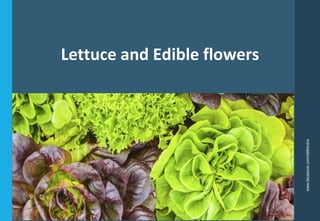
Lettuce and Edible flowers
www.facebook.com/delhindra
▪ Handling Greens
▪ Types of Green
▪ Handling Edible Flowers
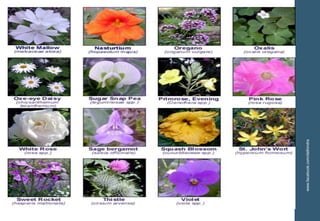
▪ Types of Edible Flowers
▪ Taste / Flavor / Texture Wheel
Learning Objectives
www.facebook.com/delhindra
Since all salad greens grow in the dirt or in hydroponic solutions,
they must be properly washed, dried and refrigerated before
serving.
1. Start by plucking out and discarding any bruised, old,
yellowed, or tough leaves. If you aren't going to use stems or
roots (as in salads with spinach or watercress), cut them off
before washing leaves
2. 2. Fill a clean sink or tub with very cold water and submerge
and agitate the greens repeatedly to remove dirt and grit,
thus chilling the leaves and allowing them to crisp up.
Note: Since they are considered ready-to-eat foods, wear gloves
when handling greens.
Handling Greens
www.facebook.com/delhindra
3. Once properly cleaned, they should be placed in a clean and
sanitized salad spinner until dried—a critical step as moisture
will diminish shelf life, cause dressing to run off leaves and
inhibit a crisp texture. Spinners can bruises the leaves slightly, so
you'll need to use them fairly soon.
4. Once properly washed and dried, greens should be placed in a
shallow plastic container covered with a damp towel, kept cold
and used in a day or two.
Note: Greens get crisper because the leaves actually "drink" the
water, pulling it into their cells, which swell and firm. The towels
keep excess moisture away from the leaves (too much water
makes them get slimy faster), and the plastic keeps the moisture
from evaporating.
www.facebook.com/delhindra
1. Mild Greens - delicate in flavor, have a variety of textures
and fall into several types:
▪ Looseleaf - loosely gathered, growing as a rosette,
enabling the grower to just remove the leaves rather
than harvest the entire plant’
▪ Butterhead - round, but the leaves are more loose and
have a smoother texture than those of their crisphead
cousins.
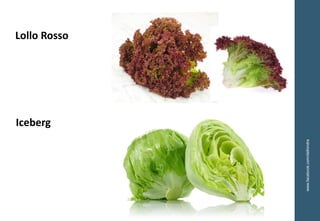
▪ Crisphead – ex. iceburg
▪ Romaine - elongated leaves with thick white ribs.
Types of Greens & Edible Flowers
www.facebook.com/delhindra
2. Bitter & Spicy Greens - aggressive flavor with many bitter
varieties having a “tough” texture.
3. Micro Greens - seedlings of vegetables and herbs that are
grown hydroponically in greenhouses. Very delicate with flavors
that are mild renditions of their larger counterparts. Used as
accompaniments and garnishes.
4. Edible Flowers – can be aggressive in flavor and used
sparingly. Avoid using any flowers from unknown sources since
they could be contaminated with pesticides and chemicals.
www.facebook.com/delhindra
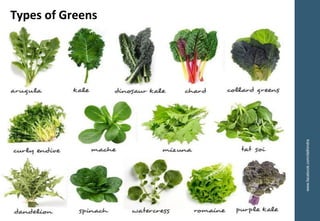
Types of Greens
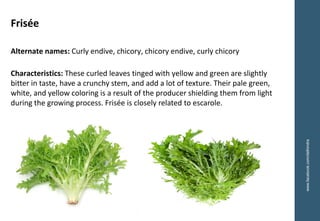
Frisée
Alternate names: Curly endive, chicory, chicory endive, curly chicory
Characteristics: These curled leaves tinged with yellow and green are slightly
bitter in taste, have a crunchy stem, and add a lot of texture. Their pale green,
white, and yellow coloring is a result of the producer shielding them from light
during the growing process. Frisée is closely related to escarole.
www.facebook.com/delhindra
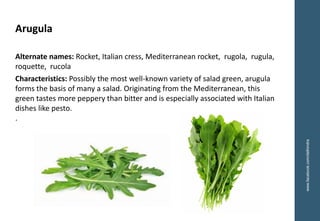
Arugula
Alternate names: Rocket, Italian cress, Mediterranean rocket, rugola, rugula,
roquette, rucola
Characteristics: Possibly the most well-known variety of salad green, arugula
forms the basis of many a salad. Originating from the Mediterranean, this
green tastes more peppery than bitter and is especially associated with Italian
dishes like pesto.
.
www.facebook.com/delhindra
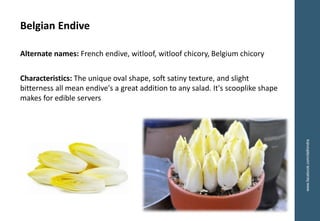
Belgian Endive
Alternate names: French endive, witloof, witloof chicory, Belgium chicory
Characteristics: The unique oval shape, soft satiny texture, and slight
bitterness all mean endive's a great addition to any salad. It's scooplike shape
makes for edible servers
www.facebook.com/delhindra
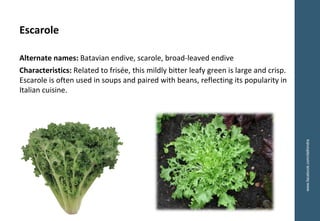
Escarole
Alternate names: Batavian endive, scarole, broad-leaved endive
Characteristics: Related to frisée, this mildly bitter leafy green is large and crisp.
Escarole is often used in soups and paired with beans, reflecting its popularity in
Italian cuisine.
www.facebook.com/delhindra
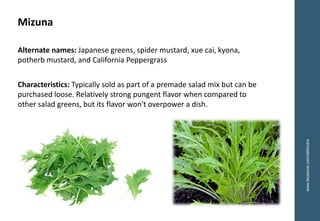
Mizuna
Alternate names: Japanese greens, spider mustard, xue cai, kyona,
potherb mustard, and California Peppergrass
Characteristics: Typically sold as part of a premade salad mix but can be
purchased loose. Relatively strong pungent flavor when compared to
other salad greens, but its flavor won't overpower a dish.
www.facebook.com/delhindra
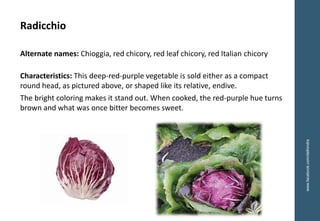
Radicchio
Alternate names: Chioggia, red chicory, red leaf chicory, red Italian chicory
Characteristics: This deep-red-purple vegetable is sold either as a compact
round head, as pictured above, or shaped like its relative, endive.
The bright coloring makes it stand out. When cooked, the red-purple hue turns
brown and what was once bitter becomes sweet.
www.facebook.com/delhindra
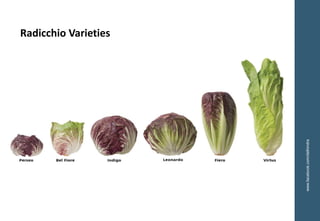
Radicchio Varieties
www.facebook.com/delhindra
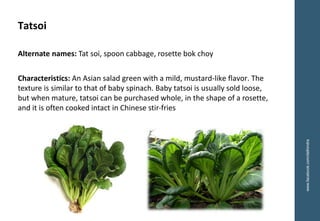
Tatsoi
Alternate names: Tat soi, spoon cabbage, rosette bok choy
Characteristics: An Asian salad green with a mild, mustard-like flavor. The
texture is similar to that of baby spinach. Baby tatsoi is usually sold loose,
but when mature, tatsoi can be purchased whole, in the shape of a rosette,
and it is often cooked intact in Chinese stir-fries
www.facebook.com/delhindra
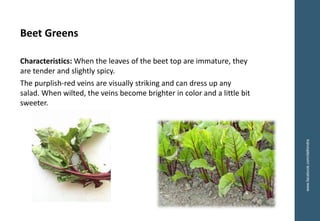
Beet Greens
Characteristics: When the leaves of the beet top are immature, they
are tender and slightly spicy.
The purplish-red veins are visually striking and can dress up any
salad. When wilted, the veins become brighter in color and a little bit
sweeter.
www.facebook.com/delhindra
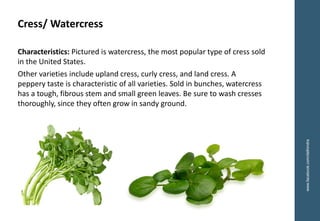
Cress/ Watercress
Characteristics: Pictured is watercress, the most popular type of cress sold
in the United States.
Other varieties include upland cress, curly cress, and land cress. A
peppery taste is characteristic of all varieties. Sold in bunches, watercress
has a tough, fibrous stem and small green leaves. Be sure to wash cresses
thoroughly, since they often grow in sandy ground.
www.facebook.com/delhindra
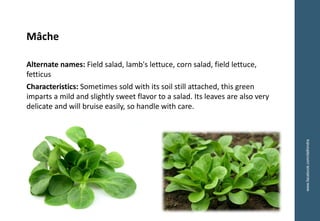
Mâche
Alternate names: Field salad, lamb's lettuce, corn salad, field lettuce,
fetticus
Characteristics: Sometimes sold with its soil still attached, this green
imparts a mild and slightly sweet flavor to a salad. Its leaves are also very
delicate and will bruise easily, so handle with care.
www.facebook.com/delhindra
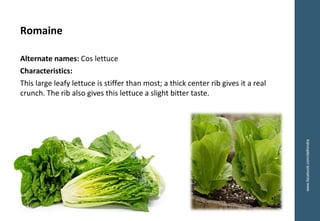
Romaine
Alternate names: Cos lettuce
Characteristics:
This large leafy lettuce is stiffer than most; a thick center rib gives it a real
crunch. The rib also gives this lettuce a slight bitter taste.
www.facebook.com/delhindra
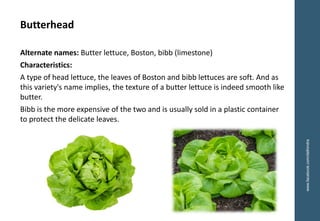
Butterhead
Alternate names: Butter lettuce, Boston, bibb (limestone)
Characteristics:
A type of head lettuce, the leaves of Boston and bibb lettuces are soft. And as
this variety's name implies, the texture of a butter lettuce is indeed smooth like
butter.
Bibb is the more expensive of the two and is usually sold in a plastic container
to protect the delicate leaves.
www.facebook.com/delhindra
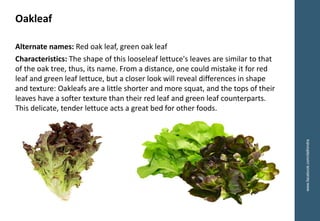
Oakleaf
Alternate names: Red oak leaf, green oak leaf
Characteristics: The shape of this looseleaf lettuce's leaves are similar to that
of the oak tree, thus, its name. From a distance, one could mistake it for red
leaf and green leaf lettuce, but a closer look will reveal differences in shape
and texture: Oakleafs are a little shorter and more squat, and the tops of their
leaves have a softer texture than their red leaf and green leaf counterparts.
This delicate, tender lettuce acts a great bed for other foods.
www.facebook.com/delhindra
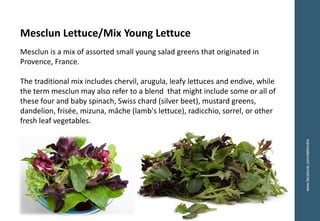
Mesclun Lettuce/Mix Young Lettuce
Mesclun is a mix of assorted small young salad greens that originated in
Provence, France.
The traditional mix includes chervil, arugula, leafy lettuces and endive, while
the term mesclun may also refer to a blend that might include some or all of
these four and baby spinach, Swiss chard (silver beet), mustard greens,
dandelion, frisée, mizuna, mâche (lamb's lettuce), radicchio, sorrel, or other
fresh leaf vegetables.
www.facebook.com/delhindra
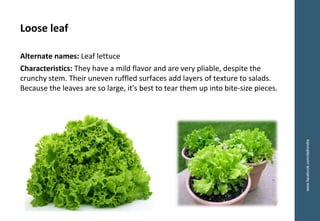
Loose leaf
Alternate names: Leaf lettuce
Characteristics: They have a mild flavor and are very pliable, despite the
crunchy stem. Their uneven ruffled surfaces add layers of texture to salads.
Because the leaves are so large, it's best to tear them up into bite-size pieces.
www.facebook.com/delhindra
Lollo Rosso
Iceberg
▪ No flowers is safe to eat unless it was grown organically.
▪ Wash all flowers thoroughly before you eat them.
▪ Remove pistils and stamens from flowers before eating. Separate
the flower petals from the rest of the flower just prior to use to
keep wilting to a minimum.
▪ Use flowers sparingly in your recipes due to the digestive
complications that can occur with a large consumption rate.
▪ Most herb flowers have a taste that's similar to the leaf, but
spicier.
Handling Edible Flowers
www.facebook.com/delhindra
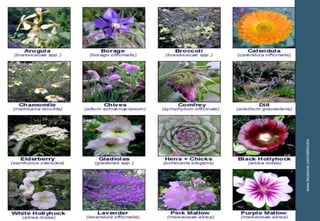
▪ Floral Flowers
- Calendula, Carnations, Chrysanthemums, Clover, Cornflower, Dame's or
Sweet Rocket, Dandelions, Day Lilies, English Daisy
▪ Fruit Flowers
- Apple Blossoms, Banana Blossoms, Citrus Blossoms, Elderberry Blossoms,
Fuchsia, Garden Sorrel, Gladiolus
▪ Herb Flowers
- Alliums (leeks, chives, garlic, garlic chives), Anise Hyssop, Basil, Bee Balm
Borage, Burnet, Chervil, Chicory, Cilantro/Coriander, Chamomile, Dill, Fennel,
Ginger, Jasmine, Lavender, Lemon Verbena, Marjoram, Oregano, Rosemary,
Safflower, Sage, Savory, Thyme
▪ Vegetable Flowers
Avoid nightshade flowers (tomato, potato, eggplant, peppers & asparagus) – Toxic!
- Arugula, Artichoke, Broccoli Florets, Corn Shoots, Mustard, Okra, Pac Choy,
Pea Blossoms, Radish Flowers, Scarlet Runner Beans, Squash Blossoms
Types Edible Flowers
www.facebook.com/delhindra

Lettuce and Edible Flower: https://www.facebook.com/delhindra/

  • 1.
  • 2.
    Lettuce and Edibleflowers www.facebook.com/delhindra
  • 3.
    ▪ Handling Greens ▪Types of Green ▪ Handling Edible Flowers ▪ Types of Edible Flowers ▪ Taste / Flavor / Texture Wheel Learning Objectives www.facebook.com/delhindra
  • 4.
    Since all saladgreens grow in the dirt or in hydroponic solutions, they must be properly washed, dried and refrigerated before serving. 1. Start by plucking out and discarding any bruised, old, yellowed, or tough leaves. If you aren't going to use stems or roots (as in salads with spinach or watercress), cut them off before washing leaves 2. 2. Fill a clean sink or tub with very cold water and submerge and agitate the greens repeatedly to remove dirt and grit, thus chilling the leaves and allowing them to crisp up. Note: Since they are considered ready-to-eat foods, wear gloves when handling greens. Handling Greens www.facebook.com/delhindra
  • 5.
    3. Once properlycleaned, they should be placed in a clean and sanitized salad spinner until dried—a critical step as moisture will diminish shelf life, cause dressing to run off leaves and inhibit a crisp texture. Spinners can bruises the leaves slightly, so you'll need to use them fairly soon. 4. Once properly washed and dried, greens should be placed in a shallow plastic container covered with a damp towel, kept cold and used in a day or two. Note: Greens get crisper because the leaves actually "drink" the water, pulling it into their cells, which swell and firm. The towels keep excess moisture away from the leaves (too much water makes them get slimy faster), and the plastic keeps the moisture from evaporating. www.facebook.com/delhindra
  • 6.
    1. Mild Greens- delicate in flavor, have a variety of textures and fall into several types: ▪ Looseleaf - loosely gathered, growing as a rosette, enabling the grower to just remove the leaves rather than harvest the entire plant’ ▪ Butterhead - round, but the leaves are more loose and have a smoother texture than those of their crisphead cousins. ▪ Crisphead – ex. iceburg ▪ Romaine - elongated leaves with thick white ribs. Types of Greens & Edible Flowers www.facebook.com/delhindra
  • 7.
    2. Bitter &Spicy Greens - aggressive flavor with many bitter varieties having a “tough” texture. 3. Micro Greens - seedlings of vegetables and herbs that are grown hydroponically in greenhouses. Very delicate with flavors that are mild renditions of their larger counterparts. Used as accompaniments and garnishes. 4. Edible Flowers – can be aggressive in flavor and used sparingly. Avoid using any flowers from unknown sources since they could be contaminated with pesticides and chemicals. www.facebook.com/delhindra
  • 8.
  • 9.
    Frisée Alternate names: Curlyendive, chicory, chicory endive, curly chicory Characteristics: These curled leaves tinged with yellow and green are slightly bitter in taste, have a crunchy stem, and add a lot of texture. Their pale green, white, and yellow coloring is a result of the producer shielding them from light during the growing process. Frisée is closely related to escarole. www.facebook.com/delhindra
  • 10.
    www.facebook.com/delhindra Arugula Alternate names: Rocket,Italian cress, Mediterranean rocket, rugola, rugula, roquette, rucola Characteristics: Possibly the most well-known variety of salad green, arugula forms the basis of many a salad. Originating from the Mediterranean, this green tastes more peppery than bitter and is especially associated with Italian dishes like pesto. .
  • 11.
    www.facebook.com/delhindra Belgian Endive Alternate names:French endive, witloof, witloof chicory, Belgium chicory Characteristics: The unique oval shape, soft satiny texture, and slight bitterness all mean endive's a great addition to any salad. It's scooplike shape makes for edible servers
  • 12.
    www.facebook.com/delhindra Escarole Alternate names: Batavianendive, scarole, broad-leaved endive Characteristics: Related to frisée, this mildly bitter leafy green is large and crisp. Escarole is often used in soups and paired with beans, reflecting its popularity in Italian cuisine.
  • 13.
    www.facebook.com/delhindra Mizuna Alternate names: Japanesegreens, spider mustard, xue cai, kyona, potherb mustard, and California Peppergrass Characteristics: Typically sold as part of a premade salad mix but can be purchased loose. Relatively strong pungent flavor when compared to other salad greens, but its flavor won't overpower a dish.
  • 14.
    www.facebook.com/delhindra Radicchio Alternate names: Chioggia,red chicory, red leaf chicory, red Italian chicory Characteristics: This deep-red-purple vegetable is sold either as a compact round head, as pictured above, or shaped like its relative, endive. The bright coloring makes it stand out. When cooked, the red-purple hue turns brown and what was once bitter becomes sweet.
  • 15.
  • 16.
    www.facebook.com/delhindra Tatsoi Alternate names: Tatsoi, spoon cabbage, rosette bok choy Characteristics: An Asian salad green with a mild, mustard-like flavor. The texture is similar to that of baby spinach. Baby tatsoi is usually sold loose, but when mature, tatsoi can be purchased whole, in the shape of a rosette, and it is often cooked intact in Chinese stir-fries
  • 17.
    www.facebook.com/delhindra Beet Greens Characteristics: Whenthe leaves of the beet top are immature, they are tender and slightly spicy. The purplish-red veins are visually striking and can dress up any salad. When wilted, the veins become brighter in color and a little bit sweeter.
  • 18.
    www.facebook.com/delhindra Cress/ Watercress Characteristics: Picturedis watercress, the most popular type of cress sold in the United States. Other varieties include upland cress, curly cress, and land cress. A peppery taste is characteristic of all varieties. Sold in bunches, watercress has a tough, fibrous stem and small green leaves. Be sure to wash cresses thoroughly, since they often grow in sandy ground.
  • 19.
    www.facebook.com/delhindra Mâche Alternate names: Fieldsalad, lamb's lettuce, corn salad, field lettuce, fetticus Characteristics: Sometimes sold with its soil still attached, this green imparts a mild and slightly sweet flavor to a salad. Its leaves are also very delicate and will bruise easily, so handle with care.
  • 20.
    www.facebook.com/delhindra Romaine Alternate names: Coslettuce Characteristics: This large leafy lettuce is stiffer than most; a thick center rib gives it a real crunch. The rib also gives this lettuce a slight bitter taste.
  • 21.
    www.facebook.com/delhindra Butterhead Alternate names: Butterlettuce, Boston, bibb (limestone) Characteristics: A type of head lettuce, the leaves of Boston and bibb lettuces are soft. And as this variety's name implies, the texture of a butter lettuce is indeed smooth like butter. Bibb is the more expensive of the two and is usually sold in a plastic container to protect the delicate leaves.
  • 22.
    www.facebook.com/delhindra Oakleaf Alternate names: Redoak leaf, green oak leaf Characteristics: The shape of this looseleaf lettuce's leaves are similar to that of the oak tree, thus, its name. From a distance, one could mistake it for red leaf and green leaf lettuce, but a closer look will reveal differences in shape and texture: Oakleafs are a little shorter and more squat, and the tops of their leaves have a softer texture than their red leaf and green leaf counterparts. This delicate, tender lettuce acts a great bed for other foods.
  • 23.
    www.facebook.com/delhindra Mesclun Lettuce/Mix YoungLettuce Mesclun is a mix of assorted small young salad greens that originated in Provence, France. The traditional mix includes chervil, arugula, leafy lettuces and endive, while the term mesclun may also refer to a blend that might include some or all of these four and baby spinach, Swiss chard (silver beet), mustard greens, dandelion, frisée, mizuna, mâche (lamb's lettuce), radicchio, sorrel, or other fresh leaf vegetables.
  • 24.
    www.facebook.com/delhindra Loose leaf Alternate names:Leaf lettuce Characteristics: They have a mild flavor and are very pliable, despite the crunchy stem. Their uneven ruffled surfaces add layers of texture to salads. Because the leaves are so large, it's best to tear them up into bite-size pieces.
  • 25.
  • 26.
    ▪ No flowersis safe to eat unless it was grown organically. ▪ Wash all flowers thoroughly before you eat them. ▪ Remove pistils and stamens from flowers before eating. Separate the flower petals from the rest of the flower just prior to use to keep wilting to a minimum. ▪ Use flowers sparingly in your recipes due to the digestive complications that can occur with a large consumption rate. ▪ Most herb flowers have a taste that's similar to the leaf, but spicier. Handling Edible Flowers www.facebook.com/delhindra
  • 27.
    ▪ Floral Flowers -Calendula, Carnations, Chrysanthemums, Clover, Cornflower, Dame's or Sweet Rocket, Dandelions, Day Lilies, English Daisy ▪ Fruit Flowers - Apple Blossoms, Banana Blossoms, Citrus Blossoms, Elderberry Blossoms, Fuchsia, Garden Sorrel, Gladiolus ▪ Herb Flowers - Alliums (leeks, chives, garlic, garlic chives), Anise Hyssop, Basil, Bee Balm Borage, Burnet, Chervil, Chicory, Cilantro/Coriander, Chamomile, Dill, Fennel, Ginger, Jasmine, Lavender, Lemon Verbena, Marjoram, Oregano, Rosemary, Safflower, Sage, Savory, Thyme ▪ Vegetable Flowers Avoid nightshade flowers (tomato, potato, eggplant, peppers & asparagus) – Toxic! - Arugula, Artichoke, Broccoli Florets, Corn Shoots, Mustard, Okra, Pac Choy, Pea Blossoms, Radish Flowers, Scarlet Runner Beans, Squash Blossoms Types Edible Flowers www.facebook.com/delhindra
  • 28.
  • 29.
  • 30.