Project Orientation
Programme
III Sem MBA Project Work
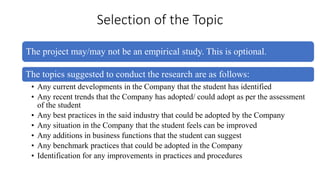
Selection of the Topic
The project may/may not be an empirical study. This is optional.
The topics suggested to conduct the research are as follows:
• Any current developments in the Company that the student has identified
• Any recent trends that the Company has adopted/ could adopt as per the assessment
of the student
• Any best practices in the said industry that could be adopted by the Company
• Any situation in the Company that the student feels can be improved
• Any additions in business functions that the student can suggest
• Any benchmark practices that could be adopted in the Company
• Identification for any improvements in practices and procedures
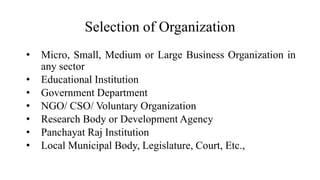
Selection of Organization
• Micro, Small, Medium or Large Business Organization in
any sector
• Educational Institution
• Government Department
• NGO/ CSO/ Voluntary Organization
• Research Body or Development Agency
• Panchayat Raj Institution
• Local Municipal Body, Legislature, Court, Etc.,
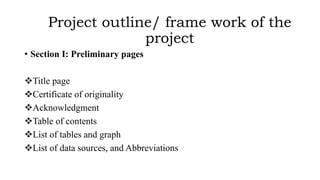
Project outline/ frame work of the
project
• Section I: Preliminary pages
Title page
Certificate of originality
Acknowledgment
Table of contents
List of tables and graph
List of data sources, and Abbreviations
Body of the Report
• Chapter 1 : Introduction / Industry Profile
• Chapter 2 : Company Profile and Overall
Organizational Study/ Departmental Study
• Chapter 3 : Research Design/Methodology
• Chapter 4 : Framework of Analysis
• Chapter 5 : Summary of Findings, Conclusion and
Recommendations
Chapter 1- Introduction
• 1.1 Conceptual Background of the study (Specialization Area)
• 1.2 Industry Profile/Survey /industry back ground of the study
• Note: Number of Pages: 15 to 20 pages
Chapter 2
• Company profile /overall organizational study/ departmental study
a. Company History
b. Vision, Mission and Objectives
c. Organizational hierarchy /Chart
d. Milestone/Achievements
e. Product and Service Profile
f. Competitor profile and analysis
g. Organizational hierarchy (Visual representation of particular company)
h. Departmental Hierarchy (Represent each department individually)
Models Suggested to enumerate are:
1. Porter’s five force Model (1. Competition in the industry
2. Potential of new entrants into the industry 3. Power of
suppliers 4. Power of customers 5. Threat of substitute
products )
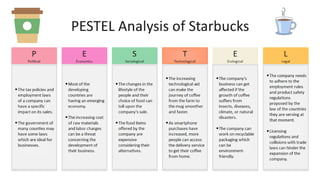
2. PESTEL (PESTEL = Political, Economic, Social,
Technological, Environmental & Legal)
3. BCG Matrix
4. McKinsey 7 S Model
The Model Should Consist of
• a. Visual /pictographically representation
• b. Model should represent the situation of selected industry
and company specific analysis based on its dimensions /
parameter/criteria
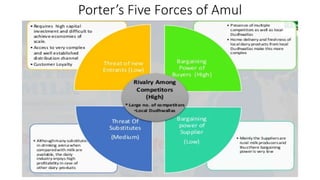
Porter’s Five Forces of Amul
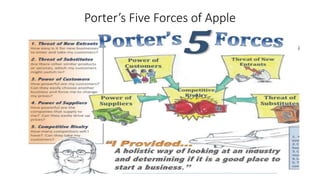
Porter’s Five Forces of Apple
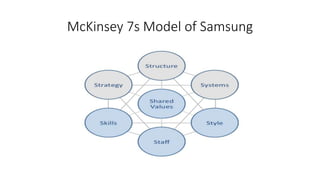
McKinsey 7s Model of Samsung
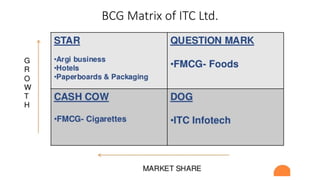
BCG Matrix of ITC Ltd.
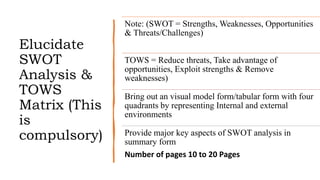
Elucidate
SWOT
Analysis &
TOWS
Matrix (This
is
compulsory)
Note: (SWOT = Strengths, Weaknesses, Opportunities
& Threats/Challenges)
TOWS = Reduce threats, Take advantage of
opportunities, Exploit strengths & Remove
weaknesses)
Bring out an visual model form/tabular form with four
quadrants by representing Internal and external
environments
Provide major key aspects of SWOT analysis in
summary form
Number of pages 10 to 20 Pages
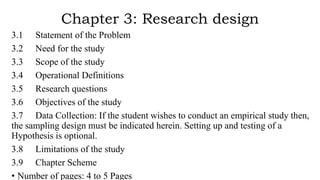
Chapter 3: Research design
3.1 Statement of the Problem
3.2 Need for the study
3.3 Scope of the study
3.4 Operational Definitions
3.5 Research questions
3.6 Objectives of the study
3.7 Data Collection: If the student wishes to conduct an empirical study then,
the sampling design must be indicated herein. Setting up and testing of a
Hypothesis is optional.
3.8 Limitations of the study
3.9 Chapter Scheme
• Number of pages: 4 to 5 Pages
Chapter 4: Framework of analysis
• The Data analysis consists of the following:
 An introductory paragraph which explains the chapter
 A critical view for the results that the analysis throws up.
 If any new theme emerges from the analysis the researcher is to
acknowledge it and link it with the appropriate conclusion that is
drawn for the analysis.
• The writing style should be such that it communicates the findings and
results to the reader.
Chapter 5: Summary of findings,
Conclusions and Recommendations
5.1. Findings:
• As per the outcome of the study researcher/student has to exhibit the findings
pertaining to chapter 3 and chapter 4 and also to provide suggestions or
recommendations to address the problem.
5.2. Conclusions
• It denotes the achievements made as a result of completing the project. This part of
report concludes the challenges or opportunities of future perspective of a project.
5.3. Suggestions/ Recommendations:
• Solution, alternative solutions, based on Internal and external factor analysis and
research
Note: Number of pages 2 to 5
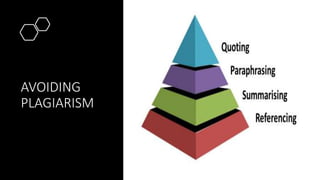
AVOIDING
PLAGIARISM
Section III: Bibliography
• Bibliography must mention the books, articles, journals, manuals etc.
which are used or referred in the report. Full and accurate information
regarding sources used such as title, author name, and issue and page
number should be mentioned.
Annexures
• Supporting Documents
• Authenticating data source
• Annexure relevant to the project such as figures, graphs and
• Photographs etc,.
Citation – APA style (7th edition)
Reference - APA style (7th edition)
Examples
• Articles : Example
• Collins, C. J., & Clark, K. D. (2003). Strategic Human Resource
Practices, Top Management Team Social Networks, and Firm
Performance: The Role of Human Resource Practices in Creating
Organizational Competitive Advantage. Academy of Management
Journal, 46(6), 740–751. https://doi.org/10.5465/30040665
• Journal: Example
• Marler, J. H., & Fisher, S. L. (2013). An evidence-based review of e-
HRM and strategic human resource management. Human Resource
Management Review, 23(1), 18–36.
https://doi.org/10.1016/j.hrmr.2012.06.002
• Books: Example
• Kothari, C. R. (Ed.). (n.d.). Research Methodology Methods & teh
(Second Revised Edition, Vols. 1–2). PUBLISHING FOR ONE
WORLD NEW AGE INTERNATIONAL (P) LIMITED,
PUBLISHERS
• Website links:
• And Any reference material
Guidelines for Submission
1. The body of the report must not be less than 80 pages.
2. Font size: Chapter heading: 18; Sub-heading: 14 and text of the
running matter: 12.
3. Fonts to be used are Times New Roman.
4. The text of the project should have 1.5 line spacing; quotations and
foot notes should be in single-line space.
Project orientation Program.pptx axcndccs

Project orientation Program.pptx axcndccs

  • 1.
  • 2.
    Selection of theTopic The project may/may not be an empirical study. This is optional. The topics suggested to conduct the research are as follows: • Any current developments in the Company that the student has identified • Any recent trends that the Company has adopted/ could adopt as per the assessment of the student • Any best practices in the said industry that could be adopted by the Company • Any situation in the Company that the student feels can be improved • Any additions in business functions that the student can suggest • Any benchmark practices that could be adopted in the Company • Identification for any improvements in practices and procedures
  • 3.
    Selection of Organization •Micro, Small, Medium or Large Business Organization in any sector • Educational Institution • Government Department • NGO/ CSO/ Voluntary Organization • Research Body or Development Agency • Panchayat Raj Institution • Local Municipal Body, Legislature, Court, Etc.,
  • 4.
    Project outline/ framework of the project • Section I: Preliminary pages Title page Certificate of originality Acknowledgment Table of contents List of tables and graph List of data sources, and Abbreviations
  • 5.
    Body of theReport • Chapter 1 : Introduction / Industry Profile • Chapter 2 : Company Profile and Overall Organizational Study/ Departmental Study • Chapter 3 : Research Design/Methodology • Chapter 4 : Framework of Analysis • Chapter 5 : Summary of Findings, Conclusion and Recommendations
  • 6.
    Chapter 1- Introduction •1.1 Conceptual Background of the study (Specialization Area) • 1.2 Industry Profile/Survey /industry back ground of the study • Note: Number of Pages: 15 to 20 pages
  • 7.
    Chapter 2 • Companyprofile /overall organizational study/ departmental study a. Company History b. Vision, Mission and Objectives c. Organizational hierarchy /Chart d. Milestone/Achievements e. Product and Service Profile f. Competitor profile and analysis g. Organizational hierarchy (Visual representation of particular company) h. Departmental Hierarchy (Represent each department individually)
  • 8.
    Models Suggested toenumerate are: 1. Porter’s five force Model (1. Competition in the industry 2. Potential of new entrants into the industry 3. Power of suppliers 4. Power of customers 5. Threat of substitute products ) 2. PESTEL (PESTEL = Political, Economic, Social, Technological, Environmental & Legal) 3. BCG Matrix 4. McKinsey 7 S Model
  • 9.
    The Model ShouldConsist of • a. Visual /pictographically representation • b. Model should represent the situation of selected industry and company specific analysis based on its dimensions / parameter/criteria
  • 10.
  • 11.
  • 12.
  • 13.
    BCG Matrix ofITC Ltd.
  • 15.
    Elucidate SWOT Analysis & TOWS Matrix (This is compulsory) Note:(SWOT = Strengths, Weaknesses, Opportunities & Threats/Challenges) TOWS = Reduce threats, Take advantage of opportunities, Exploit strengths & Remove weaknesses) Bring out an visual model form/tabular form with four quadrants by representing Internal and external environments Provide major key aspects of SWOT analysis in summary form Number of pages 10 to 20 Pages
  • 16.
    Chapter 3: Researchdesign 3.1 Statement of the Problem 3.2 Need for the study 3.3 Scope of the study 3.4 Operational Definitions 3.5 Research questions 3.6 Objectives of the study 3.7 Data Collection: If the student wishes to conduct an empirical study then, the sampling design must be indicated herein. Setting up and testing of a Hypothesis is optional. 3.8 Limitations of the study 3.9 Chapter Scheme • Number of pages: 4 to 5 Pages
  • 17.
    Chapter 4: Frameworkof analysis • The Data analysis consists of the following:  An introductory paragraph which explains the chapter  A critical view for the results that the analysis throws up.  If any new theme emerges from the analysis the researcher is to acknowledge it and link it with the appropriate conclusion that is drawn for the analysis. • The writing style should be such that it communicates the findings and results to the reader.
  • 18.
    Chapter 5: Summaryof findings, Conclusions and Recommendations 5.1. Findings: • As per the outcome of the study researcher/student has to exhibit the findings pertaining to chapter 3 and chapter 4 and also to provide suggestions or recommendations to address the problem. 5.2. Conclusions • It denotes the achievements made as a result of completing the project. This part of report concludes the challenges or opportunities of future perspective of a project. 5.3. Suggestions/ Recommendations: • Solution, alternative solutions, based on Internal and external factor analysis and research Note: Number of pages 2 to 5
  • 19.
  • 20.
    Section III: Bibliography •Bibliography must mention the books, articles, journals, manuals etc. which are used or referred in the report. Full and accurate information regarding sources used such as title, author name, and issue and page number should be mentioned. Annexures • Supporting Documents • Authenticating data source • Annexure relevant to the project such as figures, graphs and • Photographs etc,. Citation – APA style (7th edition) Reference - APA style (7th edition)
  • 21.
    Examples • Articles :Example • Collins, C. J., & Clark, K. D. (2003). Strategic Human Resource Practices, Top Management Team Social Networks, and Firm Performance: The Role of Human Resource Practices in Creating Organizational Competitive Advantage. Academy of Management Journal, 46(6), 740–751. https://doi.org/10.5465/30040665 • Journal: Example • Marler, J. H., & Fisher, S. L. (2013). An evidence-based review of e- HRM and strategic human resource management. Human Resource Management Review, 23(1), 18–36. https://doi.org/10.1016/j.hrmr.2012.06.002 • Books: Example • Kothari, C. R. (Ed.). (n.d.). Research Methodology Methods & teh (Second Revised Edition, Vols. 1–2). PUBLISHING FOR ONE WORLD NEW AGE INTERNATIONAL (P) LIMITED, PUBLISHERS • Website links: • And Any reference material
  • 22.
    Guidelines for Submission 1.The body of the report must not be less than 80 pages. 2. Font size: Chapter heading: 18; Sub-heading: 14 and text of the running matter: 12. 3. Fonts to be used are Times New Roman. 4. The text of the project should have 1.5 line spacing; quotations and foot notes should be in single-line space.