Gerontological Nursing


 INTRODUCTION TO
 GERONTOLOGIC NURSiNG
 Jose Karlo M. Pañgan,RN, MAN

                           `


                                Week
                                One
GERONTOLOGY
NURSING

WEEK ONE
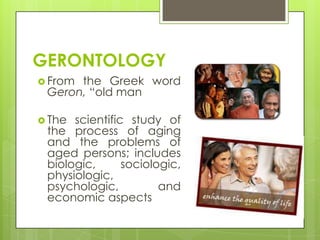
GERONTOLOGY
 Fromthe Greek word
 Geron, “old man

 The scientific study of
 the process of aging
 and the problems of
 aged persons; includes
 biologic,      sociologic,
 physiologic,
 psychologic,          and
 economic aspects
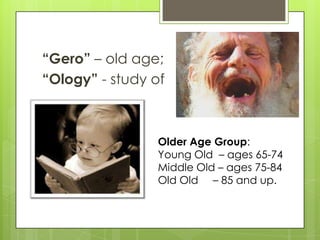
“Gero” – old age;
“Ology” - study of


                 Older Age Group:
                 Young Old – ages 65-74
                 Middle Old – ages 75-84
                 Old Old – 85 and up.
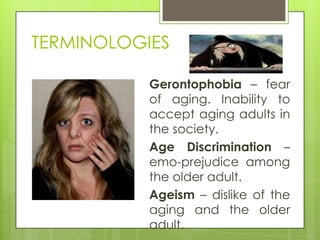
TERMINOLOGIES

           Gerontophobia – fear
           of aging. Inability to
           accept aging adults in
           the society.
           Age Discrimination –
           emo-prejudice among
           the older adult.
           Ageism – dislike of the
           aging and the older
           adult.
 Geriatrics– generic term relating to the
 aged, but specifically refers to medical
 care for the aged.

 SocialGerontology – concerned mainly
 with the social aspects of aging versus
 the biological or psychological

 Geropsychology     –   refers to   the
 specialists    in   psychiatry    whose
 knowledge, expertise and practice are
 with the older population.
 Geropharmaceutics        – also    called
  Geropharmacology is a unique branch in
  which pharmacists obtain special training
  in geriatrics.
 Financial      Gerontology –    combines
  knowledge of financial planning and
  services with a special expertise in the
  needs of older adults.
Gerontological Rehabilitation Nursing –
combines expertise in Gerontologic nursing
with rehabilitation concepts and practice.
Gerontological Nursing – the aspect of
gerontology that falls within the discipline of
nursing and the scope of nursing practice.
ROLES OF THE GERONTOLOGIC
NURSE

 Provider   of care
 Teacher
 Manager
 Advocate
 Research    Consumer
DEMOGRAPHICS OF OLD
PEOPLE
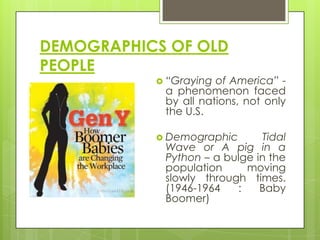
            “Graying of America” -
            a phenomenon faced
            by all nations, not only
            the U.S.

            Demographic       Tidal
            Wave or A pig in a
            Python – a bulge in the
            population     moving
            slowly through times.
            (1946-1964   :    Baby
            Boomer)
DEMOGRAPHICS OF OLD
 PEOPLE
 By  year 2010, the number of persons 65
  and older in the United States is at 39
  million: 13% of the population. By 2010-
  2030, it is expected that 65 year olds will
  be more than 79 million.
 Women comprise the majority of the
  older population in all nations (55%), and
  the majority of these women (58%) live in
  developing countries.
Marital Status
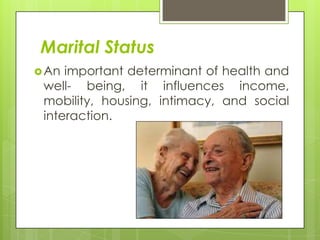
 An important determinant of health and
 well- being, it influences income,
 mobility, housing, intimacy, and social
 interaction.
Gender
 Women  live longer than men due to
 reduced maternal mortality, decreased
 death rate from infectious diseases, and
 increase death rate in men from chronic
 diseases.


 Women  are likely to poor, alone, and
 greater degree of functional impairment
 and chronic diseases.
Living Arrangement and
Housing
A person’s overall degree of health and
well-being    greatly    influences    the
selection of housing in old age. Ideal
housing        promotes         functional
independence while emphasizing safety
and social interaction needs.
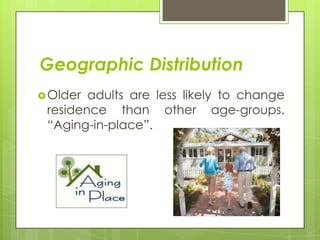
Geographic Distribution
 Older adults are less likely to change
 residence than other age-groups.
 “Aging-in-place”.
Education
 The educational level of older adult
 clients affects the nurse-client health
 teaching process and an important
 consideration in health promotion
 and disease prevention.
Income and Poverty
 Major   source of income is SSS, and
  other supplemental income         like
  assets,     public    and     private
  pensions,    earnings   and    public
  assistance.
 Income affects health and lifestyle –
  people are unable to meet basic
  needs and typically reduced the
  amount of spending in health-related
  matters.
Employment

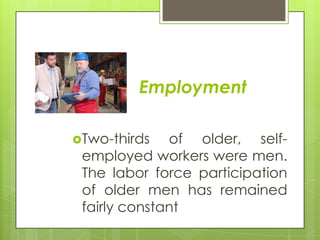
Two-thirds   of older, self-
 employed workers were men.
 The labor force participation
 of older men has remained
 fairly constant
Functional Status
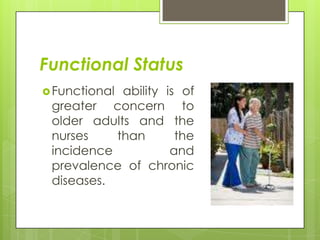
 Functionalability is of
 greater concern to
 older adults and the
 nurses    than       the
 incidence           and
 prevalence of chronic
 diseases.
 Functional ability – the capacity to
 carry out the basic self-care activities
 that ensure overall health and well-
 being.

 ADLs:   Bathing, Dressing,     eating,
 transferring and toileting;

 InstrumantalADLs:        shopping,
 cooking, housekeeping, laundry and
 handling money.
 Nurseshould determine the plan of
 action on impact of chronic diseases.
 Improvement and Prevention are the
 keys.
Implications to Health Care
  Delivery
 Create  roles that meet the needs of the
  older people, across the continuum of
  care
 Develop models of care directed at all
  levels of prevention with emphasis on
  primary prevention and health
  promotion services in the Community-
  Based Setting.
 Assume leadership, in health care and in
  political arena.
SETTINGS OF CARE

Acute Care Setting
 Only few hospitals can adequately
  manage      acute     conditions    by
  preventing functional decline:
 IMPLICATION persons.: hospital setting
  continues to be one of the most
  dangerous for older
 The point of entry to the health care
 systems for older adults.

 Inthis setting, Gerontologic Nurses focus
 on treatment and nursing care of acute
 problems such as those occurring from
 trauma,        accidents,     orthopaedic
 injuries, respiratory ailments or serious
 circulatory problems.
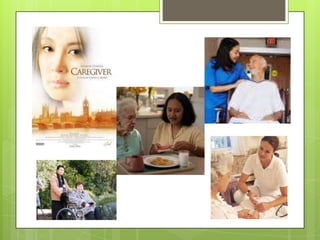
Long Term Care/Nursing Facilities

  Include        Assisted      Living,
   Intermediate care, subacute or
   transitional care skilled care and
   Alzheimer’s unit.
Assisted Living / Home Care

     Provides an alternative for those
     older adults who do not feel safe
     living alone, who wish to live in a
     community setting or who need
     some additional help with the
     activities of daily living.
Intermediate Care

  Level of care provides 24 hour per
   day direct nursing contact and
   may be considered to be the
   entry level into the nursing home
   care.
Subacute or Transitional Care

  generally   for patients who require
   more intensive nursing care than the
   traditional    nursing   home   can
   provide but less than the acute
   care hospital.
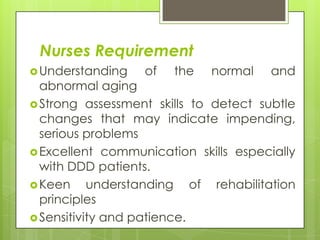
Nurses Requirement
 Understanding   of   the   normal    and
  abnormal aging
 Strong assessment skills to detect subtle
  changes that may indicate impending,
  serious problems
 Excellent communication skills especially
  with DDD patients.
 Keen     understanding of rehabilitation
  principles
 Sensitivity and patience.
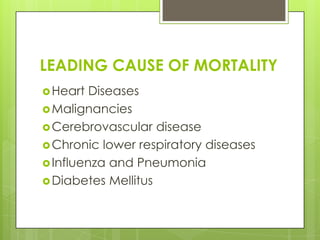
LEADING CAUSE OF MORTALITY
 Heart  Diseases
 Malignancies
 Cerebrovascular disease
 Chronic lower respiratory diseases
 Influenza and Pneumonia
 Diabetes Mellitus
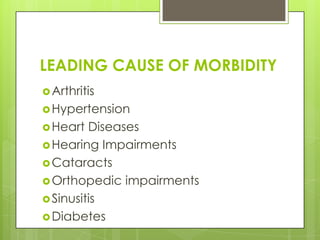
LEADING CAUSE OF MORBIDITY
 Arthritis
 Hypertension
 Heart  Diseases
 Hearing Impairments
 Cataracts
 Orthopedic impairments
 Sinusitis
 Diabetes
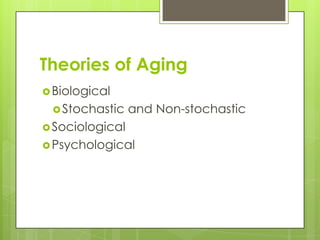
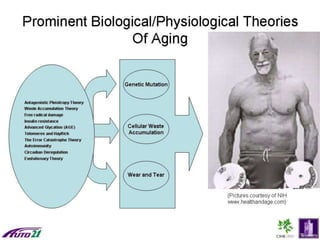
Theories of Aging
 Biological
  Stochastic    and Non-stochastic
 Sociological
 Psychological
THEORIES OF AGING:
 I.
   STOCHASTIC THEORIES
   Based on random events that cause
    cellular damage that accumulates as the
    organism ages.

 II.
    NON STOCHASTIC THEORIES OF AGING
   Based on the genetically programmed
    events that cause cellular damage that
    accelerates aging of the organism.
I. STOCHASTIC THEORIES
Free Radical Theory
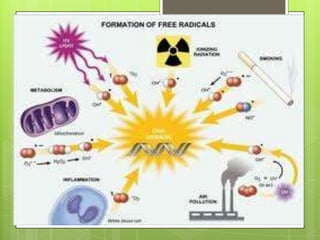
  Membranes,      Nucleic acids
   and proteins are damaged by
   free radicals which causes
   cellular injury,
  Exogenous Free radicals:
   Tobacco smoke, Pepticides,
   organic solvents, Radiation,
   ozone and selected
   Medications.
Health Teaching
 Decrease    calories in order to lower
    weight
  Maintain a diet high in nutrients using
    anti-oxidants
  Avoid inflammation
  Minimize accumulation of metals in
    the body that can trigger free
    radicals reactions.
 Older adults are more vulnerable to
  free radicals.
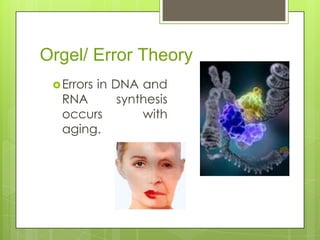
Orgel/ Error Theory
  Errors
       in DNA and
  RNA      synthesis
  occurs       with
  aging.
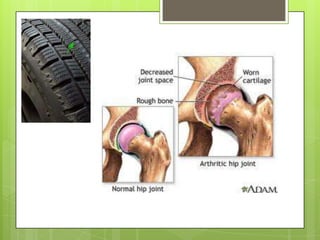
Wear and Tear Theory
 Cells wears out and cannot function
  with aging.
 Like a machine which losses function
  when its parts wears off.
Connective Tissue Theory /
Cross-linkage theory

 With aging, proteins impede metabolic
 processes and cause trouble with
 getting nutrients to cells and removing
 cellular waste products.
II. NON STOCHASTIC THEORIES
OF AGING
Programmed Theory/ Haylick
Limit Theory
 Cells  divide until they are no longer
  able to and this triggers to apoptosis or
  cell death.
 Shortening of the TELOMERES – the
  distal      appendages        of     the
  chromosomes arm.
 TELOMERASE – an enzyme, “cellular
  fountain of youth”
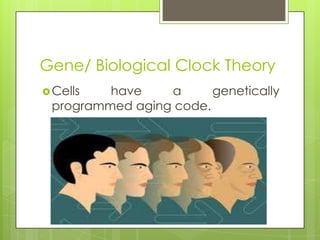
Gene/ Biological Clock Theory
 Cells  have    a      genetically
 programmed aging code.
Neuroendocrine control or
pacemaker theory
 Problems   with the hypothalamus-
 pituitary-endocrine gland feedback
 system causes disease.

 Increased   insulin   growth   factor
 accelerates aging.
Immunologic/ Autoimmune
Theory
 Aging is due to faulty immunological
 function, which is linked to general
 well-being.
SOCIOLOGIC THEORIES OF
AGING
 Attemptto explain aging in terms of
 behaviour, personality and attitude
 change.
SOCIOLOGICAL THEORIES

  changing  roles, relationship, status
  and generational cohort impact
  the older adult’s ability to adapt.
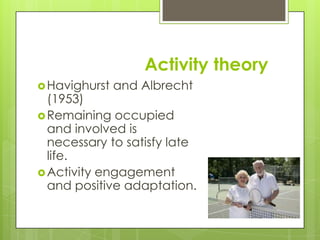
Activity theory
 Havighurst   and Albrecht
  (1953)
 Remaining occupied
  and involved is
  necessary to satisfy late
  life.
 Activity engagement
  and positive adaptation.
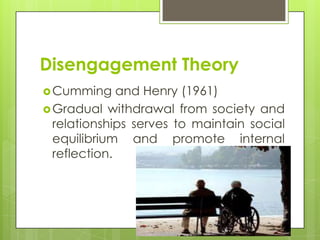
Disengagement Theory
 Cumming     and Henry (1961)
 Gradual withdrawal from society and
  relationships serves to maintain social
  equilibrium and promote internal
  reflection.
Continuity Theory
  Havighurst(1960)
  also   known as      Development
   Theory
  Personality influences role and life
   satisfaction      and       remains
   consistent throughout life.
Age Stratification Theory
       Riley  (1960)
       Society is stratified by age
        groups that are the basis
        for acquiring resources,
        roles,       status      and
        deference from others.
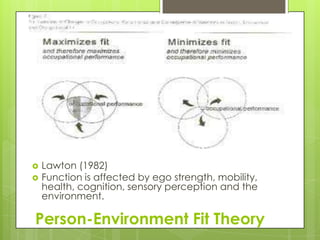
   Lawton (1982)
   Function is affected by ego strength, mobility,
    health, cognition, sensory perception and the
    environment.

Person-Environment Fit Theory
PSYCHOLOGICAL THEORIES OF AGING

  Explain aging in terms of mental
  processes, emotions, attitudes,
  motivation, and personality
  development that is characterized
  by life stage transitions.
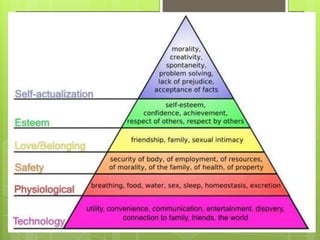
Human needs
  Maslow’s  (1954)
  Five basic needs motivate human
   behaviour in a lifelong process
   toward need fulfilment.
  Self – Actualization
Individualism Theory
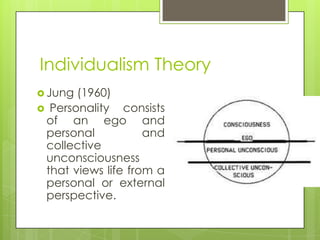
 Jung (1960)
 Personality   consists
 of an ego and
 personal           and
 collective
 unconsciousness
 that views life from a
 personal or external
 perspective.
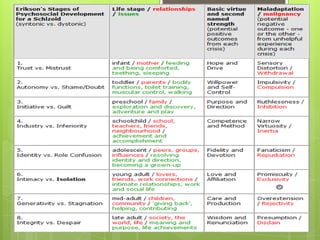
Stages of Personality
Development
 Erikson(1963)
 Personality     develops   in     eight
 sequential stages with corresponding
 life tasks. The eighth phase, integrity
 versus despair, is characterized by
 evaluating     life    accomplishments;
 struggles          include       letting
 go,                         accepting
 care, detachment, and physical and
 mental decline.
Selective optimization with
compensation

 individuals
            cope with aging losses
 through        activity     /role
 selection,    optimization   and
 compensation.
GERONTOLOGIC ASSESSMENT
   Learning Objective: Explain the relationship
    between physical and psychosocial aspects of
    aging as it affects the assessment process.

       Special Considerations affecting assessment
       Interrelationship between Physical and
        Psychosocial aspects of aging.
       Nature of Disease and disability and their effects
        on functional status
       Tailoring the nursing assessment to the older
        person
       The health history
       Additional assessment measures
PRINCIPLES OF ASSESSMENT
 Use   of an individual, person-centered
  approach
 View of clients as participants in health
  monitoring and treatment
 An emphasis on clients’ functional
  ability

   Note:     Nursing-Focused   Assessment   should   be
    scientifically based-knowledge and always practice to
    acquire the art of assessment.
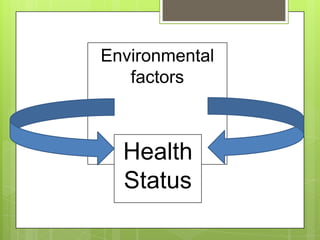
Environmental
   factors


  Health
  Status
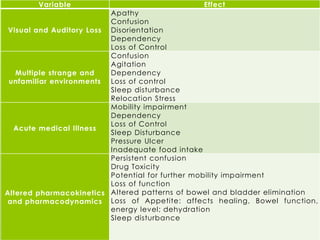
Effects of Selected Variables
on Functional Status
Variable                                Effect
                          Apathy
                          Confusion
 Visual and Auditory Loss Disorientation
                          Dependency
                          Loss of Control
                          Confusion
                          Agitation
   Multiple strange and   Dependency
 unfamiliar environments Loss of control
                          Sleep disturbance
                          Relocation Stress
                          Mobility impairment
                          Dependency
                          Loss of Control
  Acute medical Illness
                          Sleep Disturbance
                          Pressure Ulcer
                          Inadequate food intake
                          Persistent confusion
                          Drug Toxicity
                          Potential for further mobility impairment
                          Loss of function
Altered pharmacokinetics Altered patterns of bowel and bladder elimination
and pharmacodynamics Loss of Appetite: affects healing, Bowel function,
                          energy level; dehydration
                          Sleep disturbance
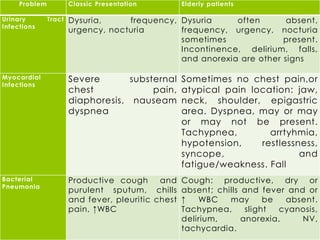
Problem           Classic Presentation      Elderly patients

Urinary        Tract   Dysuria,     frequency, Dysuria     often       absent,
Infections
                       urgency, nocturia       frequency, urgency, nocturia
                                               sometimes              present.
                                               Incontinence, delirium, falls,
                                               and anorexia are other signs

Myocardial             Severe       substernal Sometimes no chest pain,or
Infections
                       chest             pain, atypical pain location: jaw,
                       diaphoresis, nauseam neck, shoulder, epigastric
                       dyspnea                 area. Dyspnea, may or may
                                               or may not be present.
                                               Tachypnea,        arrtyhmia,
                                               hypotension,    restlessness,
                                               syncope,                 and
                                               fatigue/weakness. Fall
Bacterial              Productive cough      and Cough: productive, dry or
Pneumonia
                       purulent sputum, chills absent; chills and fever and or
                       and fever, pleuritic chest ↑   WBC   may      be  absent.
                       pain, ↑WBC                 Tachypnea,    slight  cyanosis,
                                                  delirium,    anorexia,    NV,
                                                  tachycardia.
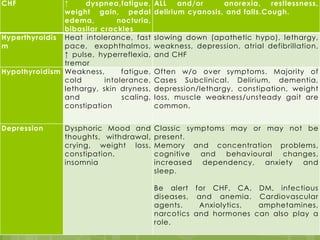
CHF            ↑    dyspnea,fatigue,      ALL    and/or     anorexia,    restlessness,
               weight gain, pedal         delirium cyanosis, and falls.Cough.
               edema,         nocturia,
               bibasilar crackles
Hyperthyroidis Heat intolerance, fast     slowing down (apathetic hypo), lethargy,
m              pace, exophthalmos,        weakness, depression, atrial defibrillation,
               ↑ pulse, hyperreflexia,    and CHF
               tremor
Hypothyroidism Weakness,       fatigue,   Often w/o over symptoms. Majority of
               cold       intolerance,    Cases Subclinical. Delirium, dementia,
               lethargy, skin dryness,    depression/lethargy, constipation, weight
               and             scaling,   loss, muscle weakness/unsteady gait are
               constipation               common.


Depression      Dysphoric Mood and        Classic symptoms may or may not be
                thoughts, withdrawal,     present.
                crying, weight loss,      Memory and concentration problems,
                constipation,             cognitive  and  behavioural  changes,
                insomnia                  increased  dependency,   anxiety and
                                          sleep.

                                          Be alert for CHF, CA, DM, infectious
                                          diseases, and anemia. Cardiovascular
                                          agents.    Anxiolytics, amphetamines,
                                          narcotics and hormones can also play a
                                          role.
2.2 NATURE OF DISEASE AND
DISABILITY AND THEIR EFFECTS
ON THE FUNCTIONAL STATUS
 Aging   does not necessarily result in
  diseases and disability
 Chronic    diseases increases older
  adults’ vulnerability to functional
  decline
 Common Mistake: Nurses and adults
  attribute vague signs and symptoms as
  normal signs of “growing old”.
A comprehensive assessment of
physical     and    psychosocial
function is important because it
can provide valuable clues to a
diseases’ effect on functional
status.
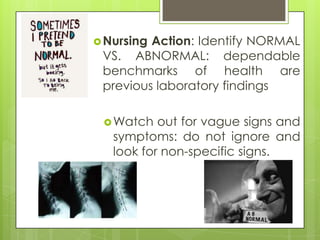
 NursingAction: Identify NORMAL
 VS. ABNORMAL: dependable
 benchmarks of health are
 previous laboratory findings

  Watch   out for vague signs and
   symptoms: do not ignore and
   look for non-specific signs.
2.2.1 Decreased Efficiency of
  homeostatic Mechanisms
 The older persons’ adaptive reserves are
  reduced- results in decreased ability to
  respond to physical and emotional stress.
 Immunocompetence       is affected by
  multiple factors.
Adults    repeatedly encounters
 losses: needs time to recover
 between losses and recuperation.
 The shorter time interval between
 losses, the lesser ability to respond
 and return to baseline stage of
 health compared to younger
 people.
Nursing Action
Assess older adults for presence of
 physical     and     psychological
 stressors and their physical and
 emotional manifestations.
Lack of Standards of Health
  and illness
 Difficultyarises on identifying the health
  status of older adults due to:
 Norms or standards are always redefined
 Polypharmacy and state of illness and
  disease may affect laboratory data.
 No aging norms for many pathologic
  conditions
 There are few landmarks for stages of
  development for the older adulthood
  compared to other age groups.
Nursing Action:
 Assume        heterogeneity          rather
  homogeneity: uniqueness of personal
  health standards.
 Look for previous health history and
  related        matters:            previous
  work, residence, lifestyle etc.
 Compare      presenting       signs    and
  symptoms with the older adults’ normal
  baseline.
COGNITIVE IMPAIRMENT

 Delirium     – one of the most
 common, atypical presentations of
 illness in older adults.
Confusion, mental status changes,
cognitive changes and delirium –

used to describe one of the most
common manifestations of illness in old
age.
Acute Confusional State (ACS)-
 an     organic     brain     syndrome
 characterized by transient, global
 cognitive impairment of abrupt onset
 and      relatively   brief    duration,
 accompanied by diurnal fluctuation of
 simultaneous disturbances of the sleep-
 wake cycle, psychomotor behavior,
 attention, and affect”( Foreman, 1986)
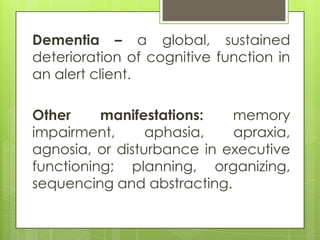
Dementia – a global, sustained
deterioration of cognitive function in
an alert client.

Other     manifestations:   memory
impairment,      aphasia,   apraxia,
agnosia, or disturbance in executive
functioning; planning, organizing,
sequencing and abstracting.
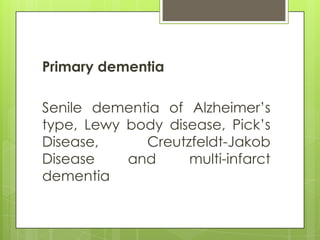
Primary dementia

Senile dementia of Alzheimer’s
type, Lewy body disease, Pick’s
Disease,     Creutzfeldt-Jakob
Disease    and     multi-infarct
dementia
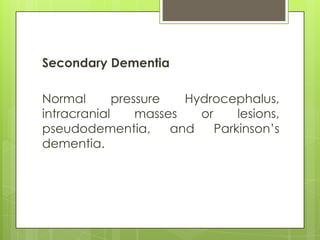
Secondary Dementia

Normal       pressure   Hydrocephalus,
intracranial     masses   or     lesions,
pseudodementia,       and    Parkinson’s
dementia.
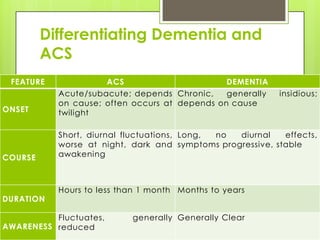
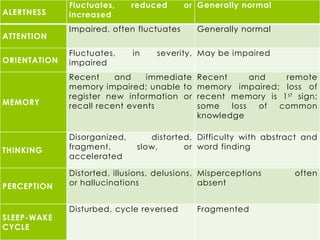
Differentiating Dementia and
         ACS
 FEATURE             ACS                       DEMENTIA
           Acute/subacute; depends Chronic,    generally   insidious;
           on cause; often occurs at depends on cause
ONSET      twilight

           Short, diurnal fluctuations, Long, no diurnal    effects,
           worse at night, dark and symptoms progressive, stable
COURSE     awakening


           Hours to less than 1 month Months to years
DURATION

          Fluctuates,      generally Generally Clear
AWARENESS reduced
Fluctuates,     reduced      or Generally normal
ALERTNESS     increased
              Impaired, often fluctuates     Generally normal
ATTENTION

              Fluctuates,     in   severity, May be impaired
ORIENTATION   impaired
              Recent     and    immediate    Recent      and   remote
              memory impaired; unable to     memory impaired; loss of
              register new information or    recent memory is 1 st sign;
MEMORY        recall recent events           some   loss   of common
                                             knowledge

              Disorganized,       distorted, Difficulty with abstract and
THINKING      fragment,        slow,      or word finding
              accelerated

              Distorted, illusions, delusions, Misperceptions      often
PERCEPTION    or hallucinations                absent


              Disturbed, cycle reversed      Fragmented
SLEEP-WAKE
CYCLE
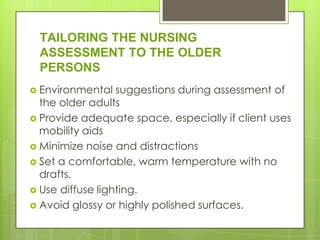
TAILORING THE NURSING
 ASSESSMENT TO THE OLDER
 PERSONS
 Environmental   suggestions during assessment of
  the older adults
 Provide adequate space, especially if client uses
  mobility aids
 Minimize noise and distractions
 Set a comfortable, warm temperature with no
  drafts.
 Use diffuse lighting.
 Avoid glossy or highly polished surfaces.
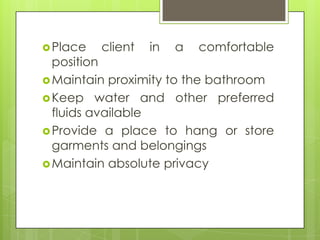
 Place   client   in   a   comfortable
  position
 Maintain proximity to the bathroom
 Keep water and other preferred
  fluids available
 Provide a place to hang or store
  garments and belongings
 Maintain absolute privacy
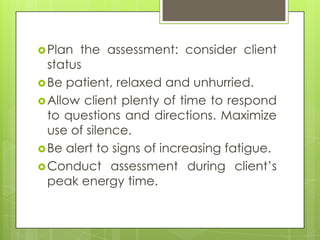
 Plan  the assessment: consider client
  status
 Be patient, relaxed and unhurried.
 Allow client plenty of time to respond
  to questions and directions. Maximize
  use of silence.
 Be alert to signs of increasing fatigue.
 Conduct assessment during client’s
  peak energy time.
THE HEALTH HISTORY
 The       first    phase       of      a
  comprehensive, nursing-focused health
  assessment, provides a subjective
  account of the older adults’ current and
  past health.
 The   nursing history should include
  assessment                             of
  functional, cognitive, affective, and
  social well-being.
 The interviewer should adapt the styles
  and techniques of interview in the
THE INTERVIEWER
Factors to consider during nurse-client
communication during assessment

 Attitudeof nurse
 Myths and Stereotypes about older
  people
 Nurse’s own anxiety and fear of
  personal aging
Guide to an effective interview
   State  reason for the interview
   Let client accomplish a pre
    interview form
   A goal-directed interview
    process
   Setting of time limit
Secure   permission to take down
 notes
Observe most effective and
 comfortable     distance    and
 position, and personal space for
 the session
Appropriate use of touch
Take        advantage         of
 opportunities such as meal time,
 game, hobby, and other social
 activity.
THE CLIENT
 There are factors the nurse should consider
  while interviewing an older adult such as:
 Sensory-perceptual deficits
 Anxiety
 Reduced energy level
 Pain
 Multiple and interrelated health problems
 The tendency to reminisce
THE HEALTH HISTORY FORMAT

 Client Profile/ Biographic data
 Family Profile
 Occupational Profile
 Living Environment profile
 Recreation/Leisure Profile
 Resources/Support systems used
THE HEALTH HISTORY FORMAT
 Description of typical day
 Present health status
 Medications
 Immunization and health Screening Status
 Allergies
 Nutrition
 Past Health Status
 Family History
 Review of Systems
SYMPTOM ANALYSIS FACTORS
 Dimensions of a Symptom
    Location
    Quality
    Quantity
    Timing
    Setting
    Aggravating or Alleviating factors
    Associated symptoms
THE PHYSICAL EXAMINATION
APPROACH AND SEQUENCE
 Should  be systematic and deliberate
 Determine client strengths and
  capabilities; disabilities and limitations
 Verify and gain objective support
 Gather objective data not previously
  known
GENERAL GUIDELINES
Recognition   of no previous experience
 with the nurse conducting physical
 examination by the adult
Be alert on the clients energy level
Respect the client’s modesty
Keep the client comfortably draped
Sequence examination to keep position
 changes to a minimum
Develop  an efficient sequence for
 examination that minimizes nurse and
 client movement
Ensure comfort for the client
Warn of any discomfort that may occur. Be
 gentle
Probe painful areas last
Share findings with the client when possible
Take advantage of teachable moments
Develop a standard format on which to
 note selected findings.
EQUIPMENT AND SKILLS

  Check     proper     function and
   readiness of all equipment
  Place equipment within reach
  Use of Inspection, Auscultation,
   Palpation, and Percussion.

Editor's Notes