GERONTOLOGY
& GERIATRIC
NURSING
MRS. MIRNA LAHOUD
LEARNING OUTCOMES
• LO#1Distinguish the different concepts related to the aging of the elderly.
• LO#2: Identify the principles of communication with the elderly in institutions.
• LO#3: Analyse the health problems related to aging.
• Lo#4: Understand the importance of respecting the dignity of the elderly person.
• LO#5: Analyse the situation of the elderly person with mental problems
• LO#6: Analyse the situation of the elderly person with physical problems.
COURSE OUTLINE
A. GERONTOLOGY
• I. Theories of aging
• II. Impact of aging on
society
• III. Effect of aging on the
body.
B- GERIATRIC
• I. Pathologies of the sense organs
• II. Cardiovascular pathologies
• III. Respiratory pathologies
• IV. Dehydration
• V. Malnutrition – Undernutrition
• VI. Falls and the elderly
• VII. Urinary and fecal incontinence
• VIII. Pain
• IX. Polymedication in the elderly
• X. Sleep problems in elderly, elderly abuse,
dementia
• XI. Depression and suicide
• Gerontology - scientific study of Aging Process
• Aging - process of growing older, biologic and physiological changes
• Gerontologic Nursing – is the care & attention to individuals undergoing the
aging process with emphasis on the developmental stages of aging.
• Life Span - maximum potential for survival (115 y/o)
• Life Expectancy - from birth to death (76.3 y/o)
• Frail Old - 75 y/o, functional impairment to self care
↑
• Centenarians – 100 y/o and above
Gerontological Nursing
Terminology
• Geriatrics – the science & study of the physiologic & pathologic
problems of individuals in their later maturity.
• Geriatric Nursing - Care of the elderly individual regardless of
whether they are diseased or not.
• Senescence – the normal aging process
• Senility – aging process characterized by severe mental
deterioration
Gerontological Nursing
Terminology
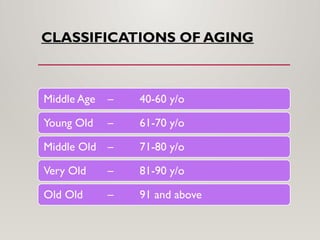
CLASSIFICATIONS OF AGING
Middle Age – 40-60 y/o
Young Old – 61-70 y/o
Middle Old – 71-80 y/o
Very Old – 81-90 y/o
Old Old – 91 and above
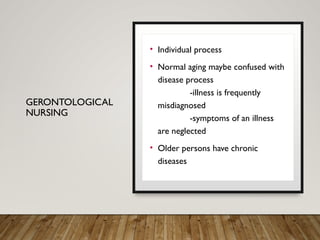
GERONTOLOGICAL
NURSING
• Individual process
• Normal aging maybe confused with
disease process
-illness is frequently
misdiagnosed
-symptoms of an illness
are neglected
• Older persons have chronic
diseases
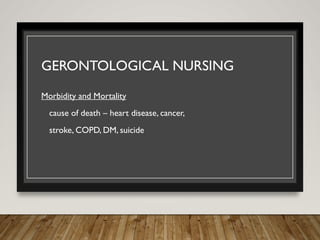
GERONTOLOGICAL NURSING
Morbidity and Mortality
cause of death – heart disease, cancer,
stroke, COPD, DM, suicide
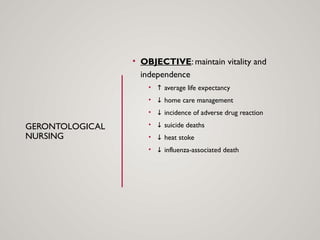
GERONTOLOGICAL
NURSING
• OBJECTIVE: maintain vitality and
independence
• ↑ average life expectancy
• ↓ home care management
• ↓ incidence of adverse drug reaction
• ↓ suicide deaths
• ↓ heat stoke
• ↓ influenza-associated death
I - THEORIES OF
AGING
BASED ON INFORMATION IN: MADISON, H.E. (2002).“THEORIES
OF AGING”. IN LUECKENOTTE,A.G. (ED), GERONTOLOGIC
NURSING. ST. LOUIS: MOSBY.
THEORIES OF AGING:
• attempt to explain the phenomenon of aging as it occurs over the
lifespan
• aging is viewed as a total process that begins at
conception
• senescence: a change in the behavior of an organism
with age leading to a decreased power of survival and
adjustment
THEORIES OF AGING:TYPES
• A- Biologic
• B- Sociologic
• C- Psychologic
• D- Moral/Spiritual
A- BIOLOGICTHEORIES:
• Concerned with answering basic questions regarding the physiological
processes that occur in all living organisms as they chronologically age
FOCI OF BIOLOGICTHEORIES
• Explanations of:
• 1) deleterious effects leading to decreasing function of the organism
• 2) gradually occurring age-related changes that are progressive over
time
• 3) intrinsic changes that can affect all member of a species because of
chronologic age
ALSO:
• all organs in any one organism do not
age at the same rate
• any single organ does not necessarily
age at the same rate in difference
individuals of the same species
BIOLOGIC THEORIES: DIVISIONS
• Stochastic: Explain aging as events that
occur randomly and accumulate over time
• Nonstochastic:View aging as certain
predetermined, timed phenomena
STOCHASTICTHEORIES
• Error Theory Free RadicalTheory
• Cross-LinkageTheory
• Wear &TearTheory
ERROR THEORY
• Originally proposed in 1963
Basis:
• 1)errors can occur in the transcription in any step of the
protein synthesis of DNA
• 2) error causes the reproduction of an enzyme or protein that
is not an exact copy
• 3) As transcription errors to occur, the end product would not
even resemble the original cell, thereby compromising its
functional ability
ERROR, CONT’D
• More recently the theory has not been supported by
research
• not all aged cells contain altered or misspecified proteins
• nor is aging automatically or necessarily accelerated if misspecified
proteins or enzymes are introduced into a cell
FREE RADICAL THEORY
• Free radicals are byproducts of metabolism--can increase because of
environmental pollutants
• When they accumulate, they damage cell membrane, decreasing its
efficiency
• The body produces antioxidants that scavenge the free radicals
FREE RADS, CONT’D
• In animal studies, administration of antioxidants postpones
the appearance of diseases such as cardiovascular disease
and CA
• Free radicals are also implicated in the development of
plaques associated with Alzheimer’s
CROSS-LINKAGE THEORY
• Some proteins in the body become cross-linked, thereby
not allowing for normal metabolic activities
• Waste products accumulate
• Result: tissues do not function at optimal efficiency
C-L THEORY, CONT’D
• Some research supports a combination of exercise and
dietary restrictions in helping to inhibit the cross-linkage
process
WEAR & TEAR THEORY
• Proposed first in 1882
• Cells simply wear out over time because of continued use--
rather like a machine
• Would seem to be refuted by the fact that exercise in OA’s
actually makes them MORE functional, not less
NONSTOCHASTICTHEORIES:
• ProgrammedTheory
• Immunity Theory
PROGRAMMED (HAYFLICK LIMIT)
THEORY
• Based on lab experiments on fetal fibroblastic cells and
their reproductive capabilities in 1961
• Cells can only reproduce themselves a limited number of
times.
• Life expectancies are seen as preprogrammed within a
species-specific range
IMMUNITYTHEORY
• Immunosenescence: Age-related functional diminution of the
immune system
• Lower rate of T-lymphocyte (“killer cells”) proliferation in
response to a stimulus
• & therefore a decrease in the body’s defense against foreign
pathogens
IMMUNITY, CONT’D
• Change include a decrease in humoral immune response,
often predisposing older adults to:
• 1)decreased resistance to a tumor cell challenge and the
development of cancer
• 2) decreased ability to initiate the immune process and mobilize
defenses in aggressively attaching pathogens
• 3) increased susceptibility to auto-immune diseases
EMERGING THEORIES OF AGING
• Neuroendocrine Control (Pacemaker) Theory
• Metabolic Theory/Caloric Restriction
• DNA-Related Research
NEUROENDOCRINE CONTROL
• “…examines the interrelated role of the neurologic and
endocrine systems over the life-span of an individual”. (p.
24)
• there is a decline, or even cessation, in many of the
components of the neuroendocrine system over the
lifespan
NEURO, CONT’D
• Research has shown
• 1) the female reproductive system is controlled by the hypothalamus.
What are the mechanisms that trigger changes?
• 2) adrenal glands’ DHEA hormone
• 3) melatonin (from pineal gland)--a regulator of biologic rhythms and
a powerful antioxidant. Declines sharply from just after puberty
METOBOLIC THEORY OF AGING
(CALORIC RESTRICTION)
• “…proposes that all organisms have a finite amount of
metabolic lifetime and that organisms with a higher
metabolic rate have a shorter lifespan”. (p. 24)
• Rodent-based research has demonstrated that caloric
restriction increases the lifespan and delays the onset of
age-dependent diseases
DNA-RELATED RESEARCH
• Major Developments:
• Mapping the human genome (“…there may be as many as 200 genes
responsible for contolling aging in humans”)
• Discovery of telomeres
B- SOCIOLOGIC THEORIES OF
AGING
• Disengagement Theory
• Activity/Developmental TaskTheory
• Continuity Theory
• Age Stratification Theory
• Person-Environment Fit Theory
DISENGAGEMENTTHEORY
• Cumming & Henry--1961
• Aging seen as a developmental task in and of itself, with its
own norms & appropriate patterns of behavior
• “appropriate” behavior patterns involved a mutual
agreement between OA’s and society on a reciprocal
withdrawal.
• No longer supported
ACTIVITYTHEORY
(DEVELOPMENTAL TASKTHEORY)
• Havighurst, Neugarten,Tobin ~1963
• “Activity is viewed by this theory as necessary to maintain
a person’s life satisfaction and a positive self-concept”.
(p.27)
ACTIVITY, CONT’D
• Theory based on assumptions:
• 1) it’s better to be active than inactive
• 2) it is better to be happy than unhappy
• 3) an older individual is the best judge of his or her own success in
achieving the first two assumptions
CONTINUITY THEORY
• How a person has been throughout life is how that person
will continue through the remainder of life
• Old age is not a separate phase of life, but rather a
continuation and thus an integral component
AGE STRATIFICATION THEORY
• Riley--1985
• Society consists of groups of cohorts that age collectively
• The people & Roles in these cohorts change & influence
each other, as does society at large
• Thus, there is a high degree of interdependence between
older adults & society
PERSON-ENVIRONMENT FIT
THEORY
• Lawton, 1982
• Individuals have personal competencies that assist in dealing
with the environment:
• ego strength
• level of motor skills
• individual biologic health
• cognitive & sensory-perceptual capacities
P-E FIT, CONT’D
• As a person ages, there may be changes in competencies &
these changes alter the ability to interrelate with the
environment
• Significant implications in a society that is characterized by
constantly changing technology
C- PSYCHOLOGICTHEORIES OF
AGING
• Maslow’s Hierarchy of Human Needs
• Jung’s Theory of Individualism
• Erikson’s Eight Stages of Life
• Peck’s Expansion of Erikson’s Theory
• Selective Optimization with Compensation
MASLOW’S HIERARCHY OF
HUMAN NEEDS
• Maslow--1954
• “…each individual has an innate internal hierarchy of needs
that motivates all human behaviors”. (p. 29
• depicted as a pyramid; the ideal is to achieve self-
actualization, having met all the “lower” level needs
successful
• “Maslow’s fully developed, self-actualized person displays
high levels of all the following characteristics: perception of
reality; acceptance of self, others, and nature; spontaneity;
problem-solving ability; self-direction; detachment and the
desire for primacy; freshness of peak experiences;
identification with other human beings;…….
• …satisfying and changing relationships with other people; a
democratic character structure; creativity; and a sense of
values.
• Only about 1% of us are truly ideal self-actualized persons
JUNG’STHEORY OF
INDIVIDUALISM
• Carl Jung--1960
• origins are Freudian
• Self-realization is the goal of personality development
• as individual ages, each can transform into a more spiritual
being
ERIKSON’S EIGHT STAGES OF LIFE
• 1993
• Stages throughout the life course. Each represents a crisis to be
resolved.
• For OA’s:
• 40 to 65 (middle adulthood): generativity versus self-absorption or stagnation
• 65 to death (older adulthood): ego integrity versus despair
ERIKSON, CONT’D
• “Self-absorbed adults will be preoccupied with their
personal well-being and material gains. Preoccupation with
self leads to stagnation of life”
• “Unsuccessful resolution of the last crisis may result in a
sense of despair in which individuals view life as a series of
misfortunes, disappointments, and failures”. (p.30)
PECK’S EXPANSION OF ERIKSON’S
THEORY
• Erikson’s last two stages are expanded to 7
• The final three of the developmental tasks for old age:
• ego differentiation versus work role preoccupation
• body transcendence versus body preoccupation
• ego transcendence versus ego preoccupation
SELECTIVE OPTIMIZATIONWITH
COMPENSATION
• Baltes--1987
• Individuals develop strategies to manage losses of function
that occur over time
SELECTIVE OPTIMIZATION,
CONT’D
• 3 Interacting Elements:
• selection: increasing restriction of one’s life to fewer domains of
functioning
• optimization: people engage in behaviors to enrich their lives
• compensation:developing suitable, alternative adaptations
II – IMPACT OF AGING
ON SOCIETY
MRS. MIRNA LAHOUD
A: PSYCHOSOCIAL ASPECTS
OF AGING
INTRODUCTION
•Aging Population: Global trend of increasing elderly population.
•Psychosocial Challenges: Emotional, social, and psychological issues faced by older adults.
•Objective:To understand these challenges and explore interventions.
A.1 COMMON PSYCHOSOCIAL
CHALLENGES INTHE ELDERLY
•Depression: Often triggered by loneliness, loss of loved ones, or illness.
•Social Isolation: Reduced social interactions due to retirement, mobility
issues, or loss of social networks.
•Elder Abuse: Forms include physical, emotional, financial, or neglect.
•Role Changes: Shift in family roles, societal roles, and sense of identity.
•Losses: Death of spouses or friends, loss of independence, physical
decline.
A.2 DEPRESSION IN THE ELDERLY
•Prevalence: Common among the elderly but often
underdiagnosed.
•Causes: Grief, chronic illness, social withdrawal, and feelings
of uselessness.
•Symptoms: Fatigue, irritability, loss of interest in activities,
changes in appetite, suicidal thoughts.
•Intervention: Screening tools (e.g., PHQ-9), therapy,
medication, and social support.
A.3 SOCIAL ISOLATION AND
LONELINESS
•Risk Factors: Loss of loved ones, physical limitations,
retirement, living alone.
•Impact: Increases risk of cognitive decline, depression, and
mortality.
•Interventions: Encouraging social connections, community
activities, technology (e.g., video calls).
A.4 ELDER ABUSE
• Forms: Physical, emotional, financial exploitation, neglect.
• Warning Signs: Unexplained injuries, changes in behavior,
fear of caregivers, financial discrepancies.
• Prevention: Education, regular check-ins, support
networks, reporting mechanisms.
A.5 ROLE CHANGES AND LOSS OF
INDEPENDENCE
•Shift in Roles: From caregiver or professional to a dependent
role.
•Impact on Identity: Loss of self-worth or purpose.
•Coping Strategies: Encouraging meaningful activities,
volunteer work, and hobbies.
A.6 COPING WITH LOSS
•Types of Losses: Loved ones, health, mobility,
independence.
•Emotional Response: Grief, sadness, anger, fear.
•Supportive Strategies: Grief counseling, peer support
groups, family involvement.
A.7 SUPPORTIVE INTERVENTIONS
•Counseling and Therapy: Cognitive-behavioral therapy
(CBT), group therapy, grief counseling.
•Social Programs: Daycare centers, senior clubs,
volunteering opportunities.
•Health Interventions: Physical therapy, regular check-ups,
medication management.
•Family Involvement: Strengthening family bonds, educating
family on elderly care.
A.8 PROMOTING WELL-BEING
• Physical Health: Exercise, nutrition, regular health
screenings.
• Mental Health: Engaging in mentally stimulating activities,
addressing depression or anxiety.
• Social Engagement: Encourage participation in social
and community events.
• Spiritual Well-being: Exploring spiritual needs, support
from religious or spiritual communities.
B: CHANGES IN FAMILY
RELATIONSHIPS
• Aging affects not only the individual but also family
structures and relationships:
• - Caregiver Burden
• - Role Reversal
• - Impact on Family Structures
B.1 SHIFTING FAMILY DYNAMICS
• - Caregiver Burden: Increased stress and burnout.
• - Role Reversal:Adult children as caregivers for parents.
• - Intergenerational Relationships: Grandparents and
grandchildren bond deeply.
B.2 IMPACT ON FAMILY
STRUCTURE
• - Smaller families struggle to provide care.
• - Geographic dispersion complicates caregiving.
• - Divorce and remarriage alter caregiving roles and
dynamics.
C: NURSING INTERVENTIONS FOR
PSYCHOSOCIALWELL-BEING
• - Promoting Mental Health: Routine screenings using
Geriatric Depression Scale (GDS).
• - Addressing Social Isolation: Encourage participation in
community programs.
• - Caregiver Education: Support caregivers with training and
resources.
III- EFFECT OF AGING ON
THE BODY.
Mrs. Mirna Lahoud
1 - GENERAL PHYSIOLOGIC CHANGES
A- GENERAL APPEARANCE
Gray and thinning hair
Wrinkled and pigmented skin
Eyes slightly sunken
Ears and nose appear larger
Trunk thicker, thinner arms and legs
Flexion of spine and legs
Slight tremors
Gait slower and less steady
Slower movements
Slower recall
Recent memory impaired
1- GENERAL PHYSIOLOGIC CHANGES
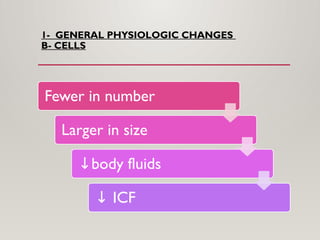
B- CELLS
Fewer in number
Larger in size
↓body fluids
↓ ICF
1- GENERAL PHYSIOLOGIC CHANGES
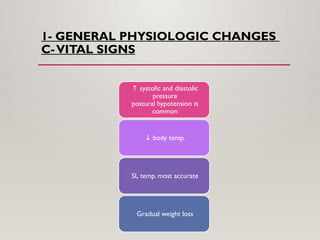
C-VITAL SIGNS
↑ systolic and diastolic
pressure
postural hypotension is
common
↓ body temp.
SL temp. most accurate
Gradual weight loss
2- PRIMARY CHANGES OF
AGING
Physiologic changes
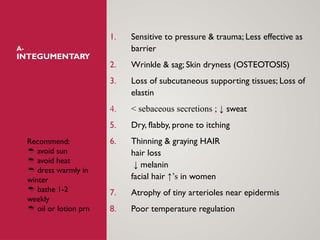
A-
INTEGUMENTARY
1. Sensitive to pressure & trauma; Less effective as
barrier
2. Wrinkle & sag; Skin dryness (OSTEOTOSIS)
3. Loss of subcutaneous supporting tissues; Loss of
elastin
4. < sebaceous secretions ; ↓ sweat
5. Dry, flabby, prone to itching
6. Thinning & graying HAIR
hair loss
↓ melanin
facial hair ↑’s in women
7. Atrophy of tiny arterioles near epidermis
8. Poor temperature regulation
Recommend:
 avoid sun
 avoid heat
 dress warmly in
winter
 bathe 1-2
weekly
 oil or lotion prn
B- EAR
1. Presbycusis (sensorineural)
inner ear
high freq are lost first ( Loss of hearing of higher pitches)
50% are affected
2. Sclerosis (tympanic m. atrophy)
3. Impacted cerumen
4. Difficulty in speech descrimation
5. Degeneration of cochlea & auditory pathways
C- EYE
1. Presbyopia (loss of lens elasticity)
2. ↓ visual field
3. Glare intolerance
4. ↓ lacrimation
5. Loss of color sensitivity ( especially purple)
6. ↓ dark adaptation
7. ↓ peripheral vision
D- OTHER SENSORY CHANGES
• Taste & Smell ( decreased)
• Lack of appetite
• Prefers salty food
• Touch ( decreased)
• Safety hazard
• Recommend
•  adequate lighting
•  avoid glare
•  vision aids
•  large print
•  contrasting colors
•  low tone speaking voice
•  reduce background noise
•  face person
•  enunciate clearly
•  moderate pace
•  gestures prn
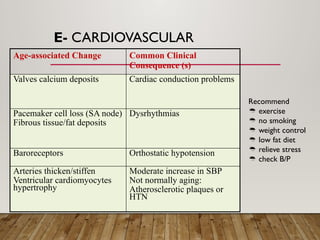
E- CARDIOVASCULAR
Mitral and aortic valves thicken (S4)
↓ CO (1% per year) due to decreased muscular strength
Loss of elasticity (Arteriosclerosis)
↑ PVR (HPN)
↑ Blood clotting (thrombus)
< elasticity of blood vessels’; Inc. BP
Atherosclerotic plaques; ischemia
> PeripheralVascular resistance
E- CARDIOVASCULAR
Age-associated Change Common Clinical
Consequence (s)
Valves calcium deposits Cardiac conduction problems
Pacemaker cell loss (SA node)
Fibrous tissue/fat deposits
Dysrhythmias
Baroreceptors Orthostatic hypotension
Arteries thicken/stiffen
Ventricular cardiomyocytes
hypertrophy
Moderate increase in SBP
Not normally aging:
Atherosclerotic plaques or
HTN
Recommend
 exercise
 no smoking
 weight control
 low fat diet
 relieve stress
check B/P

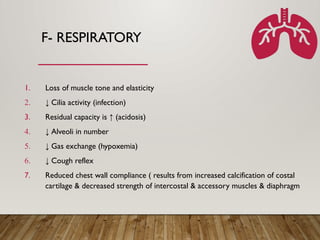
F- RESPIRATORY
1. Loss of muscle tone and elasticity
2. ↓ Cilia activity (infection)
3. Residual capacity is ↑ (acidosis)
4. ↓ Alveoli in number
5. ↓ Gas exchange (hypoxemia)
6. ↓ Cough reflex
7. Reduced chest wall compliance ( results from increased calcification of costal
cartilage & decreased strength of intercostal & accessory muscles & diaphragm
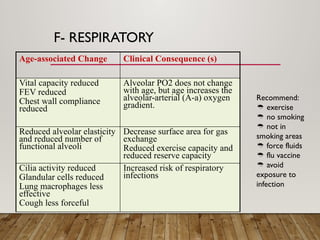
F- RESPIRATORY
Age-associated Change Clinical Consequence (s)
Vital capacity reduced
FEV reduced
Chest wall compliance
reduced
Alveolar PO2 does not change
with age, but age increases the
alveolar-arterial (A-a) oxygen
gradient.
Reduced alveolar elasticity
and reduced number of
functional alveoli
Decrease surface area for gas
exchange
Reduced exercise capacity and
reduced reserve capacity
Cilia activity reduced
Glandular cells reduced
Lung macrophages less
effective
Cough less forceful
Increased risk of respiratory
infections
Recommend:
 exercise
 no smoking
 not in
smoking areas
force fluids

flu vaccine

 avoid
exposure to
infection
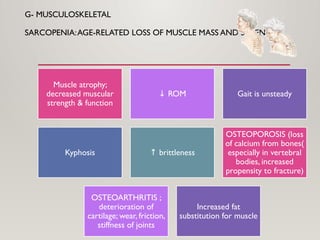
G- MUSCULOSKELETAL
SARCOPENIA:AGE-RELATED LOSS OF MUSCLE MASS AND STRENGTH
Muscle atrophy;
decreased muscular
strength & function
↓ ROM Gait is unsteady
Kyphosis ↑ brittleness
OSTEOPOROSIS (loss
of calcium from bones(
especially in vertebral
bodies, increased
propensity to fracture)
OSTEOARTHRITIS ;
deterioration of
cartilage; wear, friction,
stiffness of joints
Increased fat
substitution for muscle
G- MUSCULOSKELETAL
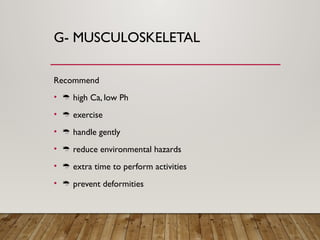
Recommend
•  high Ca, low Ph
•  exercise
•  handle gently
•  reduce environmental hazards
•  extra time to perform activities
•  prevent deformities
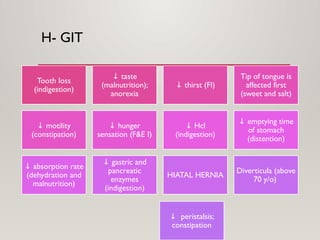
H- GIT
Tooth loss
(indigestion)
↓ taste
(malnutrition);
anorexia
↓ thirst (FI)
Tip of tongue is
affected first
(sweet and salt)
↓ motility
(constipation)
↓ hunger
sensation (F&E I)
↓ Hcl
(indigestion)
↓ emptying time
of stomach
(distention)
↓ absorption rate
(dehydration and
malnutrition)
↓ gastric and
pancreatic
enzymes
(indigestion)
HIATAL HERNIA
Diverticula (above
70 y/o)
↓ peristalsis;
constipation
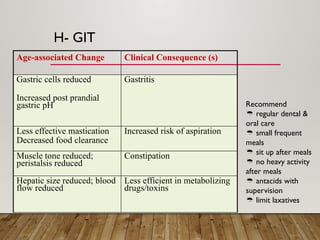
H- GIT
Age-associated Change Clinical Consequence (s)
Gastric cells reduced
Increased post prandial
gastric pH
Gastritis
Less effective mastication
Decreased food clearance
Increased risk of aspiration
Muscle tone reduced;
peristalsis reduced
Constipation
Hepatic size reduced; blood
flow reduced
Less efficient in metabolizing
drugs/toxins
Recommend
 regular dental &
oral care
 small frequent
meals
 sit up after meals
 no heavy activity
after meals
 antacids with
supervision
 limit laxatives
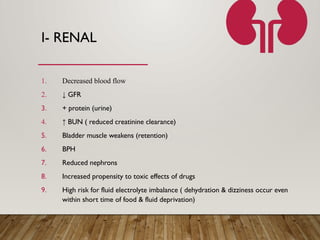
I- RENAL
1. Decreased blood flow
2. ↓ GFR
3. + protein (urine)
4. ↑ BUN ( reduced creatinine clearance)
5. Bladder muscle weakens (retention)
6. BPH
7. Reduced nephrons
8. Increased propensity to toxic effects of drugs
9. High risk for fluid electrolyte imbalance ( dehydration & dizziness occur even
within short time of food & fluid deprivation)
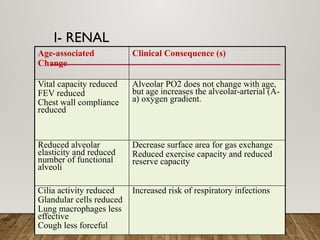
I- RENAL
Age-associated
Change
Clinical Consequence (s)
Vital capacity reduced
FEV reduced
Chest wall compliance
reduced
Alveolar PO2 does not change with age,
but age increases the alveolar-arterial (A-
a) oxygen gradient.
Reduced alveolar
elasticity and reduced
number of functional
alveoli
Decrease surface area for gas exchange
Reduced exercise capacity and reduced
reserve capacity
Cilia activity reduced
Glandular cells reduced
Lung macrophages less
effective
Cough less forceful
Increased risk of respiratory infections
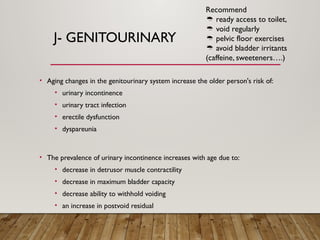
J- GENITOURINARY
• Aging changes in the genitourinary system increase the older person's risk of:
• urinary incontinence
• urinary tract infection
• erectile dysfunction
• dyspareunia
• The prevalence of urinary incontinence increases with age due to:
• decrease in detrusor muscle contractility
• decrease in maximum bladder capacity
• decrease ability to withhold voiding
• an increase in postvoid residual
Recommend
 ready access to toilet,
 void regularly
 pelvic floor exercises
 avoid bladder irritants
(caffeine, sweeteners….)
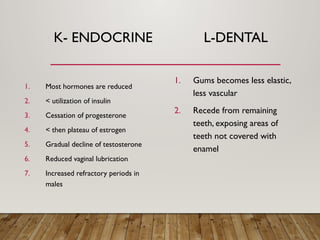
K- ENDOCRINE L-DENTAL
1. Most hormones are reduced
2. < utilization of insulin
3. Cessation of progesterone
4. < then plateau of estrogen
5. Gradual decline of testosterone
6. Reduced vaginal lubrication
7. Increased refractory periods in
males
1. Gums becomes less elastic,
less vascular
2. Recede from remaining
teeth, exposing areas of
teeth not covered with
enamel
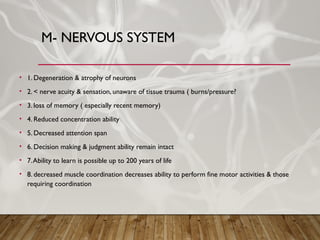
M- NERVOUS SYSTEM
• 1. Degeneration & atrophy of neurons
• 2. < nerve acuity & sensation, unaware of tissue trauma ( burns/pressure?
• 3. loss of memory ( especially recent memory)
• 4. Reduced concentration ability
• 5. Decreased attention span
• 6. Decision making & judgment ability remain intact
• 7.Ability to learn is possible up to 200 years of life
• 8. decreased muscle coordination decreases ability to perform fine motor activities & those
requiring coordination
HEALTH PROMOTION &
MAINTENANCE
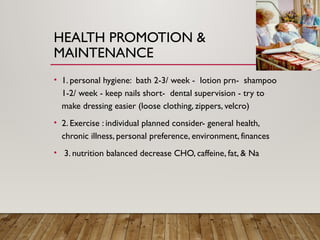
• 1. personal hygiene: bath 2-3/ week - lotion prn- shampoo
1-2/ week - keep nails short- dental supervision - try to
make dressing easier (loose clothing, zippers, velcro)
• 2. Exercise : individual planned consider- general health,
chronic illness, personal preference, environment, finances
• 3. nutrition balanced decrease CHO, caffeine, fat, & Na
REFERENCES
• 1. Erikson, E. H. (1997). *The Life Cycle Completed*.
• 2. Papalia, D. E., & Feldman, R. D. (2011). *Adult Development and
Aging*.
• 3. Carstensen, L. L., & Mikels, J.A. (2005). *Current Directions in
Psychological Science*.
• 4.WHO (2021). *Global Report on Ageism*.
• 5. Figueiredo, D., Gabriel, R. et al. (2020). *Frontiers in Psychology*.
• 6.Yadav, R., & Fealy, G. M. (2022). *Journal of Aging Studies*.
THANKYOU