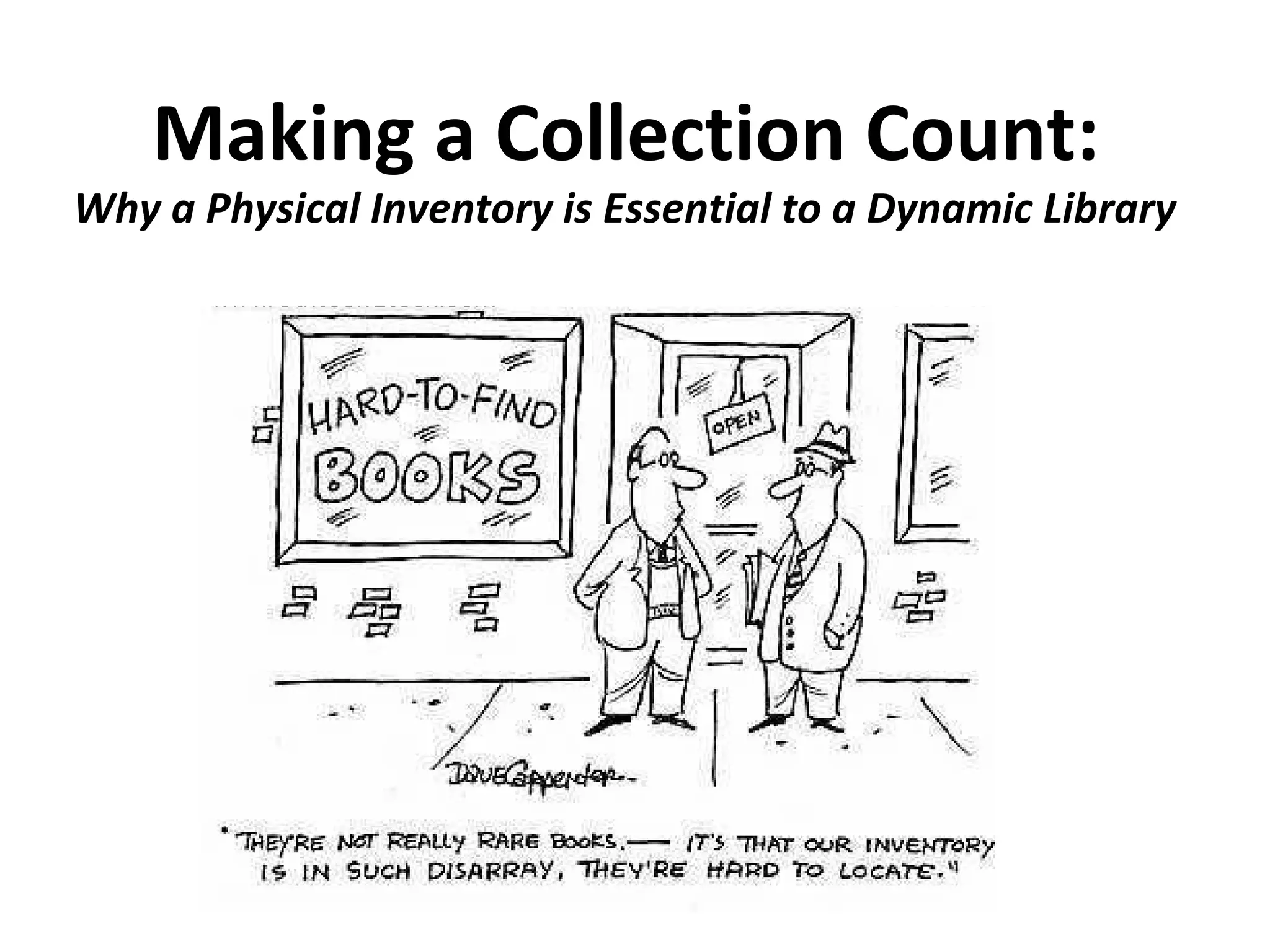
Making a Collection Count:  Why a Physical Inventory is Essential to a Dynamic Library   
Program Outline Steps to performing a physical inventory What you’ll discover Why you should care Creating collection objectives from inventory data Creating benchmarks from inventory data This presentation is available online: www.slideshare.net/hhibner
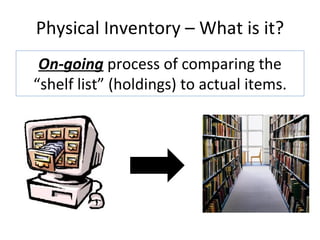
Physical Inventory – What is it? On-going  process of comparing the “shelf list” (holdings) to actual items.
Inventory Strategy: Step 1 Choose a  manageable  piece of collection SSLDL Started with audio book collection High per unit cost Newer collection Holdings at beginning of project ~ 500 items Estimated value at that time: about $32,000
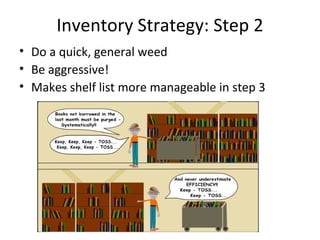
Inventory Strategy: Step 2 Do a quick, general weed Be aggressive! Makes shelf list more manageable in step 3
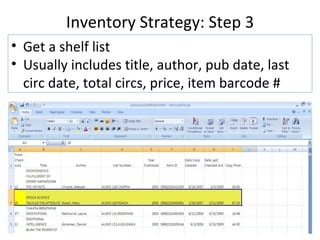
Inventory Strategy: Step 3 Get a shelf list Usually includes title, author, pub date, last circ date, total circs, price, item barcode #
Inventory Strategy: Step 4 Identify obvious errors on shelf list. Call numbers that don’t line up Items without prices or other empty fields on list Find the items and fix their records SSLDL placed holds on a special “SLYN Inventory” library card for items currently checked out
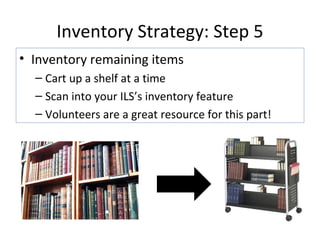
Inventory Strategy: Step 5 Inventory remaining items Cart up a shelf at a time Scan into your ILS’s inventory feature Volunteers are a great resource for this part!
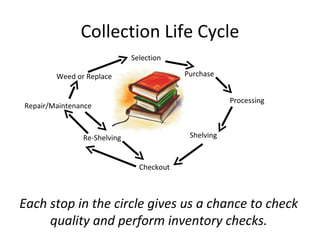
Collection Life Cycle Selection Purchase Processing Shelving Checkout Re-Shelving Repair/Maintenance Weed or Replace Each stop in the circle gives us a chance to check quality and perform inventory checks.
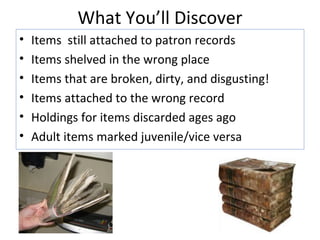
What You’ll Discover Items  still attached to patron records Items shelved in the wrong place Items that are broken, dirty, and disgusting! Items attached to the wrong record Holdings for items discarded ages ago Adult items marked juvenile/vice versa
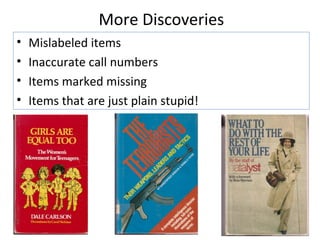
More Discoveries Mislabeled items Inaccurate call numbers  Items marked missing Items that are just plain stupid!
Why should we spend time doing this? So that catalog accurately reflects library holdings Limit customer and staff frustration To create a starting point for evaluation  Library & Librarian performance So that staff gain deeper understanding of ILS and library work flow
Physical Inventory Helps Maintain  a Quality Collection Does it circulate or is it used enough? Is it current? Is it relevant? Does it look nice? Does the catalog correctly reflect the status of the item?  (checked out, lost/missing, etc) Are collections organized logically?
Physical Inventory Defines Your Collections Geographical Shelf Location, Department Item type DVDs, Book on CD, Large Print Home Location (regardless of item type) Non-Fiction, Fiction, Audio book, Music
Monetary Reasons  to Perform a Physical Inventory Provides information for budget decisions Need to update/overhaul a collection? Waning format = limit/eliminate funds to a collection Regular inventory controls loss ( Read: $$$ )
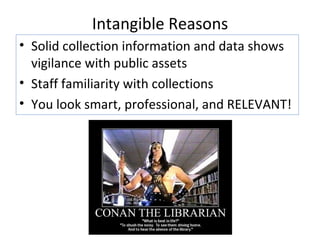
Intangible Reasons Solid collection information and data shows vigilance with public assets Staff familiarity with collections You look smart, professional, and RELEVANT!
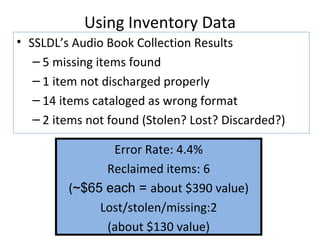
Using Inventory Data SSLDL’s Audio Book Collection Results 5 missing items found 1 item not discharged properly 14 items cataloged as wrong format 2 items not found (Stolen? Lost? Discarded?) Error Rate: 4.4% Reclaimed items: 6 ( ~$65 each =  about $390 value) Lost/stolen/missing:2 (about $130 value)
Using Inventory Data: Creating Collection Objectives A general statement of what materials will or will not be included in the collection. They are different for every library and community Can be different for each collection Collection Data is Dynamic! Is your collection doing the job  it’s supposed to?
SSLDL’s Audio Book  Collection Objective Popular materials of current interest  Since cost is a factor with audio books, titles that have a limited shelf life will be given low priority  Examples: some series fiction, political material addressing current events, travel info, certain types of science or health material that could be outdated quickly
SSLDL’s Audio Book  Collection Objective (Continued) Consideration and comparison to statistics in downloadable audios will also be investigated. Other considerations for the collection:  Classic fiction and nonfiction titles that coincide with local school and university curriculum objectives, foreign language instruction for both students and travelers
Using Inventory Data  to  Create Benchmarks Benchmark:  A standard by which something can be measured or judged Most expensive collections get most attention Non-financial reasons are important and considered! Circulation Goals Estimation of how many times you estimate this item will be checked out within 2 years of purchase
SSLDL’s Circulation Benchmarks for  Audio Book Collection Fiction Titles  10-12 checkouts within 1 year of purchase Popular Non-Fiction Bestsellers, self help, biography, etc. 8-10 checkouts within a year of purchase Informational Non-Fiction Language instruction, Shakespeare/Poetry, etc. 3 checkouts within 1 year of purchase
Other Benchmarks to Set Using Inventory Data Average unit cost of each item in a collection Total cost (worth) of a collection Number of units in a collection Weeding/maintenance schedule
Presented by : Mary Kelly  [email_address] Holly Hibner  [email_address] Presentation available online at  www.slideshare.net/hhibner

Making A Collection Count

  • 1.
    Making a CollectionCount: Why a Physical Inventory is Essential to a Dynamic Library  
  • 2.
    Program Outline Stepsto performing a physical inventory What you’ll discover Why you should care Creating collection objectives from inventory data Creating benchmarks from inventory data This presentation is available online: www.slideshare.net/hhibner
  • 3.
    Physical Inventory –What is it? On-going process of comparing the “shelf list” (holdings) to actual items.
  • 4.
    Inventory Strategy: Step1 Choose a manageable piece of collection SSLDL Started with audio book collection High per unit cost Newer collection Holdings at beginning of project ~ 500 items Estimated value at that time: about $32,000
  • 5.
    Inventory Strategy: Step2 Do a quick, general weed Be aggressive! Makes shelf list more manageable in step 3
  • 6.
    Inventory Strategy: Step3 Get a shelf list Usually includes title, author, pub date, last circ date, total circs, price, item barcode #
  • 7.
    Inventory Strategy: Step4 Identify obvious errors on shelf list. Call numbers that don’t line up Items without prices or other empty fields on list Find the items and fix their records SSLDL placed holds on a special “SLYN Inventory” library card for items currently checked out
  • 8.
    Inventory Strategy: Step5 Inventory remaining items Cart up a shelf at a time Scan into your ILS’s inventory feature Volunteers are a great resource for this part!
  • 9.
    Collection Life CycleSelection Purchase Processing Shelving Checkout Re-Shelving Repair/Maintenance Weed or Replace Each stop in the circle gives us a chance to check quality and perform inventory checks.
  • 10.
    What You’ll DiscoverItems still attached to patron records Items shelved in the wrong place Items that are broken, dirty, and disgusting! Items attached to the wrong record Holdings for items discarded ages ago Adult items marked juvenile/vice versa
  • 11.
    More Discoveries Mislabeleditems Inaccurate call numbers Items marked missing Items that are just plain stupid!
  • 12.
    Why should wespend time doing this? So that catalog accurately reflects library holdings Limit customer and staff frustration To create a starting point for evaluation Library & Librarian performance So that staff gain deeper understanding of ILS and library work flow
  • 13.
    Physical Inventory HelpsMaintain a Quality Collection Does it circulate or is it used enough? Is it current? Is it relevant? Does it look nice? Does the catalog correctly reflect the status of the item? (checked out, lost/missing, etc) Are collections organized logically?
  • 14.
    Physical Inventory DefinesYour Collections Geographical Shelf Location, Department Item type DVDs, Book on CD, Large Print Home Location (regardless of item type) Non-Fiction, Fiction, Audio book, Music
  • 15.
    Monetary Reasons to Perform a Physical Inventory Provides information for budget decisions Need to update/overhaul a collection? Waning format = limit/eliminate funds to a collection Regular inventory controls loss ( Read: $$$ )
  • 16.
    Intangible Reasons Solidcollection information and data shows vigilance with public assets Staff familiarity with collections You look smart, professional, and RELEVANT!
  • 17.
    Using Inventory DataSSLDL’s Audio Book Collection Results 5 missing items found 1 item not discharged properly 14 items cataloged as wrong format 2 items not found (Stolen? Lost? Discarded?) Error Rate: 4.4% Reclaimed items: 6 ( ~$65 each = about $390 value) Lost/stolen/missing:2 (about $130 value)
  • 18.
    Using Inventory Data:Creating Collection Objectives A general statement of what materials will or will not be included in the collection. They are different for every library and community Can be different for each collection Collection Data is Dynamic! Is your collection doing the job it’s supposed to?
  • 19.
    SSLDL’s Audio Book Collection Objective Popular materials of current interest Since cost is a factor with audio books, titles that have a limited shelf life will be given low priority Examples: some series fiction, political material addressing current events, travel info, certain types of science or health material that could be outdated quickly
  • 20.
    SSLDL’s Audio Book Collection Objective (Continued) Consideration and comparison to statistics in downloadable audios will also be investigated. Other considerations for the collection: Classic fiction and nonfiction titles that coincide with local school and university curriculum objectives, foreign language instruction for both students and travelers
  • 21.
    Using Inventory Data to Create Benchmarks Benchmark: A standard by which something can be measured or judged Most expensive collections get most attention Non-financial reasons are important and considered! Circulation Goals Estimation of how many times you estimate this item will be checked out within 2 years of purchase
  • 22.
    SSLDL’s Circulation Benchmarksfor Audio Book Collection Fiction Titles 10-12 checkouts within 1 year of purchase Popular Non-Fiction Bestsellers, self help, biography, etc. 8-10 checkouts within a year of purchase Informational Non-Fiction Language instruction, Shakespeare/Poetry, etc. 3 checkouts within 1 year of purchase
  • 23.
    Other Benchmarks toSet Using Inventory Data Average unit cost of each item in a collection Total cost (worth) of a collection Number of units in a collection Weeding/maintenance schedule
  • 24.
    Presented by :Mary Kelly [email_address] Holly Hibner [email_address] Presentation available online at www.slideshare.net/hhibner

Editor's Notes