Web Service Implementation
Using ASP.NET

    T.Ponraj ,
    Research Assistant,
    Pondicherry University,
    Puducherry.
Web services

       Definition:
        Software components that can be published,
         located, and run over the Internet using
         Extensible Markup Language (XML).
        A web service is a software application that
         works over the internet.
        A web service is service-oriented application that
         communicates over the web using messages
        We can test the web service by using the local
         web server.
Working of web service

         The web service is also a software, with its own class
    and methods .
   A request by the client application constitutes
    construction and sending a SOAP request using HTTP to
    the web server.
   For a web service to work, the computer has to be
    connected to the internet.
   The web server hosts the class and its methods of a web
    service, for a client computer to request and use.
   Any client computer located any where in the world, with
    an internet connection can request and use the class and
    its methods of the web service.
Web Service technologies
      A web service is service-oriented
application that communicates over the web
using messages.

                The Web
                XML
                SOA
1 . The Web

   A Web service is a Web resource. It
    communicates over the internet using standard
    Web protocols. Leveraging the Web yields
    universal connectivity and pervasiveness.

   A web service is also hosted on a web server.
    We can access a web service programmatically,
    only programmatically and not by a browser.
2 . XML

   XML is a language for electronic documents and
    messages. It provides a universal, self-describing data
    format that can be interpreted, processed, and
    transformed by any application running on any platform.

   Each bit of information in a document is defined by tags
    without overload of formatting present in HTML.

   This type of representation is suitable for application to
    application communication.
3 . SOA

   SOA stands for service-oriented architecture.
   SOA is a concept and describes a set of well-
    established patterns.
   Each pattern represents a mechanism to describe a
    service, to advertise and discover a service, and to
    communicate with a service.
   Web services rely on these patterns and client
    applications connect to a service using these patterns.
3.1.Basic Roles

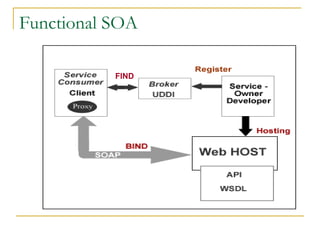
   Service provider :-
        Who develops or supplies the service.

   Service consumer :-
       Who uses the service.


   Service broker :-
        Facilitates the advertising and discovery process.
3.2.Operation
   Register :-
        The service provider registers the service with a
    service broker.
   Find :-
        The service broker gives the service consumer
    directions on how to find the service and its service
    contract .
   Bind :-
         The service consumer uses the contract to bind the
    client to the service, at which point the client and service
    can communicate.
3.3 . Standard

   WSDL :-
        WSDL provides a mechanism to describe a Web
    service.
   UDDI :-
        UDDI provides a mechanism to advertise and
    discover a Web service.
   SOAP:-
        SOAP provides a mechanism for clients and
    services to communicate.
3.3.3.SOAP
     Simple Object Access Protocol (SOAP) is an XML
 protocol. It is used by client applications to communicate
 with Web services.
     SOAP implements an envelope for sending an XML
 message. We put an XML message into an envelope
 and send it across the networks.
     A SOAP envelope is transported by various
 communication protocols. But, the most common way to
 transfer SOAP messages is to use HTTP. Other Web
 protocols commonly used are SMTP and FTP.
SOAP Message

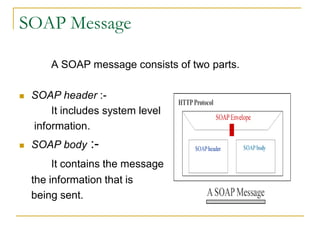
        A SOAP message consists of two parts.

   SOAP header :-
        It includes system level
    information.
   SOAP body   :-
         It contains the message
    the information that is
    being sent.
Functional SOA

           FIND
Reason for why we use Web Services
   Web Services operate on a service-based model
    architecture .
   Web Services allow us to communicate among all
    different entities without affecting their existence.
   It is written separately from the application logic.
   They improve the information flow between applications.
   web services use text based protocol that all
    applications can understand.

   Web services reduce licensing costs.

   They do not rely on special protocols.
Case Study
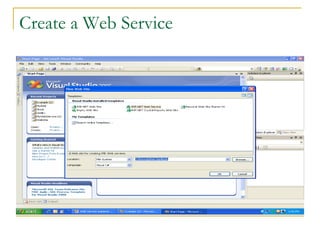
Create a Web Service
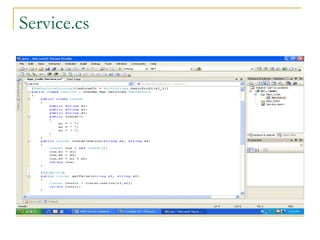
Service.cs
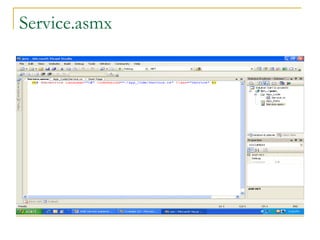
Service.asmx
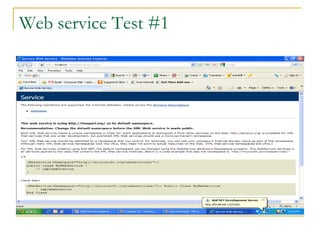
Web service Test #1
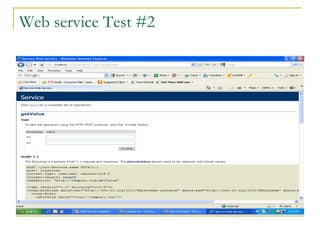
Web service Test #2
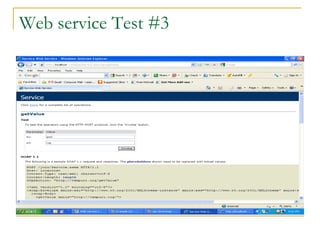
Web service Test #3
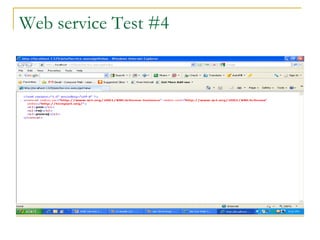
Web service Test #4
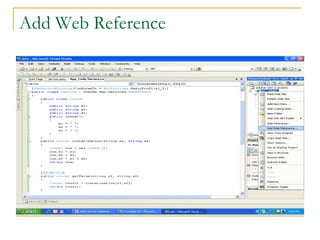
Add Web Reference
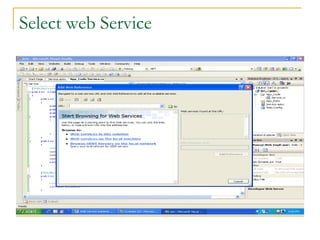
Select web Service
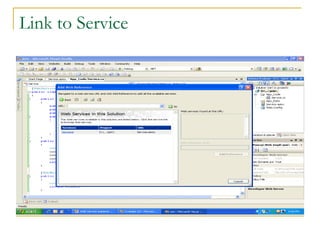
Link to Service
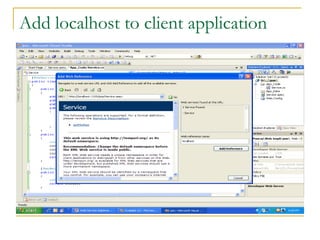
Add localhost to client application
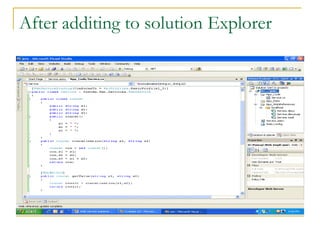
After additing to solution Explorer
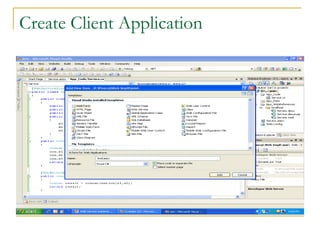
Create Client Application
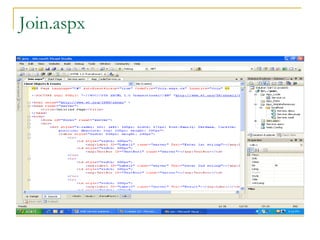
Join.aspx
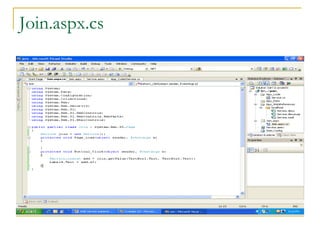
Join.aspx.cs
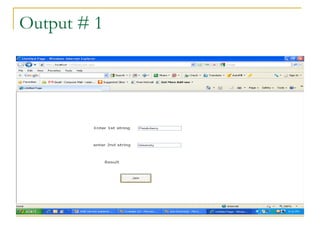
Output # 1
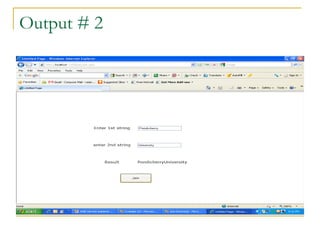
Output # 2
References

   http://www.dotnetissues.com/search/label/ASP.NET%20
    WebService
   http://msdn.microsoft.com/en-us/library/ba0z6a33.aspx
   http://www.codeproject.com/KB/webservices/
   http://www.vkinfotek.com/webservice/whycreatewebservi
    ce.aspx
   http://oreilly.com/catalog/9780596002503/
   http://www.c-
    sharpcorner.com/UploadFile/puranindia/324/
Thanks

Web Service Implementation Using ASP.NET

  • 1.
    Web Service Implementation UsingASP.NET T.Ponraj , Research Assistant, Pondicherry University, Puducherry.
  • 2.
    Web services  Definition:  Software components that can be published, located, and run over the Internet using Extensible Markup Language (XML).  A web service is a software application that works over the internet.  A web service is service-oriented application that communicates over the web using messages  We can test the web service by using the local web server.
  • 3.
    Working of webservice The web service is also a software, with its own class and methods .  A request by the client application constitutes construction and sending a SOAP request using HTTP to the web server.  For a web service to work, the computer has to be connected to the internet.  The web server hosts the class and its methods of a web service, for a client computer to request and use.  Any client computer located any where in the world, with an internet connection can request and use the class and its methods of the web service.
  • 4.
    Web Service technologies A web service is service-oriented application that communicates over the web using messages.  The Web  XML  SOA
  • 5.
    1 . TheWeb  A Web service is a Web resource. It communicates over the internet using standard Web protocols. Leveraging the Web yields universal connectivity and pervasiveness.  A web service is also hosted on a web server. We can access a web service programmatically, only programmatically and not by a browser.
  • 6.
    2 . XML  XML is a language for electronic documents and messages. It provides a universal, self-describing data format that can be interpreted, processed, and transformed by any application running on any platform.  Each bit of information in a document is defined by tags without overload of formatting present in HTML.  This type of representation is suitable for application to application communication.
  • 7.
    3 . SOA  SOA stands for service-oriented architecture.  SOA is a concept and describes a set of well- established patterns.  Each pattern represents a mechanism to describe a service, to advertise and discover a service, and to communicate with a service.  Web services rely on these patterns and client applications connect to a service using these patterns.
  • 8.
    3.1.Basic Roles  Service provider :- Who develops or supplies the service.  Service consumer :- Who uses the service.  Service broker :- Facilitates the advertising and discovery process.
  • 9.
    3.2.Operation  Register :- The service provider registers the service with a service broker.  Find :- The service broker gives the service consumer directions on how to find the service and its service contract .  Bind :- The service consumer uses the contract to bind the client to the service, at which point the client and service can communicate.
  • 10.
    3.3 . Standard  WSDL :- WSDL provides a mechanism to describe a Web service.  UDDI :- UDDI provides a mechanism to advertise and discover a Web service.  SOAP:- SOAP provides a mechanism for clients and services to communicate.
  • 11.
    3.3.3.SOAP Simple Object Access Protocol (SOAP) is an XML protocol. It is used by client applications to communicate with Web services. SOAP implements an envelope for sending an XML message. We put an XML message into an envelope and send it across the networks. A SOAP envelope is transported by various communication protocols. But, the most common way to transfer SOAP messages is to use HTTP. Other Web protocols commonly used are SMTP and FTP.
  • 12.
    SOAP Message A SOAP message consists of two parts.  SOAP header :- It includes system level information.  SOAP body :- It contains the message the information that is being sent.
  • 13.
  • 14.
    Reason for whywe use Web Services  Web Services operate on a service-based model architecture .  Web Services allow us to communicate among all different entities without affecting their existence.  It is written separately from the application logic.  They improve the information flow between applications.  web services use text based protocol that all applications can understand.  Web services reduce licensing costs.  They do not rely on special protocols.
  • 15.
  • 16.
    Create a WebService
  • 17.
  • 18.
  • 19.
  • 20.
  • 21.
  • 22.
  • 23.
  • 24.
  • 25.
  • 26.
    Add localhost toclient application
  • 27.
    After additing tosolution Explorer
  • 28.
  • 29.
  • 30.
  • 31.
  • 32.
  • 33.
    References  http://www.dotnetissues.com/search/label/ASP.NET%20 WebService  http://msdn.microsoft.com/en-us/library/ba0z6a33.aspx  http://www.codeproject.com/KB/webservices/  http://www.vkinfotek.com/webservice/whycreatewebservi ce.aspx  http://oreilly.com/catalog/9780596002503/  http://www.c- sharpcorner.com/UploadFile/puranindia/324/
  • 34.