




Compensating Tomorrow’s
Workforce, Today:
Millennials & Beyond
Mykkah Herner, MA, CCP
Modern Compensation Evangelist
Angela Ulman, CCP
Compensation Professional
A copy of the presentation and recertification credit will be sent out
within a couple of business days
15,000 Positions 3,500 Customers 11 Countries
250 Compensable Factors
54 Million Salary Profiles
www.payscale.com
Angela Ulman, CCP
Compensation Professional
https://www.linkedin.com/in/angelaulman
Mykkah Herner, MA, CCP
Modern Comp Evangelist
https://www.linkedin.com/in/mykkahherner
www.payscale.com
Understanding tomorrow’s workforce
Tailoring compensation to your workforce
• Mix of pay
• Advancement
• Communication
Where to start
www.payscale.com
57% of organizations view themselves
as modern or forward-thinking
www.payscale.com
Understanding tomorrow’s
workforce
www.payscale.com
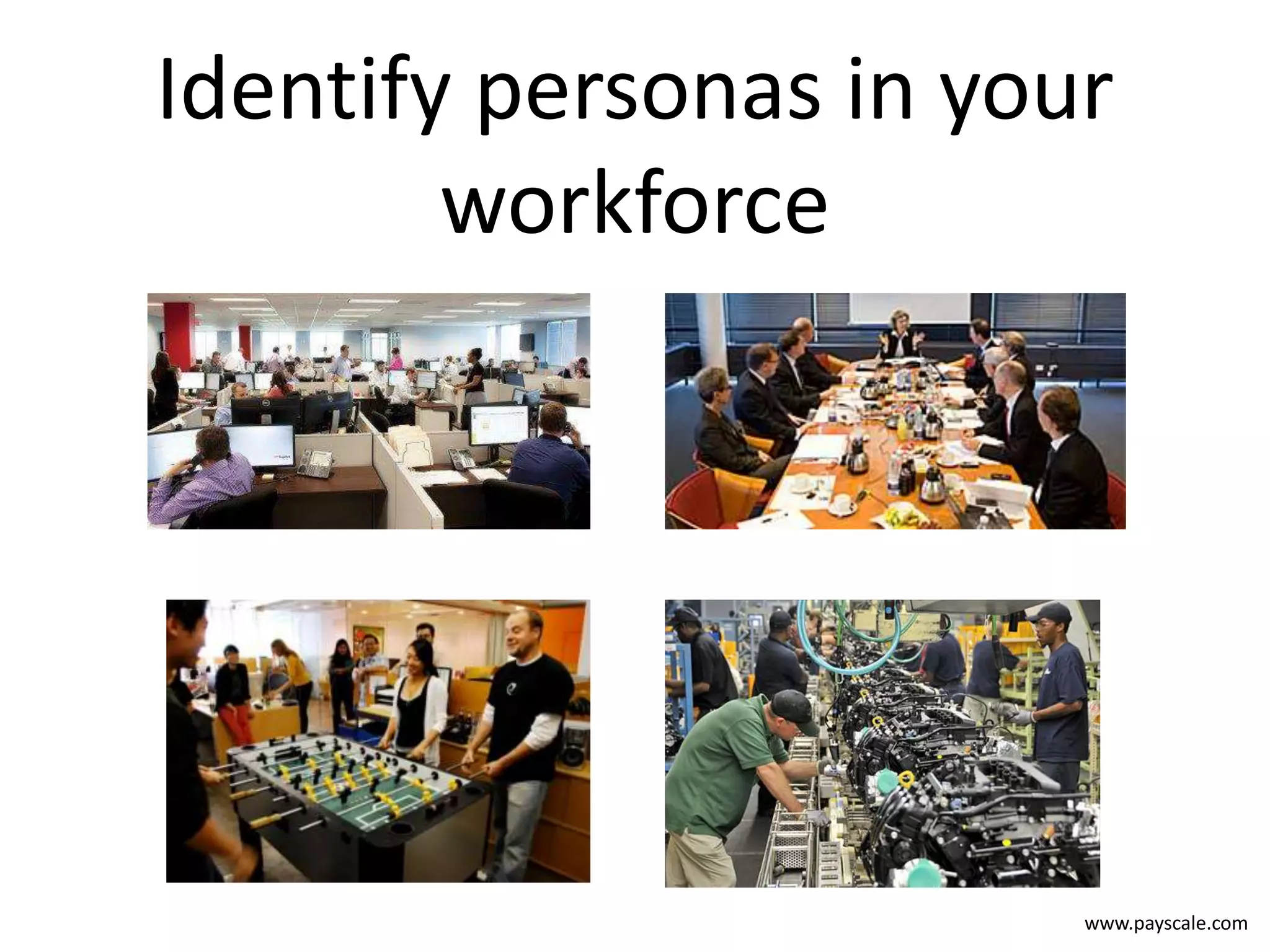
Identify personas in your
workforce
www.payscale.com
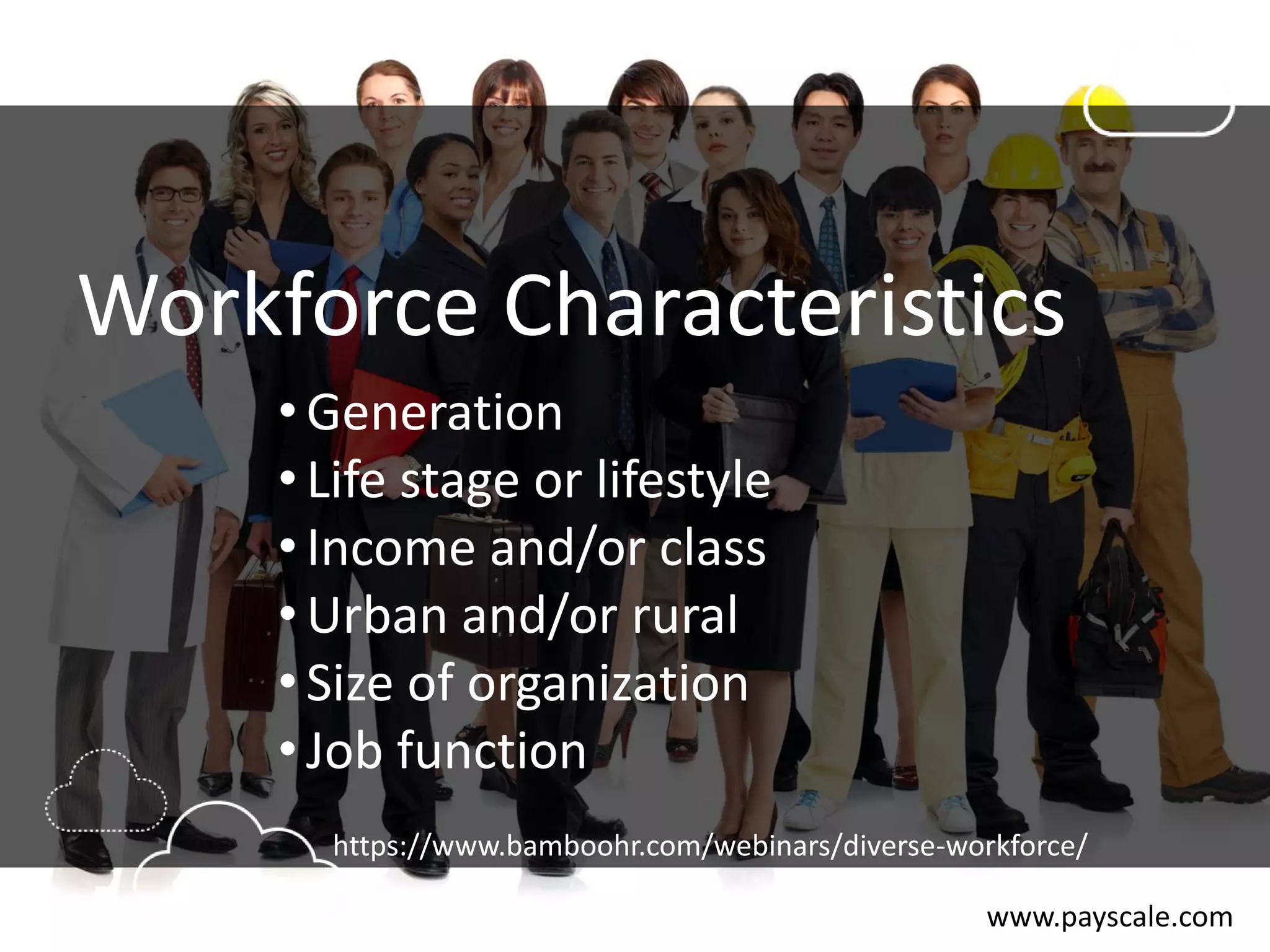
Workforce Characteristics
• Generation
• Life stage or lifestyle
• Income and/or class
• Urban and/or rural
• Size of organization
• Job function
https://www.bamboohr.com/webinars/diverse-workforce/
www.payscale.com
Defining the Generations
www.payscale.com
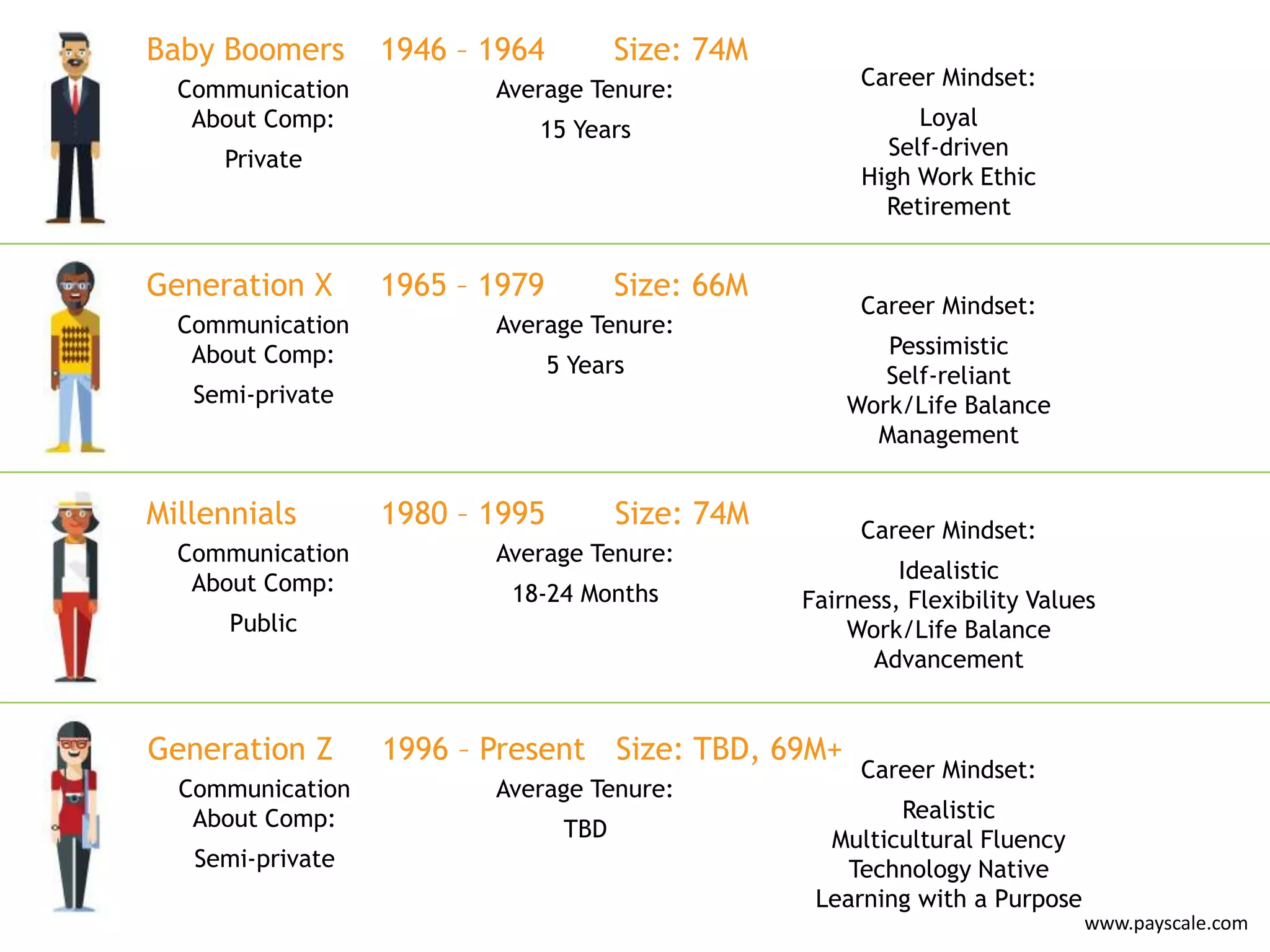
Baby Boomers 1946 – 1964 Size: 74M
Communication
About Comp:
Private
Average Tenure:
15 Years
Career Mindset:
Loyal
Self-driven
High Work Ethic
Retirement
Generation X 1965 – 1979 Size: 66M
Communication
About Comp:
Semi-private
Average Tenure:
5 Years
Career Mindset:
Pessimistic
Self-reliant
Work/Life Balance
Management
Millennials 1980 – 1995 Size: 74M
Communication
About Comp:
Public
Average Tenure:
18-24 Months
Career Mindset:
Idealistic
Fairness, Flexibility Values
Work/Life Balance
Advancement
Generation Z 1996 – Present Size: TBD, 69M+
Communication
About Comp:
Semi-private
Average Tenure:
TBD
Career Mindset:
Realistic
Multicultural Fluency
Technology Native
Learning with a Purpose
www.payscale.com
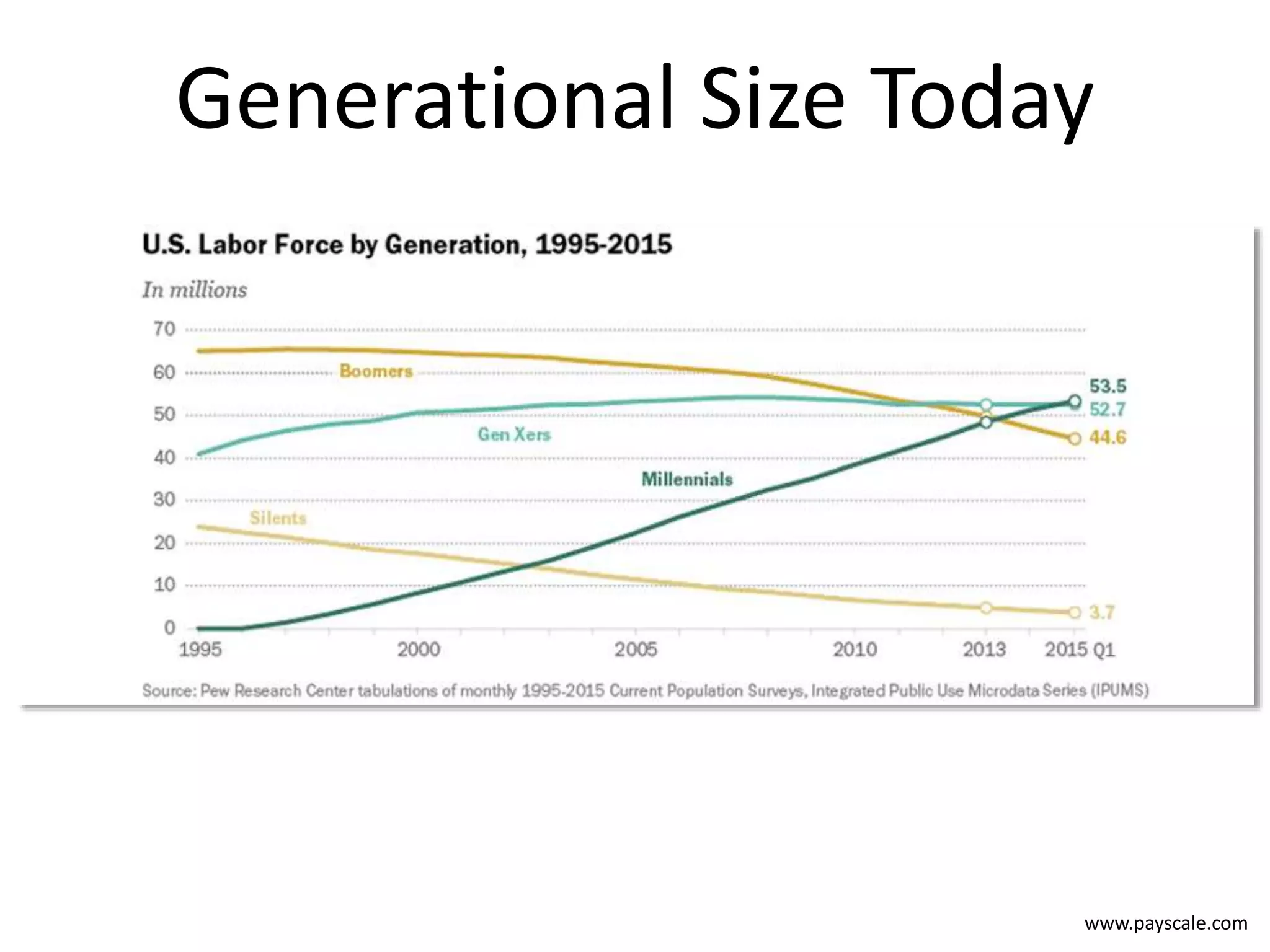
Generational Size Today
www.payscale.com
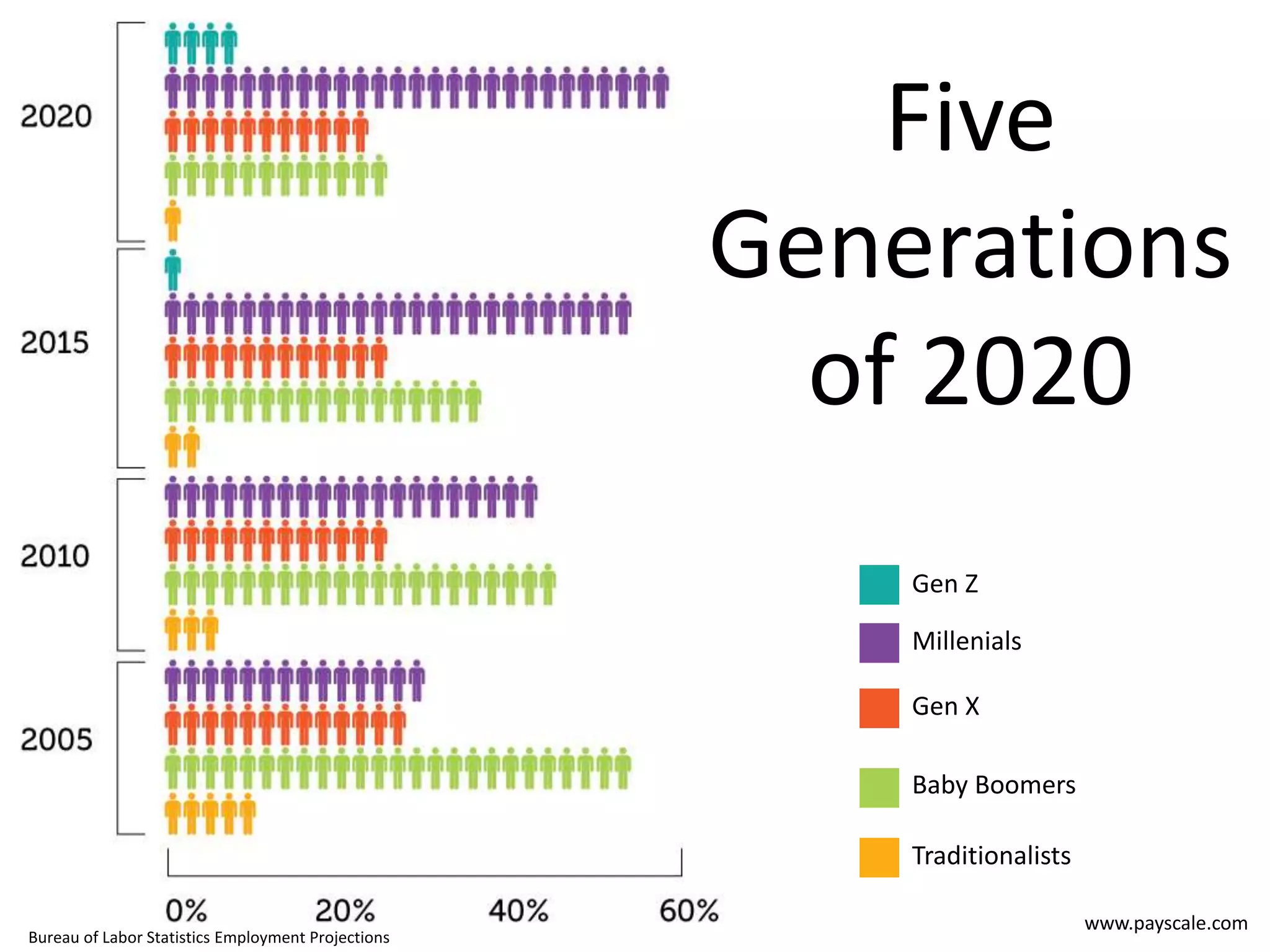
Five
Generations
of 2020
Gen Z
Millenials
Gen X
Baby Boomers
Traditionalists
Bureau of Labor Statistics Employment Projections
www.payscale.com
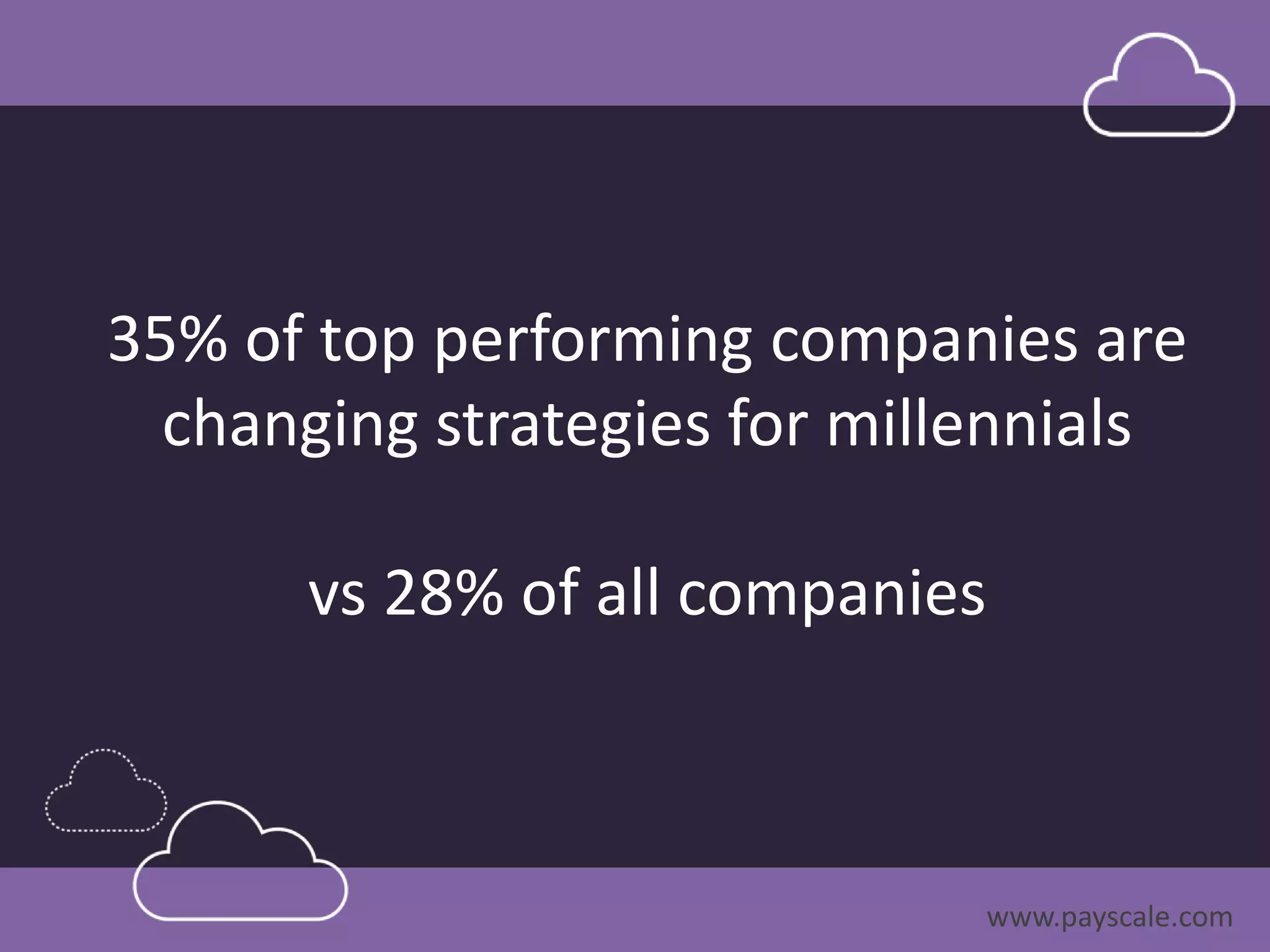
35% of top performing companies are
changing strategies for millennials
vs 28% of all companies
www.payscale.com
Tailoring compensation to your
workforce
www.payscale.com
Mix of Pay
www.payscale.com
What is the
Right
Compensation
Mix?
www.payscale.com
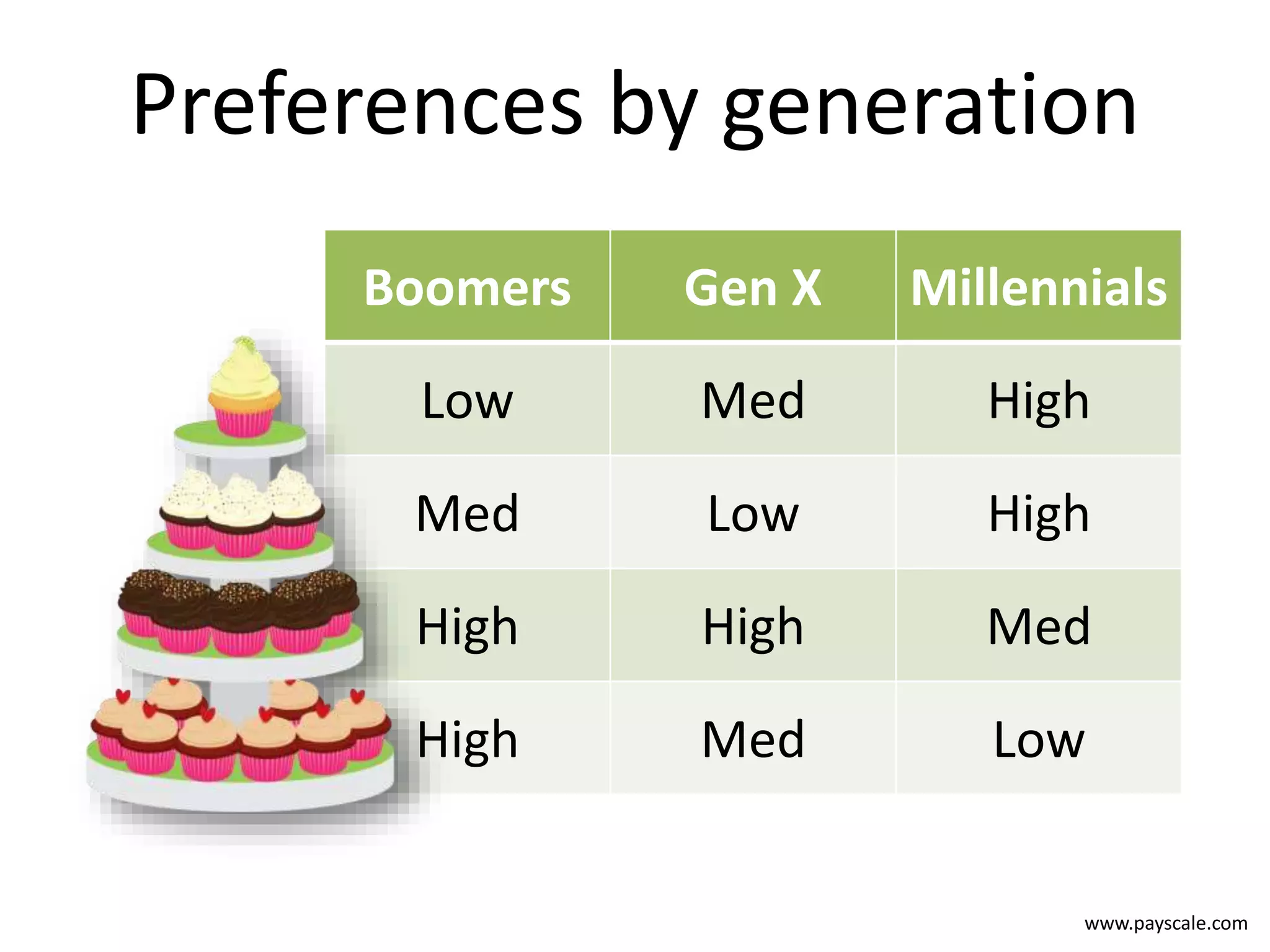
Preferences by generation
Boomers Gen X Millennials
Low Med High
Med Low High
High High Med
High Med Low
www.payscale.com
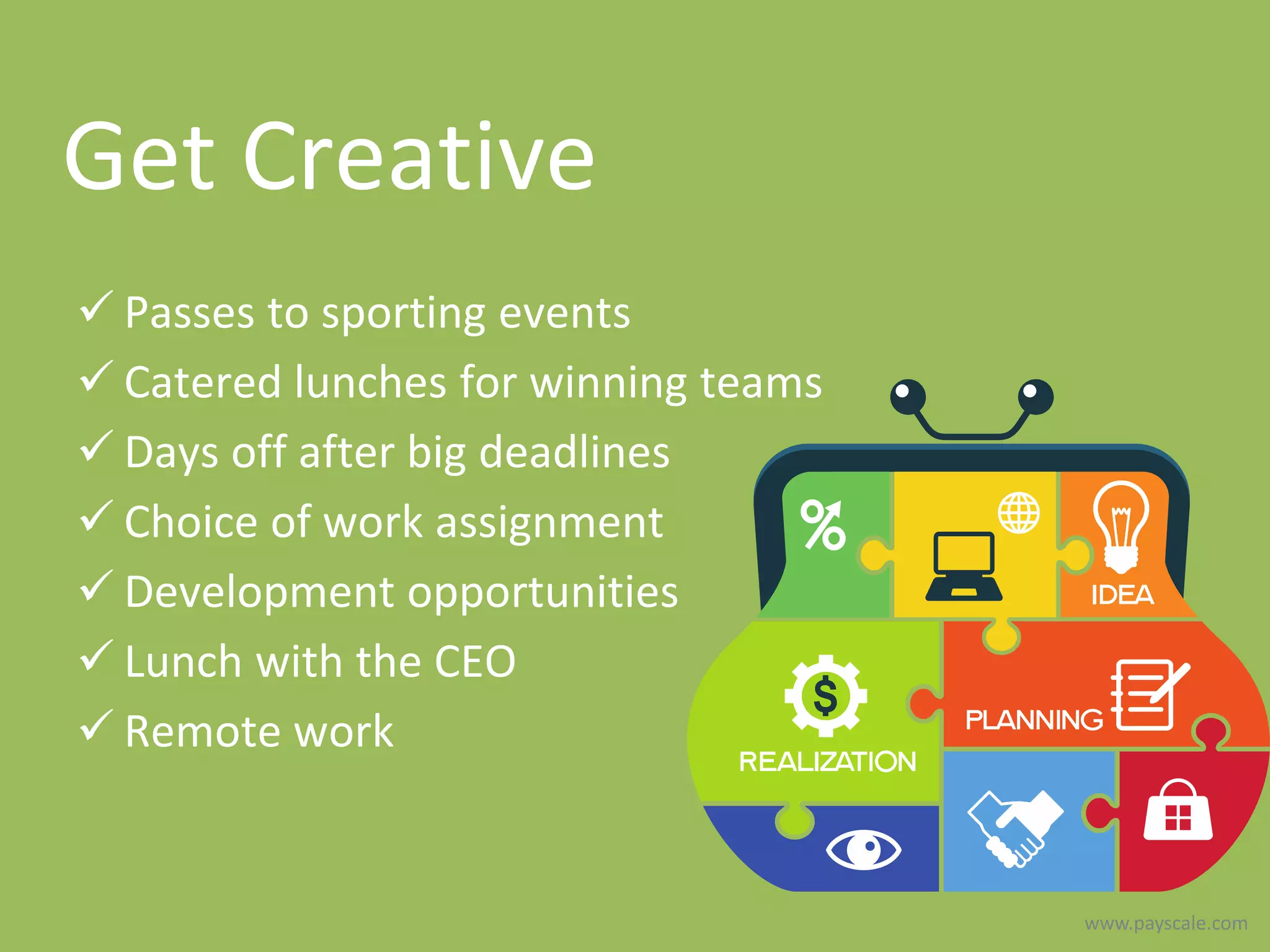
Get Creative
 Passes to sporting events
 Catered lunches for winning teams
 Days off after big deadlines
 Choice of work assignment
 Development opportunities
 Lunch with the CEO
 Remote work
www.payscale.com
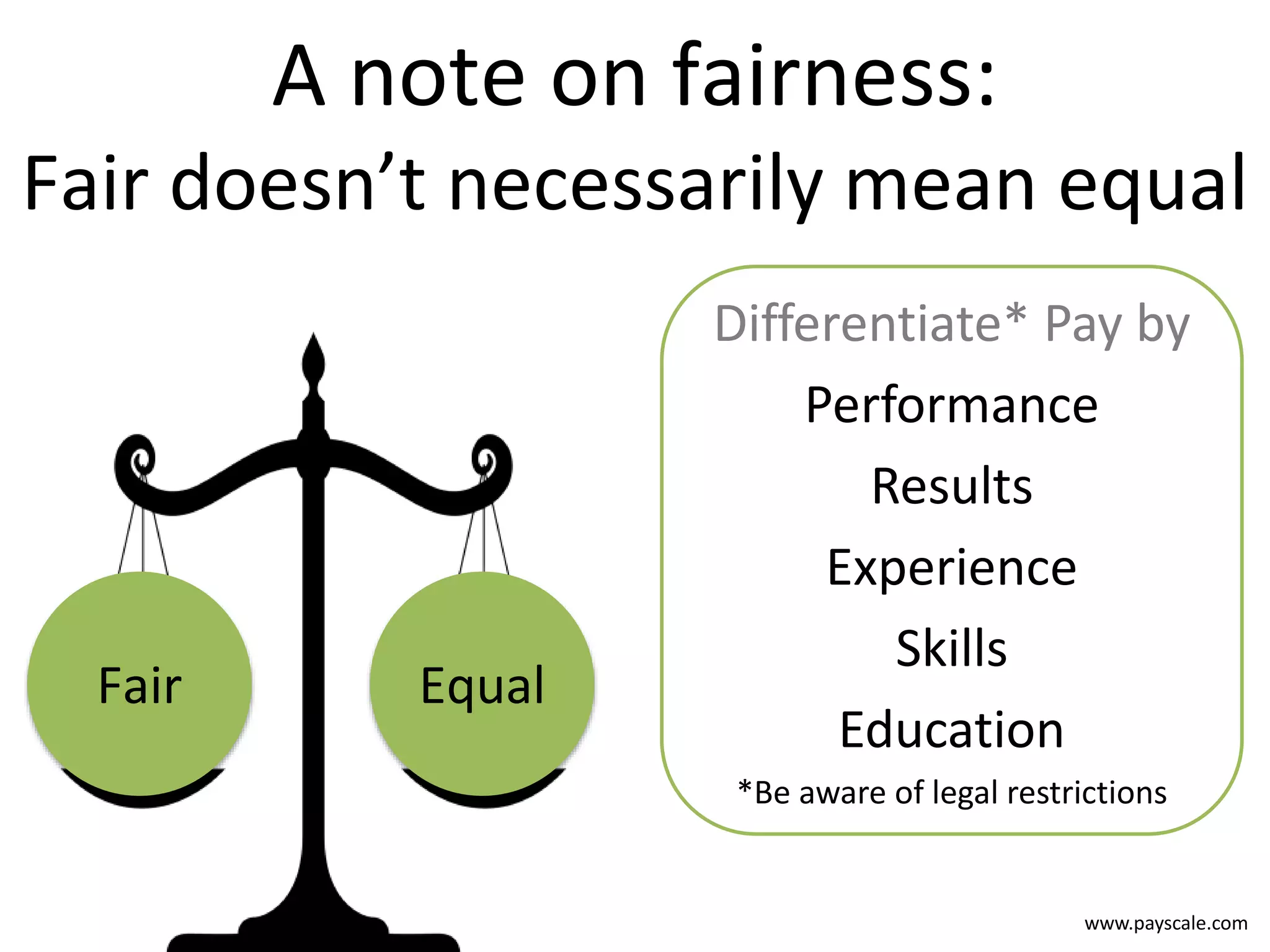
EqualFair
A note on fairness:
Fair doesn’t necessarily mean equal
Differentiate* Pay by
Performance
Results
Experience
Skills
Education
*Be aware of legal restrictions
www.payscale.com
Advancement and your
comp structure
www.payscale.com
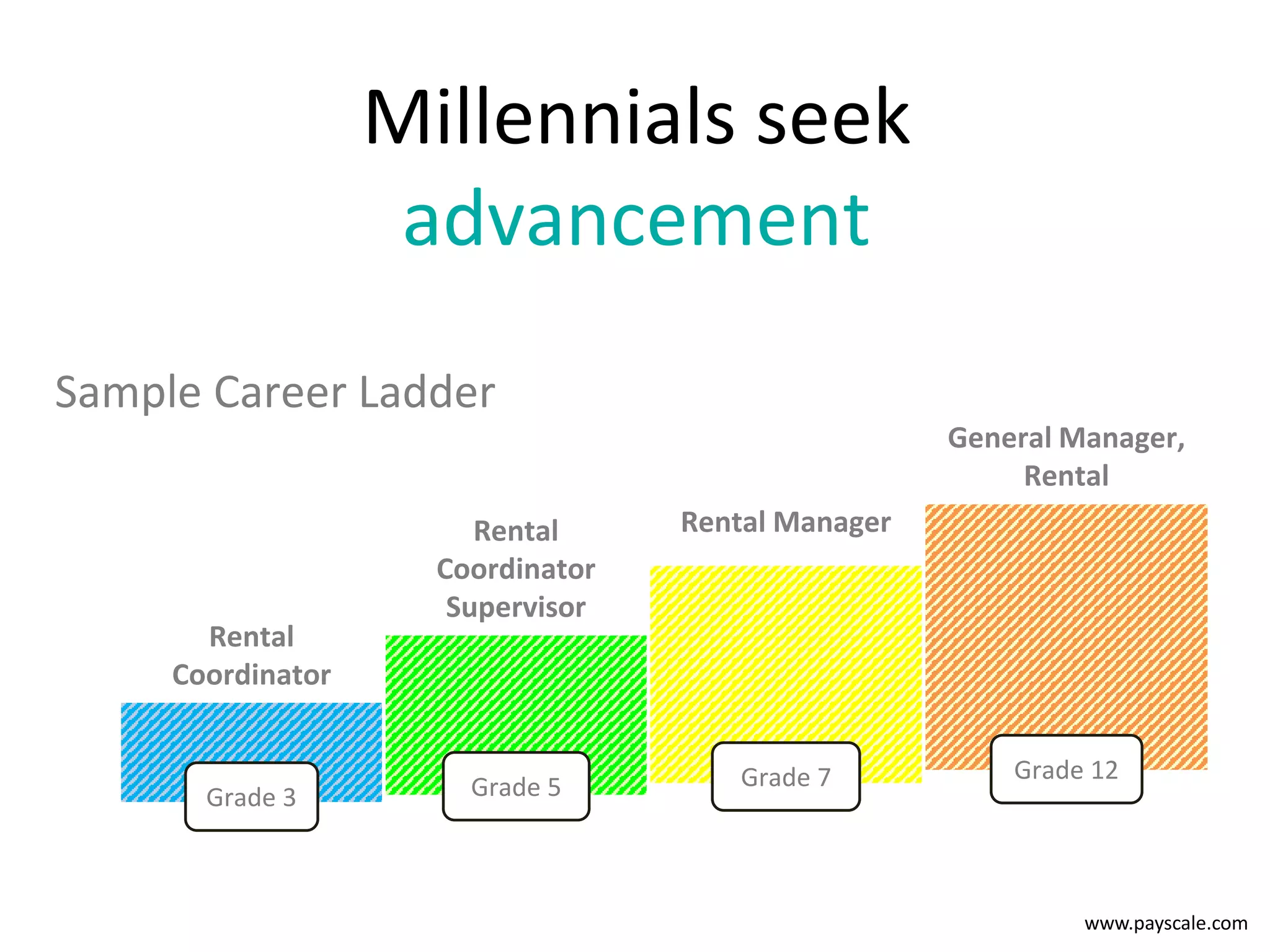
Millennials seek
advancement
Sample Career Ladder
Rental
Coordinator
General Manager,
Rental
Rental
Coordinator
Supervisor
Rental Manager
Grade 3 Grade 5 Grade 7 Grade 12
www.payscale.com
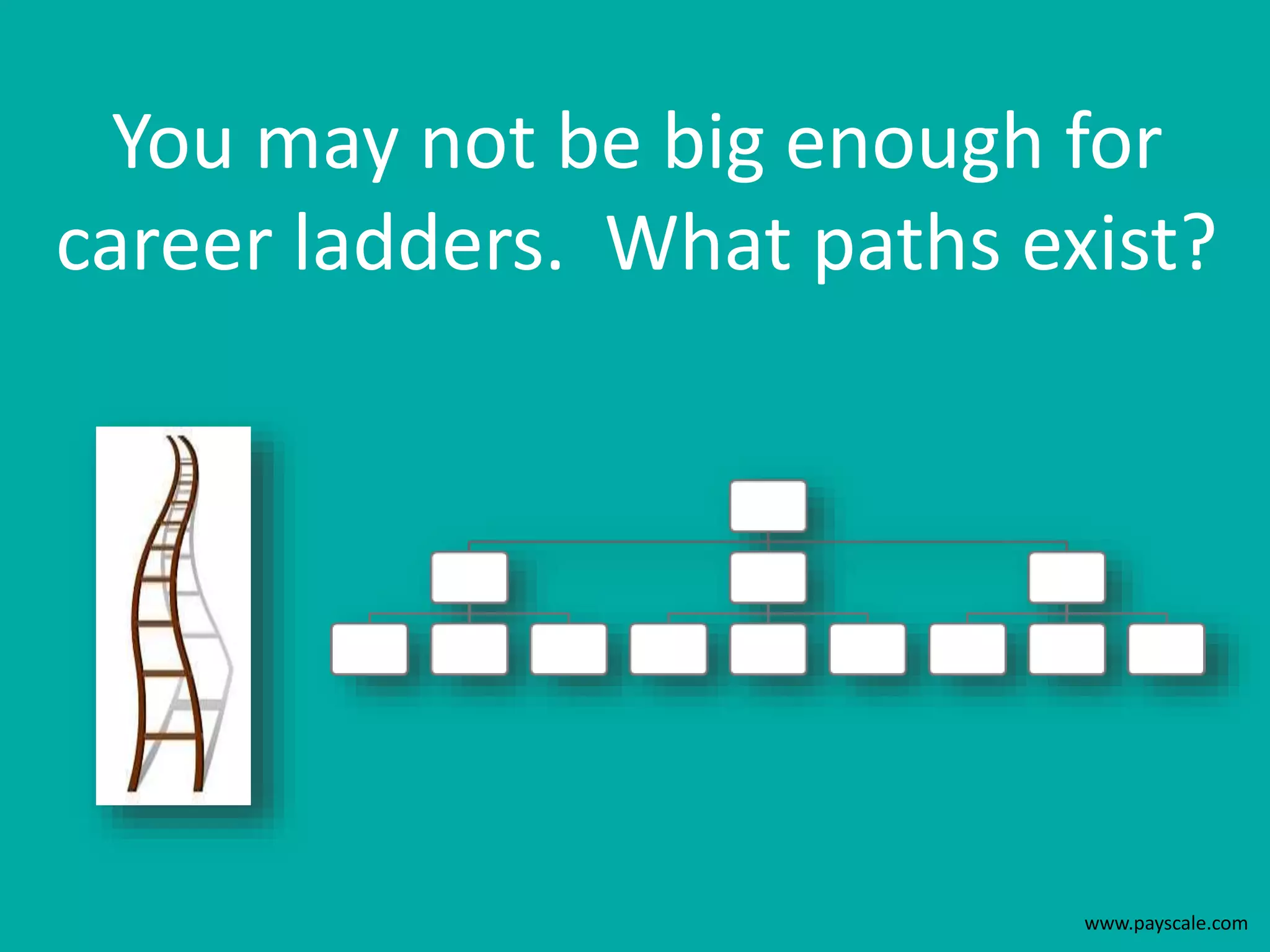
You may not be big enough for
career ladders. What paths exist?
www.payscale.com
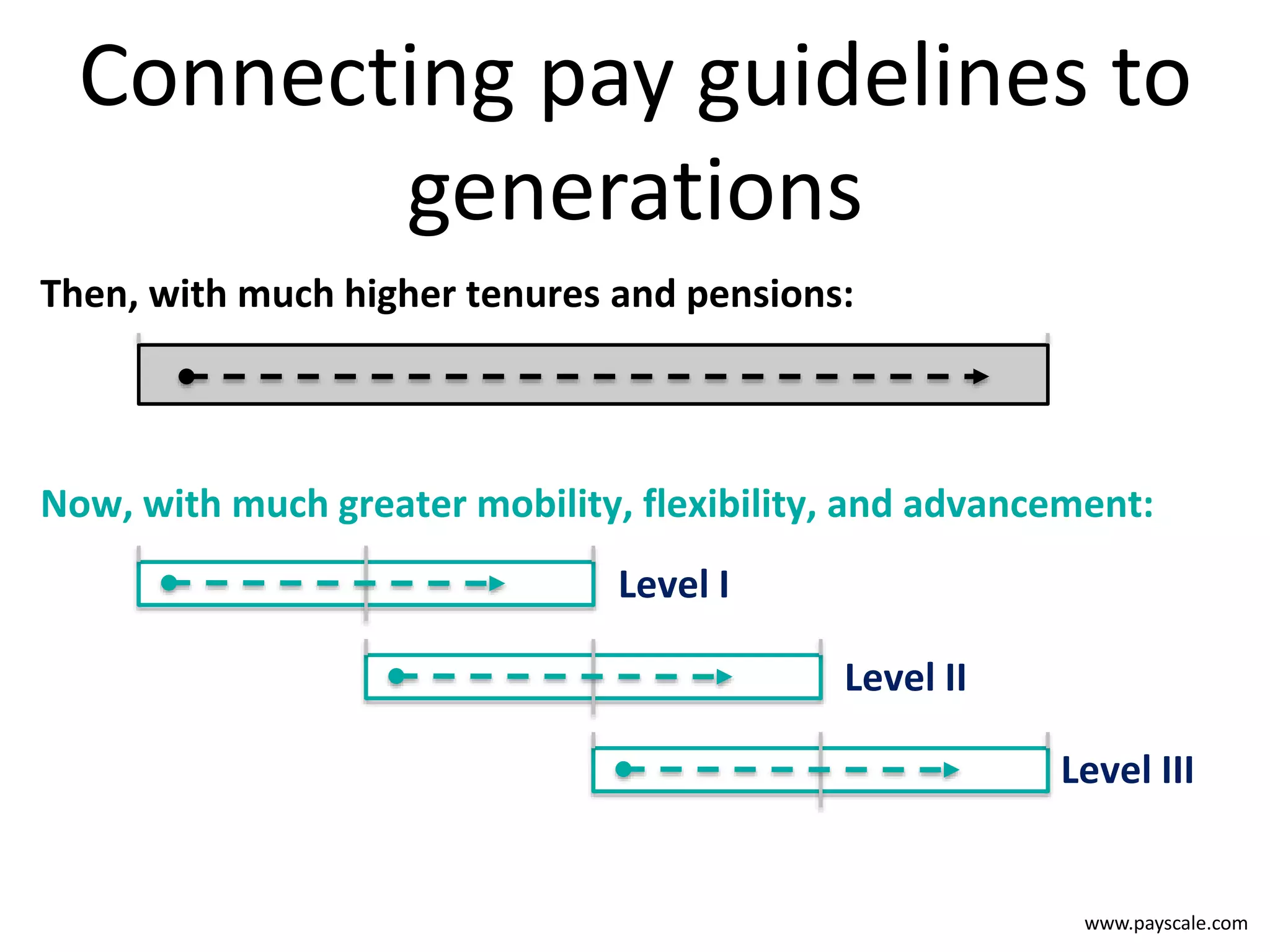
Connecting pay guidelines to
generations
Now, with much greater mobility, flexibility, and advancement:
Level III
Level II
Level I
Then, with much higher tenures and pensions:
www.payscale.com
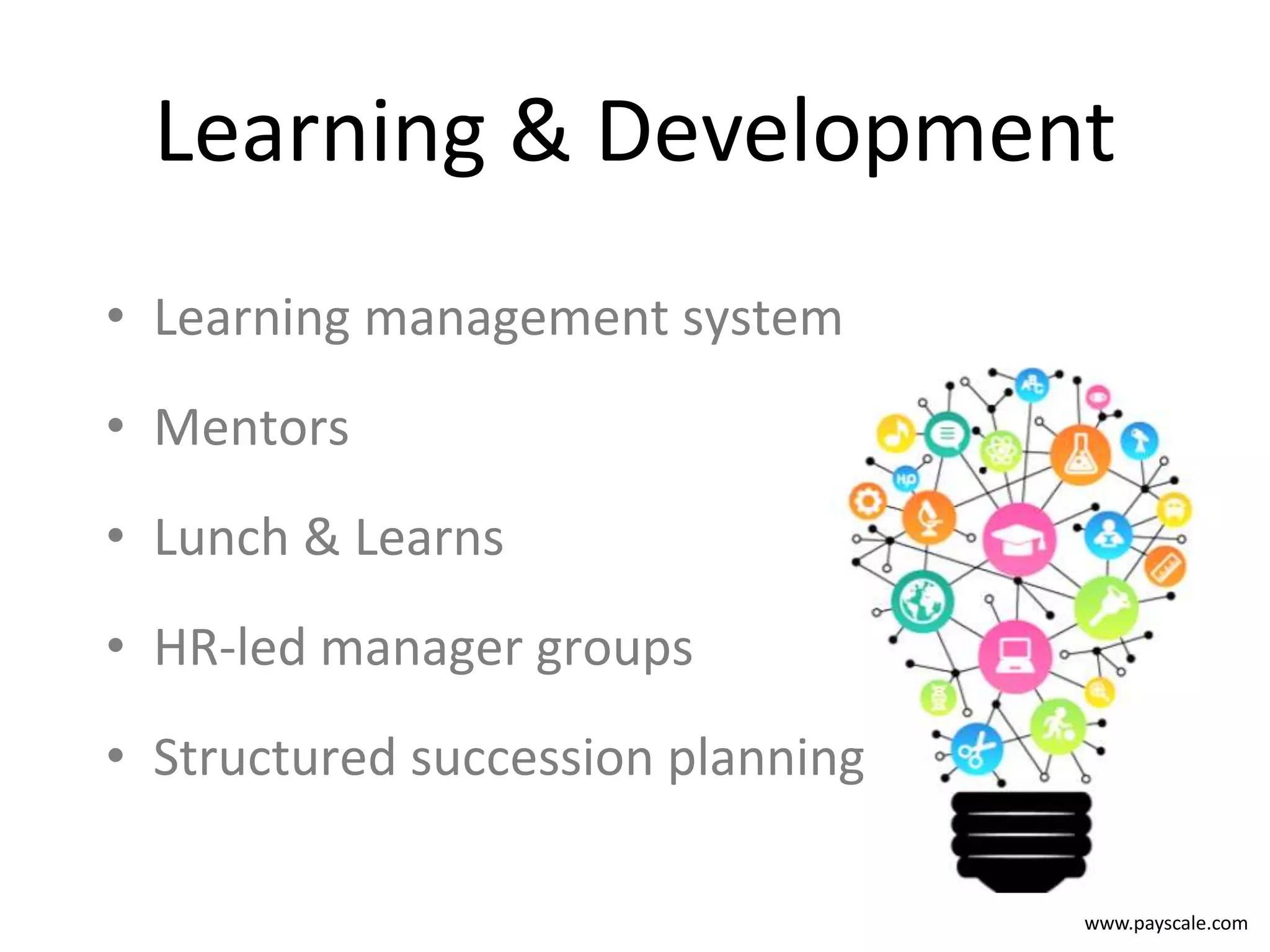
Learning & Development
• Learning management system
• Mentors
• Lunch & Learns
• HR-led manager groups
• Structured succession planning
www.payscale.com
Communication
www.payscale.com
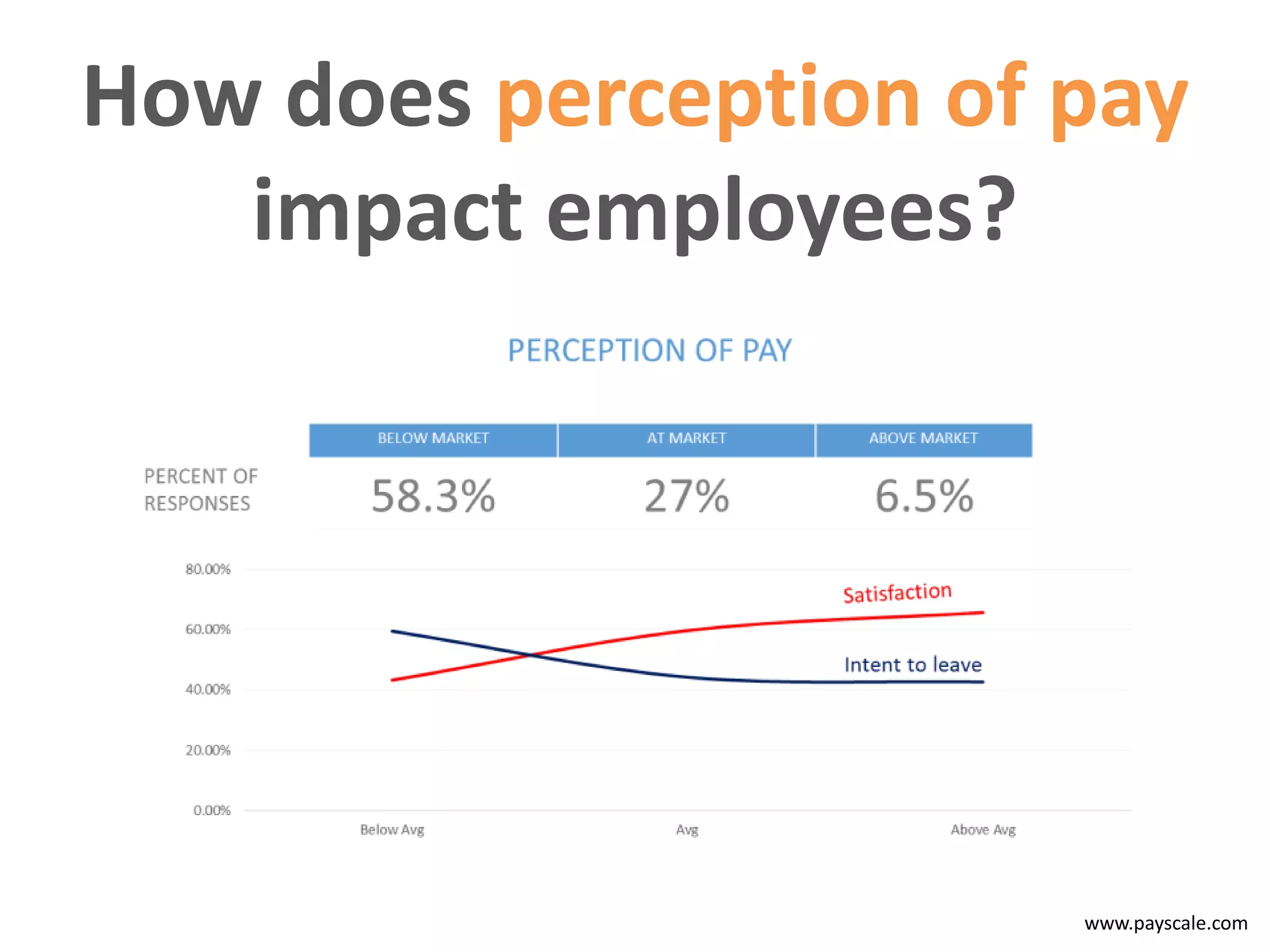
How does perception of pay
impact employees?
www.payscale.com
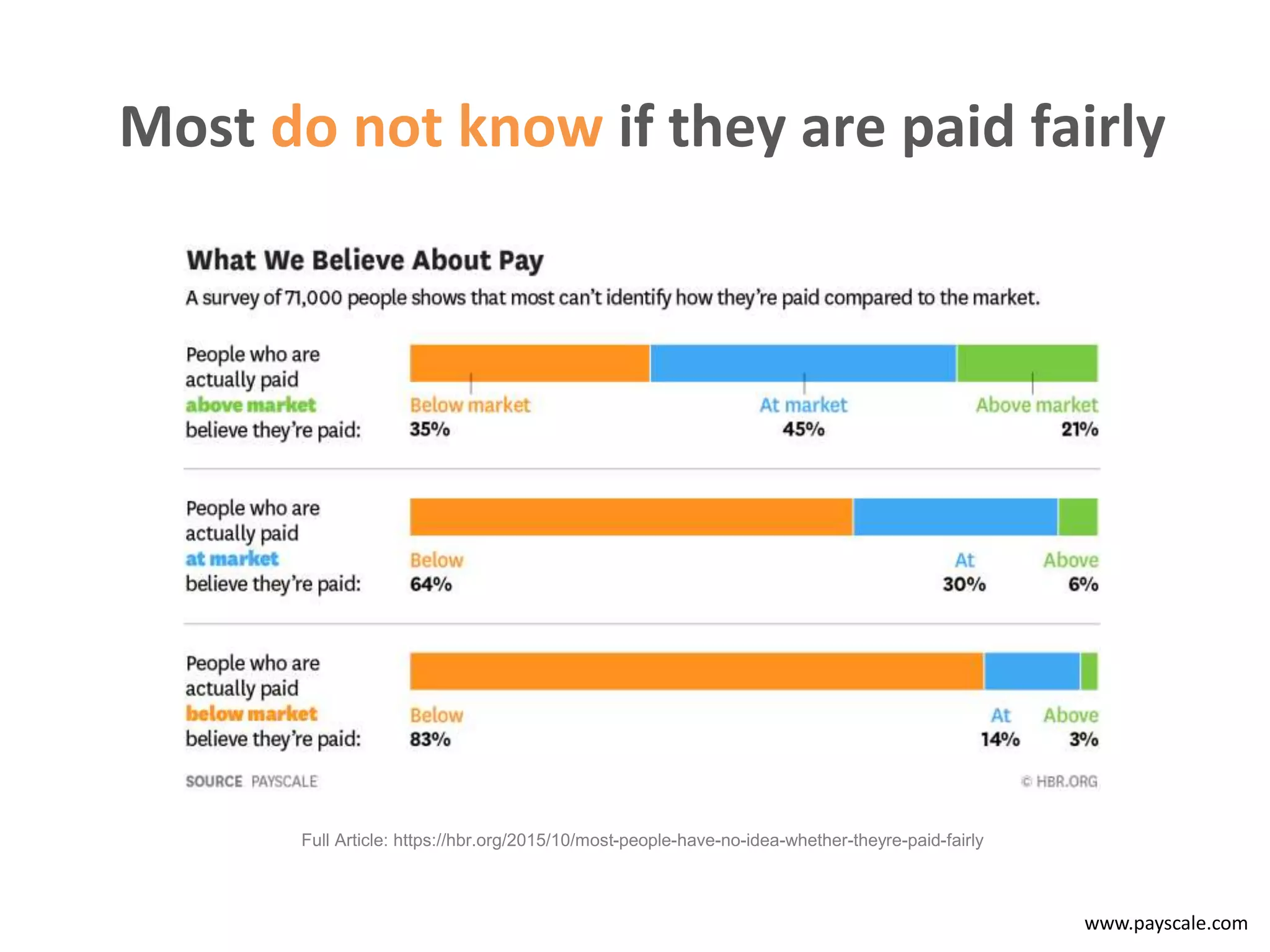
Most do not know if they are paid fairly
Full Article: https://hbr.org/2015/10/most-people-have-no-idea-whether-theyre-paid-fairly
www.payscale.com
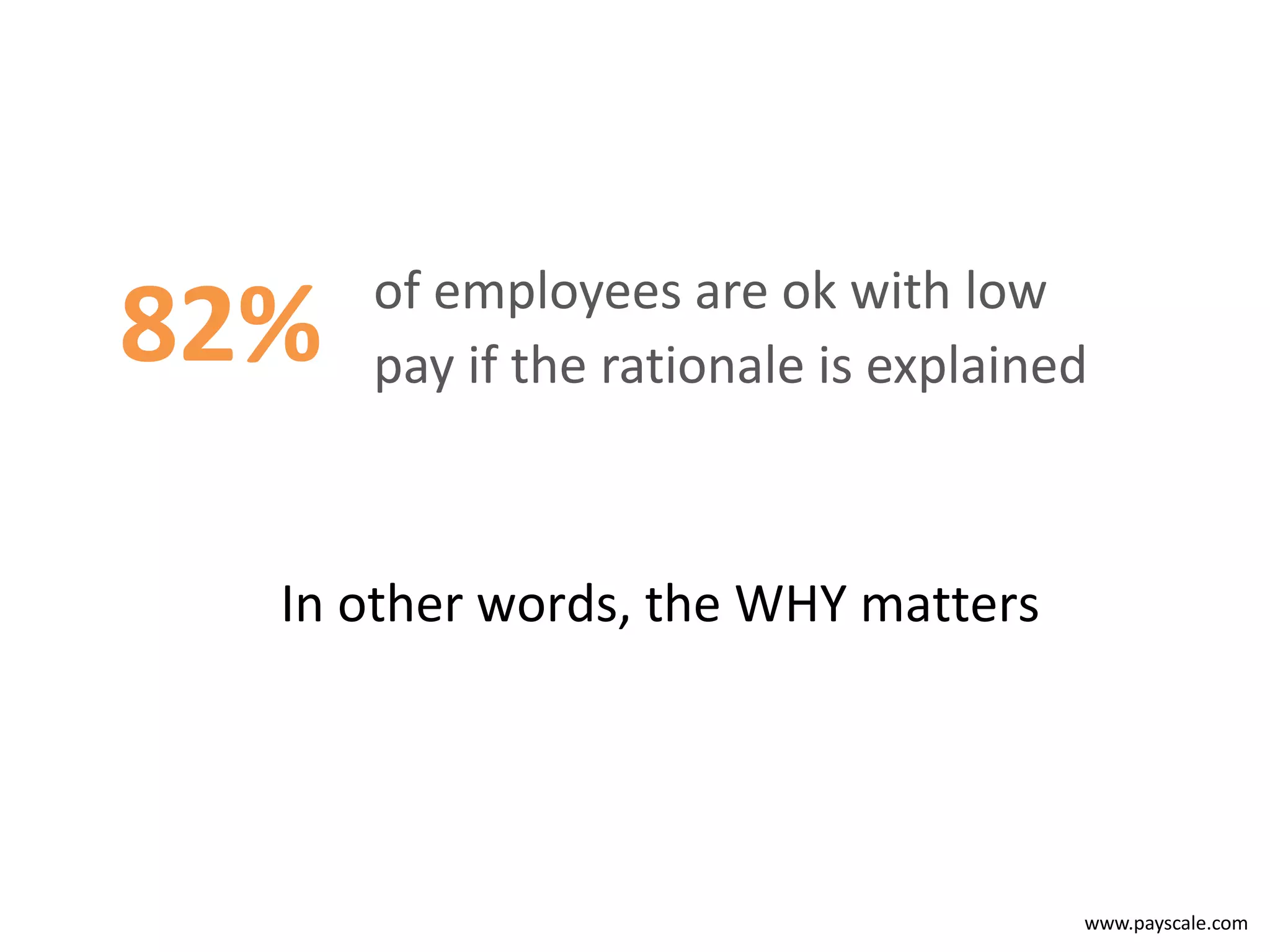
of employees are ok with low
pay if the rationale is explained82%
In other words, the WHY matters
www.payscale.com
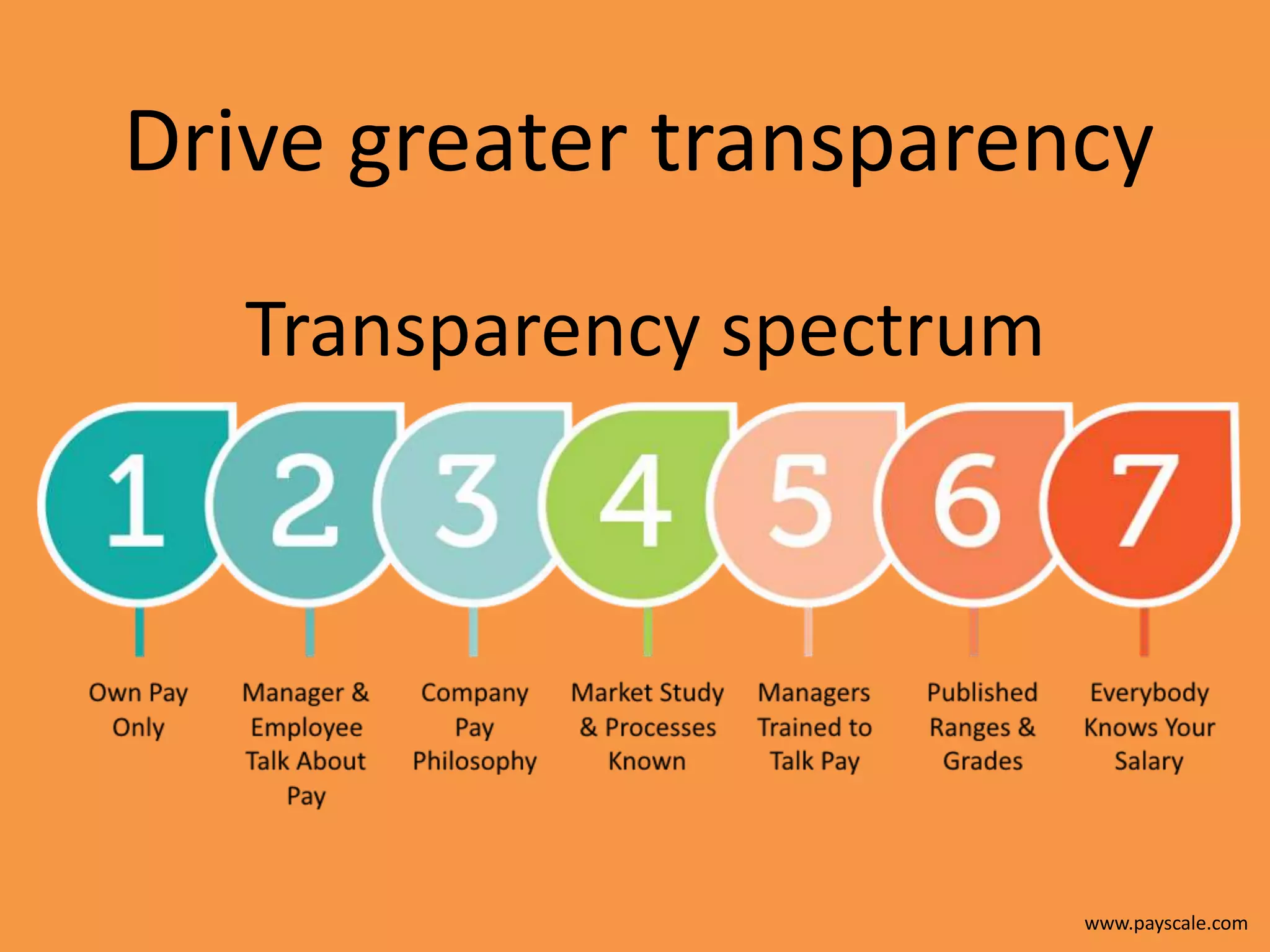
Transparency spectrum
Drive greater transparency
www.payscale.com
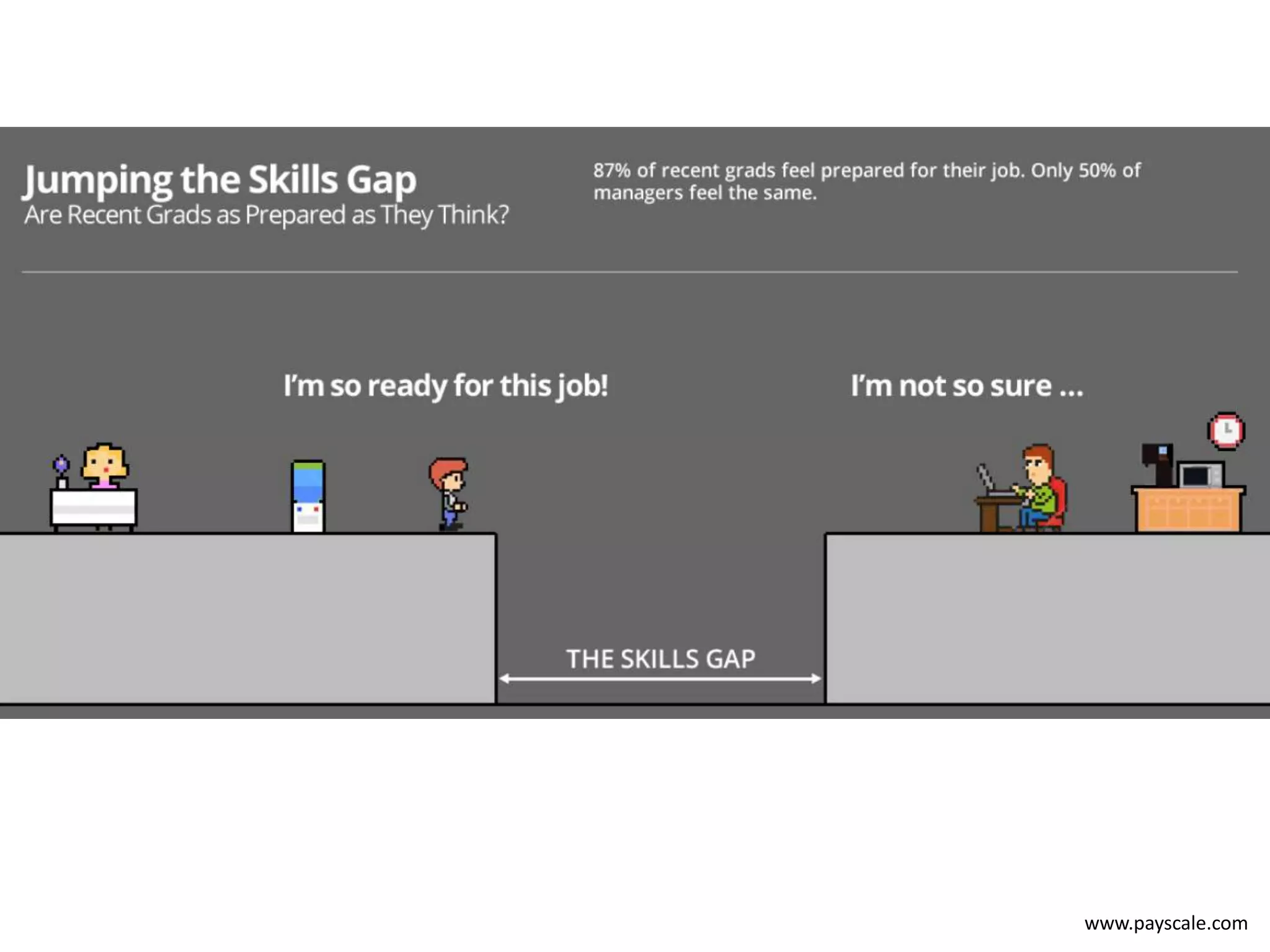
Skills Gap
www.payscale.com
www.payscale.com
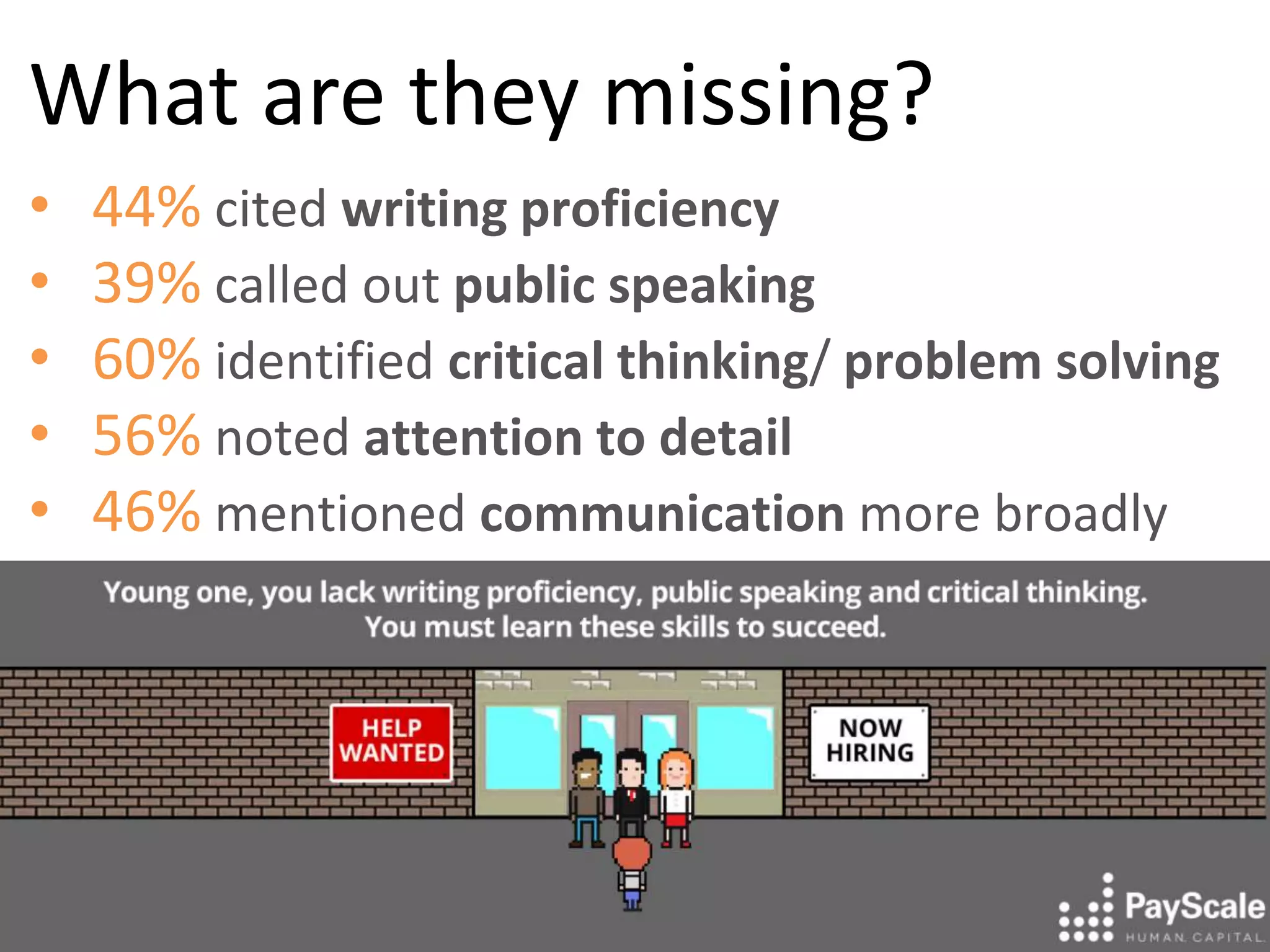
What are they missing?
• 44% cited writing proficiency
• 39% called out public speaking
• 60% identified critical thinking/ problem solving
• 56% noted attention to detail
• 46% mentioned communication more broadly
www.payscale.com
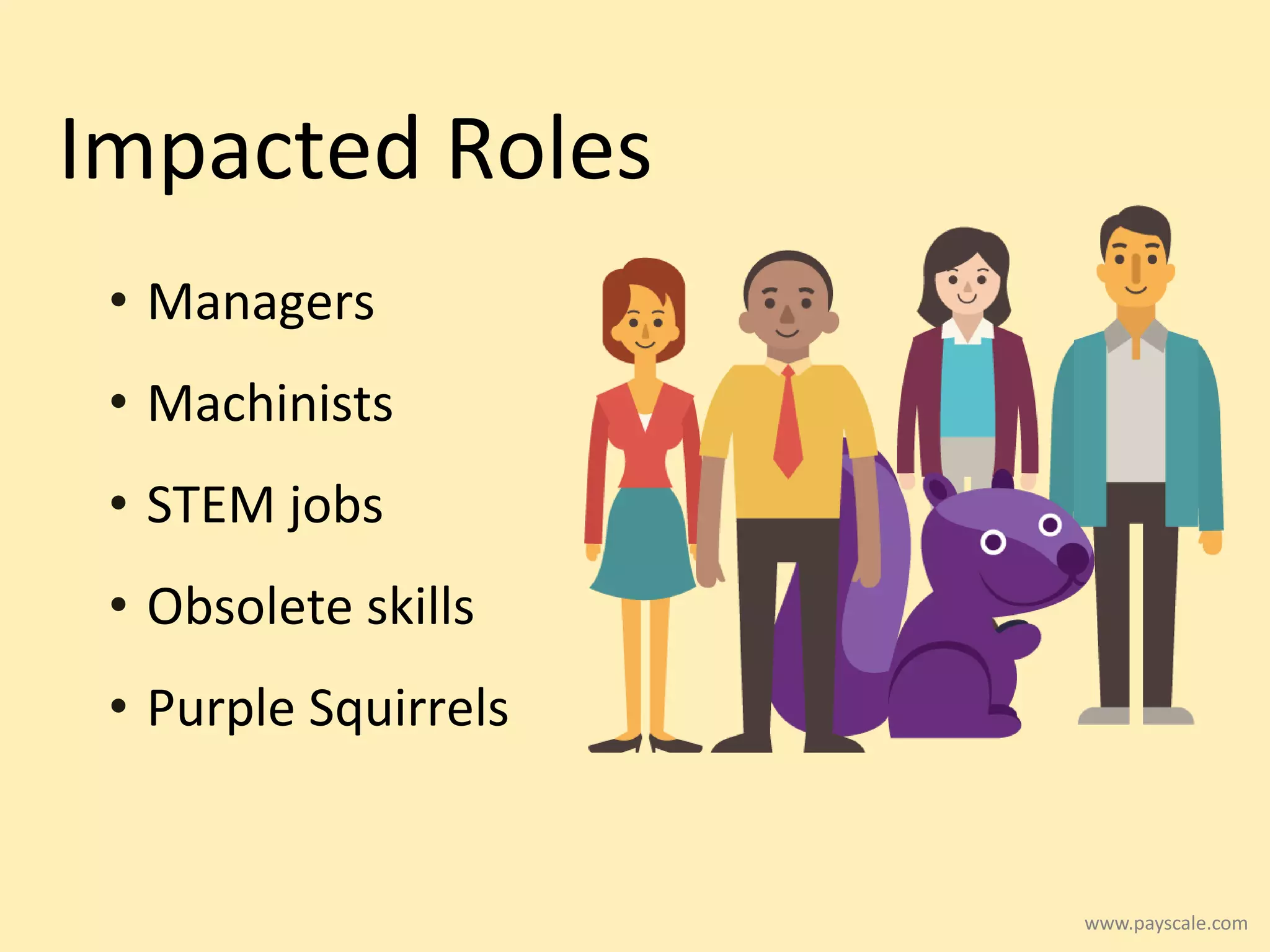
• Managers
• Machinists
• STEM jobs
• Obsolete skills
• Purple Squirrels
Impacted Roles
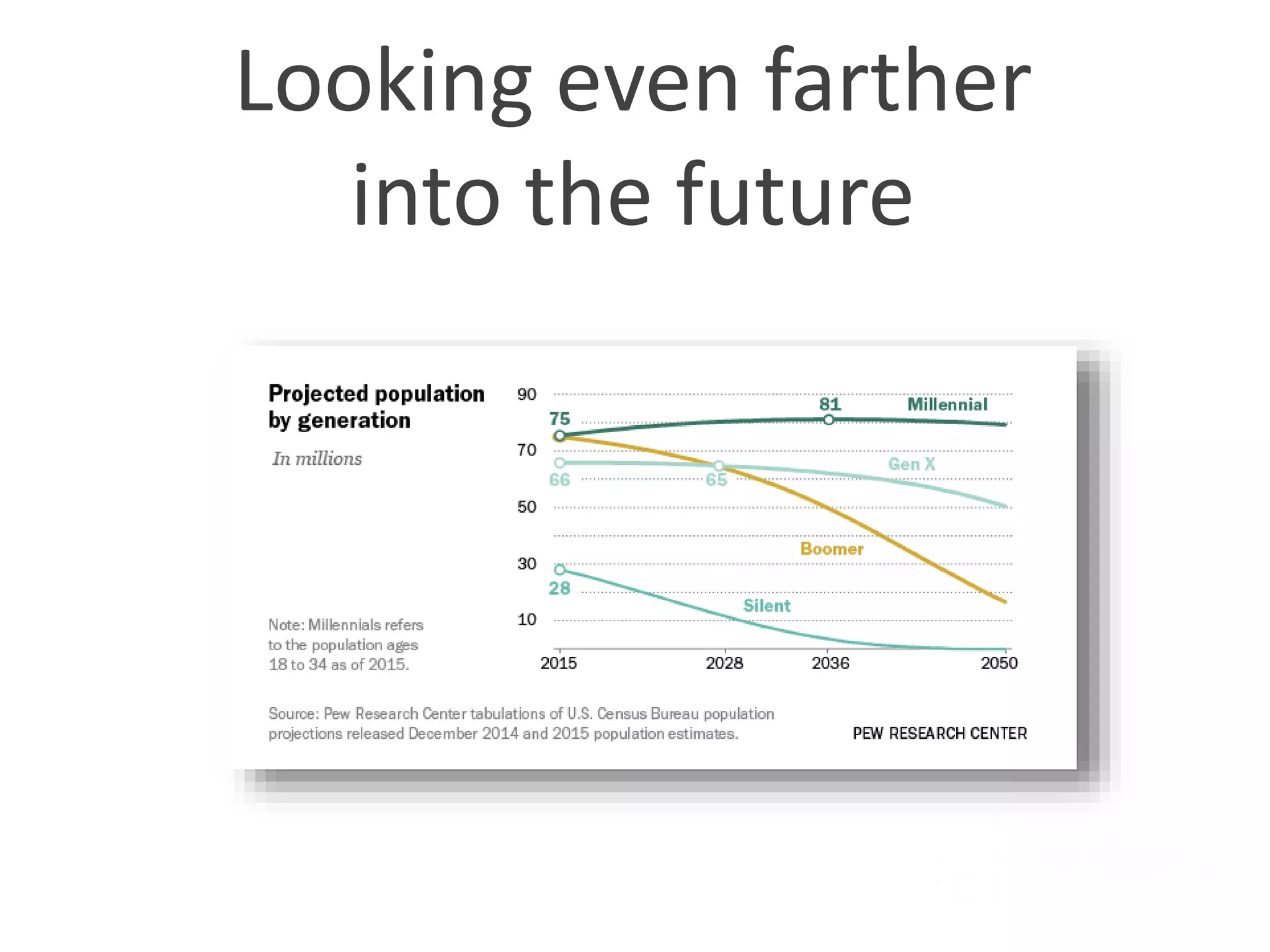
Looking even farther
into the future
www.payscale.com
Need help? Start with these questions:
• What is the make-up of your workforce?
• Determine mix of pay that you currently use – are you using all tiers?
• What are the opportunities for advancement, learning, and development?
• How transparently are you sharing compensation information?
• What skills do you currently have? Lack? How about in 5 years?
PayScale Delivers Where Other Compensation Providers Fall Short
PayScale leads the world in compensation knowledge with the freshest and
most detailed data from over 54 million salary profiles. More than 3500
organizations use PayScale’s software and intelligence to get the greatest
return on their talent. Smart businesses use PayScale Insight to recruit, retain
and motivate their people.
Visit our blog: www.payscale.com/compensation-today
Join our Group on LinkedIn: Compensation Today: HR Best Practices
Angela Ulman, CCP
Compensation Professional
Mykkah Herner, MA, CCP
Modern Compensation Evangelist
www.payscale.com

Webinar-Compensating the Workforce of Tomorrow

Editor's Notes

  • #2 Hedge
  • #3 Hedge Creator of the largest database of individual compensation profiles in the world, PayScale, Inc. provides an immediate and precise snapshot of current market salaries to employees and employers through its online tools and software. PayScale’s products are powered by innovative search and query algorithms that dynamically acquire, analyze and aggregate compensation information for millions of individuals in real time. Publisher of the quarterly PayScale IndexTM, PayScale's subscription software products for employers include PayScale MarketRateTM and PayScale InsightTM. Among PayScale's 2,500 corporate customers are organizations small and large across industries including Mozilla, Tully’s Coffee, Clemson University and the United States Postal Service.  
  • #4 both
  • #5 Mykkah
  • #6 Angela PayScale’s Compensation Best Practices Report noted that 57% of organizations view themselves as modern or forward-thinking. These top organizations take a proactive approach to anticipating the needs of tomorrow’s workforce today. Join Angela Ulman and Mykkah Herner as they explore the best ways to compensate tomorrow’s workforce, now. In this webinar we’ll cover: Ways to examine and define your workforce Having a great comp strategy that fits your workforce Getting creative about mix of pay Notes for Mykkah for later: 72%ERs have or plan to have a formal comp strategy 61%Top Performing Orgs pay more for competitive jobs vs only 54% of all companies EEFavorite benefits 35%of top performing companies are changing strategies to accommodate millennials vs 28% of all
  • #7 Mykkah Nearly 7600 Respondents
  • #8 Mykkah We’ll spend most time on Generation Picking on Generation as one characteristic of the 2020 workforce. That said, there are lots of other things to think about: life stage, economic class (job level), urban/rural – opportunity, size of your organization (movement up?)
  • #9 Mykkah Take a page out of the marketing handbook Consider building out 4-5 different personas that represent your WF & test/target communication and programs to them. - Angela Berg & David Stavney 2016 W@W conference (mercer) - Forrester – doing this in the IT world in 2009 - Originallly a marketing thing.
  • #10 Mykkah That said, there are lots of other things to think about: life stage, economic class (job level), urban/rural – opportunity, size of your organization (movement up?) You don’t see protected classes here: gender, race, ethnicity, age. If one of your org objectives is to be diverse, this is a good time to keep those initiatives in mind. https://www.bamboohr.com/webinars/diverse-workforce/
  • #11 Angela There have been a lot of studies on different generations in the workforce so we’ll spend most of our time on that, but keep in mind the other characteristics that Mykkah just mentioned as well.
  • #12 Angela There are really 5 different generations in the workforce right now. TRADITIONALISTS - 1900 - 1945 (Age 71+) Sometimes called the Silent Generation They currently makeup slightly less than 5% of the workforce. Their characteristics and preferences are important to consider if they are part of your workforce, but when thinking about compensating the workforce of the future they probably won’t be a driving force Career Mindset: similar to Boomers, also Age=Seniority, Company first BABY BOOMERS (Age 52-70) GEN X (Age 37-51) Never became the biggest generation MILLENNIALS (Age 21-36) Sometimes also called Gen Y Modern technology started during their formative years GEN Z (Up to Age 20) Sometimes called the iGen We’re not really sure who they are yet, and the defining line between Millennials and Gen Z is still fuzzy We do know that they grew up with technology and it impacts how they think and communicate. From the last generations package on the consumer side http://www.payscale.com/data-packages/generations-at-work: - 72% of millennials are more likely to value opptys for career advancement (vs 52% and 64% for boomers and gen xers respectively) - 72% also value the chance to learn new skills, vs 48% and 62% of boomers and gen xers Millennials opened the door – we all walked through
  • #13 Mykkah
  • #14 Mykkah https://hbr.org/2009/10/are-you-ready-to-manage-five-g
  • #15 Mykkah
  • #16 Angela Now that we know about the workforce, lets talk about the different ways to differentiate value to the different areas of your workforce - attract, retain, motivate, etc.
  • #17 Angela The first way to compensation your workforce is with the mix of pay - which includes all monetary forms of compensation
  • #18 Angela Explanation of what mix is. Priorities: - Pay at Risk vs Potential Pay - flex schedule - fun work environment - work life balance – benefits, flex sched, entitlement - generational diff??? Lifestage Diff???
  • #19 Angela How about for your personas? Bottom = benefits and retirement Base pay for millennials is more about advancement Potential pay Here we have it listed by generation, but other factors like life stage /life style may have more influence -> for example, whether an employee has children or likes to travel may have more affect Priorities: - Pay at Risk vs Potential Pay - flex schedule - fun work environment - work life balance – benefits, flex sched, entitlement - generational diff??? Lifestage Diff???
  • #20 Angela Getting it right doesn’t have to cost a lot Think about the intangibles that matter
  • #21 Angela This is where your comp strategy really comes into play. What are you trying to reward? How do you plan to use compensation to get you there. Decide what’s important to your org and reward based on that. Engineers v accountants want different mix of pay, but you can still differentiate pay fairly based on what you’re driven by as an organization. Fairness is rooted in consistency
  • #22 Mykkah
  • #23 Mykkah
  • #24 Mykkah Again a reminder that Millennials opened the door and we all walked through it. Especially when you consider that b/c of size, Gen X was *never* a majority generation
  • #25 Mykkah
  • #26 Mykkah Great news – it doesn’t have to cost a ton of money.
  • #27 Angela
  • #28 Angela From the engagement survey of 71K employees in 2015 Here’s my logic --- there are a few ways to appreciate employees: - through relationship with manager - through providing a good career path - through paying them. So I’m setting up the argument that the is a link between EE satisfaction, EE intent to leave, and perception of pay.
  • #29 Angela That said - most people don’t know how they’re paid Dig into each line - explain why each is a communication issue What about these these 3% of people? What else are they getting that makes them think this, culture? From Dave’s HBR Article: “This may sound obvious, but our survey showed that “intent to leave” decreased in relation to how favorable an employee felt about their pay. For example, 60% of employees who perceived they were underpaid said they intended to leave, compared to only 39% of those who perceived they were overpaid. The bottom line is this: if you don’t communicate to your employees that they are being paid fairly compared to their talent market, they may leave.” https://hbr.org/2015/10/most-people-have-no-idea-whether-theyre-paid-fairly First, people are often wrong about how much they’re paid compared to the going market rate. Perceptions about pay don’t always reflect reality, even if employers are paying the same — or more — than similar companies. In fact, a whopping two-thirds of people who are being paid the market rate believe they’re actually underpaid, representing a huge discrepancy. You all probably remember this – it’s the result of a lot of folks thinking around how and why companies decide to pay what they pay. These particular questions were the result of an academic paper out of Berkeley – the state of CA passed a law that all public employees salary needed to be published and available to the public. Some profs at Berkeley decided to do an experiment and let send email communications and surveys to employees of the school system What they found out was fascinating – 80% of the people who got access actually clicked thru. And looked. Those that were paid more than peers – had little effect. Those paid less than peers had an immediate reaction – the after scores for “how likely are you to seek work elsewhere in the next 6 months” skyrocketed – once they had the data. We added one particular question – how transparent and fair do you think your company’s pay processes are? So, it turns out perceptions about pay play a significant role in an employee’s desire to leave your company. They matter more than pay. This may sound obvious, but our survey showed that “intent to leave” decreased in relation to how favorable an employee felt about their pay. For example, 60% of employees who perceived they were underpaid said they intended to leave, compared to only 39% of those who perceived they were overpaid. The bottom line is this: if you don’t communicate to your employees that they are being paid fairly compared to their talent market, they may leave.
  • #30 Angela EE Survey: This covers 550,000 respondents who filled out PayScale's survey in 2015 and answered the various questions mentioned in the "Corporate Chasm" tab of the CPBR results. Shows years of experience
  • #31 Angela Millennials Expect greater communication. Drive transparency to the right, choosing the best level is going to depend on the makeup of your workforce and your culture They’re likely at a 2 or 3. Aiming for 4 or 5 to work well with the Millennium Audience. Pay Philosophy Pay Strategy Pay Practices Market Studies Pay Rates
  • #32 Mykkah 6+ months with an open job Hard to fill Real or myth? – fact is some jobs are going empty
  • #33 Mykkah - A higher percentage of managers who are Millennials (55%) feel that recent college graduates are well-prepared compared to managers from older generations (47% Gen X, 48% Baby Boomers). For the workplace preparedness and skills gap data, we surveyed managers and recent college graduates in the U.S. in early 2016 who completed the PayScale employee compensation survey. Managers: 63,924  Recent graduates: 14,167
  • #34 Mykkah - A higher percentage of managers who are Millennials (55%) feel that recent college graduates are well-prepared compared to managers from older generations (47% Gen X, 48% Baby Boomers). For the workplace preparedness and skills gap data, we surveyed managers and recent college graduates in the U.S. in early 2016 who completed the PayScale employee compensation survey. Managers: 63,924  Recent graduates: 14,167
  • #35 Mykkah Managers – not retiring Machinists – lifers STEM – leap of faith Obsolete skills (Medical Records vs EMR) Purple Squirrels
  • #36 Angela Population, not workforce Thinking about future workforce, consider othe rfactors too
  • #37 Angela
  • #38 Quiz/Poll –