Comp Foundations:
How to be an
Analytics Hero
www.payscale.com
Introduction
Angela Ulman, CCP
Compensation Professional
Jenny Lindenstein
Manager, Customer Success
www.payscale.com
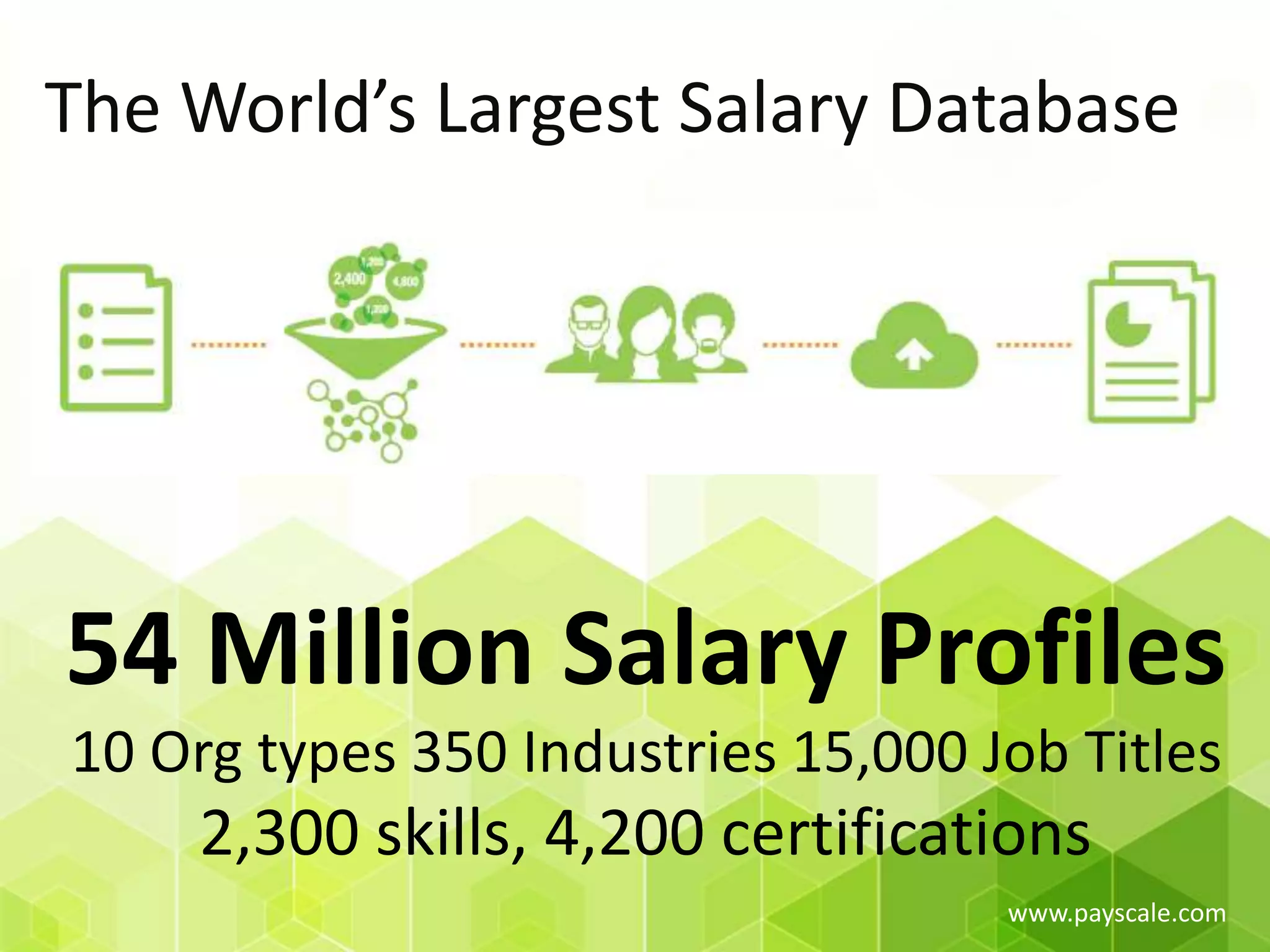
54 Million Salary Profiles
10 Org types 350 Industries 15,000 Job Titles
2,300 skills, 4,200 certifications
The World’s Largest Salary Database
www.payscale.com
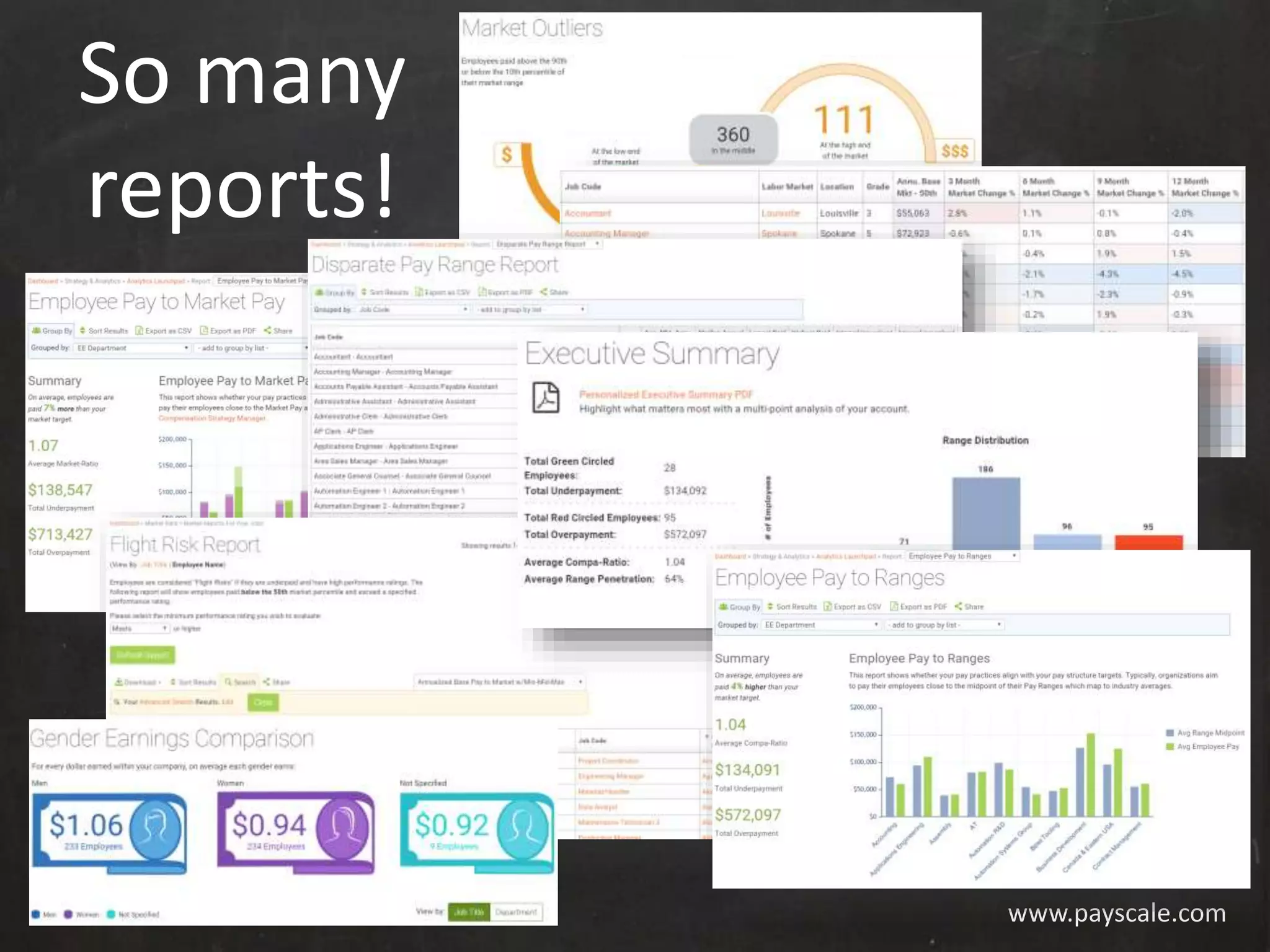
So many
reports!
www.payscale.com
The
Basics
www.payscale.com
Exploring the
Analytics Launchpad
www.payscale.com
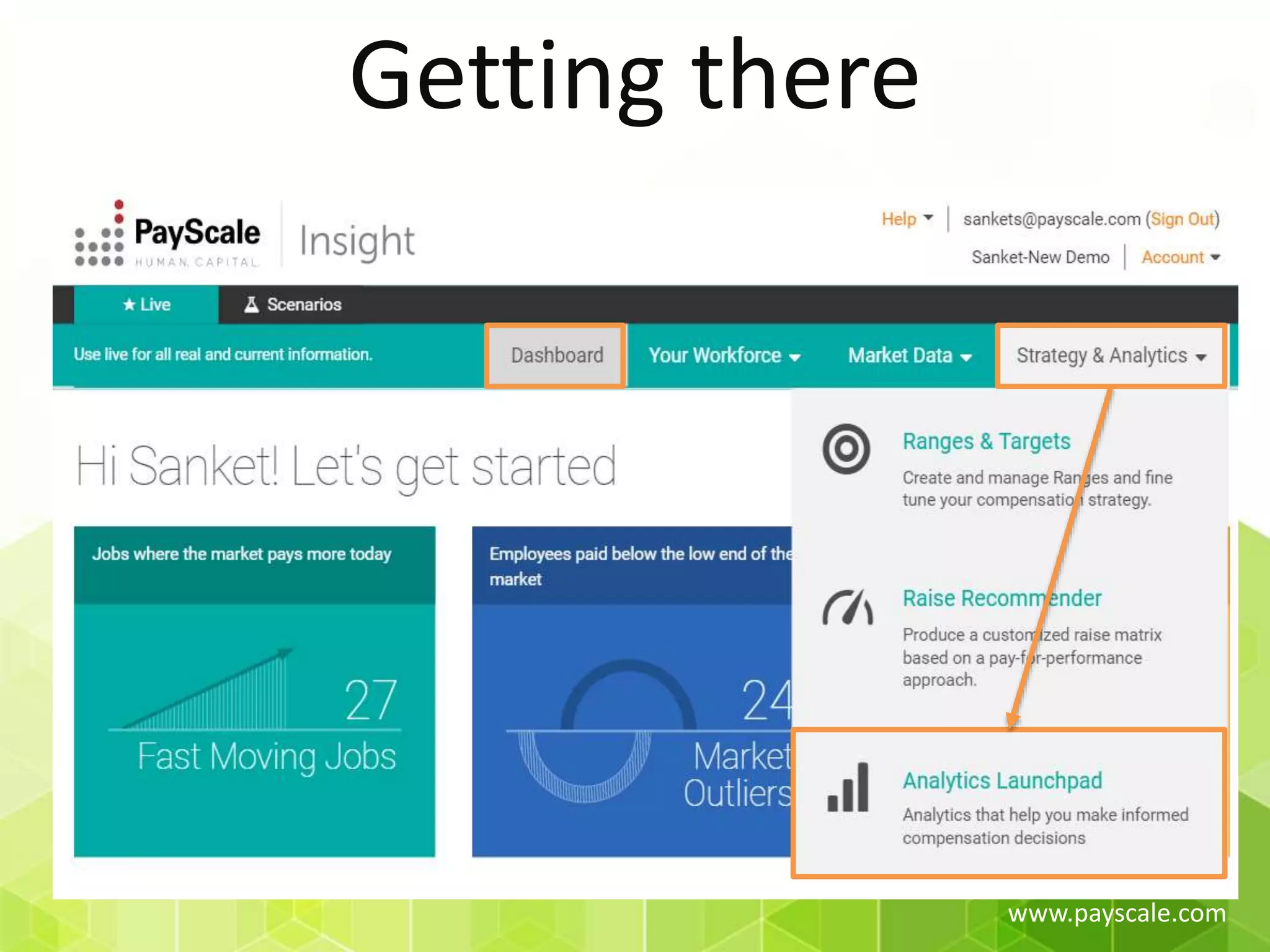
Getting there
www.payscale.com
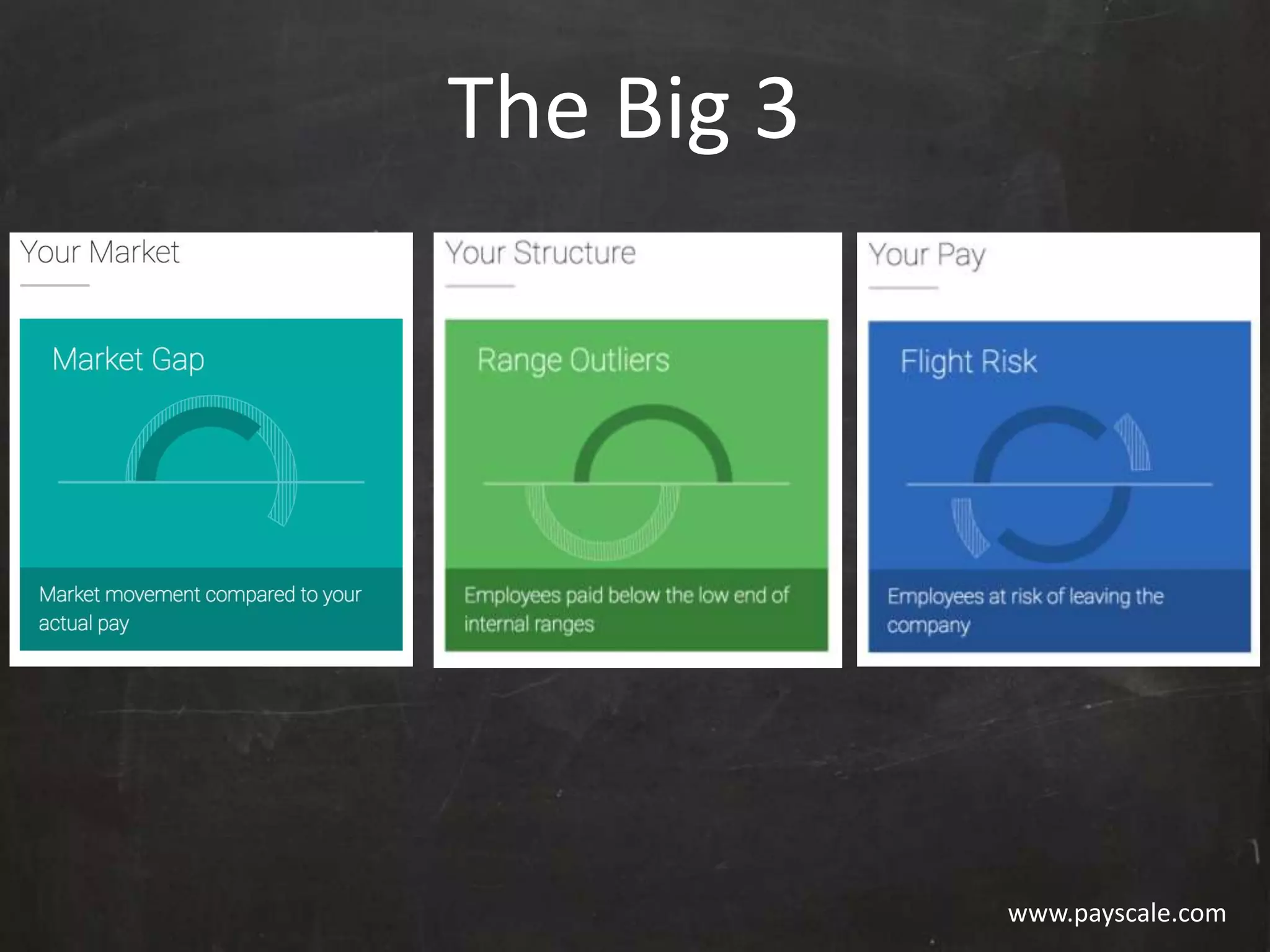
The Big 3
www.payscale.com
www.payscale.com
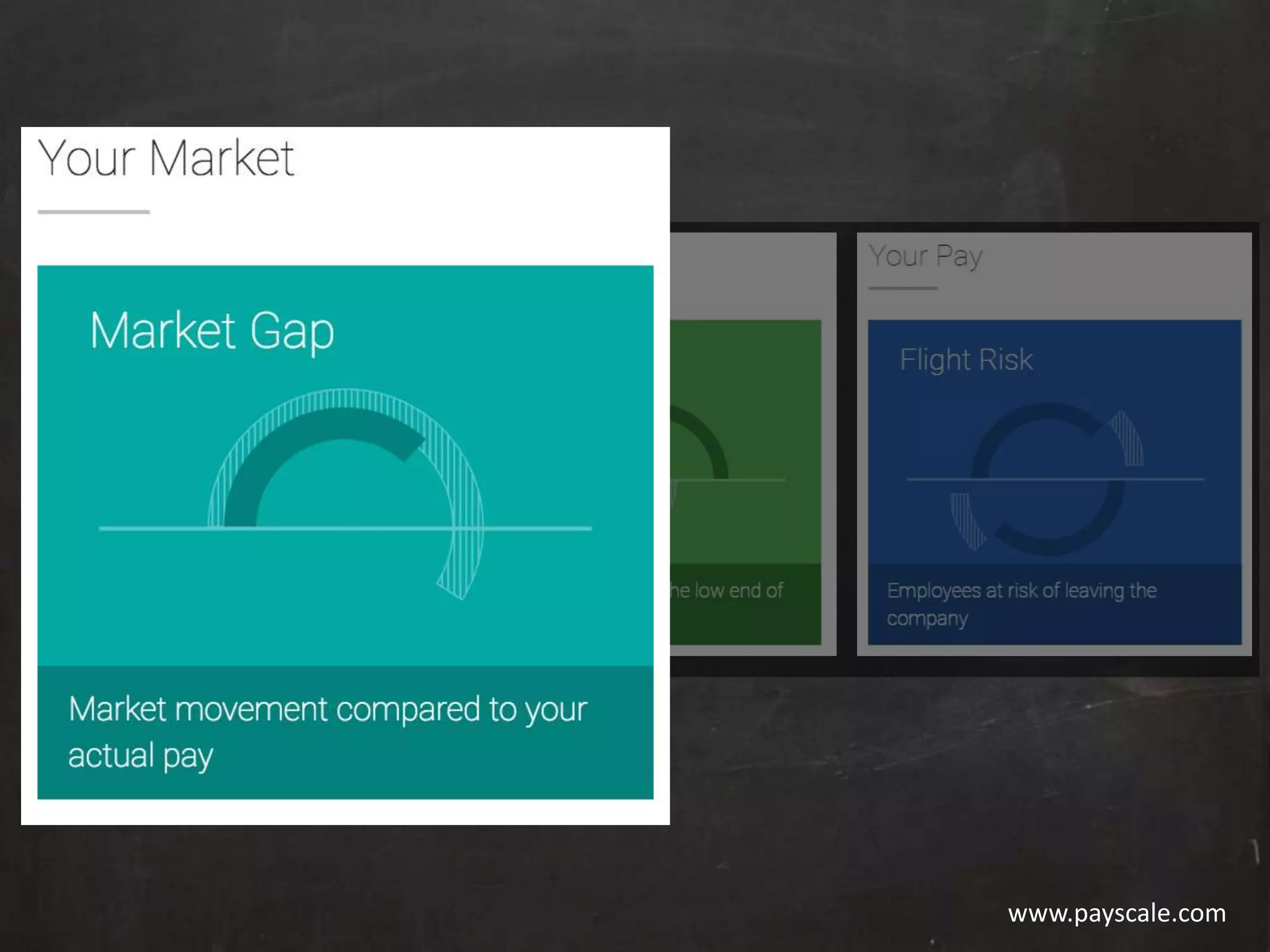
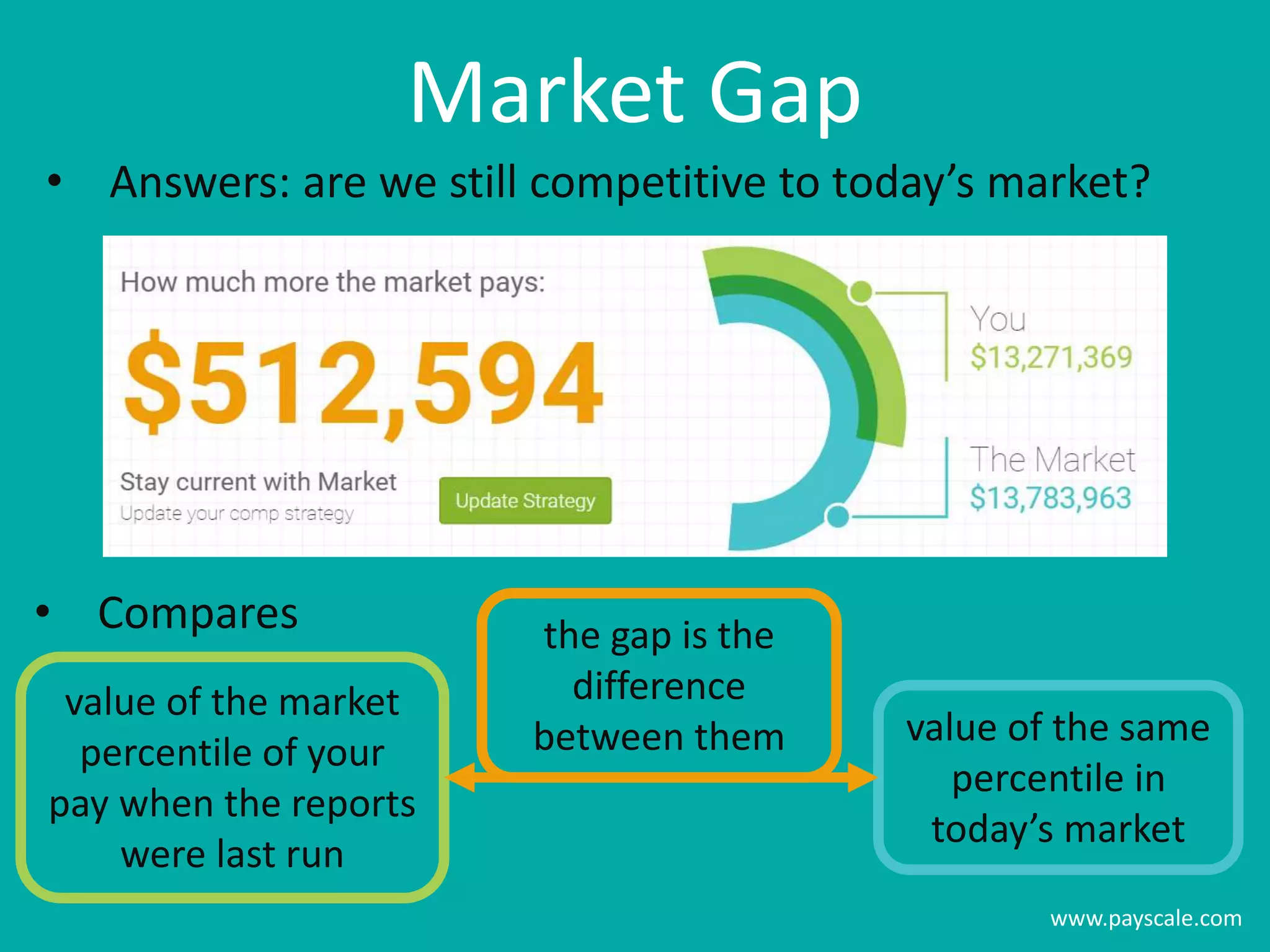
Market Gap
• Compares
• Answers: are we still competitive to today’s market?
value of the market
percentile of your
pay when the reports
were last run
value of the same
percentile in
today’s market
the gap is the
difference
between them
www.payscale.com
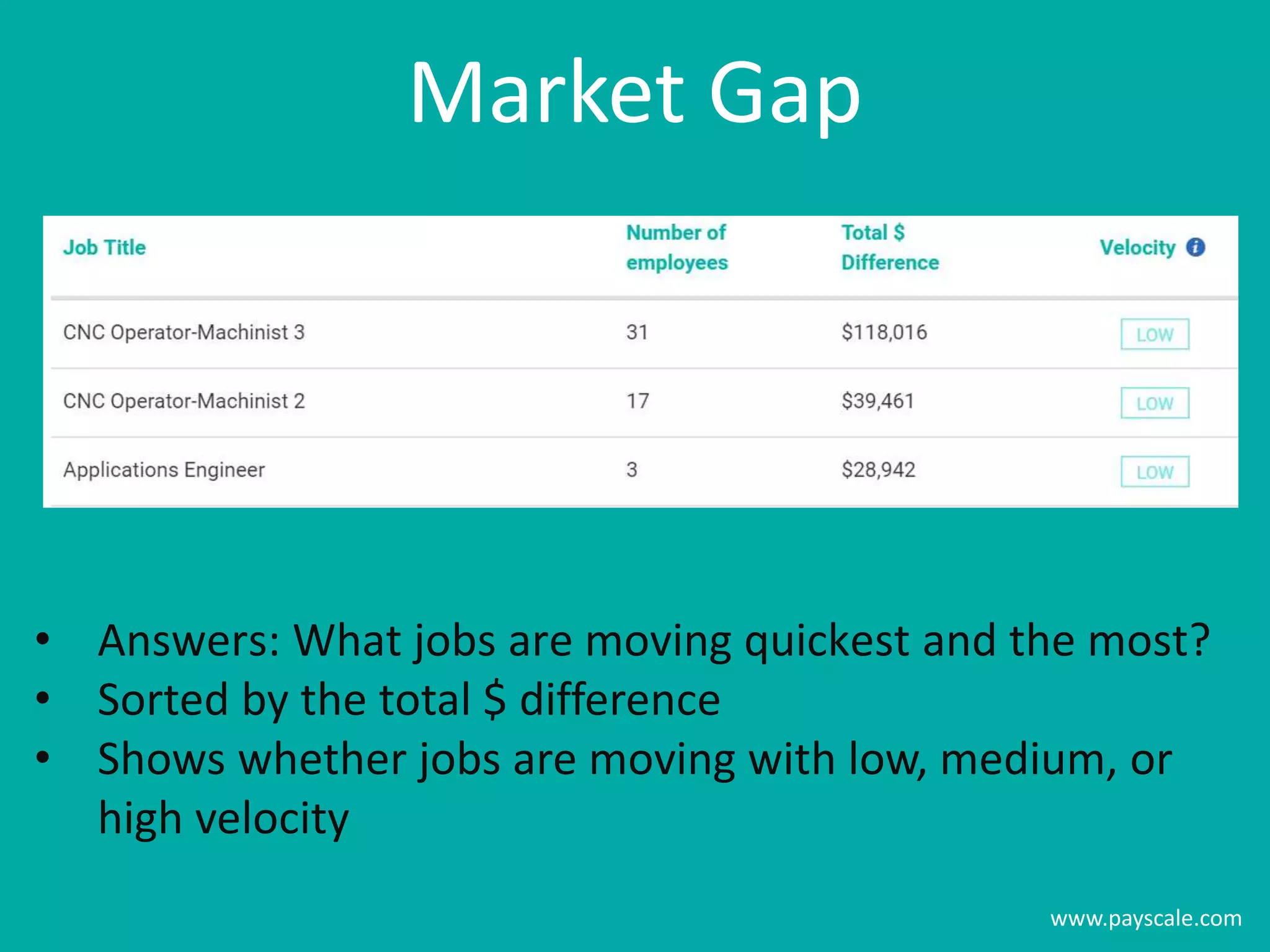
Market Gap
• Answers: What jobs are moving quickest and the most?
• Sorted by the total $ difference
• Shows whether jobs are moving with low, medium, or
high velocity
www.payscale.com
www.payscale.com
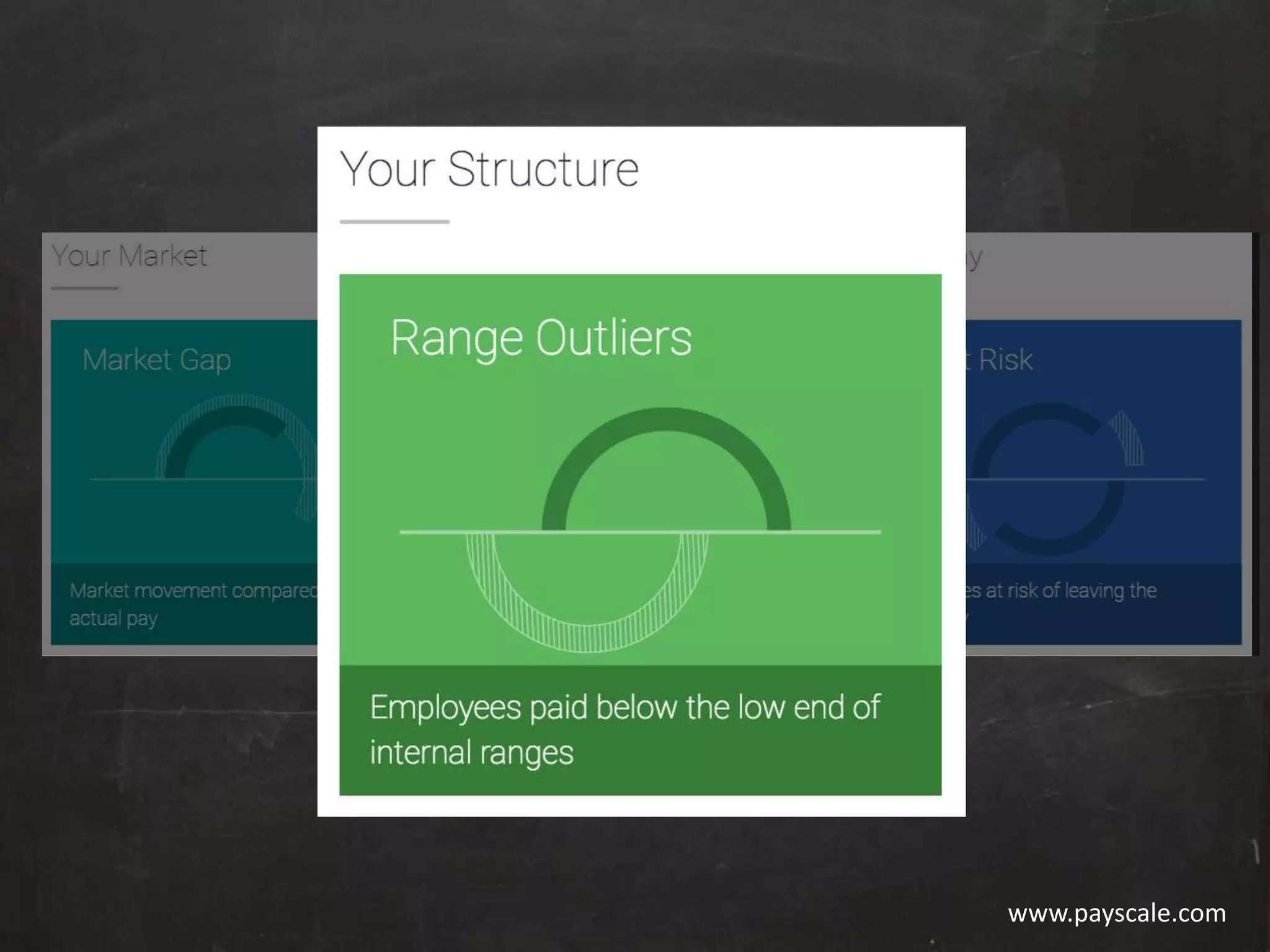
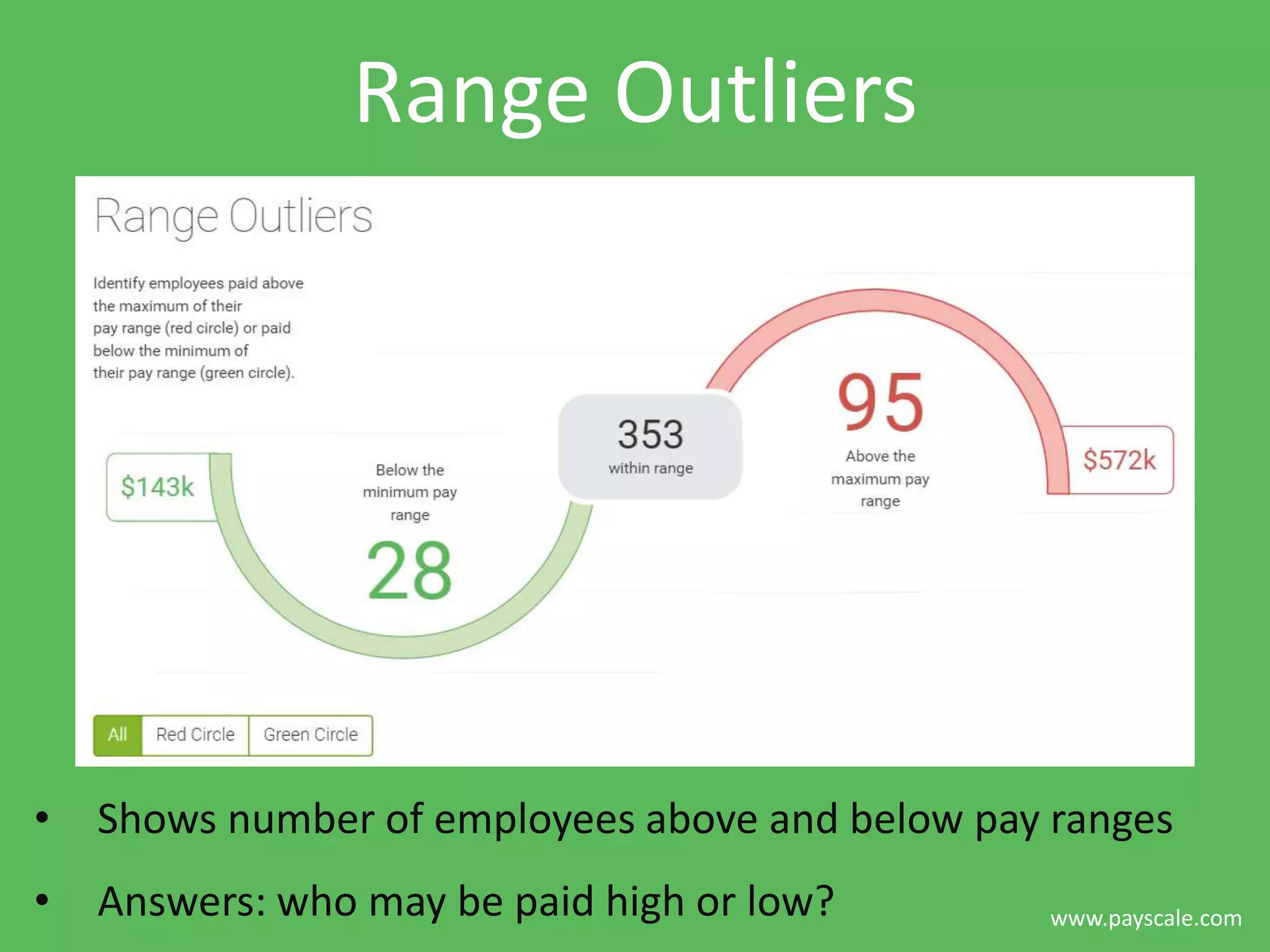
Range Outliers
• Shows number of employees above and below pay ranges
• Answers: who may be paid high or low?
www.payscale.com
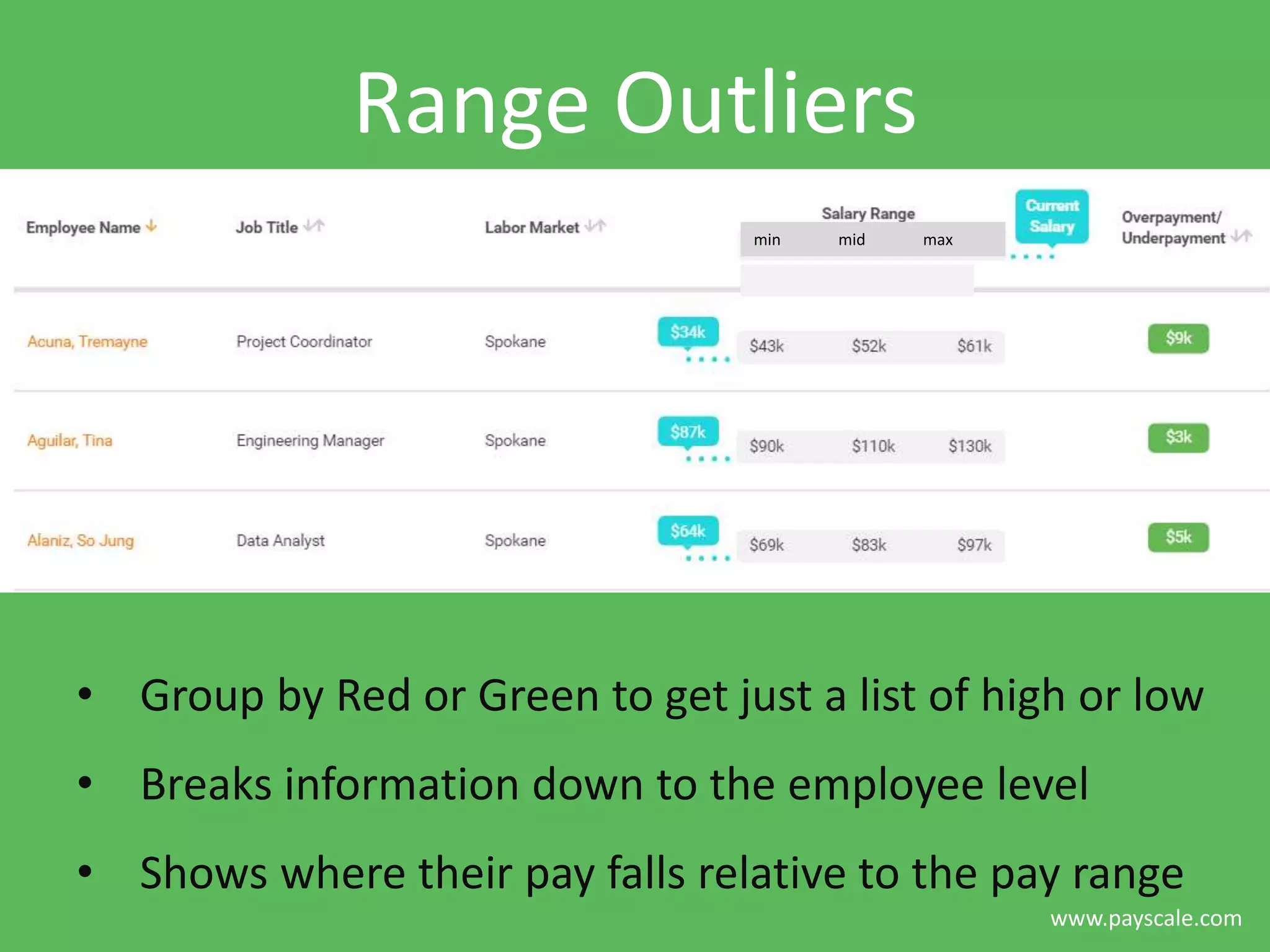
Range Outliers
• Group by Red or Green to get just a list of high or low
• Breaks information down to the employee level
• Shows where their pay falls relative to the pay range
maxmidmin
www.payscale.com
www.payscale.com
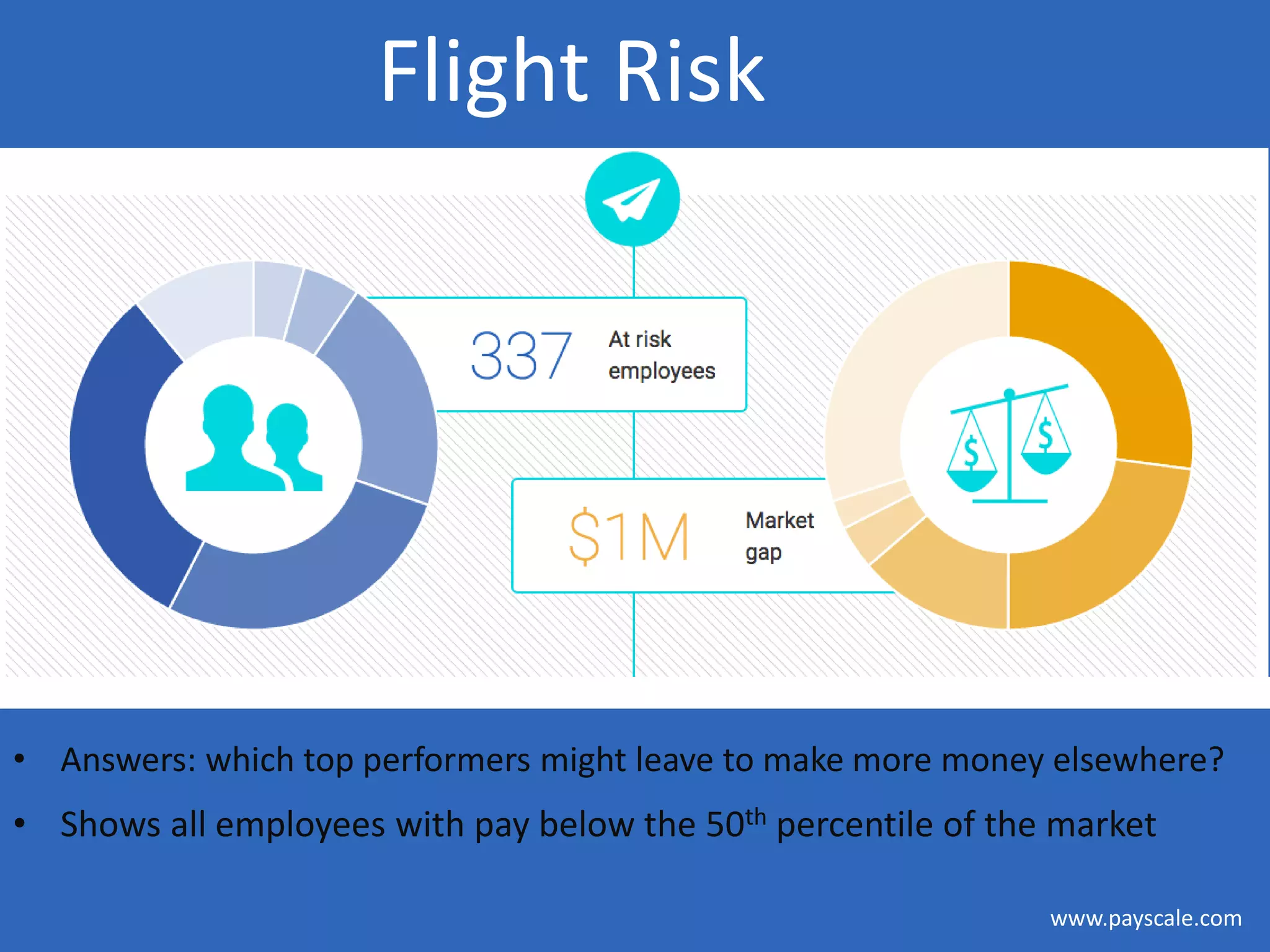
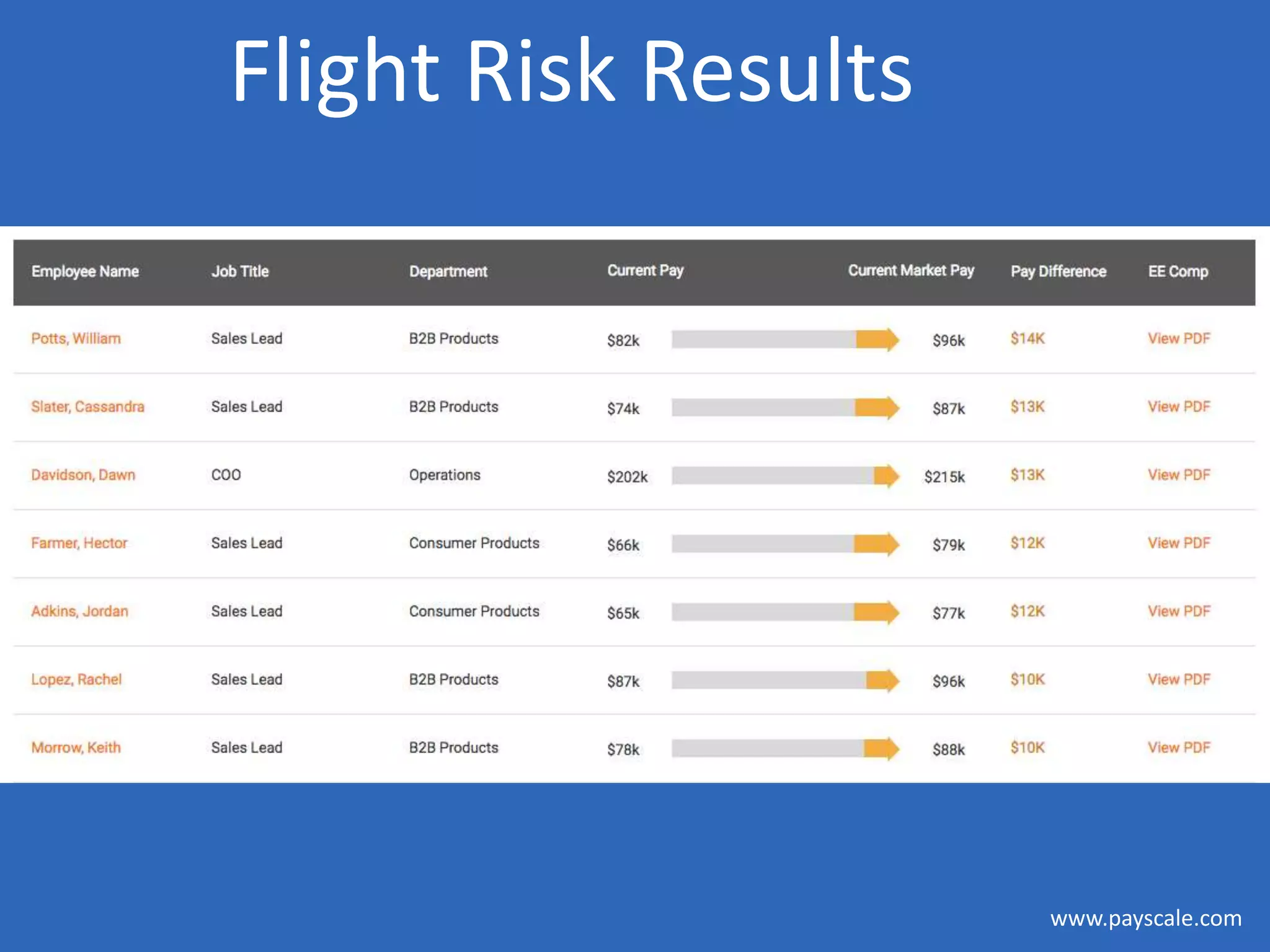
• Answers: which top performers might leave to make more money elsewhere?
• Shows all employees with pay below the 50th percentile of the market
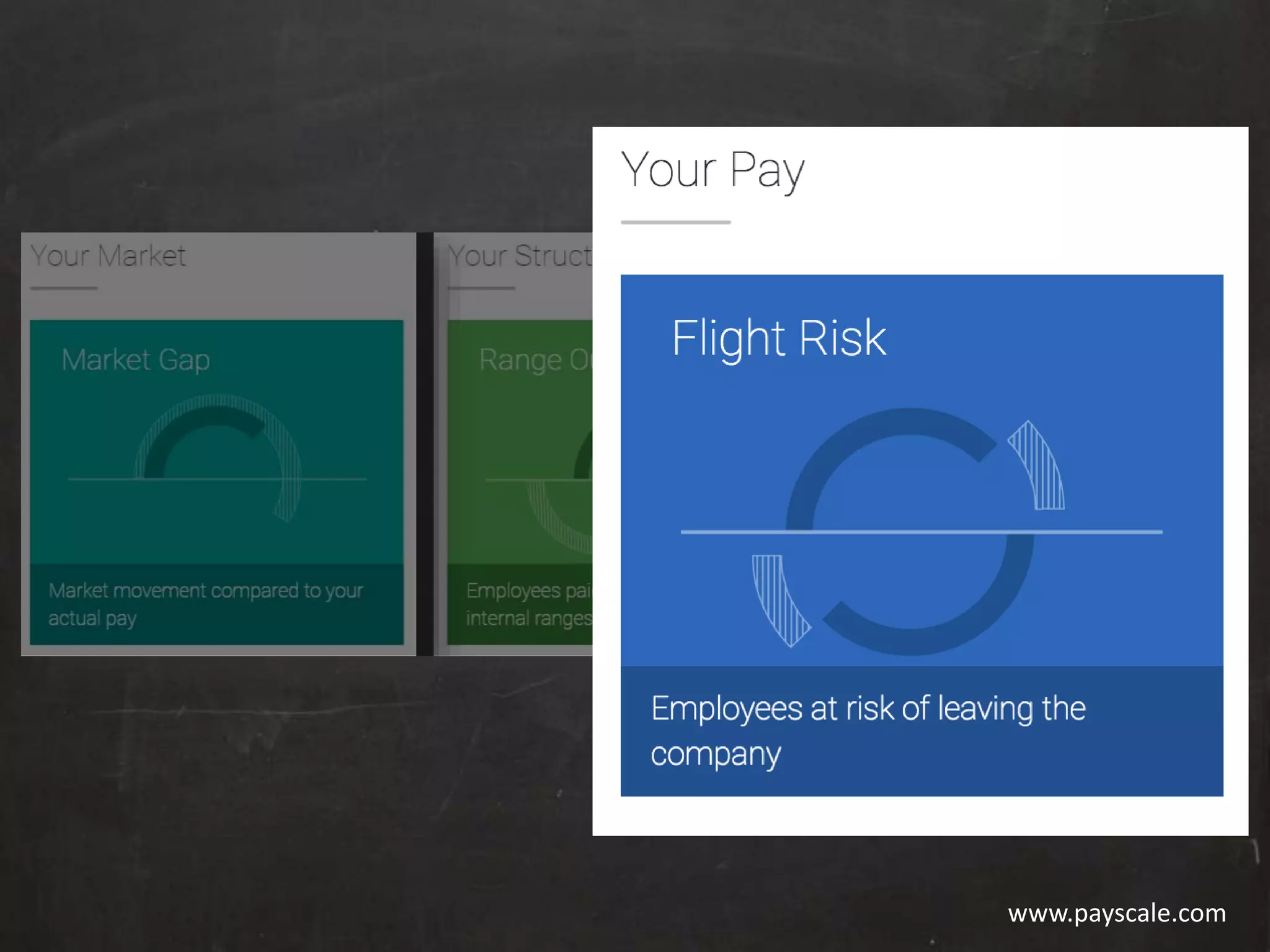
Flight Risk
www.payscale.com
Flight Risk Results
www.payscale.com
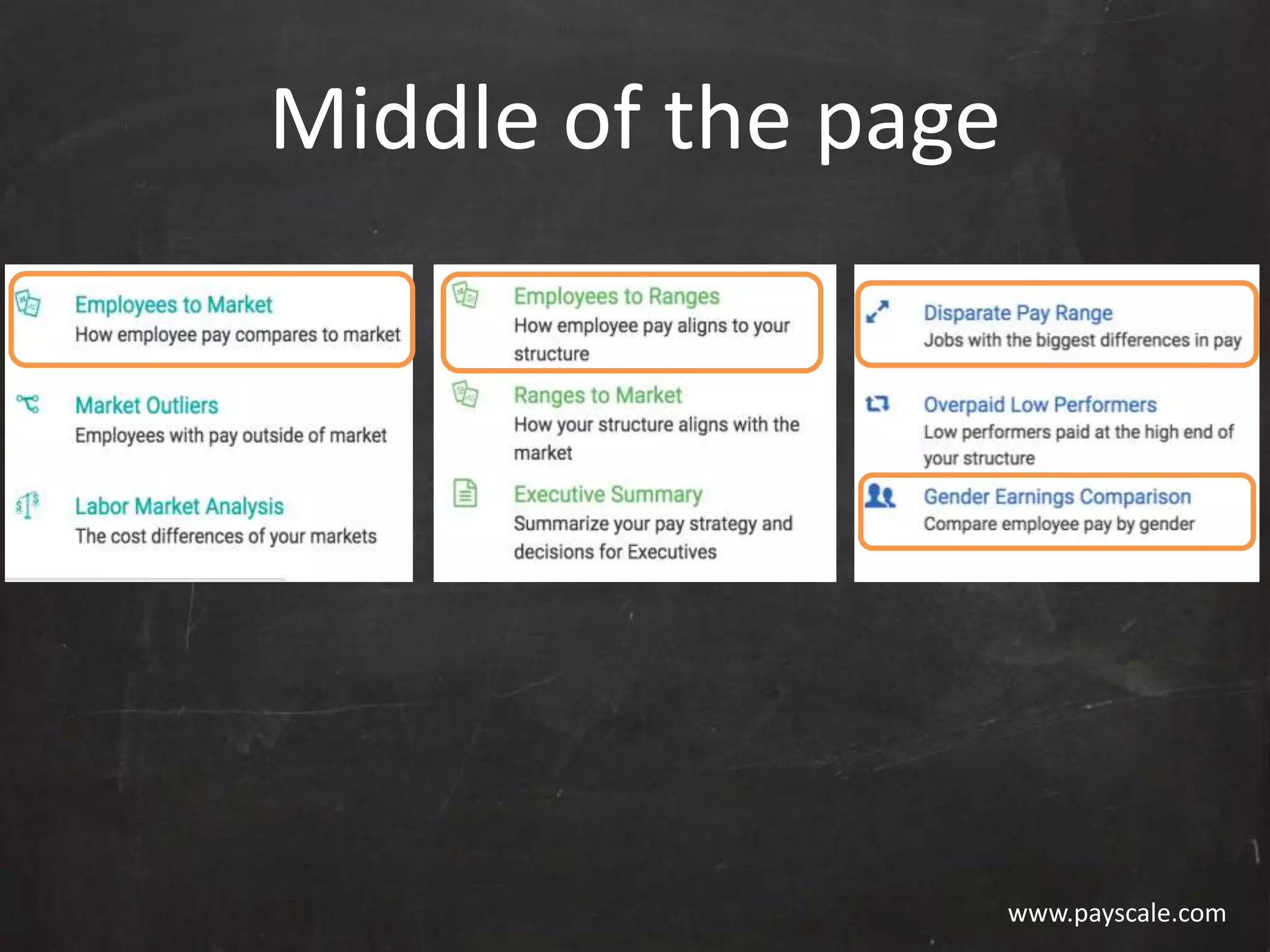
Middle of the page
www.payscale.com
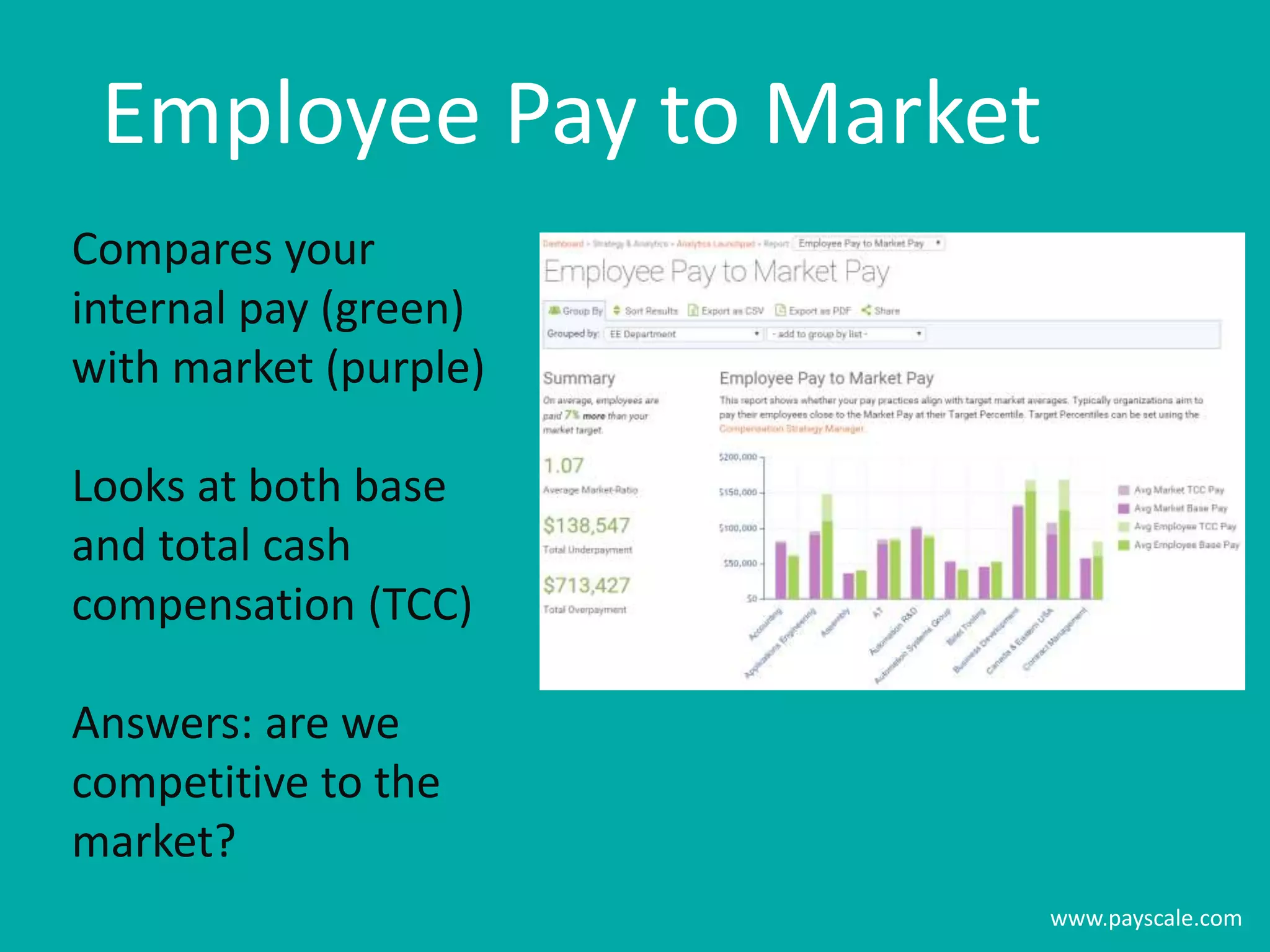
Employee Pay to Market
Compares your
internal pay (green)
with market (purple)
Looks at both base
and total cash
compensation (TCC)
Answers: are we
competitive to the
market?
www.payscale.com
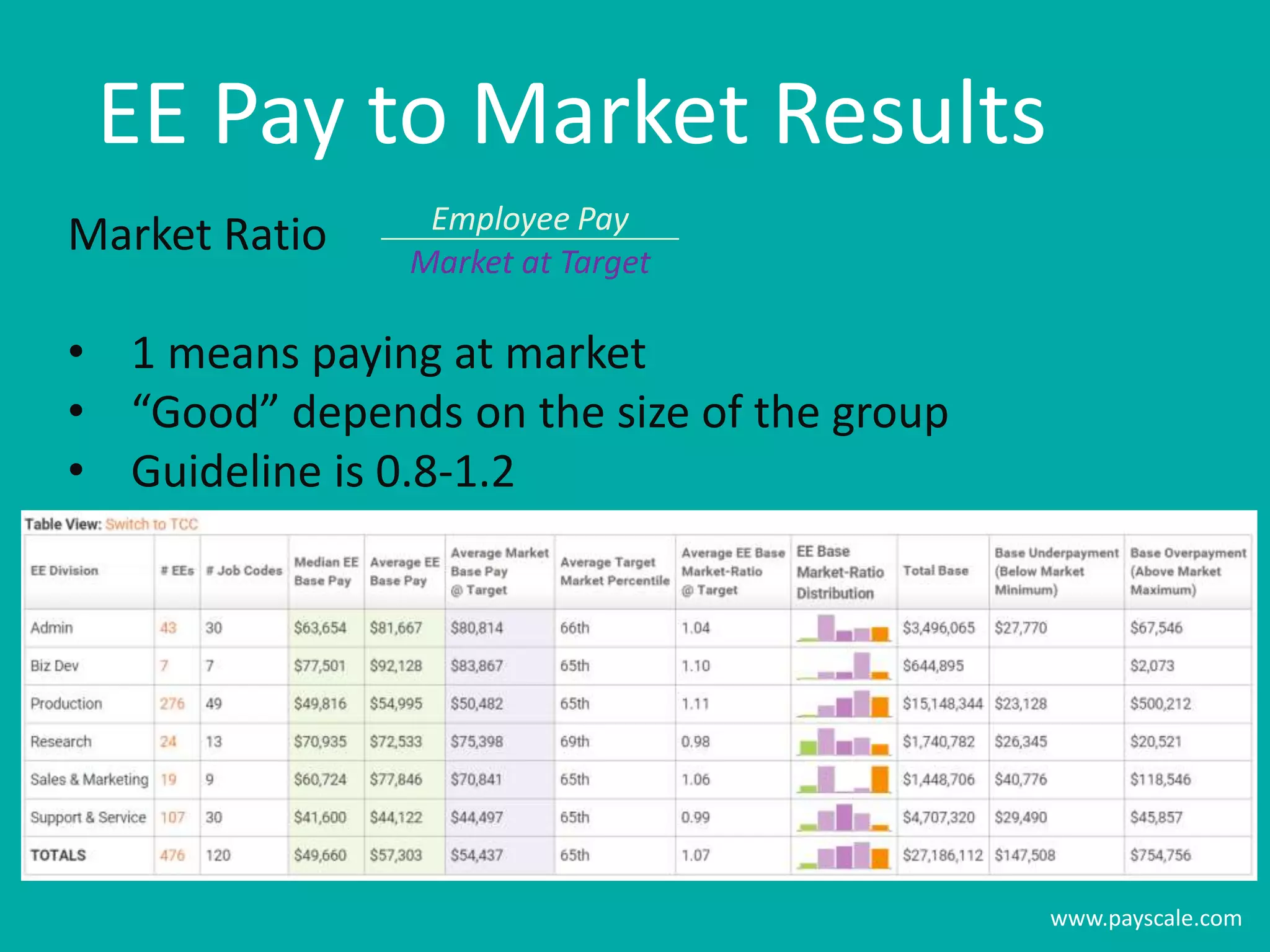
EE Pay to Market Results
Market Ratio
• 1 means paying at market
• “Good” depends on the size of the group
• Guideline is 0.8-1.2
Employee Pay
Market at Target
www.payscale.com
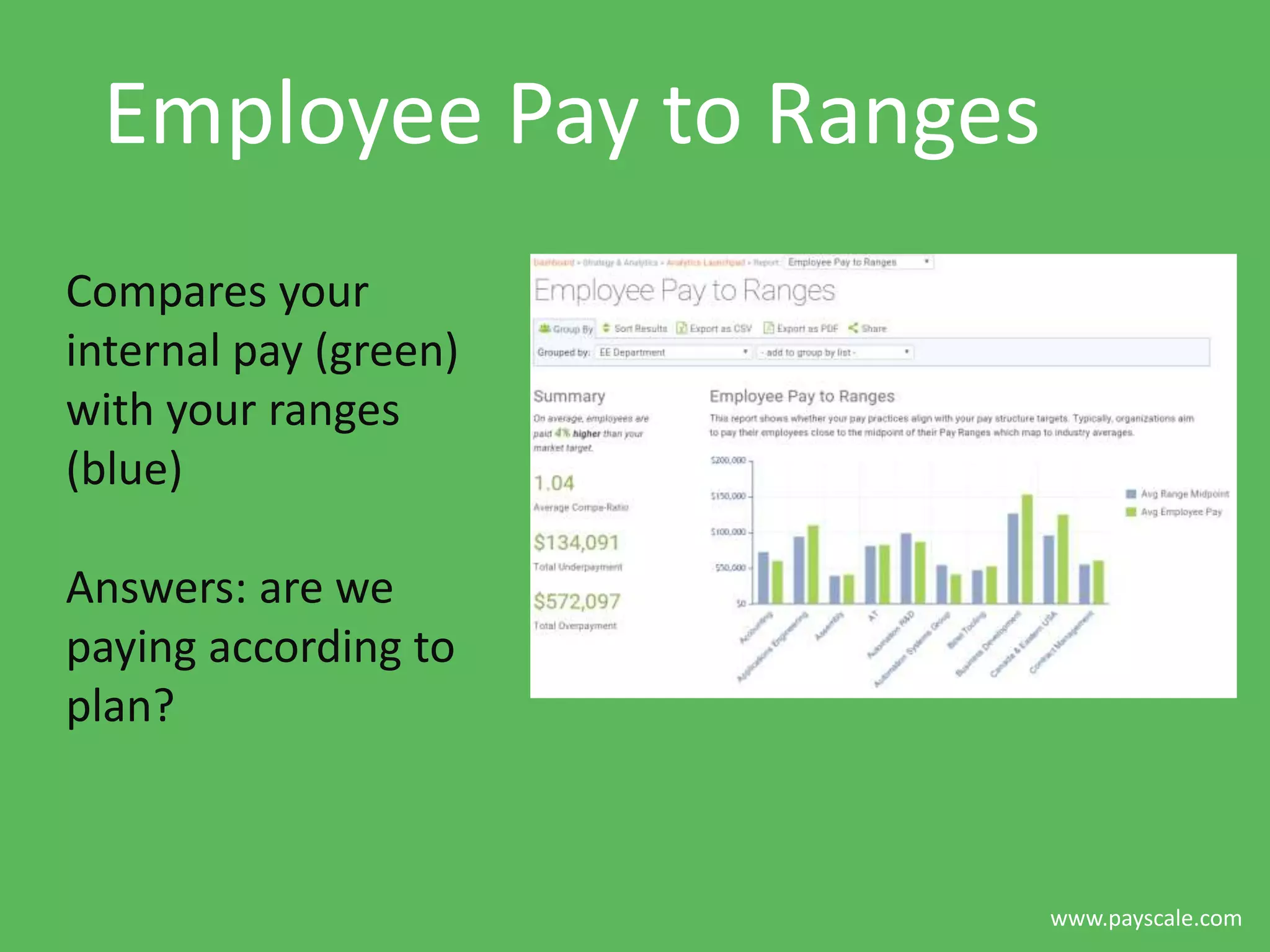
Employee Pay to Ranges
Compares your
internal pay (green)
with your ranges
(blue)
Answers: are we
paying according to
plan?
www.payscale.com
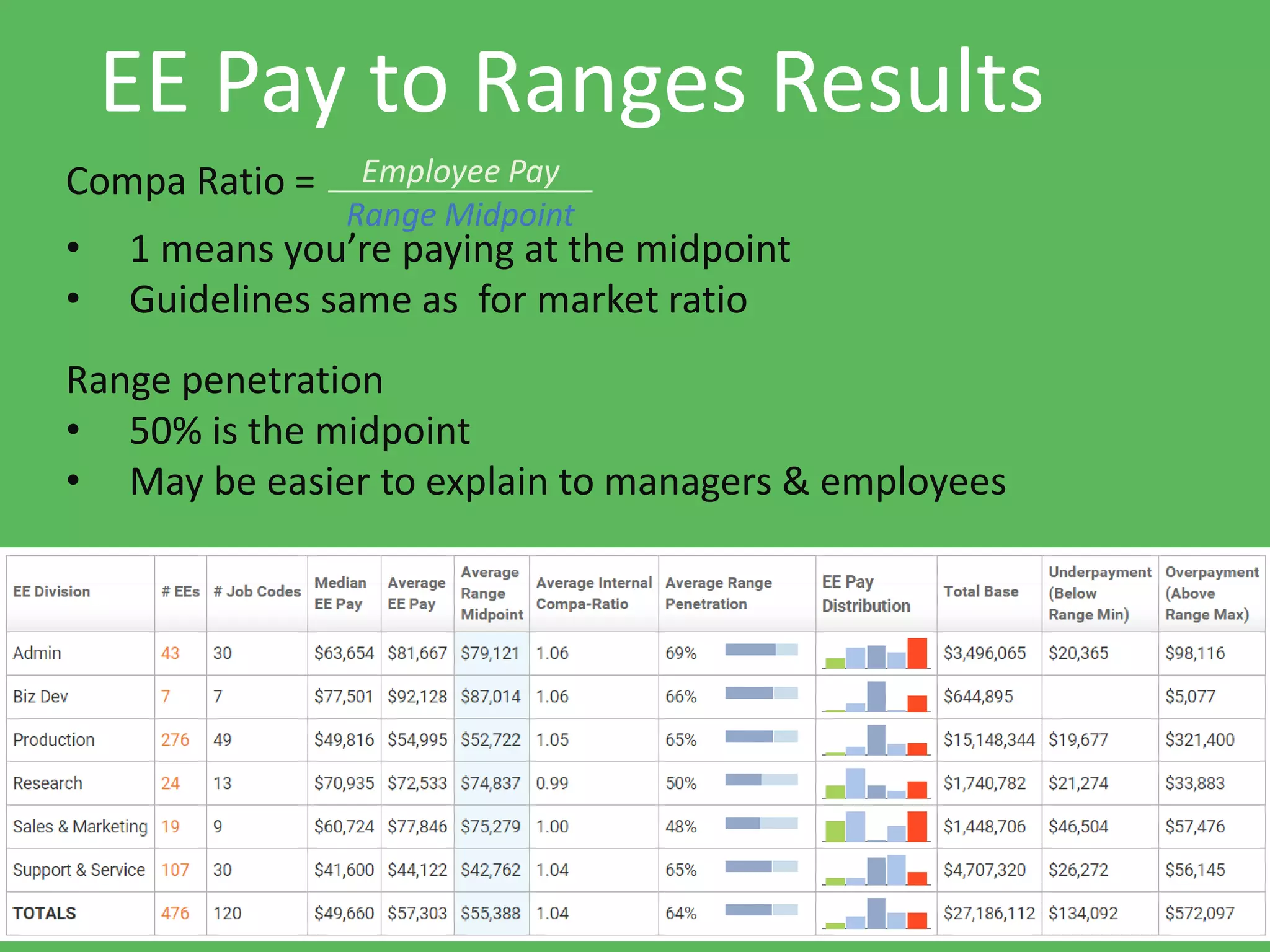
EE Pay to Ranges Results
Compa Ratio =
• 1 means you’re paying at the midpoint
• Guidelines same as for market ratio
Range penetration
• 50% is the midpoint
• May be easier to explain to managers & employees
Employee Pay
Range Midpoint
www.payscale.com
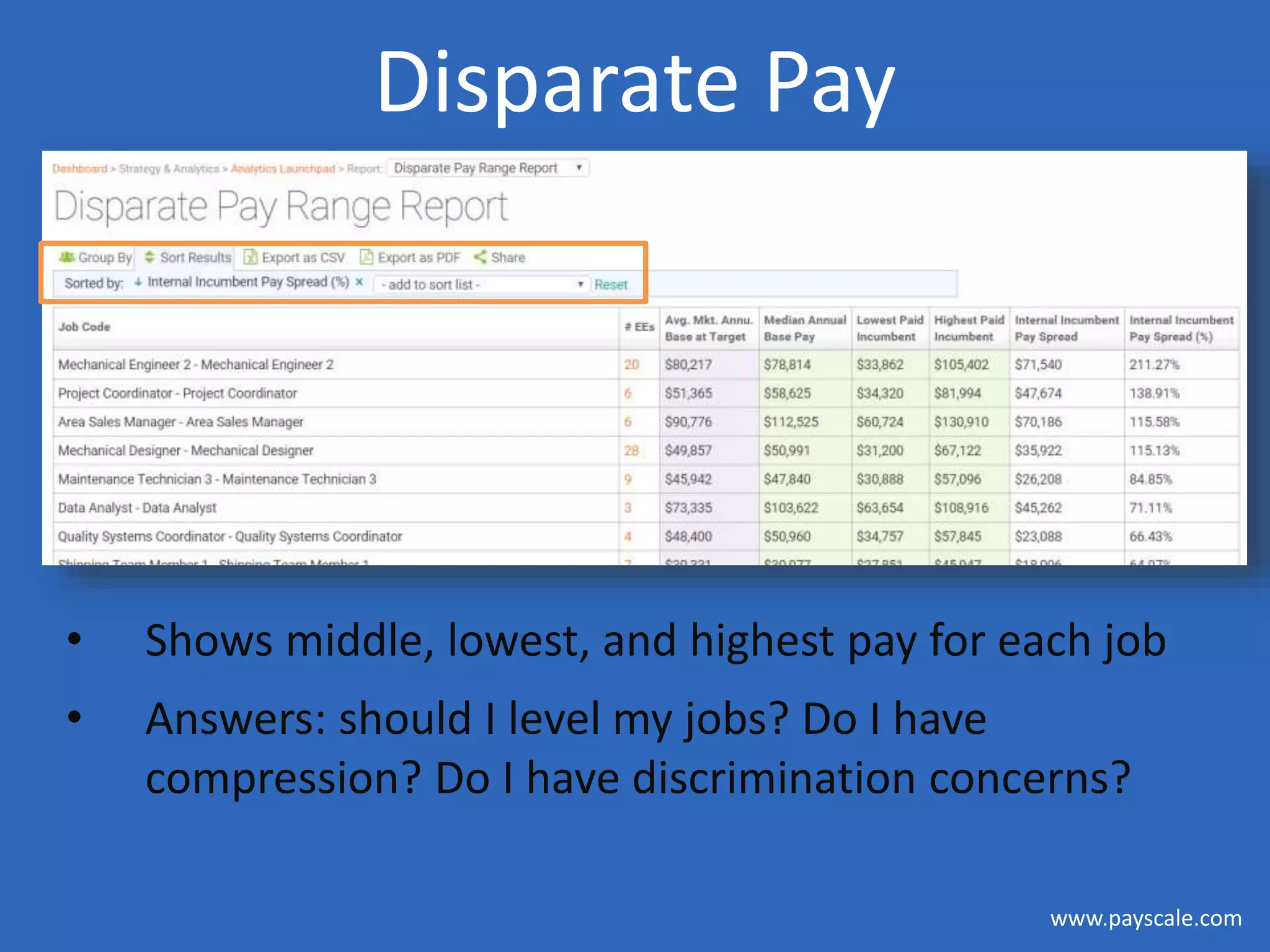
Disparate Pay
• Shows middle, lowest, and highest pay for each job
• Answers: should I level my jobs? Do I have
compression? Do I have discrimination concerns?
www.payscale.com
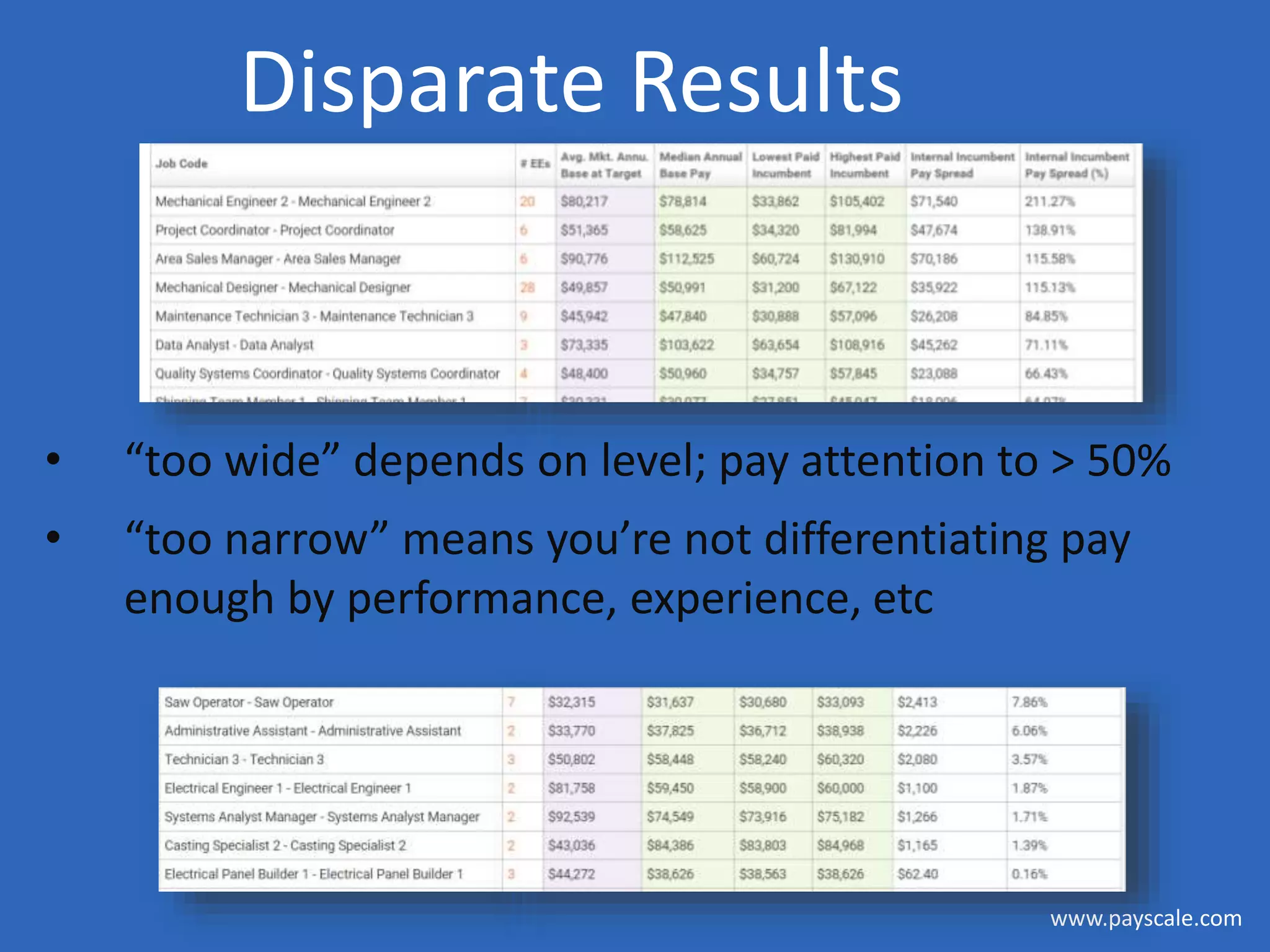
Disparate Results
• “too wide” depends on level; pay attention to > 50%
• “too narrow” means you’re not differentiating pay
enough by performance, experience, etc
www.payscale.com
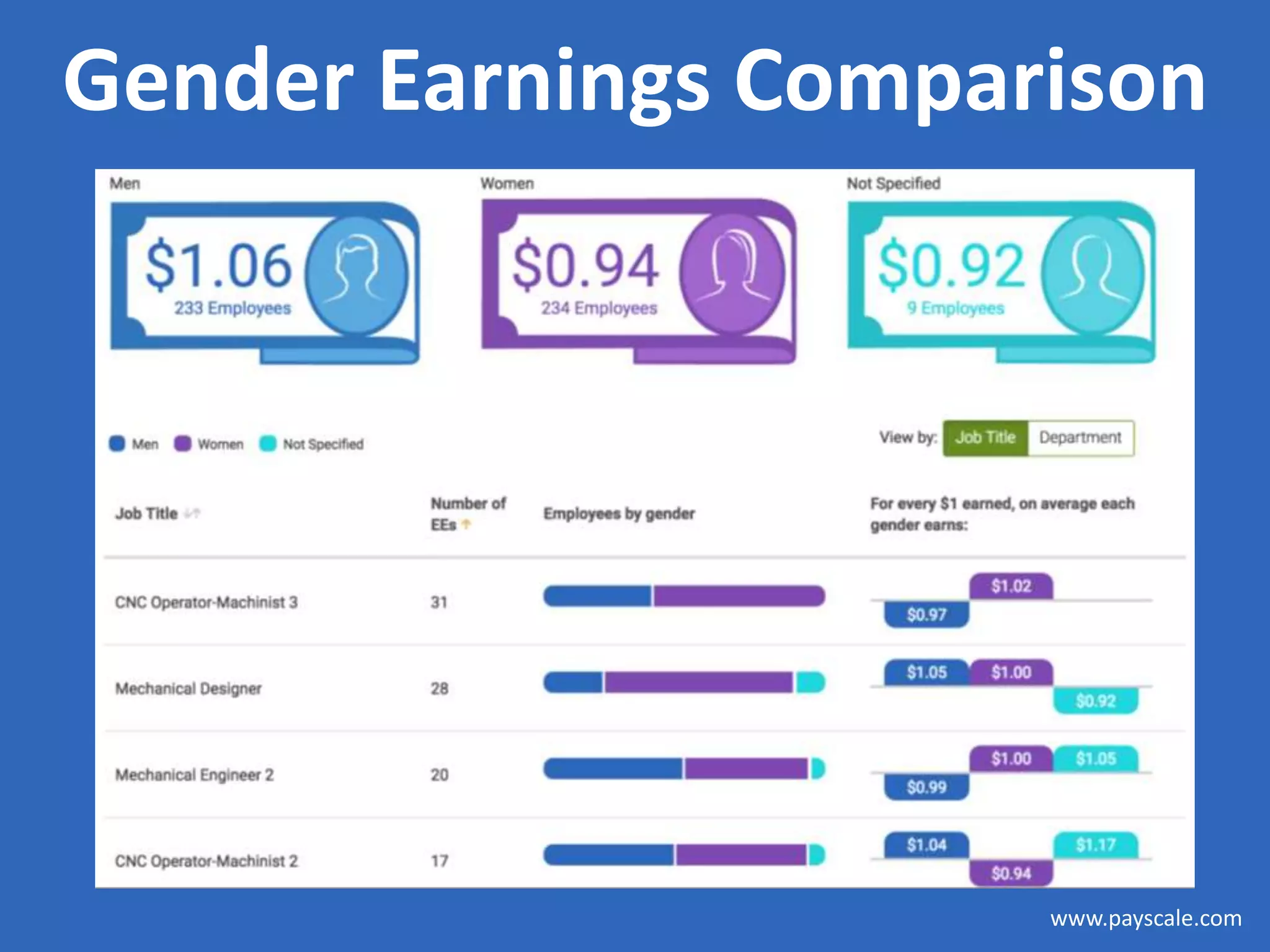
Gender Earnings Comparison
www.payscale.com
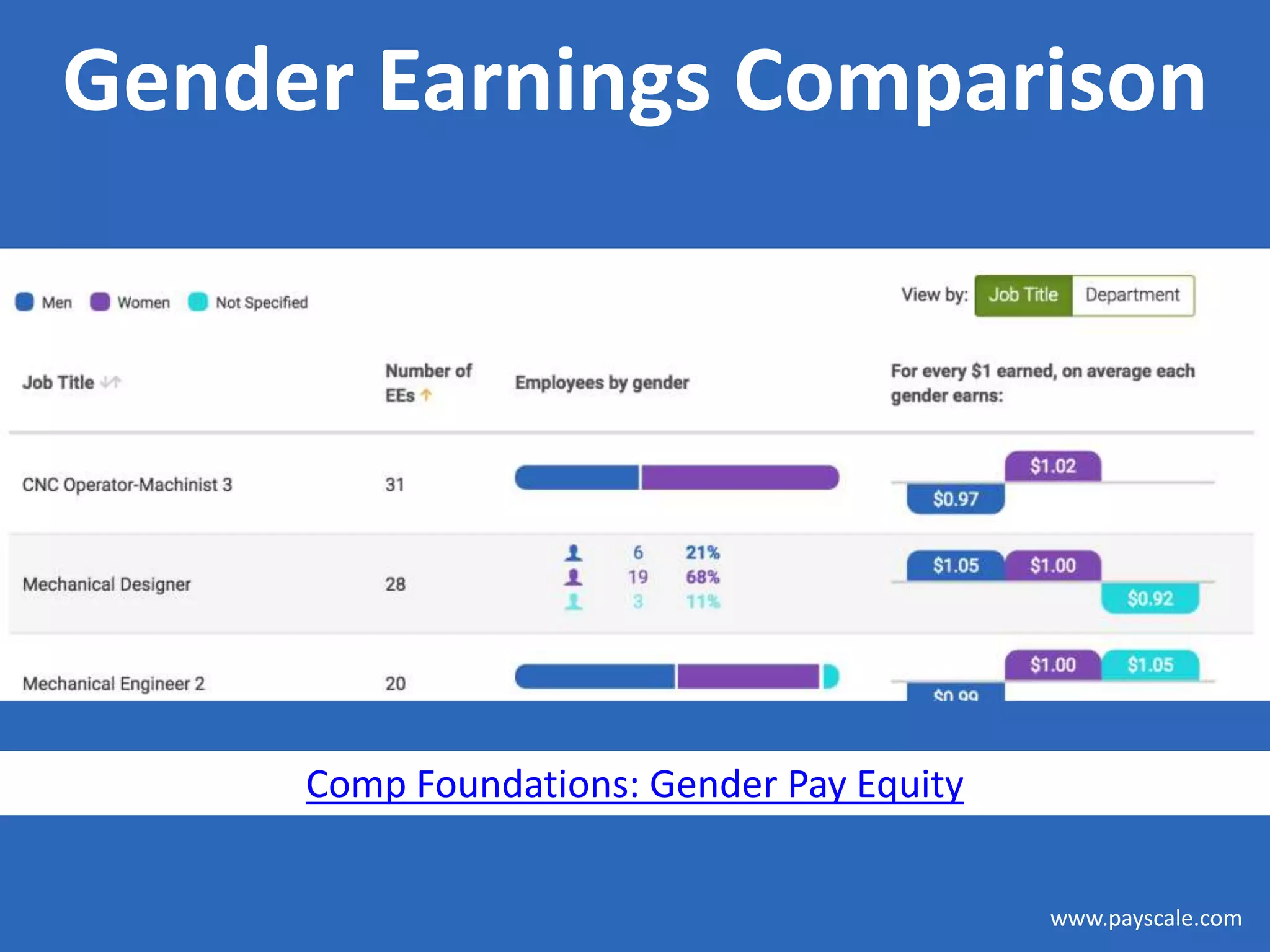
Gender Earnings Comparison
Comp Foundations: Gender Pay Equity
www.payscale.com
The
Science
www.payscale.com
Digging deeper
•Employee to Market
•Employee to Ranges
•Ranges to Market
www.payscale.com
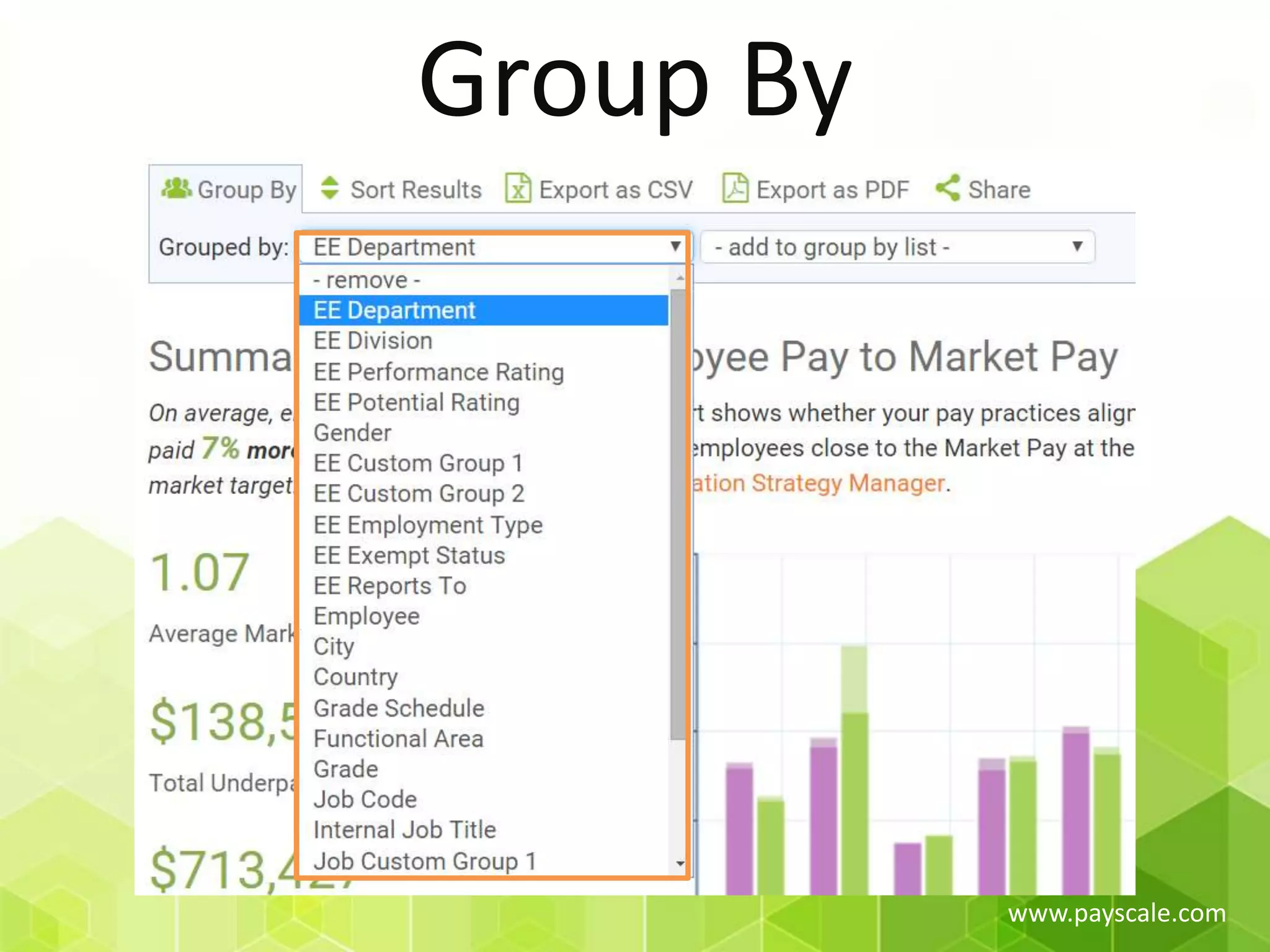
Group By
www.payscale.com
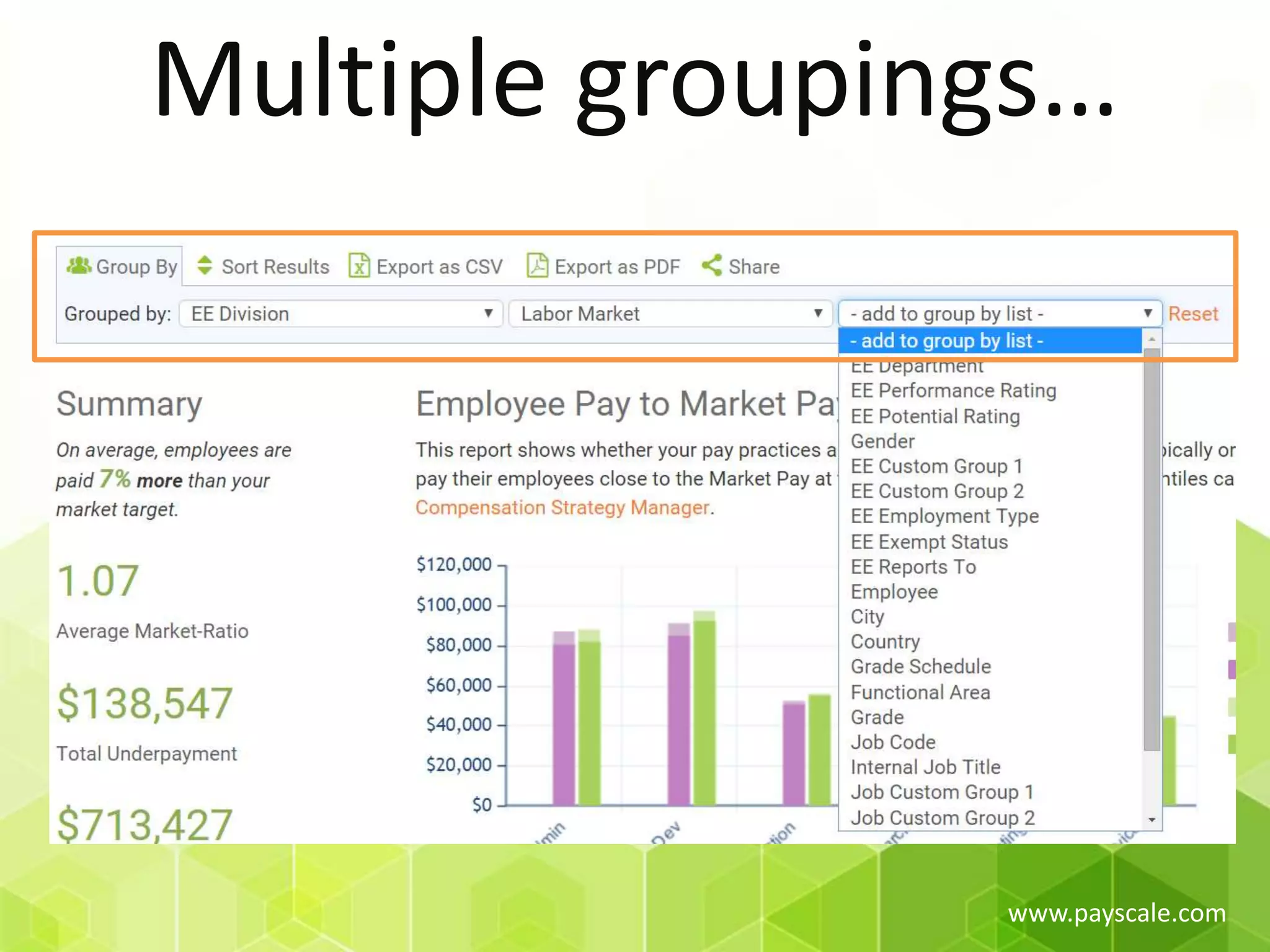
Multiple groupings…
www.payscale.com
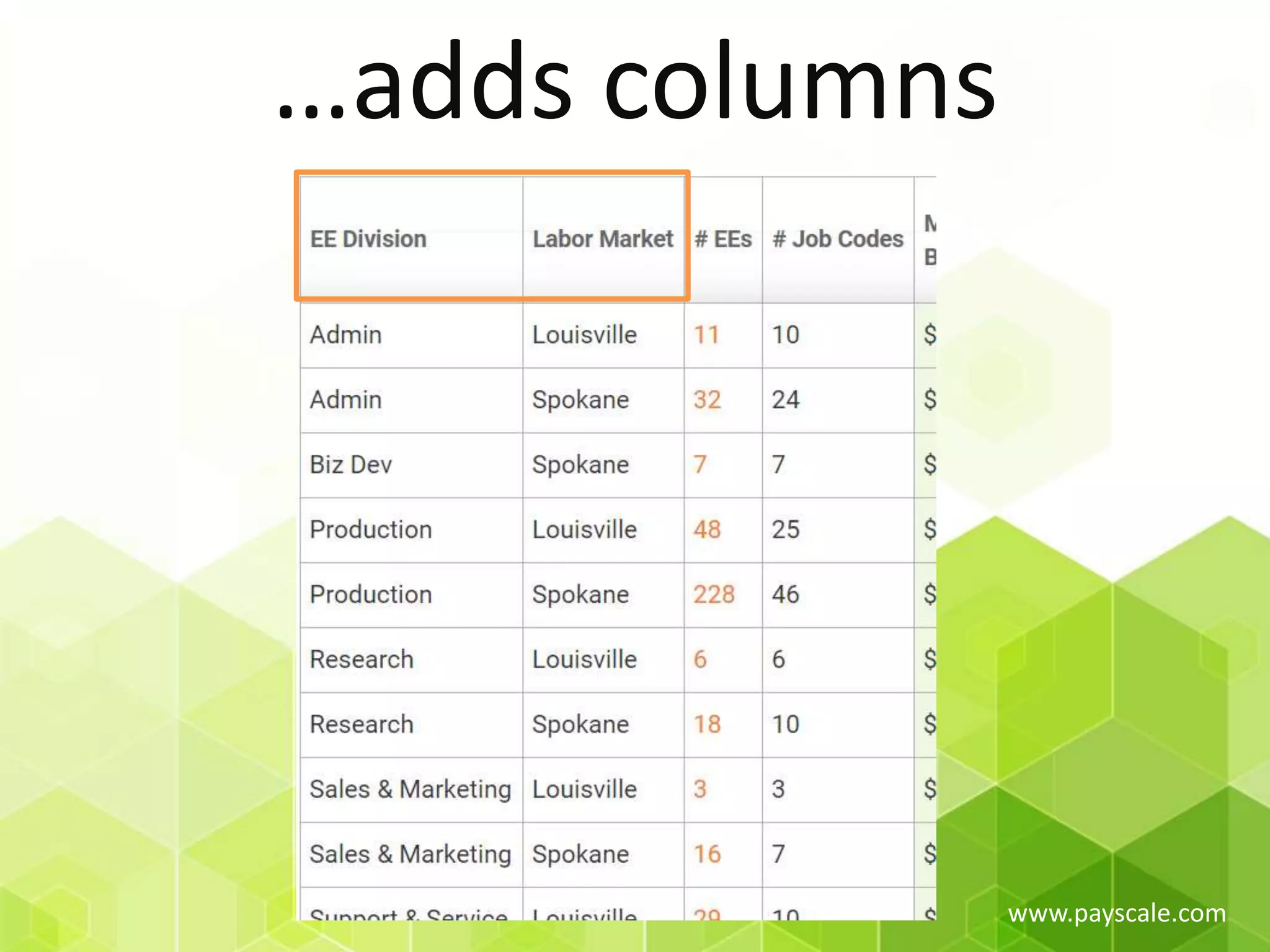
…adds columns
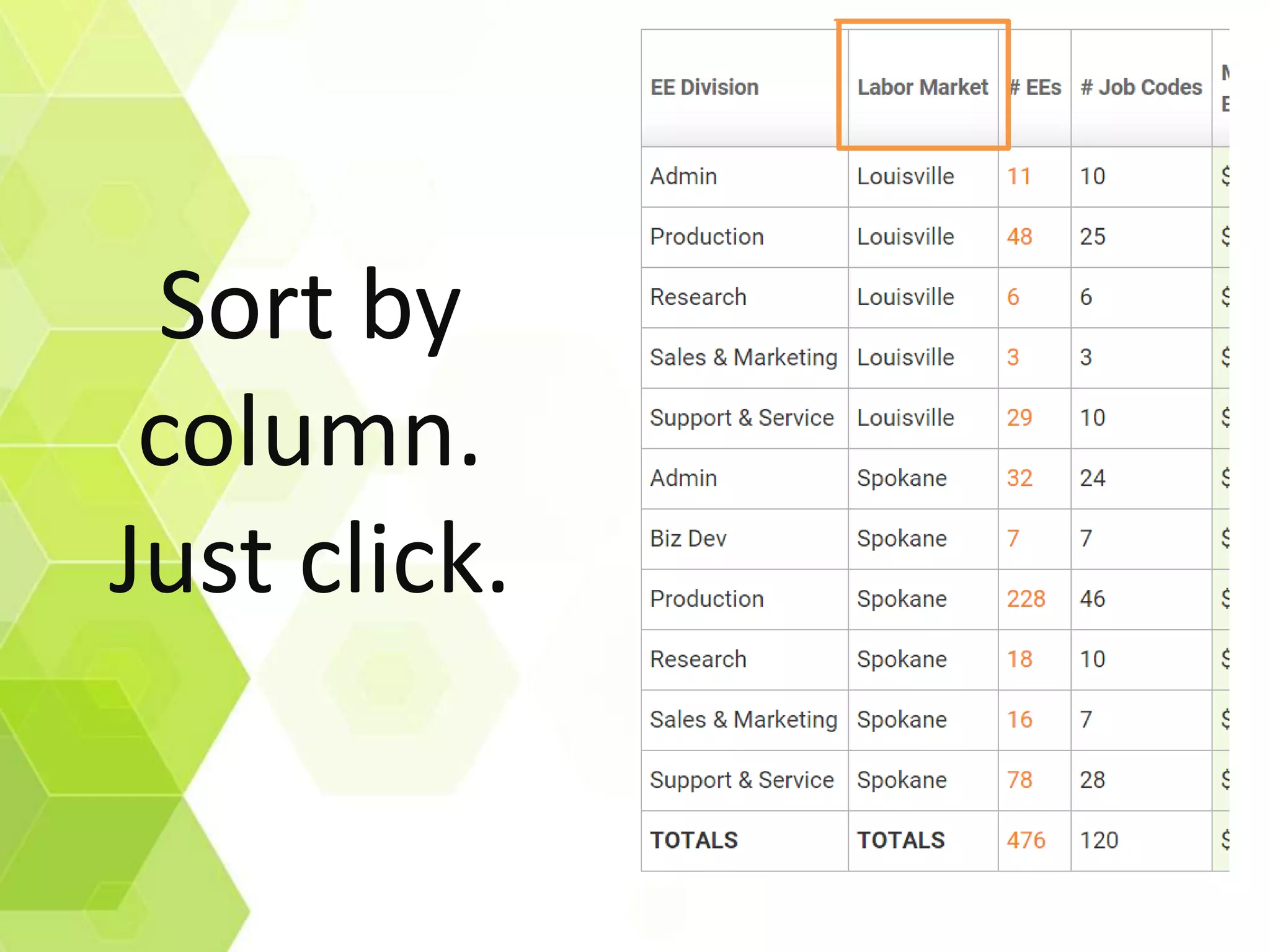
Sort by
column.
Just click.
www.payscale.com
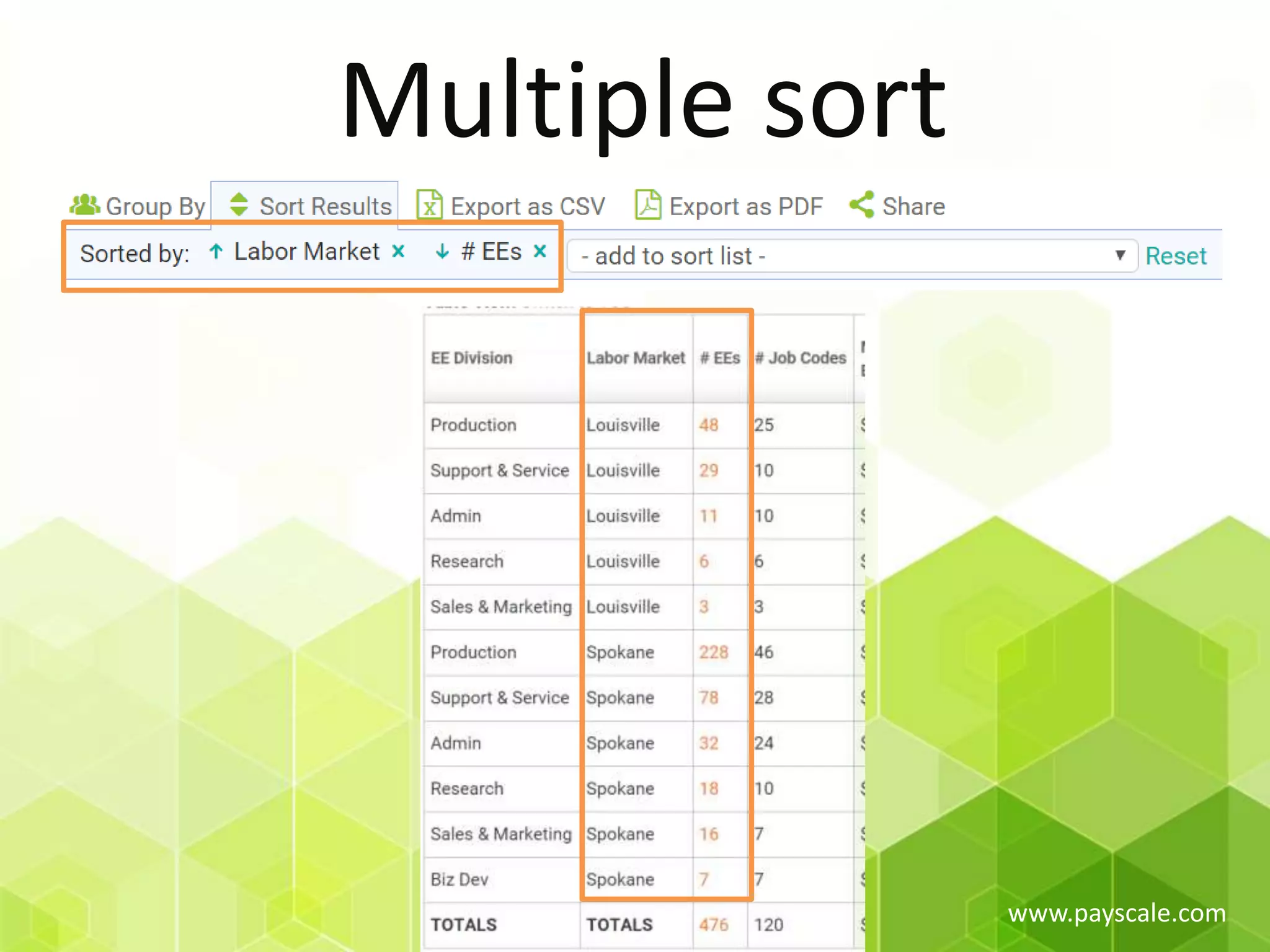
Multiple sort
www.payscale.com
The Art
www.payscale.com
What to look for
www.payscale.com
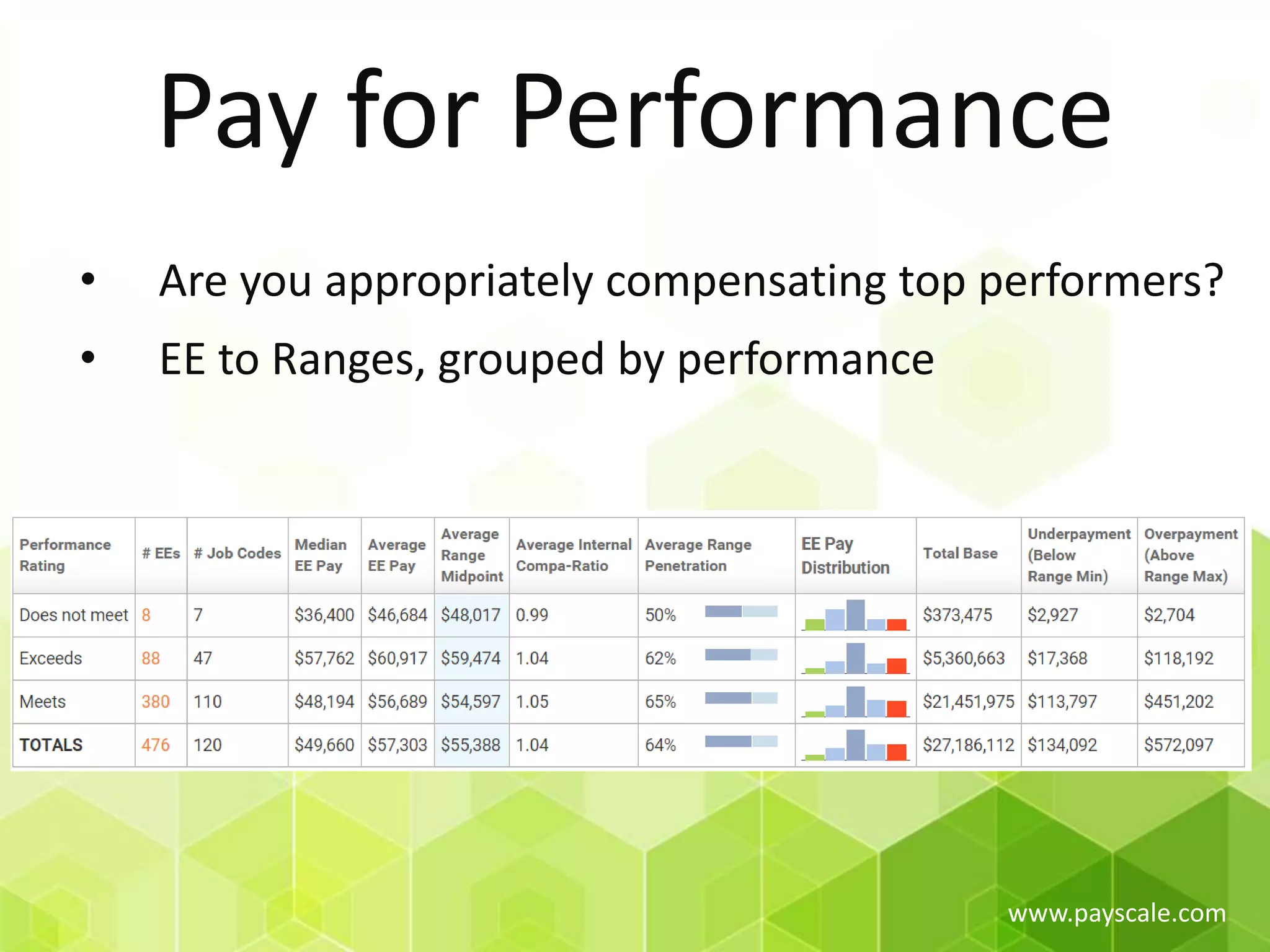
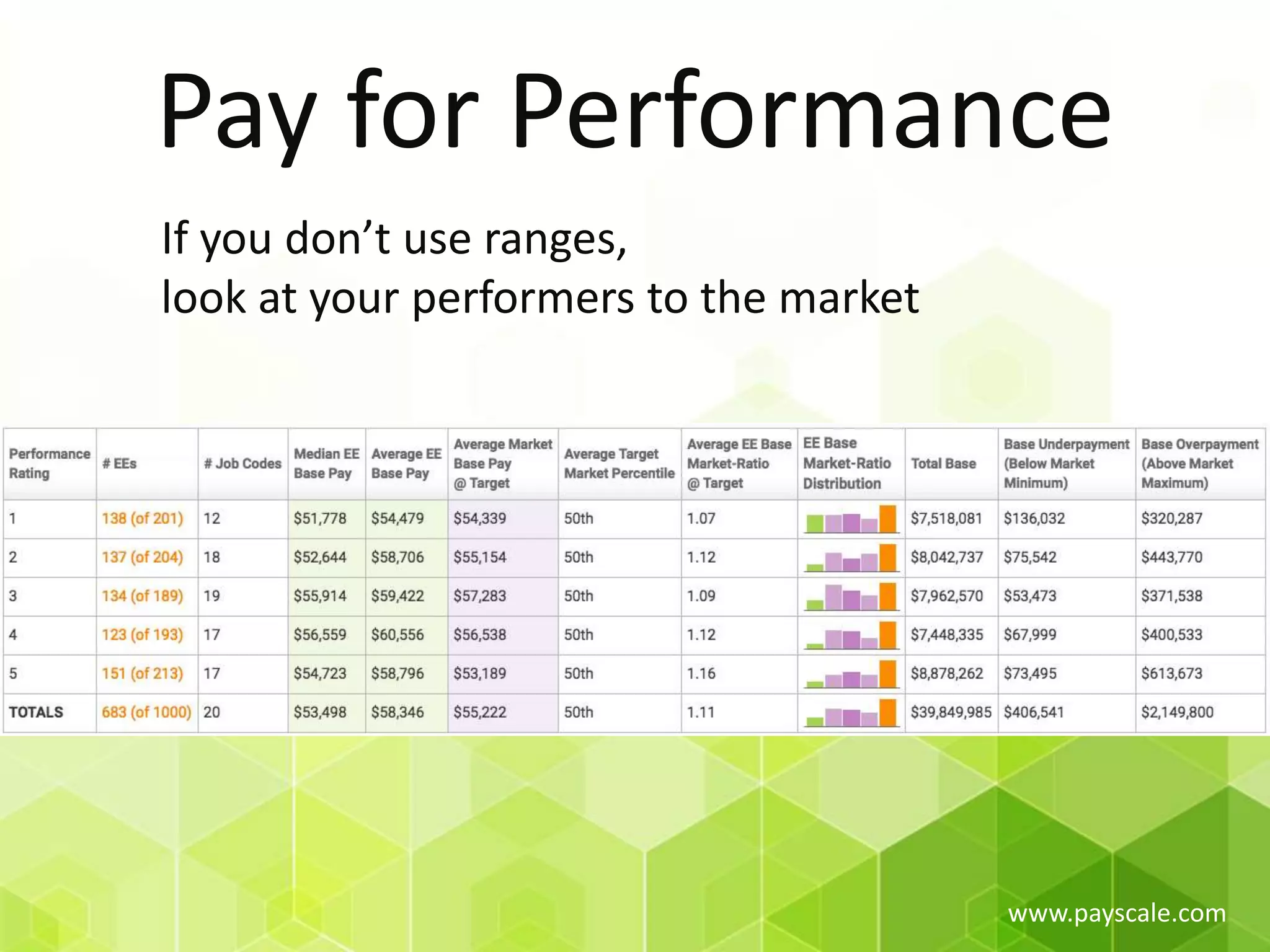
Pay for Performance
• Are you appropriately compensating top performers?
• EE to Ranges, grouped by performance
www.payscale.com
Pay for Performance
If you don’t use ranges,
look at your performers to the market
www.payscale.com
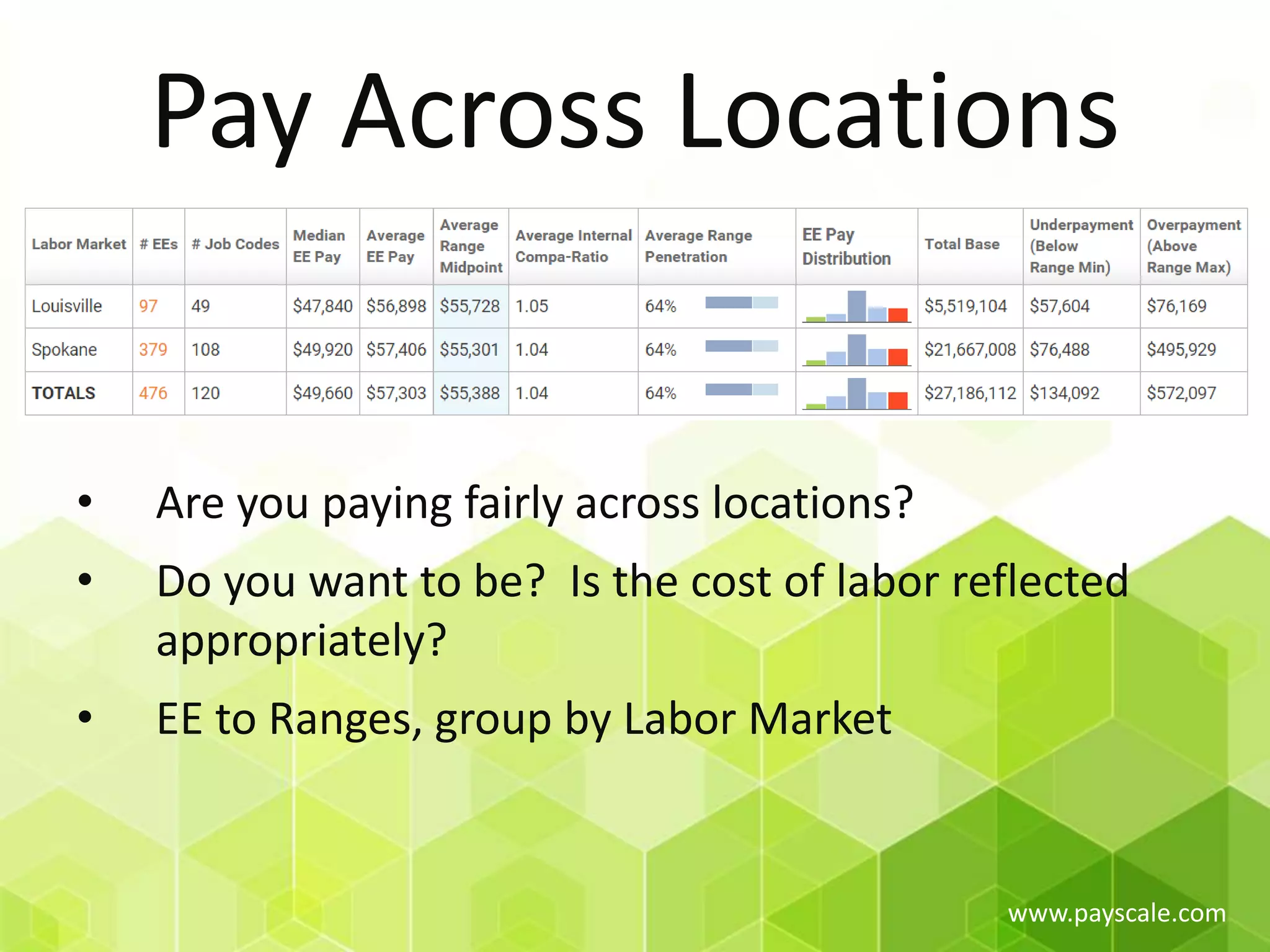
Pay Across Locations
• Are you paying fairly across locations?
• Do you want to be? Is the cost of labor reflected
appropriately?
• EE to Ranges, group by Labor Market
www.payscale.com
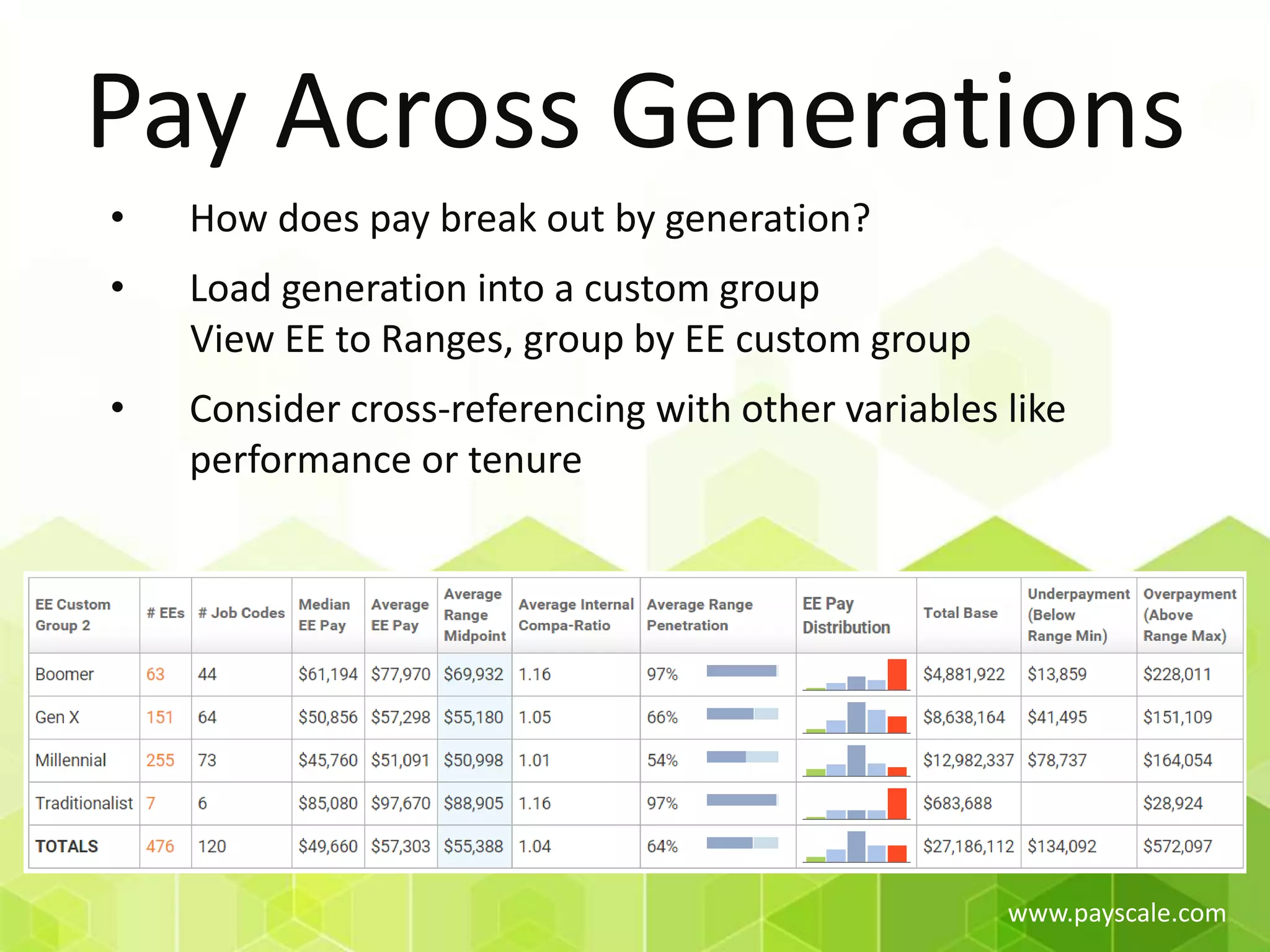
Pay Across Generations
• How does pay break out by generation?
• Load generation into a custom group
View EE to Ranges, group by EE custom group
• Consider cross-referencing with other variables like
performance or tenure
www.payscale.com
The
Execution
www.payscale.com
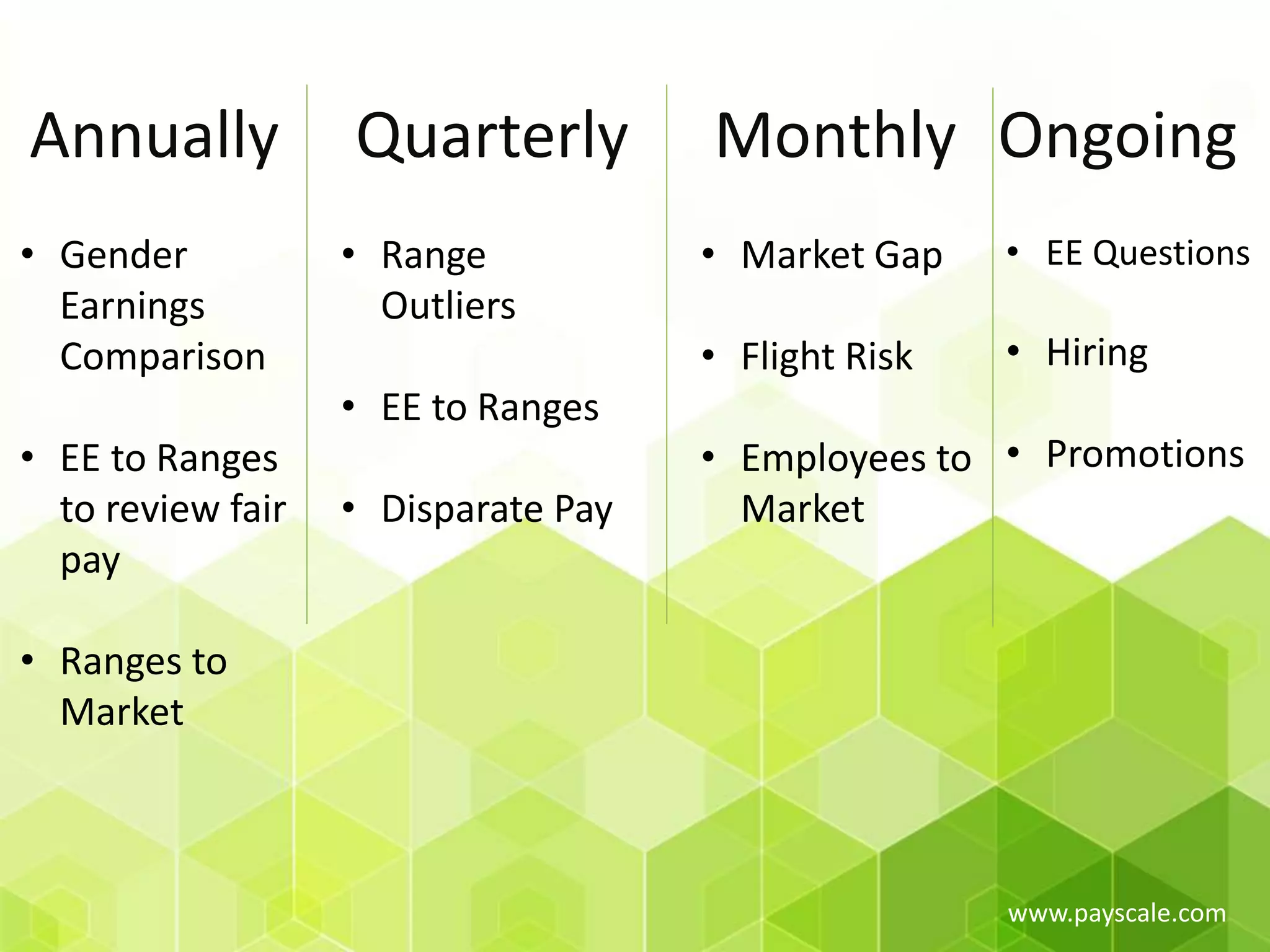
Annually Quarterly OngoingMonthly
• Gender
Earnings
Comparison
• EE to Ranges
to review fair
pay
• Ranges to
Market
• Range
Outliers
• EE to Ranges
• Disparate Pay
• Market Gap
• Flight Risk
• Employees to
Market
• EE Questions
• Hiring
• Promotions
www.payscale.com
Q & A
(we’ll email this out)
www.payscale.com
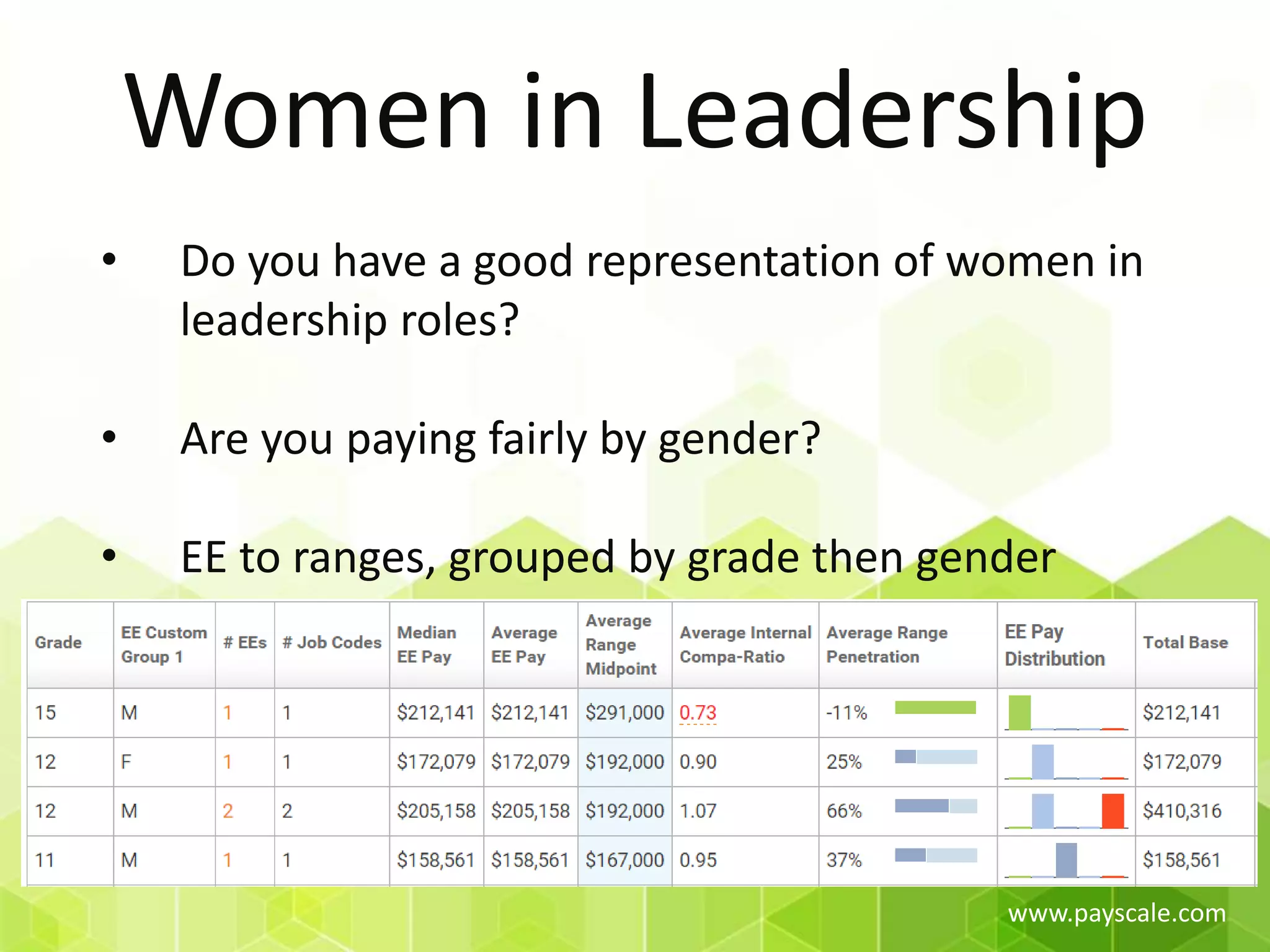
Women in Leadership
• Do you have a good representation of women in
leadership roles?
• Are you paying fairly by gender?
• EE to ranges, grouped by grade then gender
www.payscale.com
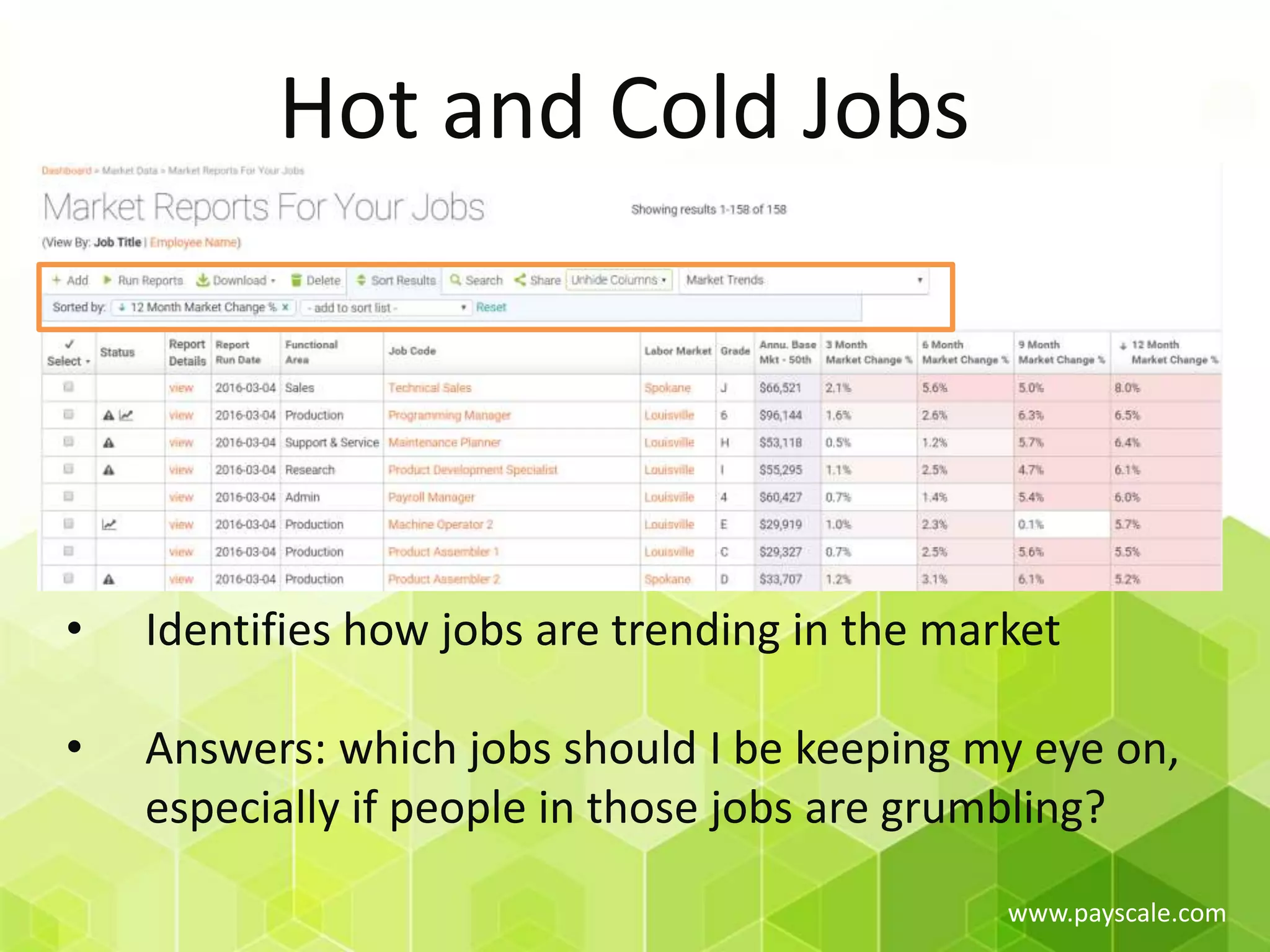
Hot and Cold Jobs
• Identifies how jobs are trending in the market
• Answers: which jobs should I be keeping my eye on,
especially if people in those jobs are grumbling?
www.payscale.com
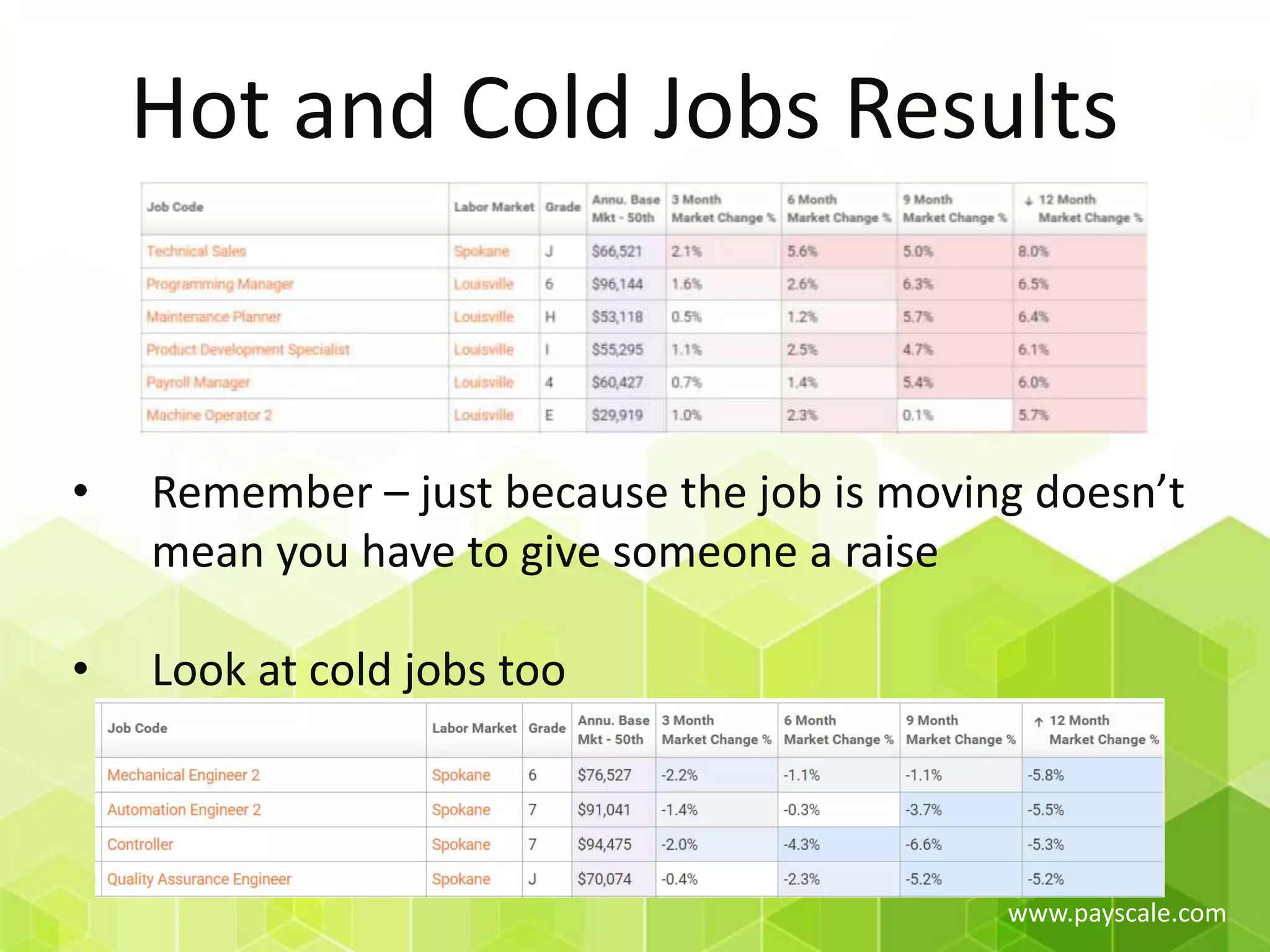
Hot and Cold Jobs Results
• Remember – just because the job is moving doesn’t
mean you have to give someone a raise
• Look at cold jobs too

Webinar-Comp Foundations-Be an Analytics Hero

Editor's Notes

  • #4 – PayScale is great To get the right pay match for your role, it’s essential that you define which labor market you’re competing in. PayScale has over 40 million profiles, all with multiple data points. Some will be relevant to your role, some won’t – and telling PayScale about your Labor Market lets us know which ones are. ----- Meeting Notes (1/14/16 11:29) ----- Update Mykkah ----- Meeting Notes (6/27/16 09:43) ----- Check with Joy re slide
  • #5 … so little time Early disclaimer: all reports are based on a fictional company, so data will refer to these particular jobs in these particular markets, with these particular fictional employee pay practices.
  • #8 New Dashboard! Can direct navigate to some reports
  • #9 You can click here from the new dashboard too
  • #10 You can click here from the new dashboard too
  • #11 Notes on this feature from a chat b/n Sanket & Mykkah velocity - how fast the job is moving in the market. velo --> yeah, speed of the job in the market (we take 3/6/9/12 mo changes and come up with a score) you could explain velo as just the likelihood of the market gap increasing significantly in the short term Jobs that moved down are not on the report because the market pays LESS for those than what you did (going by the gap calc) high means it has been moving up for the last 4 consecutive quarters (and moving up more in the short term) medium means its been moving up for 3 of the last 4 quarters (and moving up in the short to mid term more) low means its moved up the 2 of the last 4 quarters but not necessarily moving up in the short term In order to maintain someone's percentile in the market, it costs money. gap --> takes the market percentile of someone's salary at the time their market report was last run and states what salary that market percentile would equate to in today's market....the gap is the difference between the two Yesterday’s market compared to Today’s market; value of your job then vs value of your job now concrete example: i'm making 10 bucks an hour. that equals 21st market percentile on 1/1/2016. now, today 10/hr is 15th market percentile. so what would it cost to maintain me at the 21st market percentile? that number is thegap Note: jobs that moved down are not included in the calculation of market gap. Typically, companies don’t reduce employee pay.
  • #12 Notes on this feature from a chat b/n Sanket & Mykkah velocity - how fast the job is moving in the market. Velo isthe likelihood of the market gap increasing significantly in the short term Jobs that moved down are not on the report because the market pays LESS for those than what you did, and reducing pay is typically not an option high means it has been moving up for the last 4 consecutive quarters (and moving up more in the short term) medium means its been moving up for 3 of the last 4 quarters (and moving up in the short to mid term more) low means its moved up the 2 of the last 4 quarters but not necessarily moving up in the short term Notes for us on market gap – in the future we may add grouping (manager, dept) and sorting functionality (velocity, #Ees)
  • #13 You can click here from the new dashboard too
  • #16 You can click here from the new dashboard too
  • #17 Sort, export (download) share, etc ----- Meeting Notes (6/27/16 09:43) ----- Take out the performance piece, make sure that it's screen shots of the most recent
  • #18 Sort by range penetration brings those who are farthest from your targets to the top Worth noting that the strategy in this example is to pay at the 65th, but the report highlights those who are below the 50th. So, it may not capture top performers who are paid low to the 65th percentile of the market.
  • #19 Explore them all. We’ll highlight 3 Market Outliers looks very similar in look & feel to Range Outliers Note to us: I hid columns in some of these reports to make them fit better
  • #20 Describe chart & summary
  • #21 Describe every column Hovering over the distribution column will tell you how many people fall into each distance from the market. Note: I didn’t do this because the hover chart is wrong. Market ratio should be closer to 1 for smaller groups Switch to TCC – company to market TCC comparison chart Export will put both base & TCC numbers onto one grid
  • #23 Compa ratio is “comparison ratio” Describe every column Hovering over the distribution column will tell you how many people fall into each distance from the market. Note: I didn’t do this because the hover chart is wrong. Compa ratio should be closer to 1 for smaller groups Range penetration - ----- Meeting Notes (6/27/16 09:43) ----- Stike out May be
  • #24 Sort by internal pay spread % to surface issue areas Group by – department, location, gender, etc. Adding things into group by adds those columns to the report (more on this follows) Export, share
  • #25 Look at both ends – high disparity & low disparity ----- Meeting Notes (6/27/16 09:43) ----- "too narrow" COULD MEAN you have room to differentiate pay more
  • #26 Deep dive on this feature in webinar ----- Meeting Notes (6/27/16 09:43) ----- NO BOLD HEADER Grab a screenshot with multiple employees Add slide with hover image
  • #27 Deep dive on this feature in webinar ----- Meeting Notes (6/27/16 09:43) ----- NO BOLD HEADER Grab a screenshot with multiple employees Add slide with hover image
  • #30 Also – Sort & Export as CSV & Export as PDF & Share
  • #32 Division Labor Market
  • #36 Well, it’s really going to depend on what matters most to your organization. Here are some ideas.
  • #37  ----- Meeting Notes (6/27/16 09:43) ----- If you have ranges, look at your performers to the ranges If you don't, then look at your performers to the market (get screen grab of that report)
  • #38  ----- Meeting Notes (6/27/16 09:43) ----- If you have ranges, look at your performers to the ranges If you don't, then look at your performers to the market (get screen grab of that report)
  • #39 Or divisions or managers or functional areas or Lines of business ----- Meeting Notes (6/27/16 09:43) ----- Swap middle bullet to: Is cost of labor reflected appropriately
  • #41 Rita: So, we’ve talked about all the things you should think about with the art & science behind creating labor markets – so the most important question – now what? Let’s do it!
  • #42 I can’t think of a report people should use weekly… but I really want to ----- Meeting Notes (6/27/16 09:43) ----- On going instead of weekly - EE questions - Hiring - Promosting Annually - Pay adjustments
  • #43 Paige – take it in to Q & A ----- Meeting Notes (6/27/16 09:43) ----- GKN something, Emil Antony
  • #44  If no grades – no problem. Load “org level” as one of your job custom groups
  • #45 Note to us: these will exist in the market reports grid for both Benchmark & Insight. Just can’t get there from Analytics Launchpad anymore. Sort – 12 month for overall year to year trend, 3 month for quick moving jobs Search, export (download), etc
  • #46 Options for hot jobs: Market bonus Base pay raise Do something creative – extra days off, extra perks, special projects, WFH, etc what do the employees in those jobs want? Do nothing – may be more risky, but if folks are happy, you may be fine for a bit. Keep your eye on the trends. Some frames of reference: Increase budgets put the typical increase at 3% annually. 5-7% is a decent sized pay increase over the course of a year. In many pay structures, the distance between grades is somewhere between 10-15%, so 5-7 ½% movement could firmly put the job in a different pay range depending on the structure