ProSAFE Switch Series
Configurare il Multicast
Andrea Rossi
Senior System Engineer
andrea.rossi@netgear.com
Formazione Online
What is Multicast?
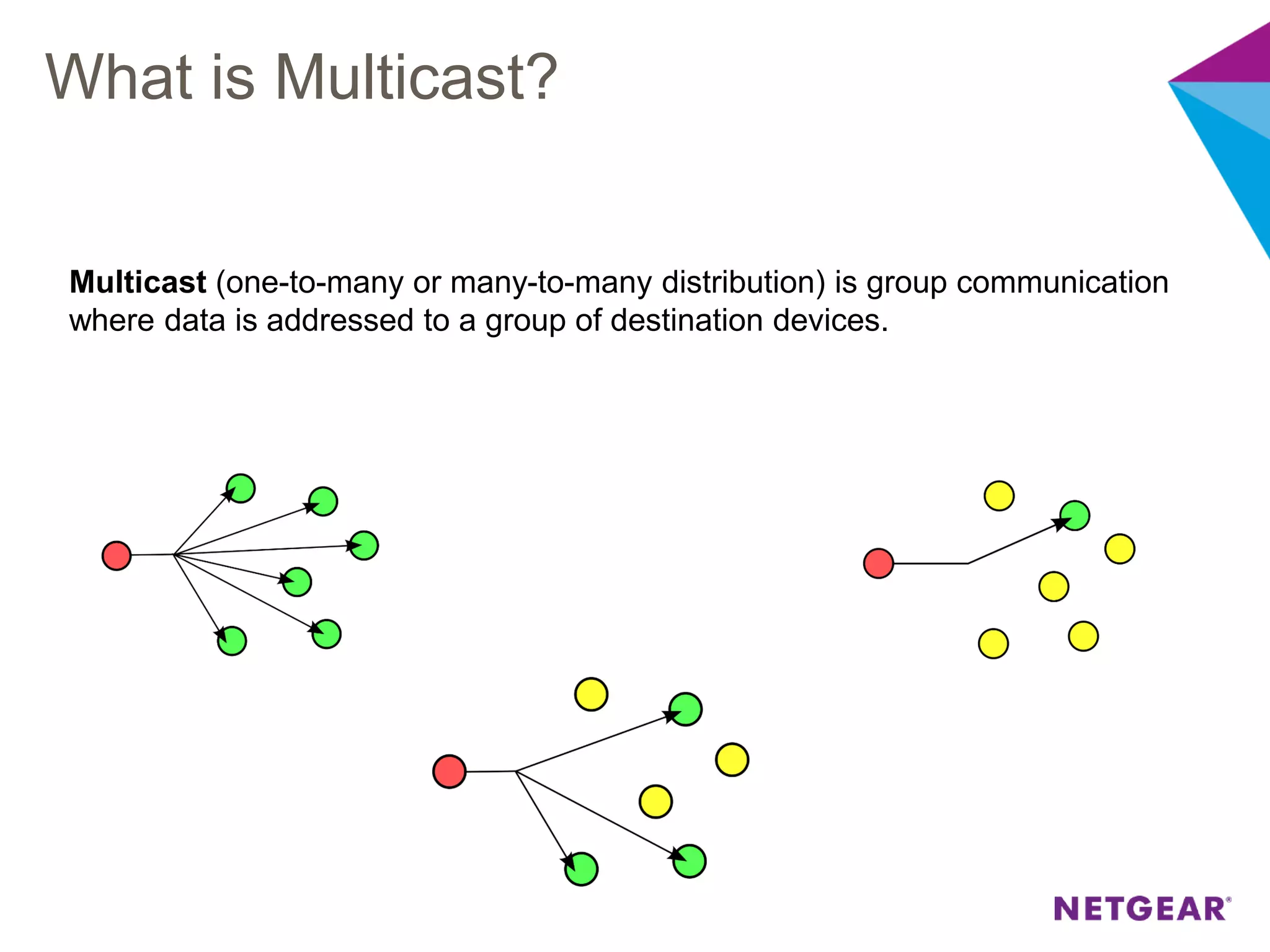
Multicast (one-to-many or many-to-many distribution) is group communication
where data is addressed to a group of destination devices.
What is Multicast?
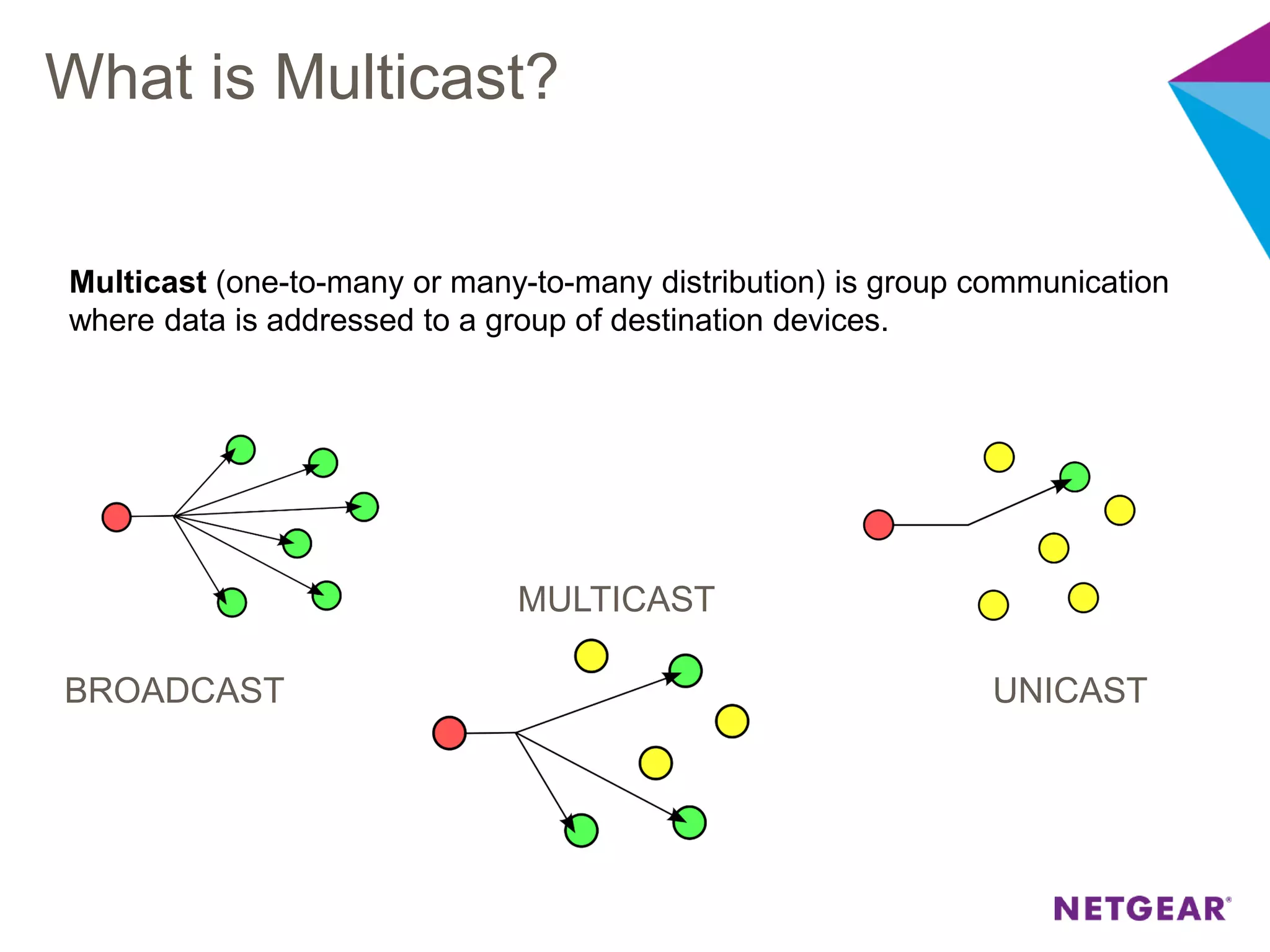
Multicast (one-to-many or many-to-many distribution) is group communication
where data is addressed to a group of destination devices.
BROADCAST UNICAST
MULTICAST
What is Multicast?
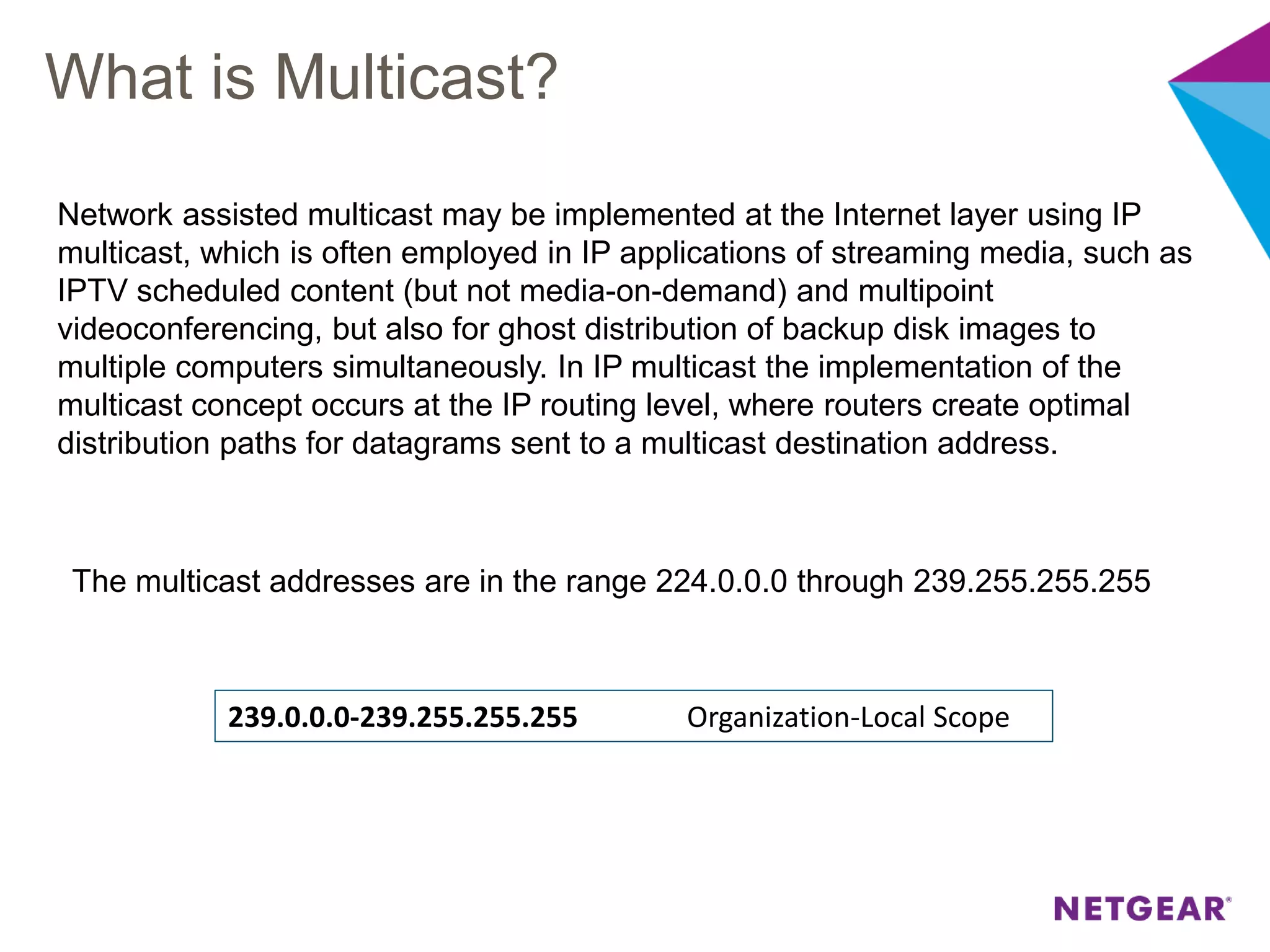
The multicast addresses are in the range 224.0.0.0 through 239.255.255.255
239.0.0.0-239.255.255.255 Organization-Local Scope
Network assisted multicast may be implemented at the Internet layer using IP
multicast, which is often employed in IP applications of streaming media, such as
IPTV scheduled content (but not media-on-demand) and multipoint
videoconferencing, but also for ghost distribution of backup disk images to
multiple computers simultaneously. In IP multicast the implementation of the
multicast concept occurs at the IP routing level, where routers create optimal
distribution paths for datagrams sent to a multicast destination address.
Internet Group Management Protocol
(IGMP)
5
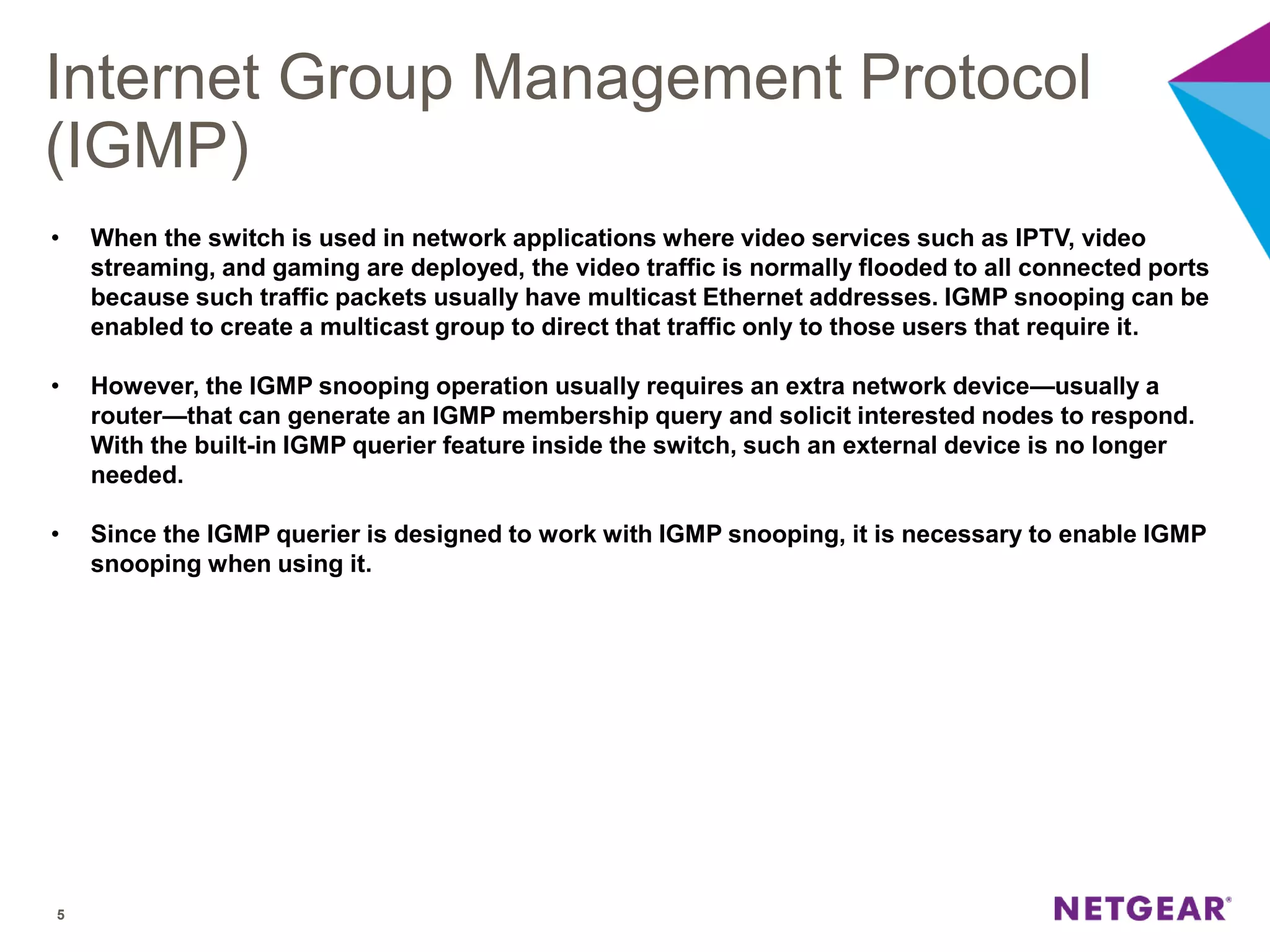
• When the switch is used in network applications where video services such as IPTV, video
streaming, and gaming are deployed, the video traffic is normally flooded to all connected ports
because such traffic packets usually have multicast Ethernet addresses. IGMP snooping can be
enabled to create a multicast group to direct that traffic only to those users that require it.
• However, the IGMP snooping operation usually requires an extra network device—usually a
router—that can generate an IGMP membership query and solicit interested nodes to respond.
With the built-in IGMP querier feature inside the switch, such an external device is no longer
needed.
• Since the IGMP querier is designed to work with IGMP snooping, it is necessary to enable IGMP
snooping when using it.
6
Host A
Reciever
Multicast Router / IGMP Snooping
Network Without IGMP Snooping
Source
IGMP Querier
Host B Host C
Switch
Host A
Reciever
Source
IGMP Querier
Host B Host C
Switch (IGMP Snooping)
Network With IGMP Snooping
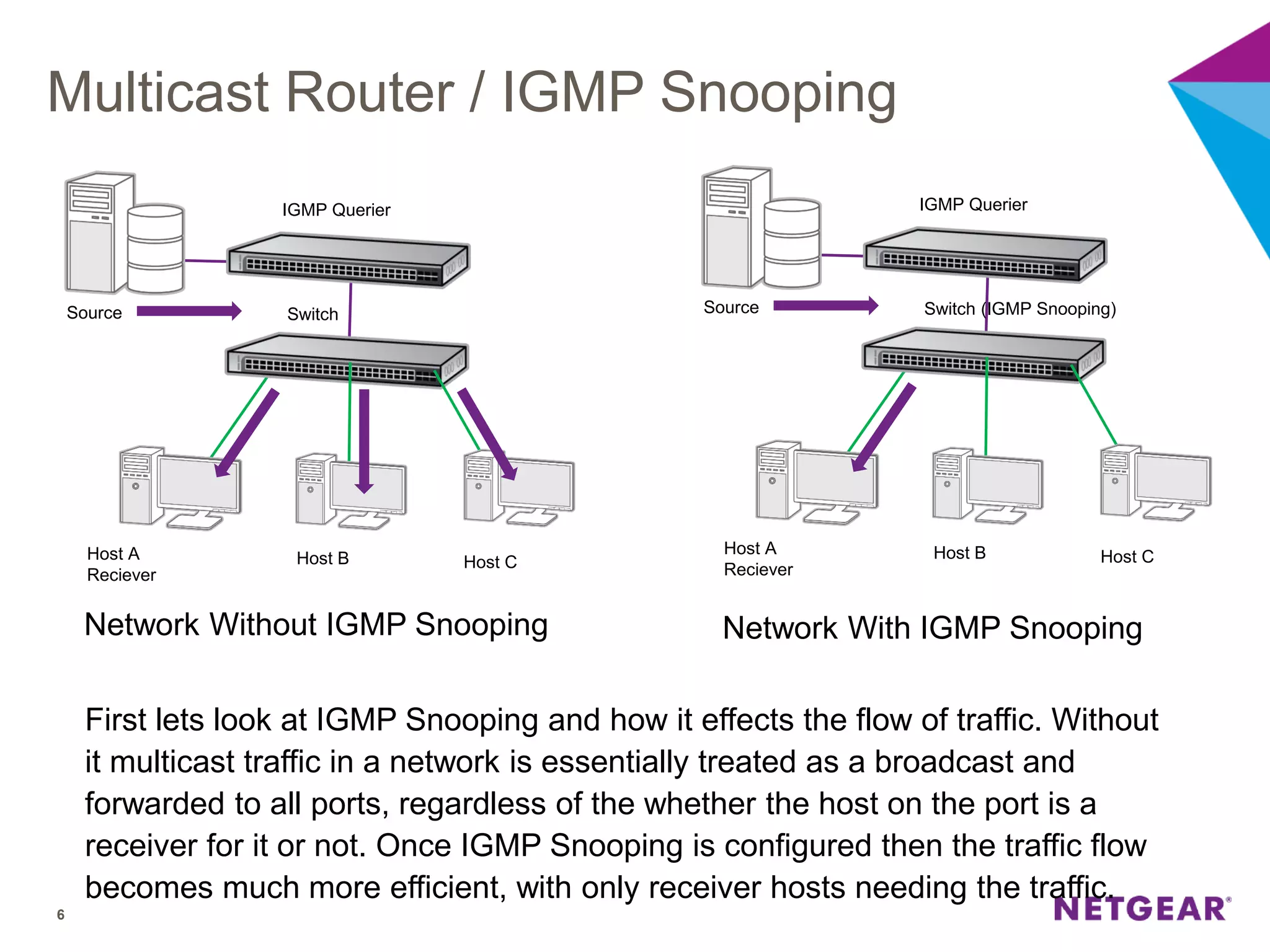
First lets look at IGMP Snooping and how it effects the flow of traffic. Without
it multicast traffic in a network is essentially treated as a broadcast and
forwarded to all ports, regardless of the whether the host on the port is a
receiver for it or not. Once IGMP Snooping is configured then the traffic flow
becomes much more efficient, with only receiver hosts needing the traffic.
7
Multicast Router / IGMP Snooping
IGMP Querier
Host A
Reciever
Source
IGMP Querier
Host B Host C
Switch (IGMP Snooping)
IGMP Querier / IGMP Snooping
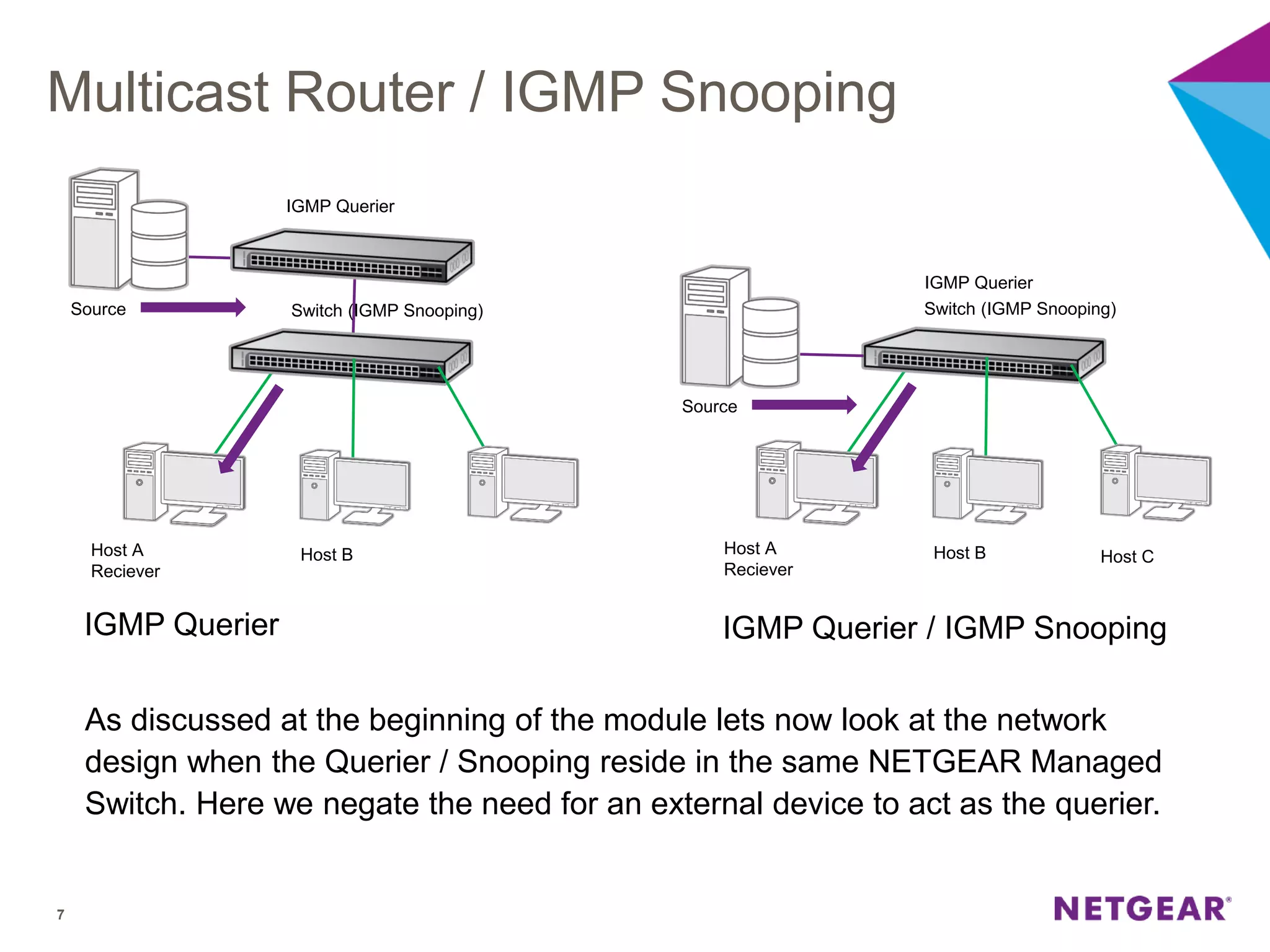
As discussed at the beginning of the module lets now look at the network
design when the Querier / Snooping reside in the same NETGEAR Managed
Switch. Here we negate the need for an external device to act as the querier.
Host A
Reciever
Source
IGMP Querier
Host B
Switch (IGMP Snooping)
8
Multicast with VLC using IGMP
For this example, we will use the VLC Media Player to stream a video to
specific ports on a VLAN.
For the first part we’ll use IGMP Snooping and Querier.
IGMP Switch Configuration:
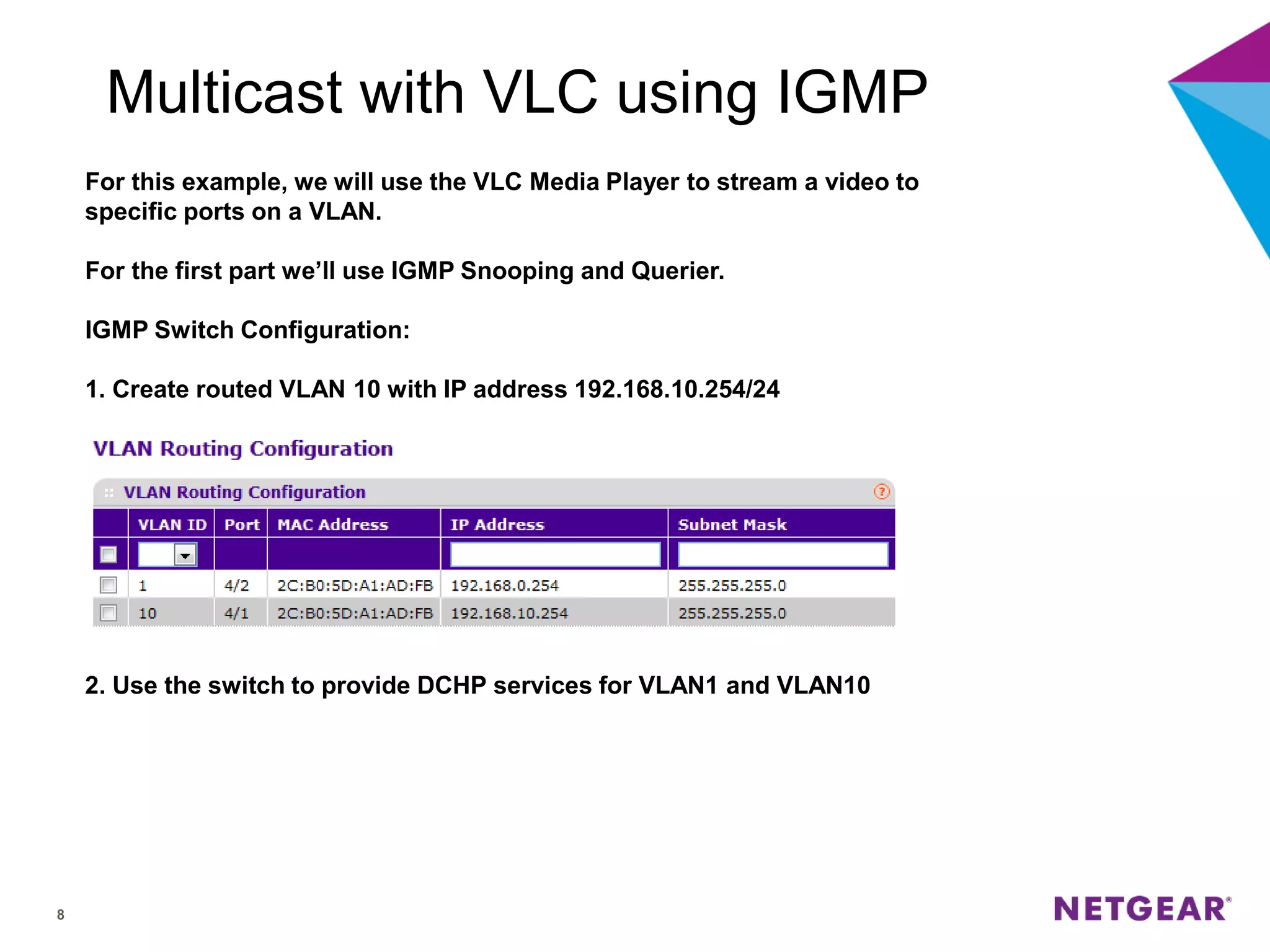
1. Create routed VLAN 10 with IP address 192.168.10.254/24
2. Use the switch to provide DCHP services for VLAN1 and VLAN10
9
Multicast with VLC using IGMP
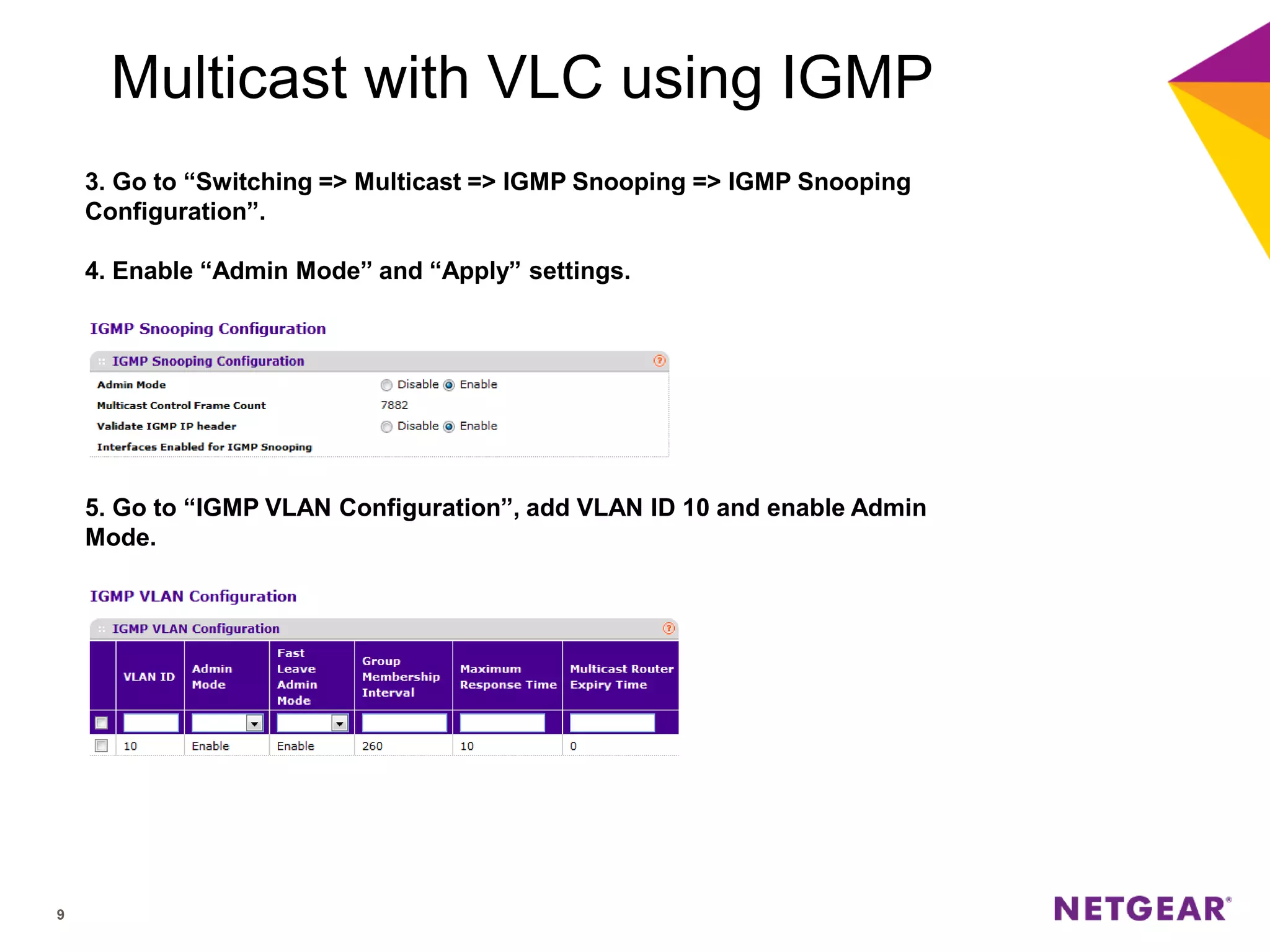
3. Go to “Switching => Multicast => IGMP Snooping => IGMP Snooping
Configuration”.
4. Enable “Admin Mode” and “Apply” settings.
5. Go to “IGMP VLAN Configuration”, add VLAN ID 10 and enable Admin
Mode.
10
Multicast with VLC using IGMP
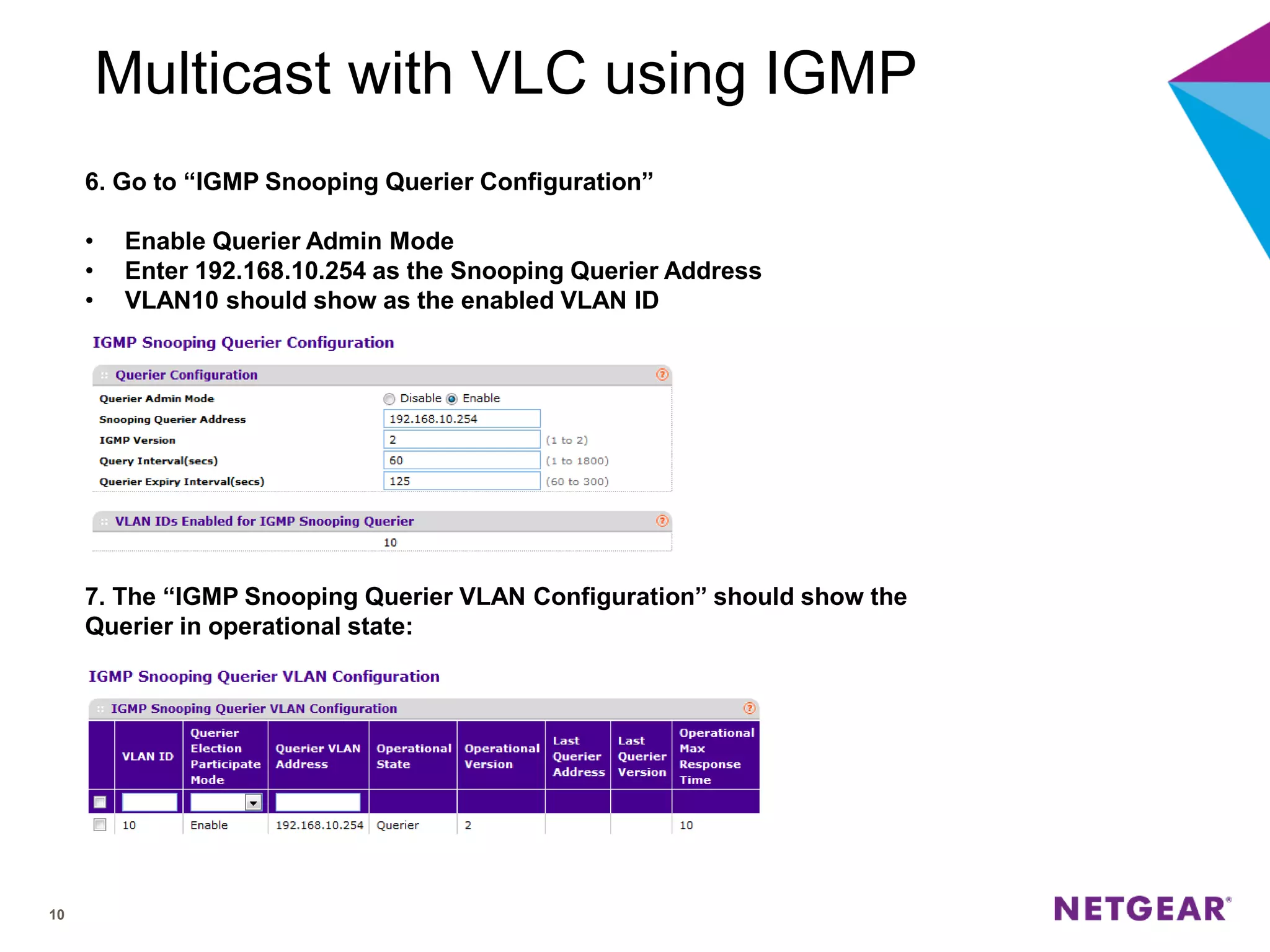
6. Go to “IGMP Snooping Querier Configuration”
• Enable Querier Admin Mode
• Enter 192.168.10.254 as the Snooping Querier Address
• VLAN10 should show as the enabled VLAN ID
7. The “IGMP Snooping Querier VLAN Configuration” should show the
Querier in operational state:
Multicast VLAN Registration (MVR)
11
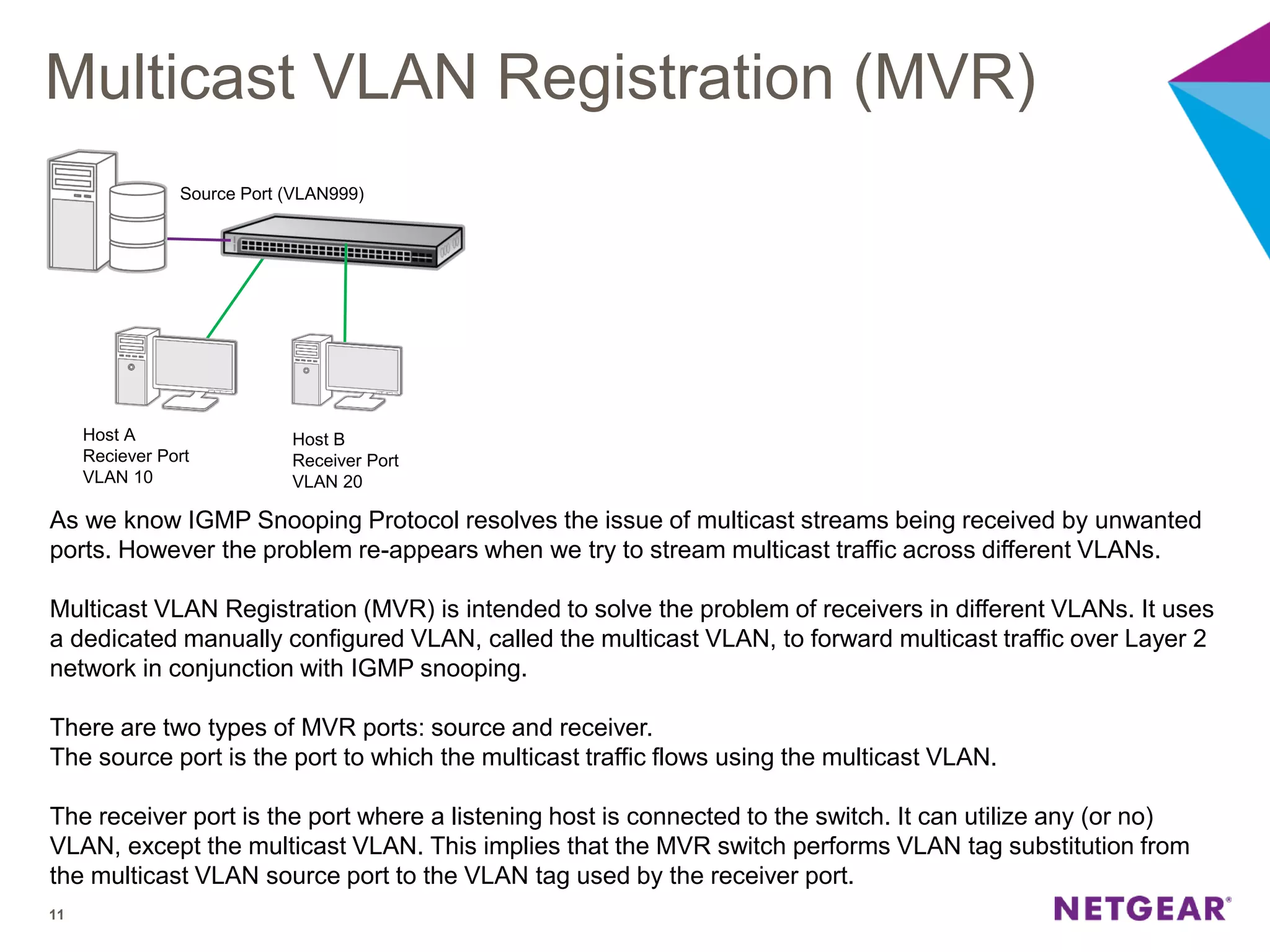
As we know IGMP Snooping Protocol resolves the issue of multicast streams being received by unwanted
ports. However the problem re-appears when we try to stream multicast traffic across different VLANs.
Multicast VLAN Registration (MVR) is intended to solve the problem of receivers in different VLANs. It uses
a dedicated manually configured VLAN, called the multicast VLAN, to forward multicast traffic over Layer 2
network in conjunction with IGMP snooping.
There are two types of MVR ports: source and receiver.
The source port is the port to which the multicast traffic flows using the multicast VLAN.
The receiver port is the port where a listening host is connected to the switch. It can utilize any (or no)
VLAN, except the multicast VLAN. This implies that the MVR switch performs VLAN tag substitution from
the multicast VLAN source port to the VLAN tag used by the receiver port.
Host A
Reciever Port
VLAN 10
Host B
Receiver Port
VLAN 20
Source Port (VLAN999)
12
Multicast with VLC using IGMP and MVR
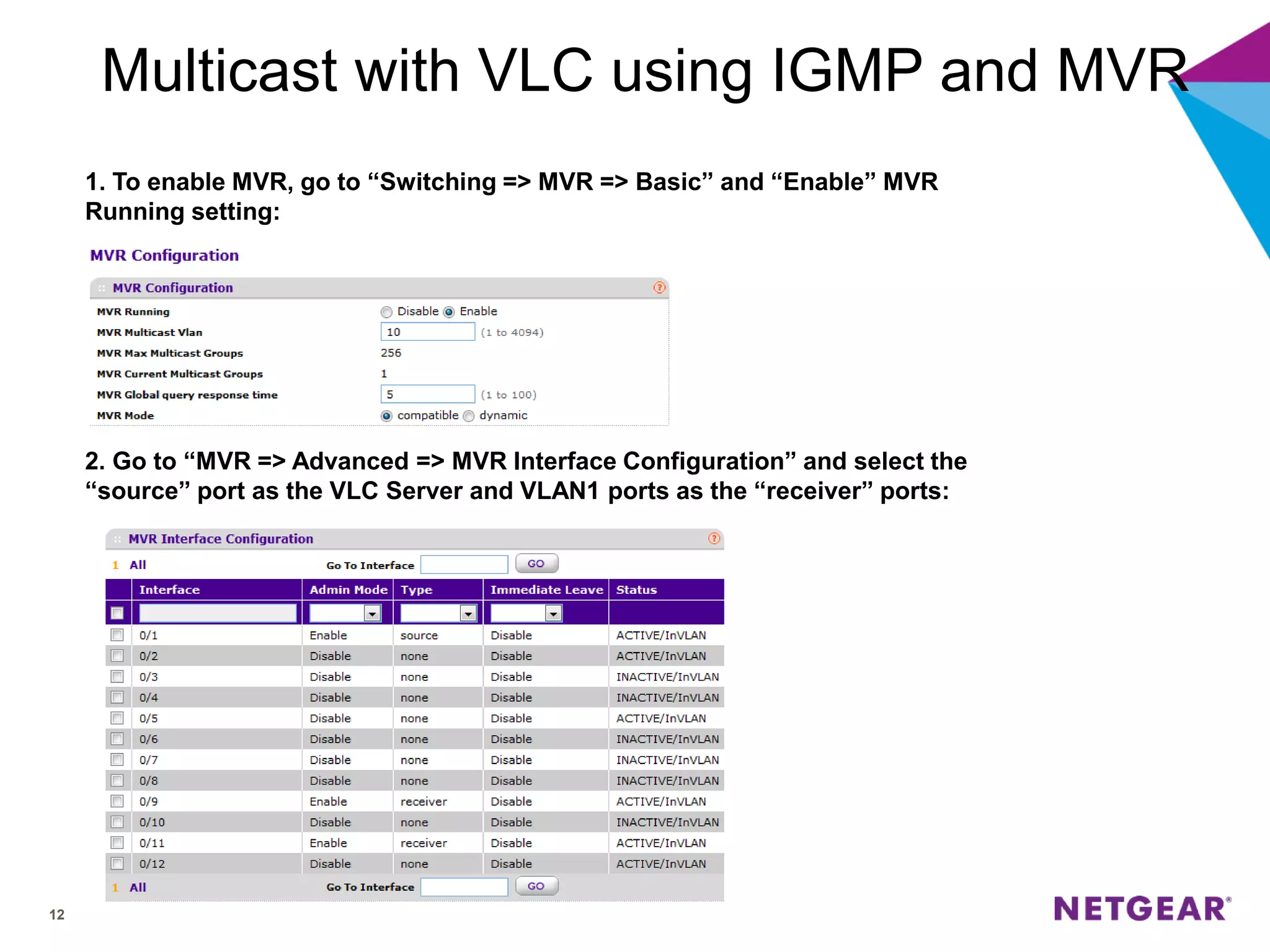
1. To enable MVR, go to “Switching => MVR => Basic” and “Enable” MVR
Running setting:
2. Go to “MVR => Advanced => MVR Interface Configuration” and select the
“source” port as the VLC Server and VLAN1 ports as the “receiver” ports:
13
Multicast with VLC using IGMP and MVR
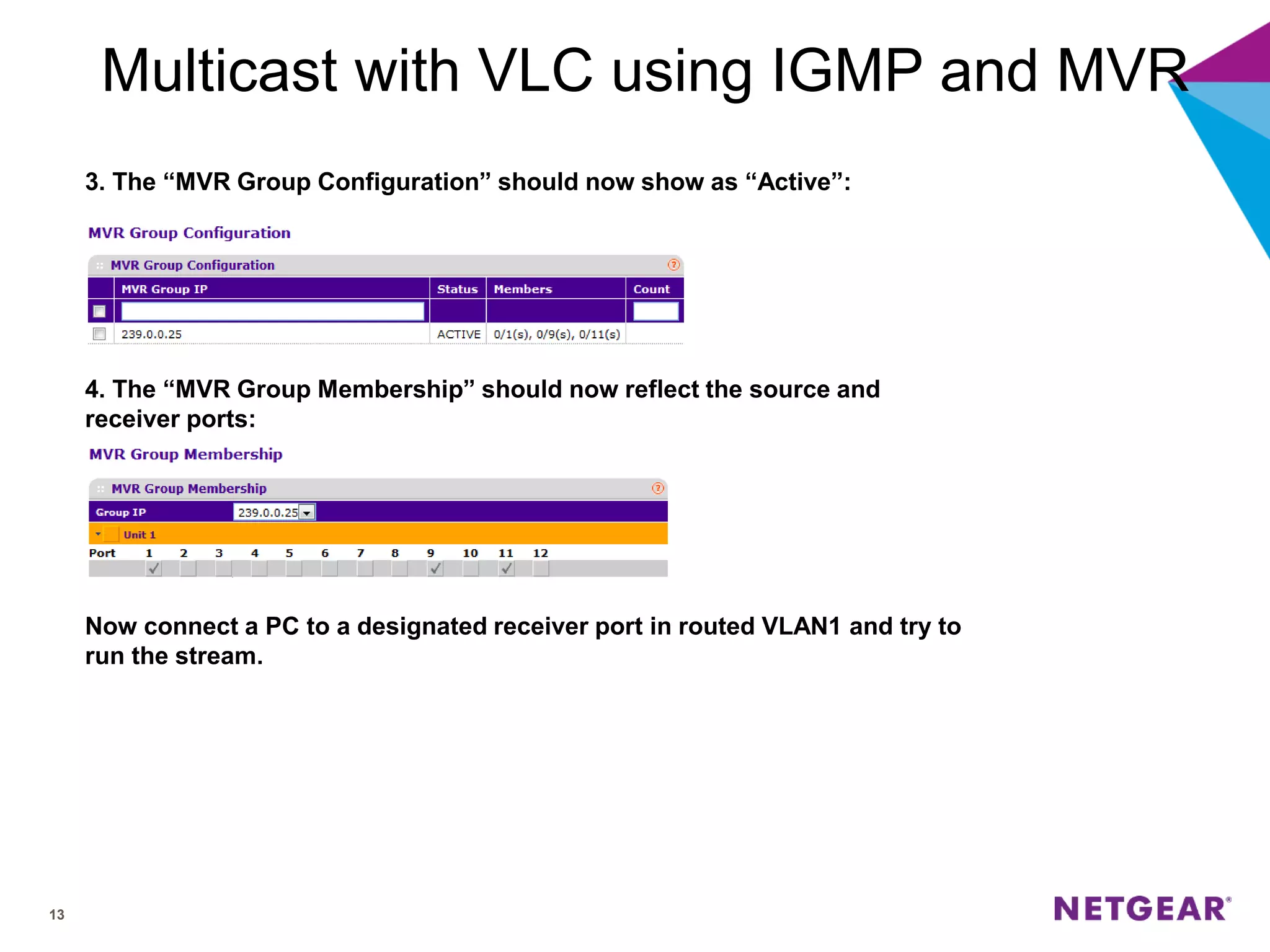
3. The “MVR Group Configuration” should now show as “Active”:
4. The “MVR Group Membership” should now reflect the source and
receiver ports:
Now connect a PC to a designated receiver port in routed VLAN1 and try to
run the stream.
14
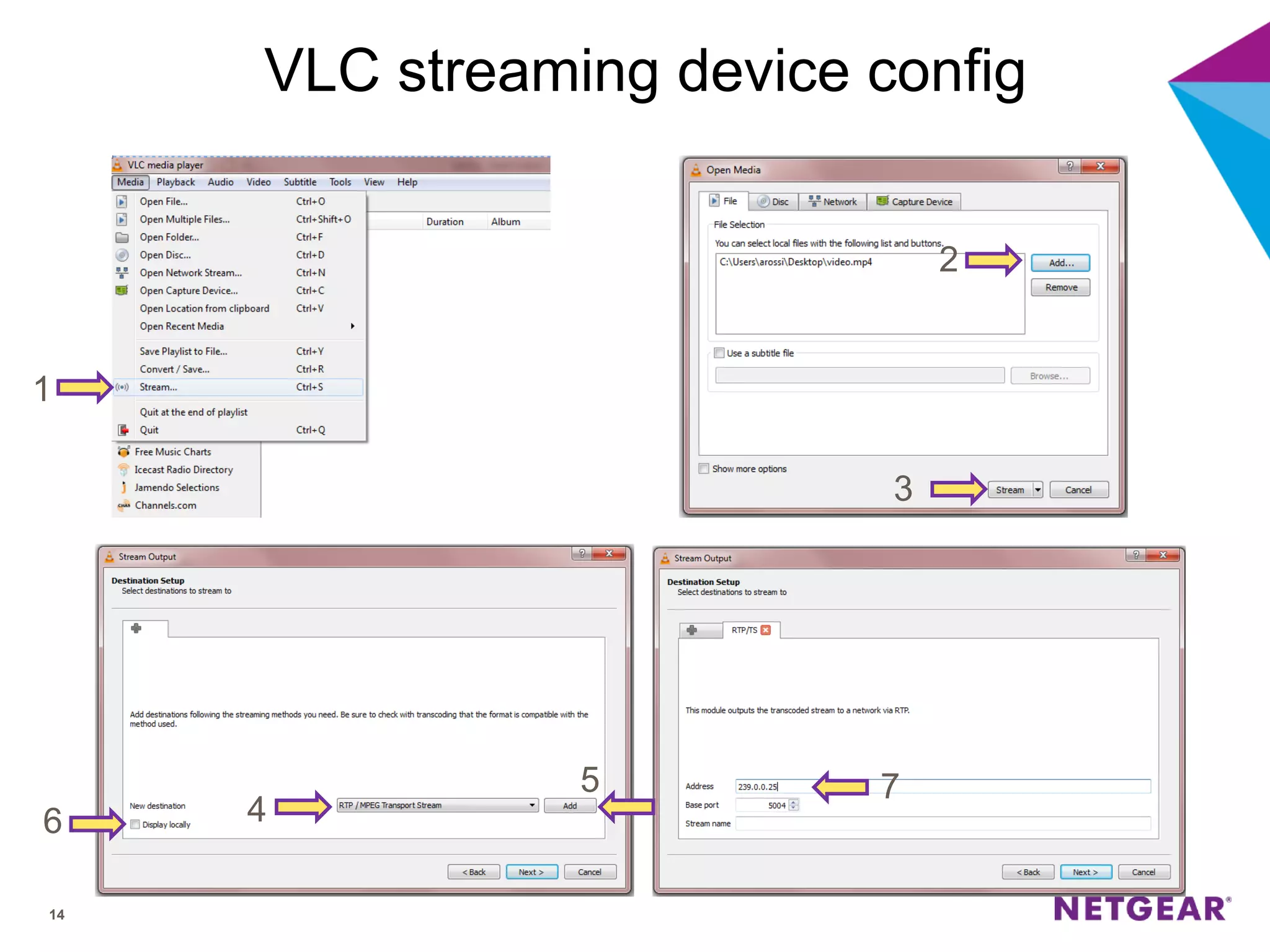
VLC streaming device config
1
2
3
4
5
6
7
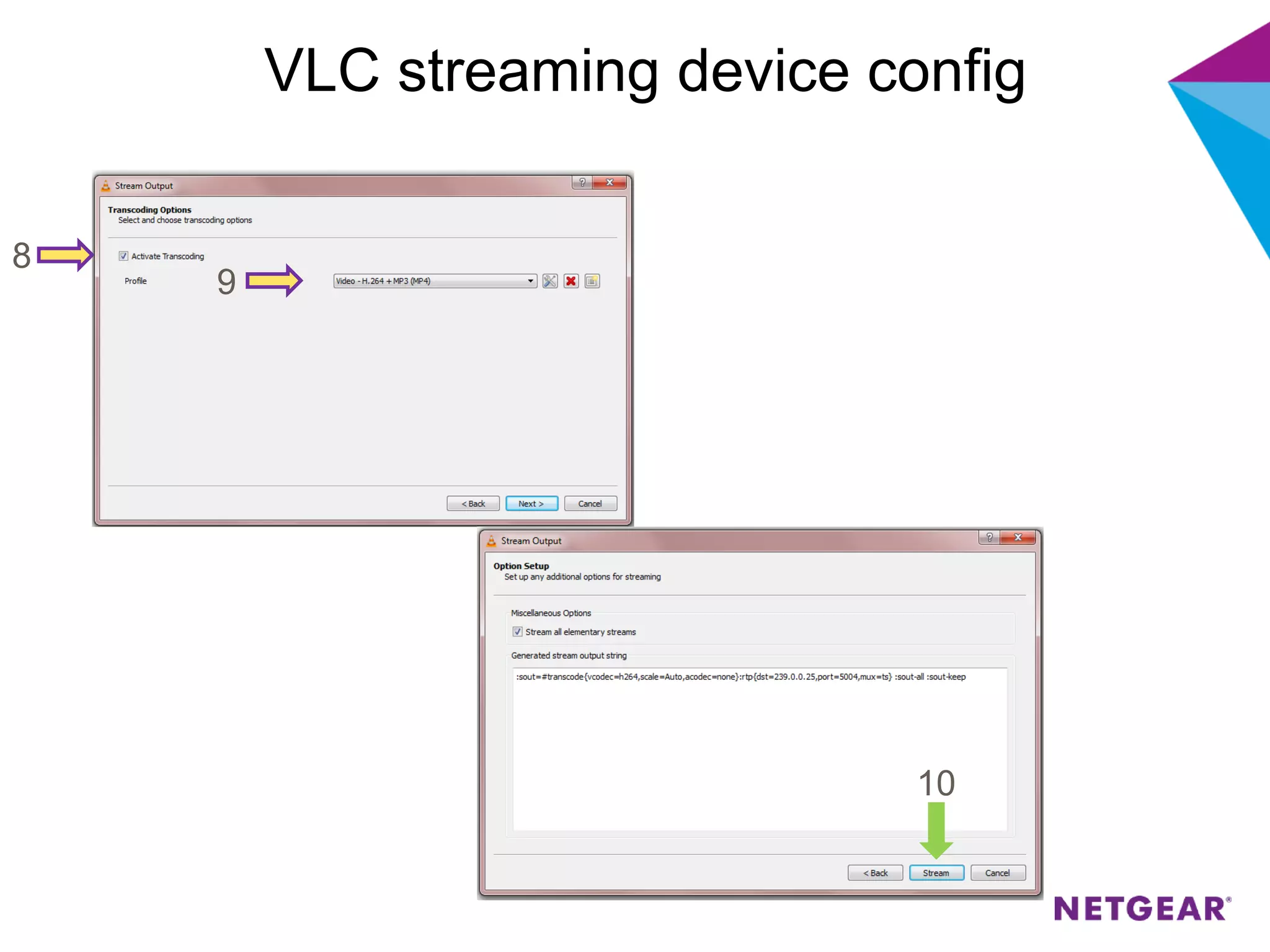
VLC streaming device config
8
9
10
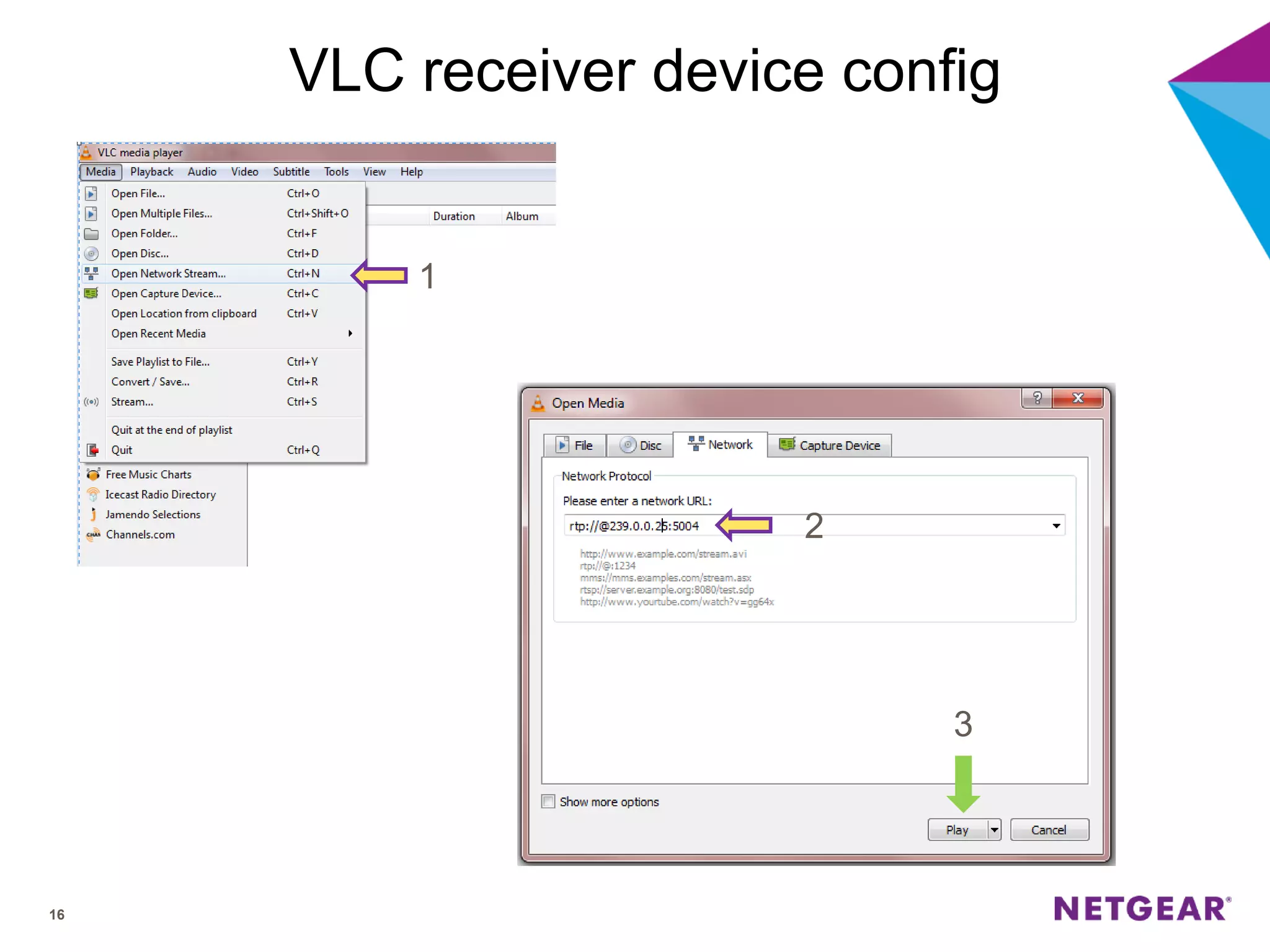
16
VLC receiver device config
1
2
3
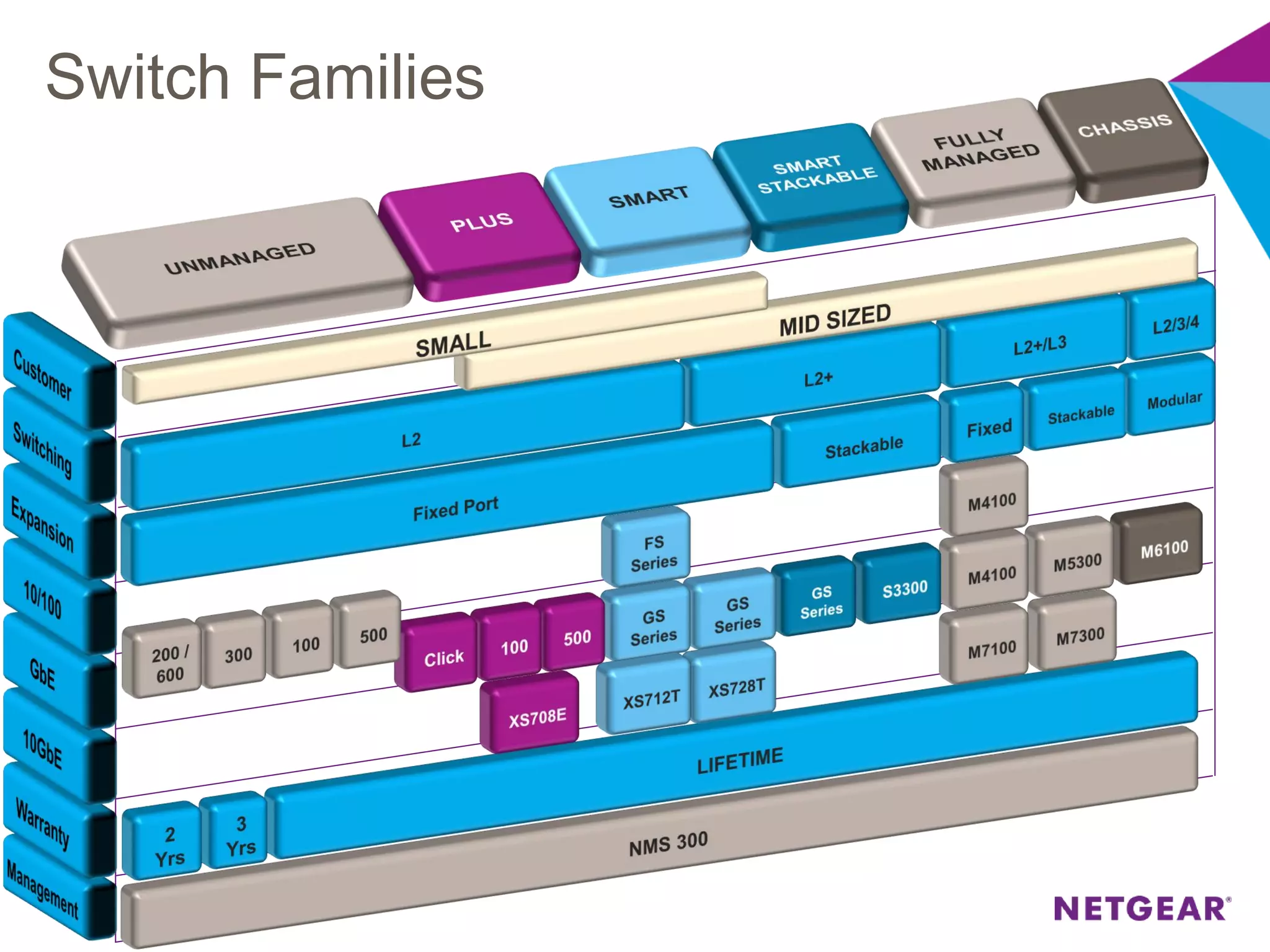
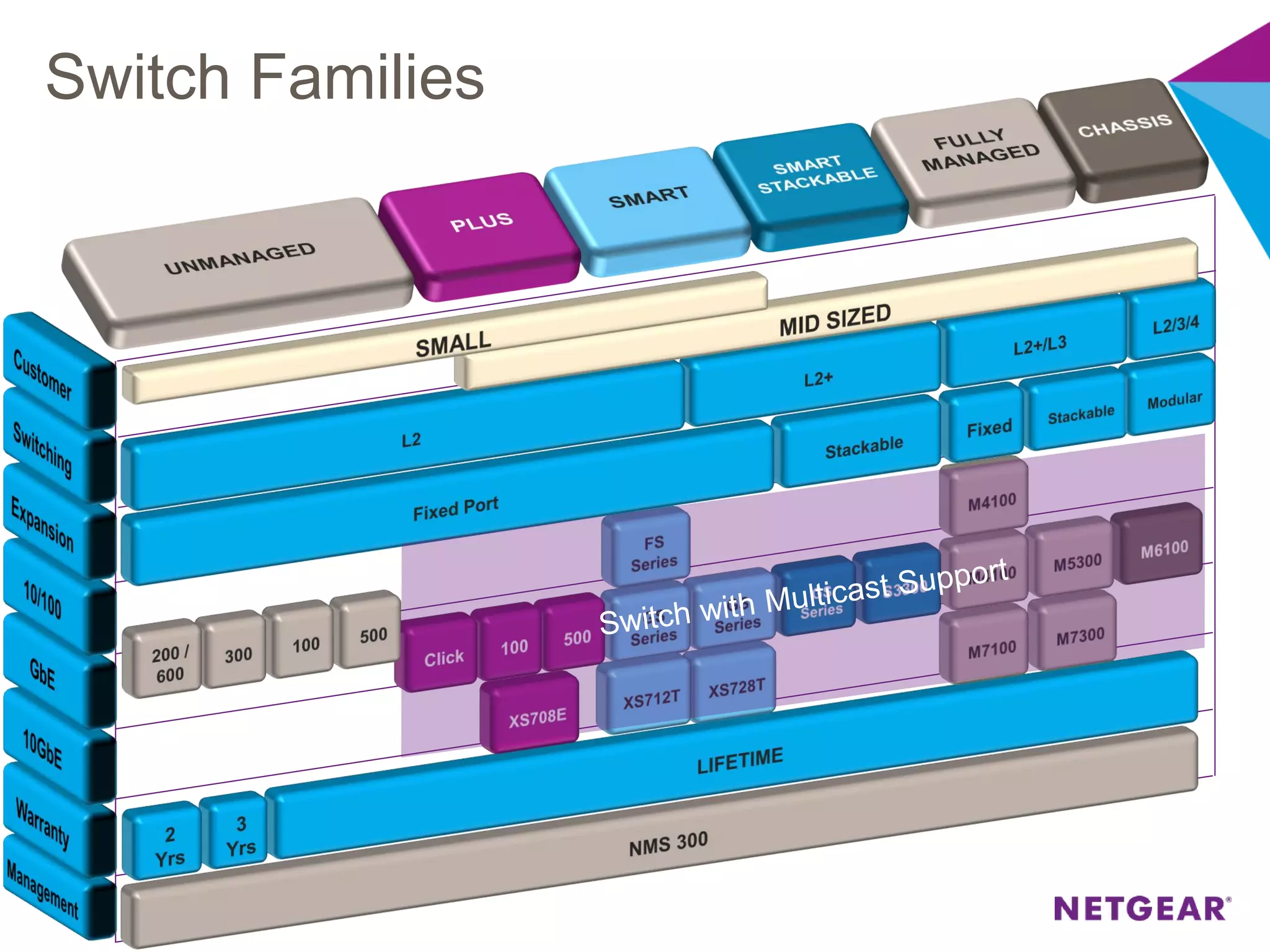
Switch Families
Switch Families
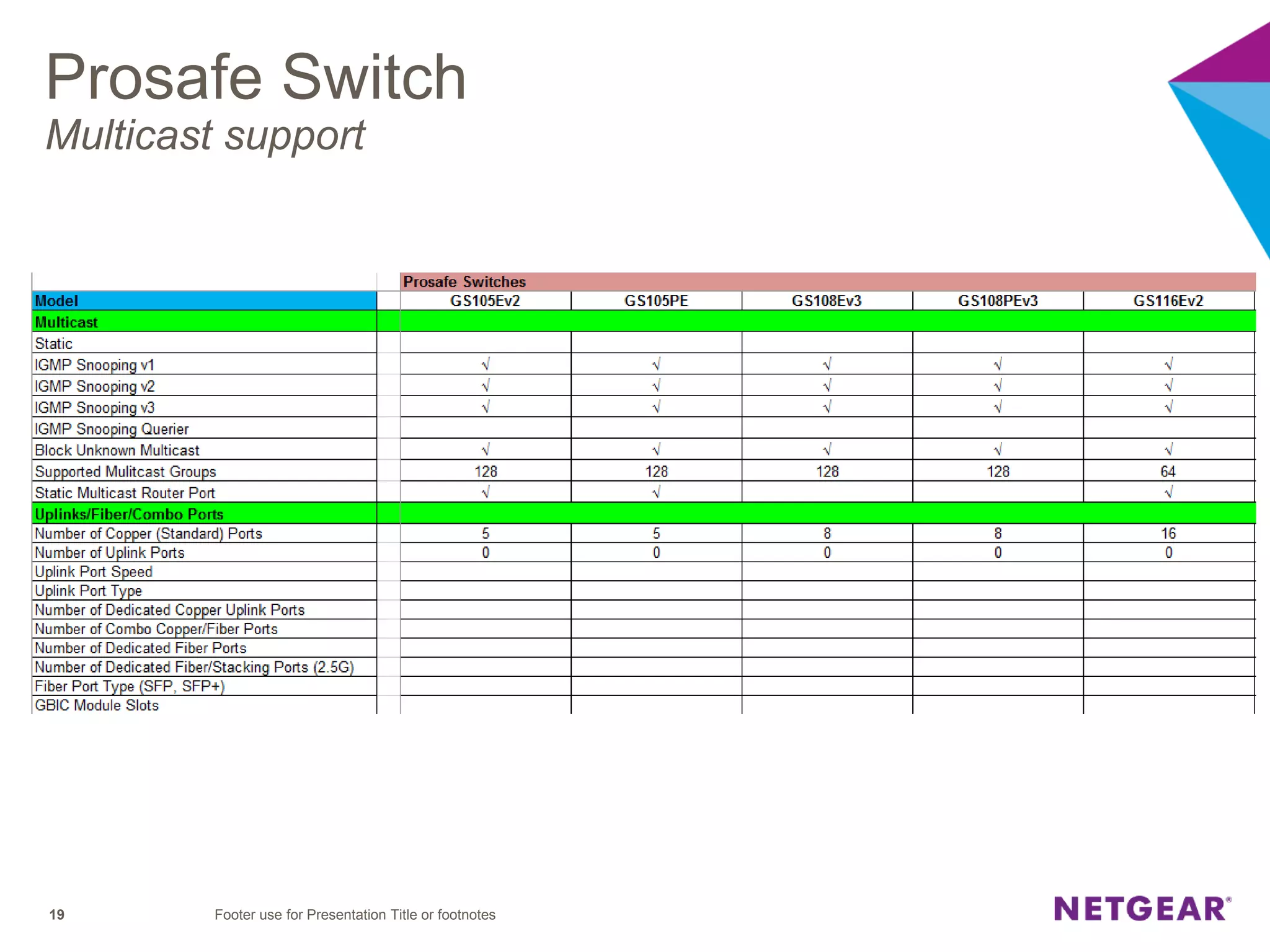
Prosafe Switch
Multicast support
Footer use for Presentation Title or footnotes19
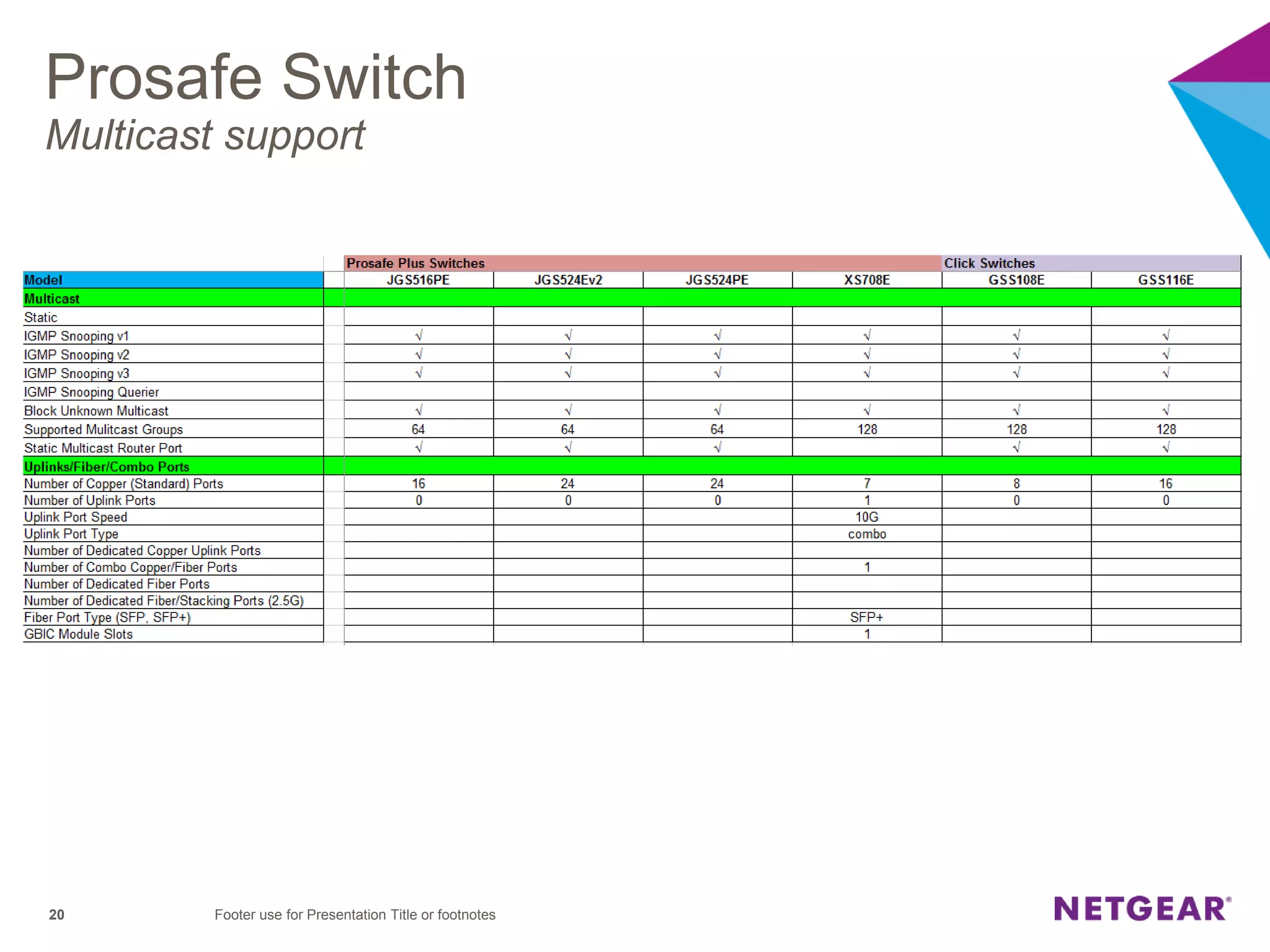
Prosafe Switch
Multicast support
Footer use for Presentation Title or footnotes20
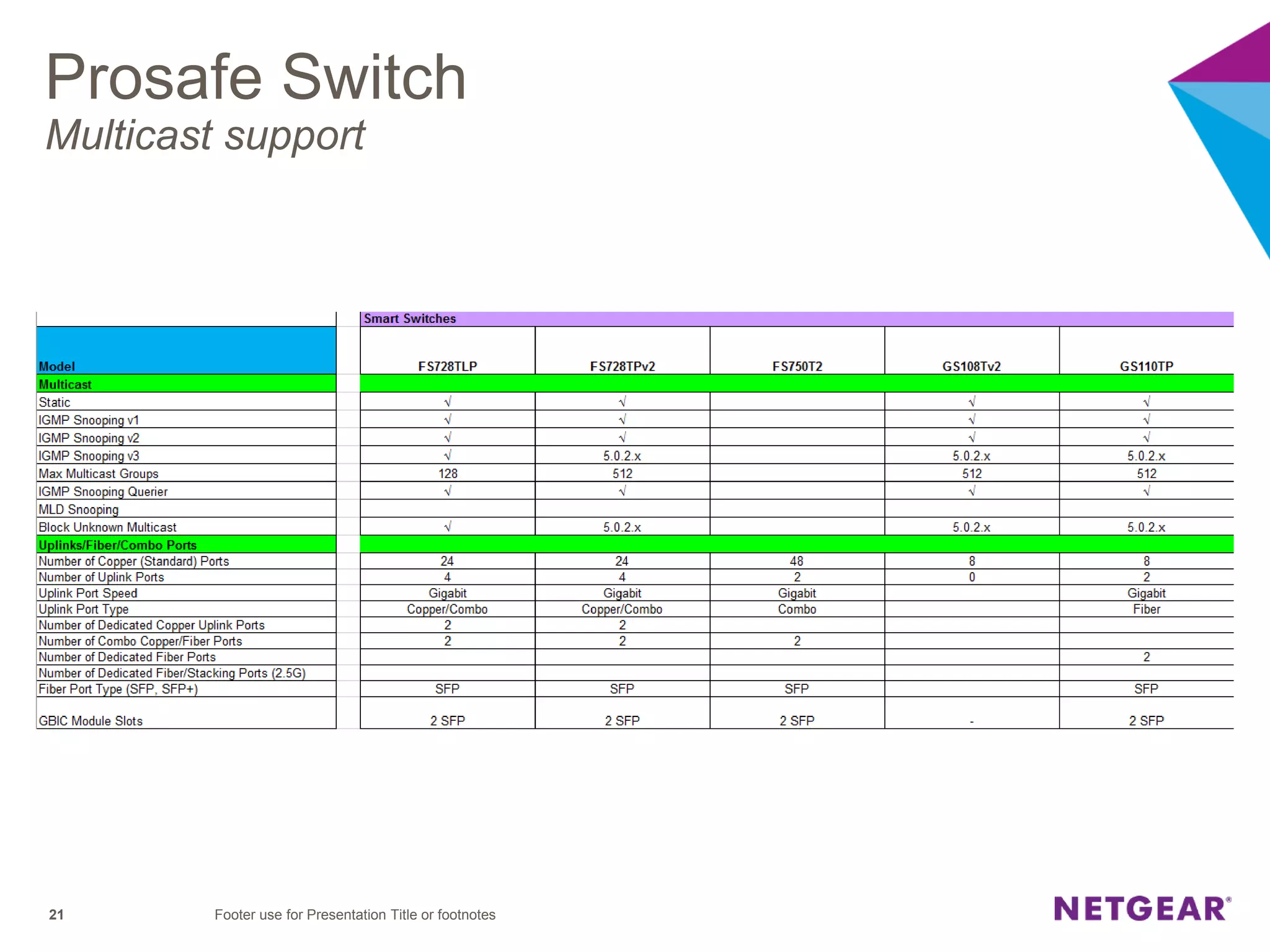
Prosafe Switch
Multicast support
Footer use for Presentation Title or footnotes21
Prosafe Switch
Multicast support
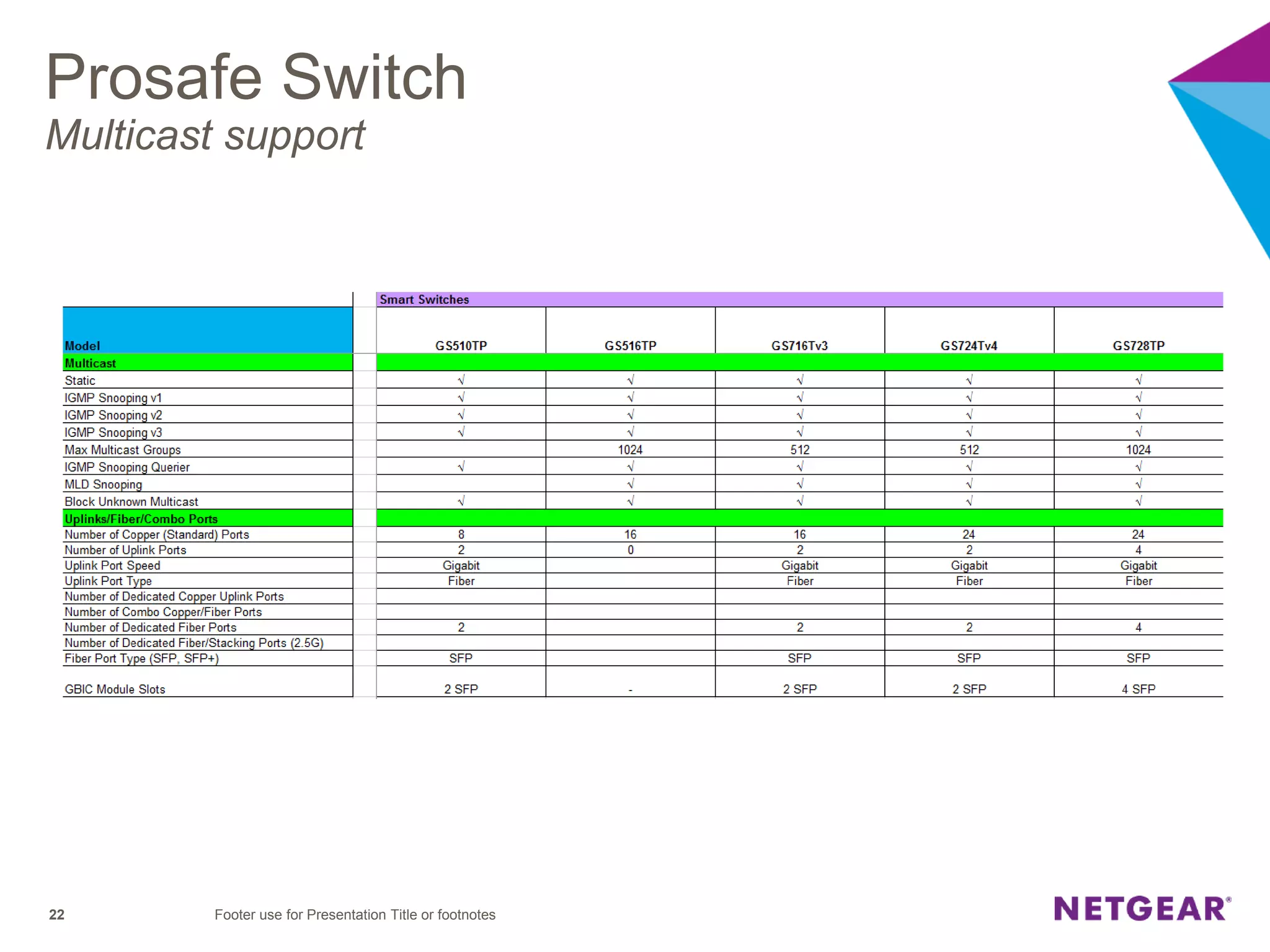
Footer use for Presentation Title or footnotes22
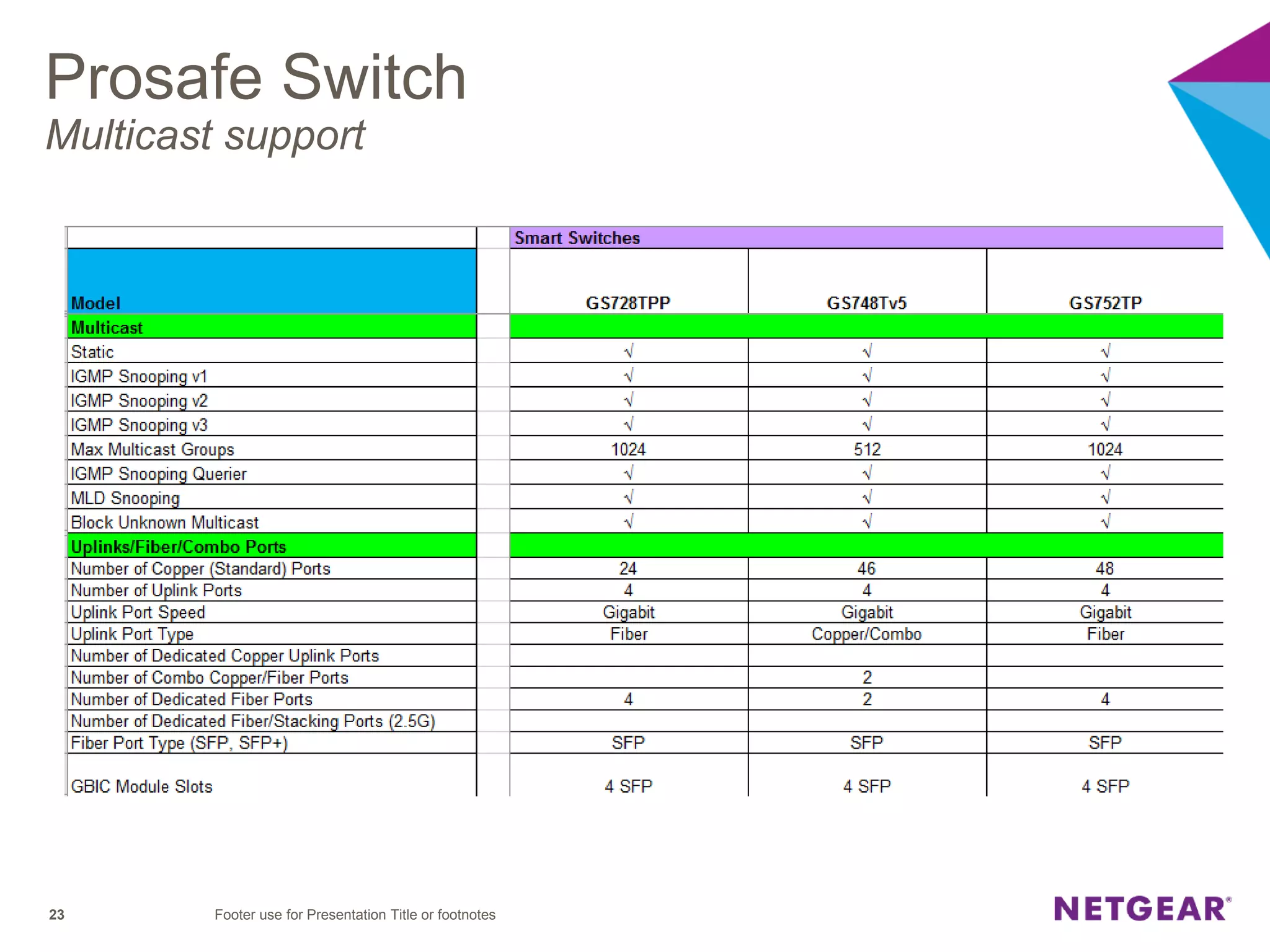
Prosafe Switch
Multicast support
Footer use for Presentation Title or footnotes23
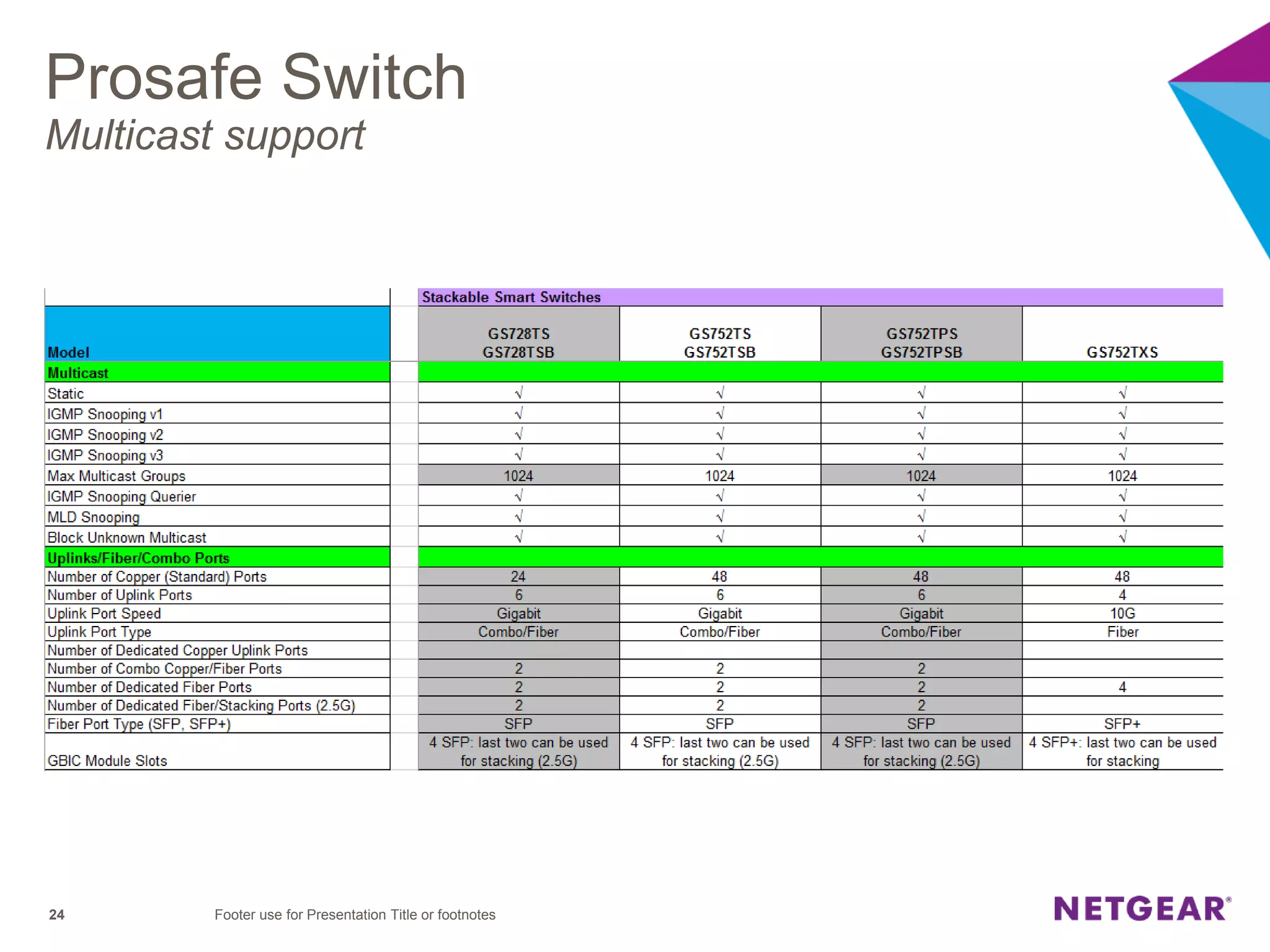
Prosafe Switch
Multicast support
Footer use for Presentation Title or footnotes24
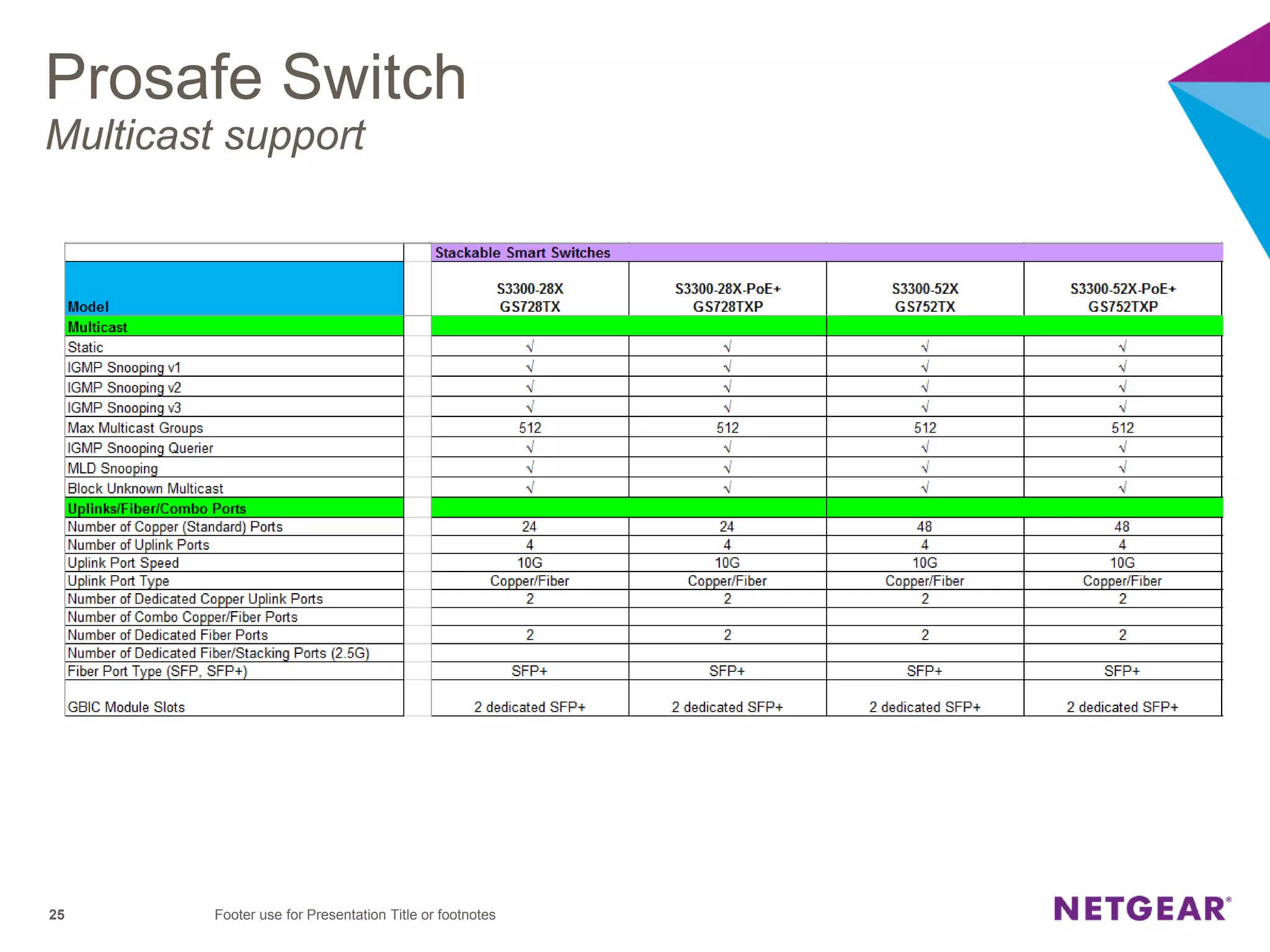
Prosafe Switch
Multicast support
Footer use for Presentation Title or footnotes25
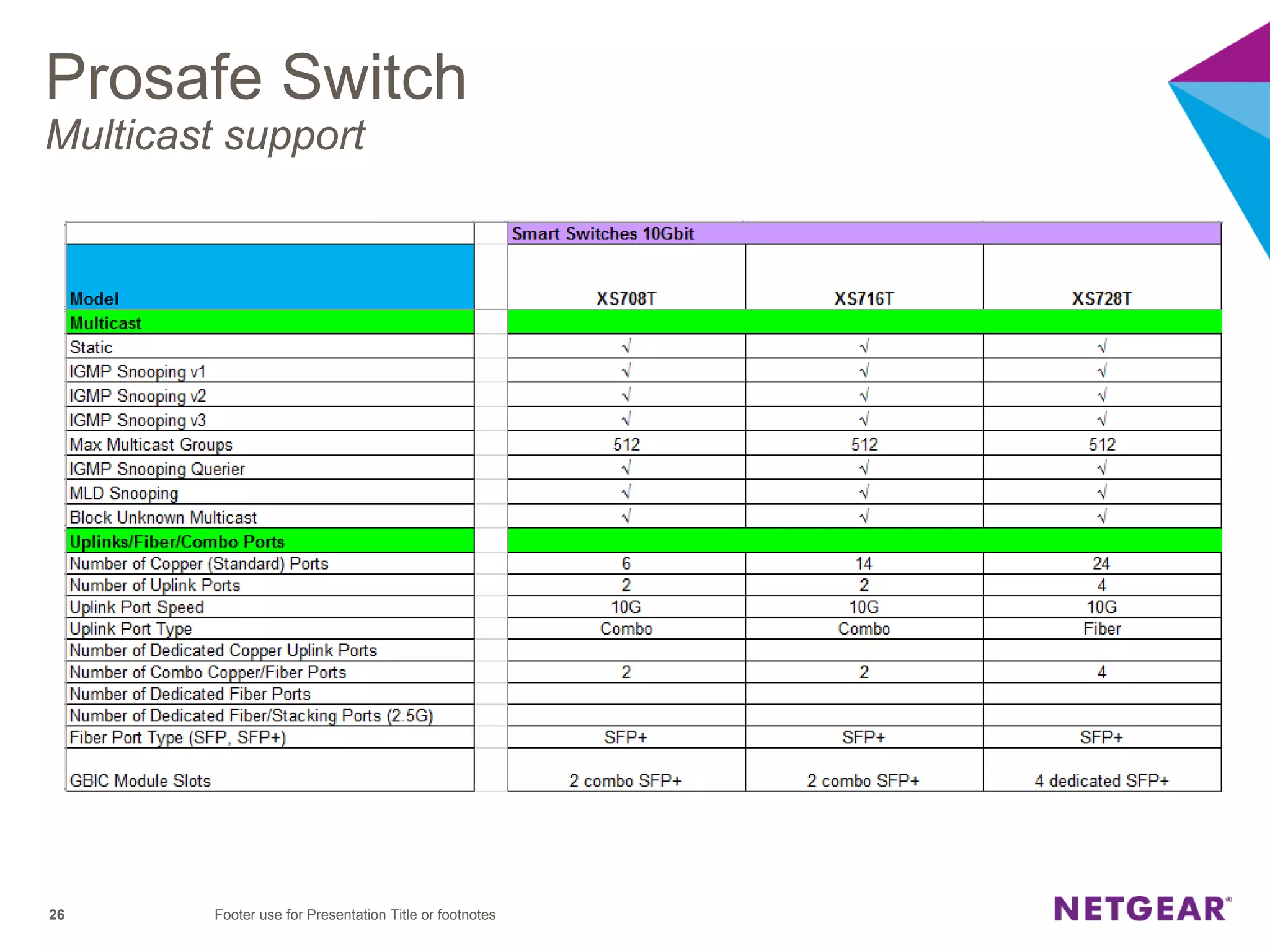
Prosafe Switch
Multicast support
Footer use for Presentation Title or footnotes26
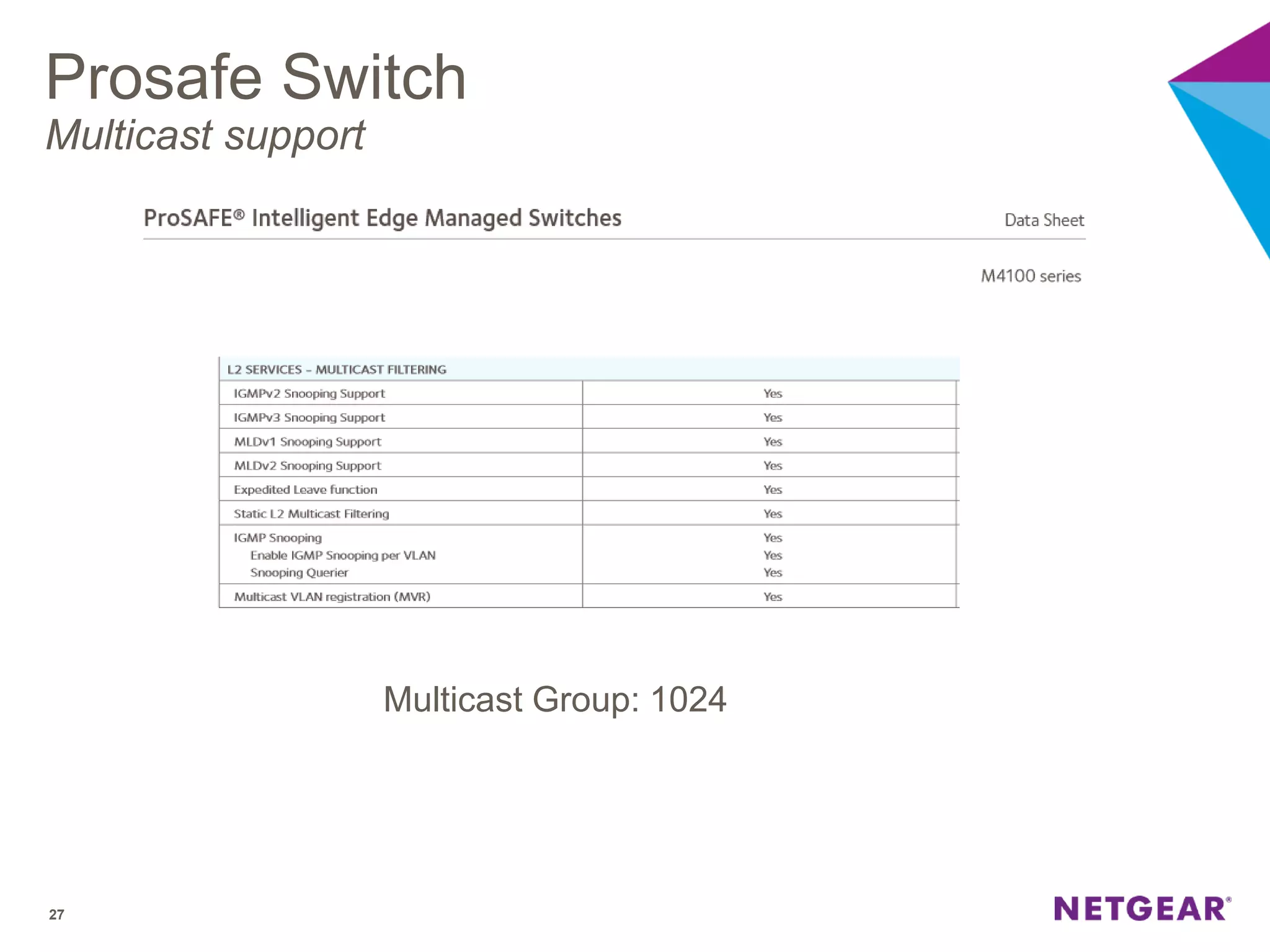
Prosafe Switch
Multicast support
27
Multicast Group: 1024
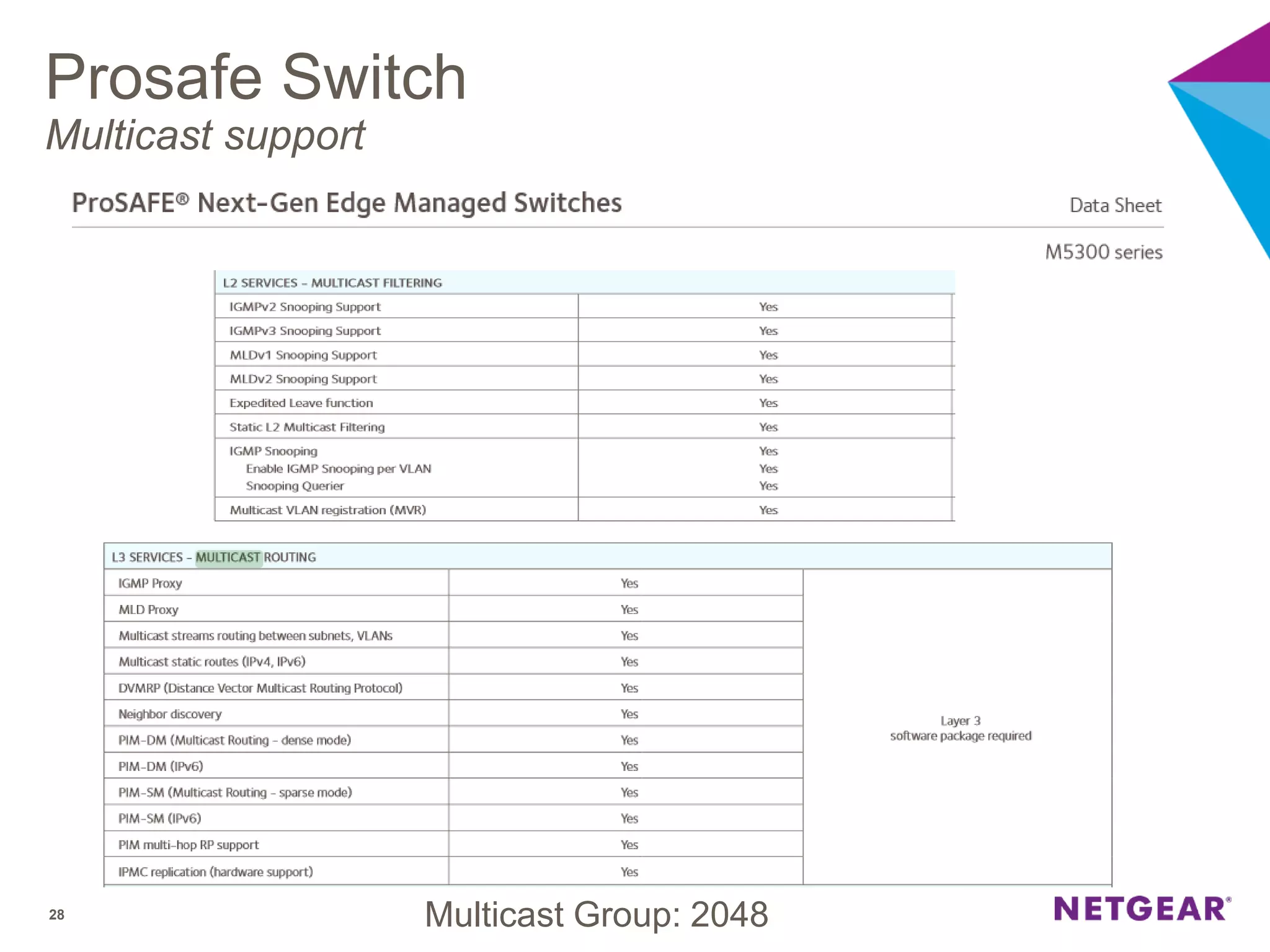
Prosafe Switch
Multicast support
28 Multicast Group: 2048

Webinar NETGEAR - Prosafe Switch - Come configurare il supporto del Multicast

  • 1.
    ProSAFE Switch Series Configurareil Multicast Andrea Rossi Senior System Engineer andrea.rossi@netgear.com Formazione Online
  • 2.
    What is Multicast? Multicast(one-to-many or many-to-many distribution) is group communication where data is addressed to a group of destination devices.
  • 3.
    What is Multicast? Multicast(one-to-many or many-to-many distribution) is group communication where data is addressed to a group of destination devices. BROADCAST UNICAST MULTICAST
  • 4.
    What is Multicast? Themulticast addresses are in the range 224.0.0.0 through 239.255.255.255 239.0.0.0-239.255.255.255 Organization-Local Scope Network assisted multicast may be implemented at the Internet layer using IP multicast, which is often employed in IP applications of streaming media, such as IPTV scheduled content (but not media-on-demand) and multipoint videoconferencing, but also for ghost distribution of backup disk images to multiple computers simultaneously. In IP multicast the implementation of the multicast concept occurs at the IP routing level, where routers create optimal distribution paths for datagrams sent to a multicast destination address.
  • 5.
    Internet Group ManagementProtocol (IGMP) 5 • When the switch is used in network applications where video services such as IPTV, video streaming, and gaming are deployed, the video traffic is normally flooded to all connected ports because such traffic packets usually have multicast Ethernet addresses. IGMP snooping can be enabled to create a multicast group to direct that traffic only to those users that require it. • However, the IGMP snooping operation usually requires an extra network device—usually a router—that can generate an IGMP membership query and solicit interested nodes to respond. With the built-in IGMP querier feature inside the switch, such an external device is no longer needed. • Since the IGMP querier is designed to work with IGMP snooping, it is necessary to enable IGMP snooping when using it.
  • 6.
    6 Host A Reciever Multicast Router/ IGMP Snooping Network Without IGMP Snooping Source IGMP Querier Host B Host C Switch Host A Reciever Source IGMP Querier Host B Host C Switch (IGMP Snooping) Network With IGMP Snooping First lets look at IGMP Snooping and how it effects the flow of traffic. Without it multicast traffic in a network is essentially treated as a broadcast and forwarded to all ports, regardless of the whether the host on the port is a receiver for it or not. Once IGMP Snooping is configured then the traffic flow becomes much more efficient, with only receiver hosts needing the traffic.
  • 7.
    7 Multicast Router /IGMP Snooping IGMP Querier Host A Reciever Source IGMP Querier Host B Host C Switch (IGMP Snooping) IGMP Querier / IGMP Snooping As discussed at the beginning of the module lets now look at the network design when the Querier / Snooping reside in the same NETGEAR Managed Switch. Here we negate the need for an external device to act as the querier. Host A Reciever Source IGMP Querier Host B Switch (IGMP Snooping)
  • 8.
    8 Multicast with VLCusing IGMP For this example, we will use the VLC Media Player to stream a video to specific ports on a VLAN. For the first part we’ll use IGMP Snooping and Querier. IGMP Switch Configuration: 1. Create routed VLAN 10 with IP address 192.168.10.254/24 2. Use the switch to provide DCHP services for VLAN1 and VLAN10
  • 9.
    9 Multicast with VLCusing IGMP 3. Go to “Switching => Multicast => IGMP Snooping => IGMP Snooping Configuration”. 4. Enable “Admin Mode” and “Apply” settings. 5. Go to “IGMP VLAN Configuration”, add VLAN ID 10 and enable Admin Mode.
  • 10.
    10 Multicast with VLCusing IGMP 6. Go to “IGMP Snooping Querier Configuration” • Enable Querier Admin Mode • Enter 192.168.10.254 as the Snooping Querier Address • VLAN10 should show as the enabled VLAN ID 7. The “IGMP Snooping Querier VLAN Configuration” should show the Querier in operational state:
  • 11.
    Multicast VLAN Registration(MVR) 11 As we know IGMP Snooping Protocol resolves the issue of multicast streams being received by unwanted ports. However the problem re-appears when we try to stream multicast traffic across different VLANs. Multicast VLAN Registration (MVR) is intended to solve the problem of receivers in different VLANs. It uses a dedicated manually configured VLAN, called the multicast VLAN, to forward multicast traffic over Layer 2 network in conjunction with IGMP snooping. There are two types of MVR ports: source and receiver. The source port is the port to which the multicast traffic flows using the multicast VLAN. The receiver port is the port where a listening host is connected to the switch. It can utilize any (or no) VLAN, except the multicast VLAN. This implies that the MVR switch performs VLAN tag substitution from the multicast VLAN source port to the VLAN tag used by the receiver port. Host A Reciever Port VLAN 10 Host B Receiver Port VLAN 20 Source Port (VLAN999)
  • 12.
    12 Multicast with VLCusing IGMP and MVR 1. To enable MVR, go to “Switching => MVR => Basic” and “Enable” MVR Running setting: 2. Go to “MVR => Advanced => MVR Interface Configuration” and select the “source” port as the VLC Server and VLAN1 ports as the “receiver” ports:
  • 13.
    13 Multicast with VLCusing IGMP and MVR 3. The “MVR Group Configuration” should now show as “Active”: 4. The “MVR Group Membership” should now reflect the source and receiver ports: Now connect a PC to a designated receiver port in routed VLAN1 and try to run the stream.
  • 14.
    14 VLC streaming deviceconfig 1 2 3 4 5 6 7
  • 15.
    VLC streaming deviceconfig 8 9 10
  • 16.
  • 17.
  • 18.
  • 19.
    Prosafe Switch Multicast support Footeruse for Presentation Title or footnotes19
  • 20.
    Prosafe Switch Multicast support Footeruse for Presentation Title or footnotes20
  • 21.
    Prosafe Switch Multicast support Footeruse for Presentation Title or footnotes21
  • 22.
    Prosafe Switch Multicast support Footeruse for Presentation Title or footnotes22
  • 23.
    Prosafe Switch Multicast support Footeruse for Presentation Title or footnotes23
  • 24.
    Prosafe Switch Multicast support Footeruse for Presentation Title or footnotes24
  • 25.
    Prosafe Switch Multicast support Footeruse for Presentation Title or footnotes25
  • 26.
    Prosafe Switch Multicast support Footeruse for Presentation Title or footnotes26
  • 27.
  • 28.