Empowerment Technologies
2
Short Quiz
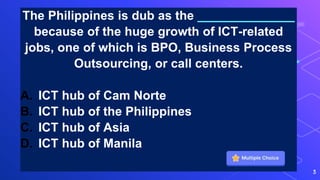
The Philippines is dub as the ______________
because of the huge growth of ICT-related
jobs, one of which is BPO, Business Process
Outsourcing, or call centers.
A. ICT hub of Cam Norte
B. ICT hub of the Philippines
C. ICT hub of Asia
D. ICT hub of Manila
3
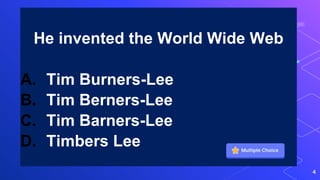
He invented the World Wide Web
A. Tim Burners-Lee
B. Tim Berners-Lee
C. Tim Barners-Lee
D. Timbers Lee
4
What is the meaning of http?
A. Hypertents Transfer Protocol
B. Hypertext Transmit Protocol
C. Hyperlink Transfer Protocol
D. Hypertext Transfer Protocol
5
 It is an information space where documents and
other web resources are identified by URLs,
interlinked by hypertext links, and can be
accessed via the Internet.
 A. Browser C. Web Site
 B. Web page D. World Wide Web
6
 It is a hypertext document connected
to the World Wide Web.
 A. Browser C. Web Site
 B. Web page D. Search Engine
7
The different online platforms of the
World Wide Web:
8
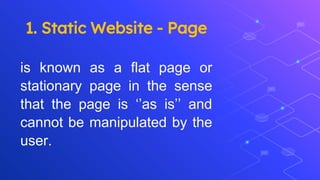
1. Static Website - Page
is known as a flat page or
stationary page in the sense
that the page is ‘’as is’’ and
cannot be manipulated by the
user.
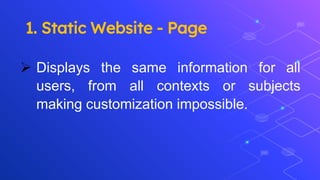
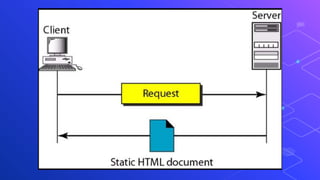
1. Static Website - Page
 Displays the same information for all
users, from all contexts or subjects
making customization impossible.
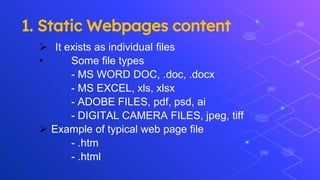
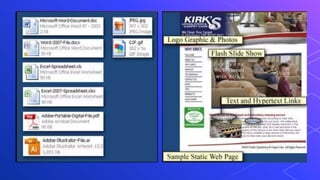
1. Static Webpages content
 It exists as individual files
• Some file types
- MS WORD DOC, .doc, .docx
- MS EXCEL, xls, xlsx
- ADOBE FILES, pdf, psd, ai
- DIGITAL CAMERA FILES, jpeg, tiff
 Example of typical web page file
- .htm
- .html
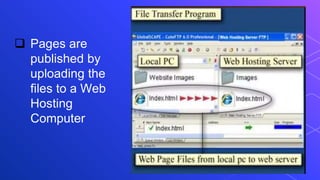
 Pages are
published by
uploading the
files to a Web
Hosting
Computer
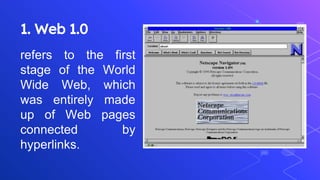
1. Web 1.0
refers to the first
stage of the World
Wide Web, which
was entirely made
up of Web pages
connected by
hyperlinks.
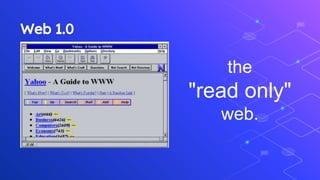
Web 1.0
the
"read only"
web.
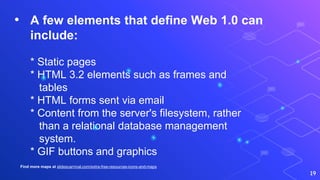
• A few elements that define Web 1.0 can
include:
* Static pages
* HTML 3.2 elements such as frames and
tables
* HTML forms sent via email
* Content from the server's filesystem, rather
than a relational database management
system.
* GIF buttons and graphics
19
Find more maps at slidescarnival.com/extra-free-resources-icons-and-maps
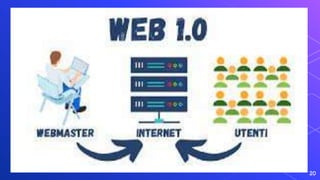
20
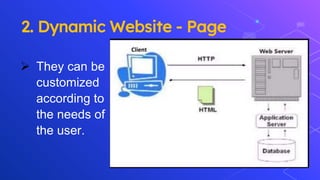
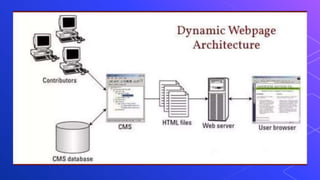
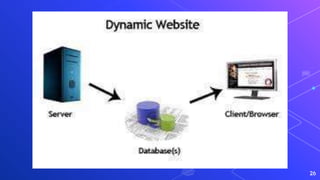
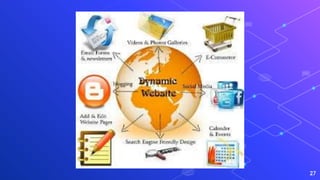
2. Dynamic Website - Page
 They can be
customized
according to
the needs of
the user.
Web 2.0
With Web 2.0, the focus moved away from a
small number of people making a large amount
of content, to a large number of people making
even more content.
Instead, this can mean creating a profile on the
site or leaving comments and reviews.
24
Basically, to
summarize Web 2.0:
the user has
become the
product.
25
26
27
28
Web 2.0, or the 'social web',
involves several tools and
platforms
29
30
Issue
A user will make a request to
the server, which will then be
sent to the webpage as a
response.
Web1.0 & 2.0.pptx

Web1.0 & 2.0.pptx

  • 2.
  • 3.
    The Philippines isdub as the ______________ because of the huge growth of ICT-related jobs, one of which is BPO, Business Process Outsourcing, or call centers. A. ICT hub of Cam Norte B. ICT hub of the Philippines C. ICT hub of Asia D. ICT hub of Manila 3
  • 4.
    He invented theWorld Wide Web A. Tim Burners-Lee B. Tim Berners-Lee C. Tim Barners-Lee D. Timbers Lee 4
  • 5.
    What is themeaning of http? A. Hypertents Transfer Protocol B. Hypertext Transmit Protocol C. Hyperlink Transfer Protocol D. Hypertext Transfer Protocol 5
  • 6.
     It isan information space where documents and other web resources are identified by URLs, interlinked by hypertext links, and can be accessed via the Internet.  A. Browser C. Web Site  B. Web page D. World Wide Web 6
  • 7.
     It isa hypertext document connected to the World Wide Web.  A. Browser C. Web Site  B. Web page D. Search Engine 7
  • 8.
    The different onlineplatforms of the World Wide Web: 8
  • 10.
    1. Static Website- Page is known as a flat page or stationary page in the sense that the page is ‘’as is’’ and cannot be manipulated by the user.
  • 11.
    1. Static Website- Page  Displays the same information for all users, from all contexts or subjects making customization impossible.
  • 13.
    1. Static Webpagescontent  It exists as individual files • Some file types - MS WORD DOC, .doc, .docx - MS EXCEL, xls, xlsx - ADOBE FILES, pdf, psd, ai - DIGITAL CAMERA FILES, jpeg, tiff  Example of typical web page file - .htm - .html
  • 15.
     Pages are publishedby uploading the files to a Web Hosting Computer
  • 17.
    1. Web 1.0 refersto the first stage of the World Wide Web, which was entirely made up of Web pages connected by hyperlinks.
  • 18.
  • 19.
    • A fewelements that define Web 1.0 can include: * Static pages * HTML 3.2 elements such as frames and tables * HTML forms sent via email * Content from the server's filesystem, rather than a relational database management system. * GIF buttons and graphics 19 Find more maps at slidescarnival.com/extra-free-resources-icons-and-maps
  • 20.
  • 22.
    2. Dynamic Website- Page  They can be customized according to the needs of the user.
  • 24.
    Web 2.0 With Web2.0, the focus moved away from a small number of people making a large amount of content, to a large number of people making even more content. Instead, this can mean creating a profile on the site or leaving comments and reviews. 24
  • 25.
    Basically, to summarize Web2.0: the user has become the product. 25
  • 26.
  • 27.
  • 28.
    28 Web 2.0, orthe 'social web', involves several tools and platforms
  • 29.
  • 30.
  • 36.
    Issue A user willmake a request to the server, which will then be sent to the webpage as a response.

Editor's Notes

  • #11 What content can be found on static websites? Message text, graphics, movies and sounds, hyperlinks, photos. Pages may contain animated or interactive media such as - movie clips, (youtube videos) adobe flash presentations, and other media types
  • #12 Suitable for content that never or rarely needs to be updated. Each request results in the same content.
  • #14 Suitable for content that never or rarely needs to be updated. Each request results in the same content.

  • #16 Directly from within the development software and transfer physically.
  • #18 Web 1.0 is the term used to describe the earliest form of the internet. This was the first example of a global network, which offered the potential for the future of digital communication and information-sharing.  Basically, Web 1 was a few people writing content and web pages for a large amount of people. So, people could access facts, information, and content from the source.
  • #19 So, this early internet was all about these webpages, which were connected to a system using hyperlinks. Think of a massive, digital encyclopaedia, without the visuals, controls, forms, and interactivity associated with the modern internet. That's why it's known as the “read-only" web. Something like Craig's List, or some shopping cart applications, can still fall under web 1.0 categorisations. It's just all about presenting information, or products, to visitors like a catalogue or brochure.
  • #20 HTML is the standard markup language for creating Web pages.  With HTML you can create your own Website. graphics interchange format GIF, in full graphics interchange format, digital file format as a means of reducing the size of images and short animations  GIFs are small animations and video footage. A GIF is commonly used to represent a feeling or action. Click here to see GIF examples. We particularly like cats and keyboards… via GIPHY.
  • #21 Utenti Italian term for the plural form of users. Utente is the singular form.
  • #22 Its construction is controlled by an application server-processing server-side script
  • #23 Its construction is controlled by an application server-processing server-side script
  • #24 Cms content management system
  • #25 This form of the internet emphasised UGC, ease of use, participation and interactivity, and compatibility with other devices and systems. Basically, it became all about the end user's experience. Communities, collaborations, dialogue and social media popped up, and is now used as many individual's primary interaction with the web.  So, it's not just about reading, it's about contributing. Now, that doesn't mean everyone's a YouTuber TikTok-er multi-hyphenate.
  • #29 Web 2.0, or the 'social web', involves a number of tools and platforms where people can share their opinions, day-to-day, and perspectives, in a hyper interactive way. So, this can involve:
  • #30 What is podcasting and how does it work? Podcasting is the preparation and distribution of audio files using RSS feeds to the computers of subscribed users. These files may then be uploaded to streaming services, which users can listen to on their smartphones or digital music and multimedia players, like an iPod.
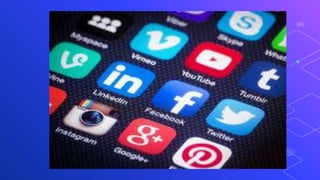
  • #31 What is Social Media? Social media refers to the means of interactions among people in which they create, share, and/or exchange information and ideas in virtual communities and networks. The Office of Communications and Marketing manages the main Facebook, Twitter, Instagram, LinkedIn and YouTube accounts.
  • #33 Tags allow social media users to engage an individual, business or any entity with a social profile when they mention them in a post or comment. In Facebook and Instagram, tagging notifies the recipient and hyperlinks to the tagged profile.
  • #34 Blogging refers to writing, photography, and other media that's self-published online. A blog is very similar to a website, where one can find content regarding any topic in a written/text format, along with images, gifs, etc. A vlog, on the other hand, consists of video content published on any topic. There are various blogging and vlogging platforms out there that support both paid and free domains. While both produce engaging content, bloggers use words, whereas vloggers use video format. If you're looking to reach a wider audience quickly or showcase experiences in real-time, video content performs better.
  • #36 The issue with Web 2.0 comes from the way the traditional Web 2.0 application works.. The only thing is whoever controls the data on the centralized server has access to a lot of data.  Facebook, Google and Twitter began storing this data in their servers to make better content using algorithms. In a utopia, this would be used to keep people's experience of the highest quality. But in reality, our data was sold to advertisers. This is where Web 3.0 comes in.