Web Versus
Mobile Payments In Nigeria
Oladipo Olasemo
Developer Community Manager
Mobile Monday Nigeria
November 2013
•
•
•
•
•
•
•
•
•

Definitions
The Players and the regulatory framework
What are people saying
The Story so far….
The Value Chain
The regulatory framework
Mobile Money Models
Global Trends
The Challenges in Nigeria
Definitions
• Mobile Money is a service in which a mobile phone is used to
access financial services.
• Mobile Money Transfer (MMT) is a movement of value that is made
from a mobile wallet, accrues to a mobile wallet, and/or is initiated
using a mobile phone.
• Mobile Payment is a movement of value that is made from a mobile
wallet, accrues to a mobile wallet, and/or is initiated using a mobile
phone. Sometimes, the term mobile payment is used to describe
only transfers to pay for goods or services, either at the point of
sale.
• Agent: a person or business that is contracted to facilitate
transactions for users. The most important of these are cash-in and
cash-out (i.e. loading value into the mobile money system, and then
converting it back out again); in many instances, agents register
new customers too
Source: GSMA Mobile Money Definitions July 2010
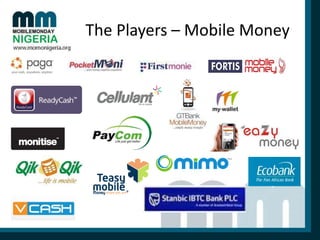
The Players – Mobile Money
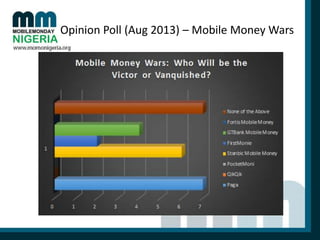
Opinion Poll (Aug 2013) – Mobile Money Wars
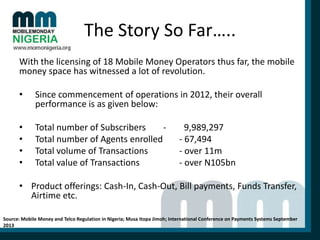
The Story So Far…..
With the licensing of 18 Mobile Money Operators thus far, the mobile
money space has witnessed a lot of revolution.
•

Since commencement of operations in 2012, their overall
performance is as given below:

•
•
•
•

Total number of Subscribers
Total number of Agents enrolled
Total volume of Transactions
Total value of Transactions

9,989,297
- 67,494
- over 11m
- over N105bn

• Product offerings: Cash-In, Cash-Out, Bill payments, Funds Transfer,
Airtime etc.
Source: Mobile Money and Telco Regulation in Nigeria; Musa Itopa Jimoh; International Conference on Payments Systems September
2013
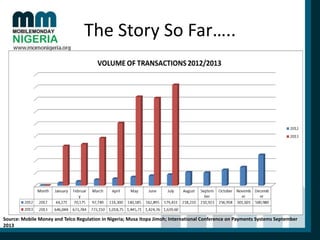
The Story So Far…..

Source: Mobile Money and Telco Regulation in Nigeria; Musa Itopa Jimoh; International Conference on Payments Systems September
2013
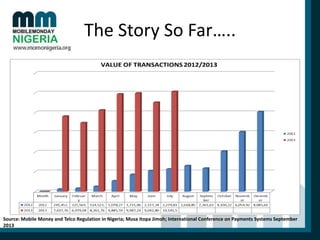
The Story So Far…..

Source: Mobile Money and Telco Regulation in Nigeria; Musa Itopa Jimoh; International Conference on Payments Systems September
2013
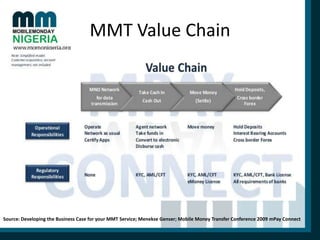
MMT Value Chain

Source: Developing the Business Case for your MMT Service; Menekse Genser; Mobile Money Transfer Conference 2009 mPay Connect
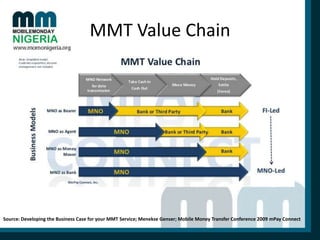
MMT Value Chain

Source: Developing the Business Case for your MMT Service; Menekse Genser; Mobile Money Transfer Conference 2009 mPay Connect
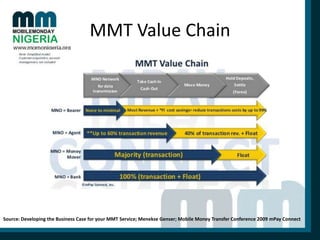
MMT Value Chain

Source: Developing the Business Case for your MMT Service; Menekse Genser; Mobile Money Transfer Conference 2009 mPay Connect
Regulatory Framework
 The Regulatory Framework (2009) for Mobile Money
provides for 3 models – Bank-Led, Non Bank-Led and
Bank Focused (Framework reviewed to collapse the 3
models to 2 – Bank led and Non Bank led)

 Telcos excluded from leading any of the models for fears
in the area of regulation, prudential supervision,
monetary policy and above all, the complexity of the
Nigerian economy
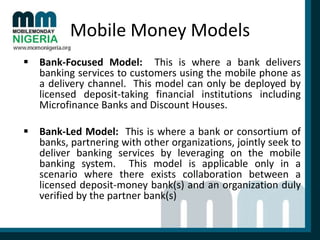
Mobile Money Models
 Bank-Focused Model: This is where a bank delivers
banking services to customers using the mobile phone as
a delivery channel. This model can only be deployed by
licensed deposit-taking financial institutions including
Microfinance Banks and Discount Houses.

 Bank-Led Model: This is where a bank or consortium of
banks, partnering with other organizations, jointly seek to
deliver banking services by leveraging on the mobile
banking system. This model is applicable only in a
scenario where there exists collaboration between a
licensed deposit-money bank(s) and an organization duly
verified by the partner bank(s)
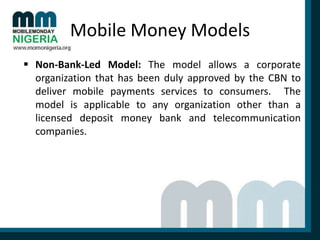
Mobile Money Models
 Non-Bank-Led Model: The model allows a corporate
organization that has been duly approved by the CBN to
deliver mobile payments services to consumers. The
model is applicable to any organization other than a
licensed deposit money bank and telecommunication
companies.
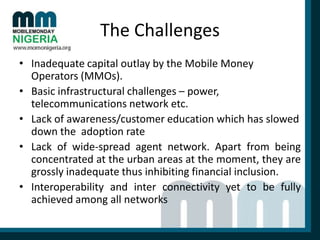
The Challenges
• Inadequate capital outlay by the Mobile Money
Operators (MMOs).
• Basic infrastructural challenges – power,
telecommunications network etc.
• Lack of awareness/customer education which has slowed
down the adoption rate
• Lack of wide-spread agent network. Apart from being
concentrated at the urban areas at the moment, they are
grossly inadequate thus inhibiting financial inclusion.
• Interoperability and inter connectivity yet to be fully
achieved among all networks
Web/Online Payments
Introduction
 An online payment service allows buyers to use a credit card or
electronic
bank
transfer
to
pay
for
goods
or
services purchased online.
 To use an online payment service, the buyer and seller generally set
up accounts that allow them to make or accept payments.
 Buyers provide payment information, like bank account or credit card
numbers, and sellers give information about where payments should
be deposited.
 In some cases, sellers do not have to create an account with the
online payment service to receive funds.
 To complete a transaction, the buyer tells the online payment service
to direct appropriate funds to the seller. The seller then gets
immediate access to the funds. Most online payment services charge
the seller to receive the funds, but some payment services charge the
buyer.
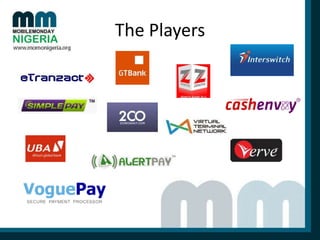
The Players
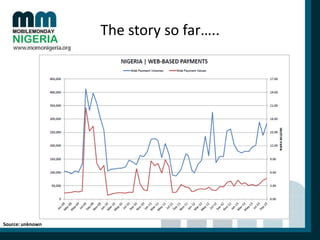
The story so far…..

Source: unknown
The Challenges
•
•
•
•

Trust – Nigerians prefer pay on delivery
Internet penetration
Infrastructure challenges
Awareness and education
Questions

Web versus mobile_payments

  • 1.
    Web Versus Mobile PaymentsIn Nigeria Oladipo Olasemo Developer Community Manager Mobile Monday Nigeria November 2013
  • 2.
    • • • • • • • • • Definitions The Players andthe regulatory framework What are people saying The Story so far…. The Value Chain The regulatory framework Mobile Money Models Global Trends The Challenges in Nigeria
  • 3.
    Definitions • Mobile Moneyis a service in which a mobile phone is used to access financial services. • Mobile Money Transfer (MMT) is a movement of value that is made from a mobile wallet, accrues to a mobile wallet, and/or is initiated using a mobile phone. • Mobile Payment is a movement of value that is made from a mobile wallet, accrues to a mobile wallet, and/or is initiated using a mobile phone. Sometimes, the term mobile payment is used to describe only transfers to pay for goods or services, either at the point of sale. • Agent: a person or business that is contracted to facilitate transactions for users. The most important of these are cash-in and cash-out (i.e. loading value into the mobile money system, and then converting it back out again); in many instances, agents register new customers too Source: GSMA Mobile Money Definitions July 2010
  • 4.
    The Players –Mobile Money
  • 5.
    Opinion Poll (Aug2013) – Mobile Money Wars
  • 6.
    The Story SoFar….. With the licensing of 18 Mobile Money Operators thus far, the mobile money space has witnessed a lot of revolution. • Since commencement of operations in 2012, their overall performance is as given below: • • • • Total number of Subscribers Total number of Agents enrolled Total volume of Transactions Total value of Transactions 9,989,297 - 67,494 - over 11m - over N105bn • Product offerings: Cash-In, Cash-Out, Bill payments, Funds Transfer, Airtime etc. Source: Mobile Money and Telco Regulation in Nigeria; Musa Itopa Jimoh; International Conference on Payments Systems September 2013
  • 7.
    The Story SoFar….. Source: Mobile Money and Telco Regulation in Nigeria; Musa Itopa Jimoh; International Conference on Payments Systems September 2013
  • 8.
    The Story SoFar….. Source: Mobile Money and Telco Regulation in Nigeria; Musa Itopa Jimoh; International Conference on Payments Systems September 2013
  • 9.
    MMT Value Chain Source:Developing the Business Case for your MMT Service; Menekse Genser; Mobile Money Transfer Conference 2009 mPay Connect
  • 10.
    MMT Value Chain Source:Developing the Business Case for your MMT Service; Menekse Genser; Mobile Money Transfer Conference 2009 mPay Connect
  • 11.
    MMT Value Chain Source:Developing the Business Case for your MMT Service; Menekse Genser; Mobile Money Transfer Conference 2009 mPay Connect
  • 12.
    Regulatory Framework  TheRegulatory Framework (2009) for Mobile Money provides for 3 models – Bank-Led, Non Bank-Led and Bank Focused (Framework reviewed to collapse the 3 models to 2 – Bank led and Non Bank led)  Telcos excluded from leading any of the models for fears in the area of regulation, prudential supervision, monetary policy and above all, the complexity of the Nigerian economy
  • 13.
    Mobile Money Models Bank-Focused Model: This is where a bank delivers banking services to customers using the mobile phone as a delivery channel. This model can only be deployed by licensed deposit-taking financial institutions including Microfinance Banks and Discount Houses.  Bank-Led Model: This is where a bank or consortium of banks, partnering with other organizations, jointly seek to deliver banking services by leveraging on the mobile banking system. This model is applicable only in a scenario where there exists collaboration between a licensed deposit-money bank(s) and an organization duly verified by the partner bank(s)
  • 14.
    Mobile Money Models Non-Bank-Led Model: The model allows a corporate organization that has been duly approved by the CBN to deliver mobile payments services to consumers. The model is applicable to any organization other than a licensed deposit money bank and telecommunication companies.
  • 15.
    The Challenges • Inadequatecapital outlay by the Mobile Money Operators (MMOs). • Basic infrastructural challenges – power, telecommunications network etc. • Lack of awareness/customer education which has slowed down the adoption rate • Lack of wide-spread agent network. Apart from being concentrated at the urban areas at the moment, they are grossly inadequate thus inhibiting financial inclusion. • Interoperability and inter connectivity yet to be fully achieved among all networks
  • 16.
  • 17.
    Introduction  An onlinepayment service allows buyers to use a credit card or electronic bank transfer to pay for goods or services purchased online.  To use an online payment service, the buyer and seller generally set up accounts that allow them to make or accept payments.  Buyers provide payment information, like bank account or credit card numbers, and sellers give information about where payments should be deposited.  In some cases, sellers do not have to create an account with the online payment service to receive funds.  To complete a transaction, the buyer tells the online payment service to direct appropriate funds to the seller. The seller then gets immediate access to the funds. Most online payment services charge the seller to receive the funds, but some payment services charge the buyer.
  • 18.
  • 19.
    The story sofar….. Source: unknown
  • 20.
    The Challenges • • • • Trust –Nigerians prefer pay on delivery Internet penetration Infrastructure challenges Awareness and education
  • 21.