Copyright © 2024 Jayanti Rajdevendra Pande. All rights reserved.
RASHTRASANT TUKDOJI MAHARAJ NAGPUR UNIVERSITY
MBA
SEMESTER: 4
SPECIALIZATION
BUSINESS ANALYTICS
SUBJECT
WEB & SOCIAL MEDIA ANALYTICS
MODULE NO : 1
CHOOSING RIGHT TOOLS FOR WEBSITE
- By Jayanti R Pande
Copyright © 2024 Jayanti Rajdevendra Pande. All rights reserved.
Q1. What is paradox of data ? How to overcome it to choose right tools for website?
PARADOX OF DATA
• The paradox of data happens when organizations have lots of data but find it hard to get useful insights.
• This gets trickier when picking tools for websites because there are so many options, all claiming to give valuable insights.
• But it's important for businesses not to gather too much data without a clear plan for how to use it.
• To beat this problem when choosing website tools, organizations can use these simple strategies -
CHOOSING RIGHT TOOLS FOR WEBSITE
1. Define Clear Objectives: Begin by clearly outlining the purpose and goals of your website. What specific outcomes are you
aiming for? This clarity will help in selecting tools that align with your objectives.
2. Focus on Relevant Metrics: Identify the key performance indicators (KPIs) that are most important for measuring success.
Prioritize metrics that directly contribute to your defined objectives, ensuring that you focus on actionable insights.
3. Evaluate Tool Functionality: Assess different analytics tools based on their capabilities to measure your chosen metrics
effectively. Look for tools that offer intuitive interfaces, robust reporting features, and accurate data analysis.
4. Consider Long-Term Scalability: Choose tools that can adapt and grow with your business over time. Ensure that the selected
tools can integrate seamlessly with your existing systems and support future expansion, thus avoiding the need for frequent
tool changes.
Copyright © 2024 Jayanti Rajdevendra Pande. All rights reserved.
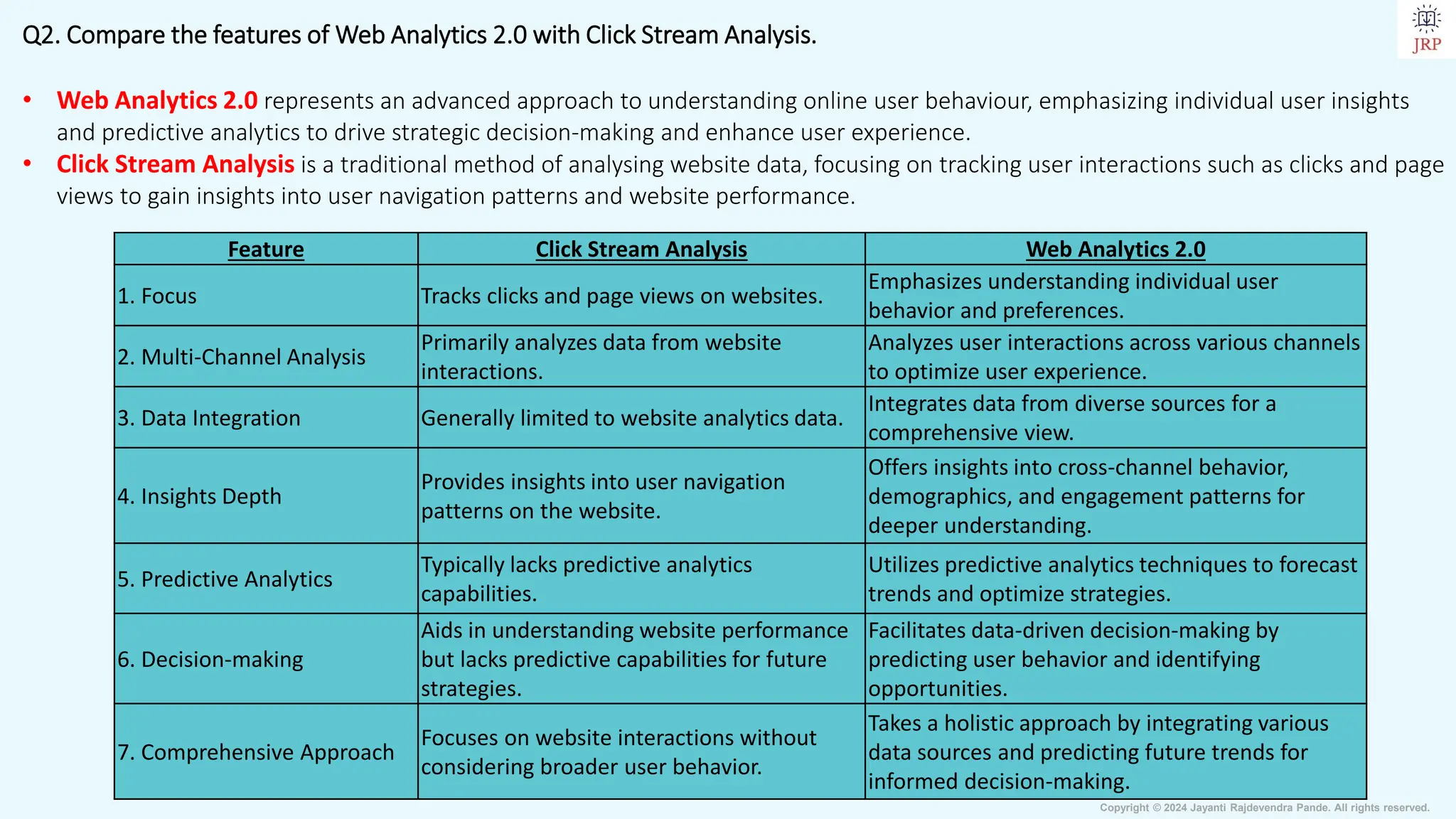
Q2. Compare the features of Web Analytics 2.0 with Click Stream Analysis.
• Web Analytics 2.0 represents an advanced approach to understanding online user behaviour, emphasizing individual user insights
and predictive analytics to drive strategic decision-making and enhance user experience.
• Click Stream Analysis is a traditional method of analysing website data, focusing on tracking user interactions such as clicks and page
views to gain insights into user navigation patterns and website performance.
Feature Click Stream Analysis Web Analytics 2.0
1. Focus Tracks clicks and page views on websites.
Emphasizes understanding individual user
behavior and preferences.
2. Multi-Channel Analysis
Primarily analyzes data from website
interactions.
Analyzes user interactions across various channels
to optimize user experience.
3. Data Integration Generally limited to website analytics data.
Integrates data from diverse sources for a
comprehensive view.
4. Insights Depth
Provides insights into user navigation
patterns on the website.
Offers insights into cross-channel behavior,
demographics, and engagement patterns for
deeper understanding.
5. Predictive Analytics
Typically lacks predictive analytics
capabilities.
Utilizes predictive analytics techniques to forecast
trends and optimize strategies.
6. Decision-making
Aids in understanding website performance
but lacks predictive capabilities for future
strategies.
Facilitates data-driven decision-making by
predicting user behavior and identifying
opportunities.
7. Comprehensive Approach
Focuses on website interactions without
considering broader user behavior.
Takes a holistic approach by integrating various
data sources and predicting future trends for
informed decision-making.
Copyright © 2024 Jayanti Rajdevendra Pande. All rights reserved.
Q3. What is four step approach that determines success of any website? Discuss in details.
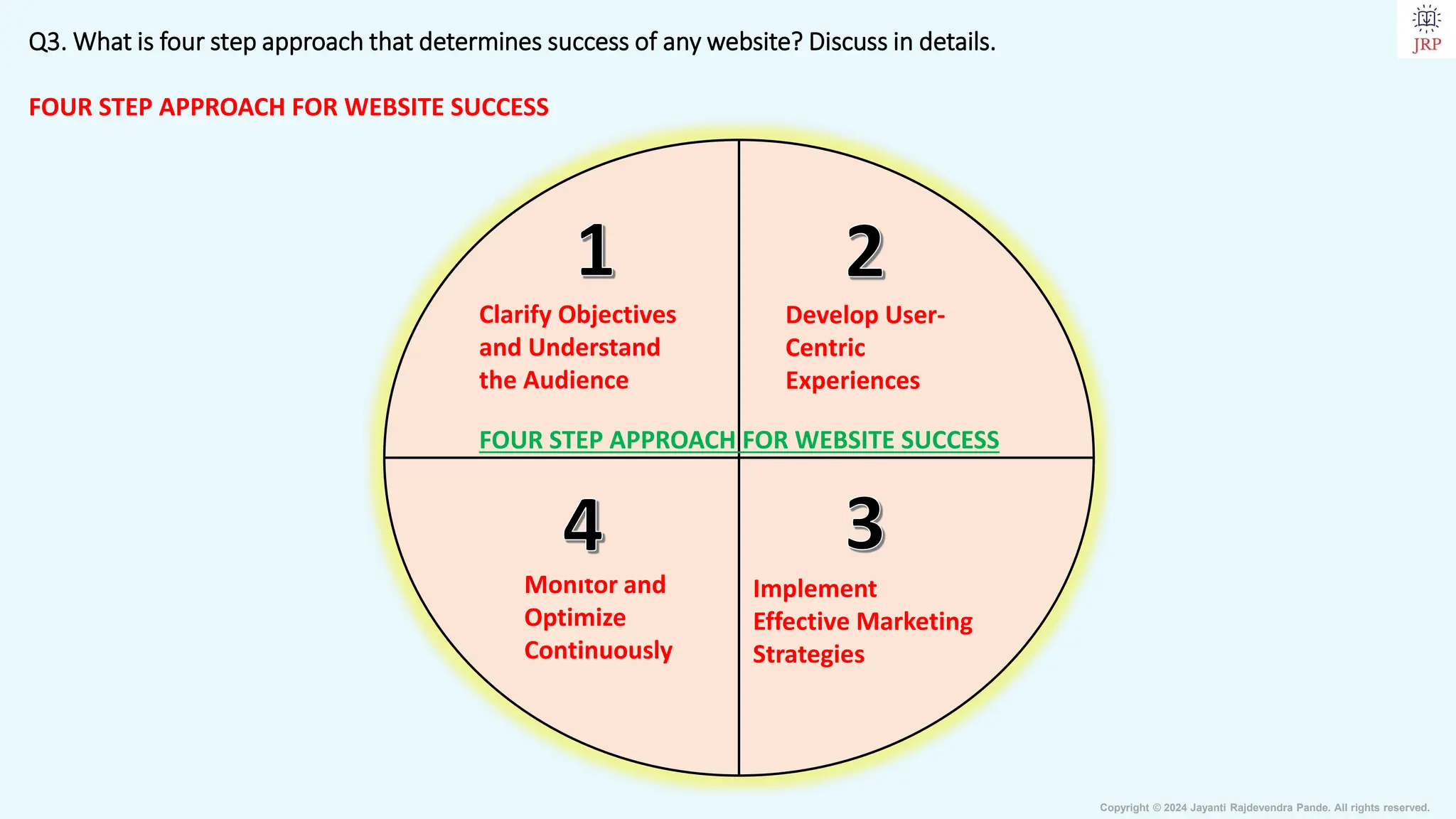
FOUR STEP APPROACH FOR WEBSITE SUCCESS
Clarify Objectives
and Understand
the Audience
Develop User-
Centric
Experiences
Implement
Effective Marketing
Strategies
Monitor and
Optimize
Continuously
FOUR STEP APPROACH FOR WEBSITE SUCCESS
Copyright © 2024 Jayanti Rajdevendra Pande. All rights reserved.
1.Clarify Objectives and Understand the Audience: Start by clearly outlining the website's goals and identifying the target
audience. This involves gaining insights into their needs, preferences, and expectations. By defining clear objectives and
understanding the audience, organizations can tailor the website's design, content, and functionality to meet their specific
requirements effectively.
2.Develop User-Centric Experiences: Create a comprehensive plan for the website's structure, layout, and user interface.
Emphasize the creation of intuitive navigation, visually appealing design elements, and engaging content that resonates with the
target audience. Prioritize usability, accessibility, and responsiveness to ensure a seamless user experience across various
devices.
3.Implement Effective Marketing Strategies: Devise and execute marketing strategies aimed at driving traffic to the website. This
may involve utilizing search engine optimization (SEO) techniques, social media marketing campaigns, content marketing efforts,
and online advertising initiatives. By promoting the website effectively, organizations can attract the desired audience and
enhance its visibility in the digital landscape.
4.Monitor and Optimize Continuously: Regularly monitor and analyze the website's performance using web analytics tools. Keep
track of key metrics such as website traffic, conversion rates, bounce rates, and user engagement metrics. Utilize the insights
gained from analytics to make data-driven optimizations, improve the user experience, and align the website's performance with
its objectives. Continuous monitoring and optimization ensure that the website remains relevant, effective, and aligned with
evolving audience needs and market trends.
By following this four-step approach, organizations can lay the groundwork for the success of their websites. It involves strategic
planning, user-centric design, proactive marketing efforts, and ongoing refinement based on performance insights.
Copyright © 2024 Jayanti Rajdevendra Pande. All rights reserved.
Copyright © 2024 Jayanti Rajdevendra Pande.
All rights reserved.
This content may be printed for personal use only. It may not be copied, distributed, or used for any other
purpose without the express written permission of the copyright owner.
This content is protected by copyright law. Any unauthorized use of the content may violate copyright laws and
other applicable laws.
For any further queries contact on email: jayantipande17@gmail.com

Web & Social Media Analytics Module 1.pdf

  • 1.
    Copyright © 2024Jayanti Rajdevendra Pande. All rights reserved. RASHTRASANT TUKDOJI MAHARAJ NAGPUR UNIVERSITY MBA SEMESTER: 4 SPECIALIZATION BUSINESS ANALYTICS SUBJECT WEB & SOCIAL MEDIA ANALYTICS MODULE NO : 1 CHOOSING RIGHT TOOLS FOR WEBSITE - By Jayanti R Pande
  • 2.
    Copyright © 2024Jayanti Rajdevendra Pande. All rights reserved. Q1. What is paradox of data ? How to overcome it to choose right tools for website? PARADOX OF DATA • The paradox of data happens when organizations have lots of data but find it hard to get useful insights. • This gets trickier when picking tools for websites because there are so many options, all claiming to give valuable insights. • But it's important for businesses not to gather too much data without a clear plan for how to use it. • To beat this problem when choosing website tools, organizations can use these simple strategies - CHOOSING RIGHT TOOLS FOR WEBSITE 1. Define Clear Objectives: Begin by clearly outlining the purpose and goals of your website. What specific outcomes are you aiming for? This clarity will help in selecting tools that align with your objectives. 2. Focus on Relevant Metrics: Identify the key performance indicators (KPIs) that are most important for measuring success. Prioritize metrics that directly contribute to your defined objectives, ensuring that you focus on actionable insights. 3. Evaluate Tool Functionality: Assess different analytics tools based on their capabilities to measure your chosen metrics effectively. Look for tools that offer intuitive interfaces, robust reporting features, and accurate data analysis. 4. Consider Long-Term Scalability: Choose tools that can adapt and grow with your business over time. Ensure that the selected tools can integrate seamlessly with your existing systems and support future expansion, thus avoiding the need for frequent tool changes.
  • 3.
    Copyright © 2024Jayanti Rajdevendra Pande. All rights reserved. Q2. Compare the features of Web Analytics 2.0 with Click Stream Analysis. • Web Analytics 2.0 represents an advanced approach to understanding online user behaviour, emphasizing individual user insights and predictive analytics to drive strategic decision-making and enhance user experience. • Click Stream Analysis is a traditional method of analysing website data, focusing on tracking user interactions such as clicks and page views to gain insights into user navigation patterns and website performance. Feature Click Stream Analysis Web Analytics 2.0 1. Focus Tracks clicks and page views on websites. Emphasizes understanding individual user behavior and preferences. 2. Multi-Channel Analysis Primarily analyzes data from website interactions. Analyzes user interactions across various channels to optimize user experience. 3. Data Integration Generally limited to website analytics data. Integrates data from diverse sources for a comprehensive view. 4. Insights Depth Provides insights into user navigation patterns on the website. Offers insights into cross-channel behavior, demographics, and engagement patterns for deeper understanding. 5. Predictive Analytics Typically lacks predictive analytics capabilities. Utilizes predictive analytics techniques to forecast trends and optimize strategies. 6. Decision-making Aids in understanding website performance but lacks predictive capabilities for future strategies. Facilitates data-driven decision-making by predicting user behavior and identifying opportunities. 7. Comprehensive Approach Focuses on website interactions without considering broader user behavior. Takes a holistic approach by integrating various data sources and predicting future trends for informed decision-making.
  • 4.
    Copyright © 2024Jayanti Rajdevendra Pande. All rights reserved. Q3. What is four step approach that determines success of any website? Discuss in details. FOUR STEP APPROACH FOR WEBSITE SUCCESS Clarify Objectives and Understand the Audience Develop User- Centric Experiences Implement Effective Marketing Strategies Monitor and Optimize Continuously FOUR STEP APPROACH FOR WEBSITE SUCCESS
  • 5.
    Copyright © 2024Jayanti Rajdevendra Pande. All rights reserved. 1.Clarify Objectives and Understand the Audience: Start by clearly outlining the website's goals and identifying the target audience. This involves gaining insights into their needs, preferences, and expectations. By defining clear objectives and understanding the audience, organizations can tailor the website's design, content, and functionality to meet their specific requirements effectively. 2.Develop User-Centric Experiences: Create a comprehensive plan for the website's structure, layout, and user interface. Emphasize the creation of intuitive navigation, visually appealing design elements, and engaging content that resonates with the target audience. Prioritize usability, accessibility, and responsiveness to ensure a seamless user experience across various devices. 3.Implement Effective Marketing Strategies: Devise and execute marketing strategies aimed at driving traffic to the website. This may involve utilizing search engine optimization (SEO) techniques, social media marketing campaigns, content marketing efforts, and online advertising initiatives. By promoting the website effectively, organizations can attract the desired audience and enhance its visibility in the digital landscape. 4.Monitor and Optimize Continuously: Regularly monitor and analyze the website's performance using web analytics tools. Keep track of key metrics such as website traffic, conversion rates, bounce rates, and user engagement metrics. Utilize the insights gained from analytics to make data-driven optimizations, improve the user experience, and align the website's performance with its objectives. Continuous monitoring and optimization ensure that the website remains relevant, effective, and aligned with evolving audience needs and market trends. By following this four-step approach, organizations can lay the groundwork for the success of their websites. It involves strategic planning, user-centric design, proactive marketing efforts, and ongoing refinement based on performance insights.
  • 6.
    Copyright © 2024Jayanti Rajdevendra Pande. All rights reserved. Copyright © 2024 Jayanti Rajdevendra Pande. All rights reserved. This content may be printed for personal use only. It may not be copied, distributed, or used for any other purpose without the express written permission of the copyright owner. This content is protected by copyright law. Any unauthorized use of the content may violate copyright laws and other applicable laws. For any further queries contact on email: jayantipande17@gmail.com