

http://www.flickr.com/photos/nzbuu/4093456029
Are Today’s Good Practices…
Tomorrow’s Performance Anti-Patterns?
@andydavies
#WebPerfDays, Amsterdam
Saturday, 18 May 13
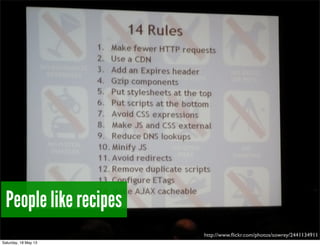
People like recipes
http://www.flickr.com/photos/sowrey/2441134911
Saturday, 18 May 13
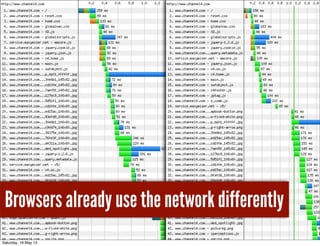
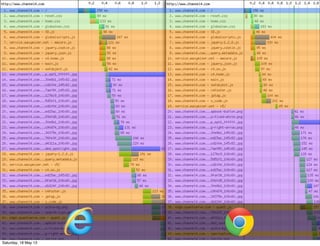
Browsers already use the network differently
Saturday, 18 May 13
Saturday, 18 May 13
New network protocols are coming here
http://www.flickr.com/photos/jonlachance/3427660741
Saturday, 18 May 13
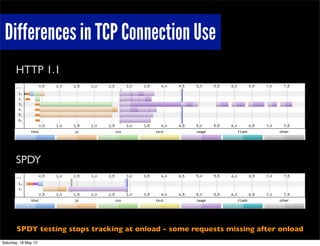
HTTP 1.1
SPDY
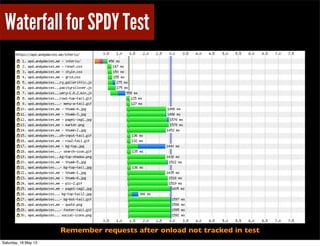
SPDY testing stops tracking at onload - some requests missing after onload
Differences in TCP Connection Use
Saturday, 18 May 13
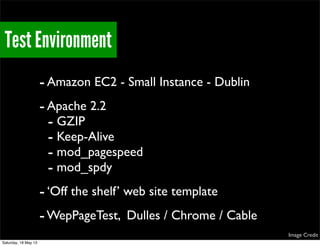
Test Environment
Image Credit
-Amazon EC2 - Small Instance - Dublin
-Apache 2.2
- GZIP
- Keep-Alive
- mod_pagespeed
- mod_spdy
-‘Off the shelf’ web site template
-WepPageTest, Dulles / Chrome / Cable
Saturday, 18 May 13
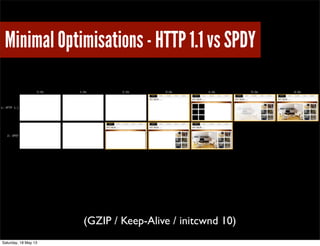
Minimal Optimisations - HTTP 1.1 vs SPDY
(GZIP / Keep-Alive / initcwnd 10)
Saturday, 18 May 13
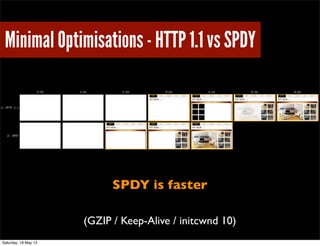
Minimal Optimisations - HTTP 1.1 vs SPDY
SPDY is faster
(GZIP / Keep-Alive / initcwnd 10)
Saturday, 18 May 13
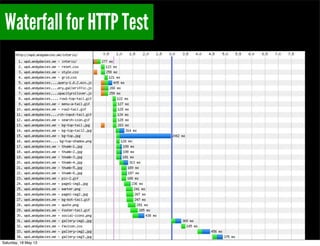
Waterfall for HTTP Test
Saturday, 18 May 13
Waterfall for SPDY Test
Remember requests after onload not tracked in test
Saturday, 18 May 13
So which rules are most likely to be at risk?
- Split dominant content domains
- Reduce requests
- Merging
- Sprites
- DataURIs
Saturday, 18 May 13
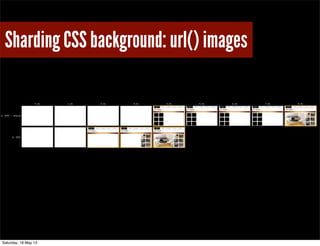
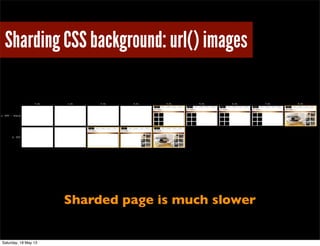
Sharding CSS background: url() images
Saturday, 18 May 13
Sharding CSS background: url() images
Sharded page is much slower
Saturday, 18 May 13
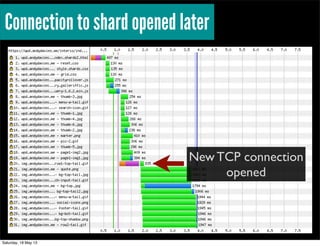
Connection to shard opened later
New TCP connection
opened
Saturday, 18 May 13
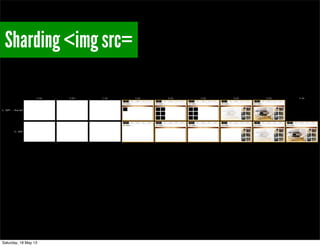
Sharding <img src=
Saturday, 18 May 13
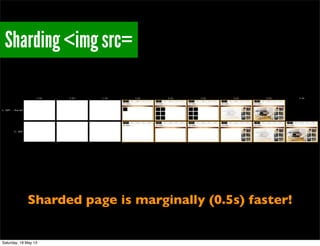
Sharding <img src=
Sharded page is marginally (0.5s) faster!
Saturday, 18 May 13
Other tests carried out
- Sharding JS
- Merging CSS
- Merging JS
- Server Push
(Fonts, third-party JS not yet tested)
Saturday, 18 May 13
What about the traditional CDN?
http://www.flickr.com/photos/jvk/166337955
Saturday, 18 May 13
How much do we rely on inline JavaScript?
http://www.flickr.com/photos/jfraissi/6352877711
Saturday, 18 May 13
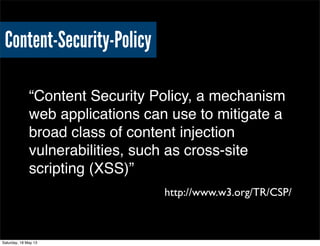
Content-Security-Policy
“Content Security Policy, a mechanism
web applications can use to mitigate a
broad class of content injection
vulnerabilities, such as cross-site
scripting (XSS)”
http://www.w3.org/TR/CSP/
Saturday, 18 May 13
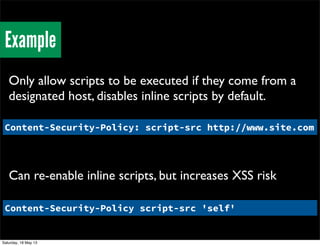
Example
Content-Security-Policy: script-src http://www.site.com
Can re-enable inline scripts, but increases XSS risk
Content-Security-Policy script-src 'self'
Only allow scripts to be executed if they come from a
designated host, disables inline scripts by default.
Saturday, 18 May 13
Typical async script loader
<script type="text/javascript">
function() {
var js = document.createElement('script');
js.async = true;
js.src = 'myscript.js';
var e = document.getElementsByTagName('script')[0];
e.parentNode.insertBefore(js, first);
})();
</script>
Relies on inline JS
Saturday, 18 May 13
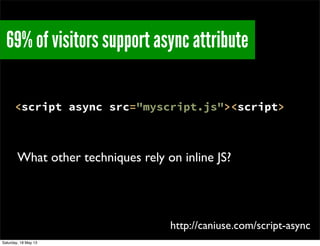
69% of visitors support async attribute
<script async src="myscript.js"><script>
http://caniuse.com/script-async
What other techniques rely on inline JS?
Saturday, 18 May 13
“Situational Performance Optimization,
The Next Frontier”
http://calendar.perfplanet.com/2012/situational-performance-optimization-the-next-frontier/
Guy Podjarny
Saturday, 18 May 13
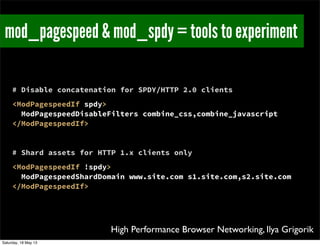
# Disable concatenation for SPDY/HTTP 2.0 clients
<ModPagespeedIf spdy>
ModPagespeedDisableFilters combine_css,combine_javascript
</ModPagespeedIf>
# Shard assets for HTTP 1.x clients only
<ModPagespeedIf !spdy>
ModPagespeedShardDomain www.site.com s1.site.com,s2.site.com
</ModPagespeedIf>
mod_pagespeed & mod_spdy = tools to experiment
High Performance Browser Networking, Ilya Grigorik
Saturday, 18 May 13
http://www.flickr.com/photos/simeon_barkas/2557059247
The end for hand crafted optimisations?
Saturday, 18 May 13
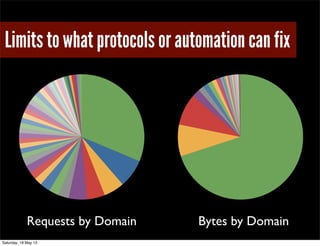
Limits to what protocols or automation can fix
Requests by Domain Bytes by Domain
Saturday, 18 May 13
- Some good practices will become obselete
-Testing tools have a few issues
- Browsers may need better loading hints
- Start experimenting now
Saturday, 18 May 13
Thank You!
@andydavies
hello@andydavies.me
http://slideshare.net/andydavies
http://www.flickr.com/photos/nzbuu/4093456029
Saturday, 18 May 13

Are Today's Good Practices… Tomorrow's Performance Anti-Patterns