Ch. 8: Web Crawling
By Filippo Menczer
Indiana University School of Informatics
in Web Data Mining by Bing Liu
Springer, 2007
Slides © 2007 Filippo Menczer, Indiana University School of Informatics
Bing Liu: Web Data Mining. Springer, 2007
Ch. 8 Web Crawling by Filippo Menczer
Outline
• Motivation and taxonomy of crawlers
• Basic crawlers and implementation issues
• Universal crawlers
• Preferential (focused and topical) crawlers
• Evaluation of preferential crawlers
• Crawler ethics and conflicts
• New developments: social, collaborative, federated
crawlers
Slides © 2007 Filippo Menczer, Indiana University School of Informatics
Bing Liu: Web Data Mining. Springer, 2007
Ch. 8 Web Crawling by Filippo Menczer
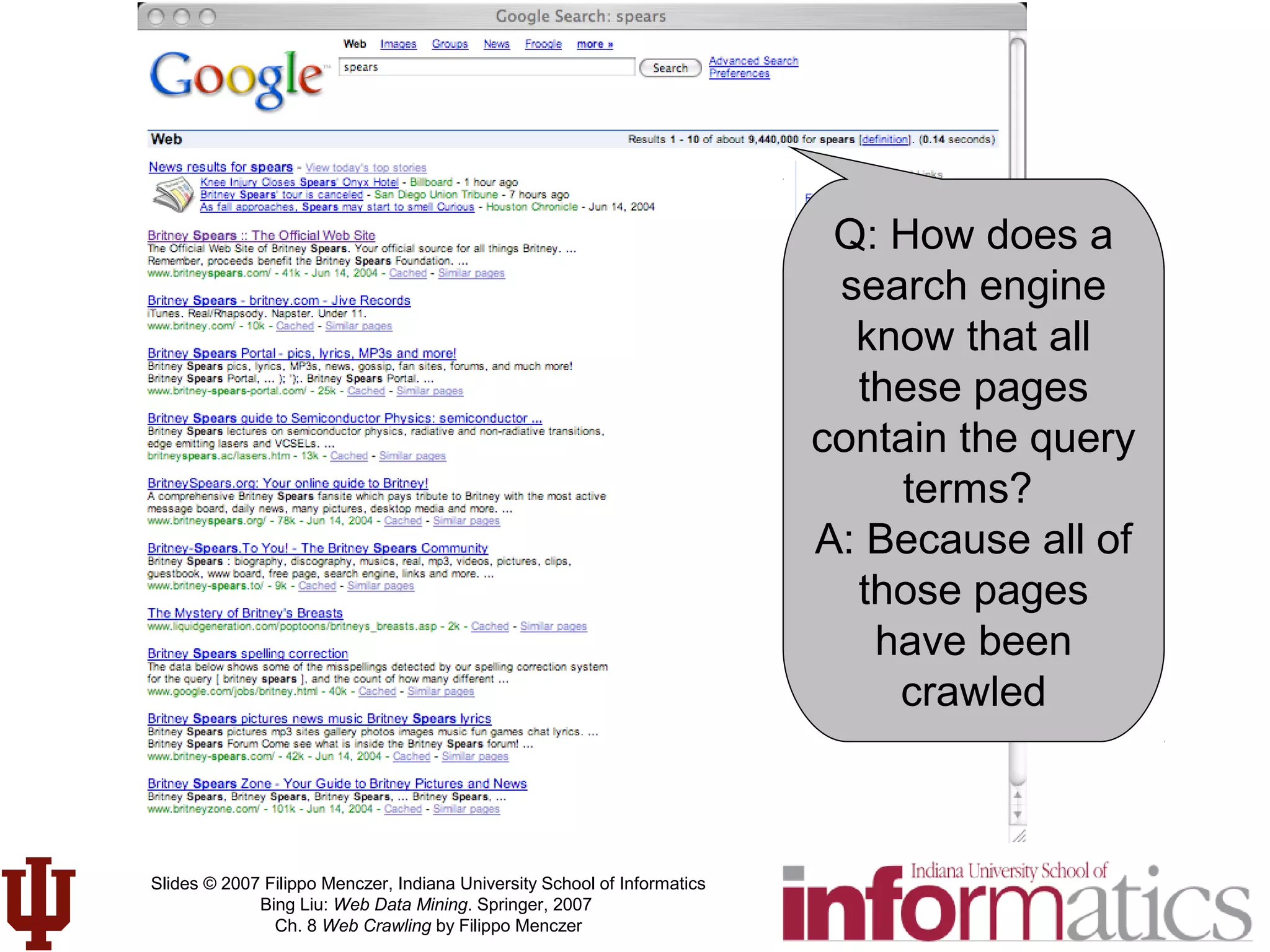
Q: How does a
search engine
know that all
these pages
contain the query
terms?
A: Because all of
those pages
have been
crawled
Slides © 2007 Filippo Menczer, Indiana University School of Informatics
Bing Liu: Web Data Mining. Springer, 2007
Ch. 8 Web Crawling by Filippo Menczer
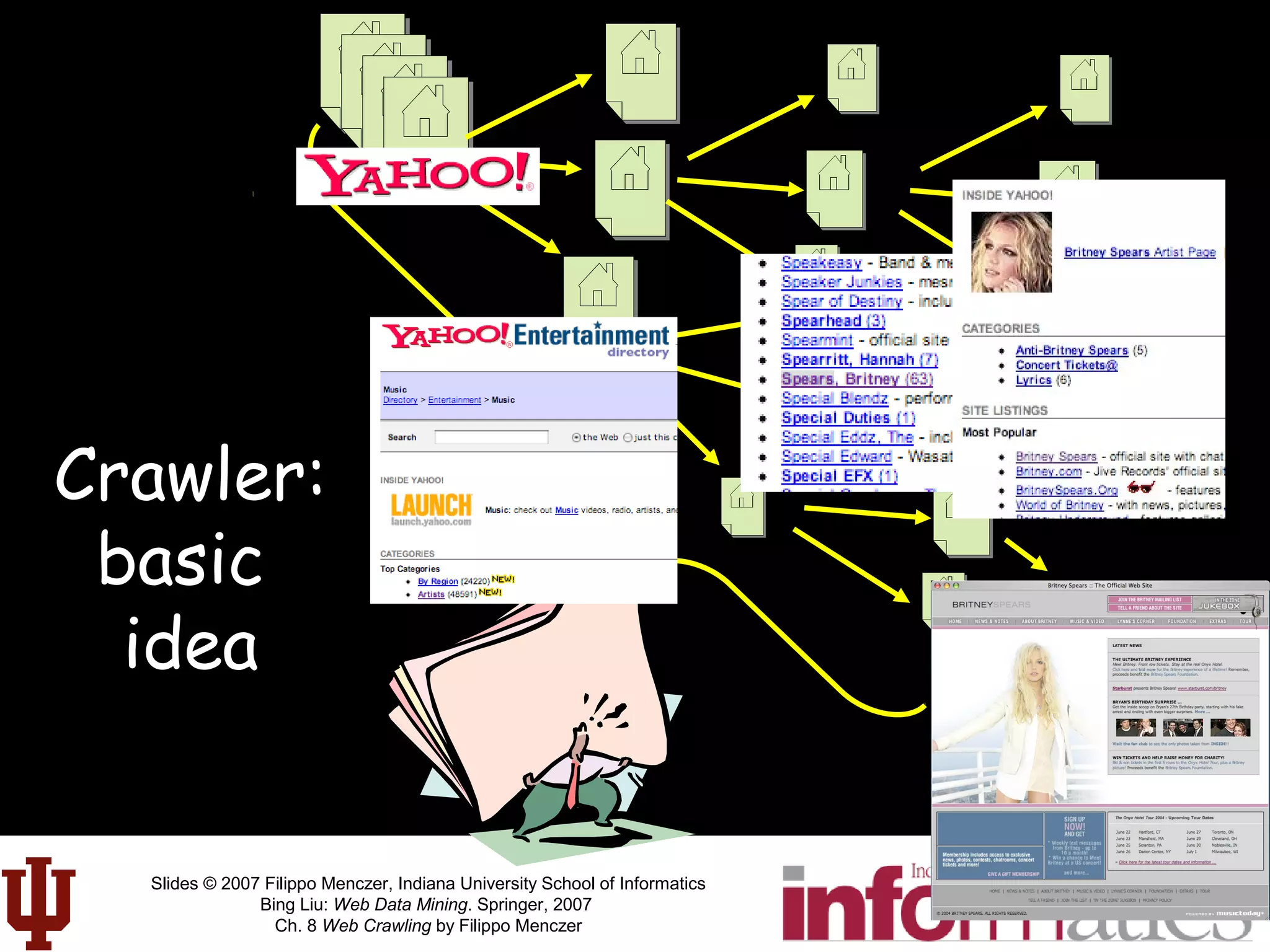
Crawler:
basic
idea
starting
pages
(seeds)
Slides © 2007 Filippo Menczer, Indiana University School of Informatics
Bing Liu: Web Data Mining. Springer, 2007
Ch. 8 Web Crawling by Filippo Menczer
Many names
• Crawler
• Spider
• Robot (or bot)
• Web agent
• Wanderer, worm, …
• And famous instances: googlebot,
scooter, slurp, msnbot, …
Slides © 2007 Filippo Menczer, Indiana University School of Informatics
Bing Liu: Web Data Mining. Springer, 2007
Ch. 8 Web Crawling by Filippo Menczer
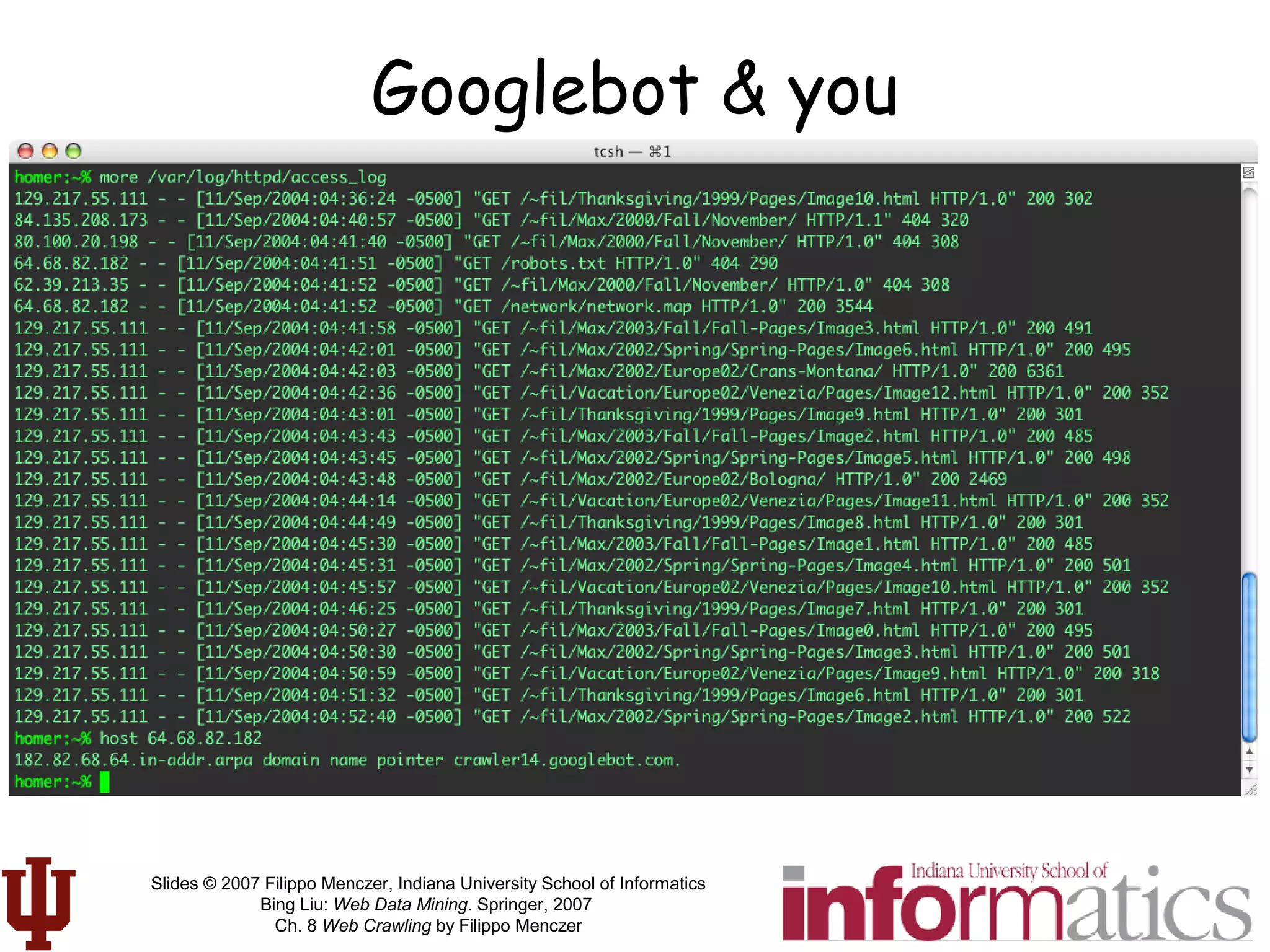
Googlebot & you
Slides © 2007 Filippo Menczer, Indiana University School of Informatics
Bing Liu: Web Data Mining. Springer, 2007
Ch. 8 Web Crawling by Filippo Menczer
Motivation for crawlers
• Support universal search engines (Google,
Yahoo, MSN/Windows Live, Ask, etc.)
• Vertical (specialized) search engines, e.g.
news, shopping, papers, recipes, reviews, etc.
• Business intelligence: keep track of potential
competitors, partners
• Monitor Web sites of interest
• Evil: harvest emails for spamming, phishing…
• … Can you think of some others?…
Slides © 2007 Filippo Menczer, Indiana University School of Informatics
Bing Liu: Web Data Mining. Springer, 2007
Ch. 8 Web Crawling by Filippo Menczer
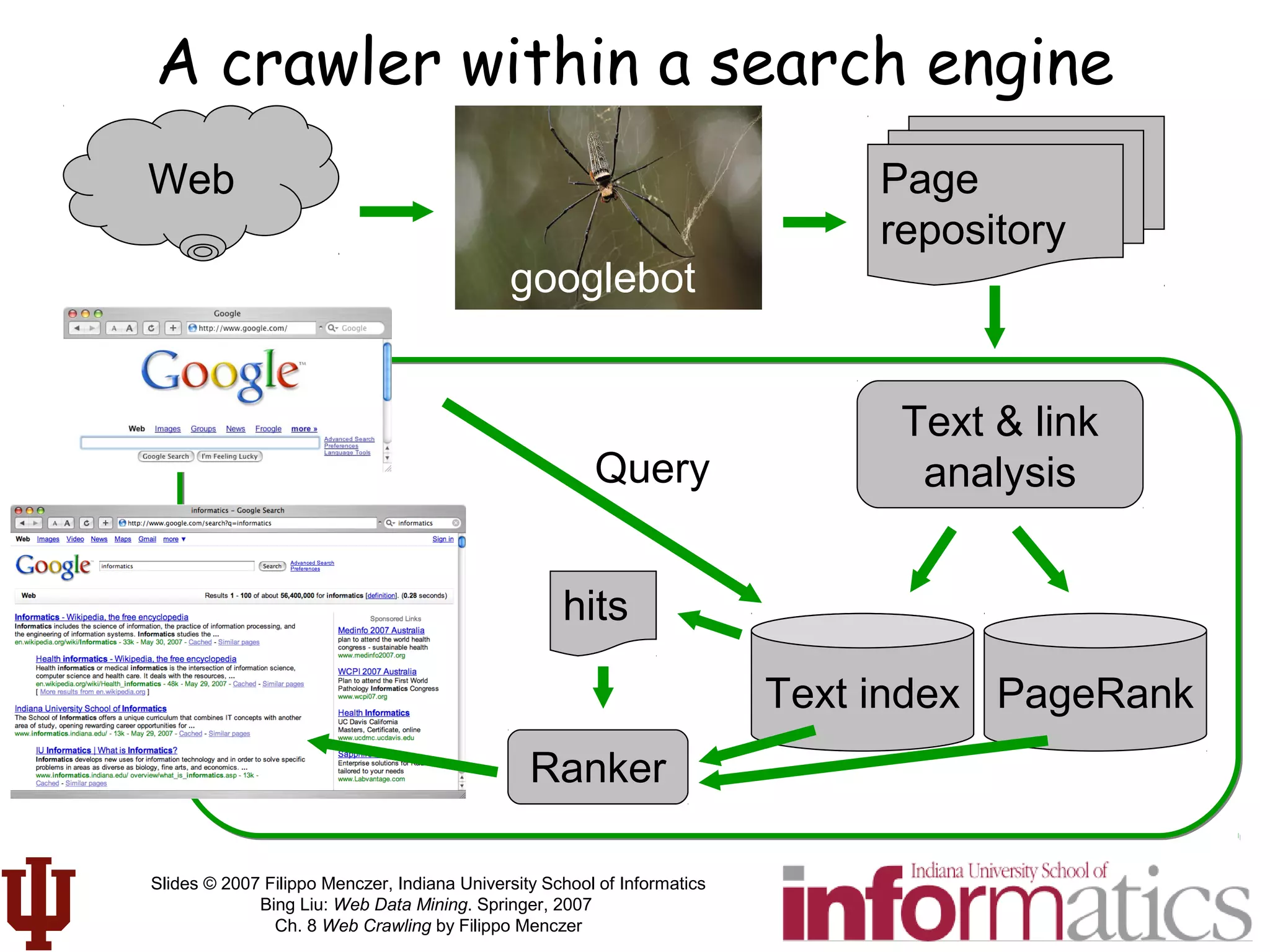
A crawler within a search engine
Web
Text index PageRank
Page
repository
googlebot
Text & link
analysisQuery
hits
Ranker
Slides © 2007 Filippo Menczer, Indiana University School of Informatics
Bing Liu: Web Data Mining. Springer, 2007
Ch. 8 Web Crawling by Filippo Menczer
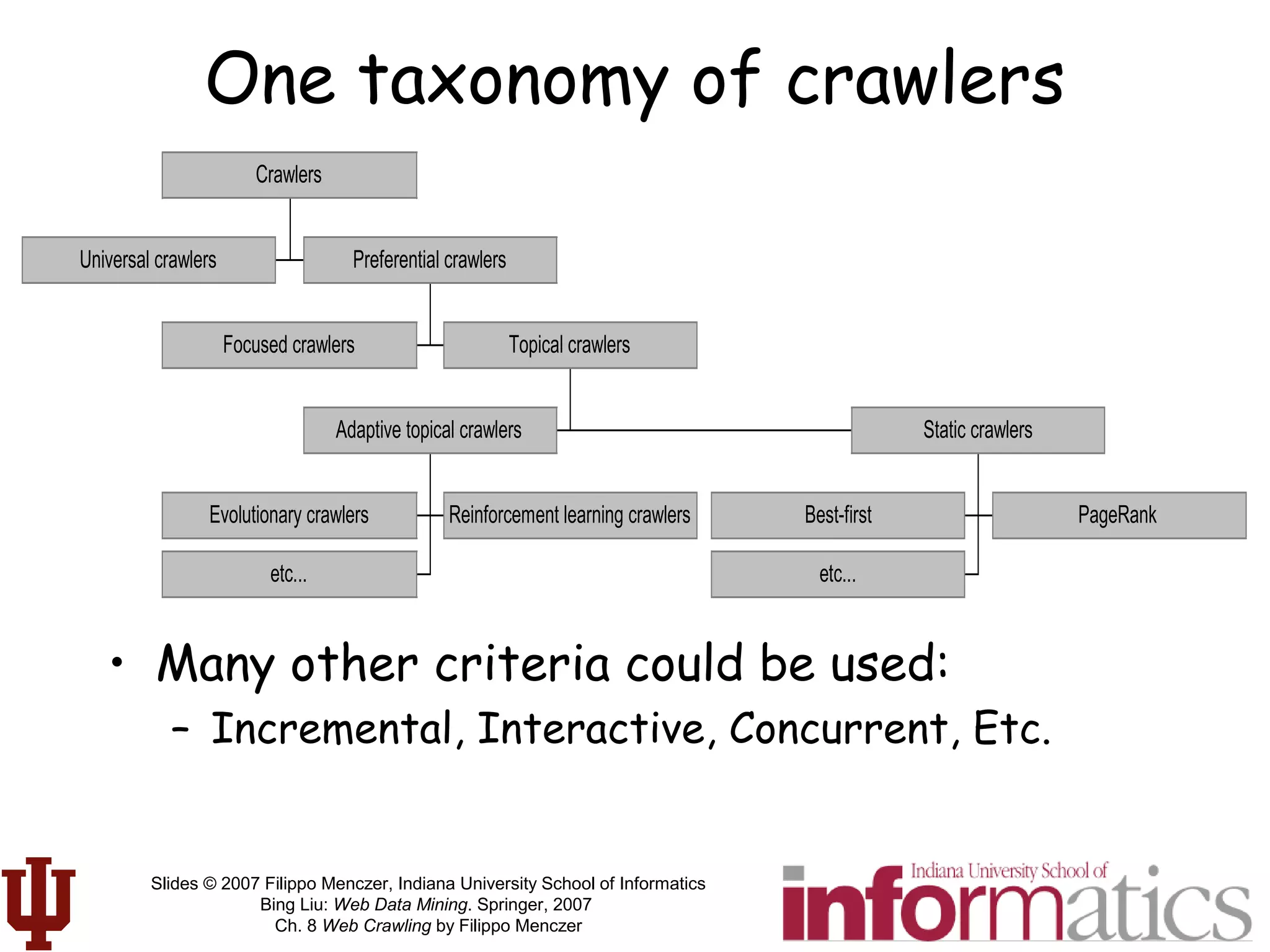
One taxonomy of crawlers
Universal crawlers
Focused crawlers
Evolutionary crawlers Reinforcement learning crawlers
etc...
Adaptive topical crawlers
Best-first PageRank
etc...
Static crawlers
Topical crawlers
Preferential crawlers
Crawlers
• Many other criteria could be used:
– Incremental, Interactive, Concurrent, Etc.
Slides © 2007 Filippo Menczer, Indiana University School of Informatics
Bing Liu: Web Data Mining. Springer, 2007
Ch. 8 Web Crawling by Filippo Menczer
Outline
• Motivation and taxonomy of crawlers
• Basic crawlers and implementation issues
• Universal crawlers
• Preferential (focused and topical) crawlers
• Evaluation of preferential crawlers
• Crawler ethics and conflicts
• New developments: social, collaborative, federated
crawlers
Slides © 2007 Filippo Menczer, Indiana University School of Informatics
Bing Liu: Web Data Mining. Springer, 2007
Ch. 8 Web Crawling by Filippo Menczer
Basic crawlers
• This is a sequential
crawler
• Seeds can be any list of
starting URLs
• Order of page visits is
determined by frontier
data structure
• Stop criterion can be
anything
Slides © 2007 Filippo Menczer, Indiana University School of Informatics
Bing Liu: Web Data Mining. Springer, 2007
Ch. 8 Web Crawling by Filippo Menczer
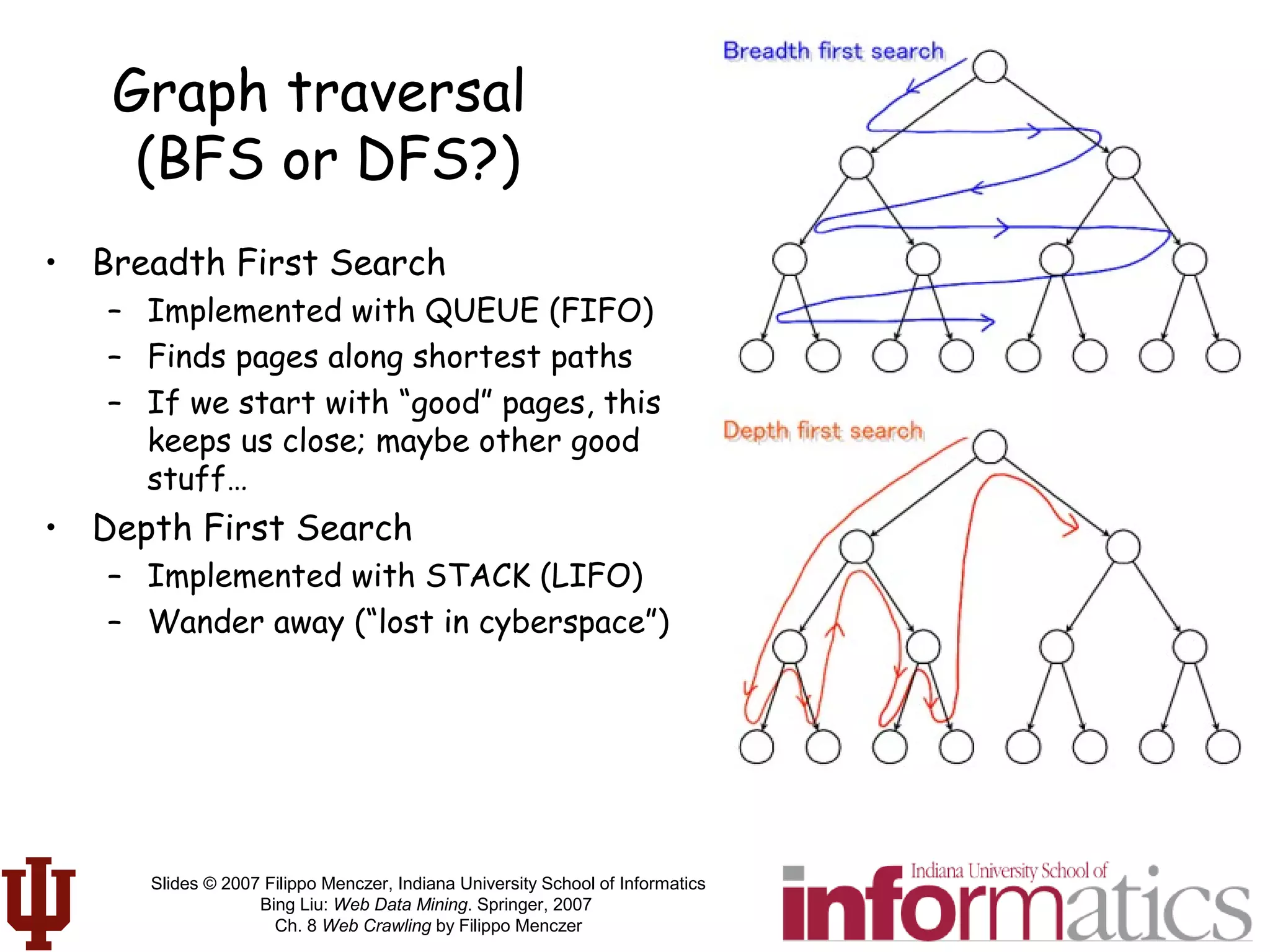
Graph traversal
(BFS or DFS?)
• Breadth First Search
– Implemented with QUEUE (FIFO)
– Finds pages along shortest paths
– If we start with “good” pages, this
keeps us close; maybe other good
stuff…
• Depth First Search
– Implemented with STACK (LIFO)
– Wander away (“lost in cyberspace”)
Slides © 2007 Filippo Menczer, Indiana University School of Informatics
Bing Liu: Web Data Mining. Springer, 2007
Ch. 8 Web Crawling by Filippo Menczer
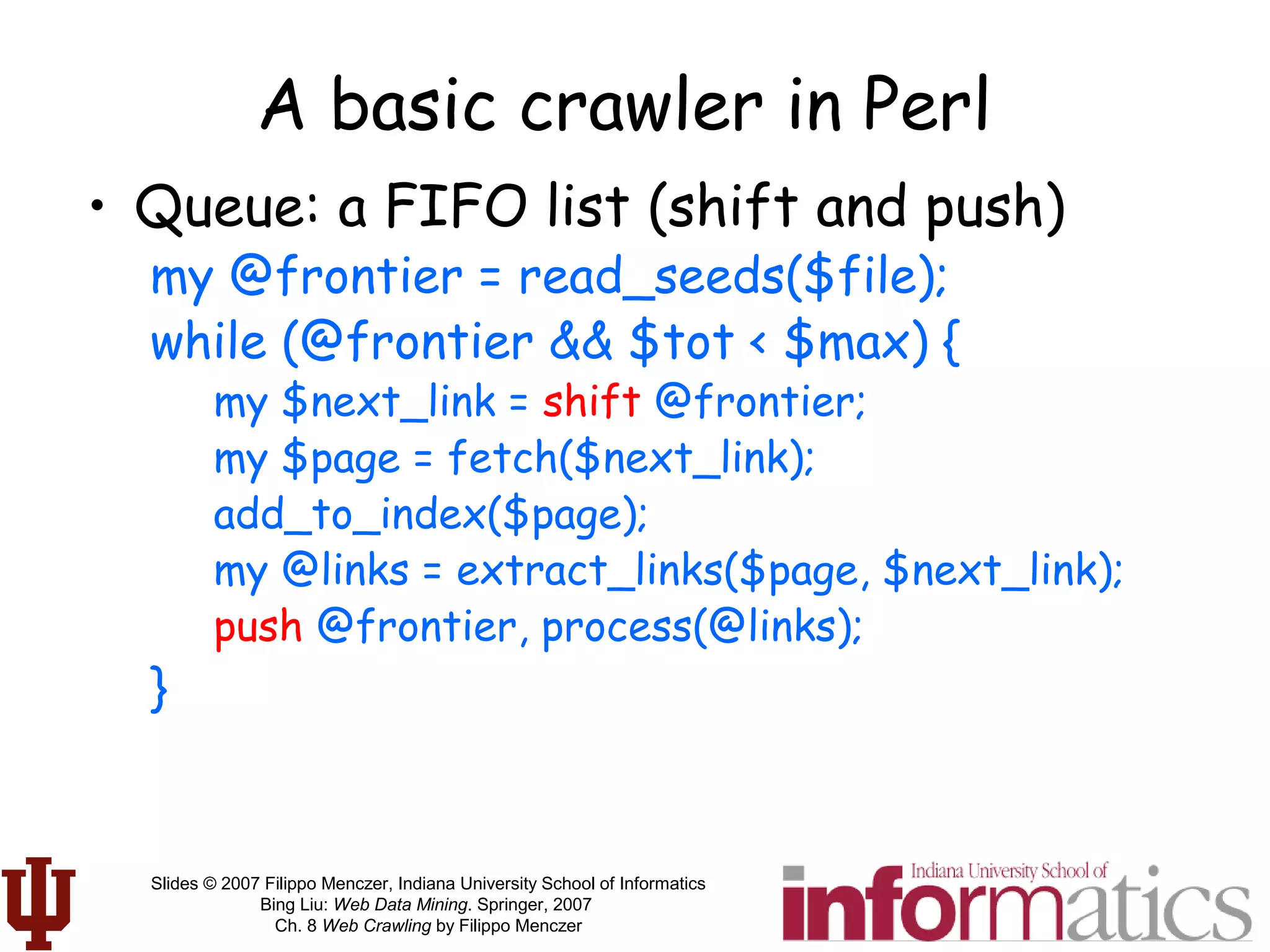
A basic crawler in Perl
• Queue: a FIFO list (shift and push)
my @frontier = read_seeds($file);
while (@frontier && $tot < $max) {
my $next_link = shift @frontier;
my $page = fetch($next_link);
add_to_index($page);
my @links = extract_links($page, $next_link);
push @frontier, process(@links);
}
Slides © 2007 Filippo Menczer, Indiana University School of Informatics
Bing Liu: Web Data Mining. Springer, 2007
Ch. 8 Web Crawling by Filippo Menczer
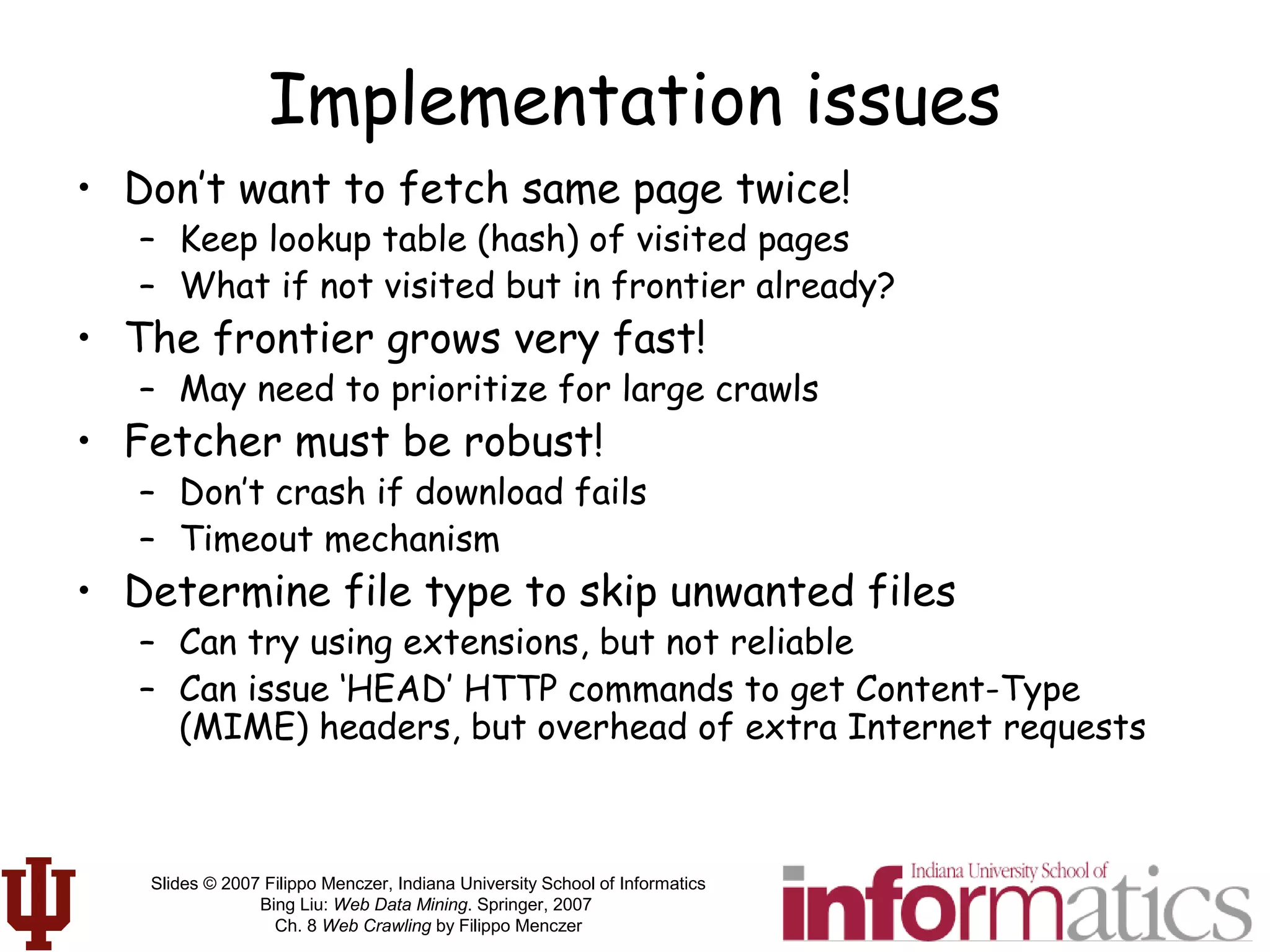
Implementation issues
• Don’t want to fetch same page twice!
– Keep lookup table (hash) of visited pages
– What if not visited but in frontier already?
• The frontier grows very fast!
– May need to prioritize for large crawls
• Fetcher must be robust!
– Don’t crash if download fails
– Timeout mechanism
• Determine file type to skip unwanted files
– Can try using extensions, but not reliable
– Can issue ‘HEAD’ HTTP commands to get Content-Type
(MIME) headers, but overhead of extra Internet requests
Slides © 2007 Filippo Menczer, Indiana University School of Informatics
Bing Liu: Web Data Mining. Springer, 2007
Ch. 8 Web Crawling by Filippo Menczer
More implementation issues
• Fetching
– Get only the first 10-100 KB per page
– Take care to detect and break
redirection loops
– Soft fail for timeout, server not
responding, file not found, and other
errors
Slides © 2007 Filippo Menczer, Indiana University School of Informatics
Bing Liu: Web Data Mining. Springer, 2007
Ch. 8 Web Crawling by Filippo Menczer
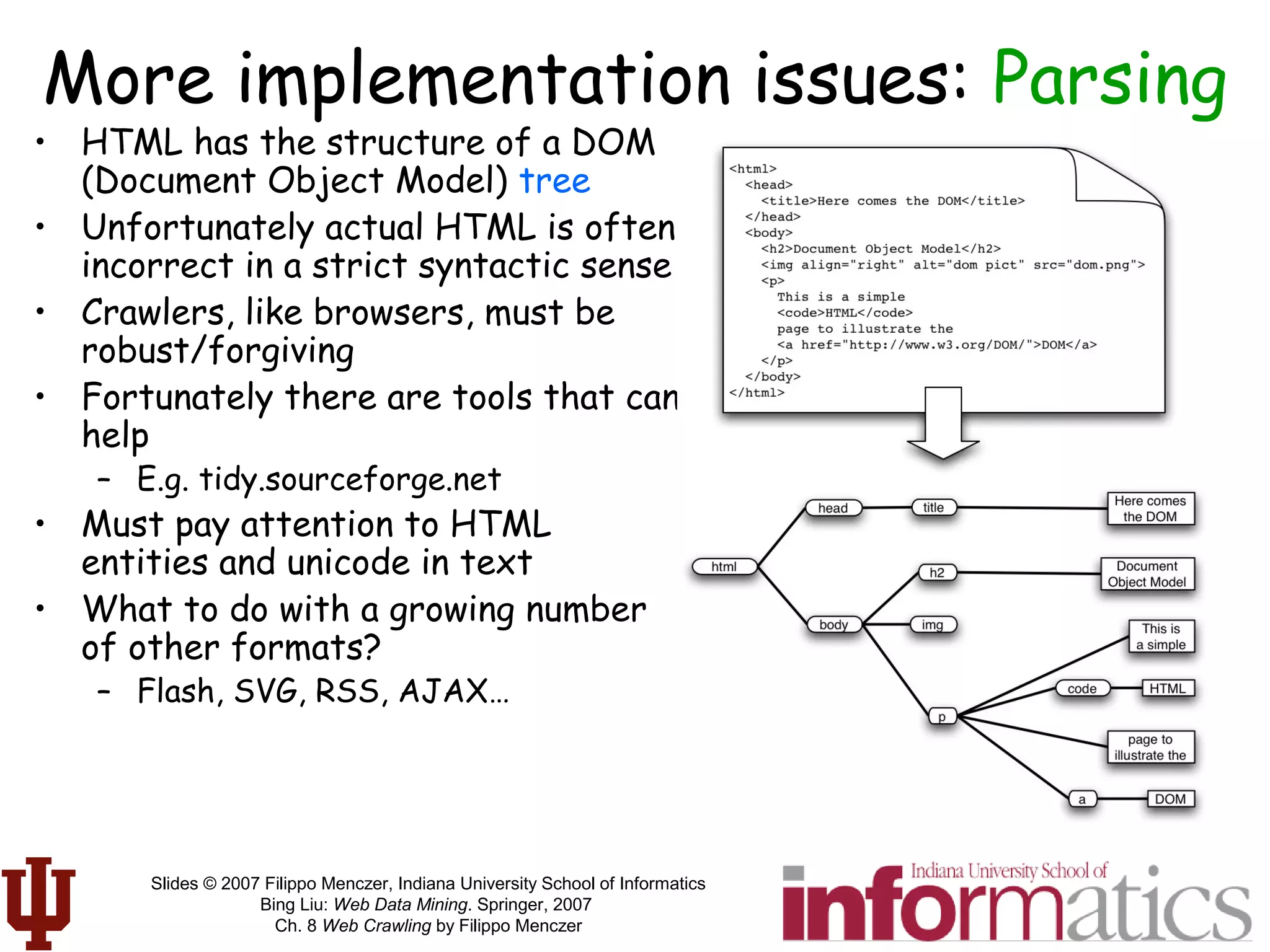
More implementation issues: Parsing
• HTML has the structure of a DOM
(Document Object Model) tree
• Unfortunately actual HTML is often
incorrect in a strict syntactic sense
• Crawlers, like browsers, must be
robust/forgiving
• Fortunately there are tools that can
help
– E.g. tidy.sourceforge.net
• Must pay attention to HTML
entities and unicode in text
• What to do with a growing number
of other formats?
– Flash, SVG, RSS, AJAX…
Slides © 2007 Filippo Menczer, Indiana University School of Informatics
Bing Liu: Web Data Mining. Springer, 2007
Ch. 8 Web Crawling by Filippo Menczer
More implementation issues
• Stop words
– Noise words that do not carry meaning should be eliminated
(“stopped”) before they are indexed
– E.g. in English: AND, THE, A, AT, OR, ON, FOR, etc…
– Typically syntactic markers
– Typically the most common terms
– Typically kept in a negative dictionary
• 10–1,000 elements
• E.g. http://ir.dcs.gla.ac.uk/resources/linguistic_utils/stop_words
– Parser can detect these right away and disregard them
Slides © 2007 Filippo Menczer, Indiana University School of Informatics
Bing Liu: Web Data Mining. Springer, 2007
Ch. 8 Web Crawling by Filippo Menczer
More implementation issues
Conflation and thesauri
• Idea: improve recall by merging words with same
meaning
1. We want to ignore superficial morphological
features, thus merge semantically similar tokens
– {student, study, studying, studious} => studi
1. We can also conflate synonyms into a single form
using a thesaurus
– 30-50% smaller index
– Doing this in both pages and queries allows to retrieve
pages about ‘automobile’ when user asks for ‘car’
– Thesaurus can be implemented as a hash table
Slides © 2007 Filippo Menczer, Indiana University School of Informatics
Bing Liu: Web Data Mining. Springer, 2007
Ch. 8 Web Crawling by Filippo Menczer
More implementation issues
• Stemming
– Morphological conflation based on rewrite rules
– Language dependent!
– Porter stemmer very popular for English
• http://www.tartarus.org/~martin/PorterStemmer/
• Context-sensitive grammar rules, eg:
– “IES” except (“EIES” or “AIES”) --> “Y”
• Versions in Perl, C, Java, Python, C#, Ruby, PHP, etc.
– Porter has also developed Snowball, a language to create
stemming algorithms in any language
• http://snowball.tartarus.org/
• Ex. Perl modules: Lingua::Stem and Lingua::Stem::Snowball
Slides © 2007 Filippo Menczer, Indiana University School of Informatics
Bing Liu: Web Data Mining. Springer, 2007
Ch. 8 Web Crawling by Filippo Menczer
More implementation issues
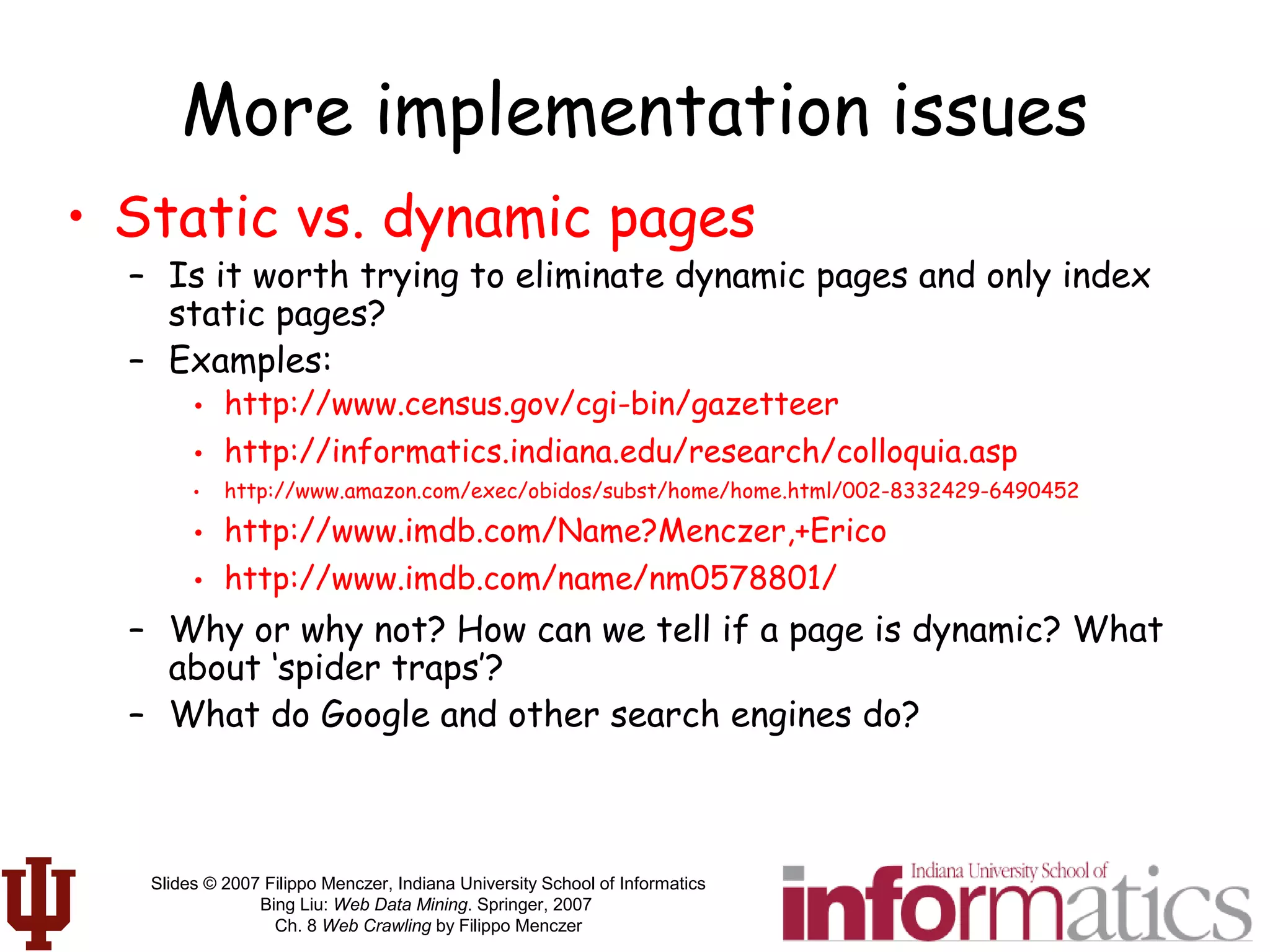
• Static vs. dynamic pages
– Is it worth trying to eliminate dynamic pages and only index
static pages?
– Examples:
• http://www.census.gov/cgi-bin/gazetteer
• http://informatics.indiana.edu/research/colloquia.asp
• http://www.amazon.com/exec/obidos/subst/home/home.html/002-8332429-6490452
• http://www.imdb.com/Name?Menczer,+Erico
• http://www.imdb.com/name/nm0578801/
– Why or why not? How can we tell if a page is dynamic? What
about ‘spider traps’?
– What do Google and other search engines do?
Slides © 2007 Filippo Menczer, Indiana University School of Informatics
Bing Liu: Web Data Mining. Springer, 2007
Ch. 8 Web Crawling by Filippo Menczer
More implementation issues
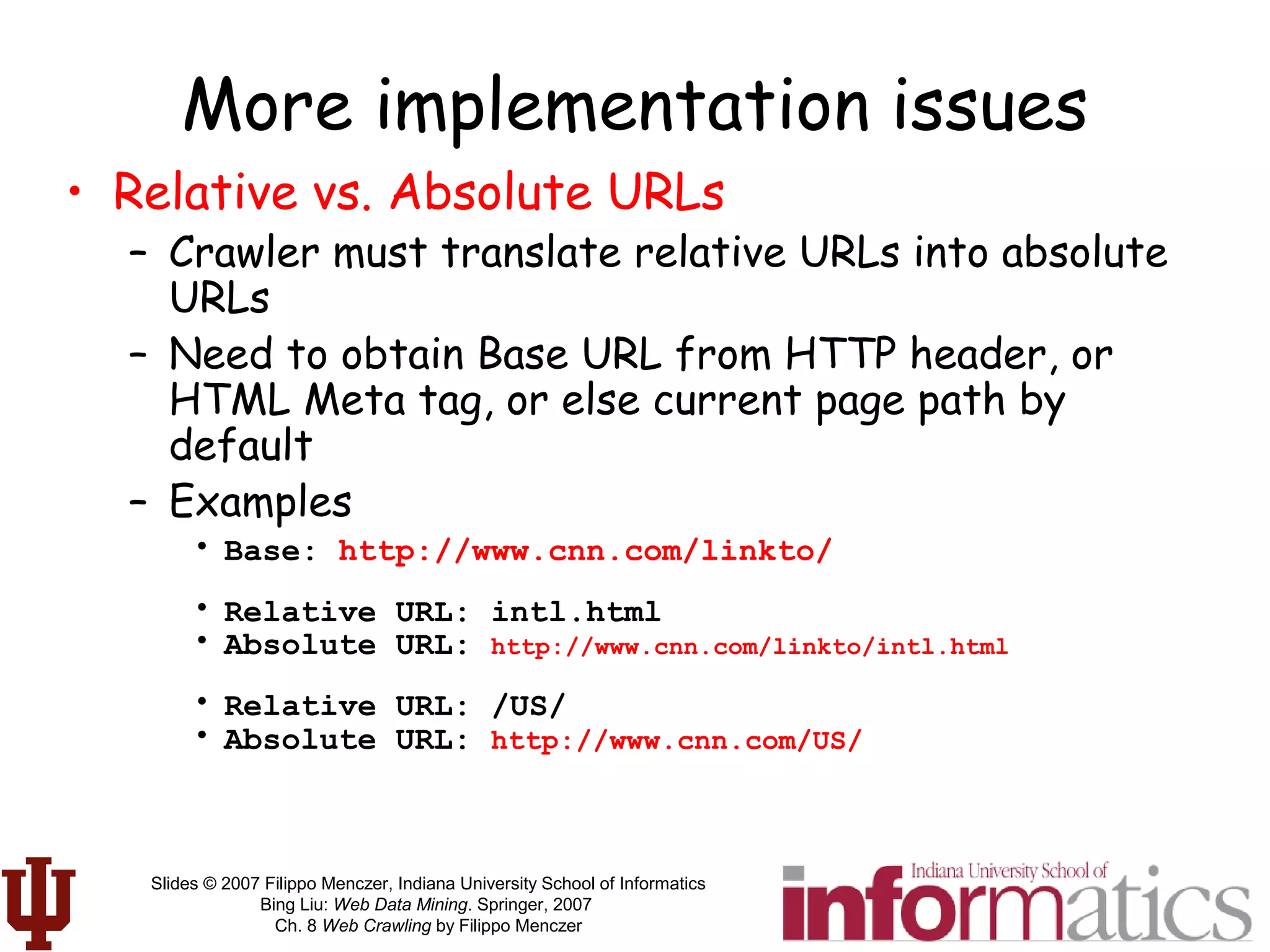
• Relative vs. Absolute URLs
– Crawler must translate relative URLs into absolute
URLs
– Need to obtain Base URL from HTTP header, or
HTML Meta tag, or else current page path by
default
– Examples
• Base: http://www.cnn.com/linkto/
• Relative URL: intl.html
• Absolute URL: http://www.cnn.com/linkto/intl.html
• Relative URL: /US/
• Absolute URL: http://www.cnn.com/US/
Slides © 2007 Filippo Menczer, Indiana University School of Informatics
Bing Liu: Web Data Mining. Springer, 2007
Ch. 8 Web Crawling by Filippo Menczer
More implementation issues
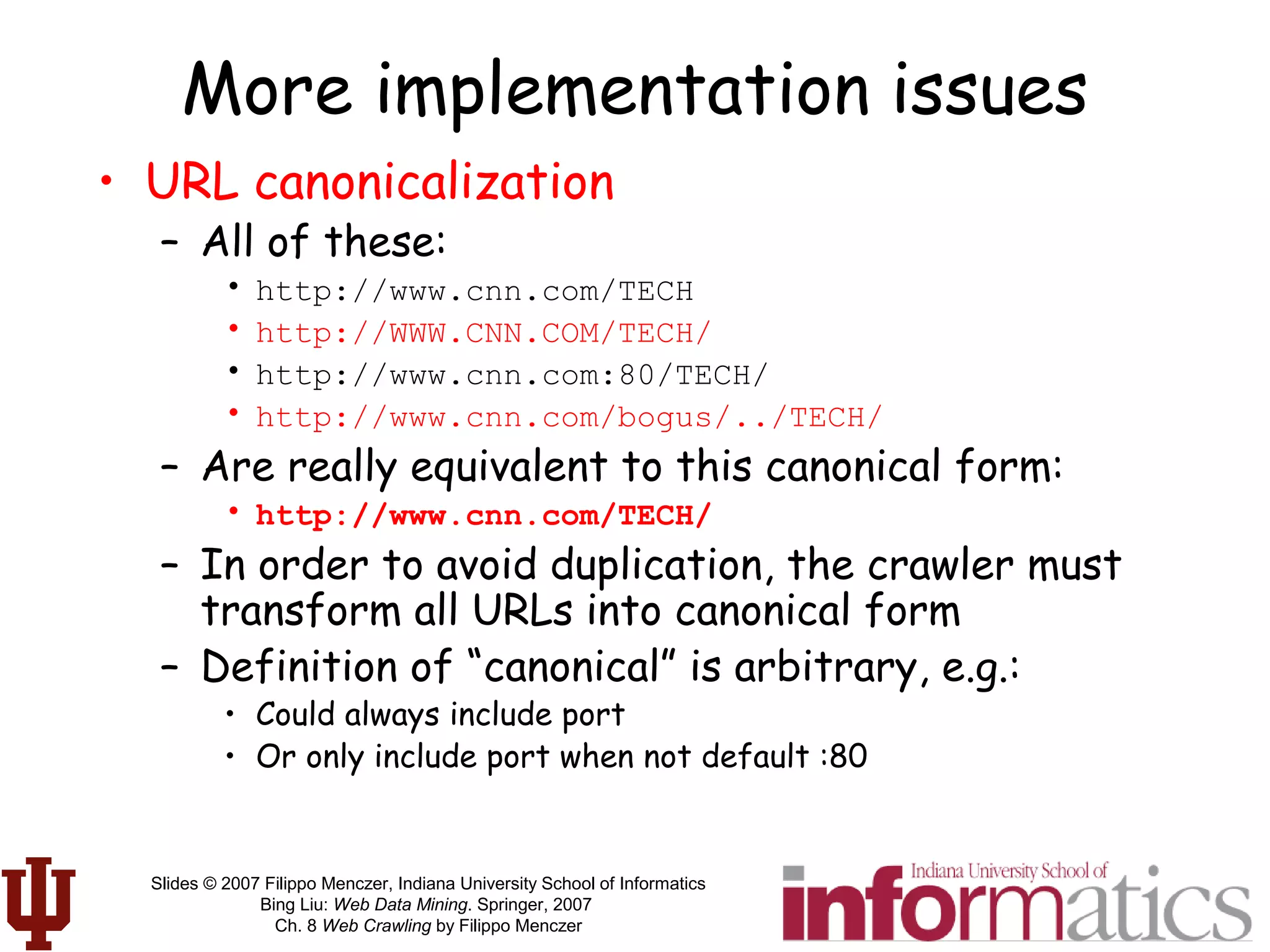
• URL canonicalization
– All of these:
• http://www.cnn.com/TECH
• http://WWW.CNN.COM/TECH/
• http://www.cnn.com:80/TECH/
• http://www.cnn.com/bogus/../TECH/
– Are really equivalent to this canonical form:
• http://www.cnn.com/TECH/
– In order to avoid duplication, the crawler must
transform all URLs into canonical form
– Definition of “canonical” is arbitrary, e.g.:
• Could always include port
• Or only include port when not default :80
Slides © 2007 Filippo Menczer, Indiana University School of Informatics
Bing Liu: Web Data Mining. Springer, 2007
Ch. 8 Web Crawling by Filippo Menczer
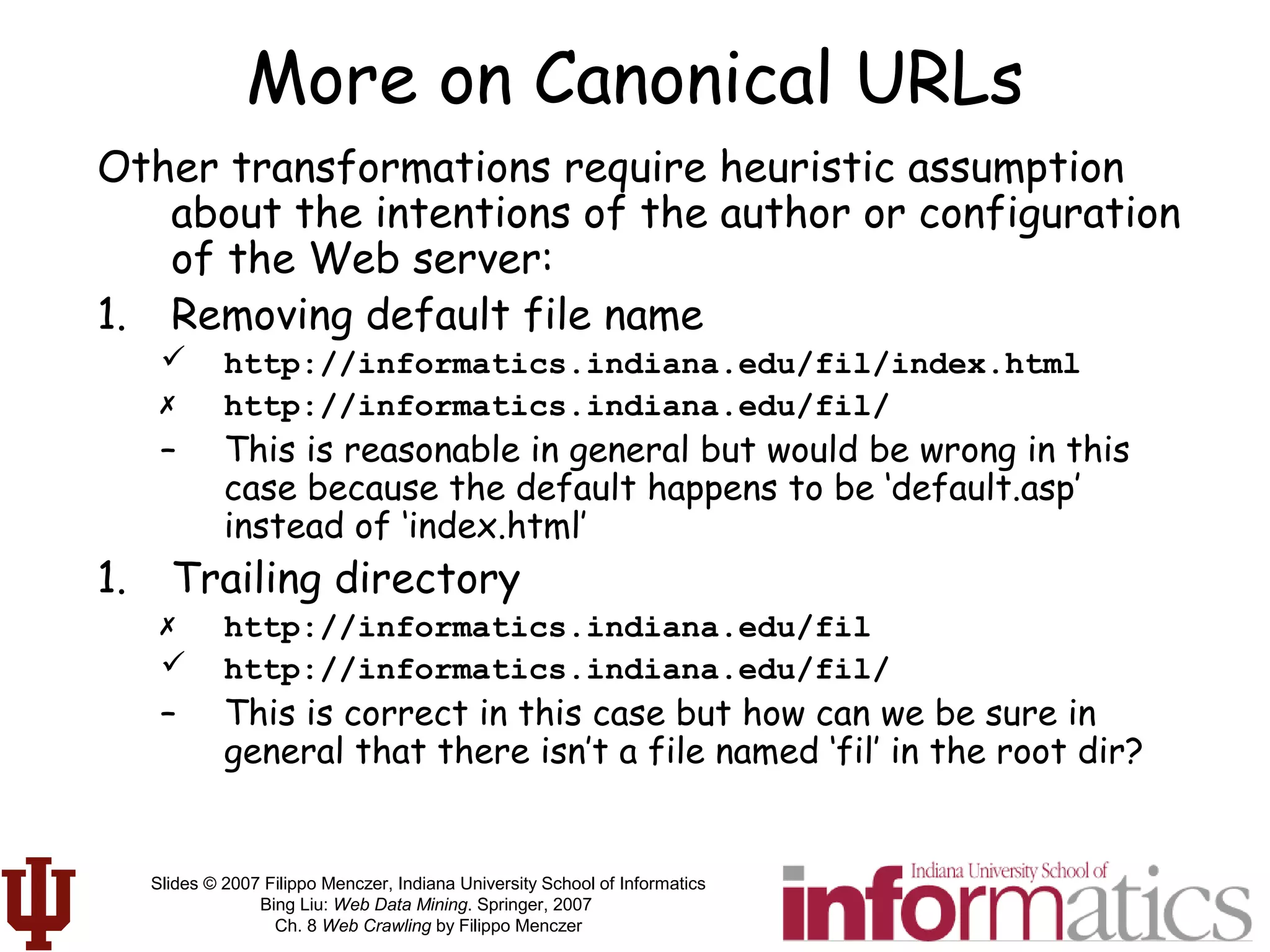
More on Canonical URLs
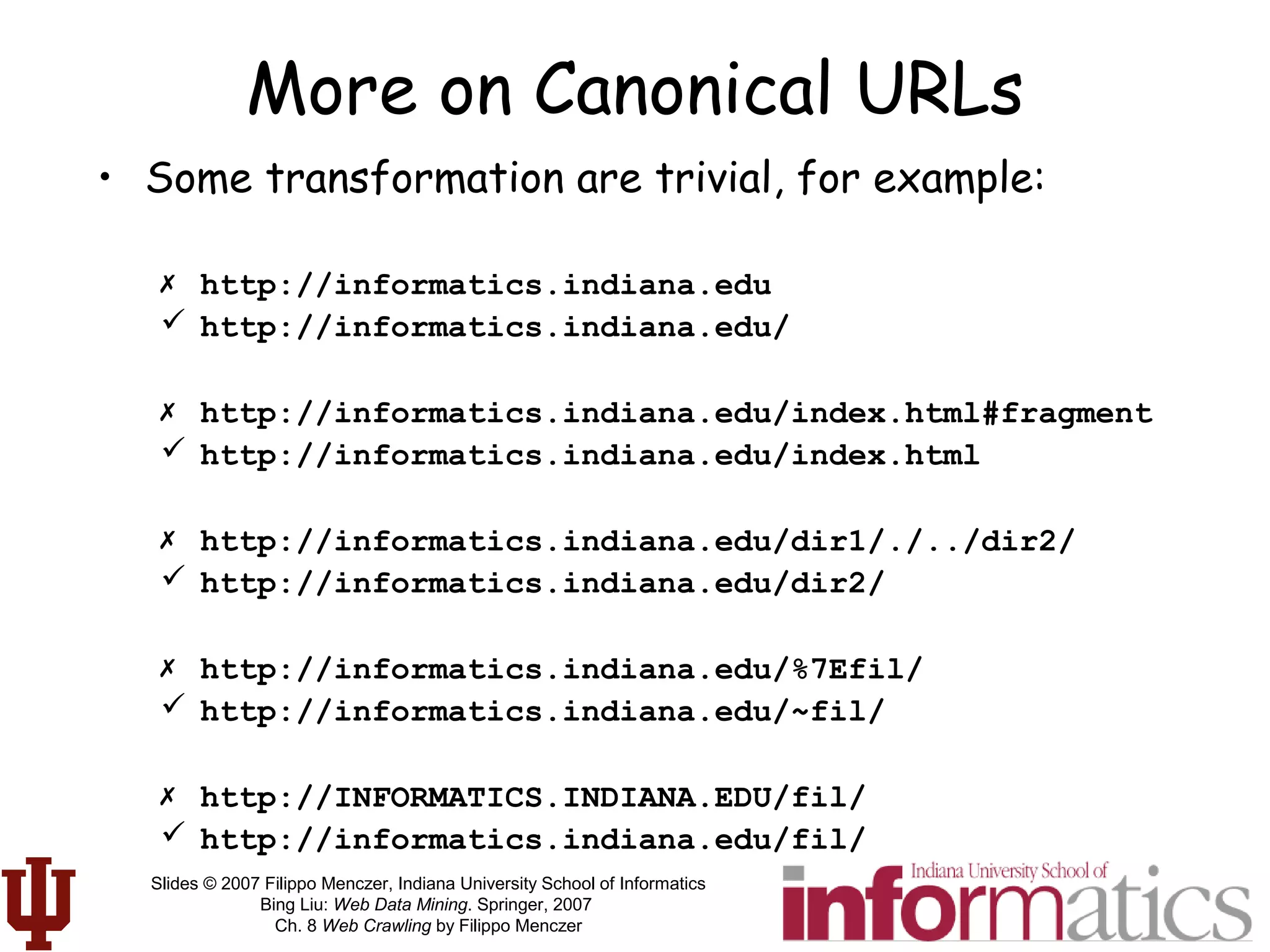
• Some transformation are trivial, for example:
 http://informatics.indiana.edu
 http://informatics.indiana.edu/
 http://informatics.indiana.edu/index.html#fragment
 http://informatics.indiana.edu/index.html
 http://informatics.indiana.edu/dir1/./../dir2/
 http://informatics.indiana.edu/dir2/
 http://informatics.indiana.edu/%7Efil/
 http://informatics.indiana.edu/~fil/
 http://INFORMATICS.INDIANA.EDU/fil/
 http://informatics.indiana.edu/fil/
Slides © 2007 Filippo Menczer, Indiana University School of Informatics
Bing Liu: Web Data Mining. Springer, 2007
Ch. 8 Web Crawling by Filippo Menczer
More on Canonical URLs
Other transformations require heuristic assumption
about the intentions of the author or configuration
of the Web server:
1. Removing default file name
 http://informatics.indiana.edu/fil/index.html
 http://informatics.indiana.edu/fil/
– This is reasonable in general but would be wrong in this
case because the default happens to be ‘default.asp’
instead of ‘index.html’
1. Trailing directory
 http://informatics.indiana.edu/fil
 http://informatics.indiana.edu/fil/
– This is correct in this case but how can we be sure in
general that there isn’t a file named ‘fil’ in the root dir?
Slides © 2007 Filippo Menczer, Indiana University School of Informatics
Bing Liu: Web Data Mining. Springer, 2007
Ch. 8 Web Crawling by Filippo Menczer
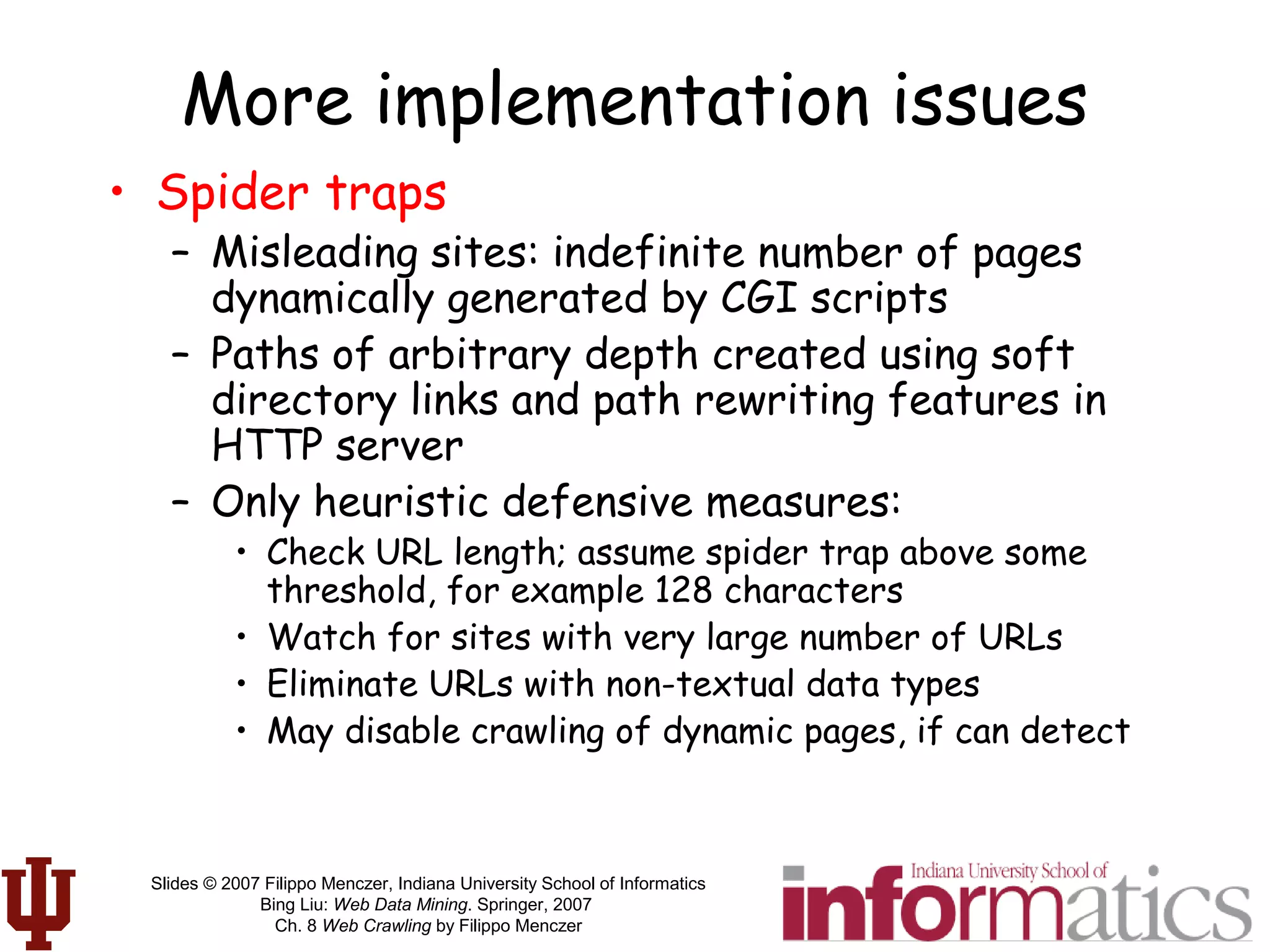
More implementation issues
• Spider traps
– Misleading sites: indefinite number of pages
dynamically generated by CGI scripts
– Paths of arbitrary depth created using soft
directory links and path rewriting features in
HTTP server
– Only heuristic defensive measures:
• Check URL length; assume spider trap above some
threshold, for example 128 characters
• Watch for sites with very large number of URLs
• Eliminate URLs with non-textual data types
• May disable crawling of dynamic pages, if can detect
Slides © 2007 Filippo Menczer, Indiana University School of Informatics
Bing Liu: Web Data Mining. Springer, 2007
Ch. 8 Web Crawling by Filippo Menczer
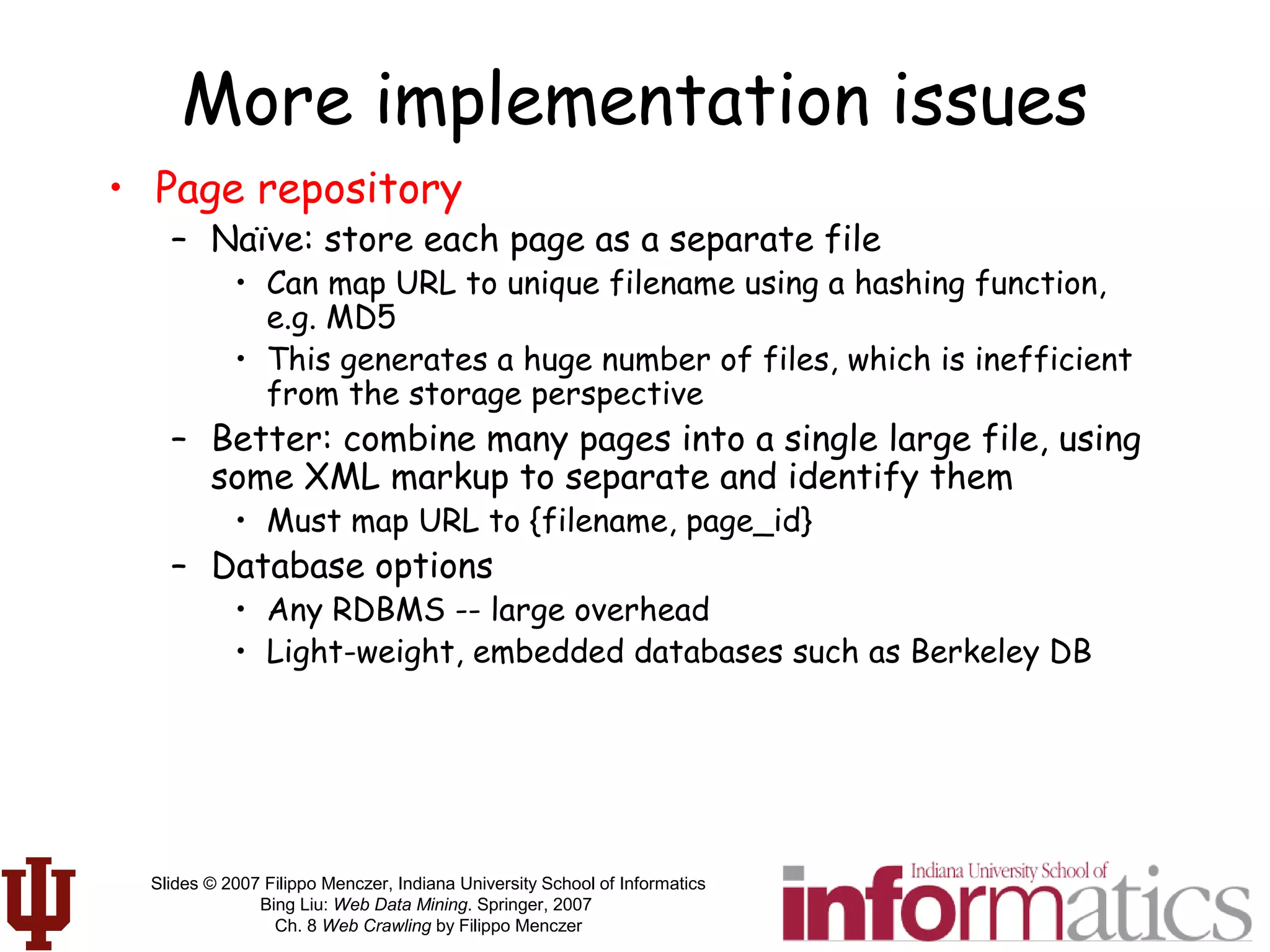
More implementation issues
• Page repository
– Naïve: store each page as a separate file
• Can map URL to unique filename using a hashing function,
e.g. MD5
• This generates a huge number of files, which is inefficient
from the storage perspective
– Better: combine many pages into a single large file, using
some XML markup to separate and identify them
• Must map URL to {filename, page_id}
– Database options
• Any RDBMS -- large overhead
• Light-weight, embedded databases such as Berkeley DB
Slides © 2007 Filippo Menczer, Indiana University School of Informatics
Bing Liu: Web Data Mining. Springer, 2007
Ch. 8 Web Crawling by Filippo Menczer
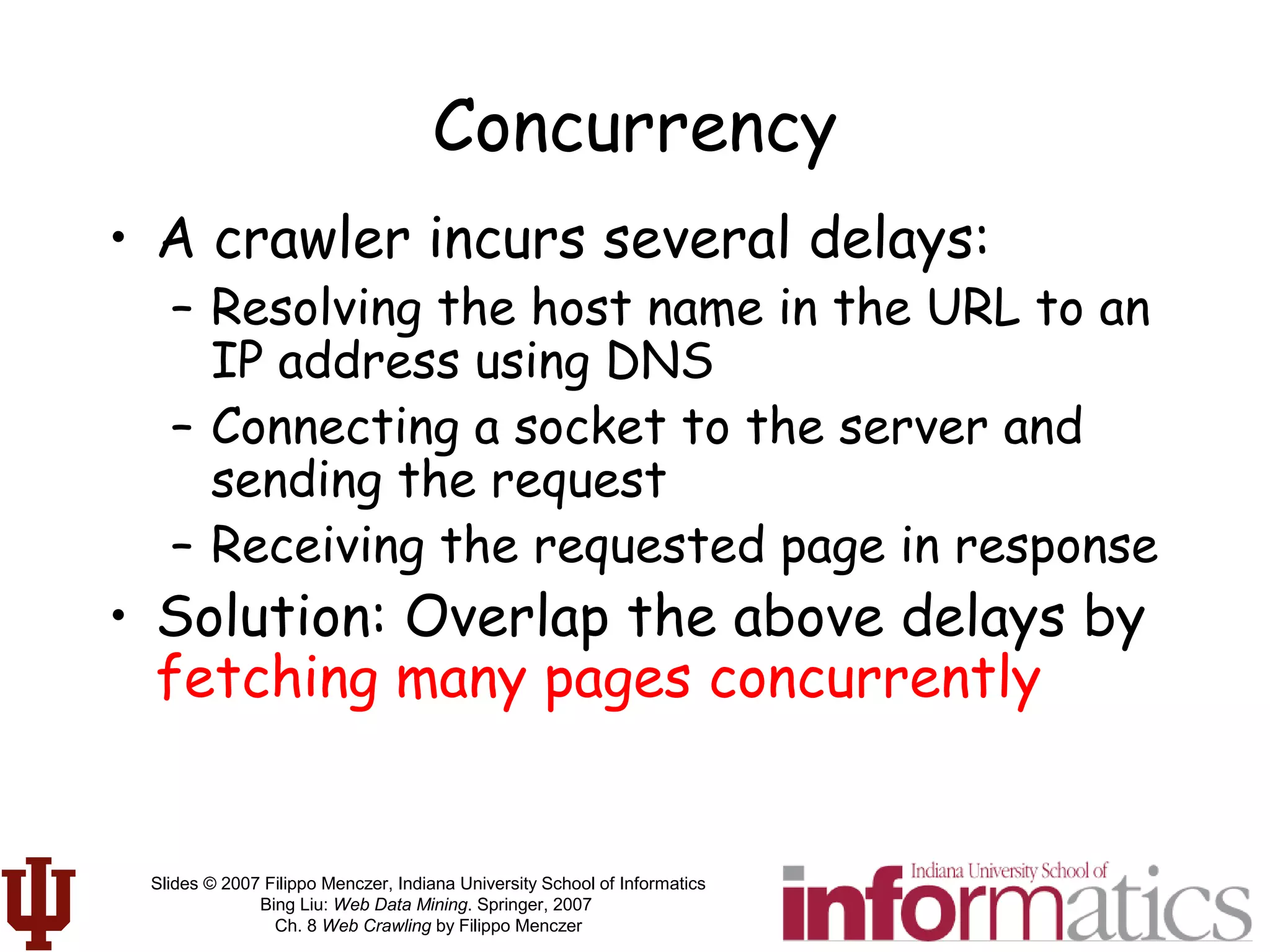
Concurrency
• A crawler incurs several delays:
– Resolving the host name in the URL to an
IP address using DNS
– Connecting a socket to the server and
sending the request
– Receiving the requested page in response
• Solution: Overlap the above delays by
fetching many pages concurrently
Slides © 2007 Filippo Menczer, Indiana University School of Informatics
Bing Liu: Web Data Mining. Springer, 2007
Ch. 8 Web Crawling by Filippo Menczer
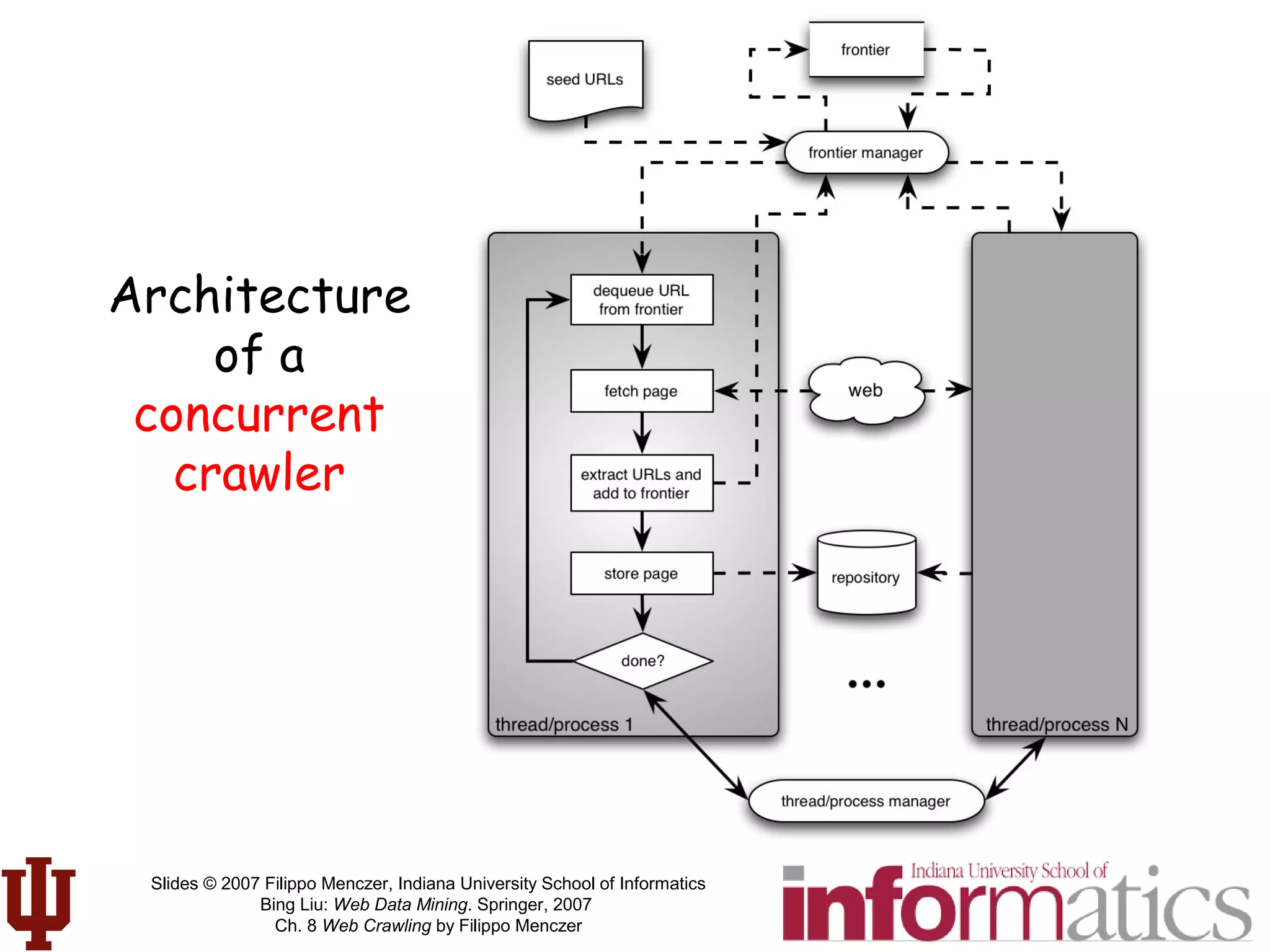
Architecture
of a
concurrent
crawler
Slides © 2007 Filippo Menczer, Indiana University School of Informatics
Bing Liu: Web Data Mining. Springer, 2007
Ch. 8 Web Crawling by Filippo Menczer
Concurrent crawlers
• Can use multi-processing or multi-threading
• Each process or thread works like a
sequential crawler, except they share data
structures: frontier and repository
• Shared data structures must be
synchronized (locked for concurrent
writes)
• Speedup of factor of 5-10 are easy this
way
Slides © 2007 Filippo Menczer, Indiana University School of Informatics
Bing Liu: Web Data Mining. Springer, 2007
Ch. 8 Web Crawling by Filippo Menczer
Outline
• Motivation and taxonomy of crawlers
• Basic crawlers and implementation issues
• Universal crawlers
• Preferential (focused and topical) crawlers
• Evaluation of preferential crawlers
• Crawler ethics and conflicts
• New developments: social, collaborative, federated
crawlers
Slides © 2007 Filippo Menczer, Indiana University School of Informatics
Bing Liu: Web Data Mining. Springer, 2007
Ch. 8 Web Crawling by Filippo Menczer
Universal crawlers
• Support universal search engines
• Large-scale
• Huge cost (network bandwidth) of
crawl is amortized over many queries
from users
• Incremental updates to existing
index and other data repositories
Slides © 2007 Filippo Menczer, Indiana University School of Informatics
Bing Liu: Web Data Mining. Springer, 2007
Ch. 8 Web Crawling by Filippo Menczer
Large-scale universal crawlers
• Two major issues:
1. Performance
• Need to scale up to billions of pages
2. Policy
• Need to trade-off coverage,
freshness, and bias (e.g. toward
“important” pages)
Slides © 2007 Filippo Menczer, Indiana University School of Informatics
Bing Liu: Web Data Mining. Springer, 2007
Ch. 8 Web Crawling by Filippo Menczer
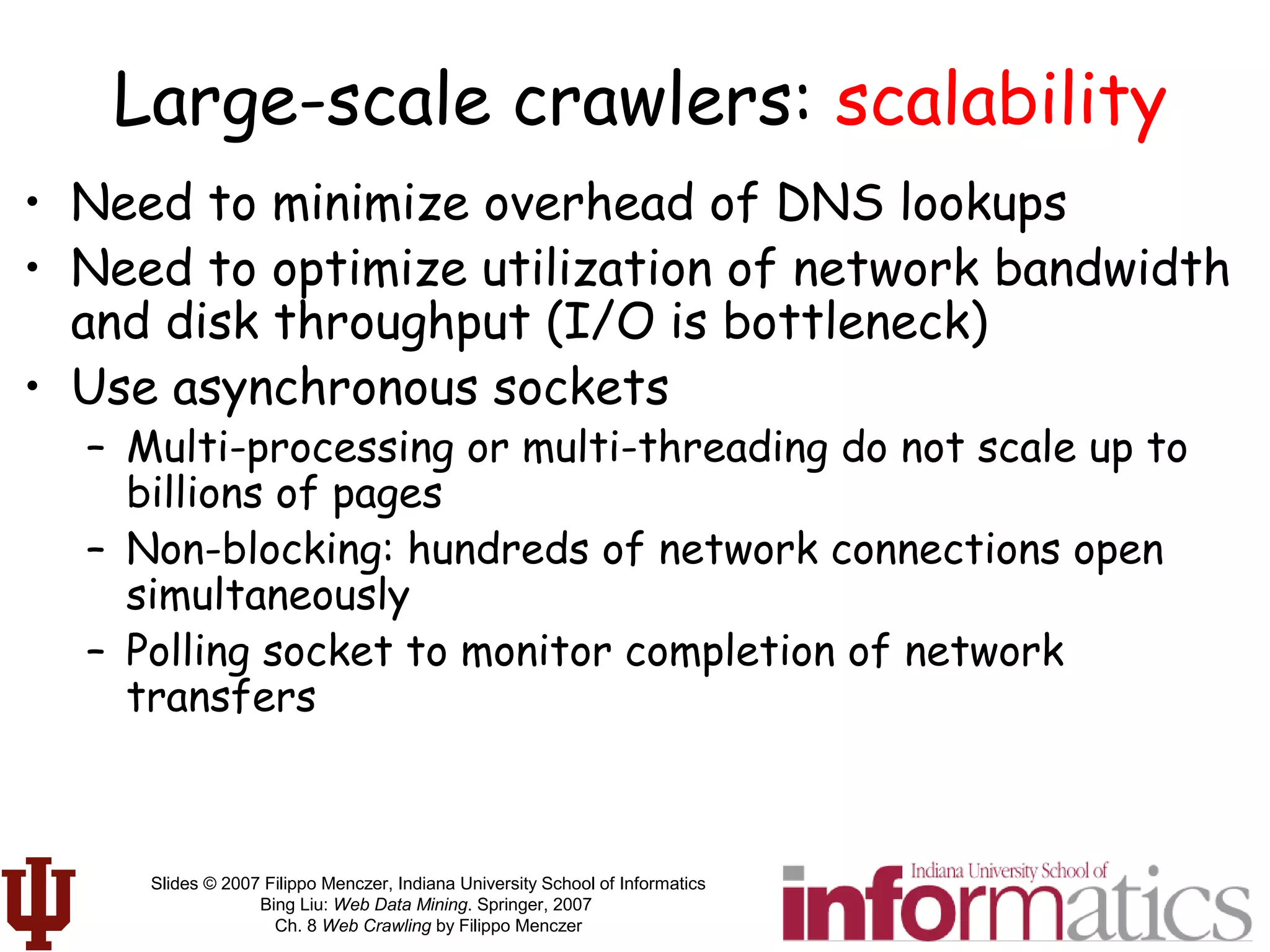
Large-scale crawlers: scalability
• Need to minimize overhead of DNS lookups
• Need to optimize utilization of network bandwidth
and disk throughput (I/O is bottleneck)
• Use asynchronous sockets
– Multi-processing or multi-threading do not scale up to
billions of pages
– Non-blocking: hundreds of network connections open
simultaneously
– Polling socket to monitor completion of network
transfers
Slides © 2007 Filippo Menczer, Indiana University School of Informatics
Bing Liu: Web Data Mining. Springer, 2007
Ch. 8 Web Crawling by Filippo Menczer
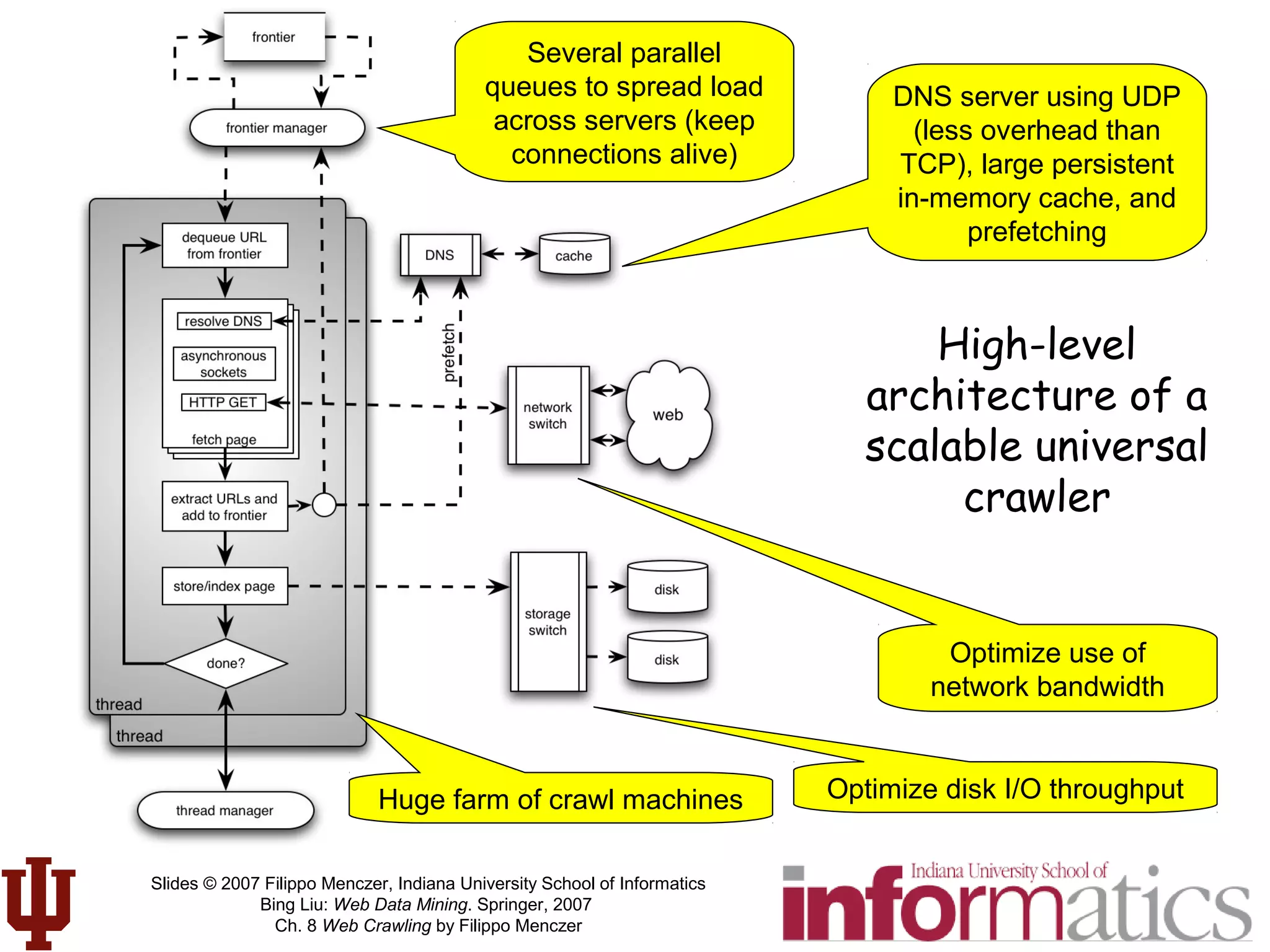
High-level
architecture of a
scalable universal
crawler
Several parallel
queues to spread load
across servers (keep
connections alive)
DNS server using UDP
(less overhead than
TCP), large persistent
in-memory cache, and
prefetching
Optimize use of
network bandwidth
Optimize disk I/O throughputHuge farm of crawl machines
Slides © 2007 Filippo Menczer, Indiana University School of Informatics
Bing Liu: Web Data Mining. Springer, 2007
Ch. 8 Web Crawling by Filippo Menczer
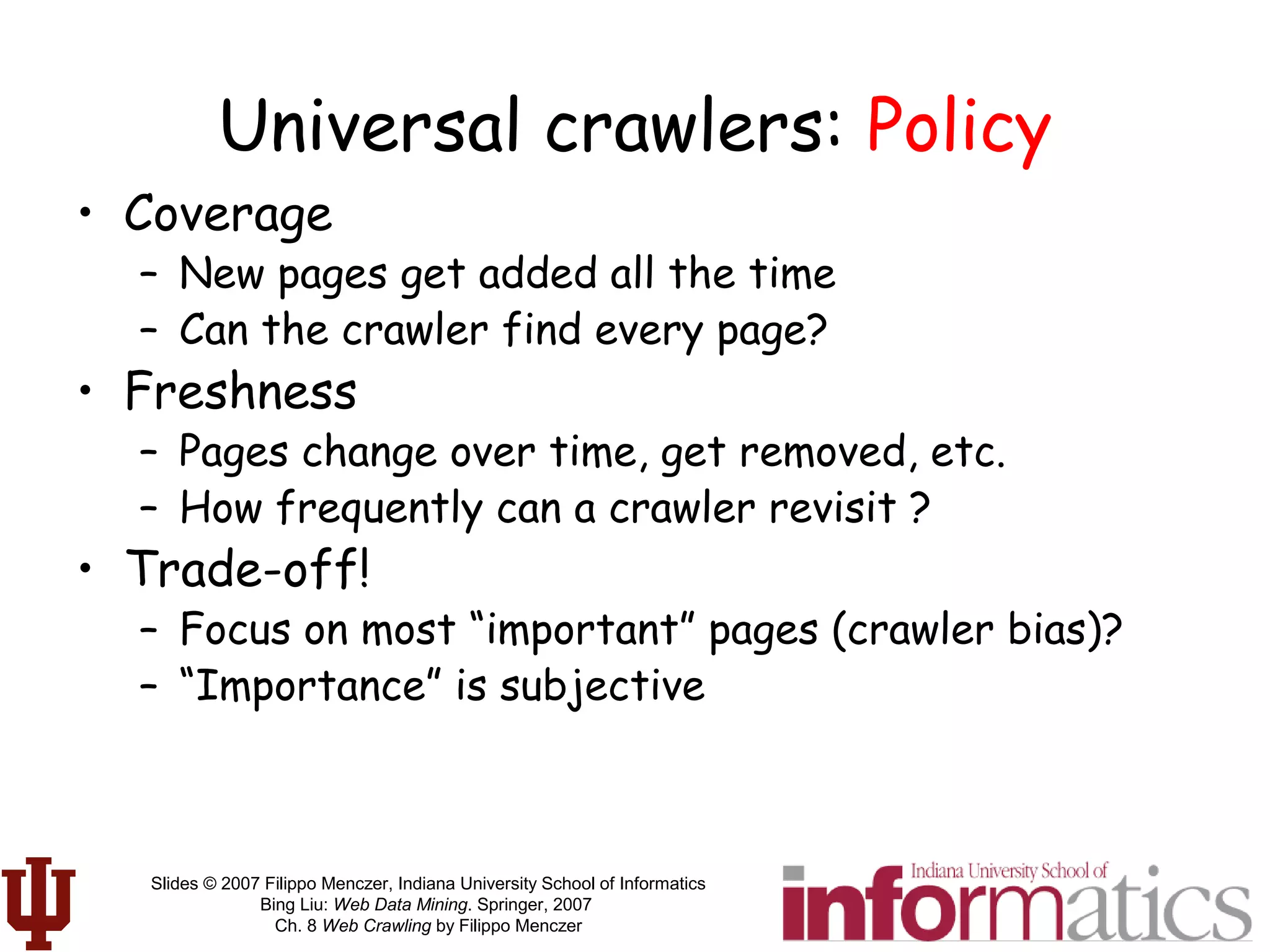
Universal crawlers: Policy
• Coverage
– New pages get added all the time
– Can the crawler find every page?
• Freshness
– Pages change over time, get removed, etc.
– How frequently can a crawler revisit ?
• Trade-off!
– Focus on most “important” pages (crawler bias)?
– “Importance” is subjective
Slides © 2007 Filippo Menczer, Indiana University School of Informatics
Bing Liu: Web Data Mining. Springer, 2007
Ch. 8 Web Crawling by Filippo Menczer
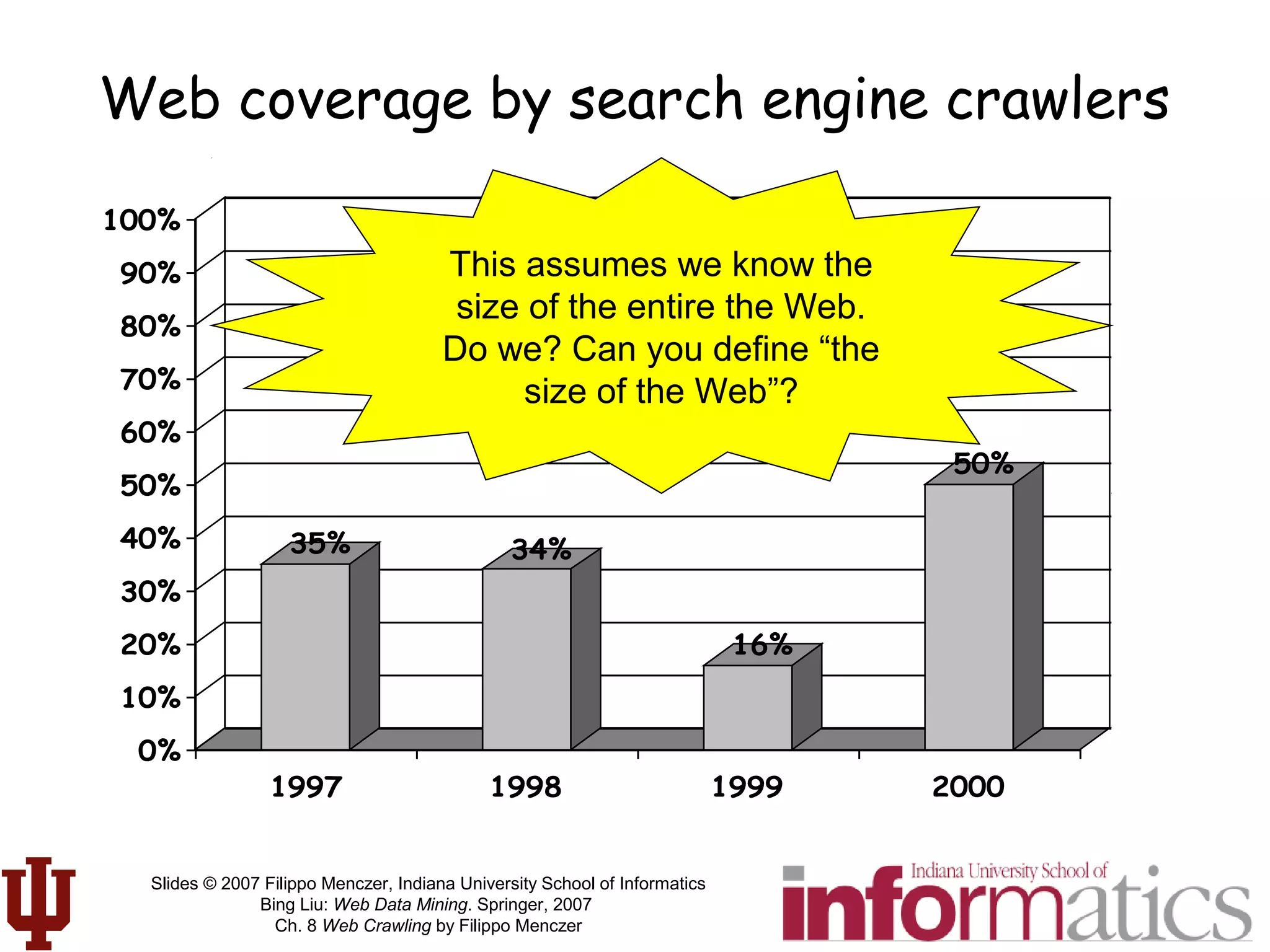
Web coverage by search engine crawlers
35% 34%
16%
50%
0%
10%
20%
30%
40%
50%
60%
70%
80%
90%
100%
1997 1998 1999 2000
This assumes we know the
size of the entire the Web.
Do we? Can you define “the
size of the Web”?
Slides © 2007 Filippo Menczer, Indiana University School of Informatics
Bing Liu: Web Data Mining. Springer, 2007
Ch. 8 Web Crawling by Filippo Menczer
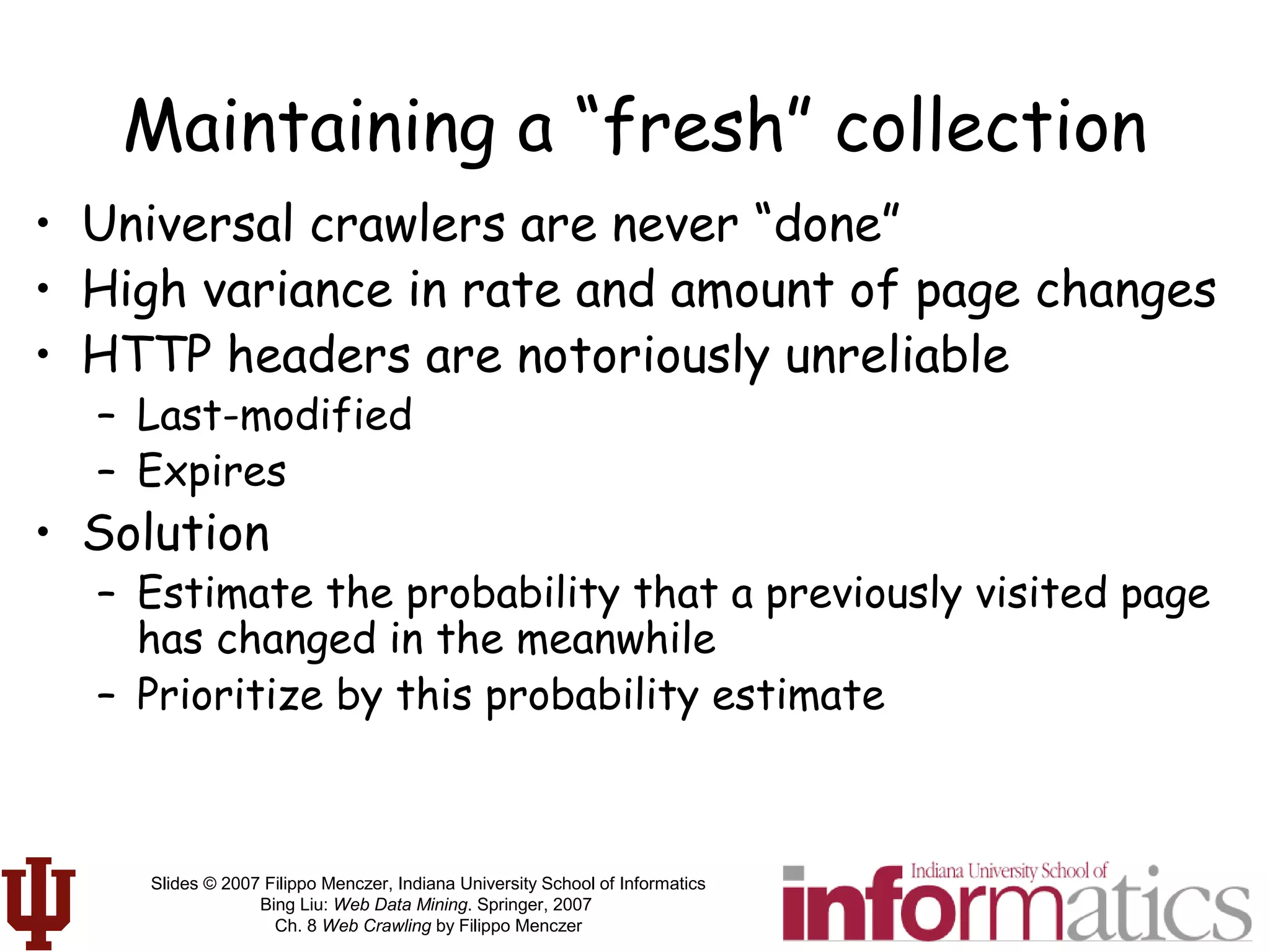
Maintaining a “fresh” collection
• Universal crawlers are never “done”
• High variance in rate and amount of page changes
• HTTP headers are notoriously unreliable
– Last-modified
– Expires
• Solution
– Estimate the probability that a previously visited page
has changed in the meanwhile
– Prioritize by this probability estimate
Slides © 2007 Filippo Menczer, Indiana University School of Informatics
Bing Liu: Web Data Mining. Springer, 2007
Ch. 8 Web Crawling by Filippo Menczer
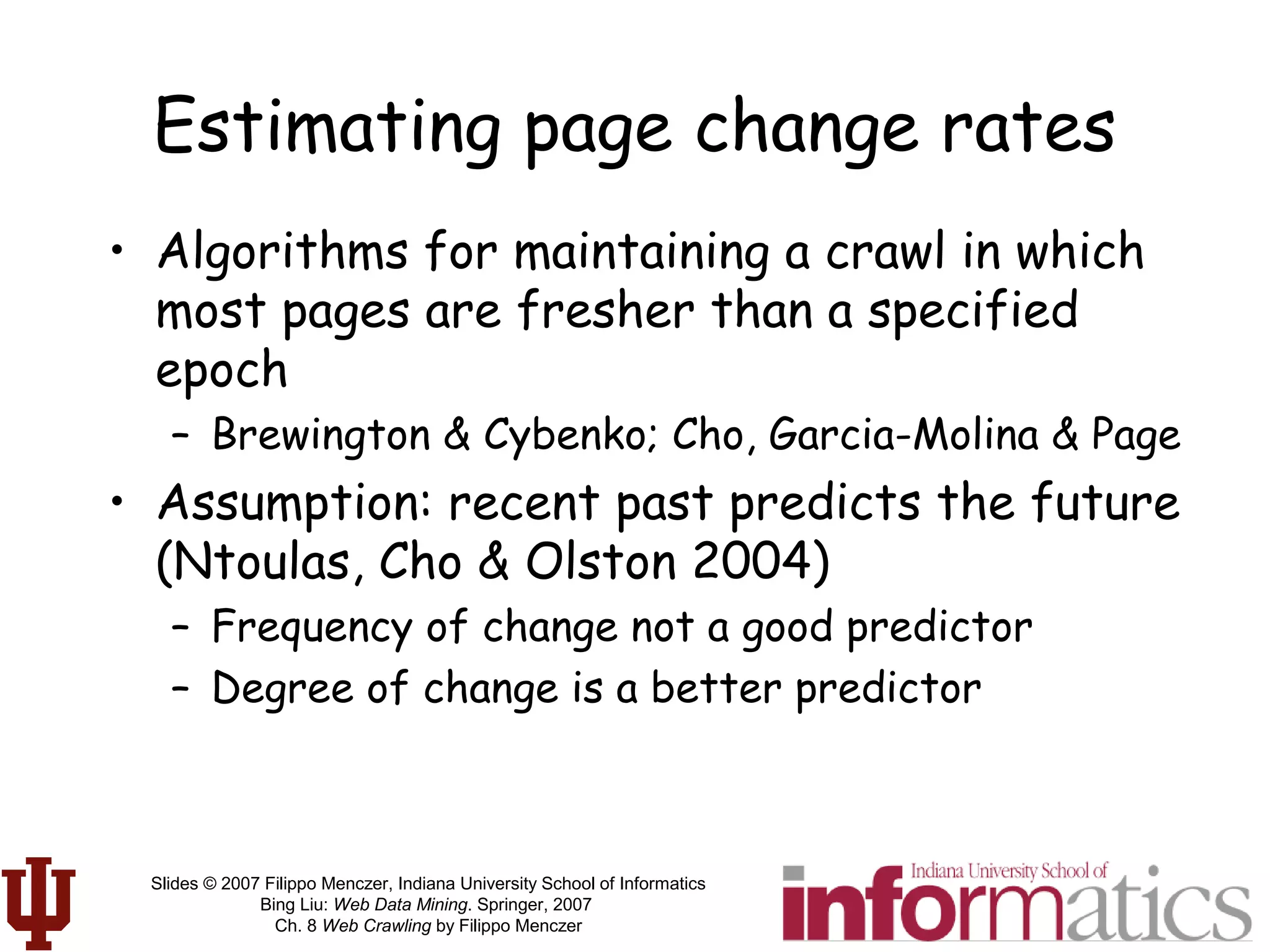
Estimating page change rates
• Algorithms for maintaining a crawl in which
most pages are fresher than a specified
epoch
– Brewington & Cybenko; Cho, Garcia-Molina & Page
• Assumption: recent past predicts the future
(Ntoulas, Cho & Olston 2004)
– Frequency of change not a good predictor
– Degree of change is a better predictor
Slides © 2007 Filippo Menczer, Indiana University School of Informatics
Bing Liu: Web Data Mining. Springer, 2007
Ch. 8 Web Crawling by Filippo Menczer
Do we need to crawl the entire Web?
• If we cover too much, it will get stale
• There is an abundance of pages in the Web
• For PageRank, pages with very low prestige are largely
useless
• What is the goal?
– General search engines: pages with high prestige
– News portals: pages that change often
– Vertical portals: pages on some topic
• What are appropriate priority measures in these
cases? Approximations?
Slides © 2007 Filippo Menczer, Indiana University School of Informatics
Bing Liu: Web Data Mining. Springer, 2007
Ch. 8 Web Crawling by Filippo Menczer
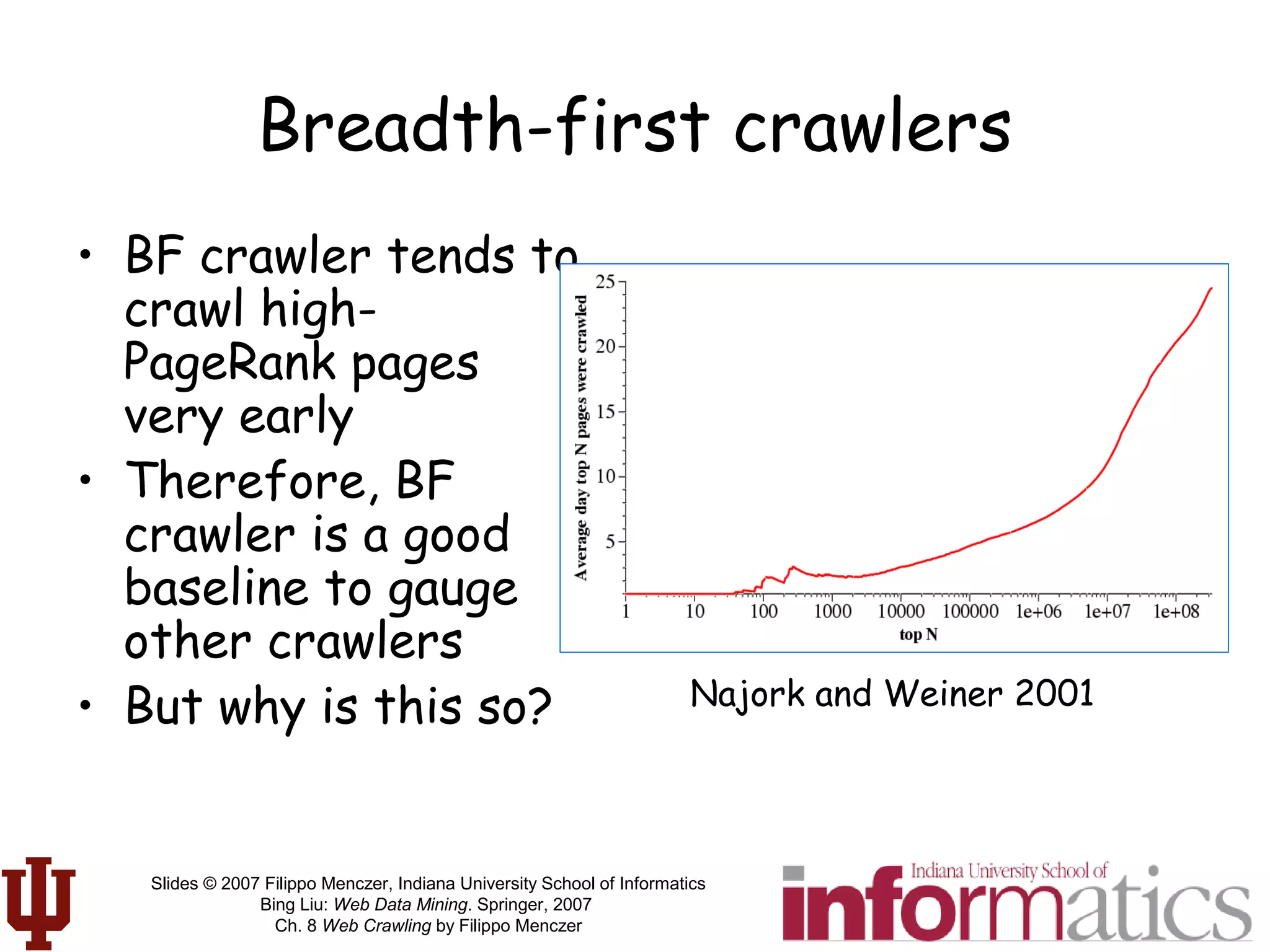
Breadth-first crawlers
• BF crawler tends to
crawl high-
PageRank pages
very early
• Therefore, BF
crawler is a good
baseline to gauge
other crawlers
• But why is this so? Najork and Weiner 2001
Slides © 2007 Filippo Menczer, Indiana University School of Informatics
Bing Liu: Web Data Mining. Springer, 2007
Ch. 8 Web Crawling by Filippo Menczer
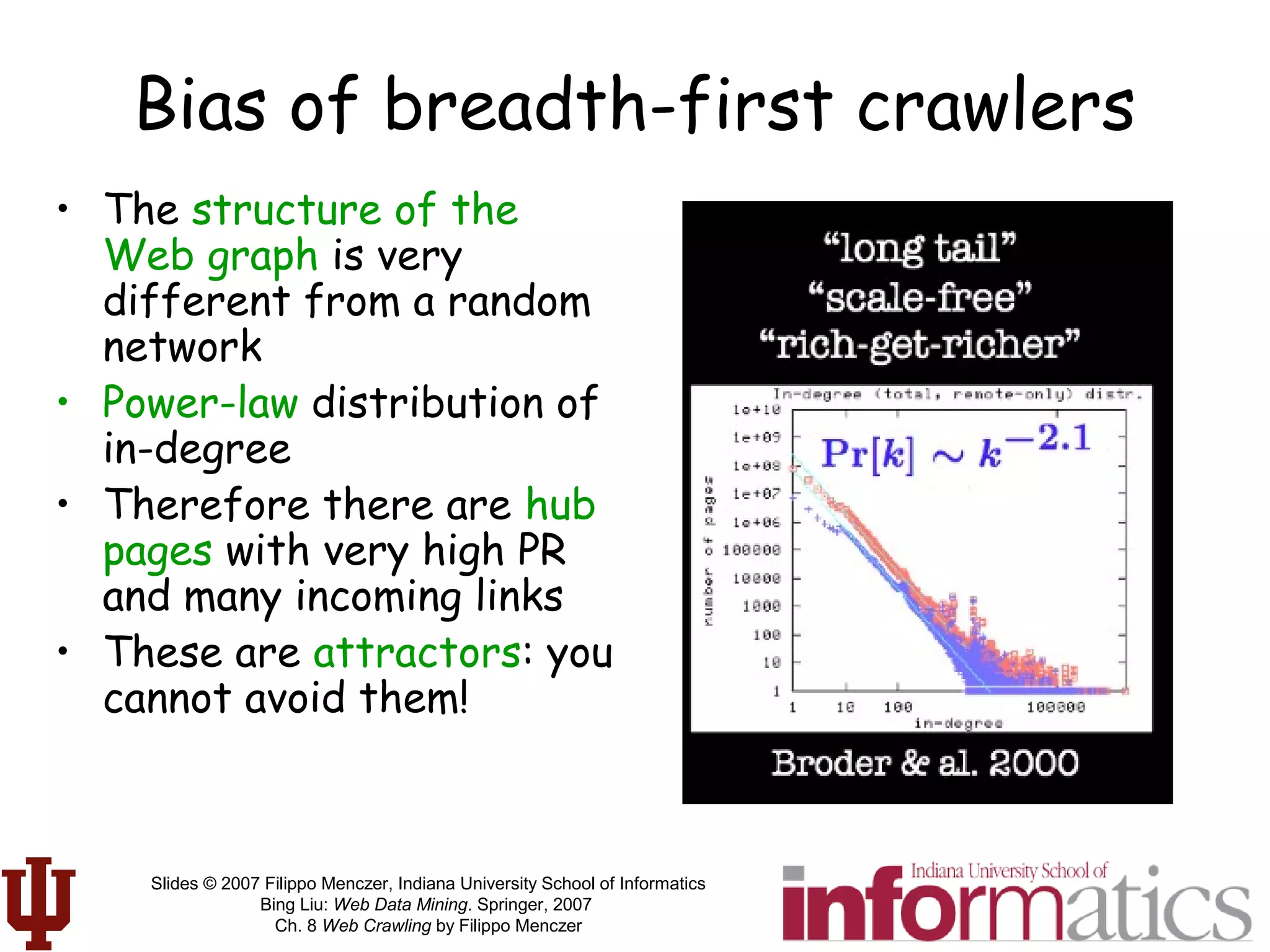
Bias of breadth-first crawlers
• The structure of the
Web graph is very
different from a random
network
• Power-law distribution of
in-degree
• Therefore there are hub
pages with very high PR
and many incoming links
• These are attractors: you
cannot avoid them!
Slides © 2007 Filippo Menczer, Indiana University School of Informatics
Bing Liu: Web Data Mining. Springer, 2007
Ch. 8 Web Crawling by Filippo Menczer
Outline
• Motivation and taxonomy of crawlers
• Basic crawlers and implementation issues
• Universal crawlers
• Preferential (focused and topical) crawlers
• Evaluation of preferential crawlers
• Crawler ethics and conflicts
• New developments: social, collaborative, federated
crawlers
Slides © 2007 Filippo Menczer, Indiana University School of Informatics
Bing Liu: Web Data Mining. Springer, 2007
Ch. 8 Web Crawling by Filippo Menczer
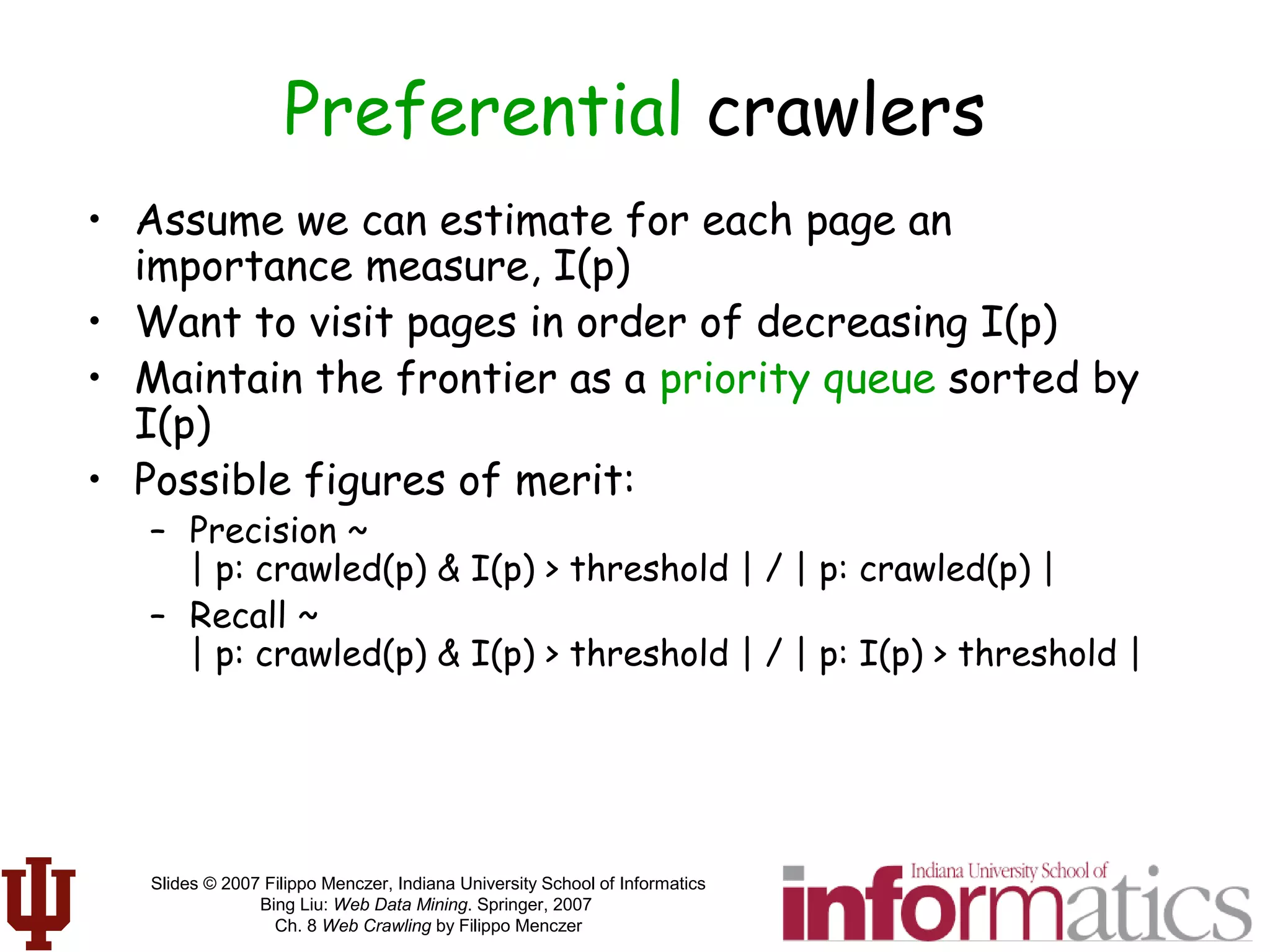
Preferential crawlers
• Assume we can estimate for each page an
importance measure, I(p)
• Want to visit pages in order of decreasing I(p)
• Maintain the frontier as a priority queue sorted by
I(p)
• Possible figures of merit:
– Precision ~
| p: crawled(p) & I(p) > threshold | / | p: crawled(p) |
– Recall ~
| p: crawled(p) & I(p) > threshold | / | p: I(p) > threshold |
Slides © 2007 Filippo Menczer, Indiana University School of Informatics
Bing Liu: Web Data Mining. Springer, 2007
Ch. 8 Web Crawling by Filippo Menczer
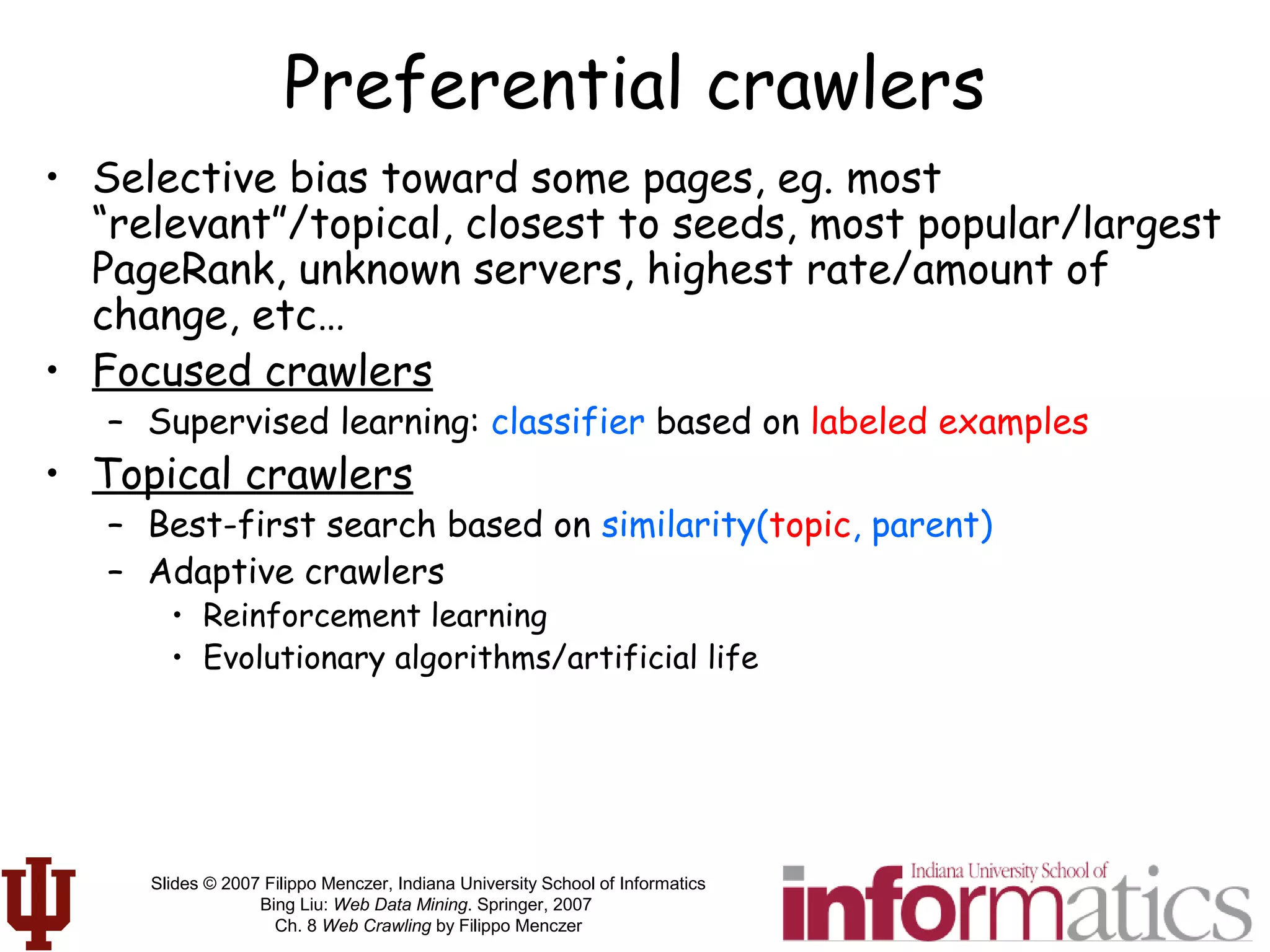
Preferential crawlers
• Selective bias toward some pages, eg. most
“relevant”/topical, closest to seeds, most popular/largest
PageRank, unknown servers, highest rate/amount of
change, etc…
• Focused crawlers
– Supervised learning: classifier based on labeled examples
• Topical crawlers
– Best-first search based on similarity(topic, parent)
– Adaptive crawlers
• Reinforcement learning
• Evolutionary algorithms/artificial life
Slides © 2007 Filippo Menczer, Indiana University School of Informatics
Bing Liu: Web Data Mining. Springer, 2007
Ch. 8 Web Crawling by Filippo Menczer
Preferential crawling algorithms:
Examples
• Breadth-First
– Exhaustively visit all links in order encountered
• Best-N-First
– Priority queue sorted by similarity, explore top N at a time
– Variants: DOM context, hub scores
• PageRank
– Priority queue sorted by keywords, PageRank
• SharkSearch
– Priority queue sorted by combination of similarity, anchor text, similarity of
parent, etc. (powerful cousin of FishSearch)
• InfoSpiders
– Adaptive distributed algorithm using an evolving population of learning
agents
Slides © 2007 Filippo Menczer, Indiana University School of Informatics
Bing Liu: Web Data Mining. Springer, 2007
Ch. 8 Web Crawling by Filippo Menczer
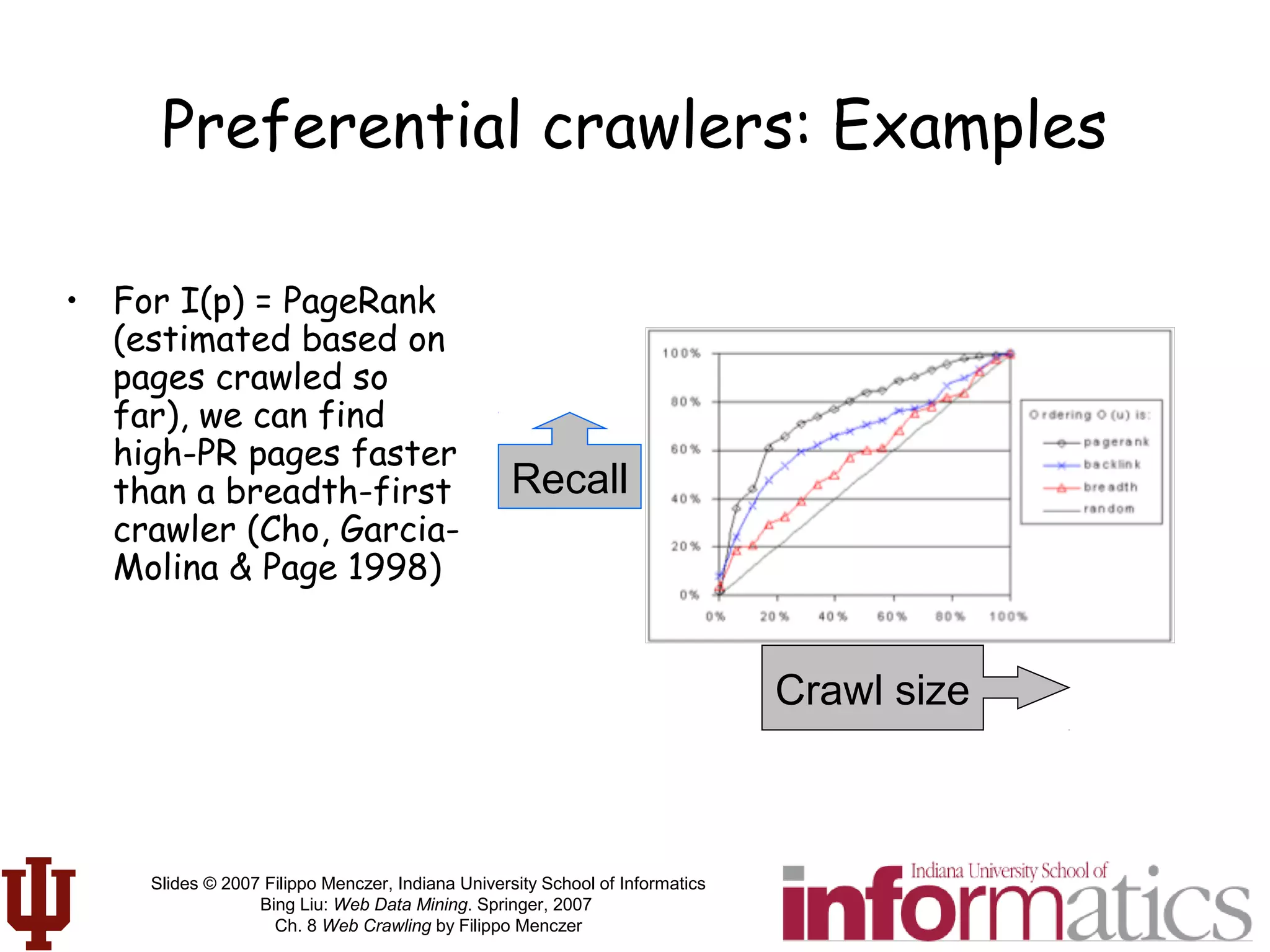
Preferential crawlers: Examples
Recall
Crawl size
• For I(p) = PageRank
(estimated based on
pages crawled so
far), we can find
high-PR pages faster
than a breadth-first
crawler (Cho, Garcia-
Molina & Page 1998)
Slides © 2007 Filippo Menczer, Indiana University School of Informatics
Bing Liu: Web Data Mining. Springer, 2007
Ch. 8 Web Crawling by Filippo Menczer
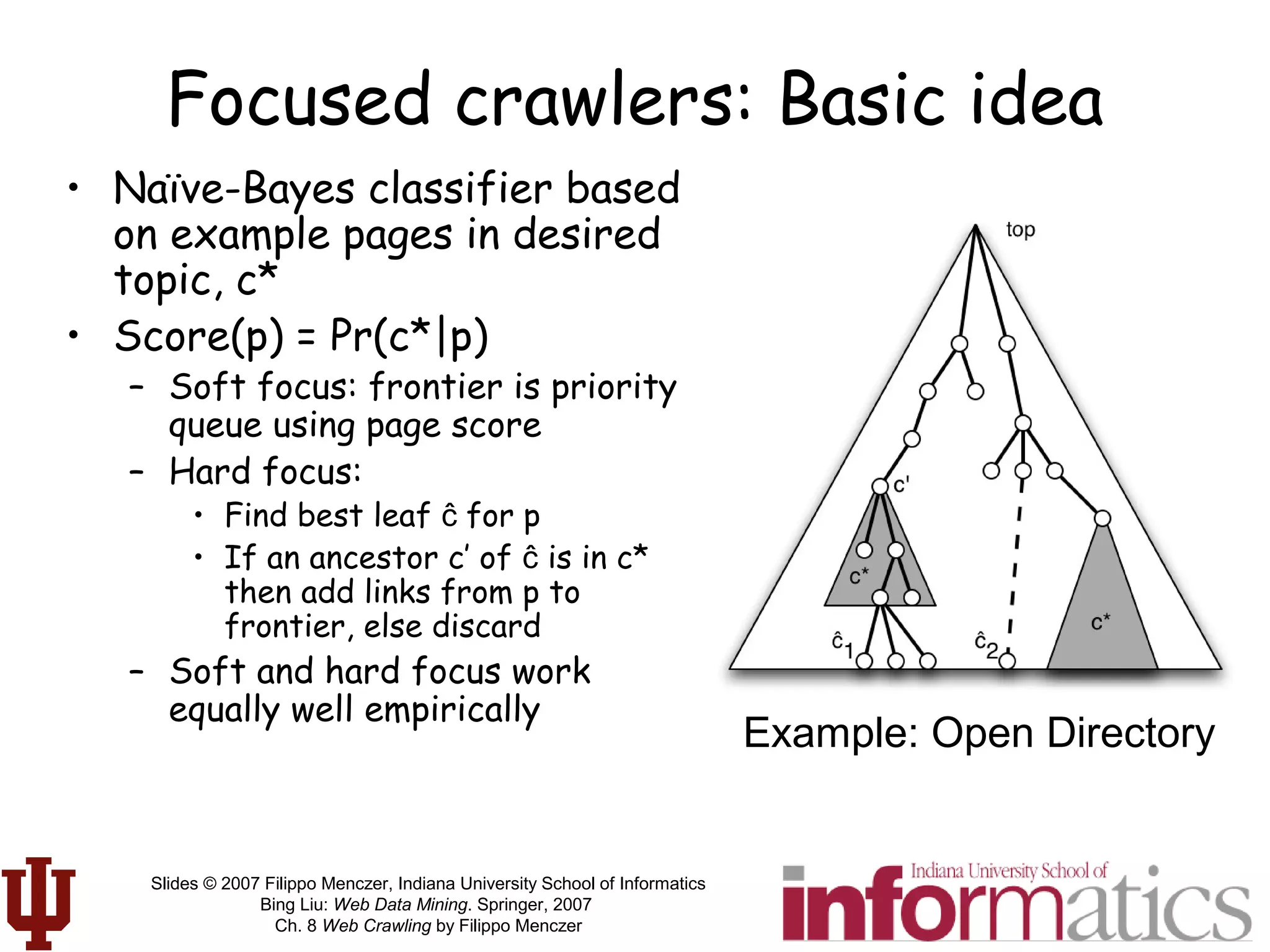
Focused crawlers: Basic idea
• Naïve-Bayes classifier based
on example pages in desired
topic, c*
• Score(p) = Pr(c*|p)
– Soft focus: frontier is priority
queue using page score
– Hard focus:
• Find best leaf ĉ for p
• If an ancestor c’ of ĉ is in c*
then add links from p to
frontier, else discard
– Soft and hard focus work
equally well empirically
Example: Open Directory
Slides © 2007 Filippo Menczer, Indiana University School of Informatics
Bing Liu: Web Data Mining. Springer, 2007
Ch. 8 Web Crawling by Filippo Menczer
Focused crawlers
• Can have multiple topics with as many classifiers,
with scores appropriately combined (Chakrabarti et
al. 1999)
• Can use a distiller to find topical hubs periodically,
and add these to the frontier
• Can accelerate with the use of a critic (Chakrabarti
et al. 2002)
• Can use alternative classifier algorithms to naïve-
Bayes, e.g. SVM and neural nets have reportedly
performed better (Pant & Srinivasan 2005)
Slides © 2007 Filippo Menczer, Indiana University School of Informatics
Bing Liu: Web Data Mining. Springer, 2007
Ch. 8 Web Crawling by Filippo Menczer
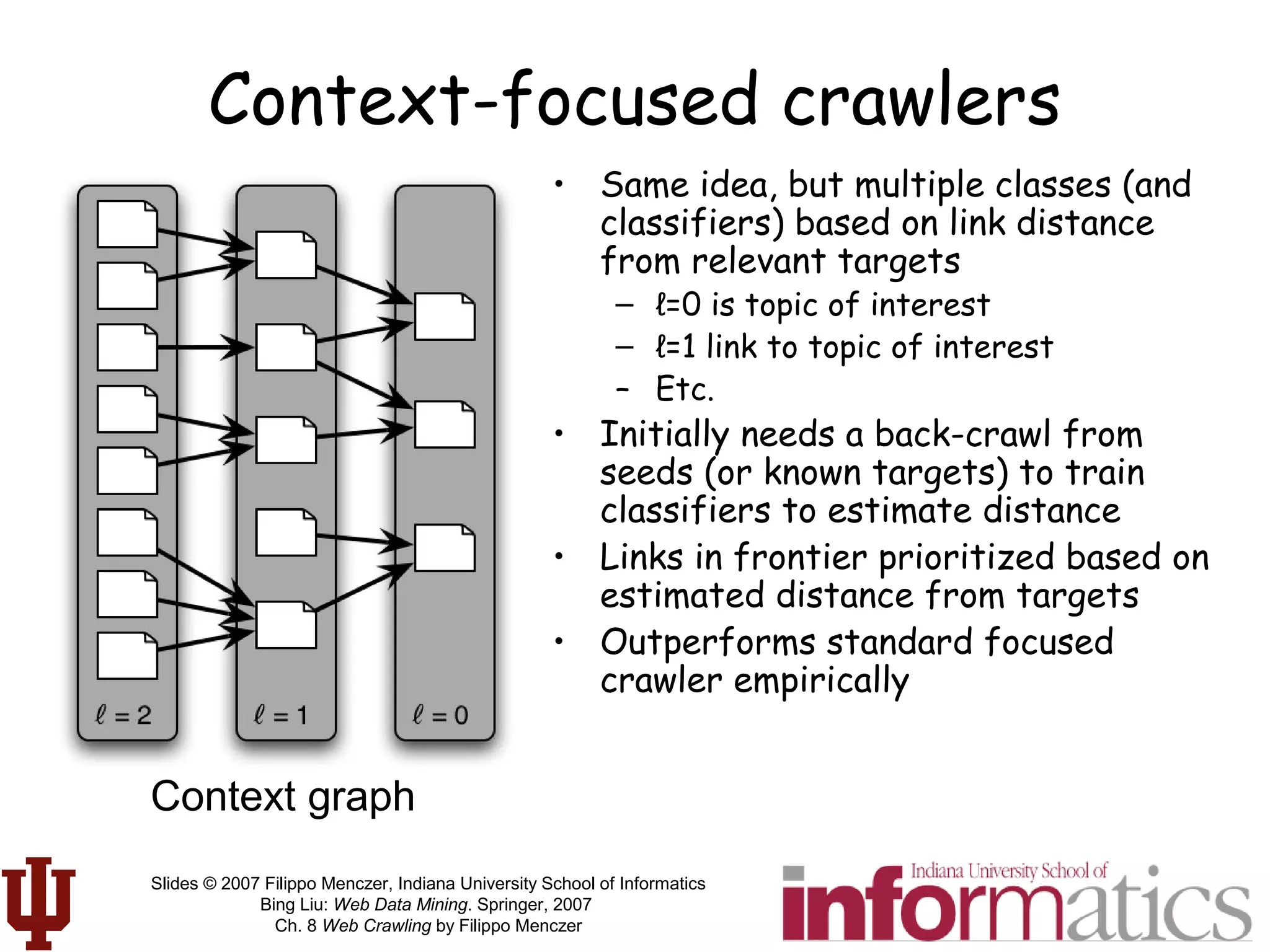
Context-focused crawlers
• Same idea, but multiple classes (and
classifiers) based on link distance
from relevant targets
– ℓ=0 is topic of interest
– ℓ=1 link to topic of interest
– Etc.
• Initially needs a back-crawl from
seeds (or known targets) to train
classifiers to estimate distance
• Links in frontier prioritized based on
estimated distance from targets
• Outperforms standard focused
crawler empirically
Context graph
Slides © 2007 Filippo Menczer, Indiana University School of Informatics
Bing Liu: Web Data Mining. Springer, 2007
Ch. 8 Web Crawling by Filippo Menczer
Topical crawlers
• All we have is a topic (query, description,
keywords) and a set of seed pages (not
necessarily relevant)
• No labeled examples
• Must predict relevance of unvisited links to
prioritize
• Original idea: Menczer 1997, Menczer &
Belew 1998
Slides © 2007 Filippo Menczer, Indiana University School of Informatics
Bing Liu: Web Data Mining. Springer, 2007
Ch. 8 Web Crawling by Filippo Menczer
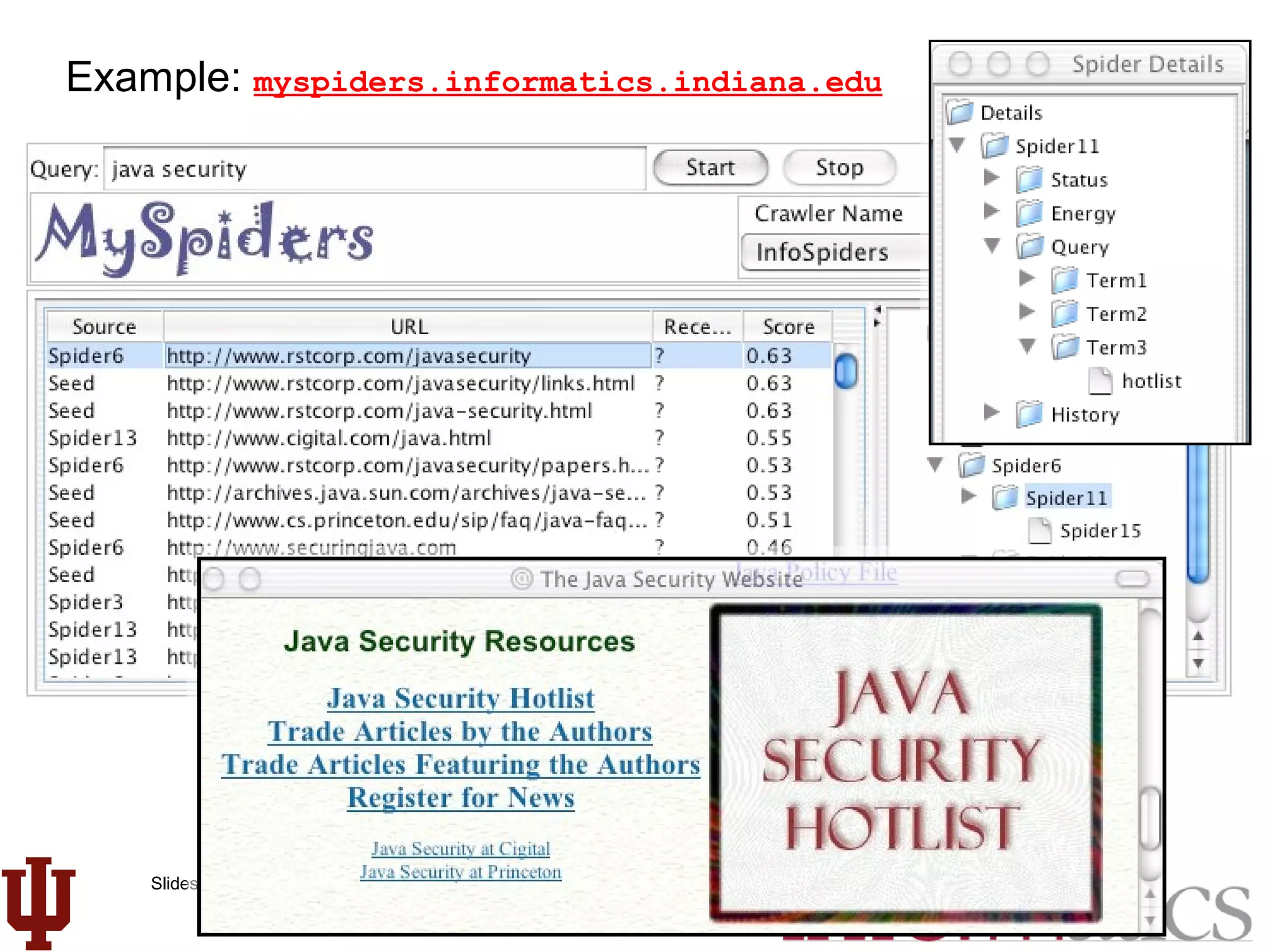
Example: myspiders.informatics.indiana.edu
Slides © 2007 Filippo Menczer, Indiana University School of Informatics
Bing Liu: Web Data Mining. Springer, 2007
Ch. 8 Web Crawling by Filippo Menczer
Topical locality
• Topical locality is a necessary condition for a topical
crawler to work, and for surfing to be a worthwhile
activity for humans
• Links must encode semantic information, i.e. say
something about neighbor pages, not be random
• It is also a sufficient condition if we start from “good”
seed pages
• Indeed we know that Web topical locality is strong :
– Indirectly (crawlers work and people surf the Web)
– From direct measurements (Davison 2000; Menczer 2004, 2005)
Slides © 2007 Filippo Menczer, Indiana University School of Informatics
Bing Liu: Web Data Mining. Springer, 2007
Ch. 8 Web Crawling by Filippo Menczer
Quantifying topical locality
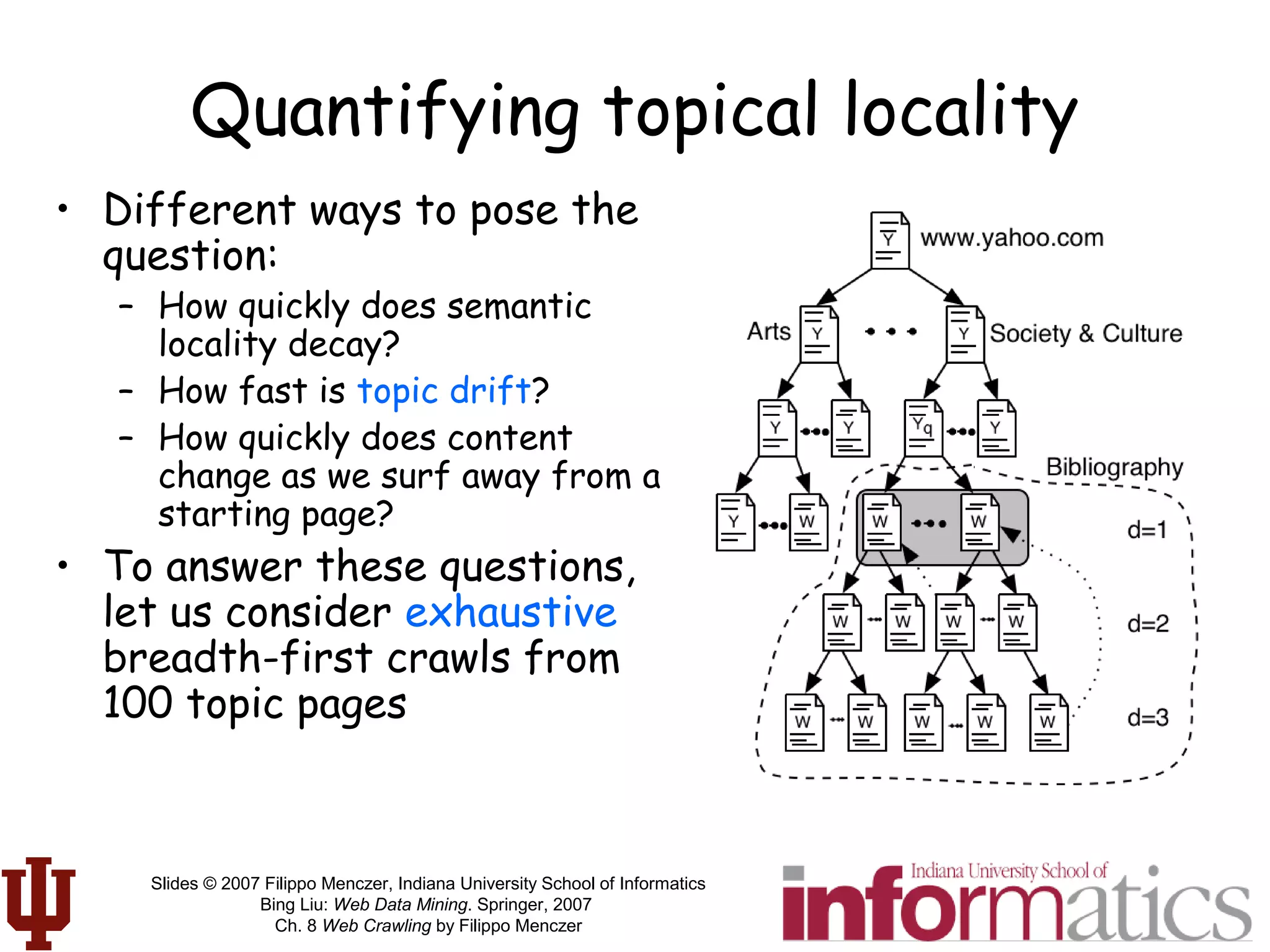
• Different ways to pose the
question:
– How quickly does semantic
locality decay?
– How fast is topic drift?
– How quickly does content
change as we surf away from a
starting page?
• To answer these questions,
let us consider exhaustive
breadth-first crawls from
100 topic pages
Slides © 2007 Filippo Menczer, Indiana University School of Informatics
Bing Liu: Web Data Mining. Springer, 2007
Ch. 8 Web Crawling by Filippo Menczer
G = 5/15
C = 2
R = 3/6
= 2/4
The “link-cluster” conjecture
• Connection between semantic topology (relevance) and
link topology (hypertext)
– G = Pr[rel(p)] ~ fraction of relevant/topical pages (topic generality)
– R = Pr[rel(p) | rel(q) AND link(q,p)] ~ cond. prob. Given neighbor on topic
• Related nodes are clustered if R > G
– Necessary and
sufficient
condition for a
random crawler
to find pages related
to start points
– Example:
2 topical clusters
with stronger
modularity within
each cluster than outside
Slides © 2007 Filippo Menczer, Indiana University School of Informatics
Bing Liu: Web Data Mining. Springer, 2007
Ch. 8 Web Crawling by Filippo Menczer
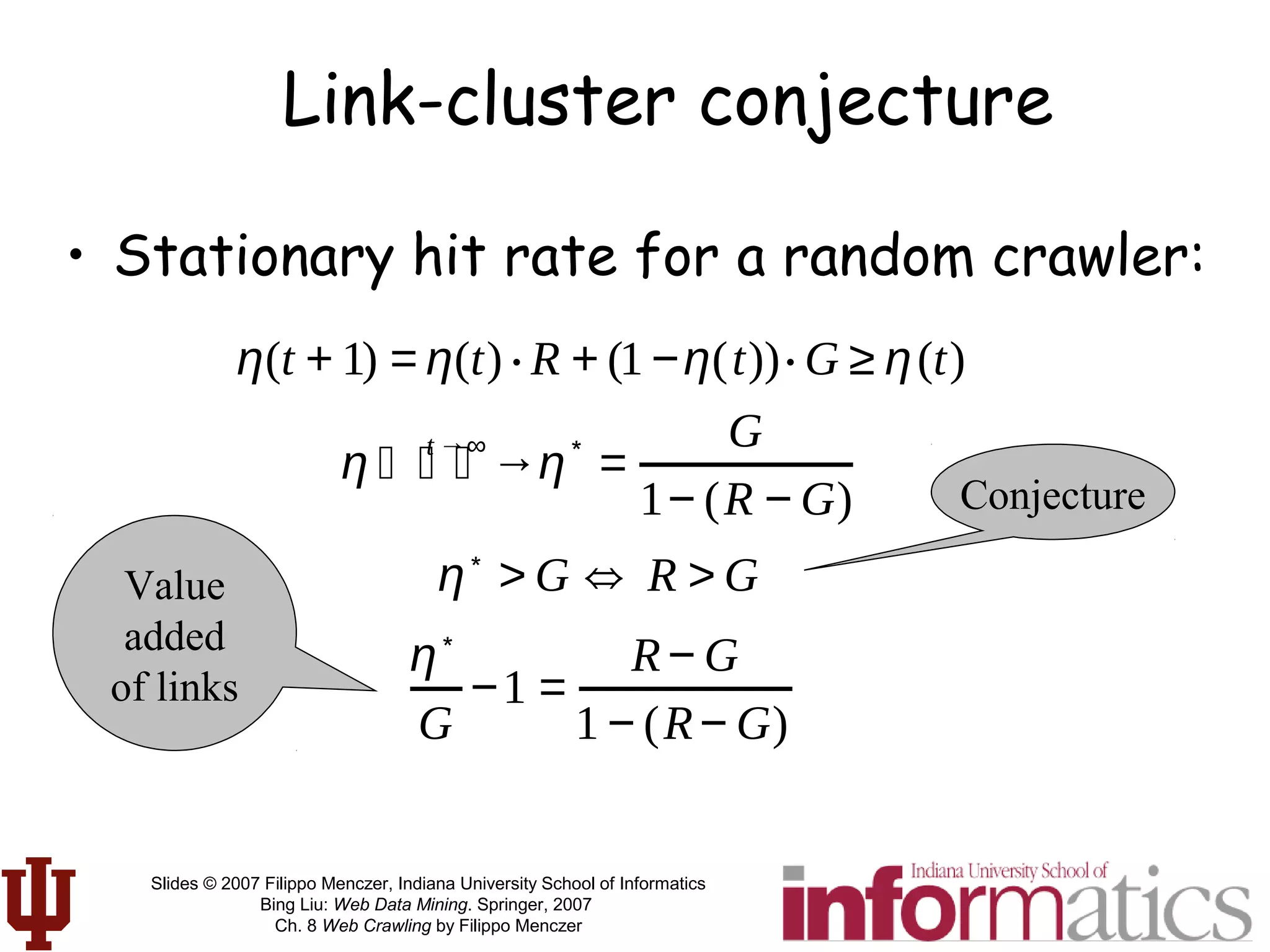
• Stationary hit rate for a random crawler:
Link-cluster conjecture
η(t + 1) = η(t) ⋅ R + (1 −η(t))⋅ G ≥ η(t)
η
t →∞
⏐ →⏐ ⏐ η
∗
=
G
1− (R − G)
η∗
> G ⇔ R > G
η∗
G
−1 =
R− G
1 − (R− G)
Value
added
of links
Conjecture
Slides © 2007 Filippo Menczer, Indiana University School of Informatics
Bing Liu: Web Data Mining. Springer, 2007
Ch. 8 Web Crawling by Filippo Menczer
• Preservation of
semantics (meaning)
across links
• 1000 times more
likely to be on topic
if near an on-topic
page!
Link-cluster
conjecture
R(q,δ)
G(q)
≡
Pr rel(p) | rel(q)∧ path(q, p) ≤δ[ ]
Pr[rel(p)]
L(q,δ) ≡
path(q, p)
{ p: path(q,p) ≤δ }
∑
{p : path(q, p) ≤δ}
Slides © 2007 Filippo Menczer, Indiana University School of Informatics
Bing Liu: Web Data Mining. Springer, 2007
Ch. 8 Web Crawling by Filippo Menczer
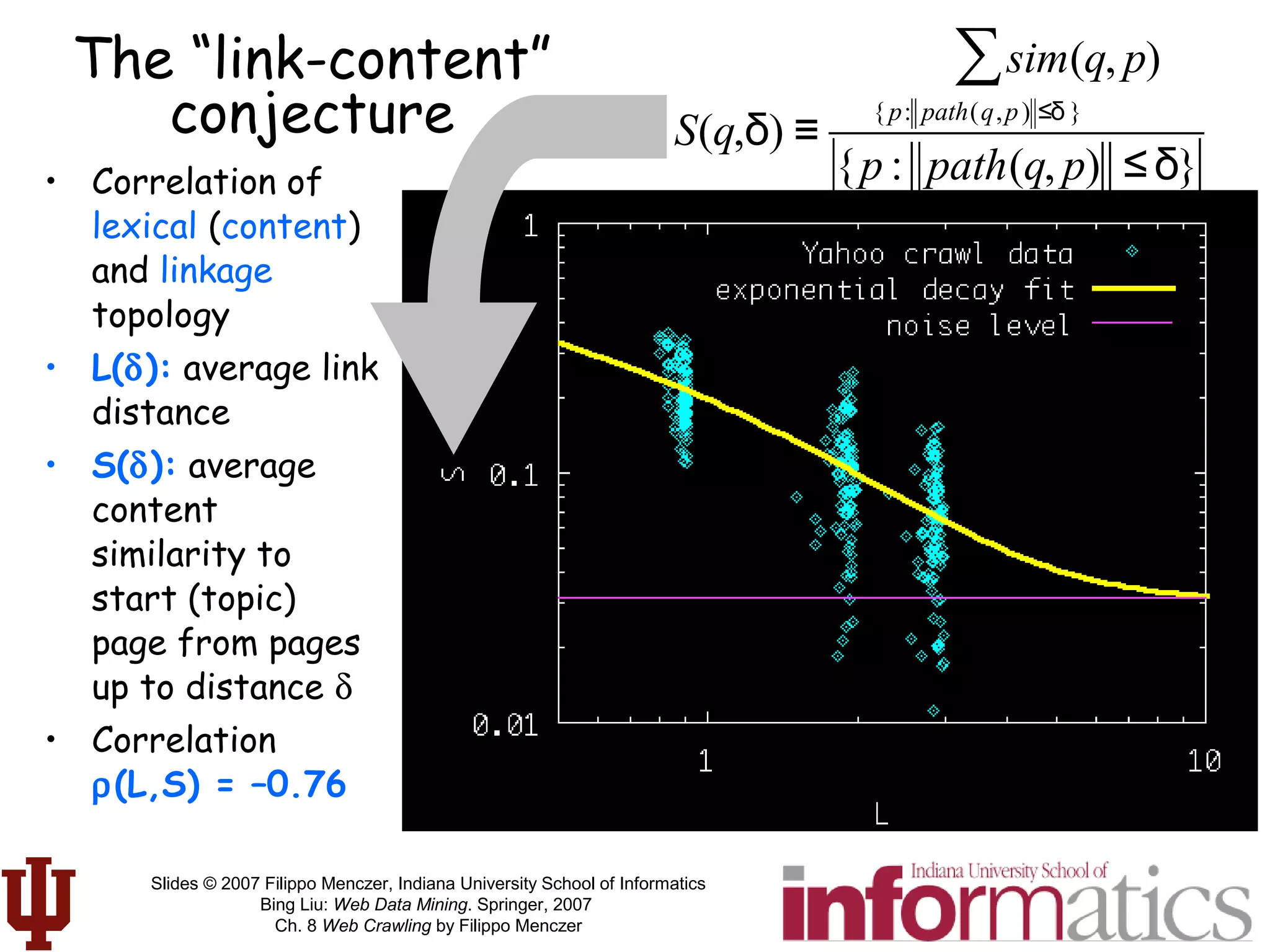
• Correlation of
lexical (content)
and linkage
topology
• L(δ): average link
distance
• S(δ): average
content
similarity to
start (topic)
page from pages
up to distance δ
• Correlation
ρ(L,S) = –0.76
The “link-content”
conjecture S(q,δ) ≡
sim(q, p)
{p: path(q,p) ≤δ }
∑
{p : path(q, p) ≤δ}
Slides © 2007 Filippo Menczer, Indiana University School of Informatics
Bing Liu: Web Data Mining. Springer, 2007
Ch. 8 Web Crawling by Filippo Menczer
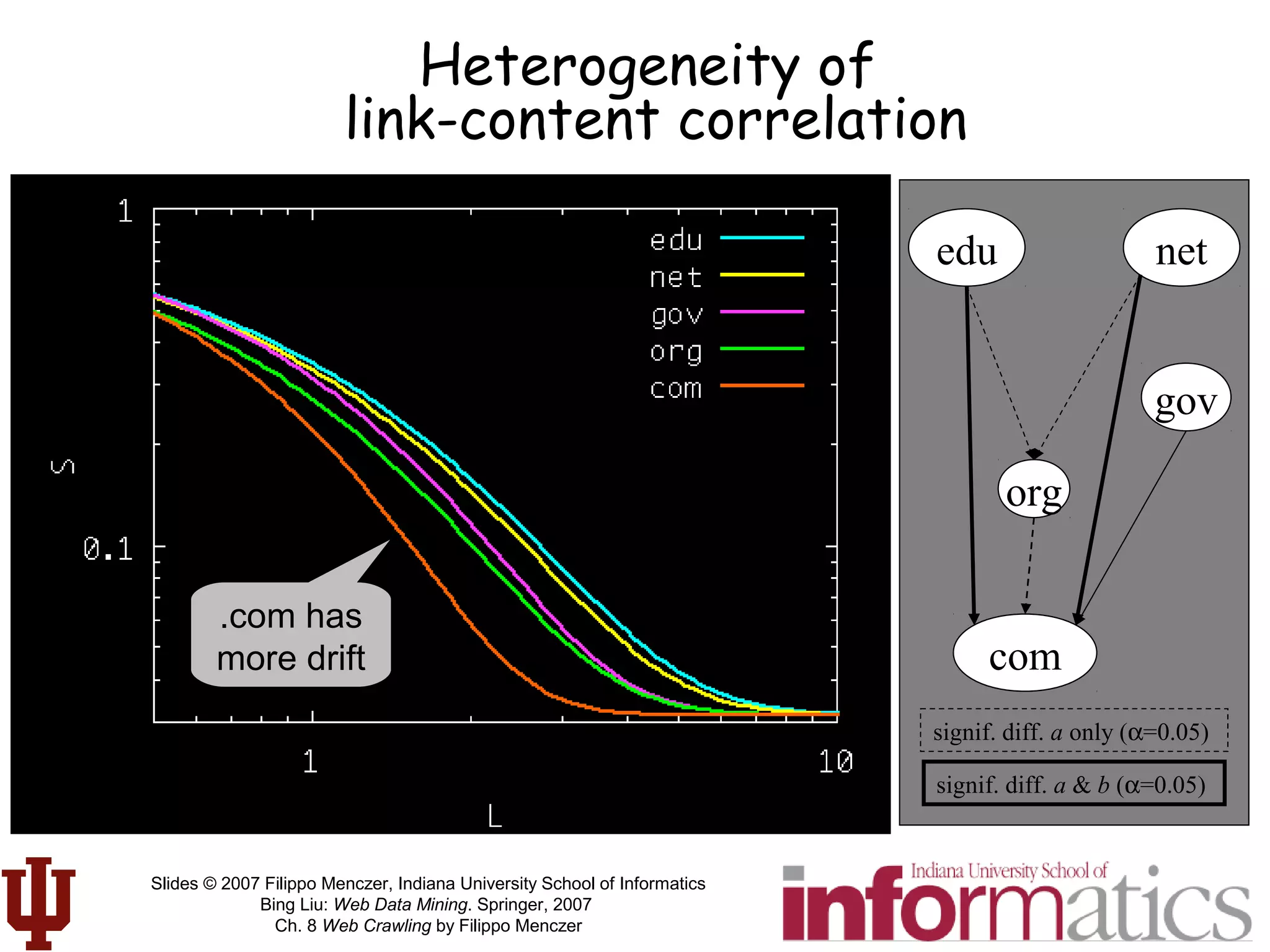
Heterogeneity of
link-content correlation
S = c + (1−c)eaLb edu net
gov
org
com
signif. diff. a only (α=0.05)
signif. diff. a & b (α=0.05)
.com has
more drift
Slides © 2007 Filippo Menczer, Indiana University School of Informatics
Bing Liu: Web Data Mining. Springer, 2007
Ch. 8 Web Crawling by Filippo Menczer
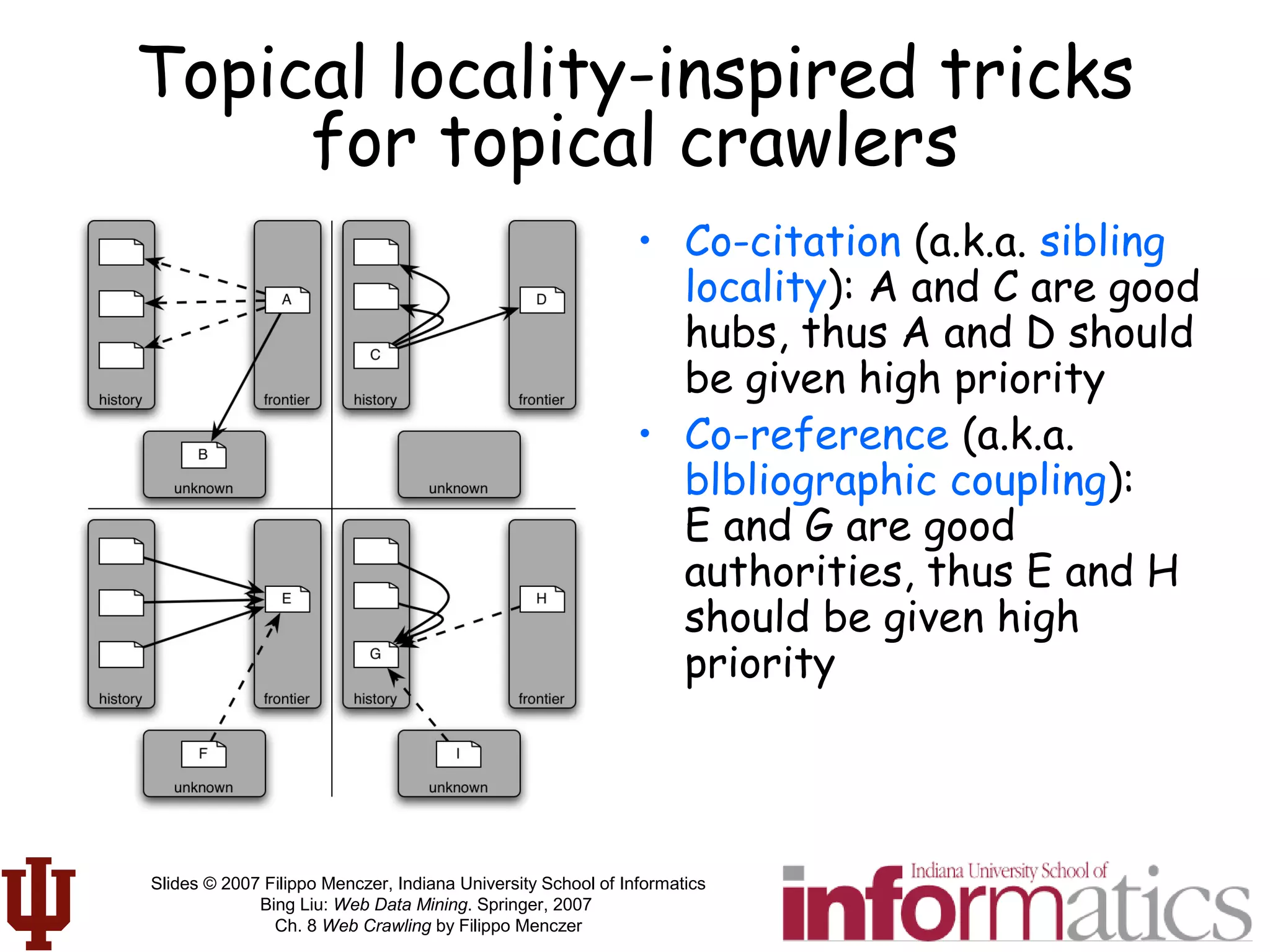
Topical locality-inspired tricks
for topical crawlers
• Co-citation (a.k.a. sibling
locality): A and C are good
hubs, thus A and D should
be given high priority
• Co-reference (a.k.a.
blbliographic coupling):
E and G are good
authorities, thus E and H
should be given high
priority
Slides © 2007 Filippo Menczer, Indiana University School of Informatics
Bing Liu: Web Data Mining. Springer, 2007
Ch. 8 Web Crawling by Filippo Menczer
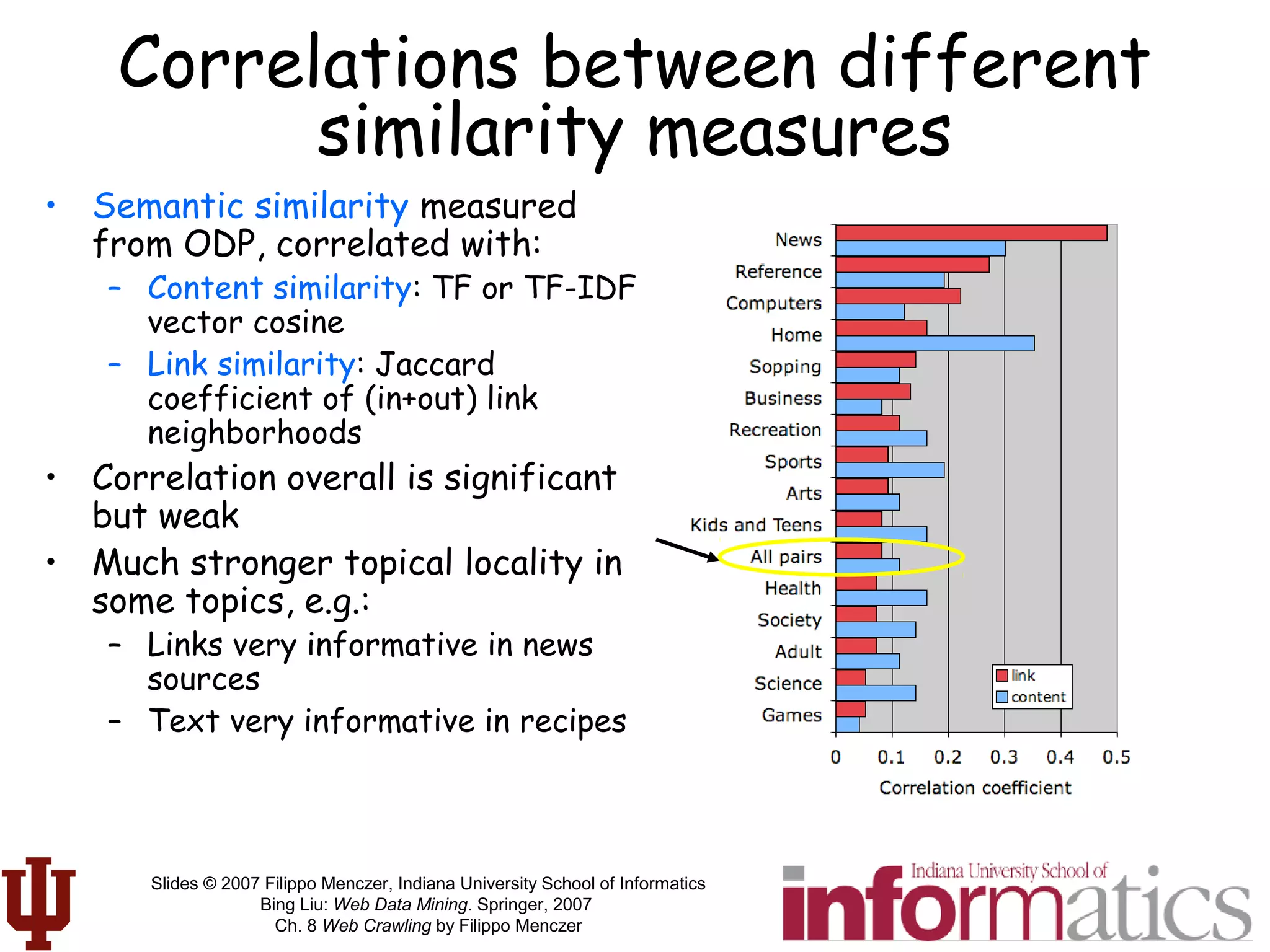
Correlations between different
similarity measures
• Semantic similarity measured
from ODP, correlated with:
– Content similarity: TF or TF-IDF
vector cosine
– Link similarity: Jaccard
coefficient of (in+out) link
neighborhoods
• Correlation overall is significant
but weak
• Much stronger topical locality in
some topics, e.g.:
– Links very informative in news
sources
– Text very informative in recipes
Slides © 2007 Filippo Menczer, Indiana University School of Informatics
Bing Liu: Web Data Mining. Springer, 2007
Ch. 8 Web Crawling by Filippo Menczer
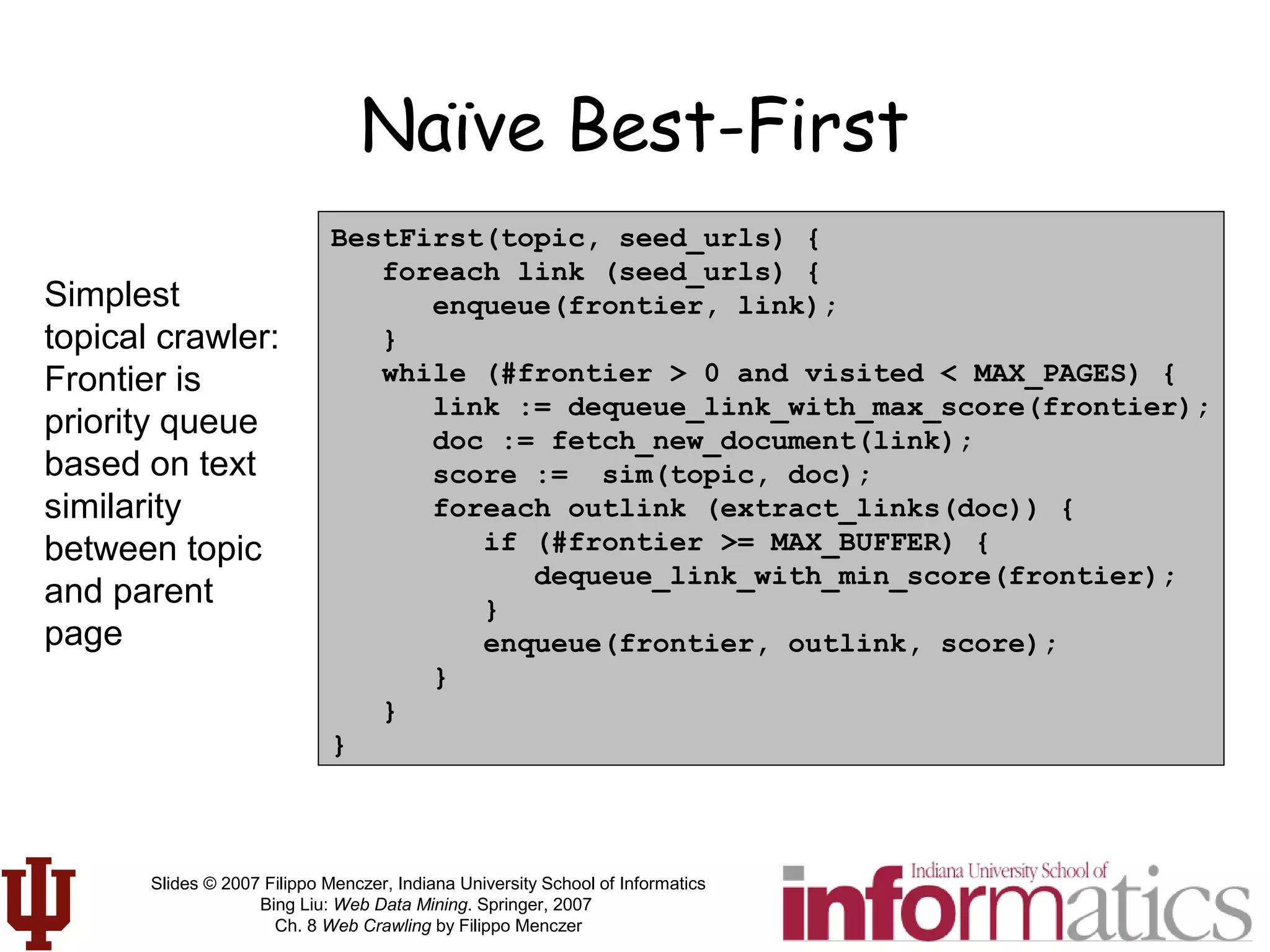
Naïve Best-First
BestFirst(topic, seed_urls) {
foreach link (seed_urls) {
enqueue(frontier, link);
}
while (#frontier > 0 and visited < MAX_PAGES) {
link := dequeue_link_with_max_score(frontier);
doc := fetch_new_document(link);
score := sim(topic, doc);
foreach outlink (extract_links(doc)) {
if (#frontier >= MAX_BUFFER) {
dequeue_link_with_min_score(frontier);
}
enqueue(frontier, outlink, score);
}
}
}
Simplest
topical crawler:
Frontier is
priority queue
based on text
similarity
between topic
and parent
page
Slides © 2007 Filippo Menczer, Indiana University School of Informatics
Bing Liu: Web Data Mining. Springer, 2007
Ch. 8 Web Crawling by Filippo Menczer
Best-first variations
• Many in literature, mostly stemming from
different ways to score unvisited URLs. E.g.:
– Giving more importance to certain HTML markup in
parent page
– Extending text representation of parent page with
anchor text from “grandparent” pages (SharkSearch)
– Limiting link context to less than entire page
– Exploiting topical locality (co-citation)
– Exploration vs exploitation: relax priorities
• Any of these can be (and many have been)
combined
Slides © 2007 Filippo Menczer, Indiana University School of Informatics
Bing Liu: Web Data Mining. Springer, 2007
Ch. 8 Web Crawling by Filippo Menczer
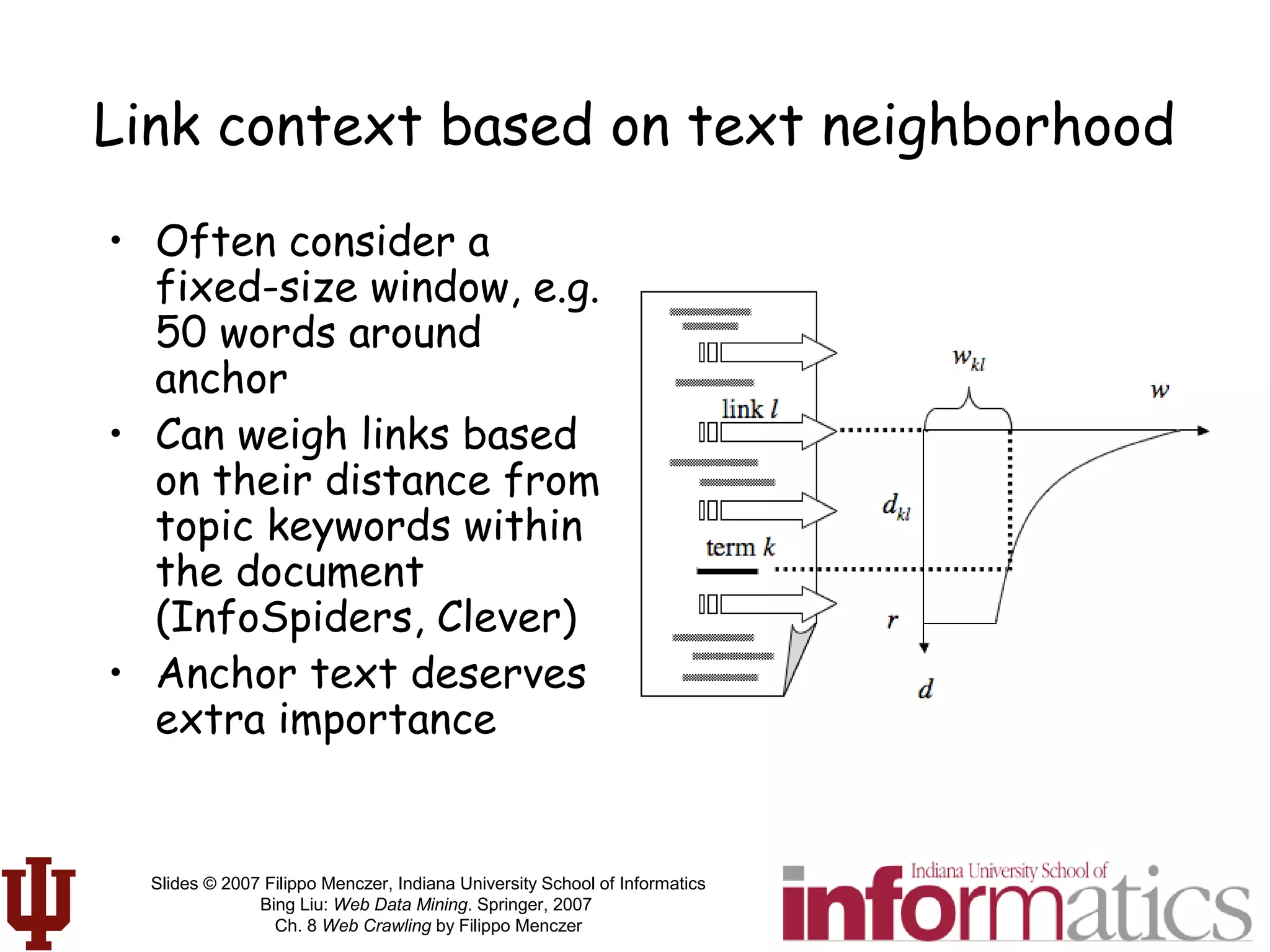
Link context based on text neighborhood
• Often consider a
fixed-size window, e.g.
50 words around
anchor
• Can weigh links based
on their distance from
topic keywords within
the document
(InfoSpiders, Clever)
• Anchor text deserves
extra importance
Slides © 2007 Filippo Menczer, Indiana University School of Informatics
Bing Liu: Web Data Mining. Springer, 2007
Ch. 8 Web Crawling by Filippo Menczer
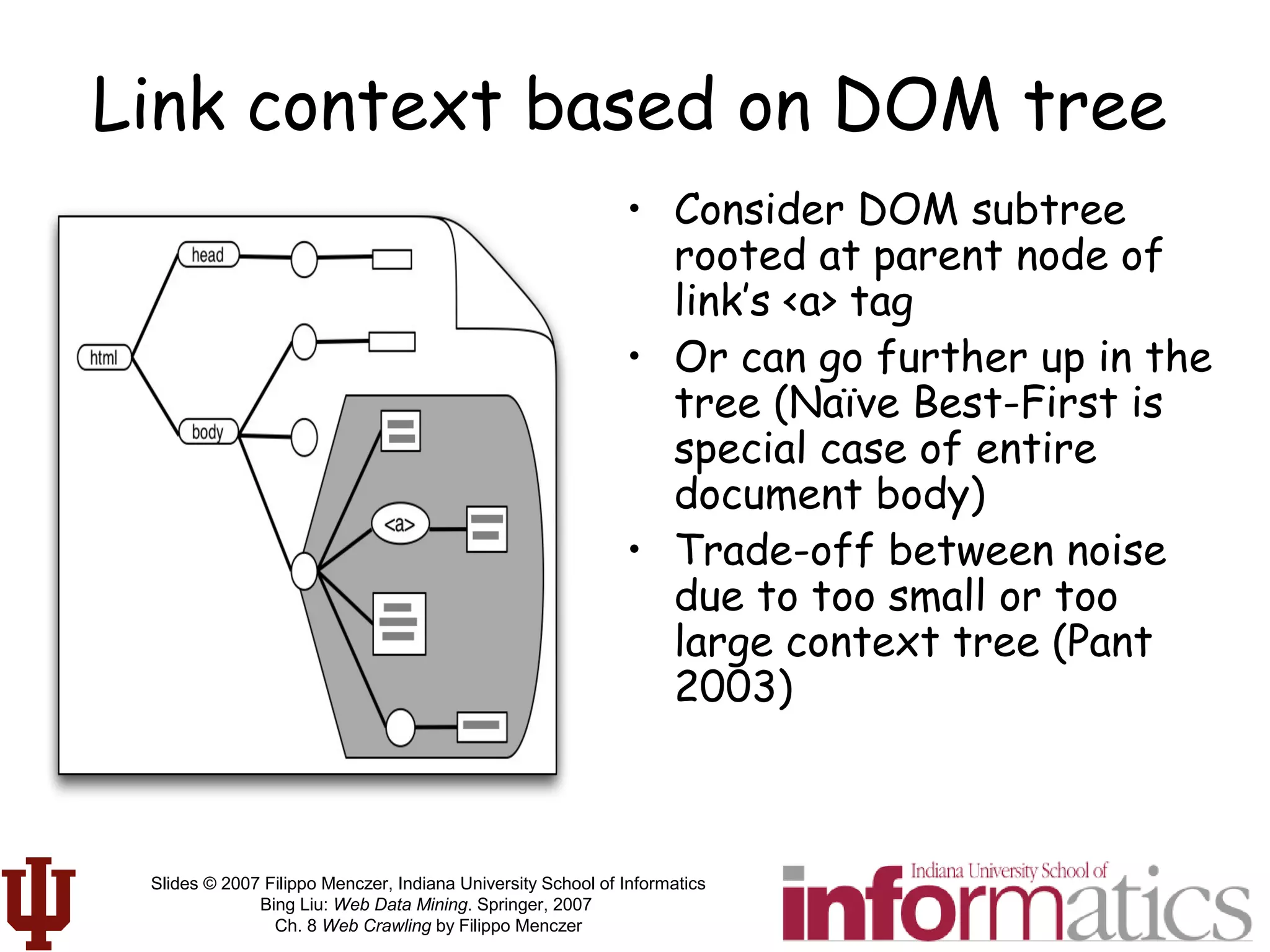
Link context based on DOM tree
• Consider DOM subtree
rooted at parent node of
link’s <a> tag
• Or can go further up in the
tree (Naïve Best-First is
special case of entire
document body)
• Trade-off between noise
due to too small or too
large context tree (Pant
2003)
Slides © 2007 Filippo Menczer, Indiana University School of Informatics
Bing Liu: Web Data Mining. Springer, 2007
Ch. 8 Web Crawling by Filippo Menczer
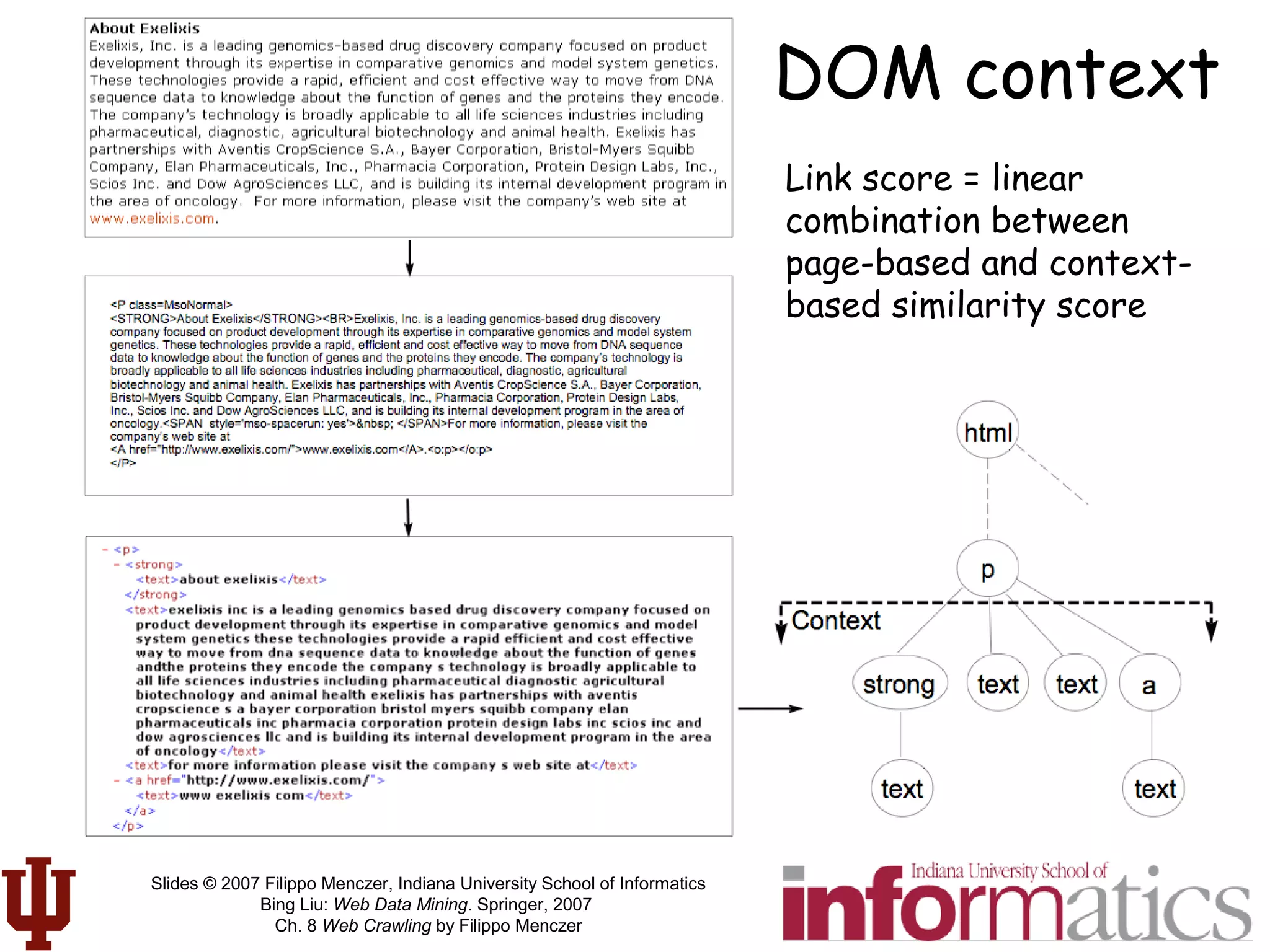
DOM context
Link score = linear
combination between
page-based and context-
based similarity score
Slides © 2007 Filippo Menczer, Indiana University School of Informatics
Bing Liu: Web Data Mining. Springer, 2007
Ch. 8 Web Crawling by Filippo Menczer
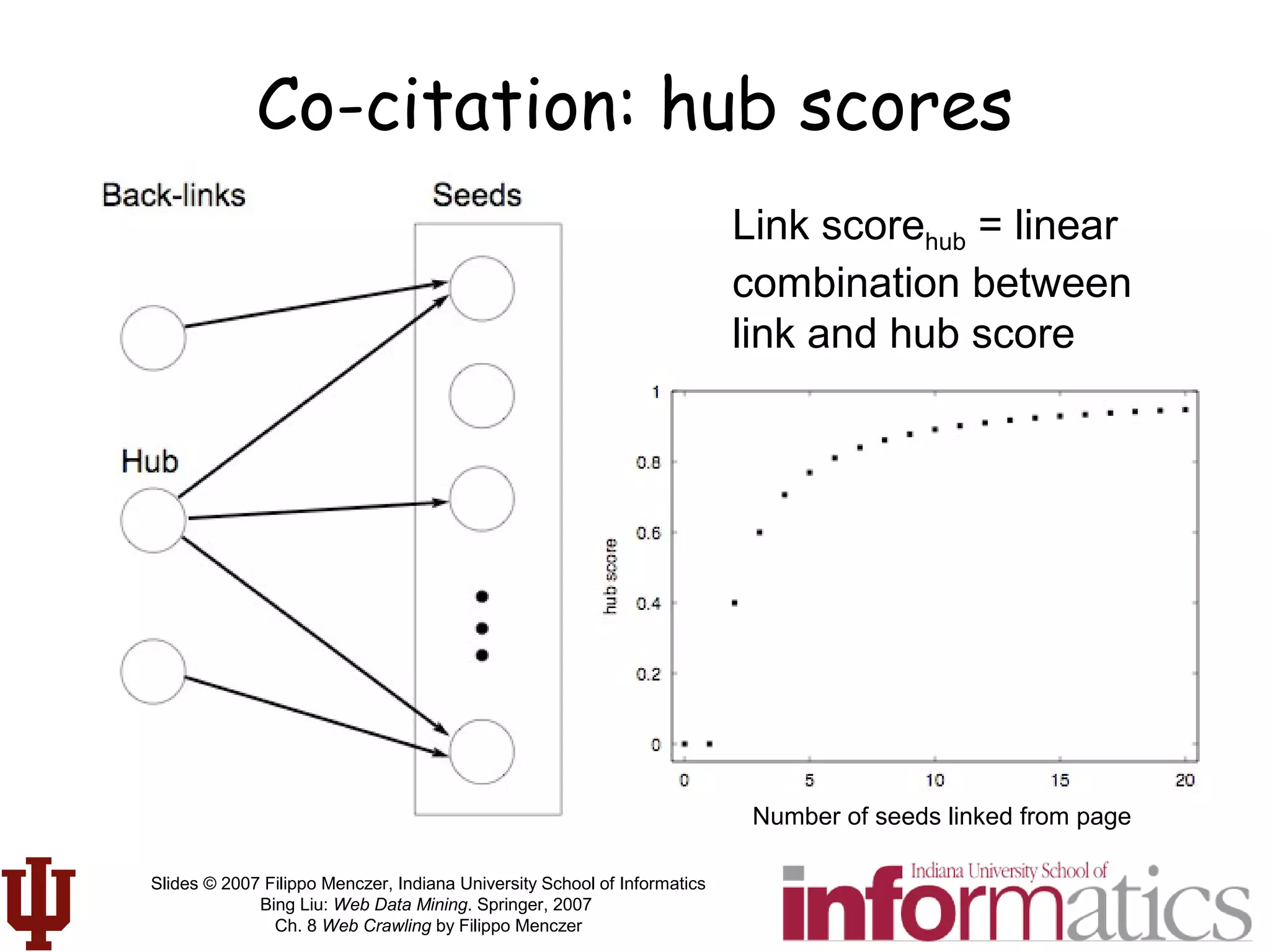
Co-citation: hub scores
Link scorehub = linear
combination between
link and hub score
Number of seeds linked from page
Slides © 2007 Filippo Menczer, Indiana University School of Informatics
Bing Liu: Web Data Mining. Springer, 2007
Ch. 8 Web Crawling by Filippo Menczer
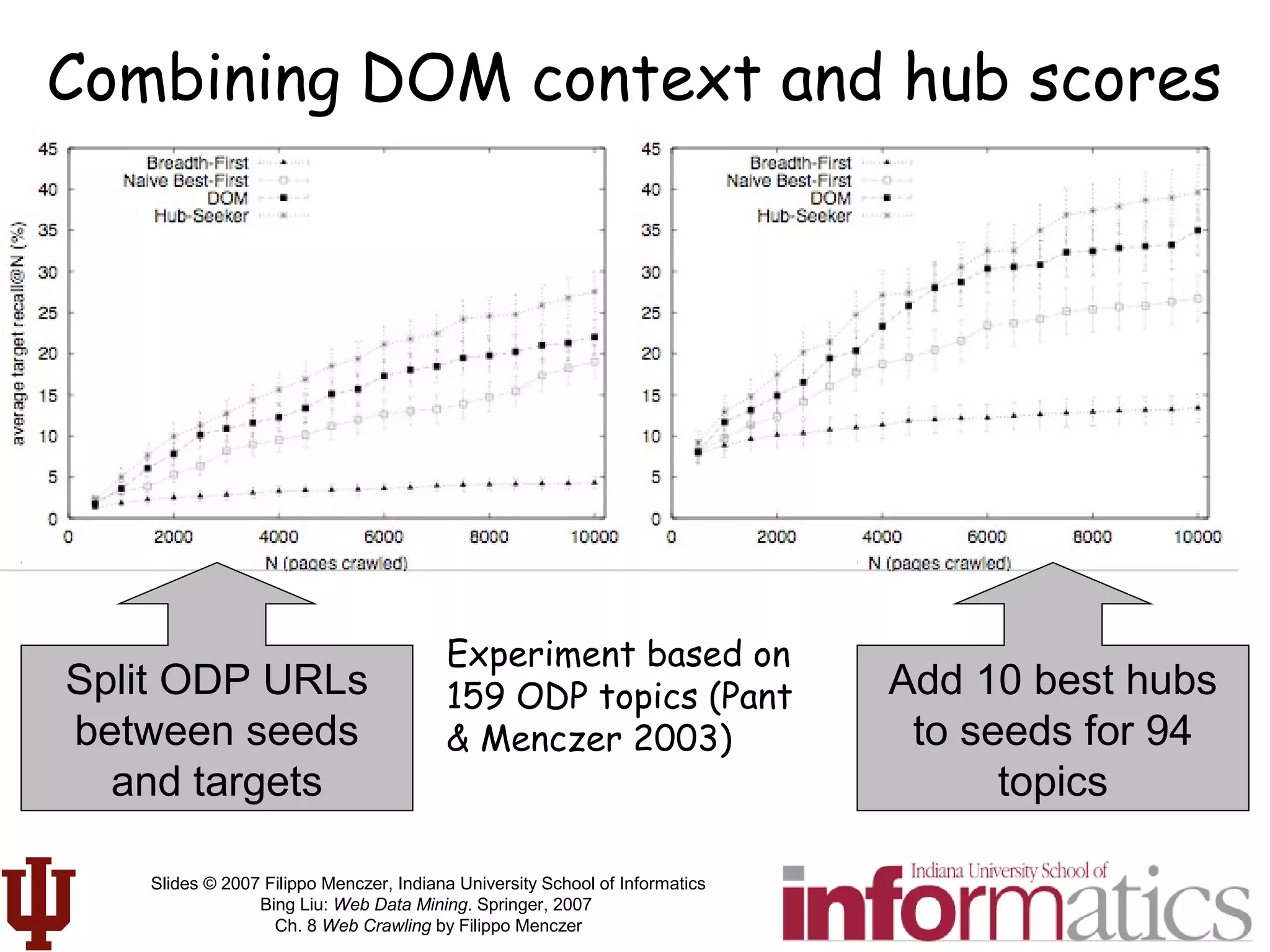
Combining DOM context and hub scores
Add 10 best hubs
to seeds for 94
topics
Experiment based on
159 ODP topics (Pant
& Menczer 2003)
Split ODP URLs
between seeds
and targets
Slides © 2007 Filippo Menczer, Indiana University School of Informatics
Bing Liu: Web Data Mining. Springer, 2007
Ch. 8 Web Crawling by Filippo Menczer
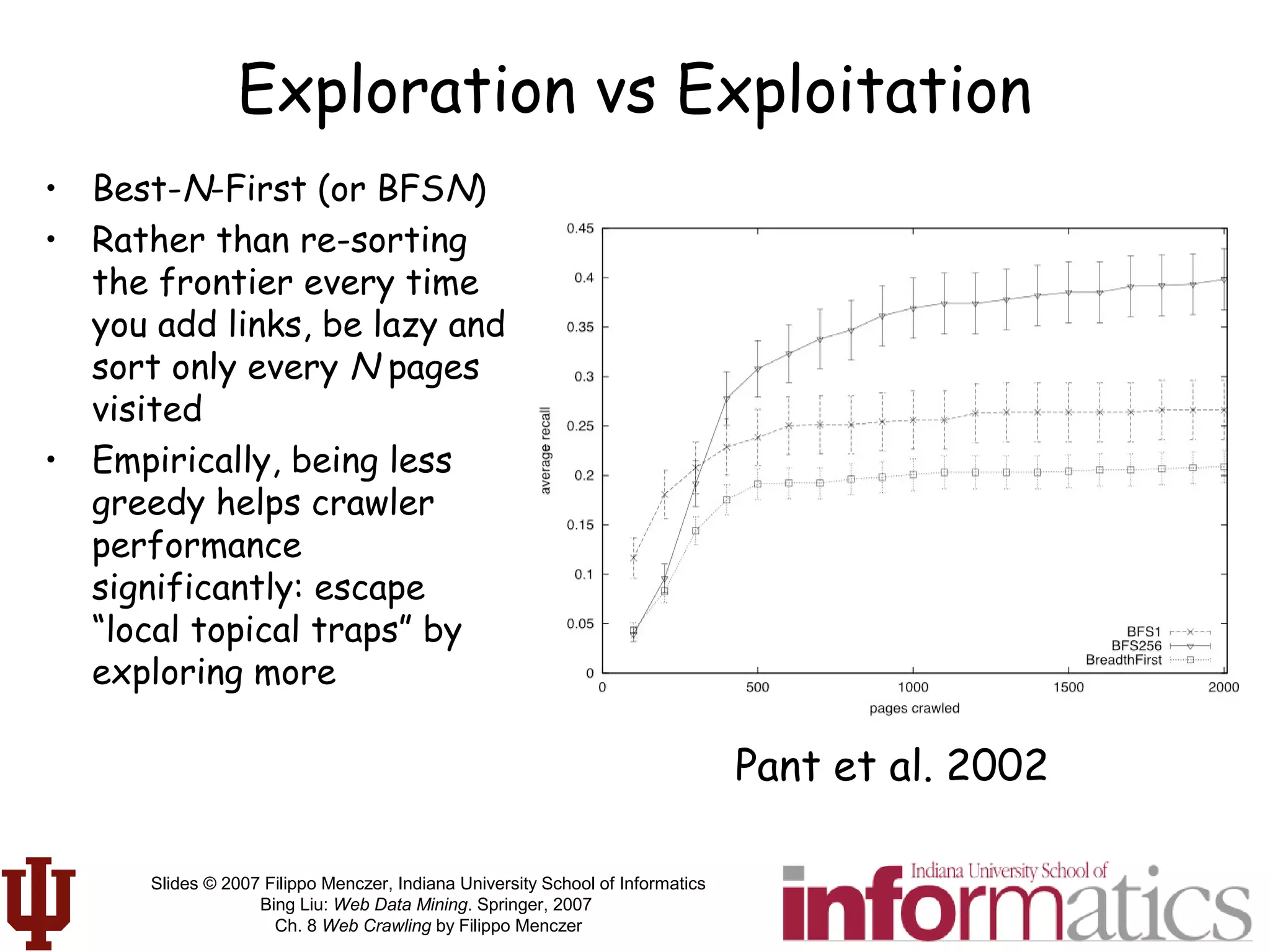
Exploration vs Exploitation
• Best-N-First (or BFSN)
• Rather than re-sorting
the frontier every time
you add links, be lazy and
sort only every N pages
visited
• Empirically, being less
greedy helps crawler
performance
significantly: escape
“local topical traps” by
exploring more
Pant et al. 2002
Slides © 2007 Filippo Menczer, Indiana University School of Informatics
Bing Liu: Web Data Mining. Springer, 2007
Ch. 8 Web Crawling by Filippo Menczer
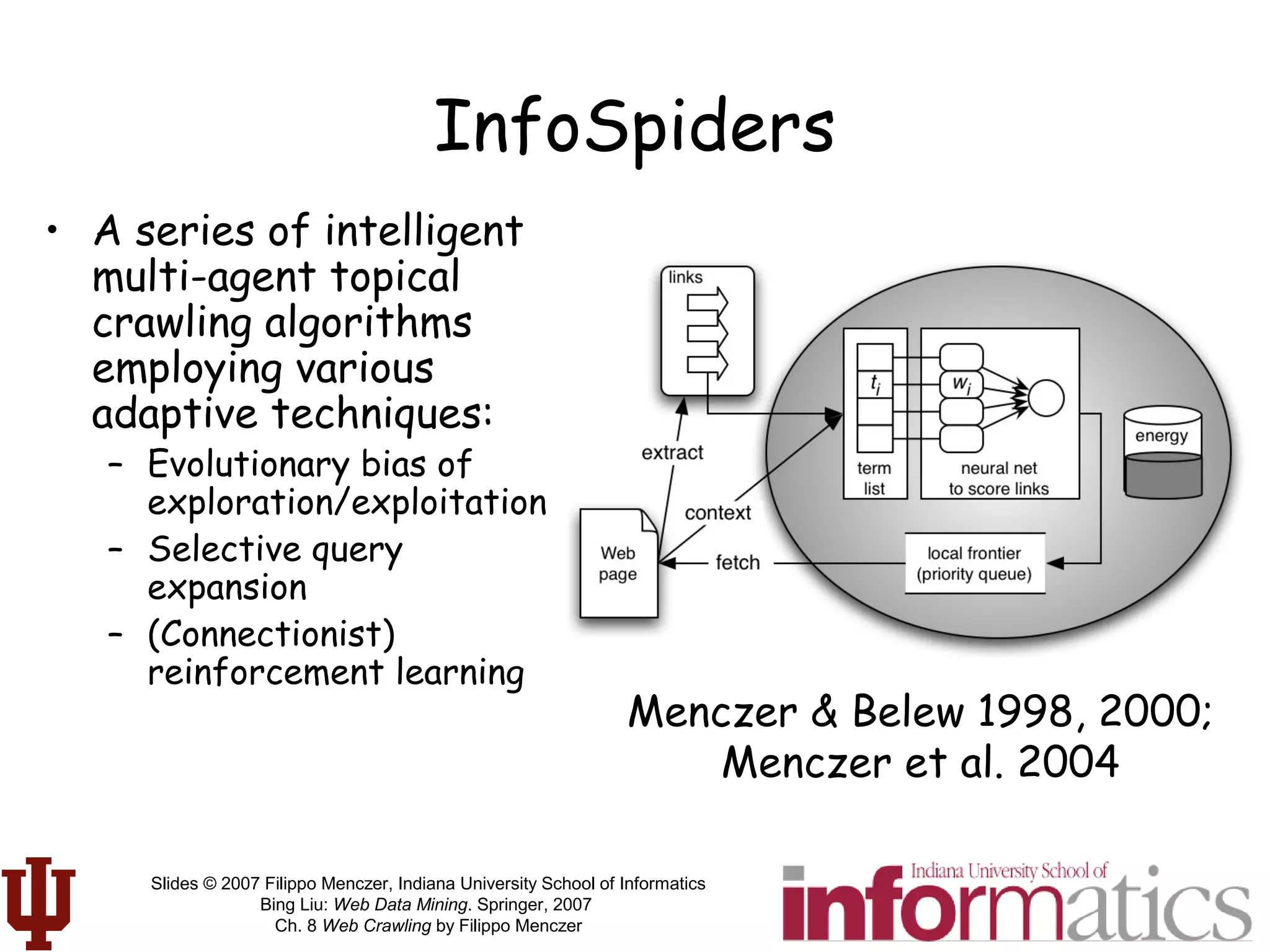
InfoSpiders
• A series of intelligent
multi-agent topical
crawling algorithms
employing various
adaptive techniques:
– Evolutionary bias of
exploration/exploitation
– Selective query
expansion
– (Connectionist)
reinforcement learning
Menczer & Belew 1998, 2000;
Menczer et al. 2004
Slides © 2007 Filippo Menczer, Indiana University School of Informatics
Bing Liu: Web Data Mining. Springer, 2007
Ch. 8 Web Crawling by Filippo Menczer
Pr l[ ] =
εβλλ
εβλλ∋
λ∋
∑
λλ= ννετ ιν1,...,ινΝ( )
ινκ =
δ κ,ω( )
διστω,λ( )ω∈∆
∑
link l instances of ki
λl
k1
kn
ki
agent's neural net
sum of matches
with
inverse-distance
weighting
link l Instances
of ki
Agent’s neural net
Stochastic
selector
Link scoring and
selection by each
crawling agent
Slides © 2007 Filippo Menczer, Indiana University School of Informatics
Bing Liu: Web Data Mining. Springer, 2007
Ch. 8 Web Crawling by Filippo Menczer
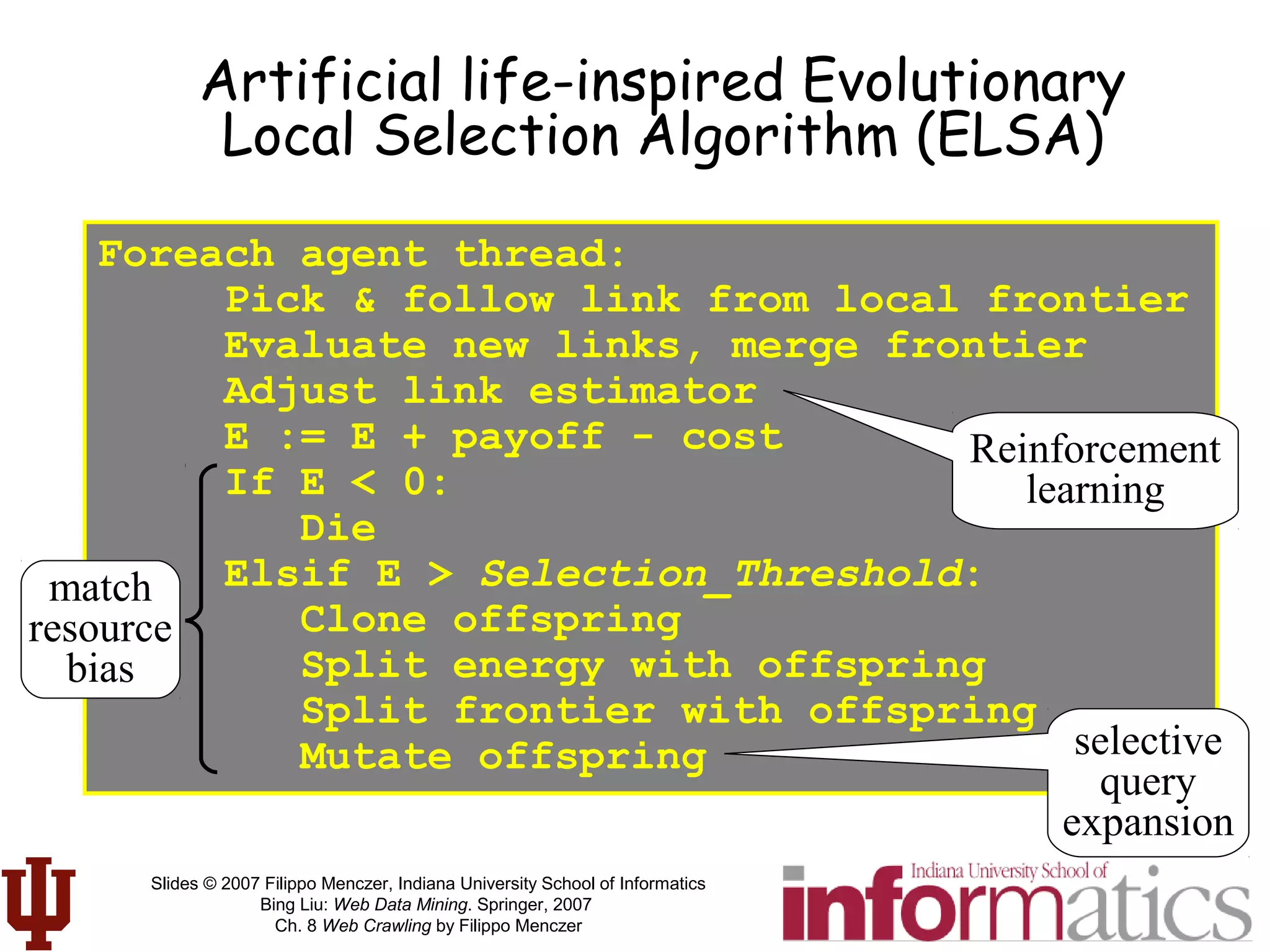
Foreach agent thread:
Pick & follow link from local frontier
Evaluate new links, merge frontier
Adjust link estimator
E := E + payoff - cost
If E < 0:
Die
Elsif E > Selection_Threshold:
Clone offspring
Split energy with offspring
Split frontier with offspring
Mutate offspring
Artificial life-inspired Evolutionary
Local Selection Algorithm (ELSA)
selective
query
expansion
match
resource
bias
Reinforcement
learning
Slides © 2007 Filippo Menczer, Indiana University School of Informatics
Bing Liu: Web Data Mining. Springer, 2007
Ch. 8 Web Crawling by Filippo Menczer
Adaptation in InfoSpiders
• Unsupervised population evolution
– Select agents to match resource bias
– Mutate internal queries: selective query
expansion
– Mutate weights
• Unsupervised individual adaptation
– Q-learning: adjust neural net weights to
predict relevance locally
Slides © 2007 Filippo Menczer, Indiana University School of Informatics
Bing Liu: Web Data Mining. Springer, 2007
Ch. 8 Web Crawling by Filippo Menczer
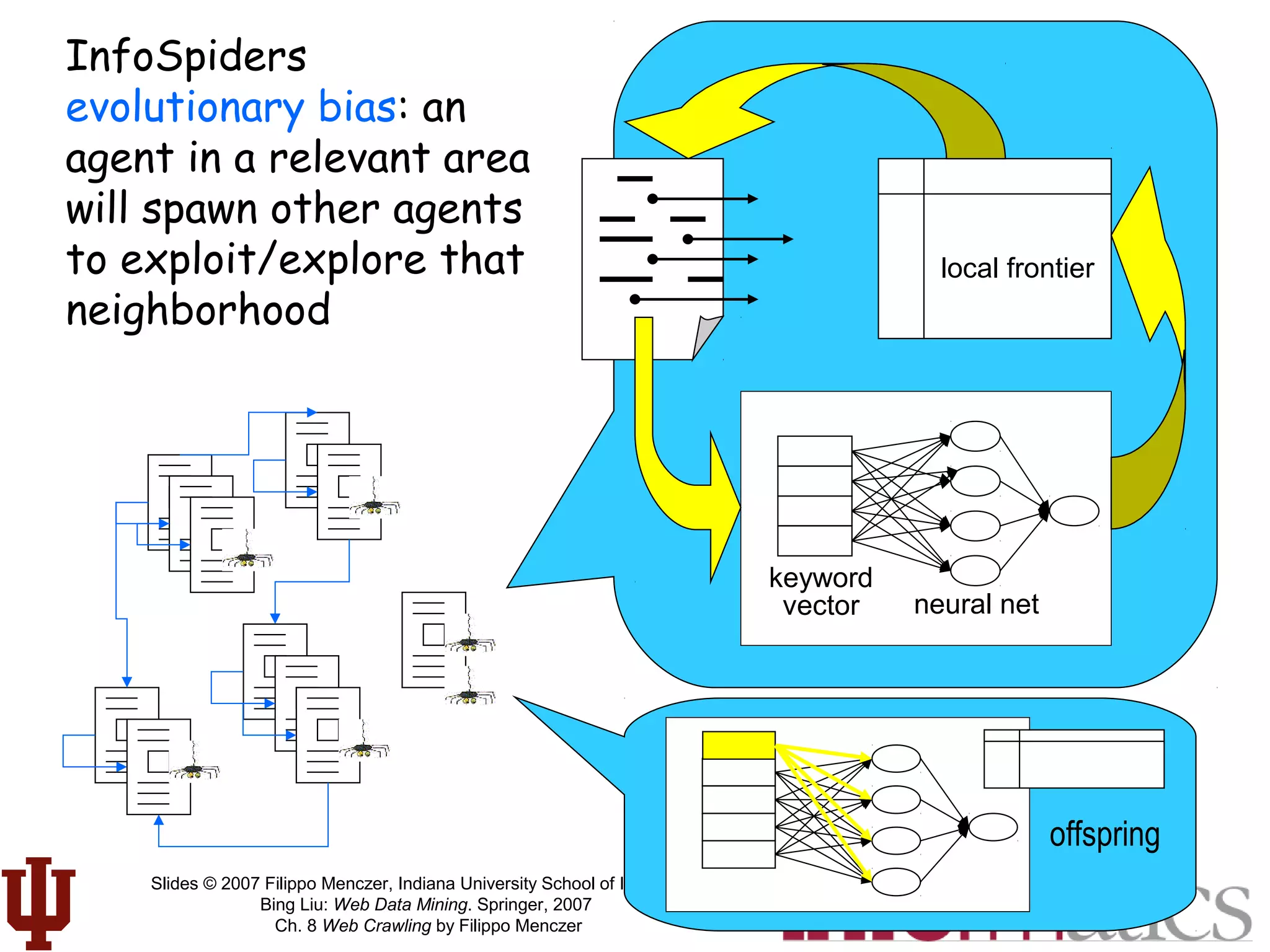
InfoSpiders
evolutionary bias: an
agent in a relevant area
will spawn other agents
to exploit/explore that
neighborhood
keyword
vector neural net
local frontier
offspring
Slides © 2007 Filippo Menczer, Indiana University School of Informatics
Bing Liu: Web Data Mining. Springer, 2007
Ch. 8 Web Crawling by Filippo Menczer
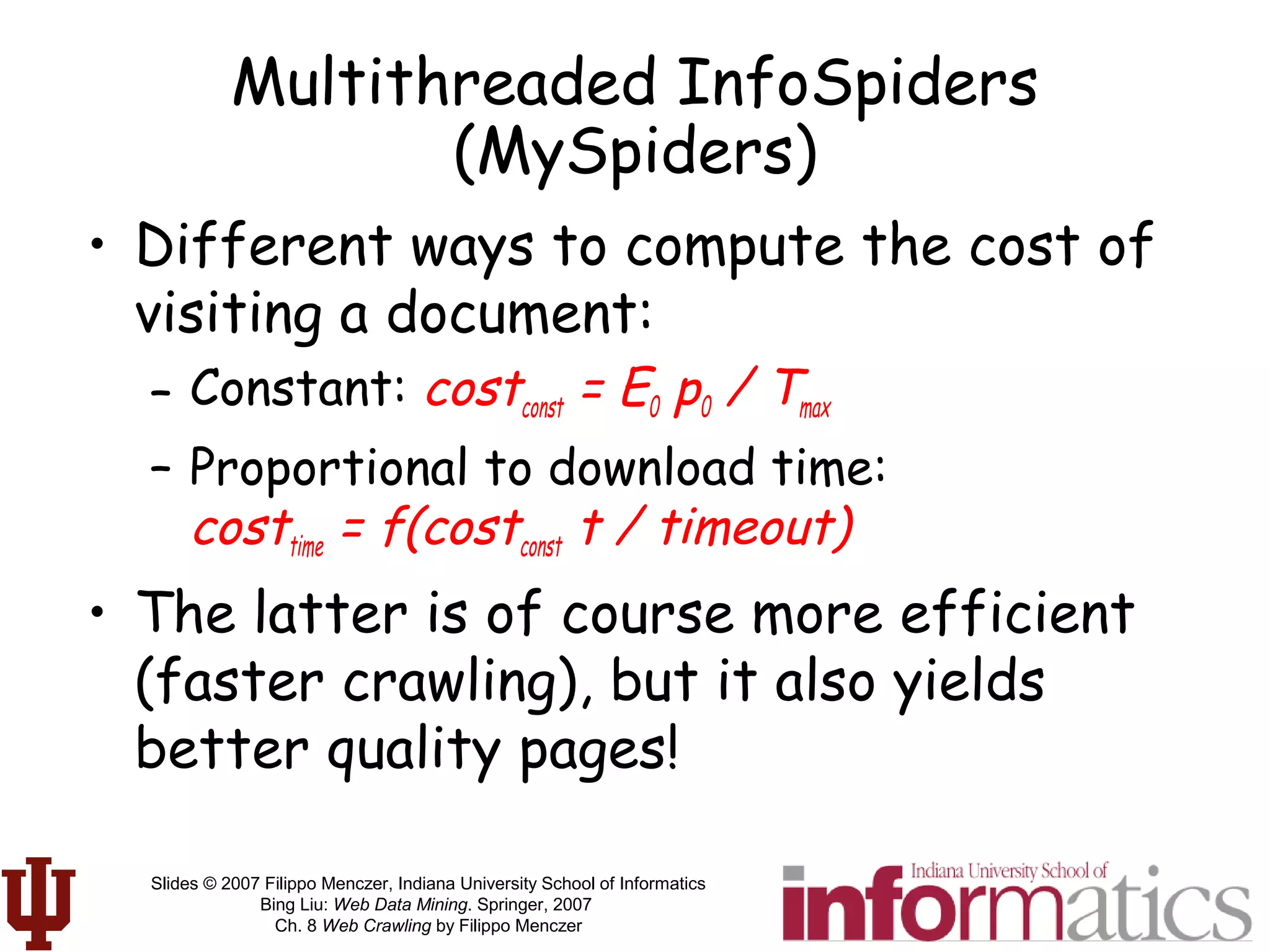
Multithreaded InfoSpiders
(MySpiders)
• Different ways to compute the cost of
visiting a document:
– Constant: costconst = E0 p0 / Tmax
– Proportional to download time:
costtime = f(costconst t / timeout)
• The latter is of course more efficient
(faster crawling), but it also yields
better quality pages!
Slides © 2007 Filippo Menczer, Indiana University School of Informatics
Bing Liu: Web Data Mining. Springer, 2007
Ch. 8 Web Crawling by Filippo Menczer
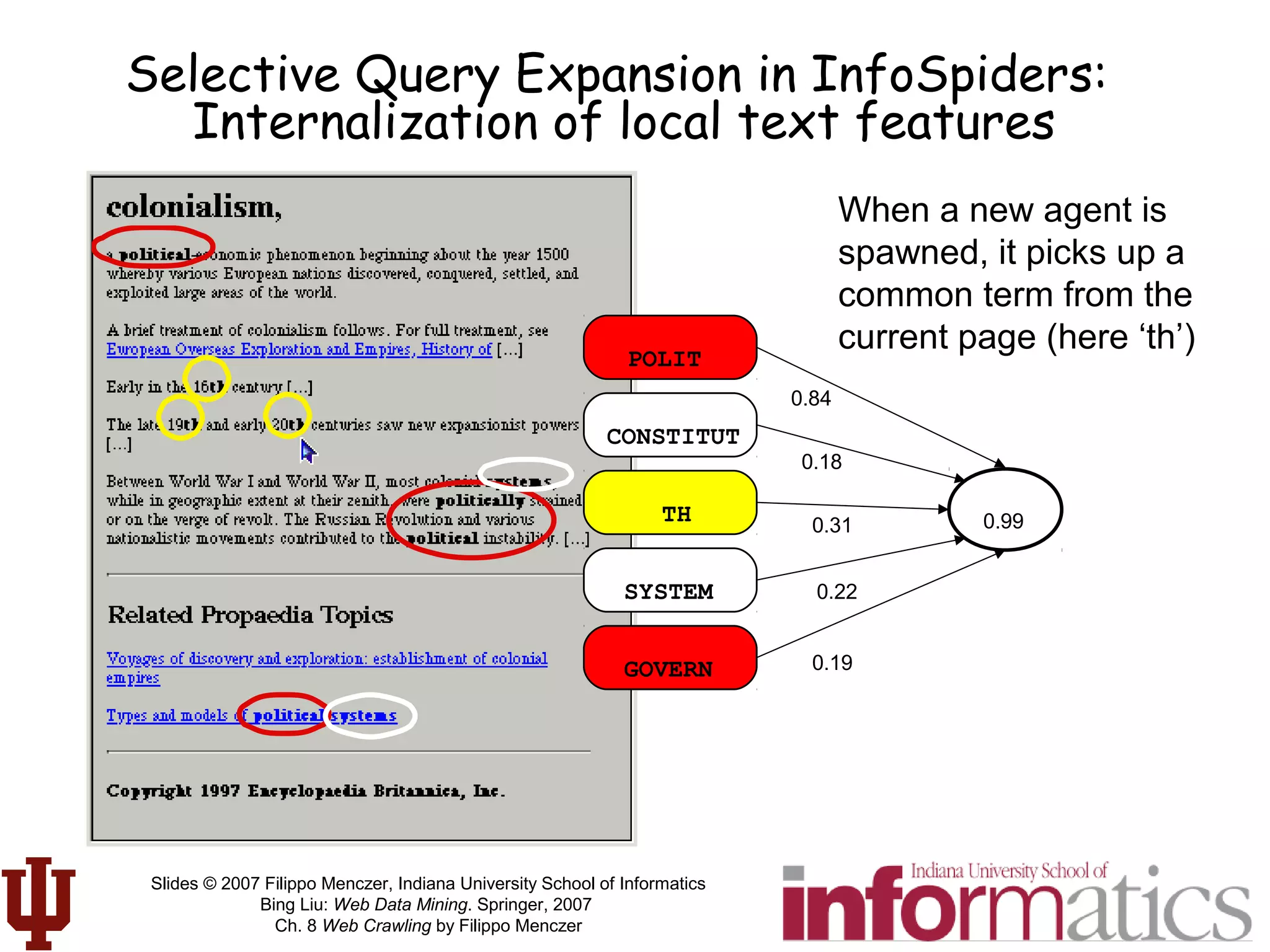
Selective Query Expansion in InfoSpiders:
Internalization of local text features
POLIT
CONSTITUT
TH
SYSTEM
GOVERN
0.99
0.84
0.18
0.31
0.19
0.22
When a new agent is
spawned, it picks up a
common term from the
current page (here ‘th’)
Slides © 2007 Filippo Menczer, Indiana University School of Informatics
Bing Liu: Web Data Mining. Springer, 2007
Ch. 8 Web Crawling by Filippo Menczer
Reinforcement Learning
• In general, reward function R: S  A  ℜ
• Learn policy (π: S  A) to maximize reward
over time, typically discounted in the
future:
• Q-learning: optimal policy
V = γt
r(t),
t
∑ 0 ≤ γ <1
π*
(s) = argmax
a
Q(s,a)
= argmax
a
R(s,a) + γV*
(s')[ ]
s
s2a2
a1 s1
Value of following optimal policy in future
Slides © 2007 Filippo Menczer, Indiana University School of Informatics
Bing Liu: Web Data Mining. Springer, 2007
Ch. 8 Web Crawling by Filippo Menczer
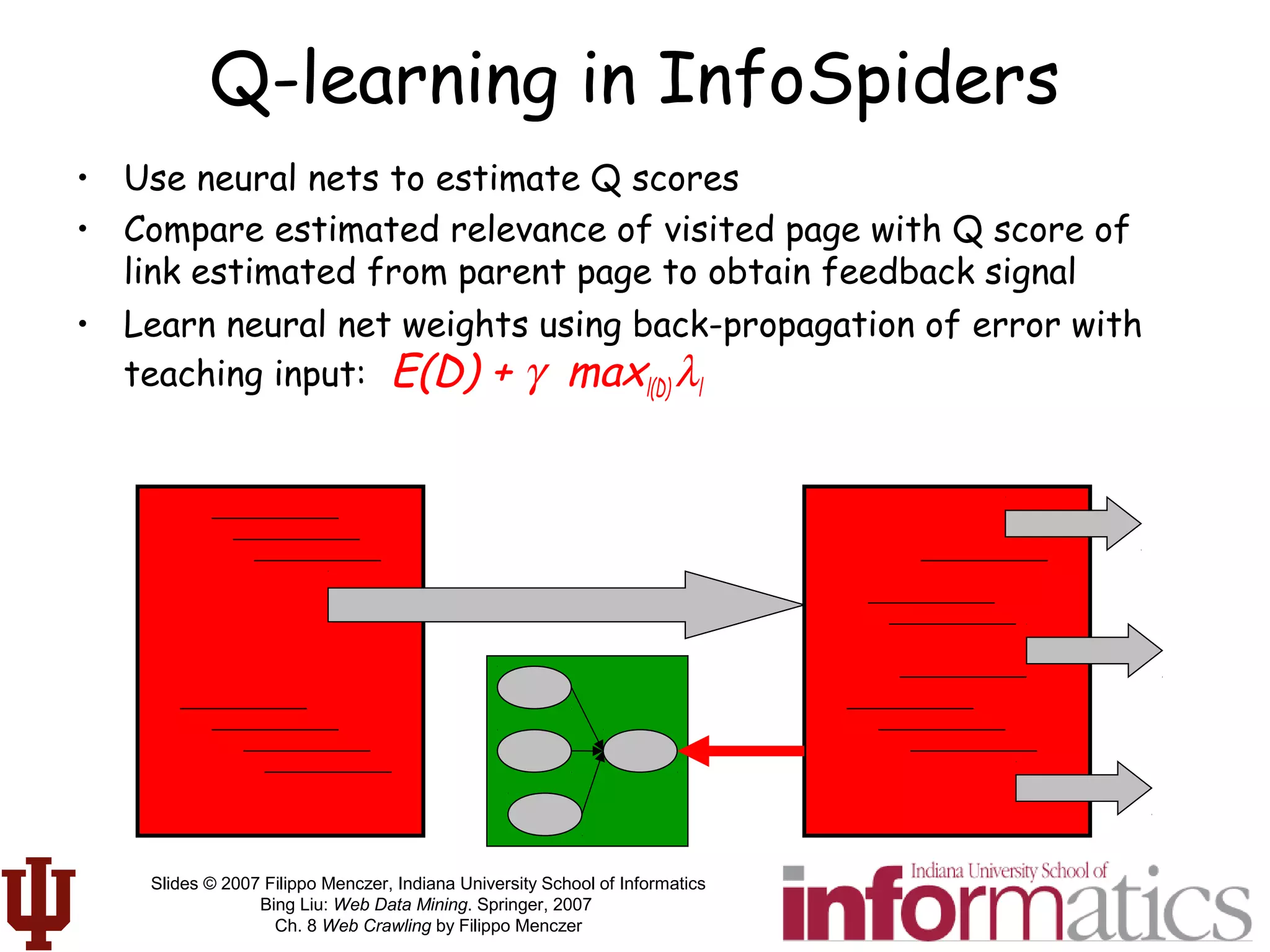
Q-learning in InfoSpiders
• Use neural nets to estimate Q scores
• Compare estimated relevance of visited page with Q score of
link estimated from parent page to obtain feedback signal
• Learn neural net weights using back-propagation of error with
teaching input: E(D) + γ maxl(D) λl
Slides © 2007 Filippo Menczer, Indiana University School of Informatics
Bing Liu: Web Data Mining. Springer, 2007
Ch. 8 Web Crawling by Filippo Menczer
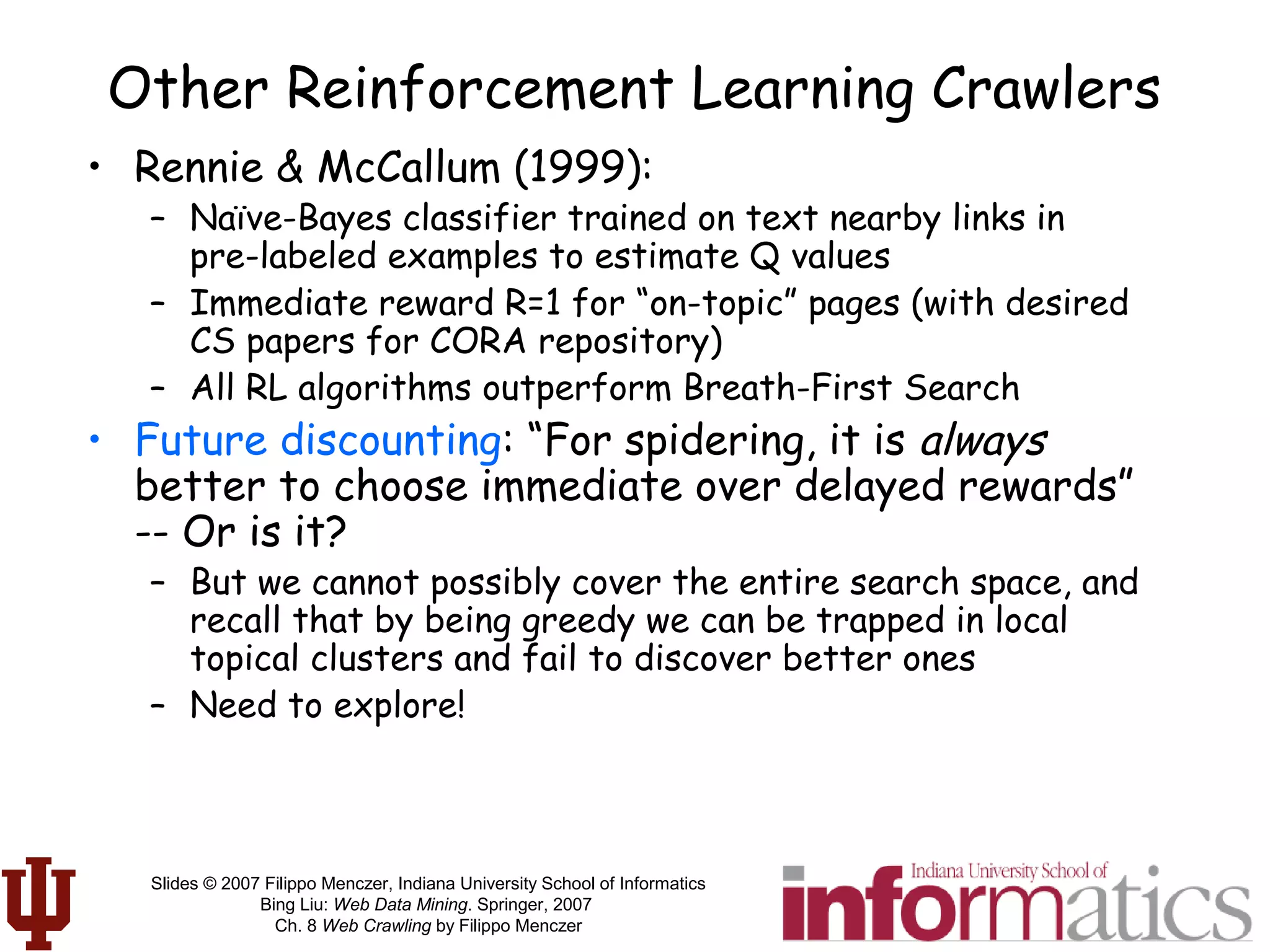
Other Reinforcement Learning Crawlers
• Rennie & McCallum (1999):
– Naïve-Bayes classifier trained on text nearby links in
pre-labeled examples to estimate Q values
– Immediate reward R=1 for “on-topic” pages (with desired
CS papers for CORA repository)
– All RL algorithms outperform Breath-First Search
• Future discounting: “For spidering, it is always
better to choose immediate over delayed rewards”
-- Or is it?
– But we cannot possibly cover the entire search space, and
recall that by being greedy we can be trapped in local
topical clusters and fail to discover better ones
– Need to explore!
Slides © 2007 Filippo Menczer, Indiana University School of Informatics
Bing Liu: Web Data Mining. Springer, 2007
Ch. 8 Web Crawling by Filippo Menczer
Outline
• Motivation and taxonomy of crawlers
• Basic crawlers and implementation issues
• Universal crawlers
• Preferential (focused and topical) crawlers
• Evaluation of preferential crawlers
• Crawler ethics and conflicts
• New developments: social, collaborative, federated
crawlers
Slides © 2007 Filippo Menczer, Indiana University School of Informatics
Bing Liu: Web Data Mining. Springer, 2007
Ch. 8 Web Crawling by Filippo Menczer
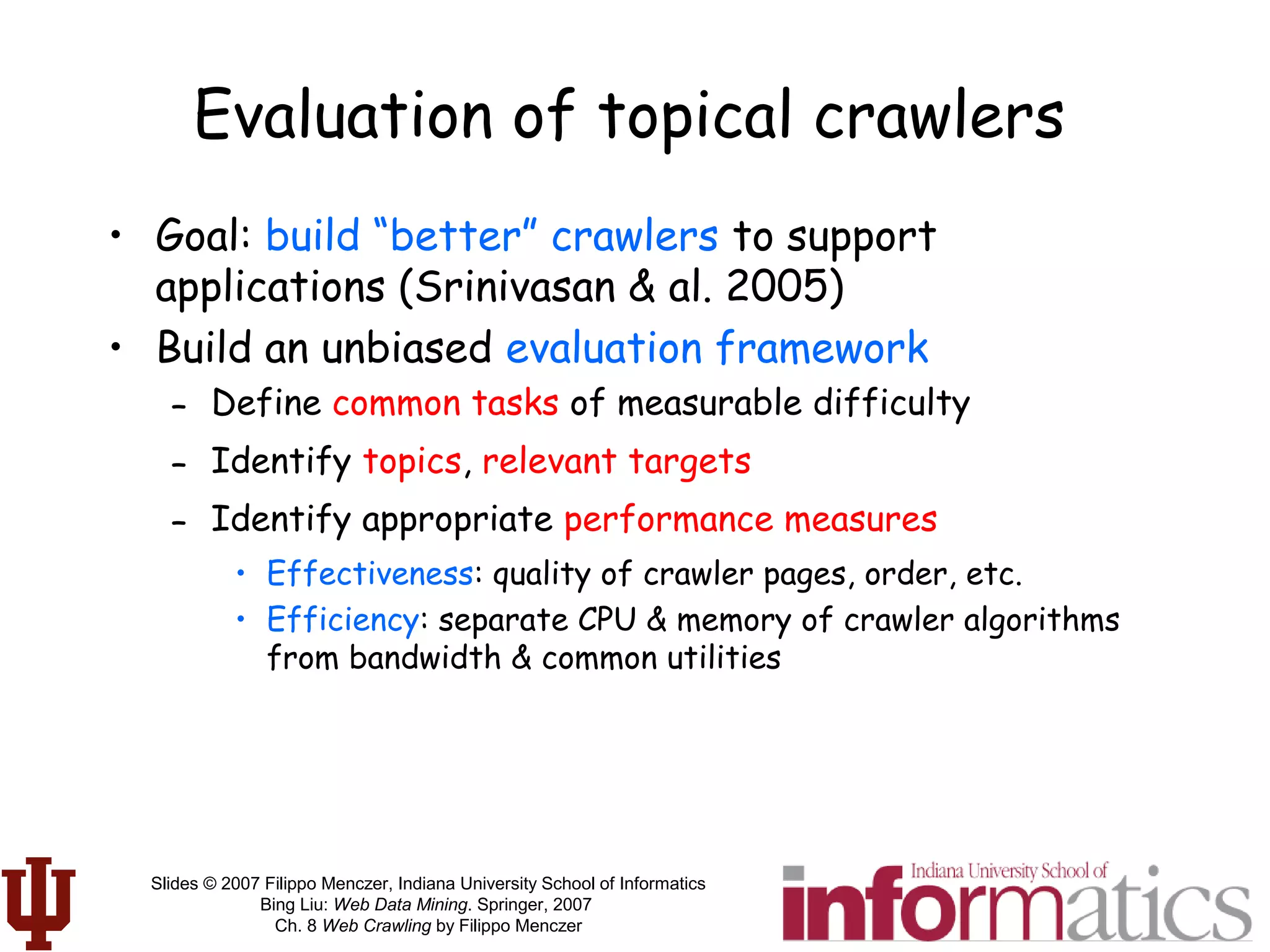
Evaluation of topical crawlers
• Goal: build “better” crawlers to support
applications (Srinivasan & al. 2005)
• Build an unbiased evaluation framework
– Define common tasks of measurable difficulty
– Identify topics, relevant targets
– Identify appropriate performance measures
• Effectiveness: quality of crawler pages, order, etc.
• Efficiency: separate CPU & memory of crawler algorithms
from bandwidth & common utilities
Slides © 2007 Filippo Menczer, Indiana University School of Informatics
Bing Liu: Web Data Mining. Springer, 2007
Ch. 8 Web Crawling by Filippo Menczer
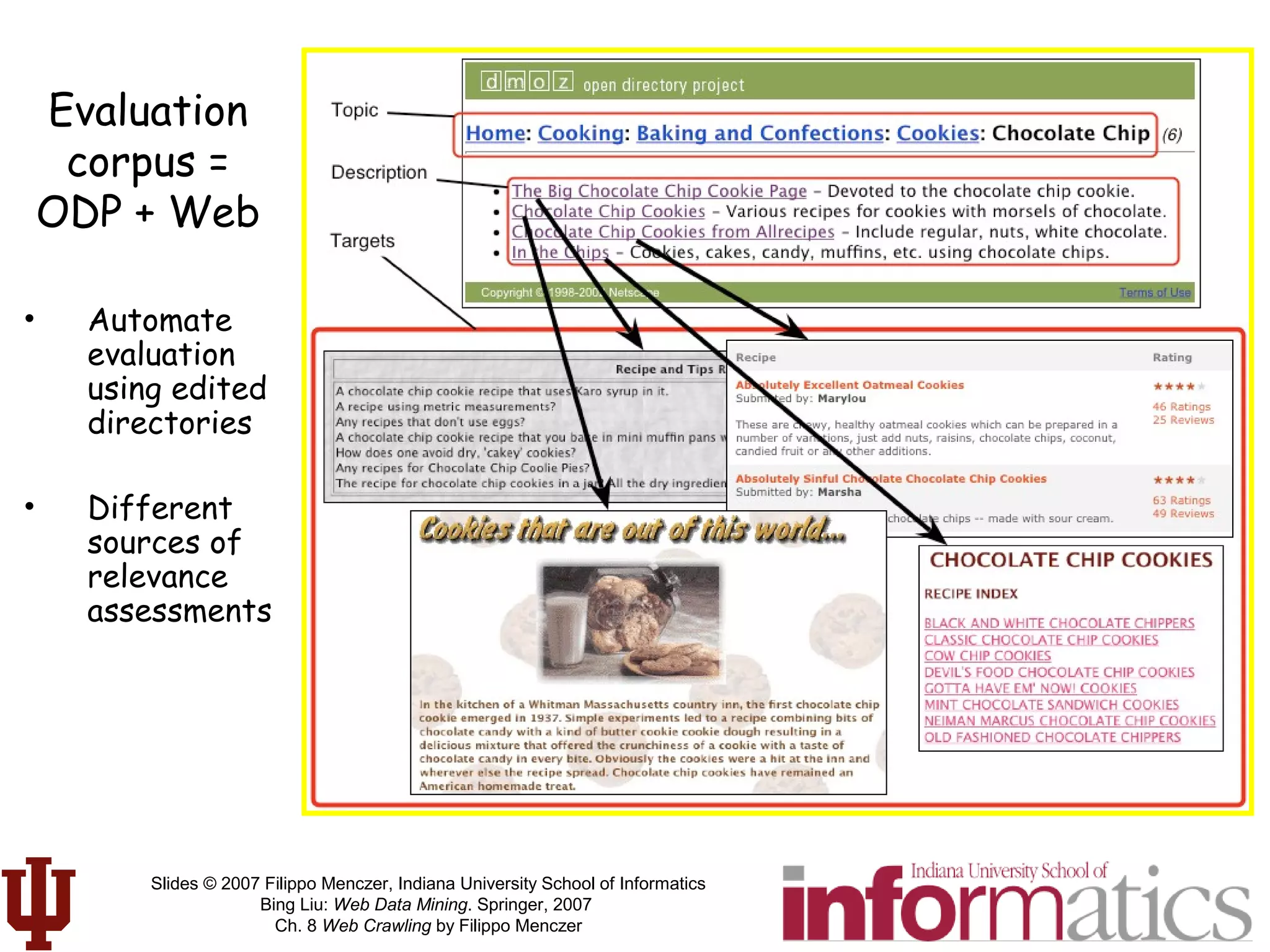
Evaluation
corpus =
ODP + Web
• Automate
evaluation
using edited
directories
• Different
sources of
relevance
assessments
Slides © 2007 Filippo Menczer, Indiana University School of Informatics
Bing Liu: Web Data Mining. Springer, 2007
Ch. 8 Web Crawling by Filippo Menczer
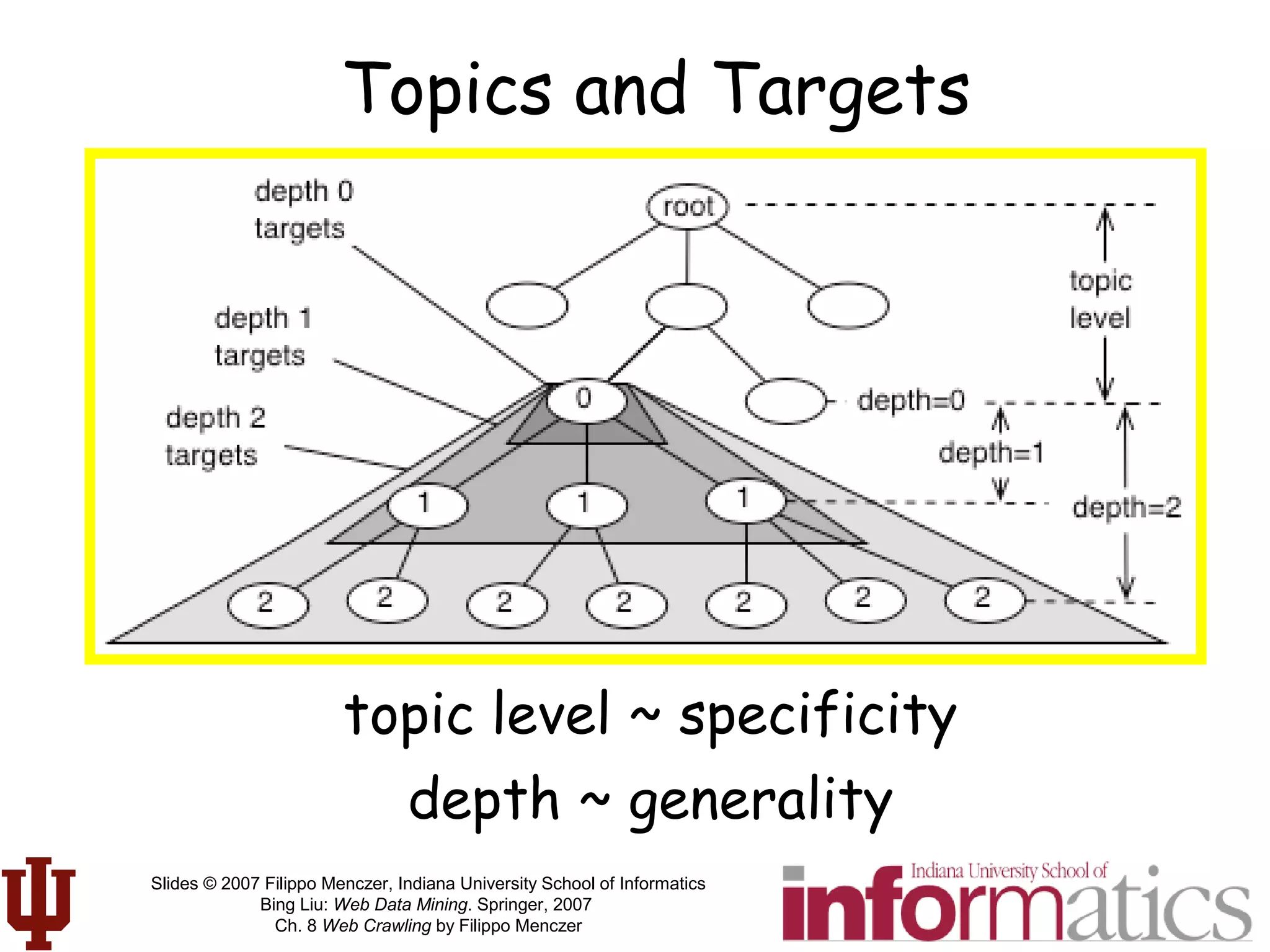
Topics and Targets
topic level ~ specificity
depth ~ generality
Slides © 2007 Filippo Menczer, Indiana University School of Informatics
Bing Liu: Web Data Mining. Springer, 2007
Ch. 8 Web Crawling by Filippo Menczer
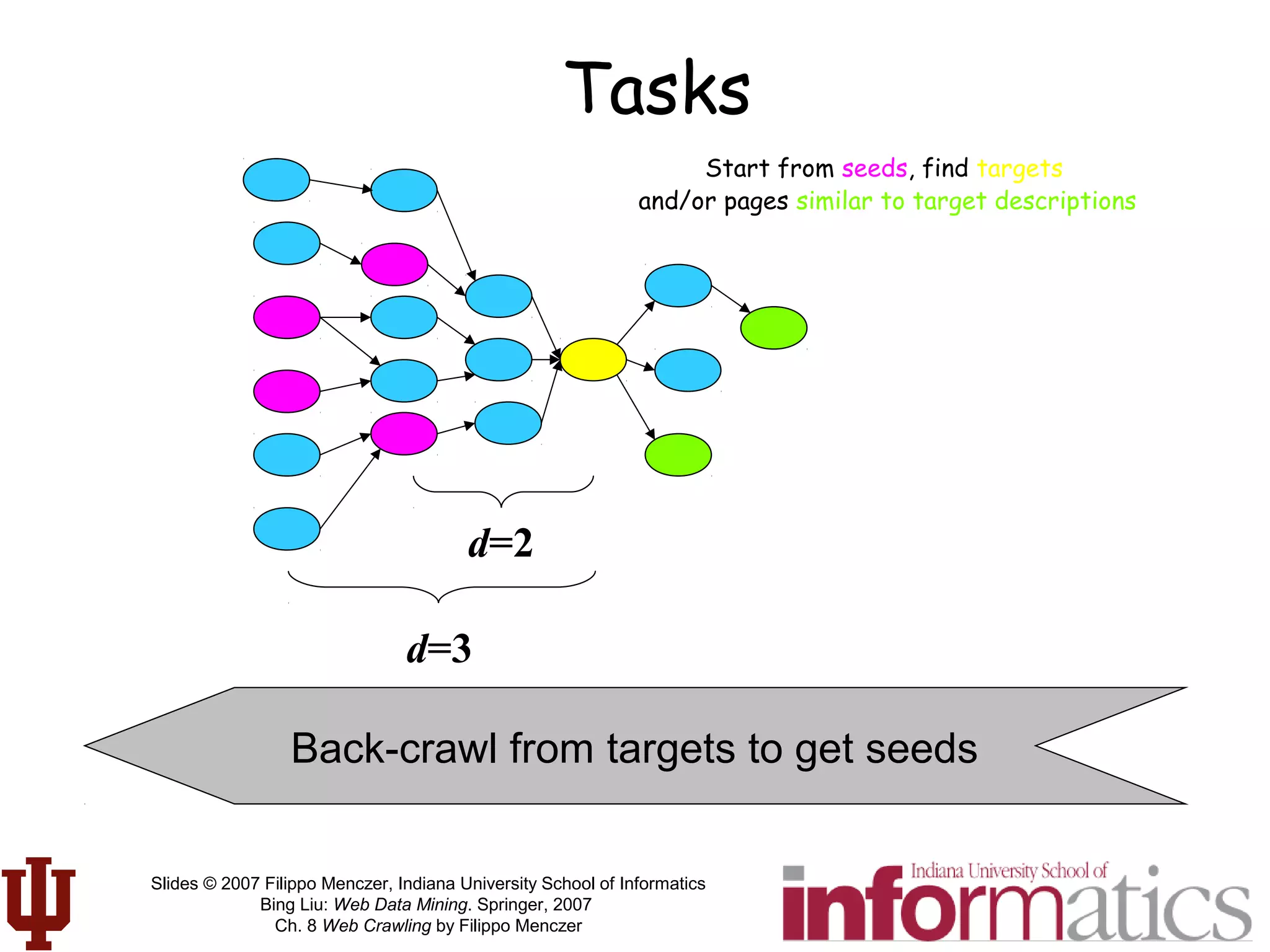
Tasks
Start from seeds, find targets
and/or pages similar to target descriptions
d=2
d=3
Back-crawl from targets to get seeds
Slides © 2007 Filippo Menczer, Indiana University School of Informatics
Bing Liu: Web Data Mining. Springer, 2007
Ch. 8 Web Crawling by Filippo Menczer
Target based performance measures
A: Independence!…Q: What assumption are we making?
Slides © 2007 Filippo Menczer, Indiana University School of Informatics
Bing Liu: Web Data Mining. Springer, 2007
Ch. 8 Web Crawling by Filippo Menczer
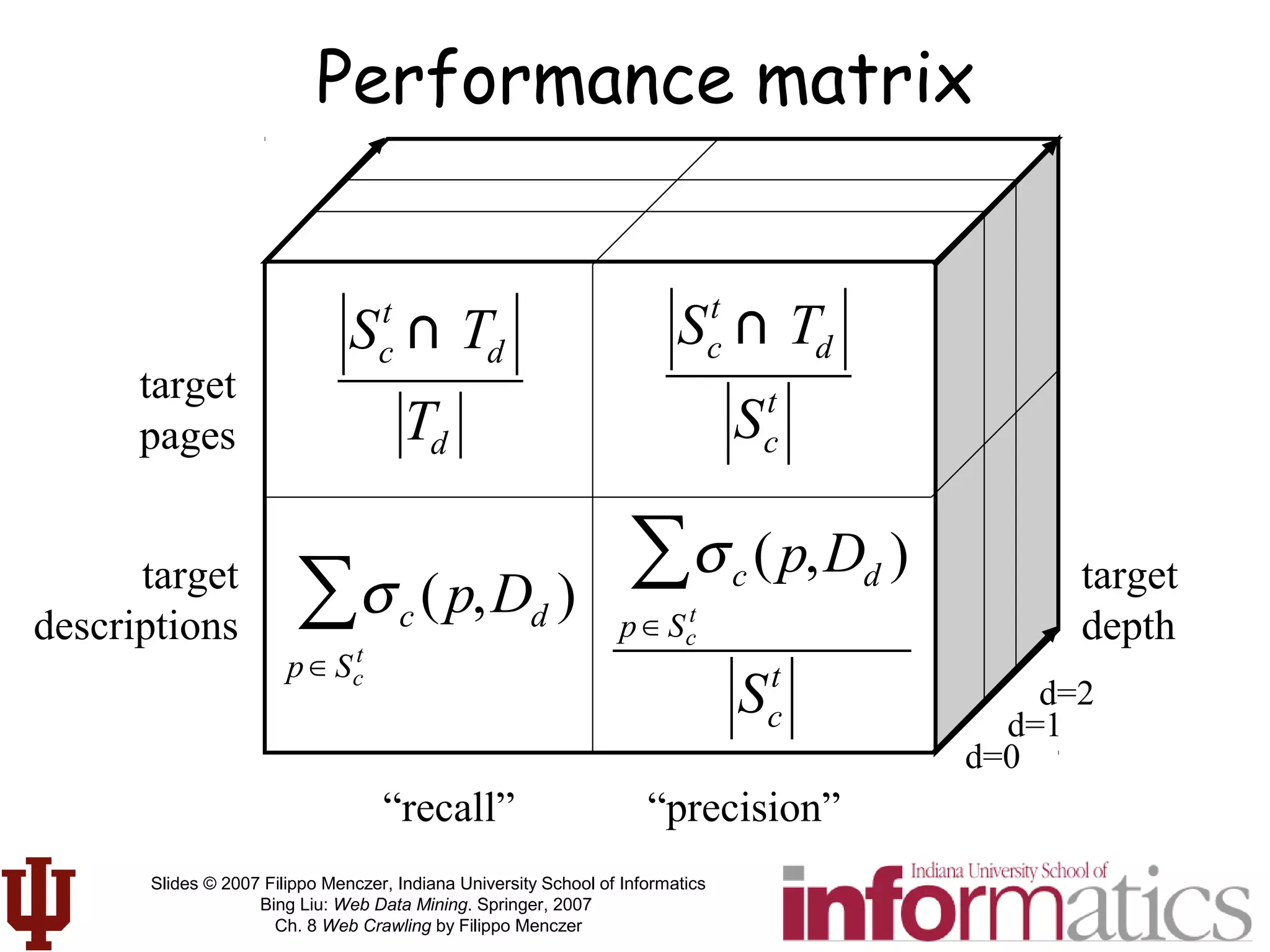
Performance matrix
target
depth
“recall” “precision”
target
pages
target
descriptions
d=0
d=1
d=2
Sc
t
∩ Td
Td
σc (p,Dd )
p∈ Sc
t
∑
Sc
t
∩ Td
Sc
t
σc (p,Dd )
p∈ Sc
t
∑
Sc
t
Slides © 2007 Filippo Menczer, Indiana University School of Informatics
Bing Liu: Web Data Mining. Springer, 2007
Ch. 8 Web Crawling by Filippo Menczer
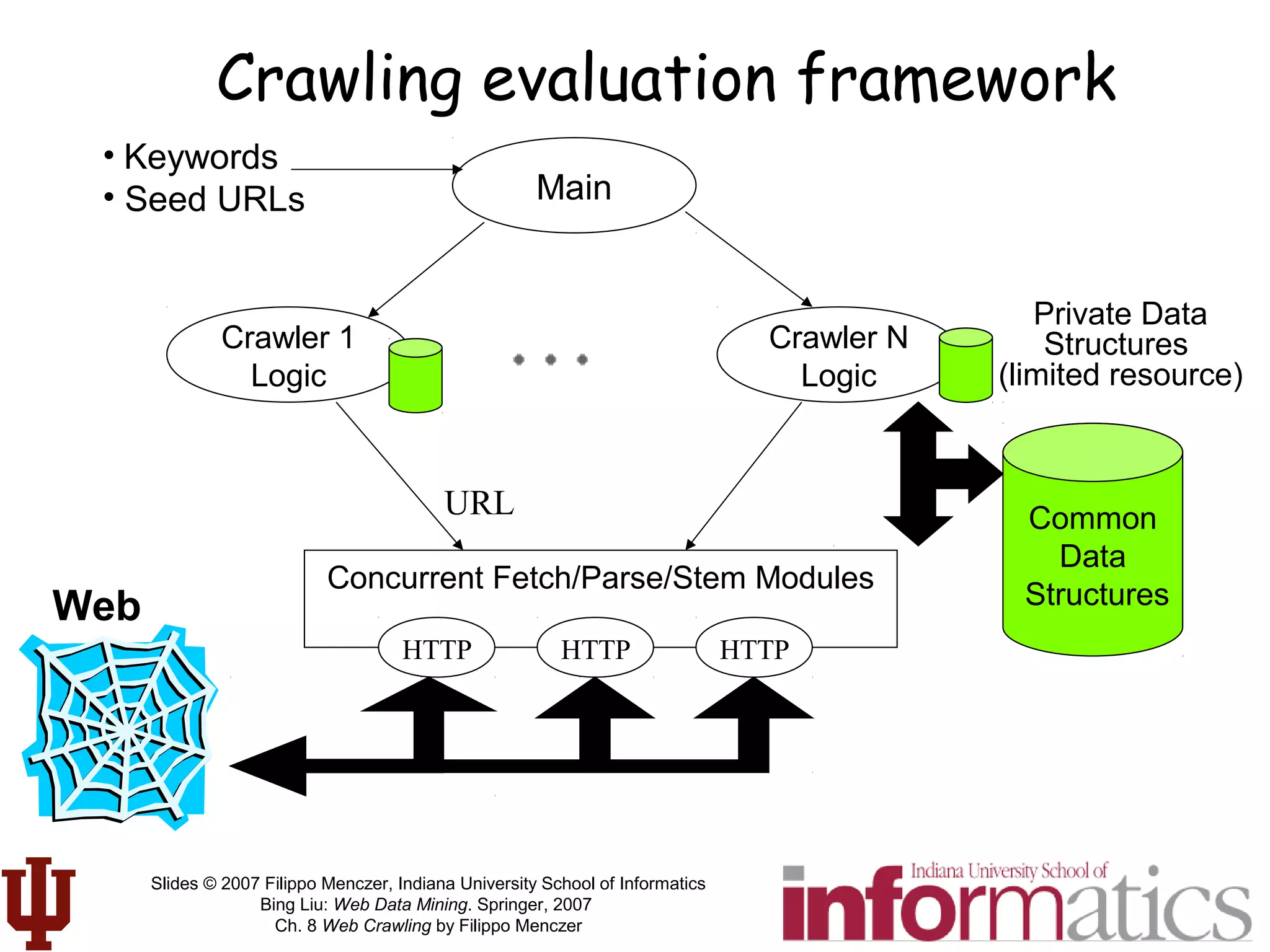
Crawling evaluation framework
URL
Web
Common
Data
Structures
Crawler 1
Logic
Main
• Keywords
• Seed URLs
Crawler N
Logic
Private Data
Structures
(limited resource)
Concurrent Fetch/Parse/Stem Modules
HTTP HTTP HTTP
Slides © 2007 Filippo Menczer, Indiana University School of Informatics
Bing Liu: Web Data Mining. Springer, 2007
Ch. 8 Web Crawling by Filippo Menczer
Using framework to compare crawler performance
Pages crawled
Average
target
page
recall
Slides © 2007 Filippo Menczer, Indiana University School of Informatics
Bing Liu: Web Data Mining. Springer, 2007
Ch. 8 Web Crawling by Filippo Menczer
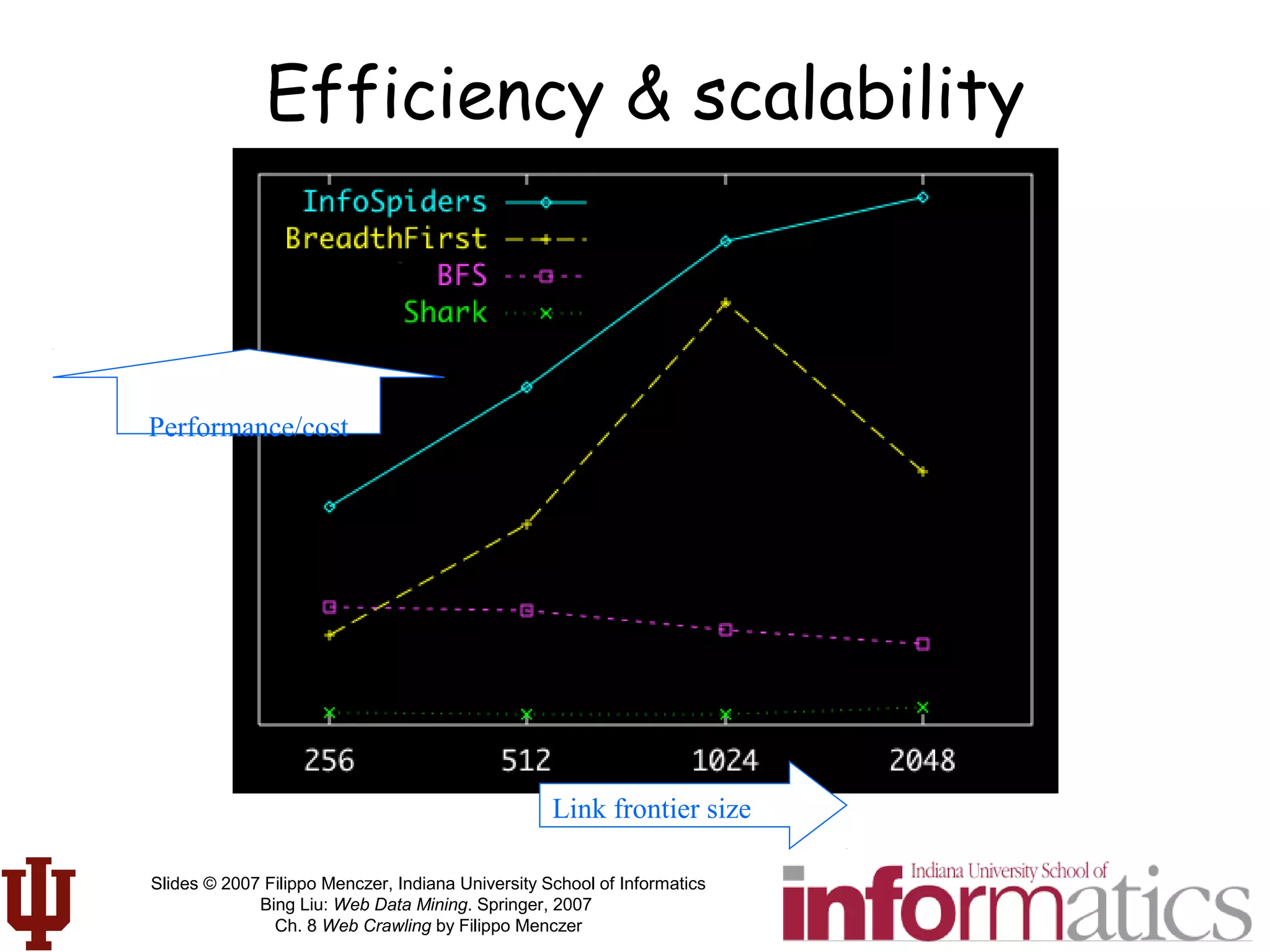
Link frontier size
Performance/cost
Efficiency & scalability
Slides © 2007 Filippo Menczer, Indiana University School of Informatics
Bing Liu: Web Data Mining. Springer, 2007
Ch. 8 Web Crawling by Filippo Menczer
Topical crawler
performance depends
on topic characteristics
++++InfoSpiders
+++BFS-256
+++BFS-1
++++BreadthFirst
LPACLPAC
Crawler
Target descriptionsTarget pages
C = target link cohesiveness
A = target authoritativeness
P = popularity (topic kw generality)
L = seed-target similarity
Slides © 2007 Filippo Menczer, Indiana University School of Informatics
Bing Liu: Web Data Mining. Springer, 2007
Ch. 8 Web Crawling by Filippo Menczer
Outline
• Motivation and taxonomy of crawlers
• Basic crawlers and implementation issues
• Universal crawlers
• Preferential (focused and topical) crawlers
• Evaluation of preferential crawlers
• Crawler ethics and conflicts
• New developments: social, collaborative, federated
crawlers
Slides © 2007 Filippo Menczer, Indiana University School of Informatics
Bing Liu: Web Data Mining. Springer, 2007
Ch. 8 Web Crawling by Filippo Menczer
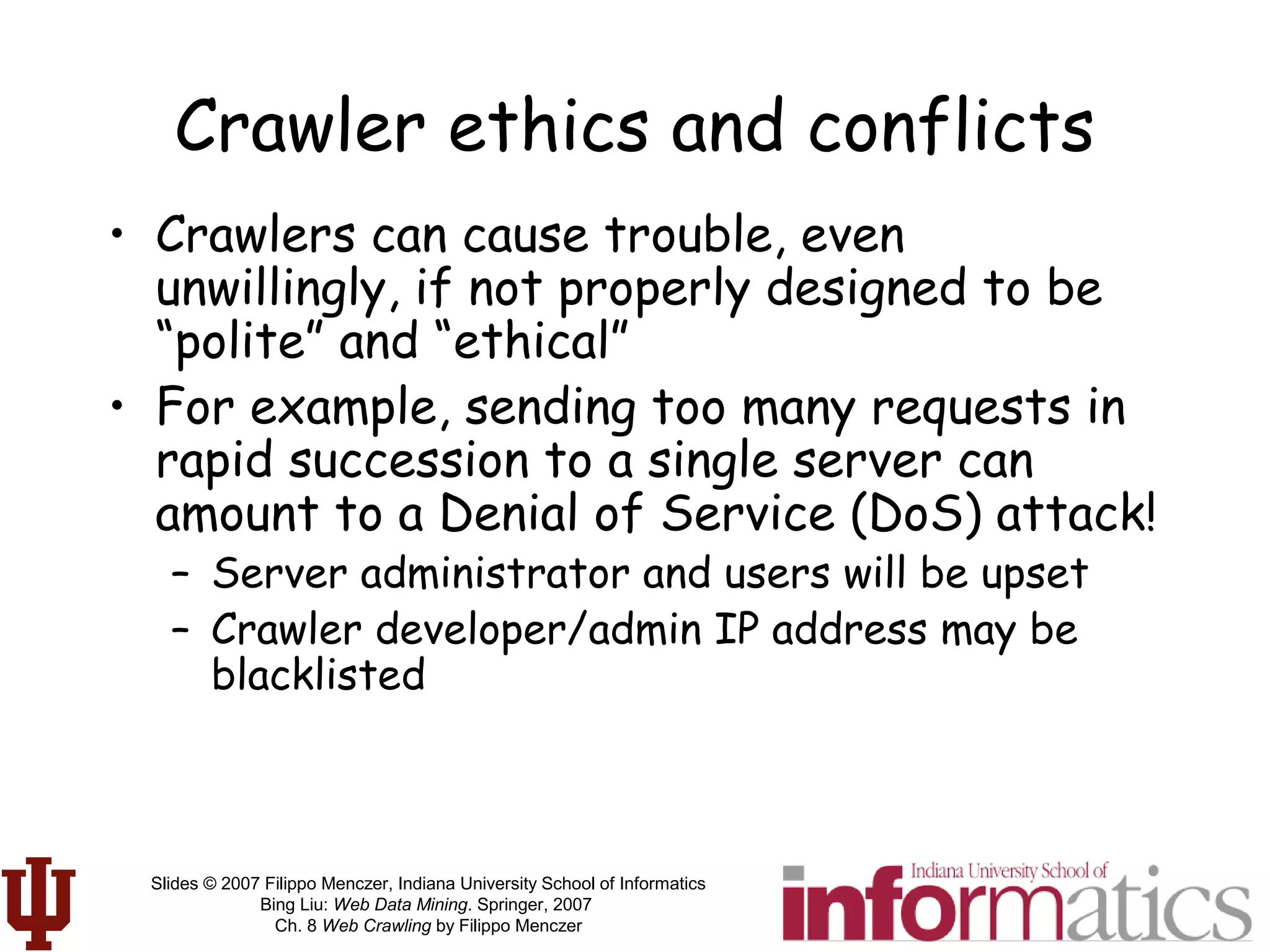
Crawler ethics and conflicts
• Crawlers can cause trouble, even
unwillingly, if not properly designed to be
“polite” and “ethical”
• For example, sending too many requests in
rapid succession to a single server can
amount to a Denial of Service (DoS) attack!
– Server administrator and users will be upset
– Crawler developer/admin IP address may be
blacklisted
Slides © 2007 Filippo Menczer, Indiana University School of Informatics
Bing Liu: Web Data Mining. Springer, 2007
Ch. 8 Web Crawling by Filippo Menczer
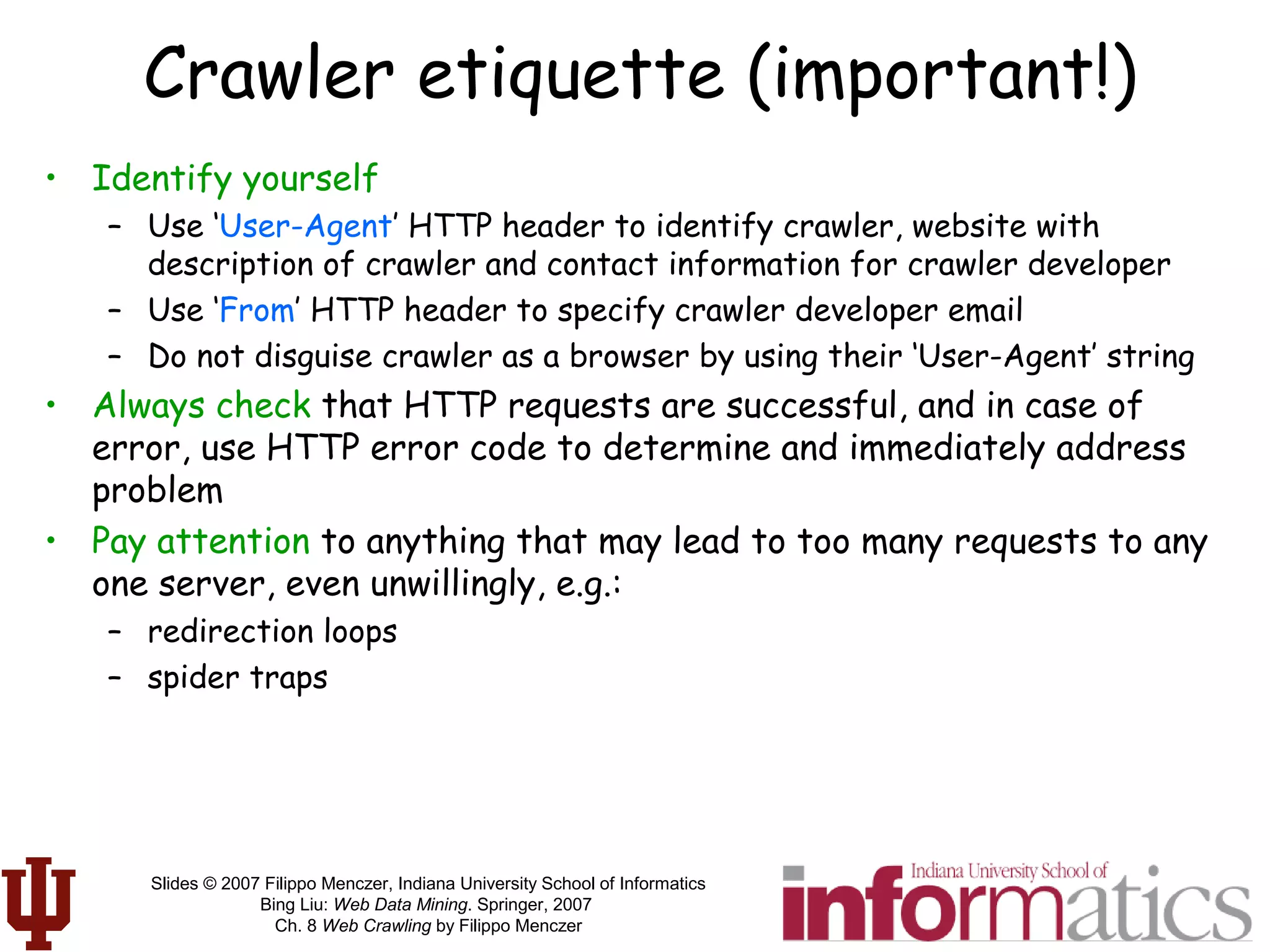
Crawler etiquette (important!)
• Identify yourself
– Use ‘User-Agent’ HTTP header to identify crawler, website with
description of crawler and contact information for crawler developer
– Use ‘From’ HTTP header to specify crawler developer email
– Do not disguise crawler as a browser by using their ‘User-Agent’ string
• Always check that HTTP requests are successful, and in case of
error, use HTTP error code to determine and immediately address
problem
• Pay attention to anything that may lead to too many requests to any
one server, even unwillingly, e.g.:
– redirection loops
– spider traps
Slides © 2007 Filippo Menczer, Indiana University School of Informatics
Bing Liu: Web Data Mining. Springer, 2007
Ch. 8 Web Crawling by Filippo Menczer
Crawler etiquette (important!)
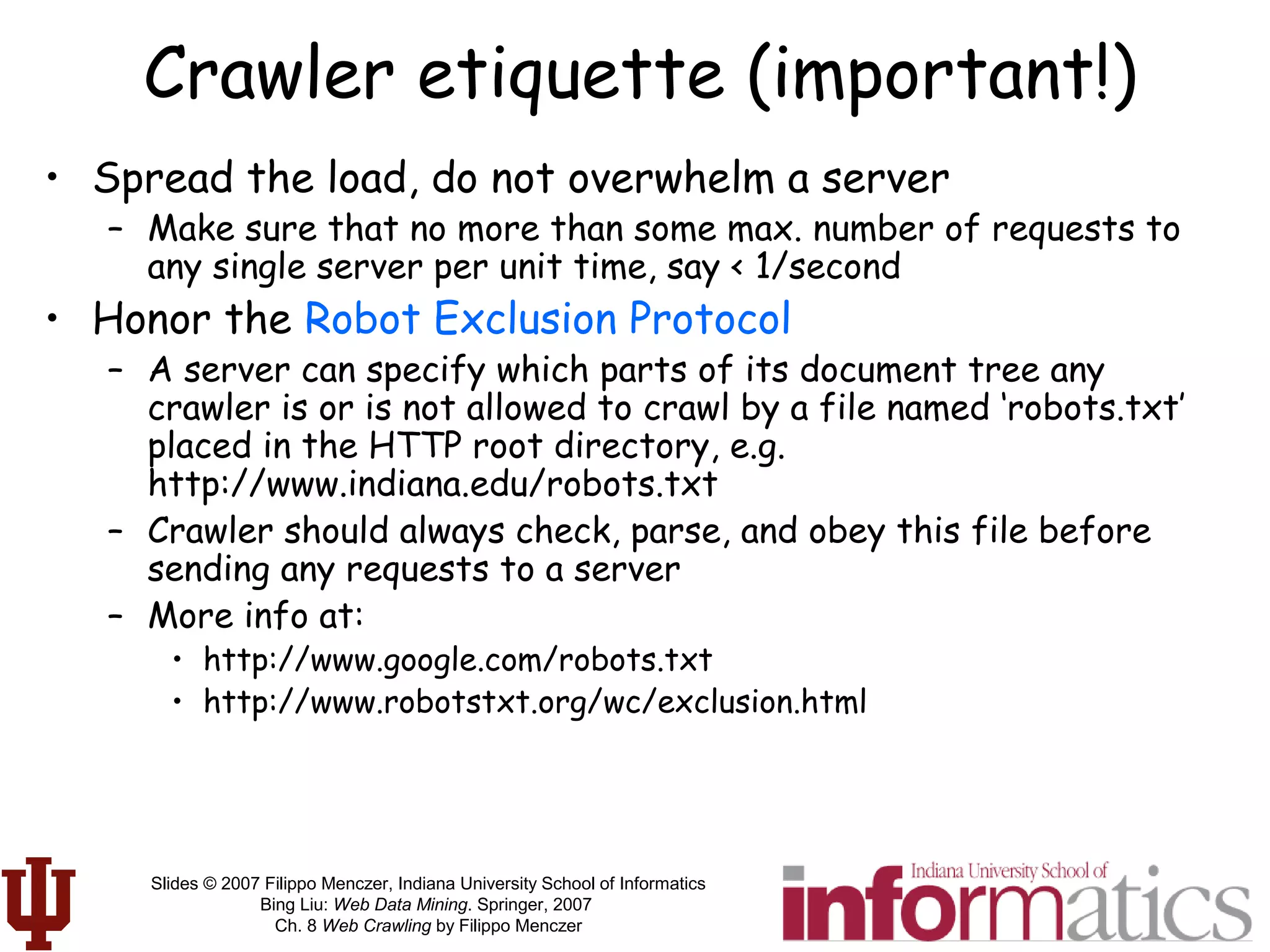
• Spread the load, do not overwhelm a server
– Make sure that no more than some max. number of requests to
any single server per unit time, say < 1/second
• Honor the Robot Exclusion Protocol
– A server can specify which parts of its document tree any
crawler is or is not allowed to crawl by a file named ‘robots.txt’
placed in the HTTP root directory, e.g.
http://www.indiana.edu/robots.txt
– Crawler should always check, parse, and obey this file before
sending any requests to a server
– More info at:
• http://www.google.com/robots.txt
• http://www.robotstxt.org/wc/exclusion.html
Slides © 2007 Filippo Menczer, Indiana University School of Informatics
Bing Liu: Web Data Mining. Springer, 2007
Ch. 8 Web Crawling by Filippo Menczer
More on robot exclusion
• Make sure URLs are canonical before
checking against robots.txt
• Avoid fetching robots.txt for each
request to a server by caching its
policy as relevant to this crawler
• Let’s look at some examples to
understand the protocol…
Slides © 2007 Filippo Menczer, Indiana University School of Informatics
Bing Liu: Web Data Mining. Springer, 2007
Ch. 8 Web Crawling by Filippo Menczer
www.apple.com/robots.txt
# robots.txt for http://www.apple.com/
User-agent: *
Disallow:
All crawlers…
…can go
anywhere!
Slides © 2007 Filippo Menczer, Indiana University School of Informatics
Bing Liu: Web Data Mining. Springer, 2007
Ch. 8 Web Crawling by Filippo Menczer
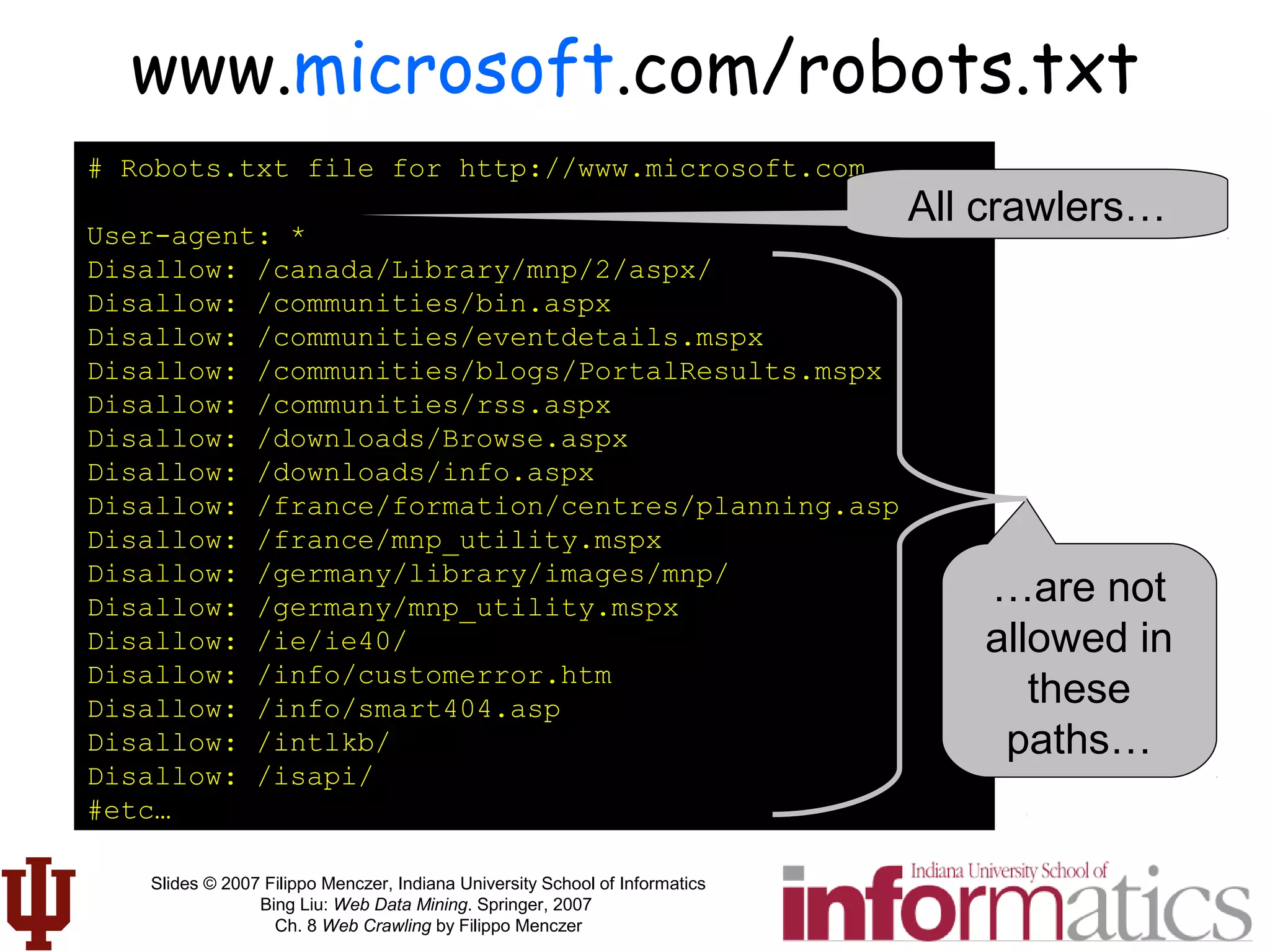
www.microsoft.com/robots.txt
# Robots.txt file for http://www.microsoft.com
User-agent: *
Disallow: /canada/Library/mnp/2/aspx/
Disallow: /communities/bin.aspx
Disallow: /communities/eventdetails.mspx
Disallow: /communities/blogs/PortalResults.mspx
Disallow: /communities/rss.aspx
Disallow: /downloads/Browse.aspx
Disallow: /downloads/info.aspx
Disallow: /france/formation/centres/planning.asp
Disallow: /france/mnp_utility.mspx
Disallow: /germany/library/images/mnp/
Disallow: /germany/mnp_utility.mspx
Disallow: /ie/ie40/
Disallow: /info/customerror.htm
Disallow: /info/smart404.asp
Disallow: /intlkb/
Disallow: /isapi/
#etc…
All crawlers…
…are not
allowed in
these
paths…
Slides © 2007 Filippo Menczer, Indiana University School of Informatics
Bing Liu: Web Data Mining. Springer, 2007
Ch. 8 Web Crawling by Filippo Menczer
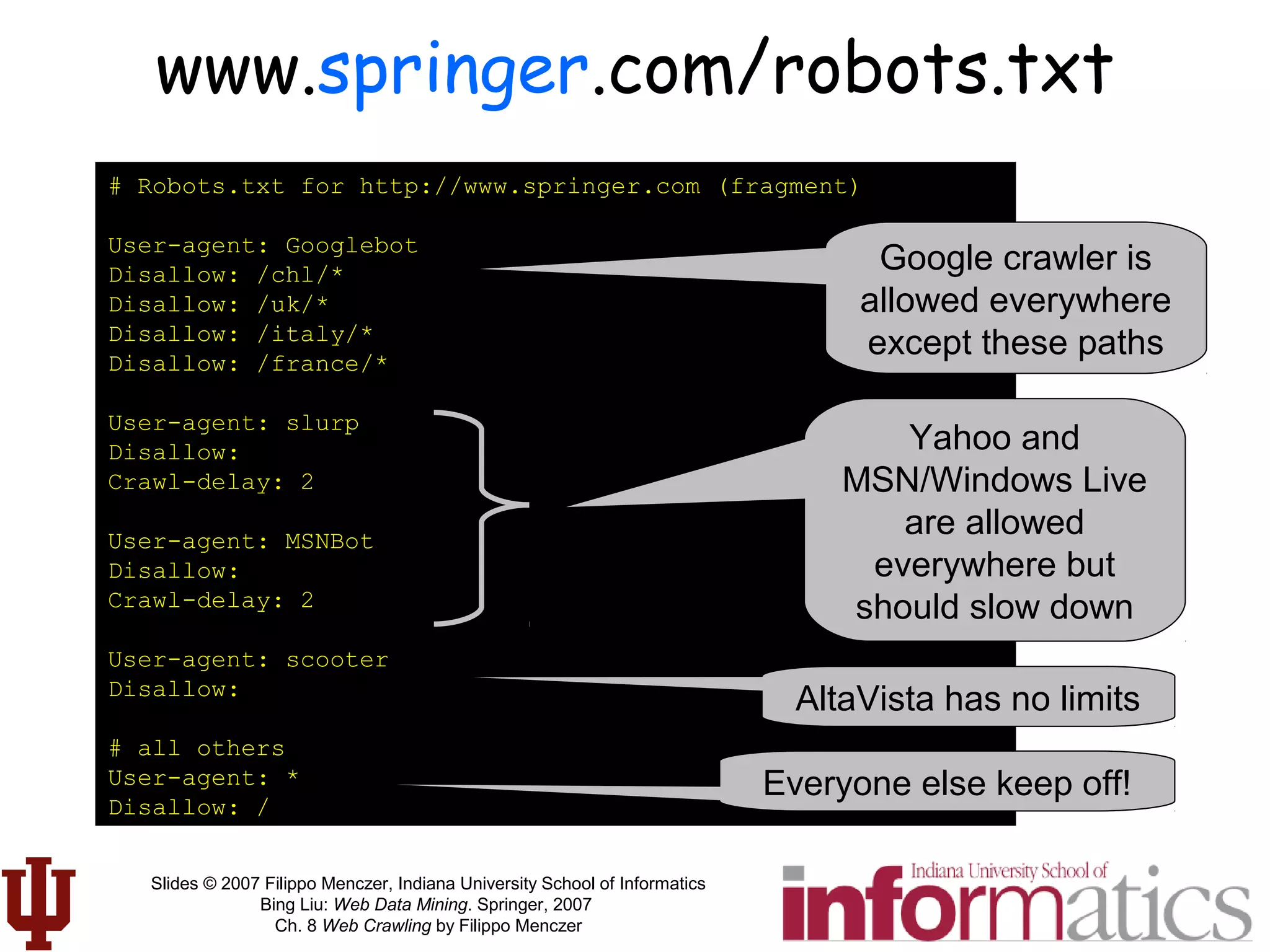
www.springer.com/robots.txt
# Robots.txt for http://www.springer.com (fragment)
User-agent: Googlebot
Disallow: /chl/*
Disallow: /uk/*
Disallow: /italy/*
Disallow: /france/*
User-agent: slurp
Disallow:
Crawl-delay: 2
User-agent: MSNBot
Disallow:
Crawl-delay: 2
User-agent: scooter
Disallow:
# all others
User-agent: *
Disallow: /
Google crawler is
allowed everywhere
except these paths
Yahoo and
MSN/Windows Live
are allowed
everywhere but
should slow down
AltaVista has no limits
Everyone else keep off!
Slides © 2007 Filippo Menczer, Indiana University School of Informatics
Bing Liu: Web Data Mining. Springer, 2007
Ch. 8 Web Crawling by Filippo Menczer
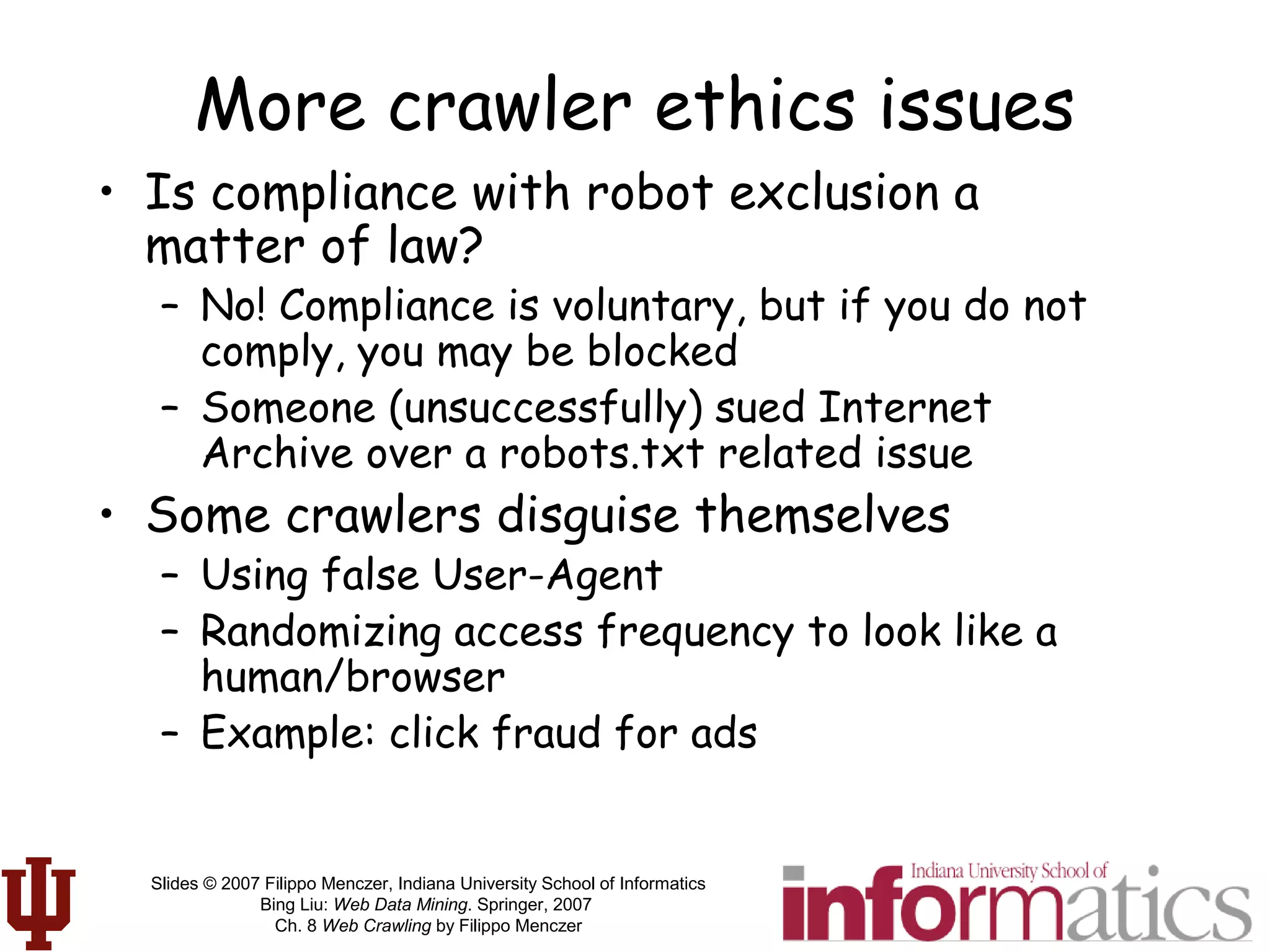
More crawler ethics issues
• Is compliance with robot exclusion a
matter of law?
– No! Compliance is voluntary, but if you do not
comply, you may be blocked
– Someone (unsuccessfully) sued Internet
Archive over a robots.txt related issue
• Some crawlers disguise themselves
– Using false User-Agent
– Randomizing access frequency to look like a
human/browser
– Example: click fraud for ads
Slides © 2007 Filippo Menczer, Indiana University School of Informatics
Bing Liu: Web Data Mining. Springer, 2007
Ch. 8 Web Crawling by Filippo Menczer
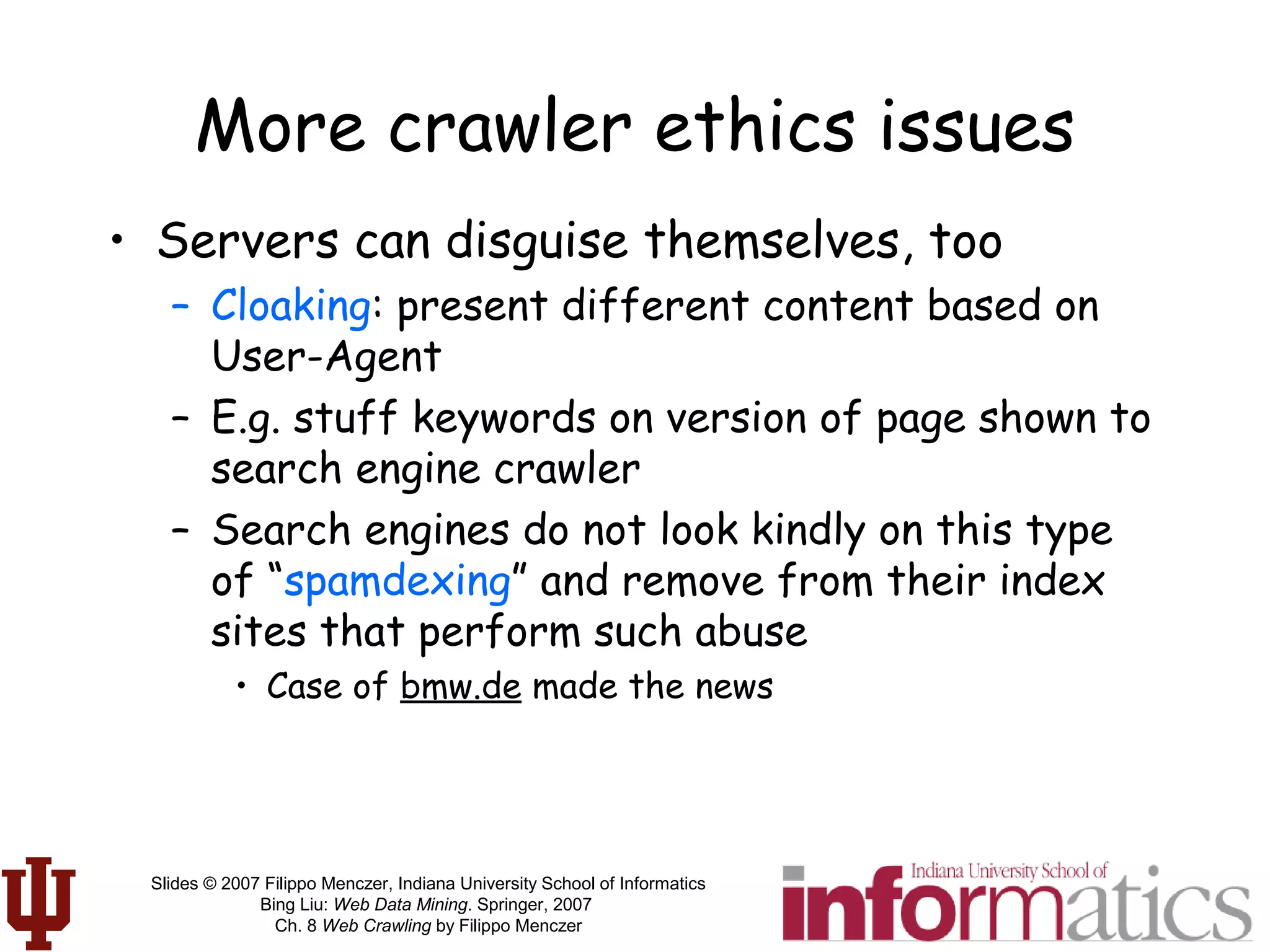
More crawler ethics issues
• Servers can disguise themselves, too
– Cloaking: present different content based on
User-Agent
– E.g. stuff keywords on version of page shown to
search engine crawler
– Search engines do not look kindly on this type
of “spamdexing” and remove from their index
sites that perform such abuse
• Case of bmw.de made the news
Slides © 2007 Filippo Menczer, Indiana University School of Informatics
Bing Liu: Web Data Mining. Springer, 2007
Ch. 8 Web Crawling by Filippo Menczer
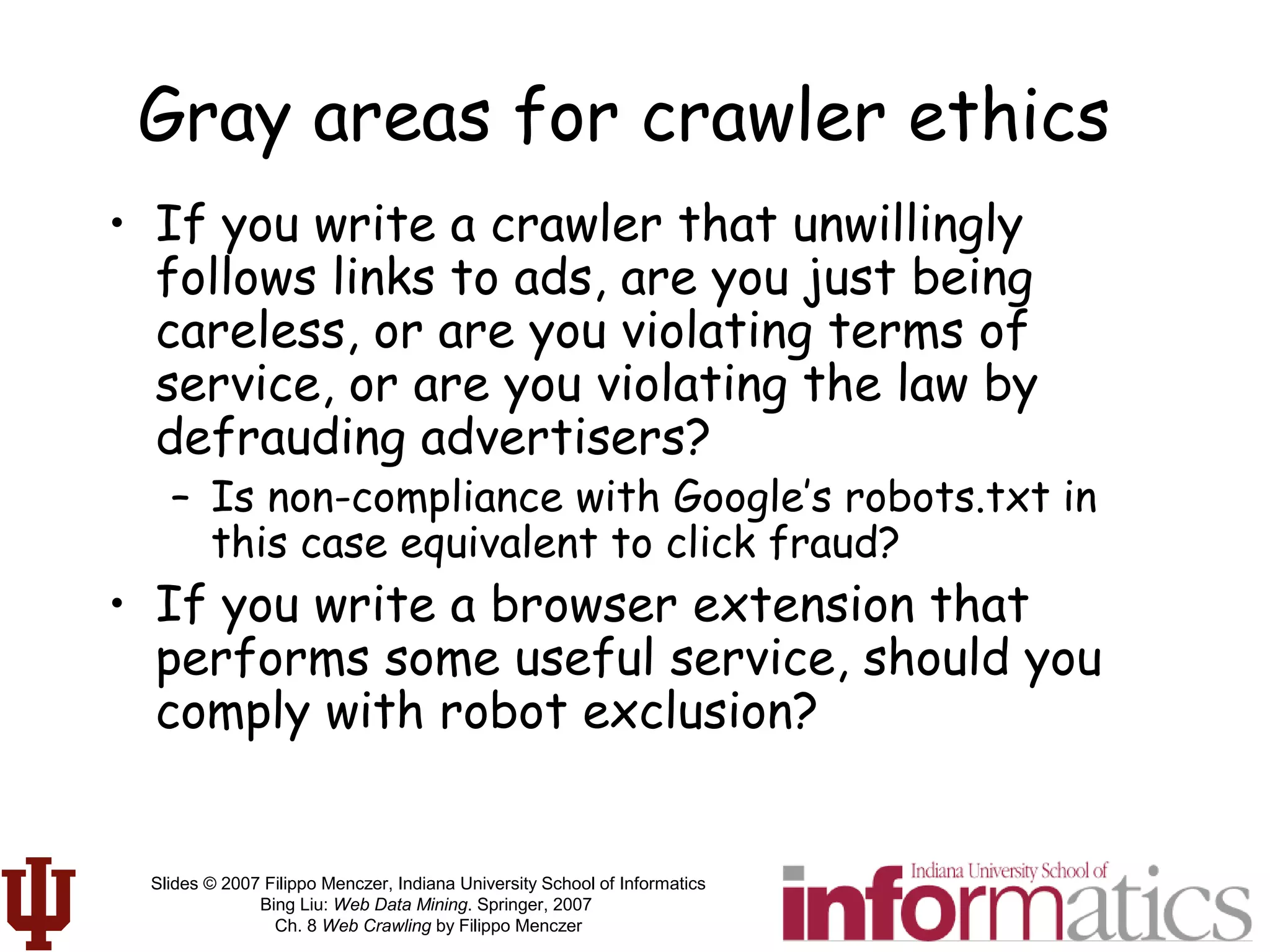
Gray areas for crawler ethics
• If you write a crawler that unwillingly
follows links to ads, are you just being
careless, or are you violating terms of
service, or are you violating the law by
defrauding advertisers?
– Is non-compliance with Google’s robots.txt in
this case equivalent to click fraud?
• If you write a browser extension that
performs some useful service, should you
comply with robot exclusion?
Slides © 2007 Filippo Menczer, Indiana University School of Informatics
Bing Liu: Web Data Mining. Springer, 2007
Ch. 8 Web Crawling by Filippo Menczer
Outline
• Motivation and taxonomy of crawlers
• Basic crawlers and implementation issues
• Universal crawlers
• Preferential (focused and topical) crawlers
• Evaluation of preferential crawlers
• Crawler ethics and conflicts
• New developments
Slides © 2007 Filippo Menczer, Indiana University School of Informatics
Bing Liu: Web Data Mining. Springer, 2007
Ch. 8 Web Crawling by Filippo Menczer
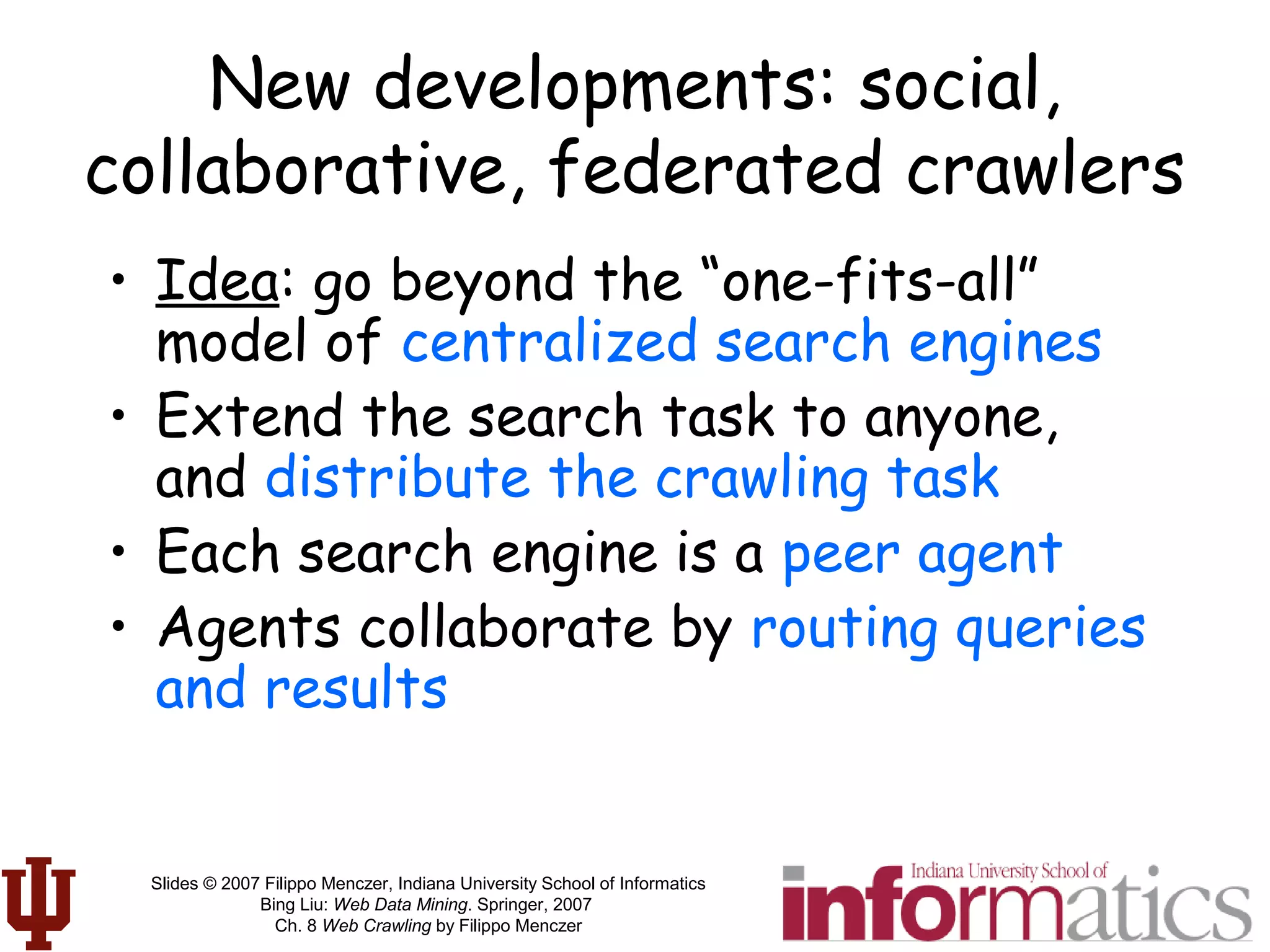
New developments: social,
collaborative, federated crawlers
• Idea: go beyond the “one-fits-all”
model of centralized search engines
• Extend the search task to anyone,
and distribute the crawling task
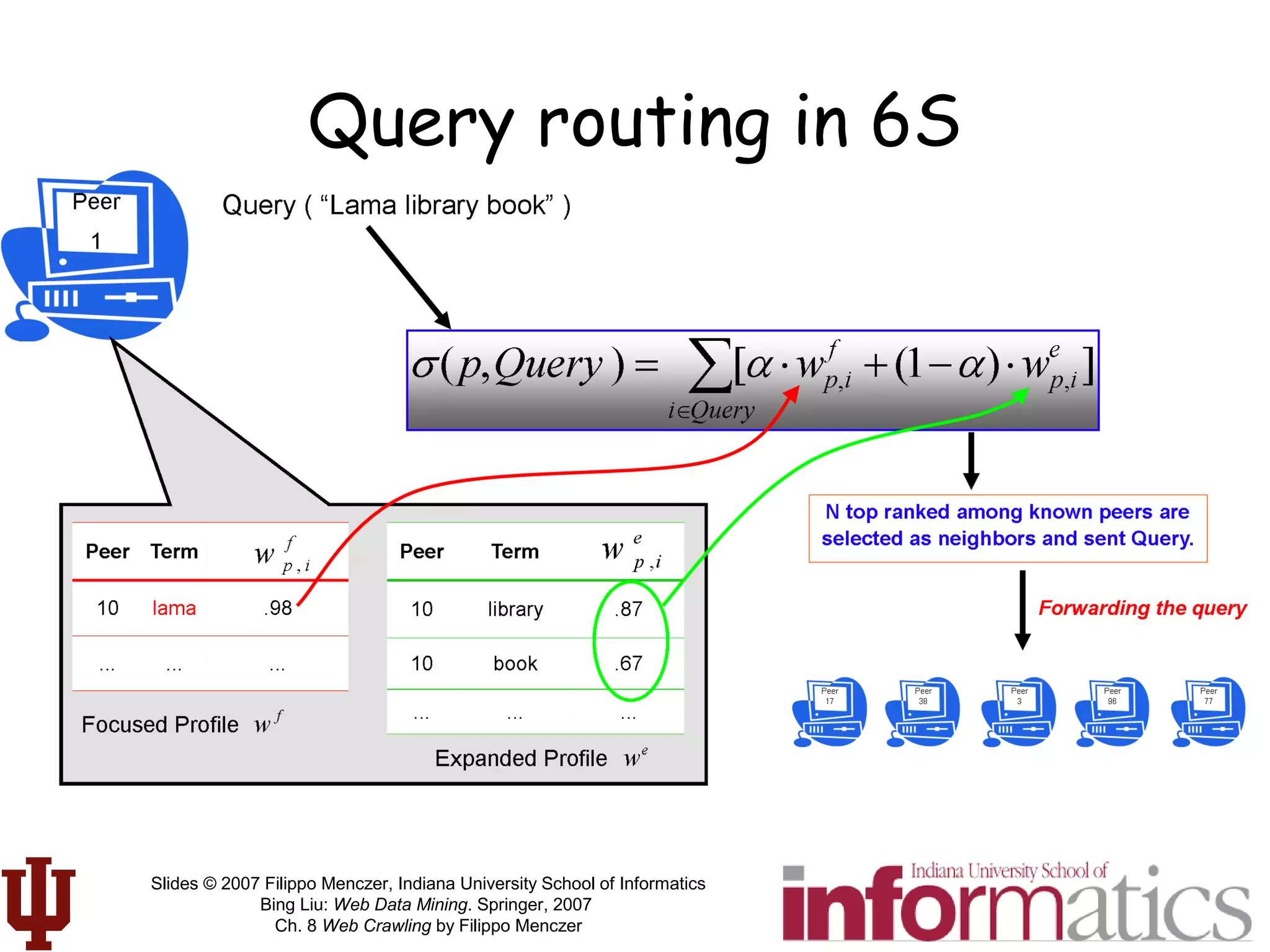
• Each search engine is a peer agent
• Agents collaborate by routing queries
and results
Slides © 2007 Filippo Menczer, Indiana University School of Informatics
Bing Liu: Web Data Mining. Springer, 2007
Ch. 8 Web Crawling by Filippo Menczer
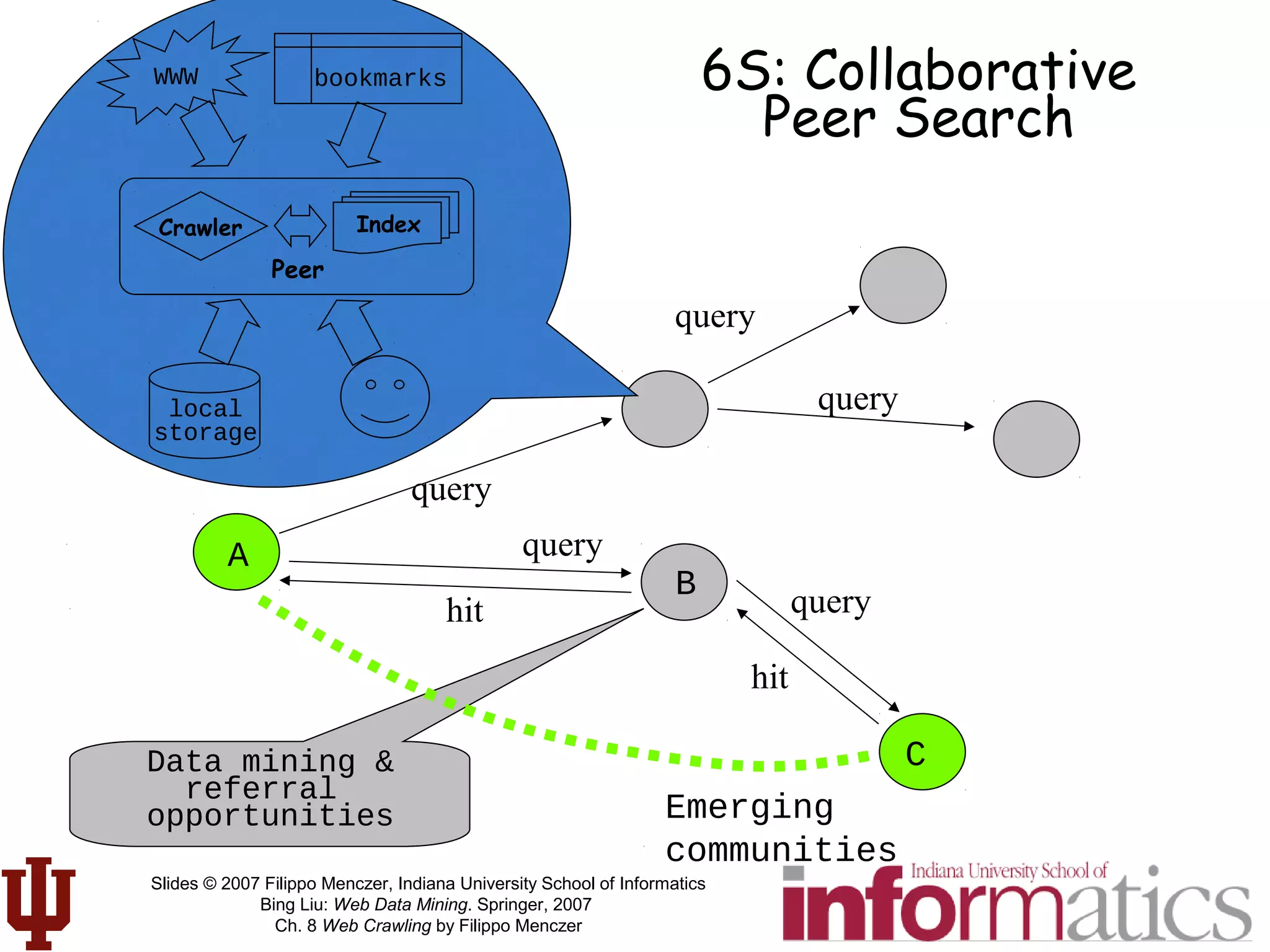
6S: Collaborative
Peer Search
A
B
query
query
hit
hit
Data mining &
referral
opportunities
query
query
query
C
Emerging
communities
bookmarks
local
storage
WWW
IndexCrawler
Peer
Slides © 2007 Filippo Menczer, Indiana University School of Informatics
Bing Liu: Web Data Mining. Springer, 2007
Ch. 8 Web Crawling by Filippo Menczer
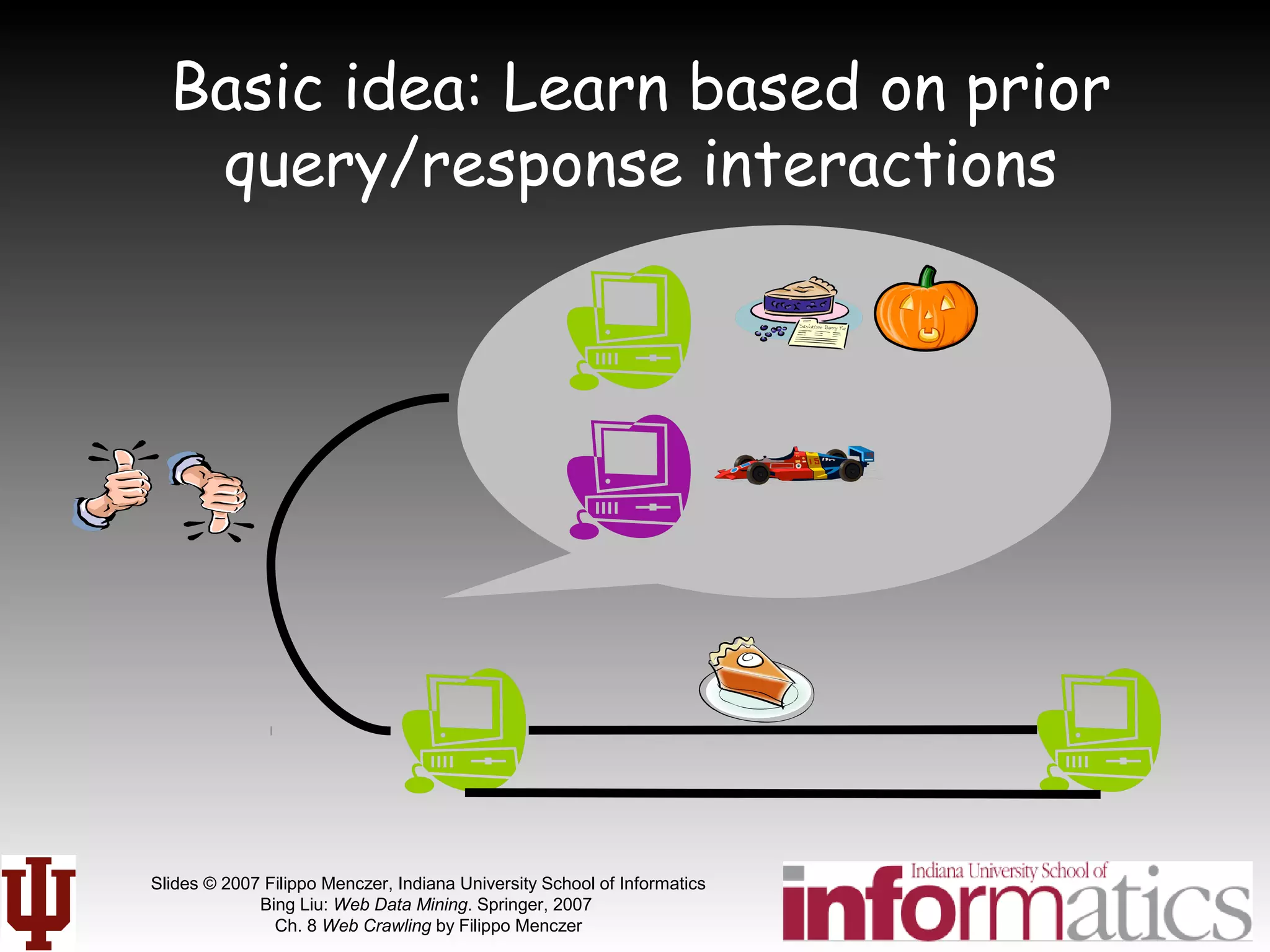
Basic idea: Learn based on prior
query/response interactions
Slides © 2007 Filippo Menczer, Indiana University School of Informatics
Bing Liu: Web Data Mining. Springer, 2007
Ch. 8 Web Crawling by Filippo Menczer
Learning about other peers
Slides © 2007 Filippo Menczer, Indiana University School of Informatics
Bing Liu: Web Data Mining. Springer, 2007
Ch. 8 Web Crawling by Filippo Menczer
Query routing in 6S
Slides © 2007 Filippo Menczer, Indiana University School of Informatics
Bing Liu: Web Data Mining. Springer, 2007
Ch. 8 Web Crawling by Filippo Menczer
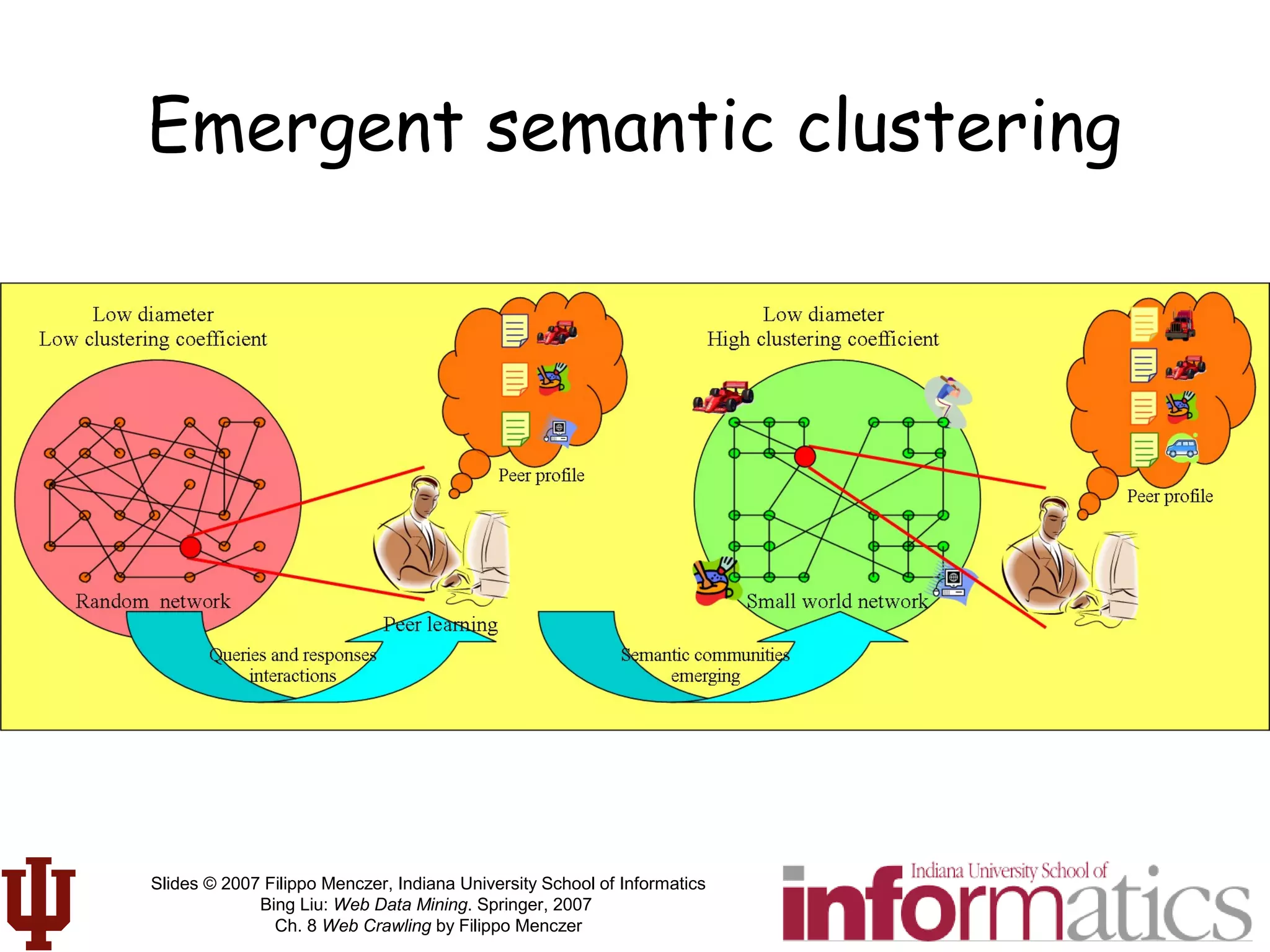
Emergent semantic clustering
Slides © 2007 Filippo Menczer, Indiana University School of Informatics
Bing Liu: Web Data Mining. Springer, 2007
Ch. 8 Web Crawling by Filippo Menczer
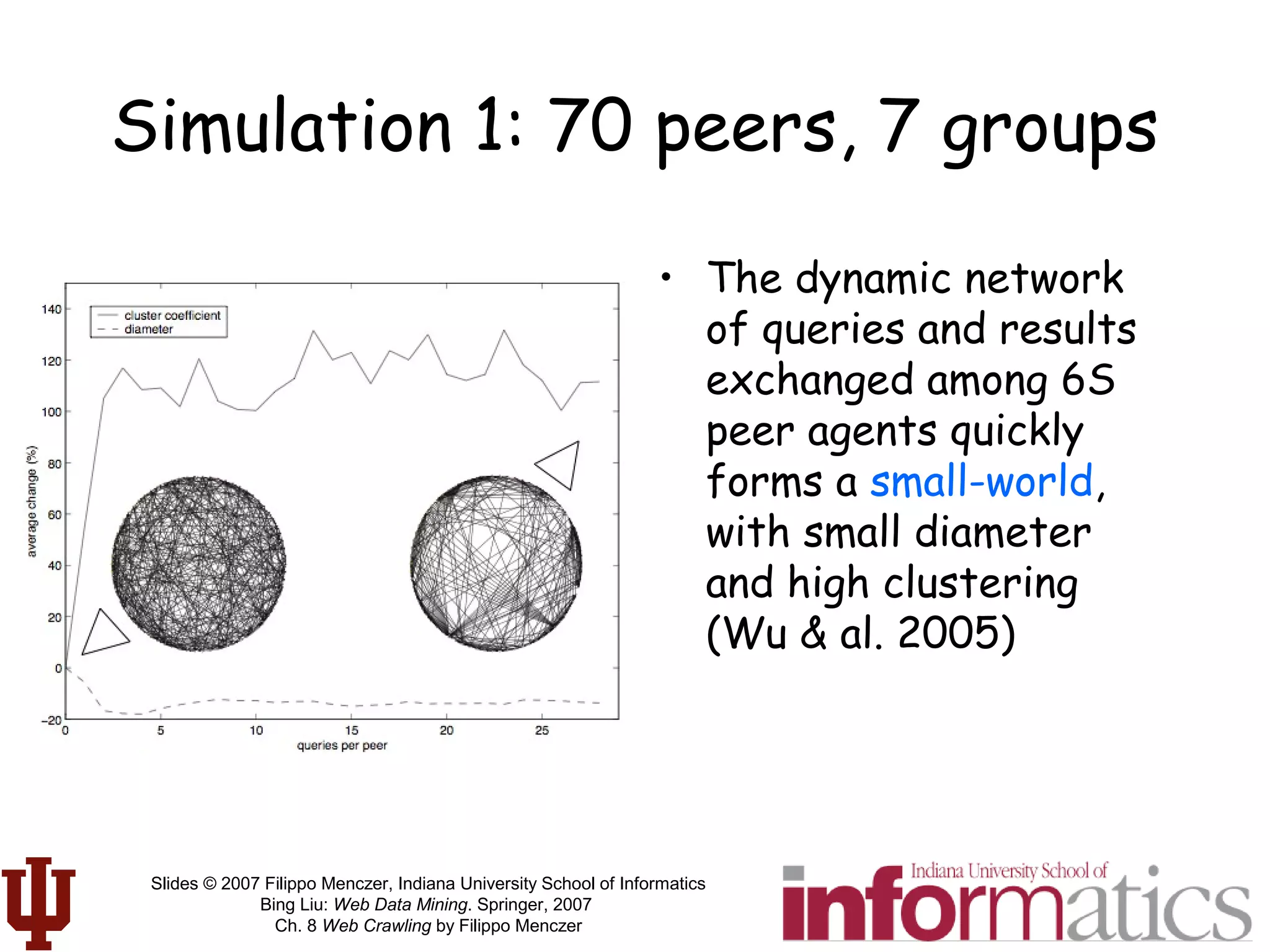
Simulation 1: 70 peers, 7 groups
• The dynamic network
of queries and results
exchanged among 6S
peer agents quickly
forms a small-world,
with small diameter
and high clustering
(Wu & al. 2005)
Slides © 2007 Filippo Menczer, Indiana University School of Informatics
Bing Liu: Web Data Mining. Springer, 2007
Ch. 8 Web Crawling by Filippo Menczer
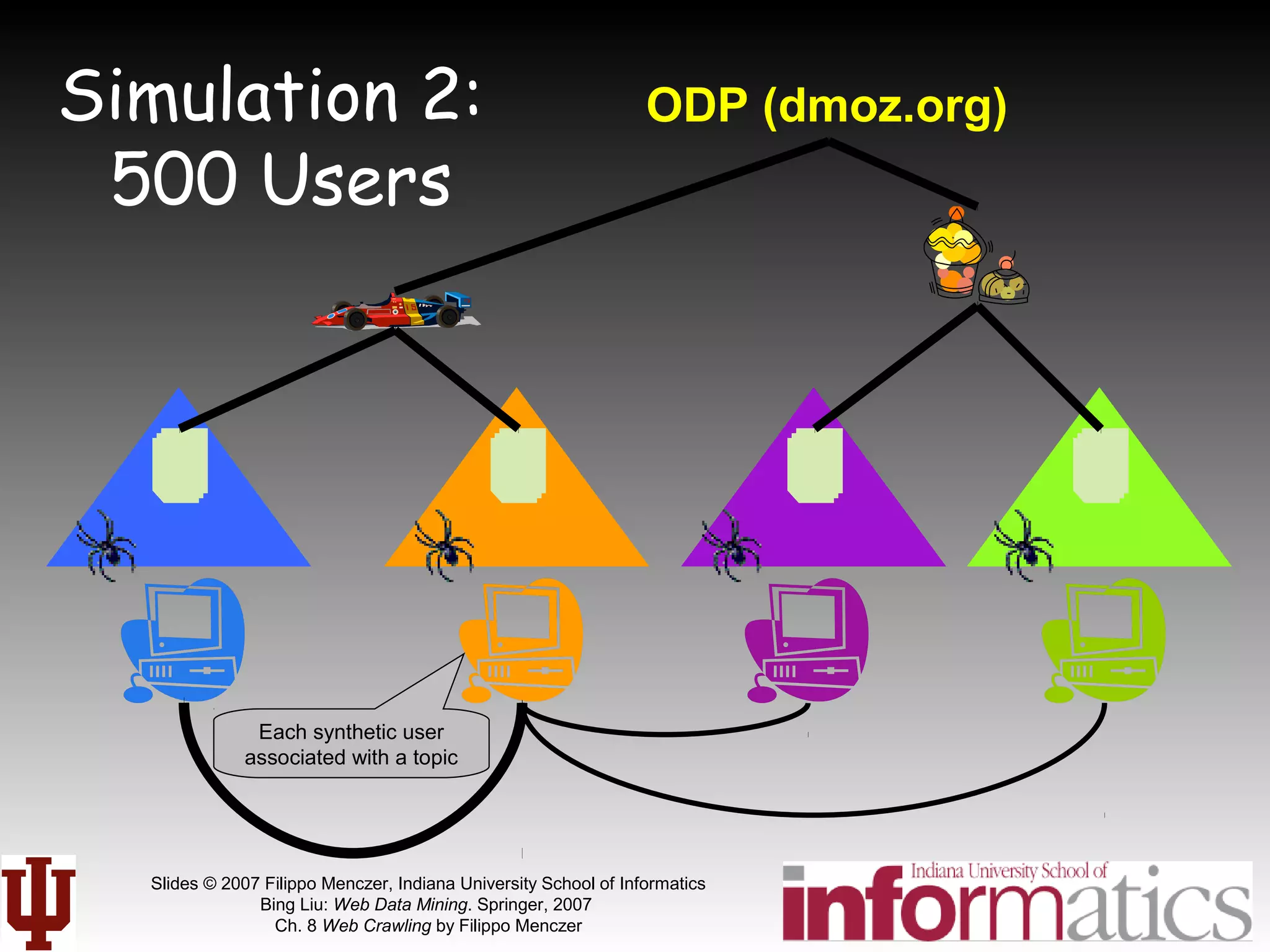
Simulation 2:
500 Users
ODP (dmoz.org)
Each synthetic user
associated with a topic
Slides © 2007 Filippo Menczer, Indiana University School of Informatics
Bing Liu: Web Data Mining. Springer, 2007
Ch. 8 Web Crawling by Filippo Menczer
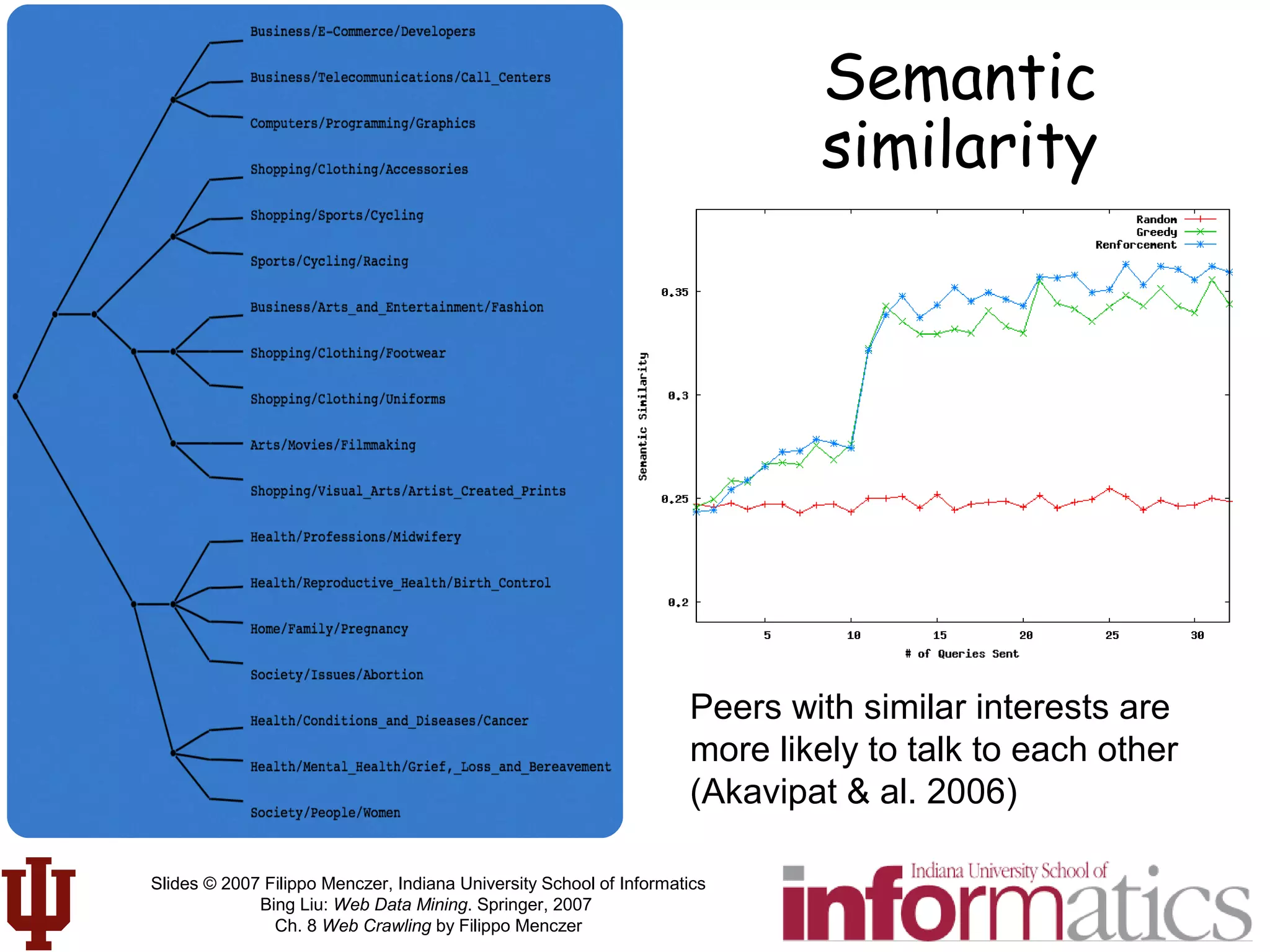
Semantic
similarity
Peers with similar interests are
more likely to talk to each other
(Akavipat & al. 2006)
Slides © 2007 Filippo Menczer, Indiana University School of Informatics
Bing Liu: Web Data Mining. Springer, 2007
Ch. 8 Web Crawling by Filippo Menczer
Quality of results
More
sophisticated
learning
algorithms
do better
The more
interactions,
the better
Slides © 2007 Filippo Menczer, Indiana University School of Informatics
Bing Liu: Web Data Mining. Springer, 2007
Ch. 8 Web Crawling by Filippo Menczer
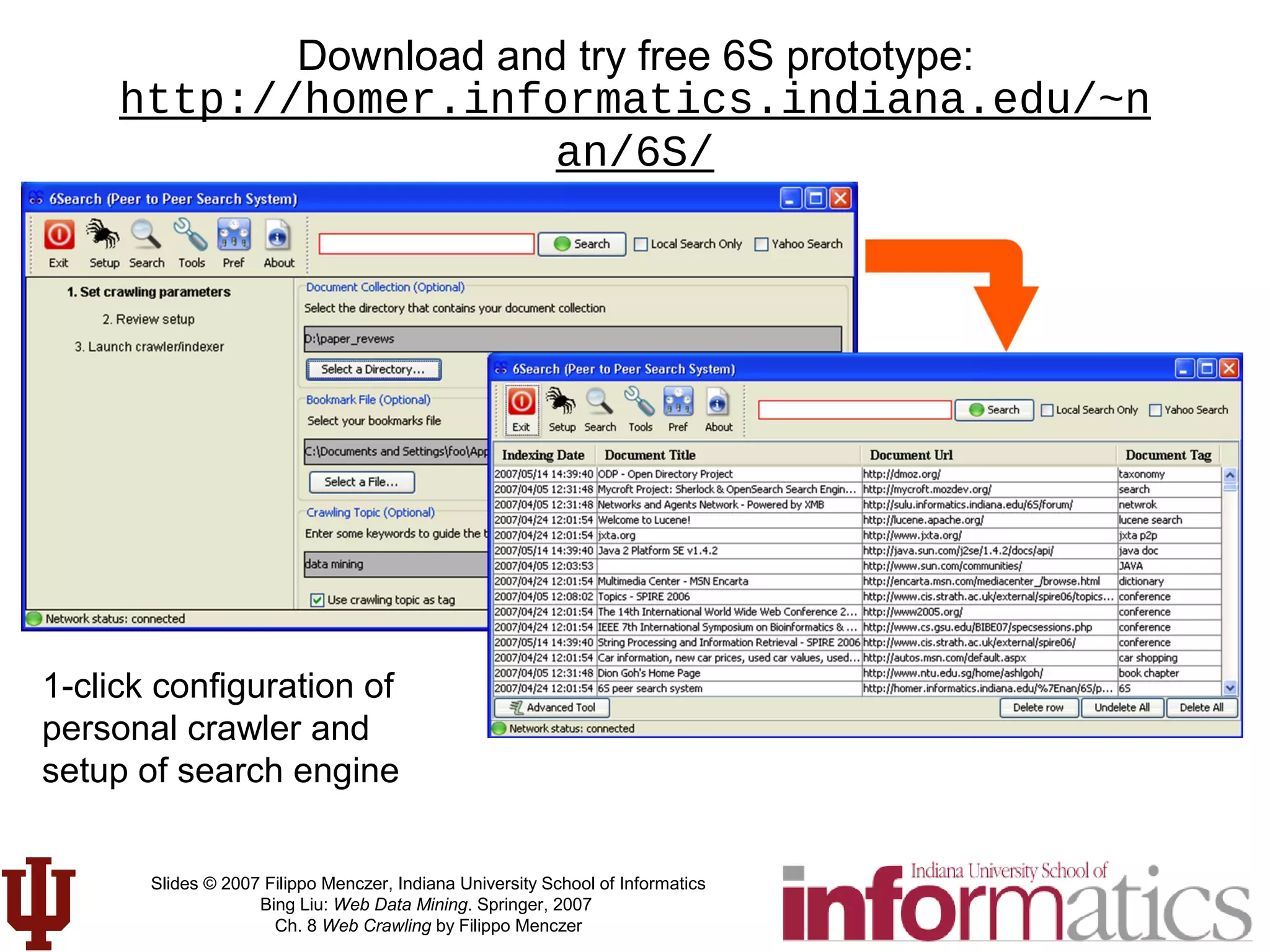
http://homer.informatics.indiana.edu/~n
an/6S/
1-click configuration of
personal crawler and
setup of search engine
Download and try free 6S prototype:
Slides © 2007 Filippo Menczer, Indiana University School of Informatics
Bing Liu: Web Data Mining. Springer, 2007
Ch. 8 Web Crawling by Filippo Menczer
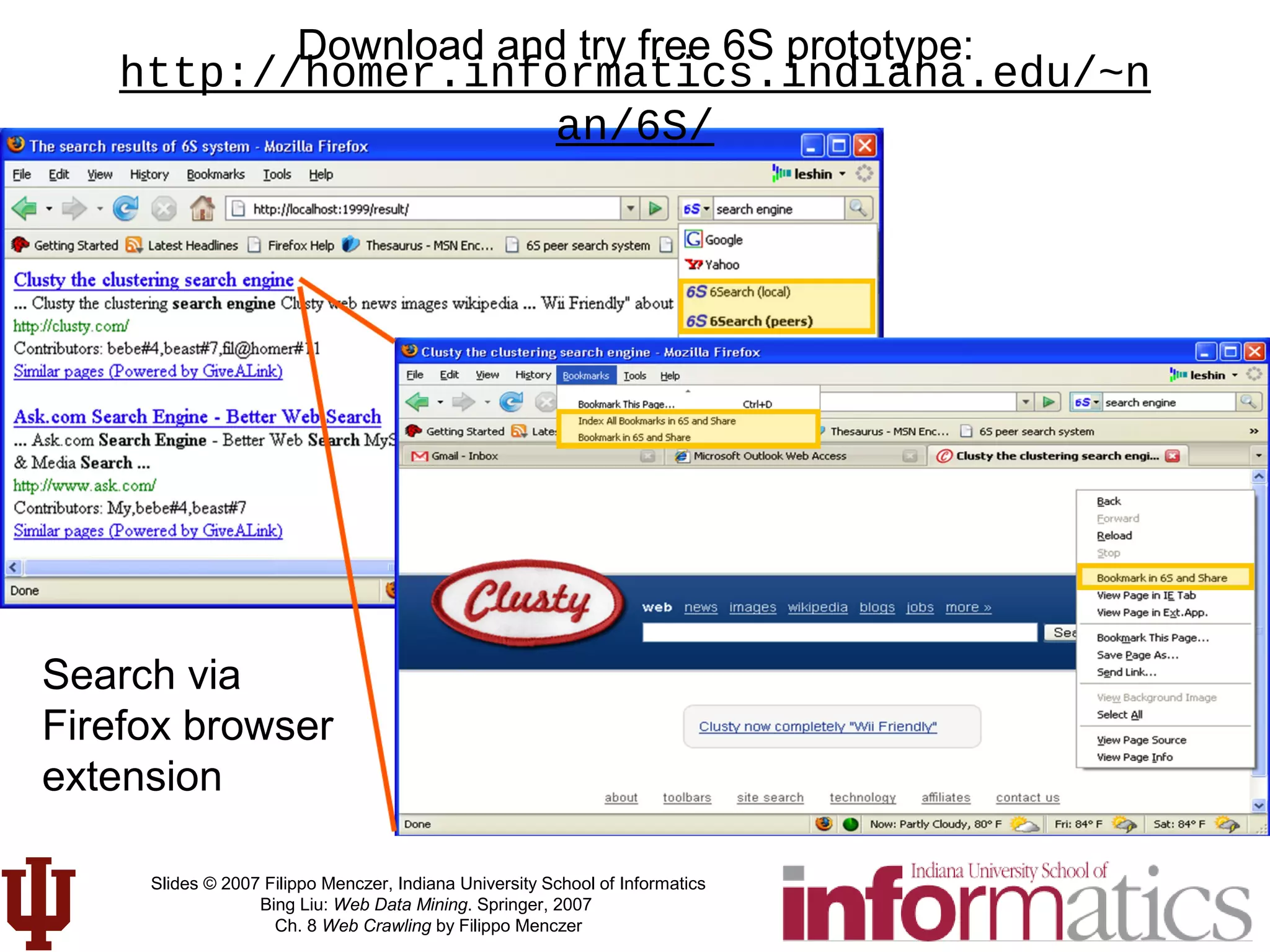
http://homer.informatics.indiana.edu/~n
an/6S/
Search via
Firefox browser
extension
Download and try free 6S prototype:
Slides © 2007 Filippo Menczer, Indiana University School of Informatics
Bing Liu: Web Data Mining. Springer, 2007
Ch. 8 Web Crawling by Filippo Menczer
Need crawling code?
• Reference C implementation of HTTP, HTML parsing, etc
– w3c-libwww package from World-Wide Web Consortium: www.w3c.org/Library/
• LWP (Perl)
– http://www.oreilly.com/catalog/perllwp/
– http://search.cpan.org/~gaas/libwww-perl-5.804/
• Open source crawlers/search engines
– Nutch: http://www.nutch.org/ (Jakarta Lucene: jakarta.apache.org/lucene/)
– Heretrix: http://crawler.archive.org/
– WIRE: http://www.cwr.cl/projects/WIRE/
– Terrier: http://ir.dcs.gla.ac.uk/terrier/
• Open source topical crawlers, Best-First-N (Java)
– http://informatics.indiana.edu/fil/IS/JavaCrawlers/
• Evaluation framework for topical crawlers (Perl)
– http://informatics.indiana.edu/fil/IS/Framework/

Web crawlingchapter

  • 1.
    Ch. 8: WebCrawling By Filippo Menczer Indiana University School of Informatics in Web Data Mining by Bing Liu Springer, 2007
  • 2.
    Slides © 2007Filippo Menczer, Indiana University School of Informatics Bing Liu: Web Data Mining. Springer, 2007 Ch. 8 Web Crawling by Filippo Menczer Outline • Motivation and taxonomy of crawlers • Basic crawlers and implementation issues • Universal crawlers • Preferential (focused and topical) crawlers • Evaluation of preferential crawlers • Crawler ethics and conflicts • New developments: social, collaborative, federated crawlers
  • 3.
    Slides © 2007Filippo Menczer, Indiana University School of Informatics Bing Liu: Web Data Mining. Springer, 2007 Ch. 8 Web Crawling by Filippo Menczer Q: How does a search engine know that all these pages contain the query terms? A: Because all of those pages have been crawled
  • 4.
    Slides © 2007Filippo Menczer, Indiana University School of Informatics Bing Liu: Web Data Mining. Springer, 2007 Ch. 8 Web Crawling by Filippo Menczer Crawler: basic idea starting pages (seeds)
  • 5.
    Slides © 2007Filippo Menczer, Indiana University School of Informatics Bing Liu: Web Data Mining. Springer, 2007 Ch. 8 Web Crawling by Filippo Menczer Many names • Crawler • Spider • Robot (or bot) • Web agent • Wanderer, worm, … • And famous instances: googlebot, scooter, slurp, msnbot, …
  • 6.
    Slides © 2007Filippo Menczer, Indiana University School of Informatics Bing Liu: Web Data Mining. Springer, 2007 Ch. 8 Web Crawling by Filippo Menczer Googlebot & you
  • 7.
    Slides © 2007Filippo Menczer, Indiana University School of Informatics Bing Liu: Web Data Mining. Springer, 2007 Ch. 8 Web Crawling by Filippo Menczer Motivation for crawlers • Support universal search engines (Google, Yahoo, MSN/Windows Live, Ask, etc.) • Vertical (specialized) search engines, e.g. news, shopping, papers, recipes, reviews, etc. • Business intelligence: keep track of potential competitors, partners • Monitor Web sites of interest • Evil: harvest emails for spamming, phishing… • … Can you think of some others?…
  • 8.
    Slides © 2007Filippo Menczer, Indiana University School of Informatics Bing Liu: Web Data Mining. Springer, 2007 Ch. 8 Web Crawling by Filippo Menczer A crawler within a search engine Web Text index PageRank Page repository googlebot Text & link analysisQuery hits Ranker
  • 9.
    Slides © 2007Filippo Menczer, Indiana University School of Informatics Bing Liu: Web Data Mining. Springer, 2007 Ch. 8 Web Crawling by Filippo Menczer One taxonomy of crawlers Universal crawlers Focused crawlers Evolutionary crawlers Reinforcement learning crawlers etc... Adaptive topical crawlers Best-first PageRank etc... Static crawlers Topical crawlers Preferential crawlers Crawlers • Many other criteria could be used: – Incremental, Interactive, Concurrent, Etc.
  • 10.
    Slides © 2007Filippo Menczer, Indiana University School of Informatics Bing Liu: Web Data Mining. Springer, 2007 Ch. 8 Web Crawling by Filippo Menczer Outline • Motivation and taxonomy of crawlers • Basic crawlers and implementation issues • Universal crawlers • Preferential (focused and topical) crawlers • Evaluation of preferential crawlers • Crawler ethics and conflicts • New developments: social, collaborative, federated crawlers
  • 11.
    Slides © 2007Filippo Menczer, Indiana University School of Informatics Bing Liu: Web Data Mining. Springer, 2007 Ch. 8 Web Crawling by Filippo Menczer Basic crawlers • This is a sequential crawler • Seeds can be any list of starting URLs • Order of page visits is determined by frontier data structure • Stop criterion can be anything
  • 12.
    Slides © 2007Filippo Menczer, Indiana University School of Informatics Bing Liu: Web Data Mining. Springer, 2007 Ch. 8 Web Crawling by Filippo Menczer Graph traversal (BFS or DFS?) • Breadth First Search – Implemented with QUEUE (FIFO) – Finds pages along shortest paths – If we start with “good” pages, this keeps us close; maybe other good stuff… • Depth First Search – Implemented with STACK (LIFO) – Wander away (“lost in cyberspace”)
  • 13.
    Slides © 2007Filippo Menczer, Indiana University School of Informatics Bing Liu: Web Data Mining. Springer, 2007 Ch. 8 Web Crawling by Filippo Menczer A basic crawler in Perl • Queue: a FIFO list (shift and push) my @frontier = read_seeds($file); while (@frontier && $tot < $max) { my $next_link = shift @frontier; my $page = fetch($next_link); add_to_index($page); my @links = extract_links($page, $next_link); push @frontier, process(@links); }
  • 14.
    Slides © 2007Filippo Menczer, Indiana University School of Informatics Bing Liu: Web Data Mining. Springer, 2007 Ch. 8 Web Crawling by Filippo Menczer Implementation issues • Don’t want to fetch same page twice! – Keep lookup table (hash) of visited pages – What if not visited but in frontier already? • The frontier grows very fast! – May need to prioritize for large crawls • Fetcher must be robust! – Don’t crash if download fails – Timeout mechanism • Determine file type to skip unwanted files – Can try using extensions, but not reliable – Can issue ‘HEAD’ HTTP commands to get Content-Type (MIME) headers, but overhead of extra Internet requests
  • 15.
    Slides © 2007Filippo Menczer, Indiana University School of Informatics Bing Liu: Web Data Mining. Springer, 2007 Ch. 8 Web Crawling by Filippo Menczer More implementation issues • Fetching – Get only the first 10-100 KB per page – Take care to detect and break redirection loops – Soft fail for timeout, server not responding, file not found, and other errors
  • 16.
    Slides © 2007Filippo Menczer, Indiana University School of Informatics Bing Liu: Web Data Mining. Springer, 2007 Ch. 8 Web Crawling by Filippo Menczer More implementation issues: Parsing • HTML has the structure of a DOM (Document Object Model) tree • Unfortunately actual HTML is often incorrect in a strict syntactic sense • Crawlers, like browsers, must be robust/forgiving • Fortunately there are tools that can help – E.g. tidy.sourceforge.net • Must pay attention to HTML entities and unicode in text • What to do with a growing number of other formats? – Flash, SVG, RSS, AJAX…
  • 17.
    Slides © 2007Filippo Menczer, Indiana University School of Informatics Bing Liu: Web Data Mining. Springer, 2007 Ch. 8 Web Crawling by Filippo Menczer More implementation issues • Stop words – Noise words that do not carry meaning should be eliminated (“stopped”) before they are indexed – E.g. in English: AND, THE, A, AT, OR, ON, FOR, etc… – Typically syntactic markers – Typically the most common terms – Typically kept in a negative dictionary • 10–1,000 elements • E.g. http://ir.dcs.gla.ac.uk/resources/linguistic_utils/stop_words – Parser can detect these right away and disregard them
  • 18.
    Slides © 2007Filippo Menczer, Indiana University School of Informatics Bing Liu: Web Data Mining. Springer, 2007 Ch. 8 Web Crawling by Filippo Menczer More implementation issues Conflation and thesauri • Idea: improve recall by merging words with same meaning 1. We want to ignore superficial morphological features, thus merge semantically similar tokens – {student, study, studying, studious} => studi 1. We can also conflate synonyms into a single form using a thesaurus – 30-50% smaller index – Doing this in both pages and queries allows to retrieve pages about ‘automobile’ when user asks for ‘car’ – Thesaurus can be implemented as a hash table
  • 19.
    Slides © 2007Filippo Menczer, Indiana University School of Informatics Bing Liu: Web Data Mining. Springer, 2007 Ch. 8 Web Crawling by Filippo Menczer More implementation issues • Stemming – Morphological conflation based on rewrite rules – Language dependent! – Porter stemmer very popular for English • http://www.tartarus.org/~martin/PorterStemmer/ • Context-sensitive grammar rules, eg: – “IES” except (“EIES” or “AIES”) --> “Y” • Versions in Perl, C, Java, Python, C#, Ruby, PHP, etc. – Porter has also developed Snowball, a language to create stemming algorithms in any language • http://snowball.tartarus.org/ • Ex. Perl modules: Lingua::Stem and Lingua::Stem::Snowball
  • 20.
    Slides © 2007Filippo Menczer, Indiana University School of Informatics Bing Liu: Web Data Mining. Springer, 2007 Ch. 8 Web Crawling by Filippo Menczer More implementation issues • Static vs. dynamic pages – Is it worth trying to eliminate dynamic pages and only index static pages? – Examples: • http://www.census.gov/cgi-bin/gazetteer • http://informatics.indiana.edu/research/colloquia.asp • http://www.amazon.com/exec/obidos/subst/home/home.html/002-8332429-6490452 • http://www.imdb.com/Name?Menczer,+Erico • http://www.imdb.com/name/nm0578801/ – Why or why not? How can we tell if a page is dynamic? What about ‘spider traps’? – What do Google and other search engines do?
  • 21.
    Slides © 2007Filippo Menczer, Indiana University School of Informatics Bing Liu: Web Data Mining. Springer, 2007 Ch. 8 Web Crawling by Filippo Menczer More implementation issues • Relative vs. Absolute URLs – Crawler must translate relative URLs into absolute URLs – Need to obtain Base URL from HTTP header, or HTML Meta tag, or else current page path by default – Examples • Base: http://www.cnn.com/linkto/ • Relative URL: intl.html • Absolute URL: http://www.cnn.com/linkto/intl.html • Relative URL: /US/ • Absolute URL: http://www.cnn.com/US/
  • 22.
    Slides © 2007Filippo Menczer, Indiana University School of Informatics Bing Liu: Web Data Mining. Springer, 2007 Ch. 8 Web Crawling by Filippo Menczer More implementation issues • URL canonicalization – All of these: • http://www.cnn.com/TECH • http://WWW.CNN.COM/TECH/ • http://www.cnn.com:80/TECH/ • http://www.cnn.com/bogus/../TECH/ – Are really equivalent to this canonical form: • http://www.cnn.com/TECH/ – In order to avoid duplication, the crawler must transform all URLs into canonical form – Definition of “canonical” is arbitrary, e.g.: • Could always include port • Or only include port when not default :80
  • 23.
    Slides © 2007Filippo Menczer, Indiana University School of Informatics Bing Liu: Web Data Mining. Springer, 2007 Ch. 8 Web Crawling by Filippo Menczer More on Canonical URLs • Some transformation are trivial, for example:  http://informatics.indiana.edu  http://informatics.indiana.edu/  http://informatics.indiana.edu/index.html#fragment  http://informatics.indiana.edu/index.html  http://informatics.indiana.edu/dir1/./../dir2/  http://informatics.indiana.edu/dir2/  http://informatics.indiana.edu/%7Efil/  http://informatics.indiana.edu/~fil/  http://INFORMATICS.INDIANA.EDU/fil/  http://informatics.indiana.edu/fil/
  • 24.
    Slides © 2007Filippo Menczer, Indiana University School of Informatics Bing Liu: Web Data Mining. Springer, 2007 Ch. 8 Web Crawling by Filippo Menczer More on Canonical URLs Other transformations require heuristic assumption about the intentions of the author or configuration of the Web server: 1. Removing default file name  http://informatics.indiana.edu/fil/index.html  http://informatics.indiana.edu/fil/ – This is reasonable in general but would be wrong in this case because the default happens to be ‘default.asp’ instead of ‘index.html’ 1. Trailing directory  http://informatics.indiana.edu/fil  http://informatics.indiana.edu/fil/ – This is correct in this case but how can we be sure in general that there isn’t a file named ‘fil’ in the root dir?
  • 25.
    Slides © 2007Filippo Menczer, Indiana University School of Informatics Bing Liu: Web Data Mining. Springer, 2007 Ch. 8 Web Crawling by Filippo Menczer More implementation issues • Spider traps – Misleading sites: indefinite number of pages dynamically generated by CGI scripts – Paths of arbitrary depth created using soft directory links and path rewriting features in HTTP server – Only heuristic defensive measures: • Check URL length; assume spider trap above some threshold, for example 128 characters • Watch for sites with very large number of URLs • Eliminate URLs with non-textual data types • May disable crawling of dynamic pages, if can detect
  • 26.
    Slides © 2007Filippo Menczer, Indiana University School of Informatics Bing Liu: Web Data Mining. Springer, 2007 Ch. 8 Web Crawling by Filippo Menczer More implementation issues • Page repository – Naïve: store each page as a separate file • Can map URL to unique filename using a hashing function, e.g. MD5 • This generates a huge number of files, which is inefficient from the storage perspective – Better: combine many pages into a single large file, using some XML markup to separate and identify them • Must map URL to {filename, page_id} – Database options • Any RDBMS -- large overhead • Light-weight, embedded databases such as Berkeley DB
  • 27.
    Slides © 2007Filippo Menczer, Indiana University School of Informatics Bing Liu: Web Data Mining. Springer, 2007 Ch. 8 Web Crawling by Filippo Menczer Concurrency • A crawler incurs several delays: – Resolving the host name in the URL to an IP address using DNS – Connecting a socket to the server and sending the request – Receiving the requested page in response • Solution: Overlap the above delays by fetching many pages concurrently
  • 28.
    Slides © 2007Filippo Menczer, Indiana University School of Informatics Bing Liu: Web Data Mining. Springer, 2007 Ch. 8 Web Crawling by Filippo Menczer Architecture of a concurrent crawler
  • 29.
    Slides © 2007Filippo Menczer, Indiana University School of Informatics Bing Liu: Web Data Mining. Springer, 2007 Ch. 8 Web Crawling by Filippo Menczer Concurrent crawlers • Can use multi-processing or multi-threading • Each process or thread works like a sequential crawler, except they share data structures: frontier and repository • Shared data structures must be synchronized (locked for concurrent writes) • Speedup of factor of 5-10 are easy this way
  • 30.
    Slides © 2007Filippo Menczer, Indiana University School of Informatics Bing Liu: Web Data Mining. Springer, 2007 Ch. 8 Web Crawling by Filippo Menczer Outline • Motivation and taxonomy of crawlers • Basic crawlers and implementation issues • Universal crawlers • Preferential (focused and topical) crawlers • Evaluation of preferential crawlers • Crawler ethics and conflicts • New developments: social, collaborative, federated crawlers
  • 31.
    Slides © 2007Filippo Menczer, Indiana University School of Informatics Bing Liu: Web Data Mining. Springer, 2007 Ch. 8 Web Crawling by Filippo Menczer Universal crawlers • Support universal search engines • Large-scale • Huge cost (network bandwidth) of crawl is amortized over many queries from users • Incremental updates to existing index and other data repositories
  • 32.
    Slides © 2007Filippo Menczer, Indiana University School of Informatics Bing Liu: Web Data Mining. Springer, 2007 Ch. 8 Web Crawling by Filippo Menczer Large-scale universal crawlers • Two major issues: 1. Performance • Need to scale up to billions of pages 2. Policy • Need to trade-off coverage, freshness, and bias (e.g. toward “important” pages)
  • 33.
    Slides © 2007Filippo Menczer, Indiana University School of Informatics Bing Liu: Web Data Mining. Springer, 2007 Ch. 8 Web Crawling by Filippo Menczer Large-scale crawlers: scalability • Need to minimize overhead of DNS lookups • Need to optimize utilization of network bandwidth and disk throughput (I/O is bottleneck) • Use asynchronous sockets – Multi-processing or multi-threading do not scale up to billions of pages – Non-blocking: hundreds of network connections open simultaneously – Polling socket to monitor completion of network transfers
  • 34.
    Slides © 2007Filippo Menczer, Indiana University School of Informatics Bing Liu: Web Data Mining. Springer, 2007 Ch. 8 Web Crawling by Filippo Menczer High-level architecture of a scalable universal crawler Several parallel queues to spread load across servers (keep connections alive) DNS server using UDP (less overhead than TCP), large persistent in-memory cache, and prefetching Optimize use of network bandwidth Optimize disk I/O throughputHuge farm of crawl machines
  • 35.
    Slides © 2007Filippo Menczer, Indiana University School of Informatics Bing Liu: Web Data Mining. Springer, 2007 Ch. 8 Web Crawling by Filippo Menczer Universal crawlers: Policy • Coverage – New pages get added all the time – Can the crawler find every page? • Freshness – Pages change over time, get removed, etc. – How frequently can a crawler revisit ? • Trade-off! – Focus on most “important” pages (crawler bias)? – “Importance” is subjective
  • 36.
    Slides © 2007Filippo Menczer, Indiana University School of Informatics Bing Liu: Web Data Mining. Springer, 2007 Ch. 8 Web Crawling by Filippo Menczer Web coverage by search engine crawlers 35% 34% 16% 50% 0% 10% 20% 30% 40% 50% 60% 70% 80% 90% 100% 1997 1998 1999 2000 This assumes we know the size of the entire the Web. Do we? Can you define “the size of the Web”?
  • 37.
    Slides © 2007Filippo Menczer, Indiana University School of Informatics Bing Liu: Web Data Mining. Springer, 2007 Ch. 8 Web Crawling by Filippo Menczer Maintaining a “fresh” collection • Universal crawlers are never “done” • High variance in rate and amount of page changes • HTTP headers are notoriously unreliable – Last-modified – Expires • Solution – Estimate the probability that a previously visited page has changed in the meanwhile – Prioritize by this probability estimate
  • 38.
    Slides © 2007Filippo Menczer, Indiana University School of Informatics Bing Liu: Web Data Mining. Springer, 2007 Ch. 8 Web Crawling by Filippo Menczer Estimating page change rates • Algorithms for maintaining a crawl in which most pages are fresher than a specified epoch – Brewington & Cybenko; Cho, Garcia-Molina & Page • Assumption: recent past predicts the future (Ntoulas, Cho & Olston 2004) – Frequency of change not a good predictor – Degree of change is a better predictor
  • 39.
    Slides © 2007Filippo Menczer, Indiana University School of Informatics Bing Liu: Web Data Mining. Springer, 2007 Ch. 8 Web Crawling by Filippo Menczer Do we need to crawl the entire Web? • If we cover too much, it will get stale • There is an abundance of pages in the Web • For PageRank, pages with very low prestige are largely useless • What is the goal? – General search engines: pages with high prestige – News portals: pages that change often – Vertical portals: pages on some topic • What are appropriate priority measures in these cases? Approximations?
  • 40.
    Slides © 2007Filippo Menczer, Indiana University School of Informatics Bing Liu: Web Data Mining. Springer, 2007 Ch. 8 Web Crawling by Filippo Menczer Breadth-first crawlers • BF crawler tends to crawl high- PageRank pages very early • Therefore, BF crawler is a good baseline to gauge other crawlers • But why is this so? Najork and Weiner 2001
  • 41.
    Slides © 2007Filippo Menczer, Indiana University School of Informatics Bing Liu: Web Data Mining. Springer, 2007 Ch. 8 Web Crawling by Filippo Menczer Bias of breadth-first crawlers • The structure of the Web graph is very different from a random network • Power-law distribution of in-degree • Therefore there are hub pages with very high PR and many incoming links • These are attractors: you cannot avoid them!
  • 42.
    Slides © 2007Filippo Menczer, Indiana University School of Informatics Bing Liu: Web Data Mining. Springer, 2007 Ch. 8 Web Crawling by Filippo Menczer Outline • Motivation and taxonomy of crawlers • Basic crawlers and implementation issues • Universal crawlers • Preferential (focused and topical) crawlers • Evaluation of preferential crawlers • Crawler ethics and conflicts • New developments: social, collaborative, federated crawlers
  • 43.
    Slides © 2007Filippo Menczer, Indiana University School of Informatics Bing Liu: Web Data Mining. Springer, 2007 Ch. 8 Web Crawling by Filippo Menczer Preferential crawlers • Assume we can estimate for each page an importance measure, I(p) • Want to visit pages in order of decreasing I(p) • Maintain the frontier as a priority queue sorted by I(p) • Possible figures of merit: – Precision ~ | p: crawled(p) & I(p) > threshold | / | p: crawled(p) | – Recall ~ | p: crawled(p) & I(p) > threshold | / | p: I(p) > threshold |
  • 44.
    Slides © 2007Filippo Menczer, Indiana University School of Informatics Bing Liu: Web Data Mining. Springer, 2007 Ch. 8 Web Crawling by Filippo Menczer Preferential crawlers • Selective bias toward some pages, eg. most “relevant”/topical, closest to seeds, most popular/largest PageRank, unknown servers, highest rate/amount of change, etc… • Focused crawlers – Supervised learning: classifier based on labeled examples • Topical crawlers – Best-first search based on similarity(topic, parent) – Adaptive crawlers • Reinforcement learning • Evolutionary algorithms/artificial life
  • 45.
    Slides © 2007Filippo Menczer, Indiana University School of Informatics Bing Liu: Web Data Mining. Springer, 2007 Ch. 8 Web Crawling by Filippo Menczer Preferential crawling algorithms: Examples • Breadth-First – Exhaustively visit all links in order encountered • Best-N-First – Priority queue sorted by similarity, explore top N at a time – Variants: DOM context, hub scores • PageRank – Priority queue sorted by keywords, PageRank • SharkSearch – Priority queue sorted by combination of similarity, anchor text, similarity of parent, etc. (powerful cousin of FishSearch) • InfoSpiders – Adaptive distributed algorithm using an evolving population of learning agents
  • 46.
    Slides © 2007Filippo Menczer, Indiana University School of Informatics Bing Liu: Web Data Mining. Springer, 2007 Ch. 8 Web Crawling by Filippo Menczer Preferential crawlers: Examples Recall Crawl size • For I(p) = PageRank (estimated based on pages crawled so far), we can find high-PR pages faster than a breadth-first crawler (Cho, Garcia- Molina & Page 1998)
  • 47.
    Slides © 2007Filippo Menczer, Indiana University School of Informatics Bing Liu: Web Data Mining. Springer, 2007 Ch. 8 Web Crawling by Filippo Menczer Focused crawlers: Basic idea • Naïve-Bayes classifier based on example pages in desired topic, c* • Score(p) = Pr(c*|p) – Soft focus: frontier is priority queue using page score – Hard focus: • Find best leaf ĉ for p • If an ancestor c’ of ĉ is in c* then add links from p to frontier, else discard – Soft and hard focus work equally well empirically Example: Open Directory
  • 48.
    Slides © 2007Filippo Menczer, Indiana University School of Informatics Bing Liu: Web Data Mining. Springer, 2007 Ch. 8 Web Crawling by Filippo Menczer Focused crawlers • Can have multiple topics with as many classifiers, with scores appropriately combined (Chakrabarti et al. 1999) • Can use a distiller to find topical hubs periodically, and add these to the frontier • Can accelerate with the use of a critic (Chakrabarti et al. 2002) • Can use alternative classifier algorithms to naïve- Bayes, e.g. SVM and neural nets have reportedly performed better (Pant & Srinivasan 2005)
  • 49.
    Slides © 2007Filippo Menczer, Indiana University School of Informatics Bing Liu: Web Data Mining. Springer, 2007 Ch. 8 Web Crawling by Filippo Menczer Context-focused crawlers • Same idea, but multiple classes (and classifiers) based on link distance from relevant targets – ℓ=0 is topic of interest – ℓ=1 link to topic of interest – Etc. • Initially needs a back-crawl from seeds (or known targets) to train classifiers to estimate distance • Links in frontier prioritized based on estimated distance from targets • Outperforms standard focused crawler empirically Context graph
  • 50.
    Slides © 2007Filippo Menczer, Indiana University School of Informatics Bing Liu: Web Data Mining. Springer, 2007 Ch. 8 Web Crawling by Filippo Menczer Topical crawlers • All we have is a topic (query, description, keywords) and a set of seed pages (not necessarily relevant) • No labeled examples • Must predict relevance of unvisited links to prioritize • Original idea: Menczer 1997, Menczer & Belew 1998
  • 51.
    Slides © 2007Filippo Menczer, Indiana University School of Informatics Bing Liu: Web Data Mining. Springer, 2007 Ch. 8 Web Crawling by Filippo Menczer Example: myspiders.informatics.indiana.edu
  • 52.
    Slides © 2007Filippo Menczer, Indiana University School of Informatics Bing Liu: Web Data Mining. Springer, 2007 Ch. 8 Web Crawling by Filippo Menczer Topical locality • Topical locality is a necessary condition for a topical crawler to work, and for surfing to be a worthwhile activity for humans • Links must encode semantic information, i.e. say something about neighbor pages, not be random • It is also a sufficient condition if we start from “good” seed pages • Indeed we know that Web topical locality is strong : – Indirectly (crawlers work and people surf the Web) – From direct measurements (Davison 2000; Menczer 2004, 2005)
  • 53.
    Slides © 2007Filippo Menczer, Indiana University School of Informatics Bing Liu: Web Data Mining. Springer, 2007 Ch. 8 Web Crawling by Filippo Menczer Quantifying topical locality • Different ways to pose the question: – How quickly does semantic locality decay? – How fast is topic drift? – How quickly does content change as we surf away from a starting page? • To answer these questions, let us consider exhaustive breadth-first crawls from 100 topic pages
  • 54.
    Slides © 2007Filippo Menczer, Indiana University School of Informatics Bing Liu: Web Data Mining. Springer, 2007 Ch. 8 Web Crawling by Filippo Menczer G = 5/15 C = 2 R = 3/6 = 2/4 The “link-cluster” conjecture • Connection between semantic topology (relevance) and link topology (hypertext) – G = Pr[rel(p)] ~ fraction of relevant/topical pages (topic generality) – R = Pr[rel(p) | rel(q) AND link(q,p)] ~ cond. prob. Given neighbor on topic • Related nodes are clustered if R > G – Necessary and sufficient condition for a random crawler to find pages related to start points – Example: 2 topical clusters with stronger modularity within each cluster than outside
  • 55.
    Slides © 2007Filippo Menczer, Indiana University School of Informatics Bing Liu: Web Data Mining. Springer, 2007 Ch. 8 Web Crawling by Filippo Menczer • Stationary hit rate for a random crawler: Link-cluster conjecture η(t + 1) = η(t) ⋅ R + (1 −η(t))⋅ G ≥ η(t) η t →∞ ⏐ →⏐ ⏐ η ∗ = G 1− (R − G) η∗ > G ⇔ R > G η∗ G −1 = R− G 1 − (R− G) Value added of links Conjecture
  • 56.
    Slides © 2007Filippo Menczer, Indiana University School of Informatics Bing Liu: Web Data Mining. Springer, 2007 Ch. 8 Web Crawling by Filippo Menczer • Preservation of semantics (meaning) across links • 1000 times more likely to be on topic if near an on-topic page! Link-cluster conjecture R(q,δ) G(q) ≡ Pr rel(p) | rel(q)∧ path(q, p) ≤δ[ ] Pr[rel(p)] L(q,δ) ≡ path(q, p) { p: path(q,p) ≤δ } ∑ {p : path(q, p) ≤δ}
  • 57.
    Slides © 2007Filippo Menczer, Indiana University School of Informatics Bing Liu: Web Data Mining. Springer, 2007 Ch. 8 Web Crawling by Filippo Menczer • Correlation of lexical (content) and linkage topology • L(δ): average link distance • S(δ): average content similarity to start (topic) page from pages up to distance δ • Correlation ρ(L,S) = –0.76 The “link-content” conjecture S(q,δ) ≡ sim(q, p) {p: path(q,p) ≤δ } ∑ {p : path(q, p) ≤δ}
  • 58.
    Slides © 2007Filippo Menczer, Indiana University School of Informatics Bing Liu: Web Data Mining. Springer, 2007 Ch. 8 Web Crawling by Filippo Menczer Heterogeneity of link-content correlation S = c + (1−c)eaLb edu net gov org com signif. diff. a only (α=0.05) signif. diff. a & b (α=0.05) .com has more drift
  • 59.
    Slides © 2007Filippo Menczer, Indiana University School of Informatics Bing Liu: Web Data Mining. Springer, 2007 Ch. 8 Web Crawling by Filippo Menczer Topical locality-inspired tricks for topical crawlers • Co-citation (a.k.a. sibling locality): A and C are good hubs, thus A and D should be given high priority • Co-reference (a.k.a. blbliographic coupling): E and G are good authorities, thus E and H should be given high priority
  • 60.
    Slides © 2007Filippo Menczer, Indiana University School of Informatics Bing Liu: Web Data Mining. Springer, 2007 Ch. 8 Web Crawling by Filippo Menczer Correlations between different similarity measures • Semantic similarity measured from ODP, correlated with: – Content similarity: TF or TF-IDF vector cosine – Link similarity: Jaccard coefficient of (in+out) link neighborhoods • Correlation overall is significant but weak • Much stronger topical locality in some topics, e.g.: – Links very informative in news sources – Text very informative in recipes
  • 61.
    Slides © 2007Filippo Menczer, Indiana University School of Informatics Bing Liu: Web Data Mining. Springer, 2007 Ch. 8 Web Crawling by Filippo Menczer Naïve Best-First BestFirst(topic, seed_urls) { foreach link (seed_urls) { enqueue(frontier, link); } while (#frontier > 0 and visited < MAX_PAGES) { link := dequeue_link_with_max_score(frontier); doc := fetch_new_document(link); score := sim(topic, doc); foreach outlink (extract_links(doc)) { if (#frontier >= MAX_BUFFER) { dequeue_link_with_min_score(frontier); } enqueue(frontier, outlink, score); } } } Simplest topical crawler: Frontier is priority queue based on text similarity between topic and parent page
  • 62.
    Slides © 2007Filippo Menczer, Indiana University School of Informatics Bing Liu: Web Data Mining. Springer, 2007 Ch. 8 Web Crawling by Filippo Menczer Best-first variations • Many in literature, mostly stemming from different ways to score unvisited URLs. E.g.: – Giving more importance to certain HTML markup in parent page – Extending text representation of parent page with anchor text from “grandparent” pages (SharkSearch) – Limiting link context to less than entire page – Exploiting topical locality (co-citation) – Exploration vs exploitation: relax priorities • Any of these can be (and many have been) combined
  • 63.
    Slides © 2007Filippo Menczer, Indiana University School of Informatics Bing Liu: Web Data Mining. Springer, 2007 Ch. 8 Web Crawling by Filippo Menczer Link context based on text neighborhood • Often consider a fixed-size window, e.g. 50 words around anchor • Can weigh links based on their distance from topic keywords within the document (InfoSpiders, Clever) • Anchor text deserves extra importance
  • 64.
    Slides © 2007Filippo Menczer, Indiana University School of Informatics Bing Liu: Web Data Mining. Springer, 2007 Ch. 8 Web Crawling by Filippo Menczer Link context based on DOM tree • Consider DOM subtree rooted at parent node of link’s <a> tag • Or can go further up in the tree (Naïve Best-First is special case of entire document body) • Trade-off between noise due to too small or too large context tree (Pant 2003)
  • 65.
    Slides © 2007Filippo Menczer, Indiana University School of Informatics Bing Liu: Web Data Mining. Springer, 2007 Ch. 8 Web Crawling by Filippo Menczer DOM context Link score = linear combination between page-based and context- based similarity score
  • 66.
    Slides © 2007Filippo Menczer, Indiana University School of Informatics Bing Liu: Web Data Mining. Springer, 2007 Ch. 8 Web Crawling by Filippo Menczer Co-citation: hub scores Link scorehub = linear combination between link and hub score Number of seeds linked from page
  • 67.
    Slides © 2007Filippo Menczer, Indiana University School of Informatics Bing Liu: Web Data Mining. Springer, 2007 Ch. 8 Web Crawling by Filippo Menczer Combining DOM context and hub scores Add 10 best hubs to seeds for 94 topics Experiment based on 159 ODP topics (Pant & Menczer 2003) Split ODP URLs between seeds and targets
  • 68.
    Slides © 2007Filippo Menczer, Indiana University School of Informatics Bing Liu: Web Data Mining. Springer, 2007 Ch. 8 Web Crawling by Filippo Menczer Exploration vs Exploitation • Best-N-First (or BFSN) • Rather than re-sorting the frontier every time you add links, be lazy and sort only every N pages visited • Empirically, being less greedy helps crawler performance significantly: escape “local topical traps” by exploring more Pant et al. 2002
  • 69.
    Slides © 2007Filippo Menczer, Indiana University School of Informatics Bing Liu: Web Data Mining. Springer, 2007 Ch. 8 Web Crawling by Filippo Menczer InfoSpiders • A series of intelligent multi-agent topical crawling algorithms employing various adaptive techniques: – Evolutionary bias of exploration/exploitation – Selective query expansion – (Connectionist) reinforcement learning Menczer & Belew 1998, 2000; Menczer et al. 2004
  • 70.
    Slides © 2007Filippo Menczer, Indiana University School of Informatics Bing Liu: Web Data Mining. Springer, 2007 Ch. 8 Web Crawling by Filippo Menczer Pr l[ ] = εβλλ εβλλ∋ λ∋ ∑ λλ= ννετ ιν1,...,ινΝ( ) ινκ = δ κ,ω( ) διστω,λ( )ω∈∆ ∑ link l instances of ki λl k1 kn ki agent's neural net sum of matches with inverse-distance weighting link l Instances of ki Agent’s neural net Stochastic selector Link scoring and selection by each crawling agent
  • 71.
    Slides © 2007Filippo Menczer, Indiana University School of Informatics Bing Liu: Web Data Mining. Springer, 2007 Ch. 8 Web Crawling by Filippo Menczer Foreach agent thread: Pick & follow link from local frontier Evaluate new links, merge frontier Adjust link estimator E := E + payoff - cost If E < 0: Die Elsif E > Selection_Threshold: Clone offspring Split energy with offspring Split frontier with offspring Mutate offspring Artificial life-inspired Evolutionary Local Selection Algorithm (ELSA) selective query expansion match resource bias Reinforcement learning
  • 72.
    Slides © 2007Filippo Menczer, Indiana University School of Informatics Bing Liu: Web Data Mining. Springer, 2007 Ch. 8 Web Crawling by Filippo Menczer Adaptation in InfoSpiders • Unsupervised population evolution – Select agents to match resource bias – Mutate internal queries: selective query expansion – Mutate weights • Unsupervised individual adaptation – Q-learning: adjust neural net weights to predict relevance locally
  • 73.
    Slides © 2007Filippo Menczer, Indiana University School of Informatics Bing Liu: Web Data Mining. Springer, 2007 Ch. 8 Web Crawling by Filippo Menczer InfoSpiders evolutionary bias: an agent in a relevant area will spawn other agents to exploit/explore that neighborhood keyword vector neural net local frontier offspring
  • 74.
    Slides © 2007Filippo Menczer, Indiana University School of Informatics Bing Liu: Web Data Mining. Springer, 2007 Ch. 8 Web Crawling by Filippo Menczer Multithreaded InfoSpiders (MySpiders) • Different ways to compute the cost of visiting a document: – Constant: costconst = E0 p0 / Tmax – Proportional to download time: costtime = f(costconst t / timeout) • The latter is of course more efficient (faster crawling), but it also yields better quality pages!
  • 75.
    Slides © 2007Filippo Menczer, Indiana University School of Informatics Bing Liu: Web Data Mining. Springer, 2007 Ch. 8 Web Crawling by Filippo Menczer Selective Query Expansion in InfoSpiders: Internalization of local text features POLIT CONSTITUT TH SYSTEM GOVERN 0.99 0.84 0.18 0.31 0.19 0.22 When a new agent is spawned, it picks up a common term from the current page (here ‘th’)
  • 76.
    Slides © 2007Filippo Menczer, Indiana University School of Informatics Bing Liu: Web Data Mining. Springer, 2007 Ch. 8 Web Crawling by Filippo Menczer Reinforcement Learning • In general, reward function R: S  A  ℜ • Learn policy (π: S  A) to maximize reward over time, typically discounted in the future: • Q-learning: optimal policy V = γt r(t), t ∑ 0 ≤ γ <1 π* (s) = argmax a Q(s,a) = argmax a R(s,a) + γV* (s')[ ] s s2a2 a1 s1 Value of following optimal policy in future
  • 77.
    Slides © 2007Filippo Menczer, Indiana University School of Informatics Bing Liu: Web Data Mining. Springer, 2007 Ch. 8 Web Crawling by Filippo Menczer Q-learning in InfoSpiders • Use neural nets to estimate Q scores • Compare estimated relevance of visited page with Q score of link estimated from parent page to obtain feedback signal • Learn neural net weights using back-propagation of error with teaching input: E(D) + γ maxl(D) λl
  • 78.
    Slides © 2007Filippo Menczer, Indiana University School of Informatics Bing Liu: Web Data Mining. Springer, 2007 Ch. 8 Web Crawling by Filippo Menczer Other Reinforcement Learning Crawlers • Rennie & McCallum (1999): – Naïve-Bayes classifier trained on text nearby links in pre-labeled examples to estimate Q values – Immediate reward R=1 for “on-topic” pages (with desired CS papers for CORA repository) – All RL algorithms outperform Breath-First Search • Future discounting: “For spidering, it is always better to choose immediate over delayed rewards” -- Or is it? – But we cannot possibly cover the entire search space, and recall that by being greedy we can be trapped in local topical clusters and fail to discover better ones – Need to explore!
  • 79.
    Slides © 2007Filippo Menczer, Indiana University School of Informatics Bing Liu: Web Data Mining. Springer, 2007 Ch. 8 Web Crawling by Filippo Menczer Outline • Motivation and taxonomy of crawlers • Basic crawlers and implementation issues • Universal crawlers • Preferential (focused and topical) crawlers • Evaluation of preferential crawlers • Crawler ethics and conflicts • New developments: social, collaborative, federated crawlers
  • 80.
    Slides © 2007Filippo Menczer, Indiana University School of Informatics Bing Liu: Web Data Mining. Springer, 2007 Ch. 8 Web Crawling by Filippo Menczer Evaluation of topical crawlers • Goal: build “better” crawlers to support applications (Srinivasan & al. 2005) • Build an unbiased evaluation framework – Define common tasks of measurable difficulty – Identify topics, relevant targets – Identify appropriate performance measures • Effectiveness: quality of crawler pages, order, etc. • Efficiency: separate CPU & memory of crawler algorithms from bandwidth & common utilities
  • 81.
    Slides © 2007Filippo Menczer, Indiana University School of Informatics Bing Liu: Web Data Mining. Springer, 2007 Ch. 8 Web Crawling by Filippo Menczer Evaluation corpus = ODP + Web • Automate evaluation using edited directories • Different sources of relevance assessments
  • 82.
    Slides © 2007Filippo Menczer, Indiana University School of Informatics Bing Liu: Web Data Mining. Springer, 2007 Ch. 8 Web Crawling by Filippo Menczer Topics and Targets topic level ~ specificity depth ~ generality
  • 83.
    Slides © 2007Filippo Menczer, Indiana University School of Informatics Bing Liu: Web Data Mining. Springer, 2007 Ch. 8 Web Crawling by Filippo Menczer Tasks Start from seeds, find targets and/or pages similar to target descriptions d=2 d=3 Back-crawl from targets to get seeds
  • 84.
    Slides © 2007Filippo Menczer, Indiana University School of Informatics Bing Liu: Web Data Mining. Springer, 2007 Ch. 8 Web Crawling by Filippo Menczer Target based performance measures A: Independence!…Q: What assumption are we making?
  • 85.
    Slides © 2007Filippo Menczer, Indiana University School of Informatics Bing Liu: Web Data Mining. Springer, 2007 Ch. 8 Web Crawling by Filippo Menczer Performance matrix target depth “recall” “precision” target pages target descriptions d=0 d=1 d=2 Sc t ∩ Td Td σc (p,Dd ) p∈ Sc t ∑ Sc t ∩ Td Sc t σc (p,Dd ) p∈ Sc t ∑ Sc t
  • 86.
    Slides © 2007Filippo Menczer, Indiana University School of Informatics Bing Liu: Web Data Mining. Springer, 2007 Ch. 8 Web Crawling by Filippo Menczer Crawling evaluation framework URL Web Common Data Structures Crawler 1 Logic Main • Keywords • Seed URLs Crawler N Logic Private Data Structures (limited resource) Concurrent Fetch/Parse/Stem Modules HTTP HTTP HTTP
  • 87.
    Slides © 2007Filippo Menczer, Indiana University School of Informatics Bing Liu: Web Data Mining. Springer, 2007 Ch. 8 Web Crawling by Filippo Menczer Using framework to compare crawler performance Pages crawled Average target page recall
  • 88.
    Slides © 2007Filippo Menczer, Indiana University School of Informatics Bing Liu: Web Data Mining. Springer, 2007 Ch. 8 Web Crawling by Filippo Menczer Link frontier size Performance/cost Efficiency & scalability
  • 89.
    Slides © 2007Filippo Menczer, Indiana University School of Informatics Bing Liu: Web Data Mining. Springer, 2007 Ch. 8 Web Crawling by Filippo Menczer Topical crawler performance depends on topic characteristics ++++InfoSpiders +++BFS-256 +++BFS-1 ++++BreadthFirst LPACLPAC Crawler Target descriptionsTarget pages C = target link cohesiveness A = target authoritativeness P = popularity (topic kw generality) L = seed-target similarity
  • 90.
    Slides © 2007Filippo Menczer, Indiana University School of Informatics Bing Liu: Web Data Mining. Springer, 2007 Ch. 8 Web Crawling by Filippo Menczer Outline • Motivation and taxonomy of crawlers • Basic crawlers and implementation issues • Universal crawlers • Preferential (focused and topical) crawlers • Evaluation of preferential crawlers • Crawler ethics and conflicts • New developments: social, collaborative, federated crawlers
  • 91.
    Slides © 2007Filippo Menczer, Indiana University School of Informatics Bing Liu: Web Data Mining. Springer, 2007 Ch. 8 Web Crawling by Filippo Menczer Crawler ethics and conflicts • Crawlers can cause trouble, even unwillingly, if not properly designed to be “polite” and “ethical” • For example, sending too many requests in rapid succession to a single server can amount to a Denial of Service (DoS) attack! – Server administrator and users will be upset – Crawler developer/admin IP address may be blacklisted
  • 92.
    Slides © 2007Filippo Menczer, Indiana University School of Informatics Bing Liu: Web Data Mining. Springer, 2007 Ch. 8 Web Crawling by Filippo Menczer Crawler etiquette (important!) • Identify yourself – Use ‘User-Agent’ HTTP header to identify crawler, website with description of crawler and contact information for crawler developer – Use ‘From’ HTTP header to specify crawler developer email – Do not disguise crawler as a browser by using their ‘User-Agent’ string • Always check that HTTP requests are successful, and in case of error, use HTTP error code to determine and immediately address problem • Pay attention to anything that may lead to too many requests to any one server, even unwillingly, e.g.: – redirection loops – spider traps
  • 93.
    Slides © 2007Filippo Menczer, Indiana University School of Informatics Bing Liu: Web Data Mining. Springer, 2007 Ch. 8 Web Crawling by Filippo Menczer Crawler etiquette (important!) • Spread the load, do not overwhelm a server – Make sure that no more than some max. number of requests to any single server per unit time, say < 1/second • Honor the Robot Exclusion Protocol – A server can specify which parts of its document tree any crawler is or is not allowed to crawl by a file named ‘robots.txt’ placed in the HTTP root directory, e.g. http://www.indiana.edu/robots.txt – Crawler should always check, parse, and obey this file before sending any requests to a server – More info at: • http://www.google.com/robots.txt • http://www.robotstxt.org/wc/exclusion.html
  • 94.
    Slides © 2007Filippo Menczer, Indiana University School of Informatics Bing Liu: Web Data Mining. Springer, 2007 Ch. 8 Web Crawling by Filippo Menczer More on robot exclusion • Make sure URLs are canonical before checking against robots.txt • Avoid fetching robots.txt for each request to a server by caching its policy as relevant to this crawler • Let’s look at some examples to understand the protocol…
  • 95.
    Slides © 2007Filippo Menczer, Indiana University School of Informatics Bing Liu: Web Data Mining. Springer, 2007 Ch. 8 Web Crawling by Filippo Menczer www.apple.com/robots.txt # robots.txt for http://www.apple.com/ User-agent: * Disallow: All crawlers… …can go anywhere!
  • 96.
    Slides © 2007Filippo Menczer, Indiana University School of Informatics Bing Liu: Web Data Mining. Springer, 2007 Ch. 8 Web Crawling by Filippo Menczer www.microsoft.com/robots.txt # Robots.txt file for http://www.microsoft.com User-agent: * Disallow: /canada/Library/mnp/2/aspx/ Disallow: /communities/bin.aspx Disallow: /communities/eventdetails.mspx Disallow: /communities/blogs/PortalResults.mspx Disallow: /communities/rss.aspx Disallow: /downloads/Browse.aspx Disallow: /downloads/info.aspx Disallow: /france/formation/centres/planning.asp Disallow: /france/mnp_utility.mspx Disallow: /germany/library/images/mnp/ Disallow: /germany/mnp_utility.mspx Disallow: /ie/ie40/ Disallow: /info/customerror.htm Disallow: /info/smart404.asp Disallow: /intlkb/ Disallow: /isapi/ #etc… All crawlers… …are not allowed in these paths…
  • 97.
    Slides © 2007Filippo Menczer, Indiana University School of Informatics Bing Liu: Web Data Mining. Springer, 2007 Ch. 8 Web Crawling by Filippo Menczer www.springer.com/robots.txt # Robots.txt for http://www.springer.com (fragment) User-agent: Googlebot Disallow: /chl/* Disallow: /uk/* Disallow: /italy/* Disallow: /france/* User-agent: slurp Disallow: Crawl-delay: 2 User-agent: MSNBot Disallow: Crawl-delay: 2 User-agent: scooter Disallow: # all others User-agent: * Disallow: / Google crawler is allowed everywhere except these paths Yahoo and MSN/Windows Live are allowed everywhere but should slow down AltaVista has no limits Everyone else keep off!
  • 98.
    Slides © 2007Filippo Menczer, Indiana University School of Informatics Bing Liu: Web Data Mining. Springer, 2007 Ch. 8 Web Crawling by Filippo Menczer More crawler ethics issues • Is compliance with robot exclusion a matter of law? – No! Compliance is voluntary, but if you do not comply, you may be blocked – Someone (unsuccessfully) sued Internet Archive over a robots.txt related issue • Some crawlers disguise themselves – Using false User-Agent – Randomizing access frequency to look like a human/browser – Example: click fraud for ads
  • 99.
    Slides © 2007Filippo Menczer, Indiana University School of Informatics Bing Liu: Web Data Mining. Springer, 2007 Ch. 8 Web Crawling by Filippo Menczer More crawler ethics issues • Servers can disguise themselves, too – Cloaking: present different content based on User-Agent – E.g. stuff keywords on version of page shown to search engine crawler – Search engines do not look kindly on this type of “spamdexing” and remove from their index sites that perform such abuse • Case of bmw.de made the news
  • 100.
    Slides © 2007Filippo Menczer, Indiana University School of Informatics Bing Liu: Web Data Mining. Springer, 2007 Ch. 8 Web Crawling by Filippo Menczer Gray areas for crawler ethics • If you write a crawler that unwillingly follows links to ads, are you just being careless, or are you violating terms of service, or are you violating the law by defrauding advertisers? – Is non-compliance with Google’s robots.txt in this case equivalent to click fraud? • If you write a browser extension that performs some useful service, should you comply with robot exclusion?
  • 101.
    Slides © 2007Filippo Menczer, Indiana University School of Informatics Bing Liu: Web Data Mining. Springer, 2007 Ch. 8 Web Crawling by Filippo Menczer Outline • Motivation and taxonomy of crawlers • Basic crawlers and implementation issues • Universal crawlers • Preferential (focused and topical) crawlers • Evaluation of preferential crawlers • Crawler ethics and conflicts • New developments
  • 102.
    Slides © 2007Filippo Menczer, Indiana University School of Informatics Bing Liu: Web Data Mining. Springer, 2007 Ch. 8 Web Crawling by Filippo Menczer New developments: social, collaborative, federated crawlers • Idea: go beyond the “one-fits-all” model of centralized search engines • Extend the search task to anyone, and distribute the crawling task • Each search engine is a peer agent • Agents collaborate by routing queries and results
  • 103.
    Slides © 2007Filippo Menczer, Indiana University School of Informatics Bing Liu: Web Data Mining. Springer, 2007 Ch. 8 Web Crawling by Filippo Menczer 6S: Collaborative Peer Search A B query query hit hit Data mining & referral opportunities query query query C Emerging communities bookmarks local storage WWW IndexCrawler Peer
  • 104.
    Slides © 2007Filippo Menczer, Indiana University School of Informatics Bing Liu: Web Data Mining. Springer, 2007 Ch. 8 Web Crawling by Filippo Menczer Basic idea: Learn based on prior query/response interactions
  • 105.
    Slides © 2007Filippo Menczer, Indiana University School of Informatics Bing Liu: Web Data Mining. Springer, 2007 Ch. 8 Web Crawling by Filippo Menczer Learning about other peers
  • 106.
    Slides © 2007Filippo Menczer, Indiana University School of Informatics Bing Liu: Web Data Mining. Springer, 2007 Ch. 8 Web Crawling by Filippo Menczer Query routing in 6S
  • 107.
    Slides © 2007Filippo Menczer, Indiana University School of Informatics Bing Liu: Web Data Mining. Springer, 2007 Ch. 8 Web Crawling by Filippo Menczer Emergent semantic clustering
  • 108.
    Slides © 2007Filippo Menczer, Indiana University School of Informatics Bing Liu: Web Data Mining. Springer, 2007 Ch. 8 Web Crawling by Filippo Menczer Simulation 1: 70 peers, 7 groups • The dynamic network of queries and results exchanged among 6S peer agents quickly forms a small-world, with small diameter and high clustering (Wu & al. 2005)
  • 109.
    Slides © 2007Filippo Menczer, Indiana University School of Informatics Bing Liu: Web Data Mining. Springer, 2007 Ch. 8 Web Crawling by Filippo Menczer Simulation 2: 500 Users ODP (dmoz.org) Each synthetic user associated with a topic
  • 110.
    Slides © 2007Filippo Menczer, Indiana University School of Informatics Bing Liu: Web Data Mining. Springer, 2007 Ch. 8 Web Crawling by Filippo Menczer Semantic similarity Peers with similar interests are more likely to talk to each other (Akavipat & al. 2006)
  • 111.
    Slides © 2007Filippo Menczer, Indiana University School of Informatics Bing Liu: Web Data Mining. Springer, 2007 Ch. 8 Web Crawling by Filippo Menczer Quality of results More sophisticated learning algorithms do better The more interactions, the better
  • 112.
    Slides © 2007Filippo Menczer, Indiana University School of Informatics Bing Liu: Web Data Mining. Springer, 2007 Ch. 8 Web Crawling by Filippo Menczer http://homer.informatics.indiana.edu/~n an/6S/ 1-click configuration of personal crawler and setup of search engine Download and try free 6S prototype:
  • 113.
    Slides © 2007Filippo Menczer, Indiana University School of Informatics Bing Liu: Web Data Mining. Springer, 2007 Ch. 8 Web Crawling by Filippo Menczer http://homer.informatics.indiana.edu/~n an/6S/ Search via Firefox browser extension Download and try free 6S prototype:
  • 114.
    Slides © 2007Filippo Menczer, Indiana University School of Informatics Bing Liu: Web Data Mining. Springer, 2007 Ch. 8 Web Crawling by Filippo Menczer Need crawling code? • Reference C implementation of HTTP, HTML parsing, etc – w3c-libwww package from World-Wide Web Consortium: www.w3c.org/Library/ • LWP (Perl) – http://www.oreilly.com/catalog/perllwp/ – http://search.cpan.org/~gaas/libwww-perl-5.804/ • Open source crawlers/search engines – Nutch: http://www.nutch.org/ (Jakarta Lucene: jakarta.apache.org/lucene/) – Heretrix: http://crawler.archive.org/ – WIRE: http://www.cwr.cl/projects/WIRE/ – Terrier: http://ir.dcs.gla.ac.uk/terrier/ • Open source topical crawlers, Best-First-N (Java) – http://informatics.indiana.edu/fil/IS/JavaCrawlers/ • Evaluation framework for topical crawlers (Perl) – http://informatics.indiana.edu/fil/IS/Framework/

Editor's Notes

  • #81 -A “good” crawler would make “good” choices and hence retrieve “good” pages early. -how do we measure the “goodness” of crawlers? -some work on evaluation has been done but is often limited in terms of number of topics or same set of measures are used to crawl and to evaluate.