Chapter 10: Information
Integration
Bing Liu, UIC ACL-07 2
Introduction
 At the end of last topic, we identified the problem of
integrating extracted data:
 column match and instance value match.
 Unfortunately, limited research has been done in
this specific context. Much of the Web information
integration research has been focused on the
integration of Web query interfaces.
 In this part, we introduce
 some basic integration techniques, and
 Web query interface integration
Bing Liu, UIC ACL-07 3
Database integration (Rahm and Berstein 2001)
 Information integration started with database
integration, which has been studied in the
database community since the early 1980s.
 Fundamental problem: schema matching,
which takes two (or more) database schemas
to produce a mapping between elements (or
attributes) of the two (or more) schemas that
correspond semantically to each other.
 Objective: merge the schemas into a single
global schema.
Bing Liu, UIC ACL-07 4
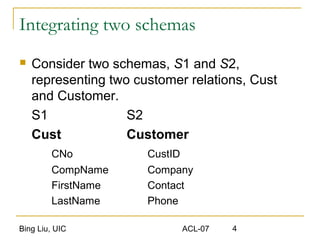
Integrating two schemas
 Consider two schemas, S1 and S2,
representing two customer relations, Cust
and Customer.
S1 S2
Cust Customer
CNo CustID
CompName Company
FirstName Contact
LastName Phone
Bing Liu, UIC ACL-07 5
Integrating two schemas (contd)
 Represent the mapping with a similarity
relation, ≅, over the power sets of S1 and S2,
where each pair in ≅ represents one element
of the mapping. E.g.,
Cust.CNo ≅ Customer.CustID
Cust.CompName ≅ Customer.Company
{Cust.FirstName, Cust.LastName} ≅
Customer.Contact
Bing Liu, UIC ACL-07 6
Different types of matching
 Schema-level only matching: only schema
information is considered.
 Domain and instance-level only matching:
some instance data (data records) and
possibly the domain of each attribute are
used. This case is quite common on the Web.
 Integrated matching of schema, domain and
instance data: Both schema and instance
data (possibly domain information) are
available.
Bing Liu, UIC ACL-07 7
Pre-processing for integration (He and Chang
SIGMOG-03, Madhavan et al. VLDB-01, Wu et al. SIGMOD-04
 Tokenization: break an item into atomic words using
a dictionary, e.g.,
 Break “fromCity” into “from” and “city”
 Break “first-name” into “first” and “name”
 Expansion: expand abbreviations and acronyms to
their full words, e.g.,
 From “dept” to “departure”
 Stopword removal and stemming
 Standardization of words: Irregular words are
standardized to a single form, e.g.,
 From “colour” to “color”
Bing Liu, UIC ACL-07 8
Schema-level matching (Rahm and Berstein 2001)
 Schema level matching relies on information
such as name, description, data type,
relationship type (e.g., part-of, is-a, etc),
constraints, etc.
 Match cardinality:
 1:1 match: one element in one schema matches
one element of another schema.
 1:m match: one element in one schema matches
m elements of another schema.
 m:n match: m elements in one schema matches n
elements of another schema.
Bing Liu, UIC ACL-07 9
An example
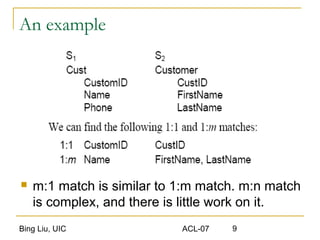
 m:1 match is similar to 1:m match. m:n match
is complex, and there is little work on it.
Bing Liu, UIC ACL-07 10
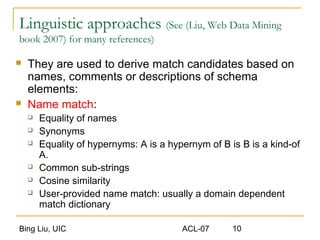
Linguistic approaches (See (Liu, Web Data Mining
book 2007) for many references)
 They are used to derive match candidates based on
names, comments or descriptions of schema
elements:
 Name match:
 Equality of names
 Synonyms
 Equality of hypernyms: A is a hypernym of B is B is a kind-of
A.
 Common sub-strings
 Cosine similarity
 User-provided name match: usually a domain dependent
match dictionary
Bing Liu, UIC ACL-07 11
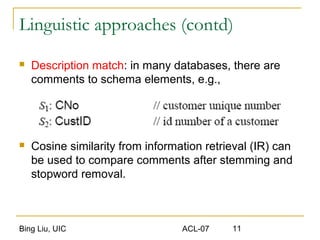
Linguistic approaches (contd)
 Description match: in many databases, there are
comments to schema elements, e.g.,
 Cosine similarity from information retrieval (IR) can
be used to compare comments after stemming and
stopword removal.
Bing Liu, UIC ACL-07 12
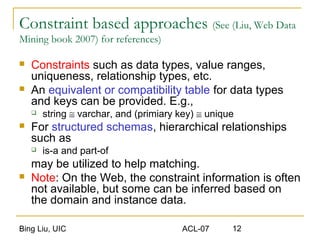
Constraint based approaches (See (Liu, Web Data
Mining book 2007) for references)
 Constraints such as data types, value ranges,
uniqueness, relationship types, etc.
 An equivalent or compatibility table for data types
and keys can be provided. E.g.,
 string ≅ varchar, and (primiary key) ≅ unique
 For structured schemas, hierarchical relationships
such as
 is-a and part-of
may be utilized to help matching.
 Note: On the Web, the constraint information is often
not available, but some can be inferred based on
the domain and instance data.
Bing Liu, UIC ACL-07 13
Domain and instance-level matching
(See (Liu, Web Data Mining book 2007) for references)
 In many applications, some data instances or
attribute domains may be available.
 Value characteristics are used in matching.
 Two different types of domains
 Simple domain: each value in the domain has
only a single component (the value cannot be
decomposed).
 Composite domain: each value in the domain
contains more than one component.
Bing Liu, UIC ACL-07 14
Match of simple domains
 A simple domain can be of any type.
 If the data type information is not available (this is
often the case on the Web), the instance values can
often be used to infer types, e.g.,
 Words may be considered as strings
 Phone numbers can have a regular expression pattern.
 Data type patterns (in regular expressions) can be
learnt automatically or defined manually.
 E.g., used to identify such types as integer, real, string,
month, weekday, date, time, zip code, phone numbers, etc.
Bing Liu, UIC ACL-07 15
Match of simple domains (contd)
 Matching methods:
 Data types are used as constraints.
 For numeric data, value ranges, averages, variances can
be computed and utilized.
 For categorical data: compare domain values.
 For textual data: cosine similarity.
 Schema element names as values: A set of values in a
schema match a set of attribute names of another schema.
E.g.,
 In one schema, the attribute color has the domain {yellow, red,
blue}, but in another schema, it has the element or attribute
names called yellow, red and blue (values are yes and no).
Bing Liu, UIC ACL-07 16
Handling composite domains
 A composite domain is usually indicated by
its values containing delimiters, e.g.,
 punctuation marks (e.g., “-”, “/”, “_”)
 White spaces
 Etc.
 To detect a composite domain, these
delimiters can be used. They are also used to
split a composite value into simple values.
 Match methods for simple domains can then
be applied.
Bing Liu, UIC ACL-07 17
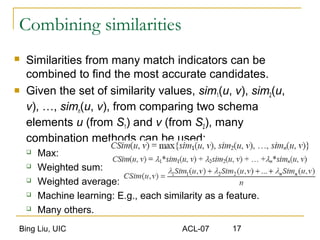
Combining similarities
 Similarities from many match indicators can be
combined to find the most accurate candidates.
 Given the set of similarity values, sim1(u, v), sim2(u,
v), …, simn(u, v), from comparing two schema
elements u (from S1) and v (from S2), many
combination methods can be used:
 Max:
 Weighted sum:
 Weighted average:
 Machine learning: E.g., each similarity as a feature.
 Many others.
Bing Liu, UIC ACL-07 18
1:m match: two types
 Part-of type: each relevant schema element on the
many side is a part of the element on the one side.
E.g.,
 “Street”, “city”, and “state” in a schema are parts of
“address” in another schema.
 Is-a type: each relevant element on the many side is
a specialization of the schema element on the one
side. E.g.,
 “Adults” and “Children” in one schema are specializations
of “Passengers” in another schema.
 Special methods are needed to identify these types
(Wu et al. SIGMOD-04).
Bing Liu, UIC ACL-07 19
Some other issues (Rahm and Berstein 2001)
 Reuse of previous match results: when matching
many schemas, earlier results may be used in later
matching.
 Transitive property: if X in schema S1 matches Y in S2, and
Y also matches Z in S3, then we conclude X matches Z.
 When matching a large number of schemas,
statistical approaches such as data mining can be
used, rather than only doing pair-wise match.
 Schema match results can be expressed in various
ways: Top N candidates, MaxDelta, Threshold, etc.
 User interaction: to pick and to correct matches.
Bing Liu, UIC ACL-07 20
Web information integration
(See (Liu, Web Data Mining book 2007) for references)
 Many integration tasks,
 Integrating Web query interfaces (search forms)
 Integrating ontologies (taxonomy)
 Integrating extracted data
 …
 We only introduce query interface integration as it
has been studied extensively.
 Many web sites provide forms (called query interfaces) to
query their underlying databases (often called the deep
web as opposed to the surface Web that can be browsed).
 Applications: meta-search and meta-query
Bing Liu, UIC ACL-07 21
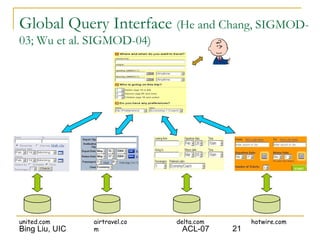
Global Query Interface (He and Chang, SIGMOD-
03; Wu et al. SIGMOD-04)
united.com airtravel.co
m
delta.com hotwire.com
Bing Liu, UIC ACL-07 22
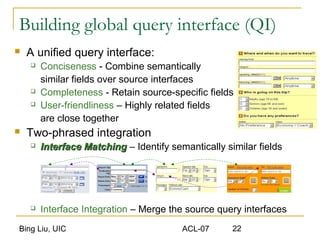
Building global query interface (QI)
 A unified query interface:
 Conciseness - Combine semantically
similar fields over source interfaces
 Completeness - Retain source-specific fields
 User-friendliness – Highly related fields
are close together
 Two-phrased integration
 Interface MatchingInterface Matching – Identify semantically similar fields
 Interface Integration – Merge the source query interfaces
Bing Liu, UIC ACL-07 23
Schema model of query interfaces
(He and Chang, SIGMOD-03)
 In each domain, there is a set of essential concepts C
= {c1, c2, …, cn}, used in query interfaces to enable the
user to restrict the search.
 A query interface uses a subset of the concepts S ⊆ C.
A concept i in S may be represented in the interface
with a set of attributes (or fields) fi1, fi2, ..., fik.
 Each concept is often represented with a single
attribute.
 Each attribute is labeled with a word or phrase, called the
label of the attribute, which is visible to the user.
 Each attribute may also have a set of possible values, its
domain.
Bing Liu, UIC ACL-07 24
Schema model of query interfaces (contd)
 All the attributes with their labels in a query interface
are called the schema of the query interface.
 Each attribute also has a name in the HTML code.
The name is attached to a TEXTBOX (which takes
the user input). However,
 this name is not visible to the user.
 It is attached to the input value of the attribute and returned
to the server as the attribute of the input value.
 For practical schema integration, we are not
concerned with the set of concepts but only the label
and name of each attribute and its domain.
Bing Liu, UIC ACL-07 25
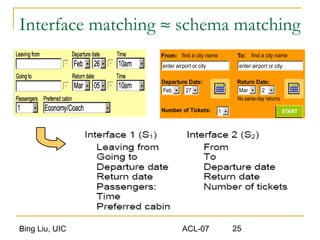
Interface matching ≈ schema matching
Bing Liu, UIC ACL-07 26
Web is different from databases
(He and Chang, SIGMOD-03)
 Limited use of acronyms and abbreviations on the
Web: but natural language words and phrases, for
general public to understand.
 Databases use acronyms and abbreviations extensively.
 Limited vocabulary: for easy understanding
 A large number of similar databases: a large number
of sites offer the same services or selling the same
products. Data mining is applicable!
 Additional structures: the information is usually
organized in some meaningful way in the interface.
E.g.,
 Related attributes are together.
 Hierarchical organization.
Bing Liu, UIC ACL-07 27
The interface integration problem
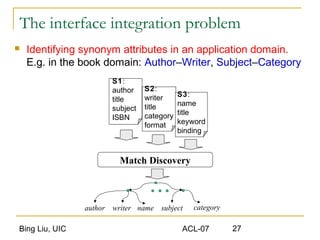
 Identifying synonym attributes in an application domain.
E.g. in the book domain: Author–Writer, Subject–Category
Match Discovery
author name subject categorywriter
S2:
writer
title
category
format
S3:
name
title
keyword
binding
S1:
author
title
subject
ISBN
Bing Liu, UIC ACL-07 28
Schema matching as correlation mining
(He and Chang, KDD-04)
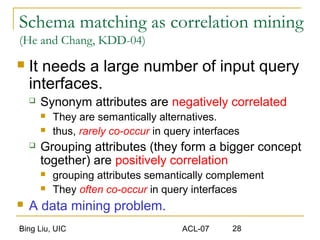
 It needs a large number of input query
interfaces.
 Synonym attributes are negatively correlated
 They are semantically alternatives.
 thus, rarely co-occur in query interfaces
 Grouping attributes (they form a bigger concept
together) are positively correlation
 grouping attributes semantically complement
 They often co-occur in query interfaces
 A data mining problem.
Bing Liu, UIC ACL-07 29
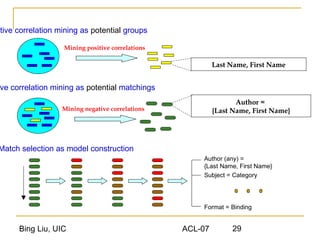
itive correlation mining as potential groups
ve correlation mining as potential matchings
Mining positive correlations
Last Name, First Name
Mining negative correlations
Author =
{Last Name, First Name}
Match selection as model construction
Author (any) =
{Last Name, First Name}
Subject = Category
Format = Binding
Bing Liu, UIC ACL-07 30
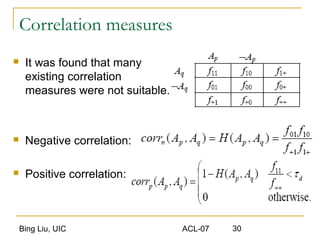
Correlation measures
 It was found that many
existing correlation
measures were not suitable.
 Negative correlation:
 Positive correlation:
Bing Liu, UIC ACL-07 31
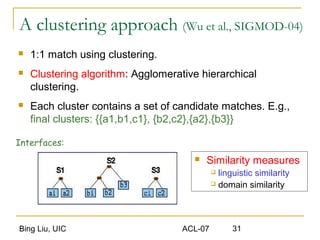
A clustering approach (Wu et al., SIGMOD-04)
Interfaces:
 Similarity measures
 linguistic similarity
 domain similarity
 1:1 match using clustering.
 Clustering algorithm: Agglomerative hierarchical
clustering.
 Each cluster contains a set of candidate matches. E.g.,
final clusters: {{a1,b1,c1}, {b2,c2},{a2},{b3}}
Bing Liu, UIC ACL-07 32
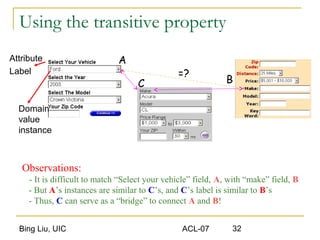
Using the transitive property
=?
A
C B
Observations:
- It is difficult to match “Select your vehicle” field, A, with “make” field, B
- But A’s instances are similar to C’s, and C’s label is similar to B’s
- Thus, C can serve as a “bridge” to connect A and B!
Attribute
Label
Domain
value
instance
Bing Liu, UIC ACL-07 33
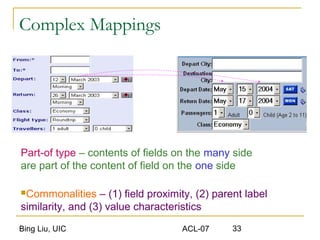
Complex Mappings
Part-of type – contents of fields on the many side
are part of the content of field on the one side
Commonalities – (1) field proximity, (2) parent label
similarity, and (3) value characteristics
Bing Liu, UIC ACL-07 34
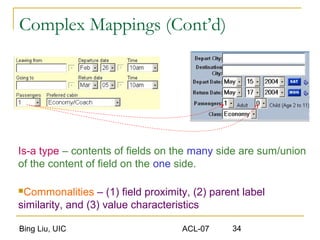
Complex Mappings (Cont’d)
Is-a type – contents of fields on the many side are sum/union
of the content of field on the one side.
Commonalities – (1) field proximity, (2) parent label
similarity, and (3) value characteristics
Bing Liu, UIC ACL-07 35
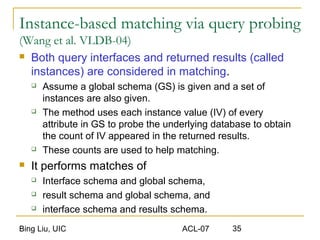
Instance-based matching via query probing
(Wang et al. VLDB-04)
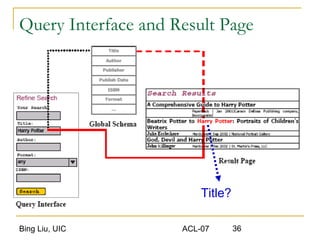
 Both query interfaces and returned results (called
instances) are considered in matching.
 Assume a global schema (GS) is given and a set of
instances are also given.
 The method uses each instance value (IV) of every
attribute in GS to probe the underlying database to obtain
the count of IV appeared in the returned results.
 These counts are used to help matching.
 It performs matches of
 Interface schema and global schema,
 result schema and global schema, and
 interface schema and results schema.
Bing Liu, UIC ACL-07 36
Query Interface and Result Page
Title?
Bing Liu, UIC ACL-07 37
Constructing a global query interface
(Dragut et al. VLDB-06)
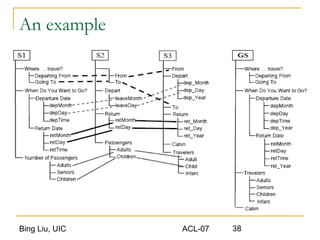
 Once a set of query interfaces in the same
domain is matched, we want to automatically
construct a well-designed global query
interface.
 Considerations:
 Structural appropriateness: group attributes
appropriately and produce a hierarchical structure.
 Lexical appropriateness: choose the right label for
each attribute or element.
 Instance appropriateness: choose the right domain
values.
Bing Liu, UIC ACL-07 38
An example
Bing Liu, UIC ACL-07 39
NLP connection
 Everywhere!
 Current techniques are mainly based on
heuristics related to text (linguistic) similarity,
structural information and patterns
discovered from a large number of interfaces.
 The focus on NLP is at the word and phrase
level, although there are also some
sentences, e.g., “where do you want to go?”
 Key: identify synonyms and hypernyms
relationships.
Bing Liu, UIC ACL-07 40
Summary
 Information integration is an active research area.
 Industrial activities are vibrant.
 We only introduced some basic integration methods
and Web query interface integration.
 Another area of research is Web ontology matching
See (Noy and Musen, AAAI-00; Agrawal and
Srikant, WWW-01; Doan et al. WWW-02; Zhang and
Lee, WWW-04).
 Finally, database schema matching is a prominent
research area in the database community as well.
See (Doan and Halevy, AI Magazine 2005) for a
short survey.

Cs583 information-integration

  • 1.
  • 2.
    Bing Liu, UICACL-07 2 Introduction  At the end of last topic, we identified the problem of integrating extracted data:  column match and instance value match.  Unfortunately, limited research has been done in this specific context. Much of the Web information integration research has been focused on the integration of Web query interfaces.  In this part, we introduce  some basic integration techniques, and  Web query interface integration
  • 3.
    Bing Liu, UICACL-07 3 Database integration (Rahm and Berstein 2001)  Information integration started with database integration, which has been studied in the database community since the early 1980s.  Fundamental problem: schema matching, which takes two (or more) database schemas to produce a mapping between elements (or attributes) of the two (or more) schemas that correspond semantically to each other.  Objective: merge the schemas into a single global schema.
  • 4.
    Bing Liu, UICACL-07 4 Integrating two schemas  Consider two schemas, S1 and S2, representing two customer relations, Cust and Customer. S1 S2 Cust Customer CNo CustID CompName Company FirstName Contact LastName Phone
  • 5.
    Bing Liu, UICACL-07 5 Integrating two schemas (contd)  Represent the mapping with a similarity relation, ≅, over the power sets of S1 and S2, where each pair in ≅ represents one element of the mapping. E.g., Cust.CNo ≅ Customer.CustID Cust.CompName ≅ Customer.Company {Cust.FirstName, Cust.LastName} ≅ Customer.Contact
  • 6.
    Bing Liu, UICACL-07 6 Different types of matching  Schema-level only matching: only schema information is considered.  Domain and instance-level only matching: some instance data (data records) and possibly the domain of each attribute are used. This case is quite common on the Web.  Integrated matching of schema, domain and instance data: Both schema and instance data (possibly domain information) are available.
  • 7.
    Bing Liu, UICACL-07 7 Pre-processing for integration (He and Chang SIGMOG-03, Madhavan et al. VLDB-01, Wu et al. SIGMOD-04  Tokenization: break an item into atomic words using a dictionary, e.g.,  Break “fromCity” into “from” and “city”  Break “first-name” into “first” and “name”  Expansion: expand abbreviations and acronyms to their full words, e.g.,  From “dept” to “departure”  Stopword removal and stemming  Standardization of words: Irregular words are standardized to a single form, e.g.,  From “colour” to “color”
  • 8.
    Bing Liu, UICACL-07 8 Schema-level matching (Rahm and Berstein 2001)  Schema level matching relies on information such as name, description, data type, relationship type (e.g., part-of, is-a, etc), constraints, etc.  Match cardinality:  1:1 match: one element in one schema matches one element of another schema.  1:m match: one element in one schema matches m elements of another schema.  m:n match: m elements in one schema matches n elements of another schema.
  • 9.
    Bing Liu, UICACL-07 9 An example  m:1 match is similar to 1:m match. m:n match is complex, and there is little work on it.
  • 10.
    Bing Liu, UICACL-07 10 Linguistic approaches (See (Liu, Web Data Mining book 2007) for many references)  They are used to derive match candidates based on names, comments or descriptions of schema elements:  Name match:  Equality of names  Synonyms  Equality of hypernyms: A is a hypernym of B is B is a kind-of A.  Common sub-strings  Cosine similarity  User-provided name match: usually a domain dependent match dictionary
  • 11.
    Bing Liu, UICACL-07 11 Linguistic approaches (contd)  Description match: in many databases, there are comments to schema elements, e.g.,  Cosine similarity from information retrieval (IR) can be used to compare comments after stemming and stopword removal.
  • 12.
    Bing Liu, UICACL-07 12 Constraint based approaches (See (Liu, Web Data Mining book 2007) for references)  Constraints such as data types, value ranges, uniqueness, relationship types, etc.  An equivalent or compatibility table for data types and keys can be provided. E.g.,  string ≅ varchar, and (primiary key) ≅ unique  For structured schemas, hierarchical relationships such as  is-a and part-of may be utilized to help matching.  Note: On the Web, the constraint information is often not available, but some can be inferred based on the domain and instance data.
  • 13.
    Bing Liu, UICACL-07 13 Domain and instance-level matching (See (Liu, Web Data Mining book 2007) for references)  In many applications, some data instances or attribute domains may be available.  Value characteristics are used in matching.  Two different types of domains  Simple domain: each value in the domain has only a single component (the value cannot be decomposed).  Composite domain: each value in the domain contains more than one component.
  • 14.
    Bing Liu, UICACL-07 14 Match of simple domains  A simple domain can be of any type.  If the data type information is not available (this is often the case on the Web), the instance values can often be used to infer types, e.g.,  Words may be considered as strings  Phone numbers can have a regular expression pattern.  Data type patterns (in regular expressions) can be learnt automatically or defined manually.  E.g., used to identify such types as integer, real, string, month, weekday, date, time, zip code, phone numbers, etc.
  • 15.
    Bing Liu, UICACL-07 15 Match of simple domains (contd)  Matching methods:  Data types are used as constraints.  For numeric data, value ranges, averages, variances can be computed and utilized.  For categorical data: compare domain values.  For textual data: cosine similarity.  Schema element names as values: A set of values in a schema match a set of attribute names of another schema. E.g.,  In one schema, the attribute color has the domain {yellow, red, blue}, but in another schema, it has the element or attribute names called yellow, red and blue (values are yes and no).
  • 16.
    Bing Liu, UICACL-07 16 Handling composite domains  A composite domain is usually indicated by its values containing delimiters, e.g.,  punctuation marks (e.g., “-”, “/”, “_”)  White spaces  Etc.  To detect a composite domain, these delimiters can be used. They are also used to split a composite value into simple values.  Match methods for simple domains can then be applied.
  • 17.
    Bing Liu, UICACL-07 17 Combining similarities  Similarities from many match indicators can be combined to find the most accurate candidates.  Given the set of similarity values, sim1(u, v), sim2(u, v), …, simn(u, v), from comparing two schema elements u (from S1) and v (from S2), many combination methods can be used:  Max:  Weighted sum:  Weighted average:  Machine learning: E.g., each similarity as a feature.  Many others.
  • 18.
    Bing Liu, UICACL-07 18 1:m match: two types  Part-of type: each relevant schema element on the many side is a part of the element on the one side. E.g.,  “Street”, “city”, and “state” in a schema are parts of “address” in another schema.  Is-a type: each relevant element on the many side is a specialization of the schema element on the one side. E.g.,  “Adults” and “Children” in one schema are specializations of “Passengers” in another schema.  Special methods are needed to identify these types (Wu et al. SIGMOD-04).
  • 19.
    Bing Liu, UICACL-07 19 Some other issues (Rahm and Berstein 2001)  Reuse of previous match results: when matching many schemas, earlier results may be used in later matching.  Transitive property: if X in schema S1 matches Y in S2, and Y also matches Z in S3, then we conclude X matches Z.  When matching a large number of schemas, statistical approaches such as data mining can be used, rather than only doing pair-wise match.  Schema match results can be expressed in various ways: Top N candidates, MaxDelta, Threshold, etc.  User interaction: to pick and to correct matches.
  • 20.
    Bing Liu, UICACL-07 20 Web information integration (See (Liu, Web Data Mining book 2007) for references)  Many integration tasks,  Integrating Web query interfaces (search forms)  Integrating ontologies (taxonomy)  Integrating extracted data  …  We only introduce query interface integration as it has been studied extensively.  Many web sites provide forms (called query interfaces) to query their underlying databases (often called the deep web as opposed to the surface Web that can be browsed).  Applications: meta-search and meta-query
  • 21.
    Bing Liu, UICACL-07 21 Global Query Interface (He and Chang, SIGMOD- 03; Wu et al. SIGMOD-04) united.com airtravel.co m delta.com hotwire.com
  • 22.
    Bing Liu, UICACL-07 22 Building global query interface (QI)  A unified query interface:  Conciseness - Combine semantically similar fields over source interfaces  Completeness - Retain source-specific fields  User-friendliness – Highly related fields are close together  Two-phrased integration  Interface MatchingInterface Matching – Identify semantically similar fields  Interface Integration – Merge the source query interfaces
  • 23.
    Bing Liu, UICACL-07 23 Schema model of query interfaces (He and Chang, SIGMOD-03)  In each domain, there is a set of essential concepts C = {c1, c2, …, cn}, used in query interfaces to enable the user to restrict the search.  A query interface uses a subset of the concepts S ⊆ C. A concept i in S may be represented in the interface with a set of attributes (or fields) fi1, fi2, ..., fik.  Each concept is often represented with a single attribute.  Each attribute is labeled with a word or phrase, called the label of the attribute, which is visible to the user.  Each attribute may also have a set of possible values, its domain.
  • 24.
    Bing Liu, UICACL-07 24 Schema model of query interfaces (contd)  All the attributes with their labels in a query interface are called the schema of the query interface.  Each attribute also has a name in the HTML code. The name is attached to a TEXTBOX (which takes the user input). However,  this name is not visible to the user.  It is attached to the input value of the attribute and returned to the server as the attribute of the input value.  For practical schema integration, we are not concerned with the set of concepts but only the label and name of each attribute and its domain.
  • 25.
    Bing Liu, UICACL-07 25 Interface matching ≈ schema matching
  • 26.
    Bing Liu, UICACL-07 26 Web is different from databases (He and Chang, SIGMOD-03)  Limited use of acronyms and abbreviations on the Web: but natural language words and phrases, for general public to understand.  Databases use acronyms and abbreviations extensively.  Limited vocabulary: for easy understanding  A large number of similar databases: a large number of sites offer the same services or selling the same products. Data mining is applicable!  Additional structures: the information is usually organized in some meaningful way in the interface. E.g.,  Related attributes are together.  Hierarchical organization.
  • 27.
    Bing Liu, UICACL-07 27 The interface integration problem  Identifying synonym attributes in an application domain. E.g. in the book domain: Author–Writer, Subject–Category Match Discovery author name subject categorywriter S2: writer title category format S3: name title keyword binding S1: author title subject ISBN
  • 28.
    Bing Liu, UICACL-07 28 Schema matching as correlation mining (He and Chang, KDD-04)  It needs a large number of input query interfaces.  Synonym attributes are negatively correlated  They are semantically alternatives.  thus, rarely co-occur in query interfaces  Grouping attributes (they form a bigger concept together) are positively correlation  grouping attributes semantically complement  They often co-occur in query interfaces  A data mining problem.
  • 29.
    Bing Liu, UICACL-07 29 itive correlation mining as potential groups ve correlation mining as potential matchings Mining positive correlations Last Name, First Name Mining negative correlations Author = {Last Name, First Name} Match selection as model construction Author (any) = {Last Name, First Name} Subject = Category Format = Binding
  • 30.
    Bing Liu, UICACL-07 30 Correlation measures  It was found that many existing correlation measures were not suitable.  Negative correlation:  Positive correlation:
  • 31.
    Bing Liu, UICACL-07 31 A clustering approach (Wu et al., SIGMOD-04) Interfaces:  Similarity measures  linguistic similarity  domain similarity  1:1 match using clustering.  Clustering algorithm: Agglomerative hierarchical clustering.  Each cluster contains a set of candidate matches. E.g., final clusters: {{a1,b1,c1}, {b2,c2},{a2},{b3}}
  • 32.
    Bing Liu, UICACL-07 32 Using the transitive property =? A C B Observations: - It is difficult to match “Select your vehicle” field, A, with “make” field, B - But A’s instances are similar to C’s, and C’s label is similar to B’s - Thus, C can serve as a “bridge” to connect A and B! Attribute Label Domain value instance
  • 33.
    Bing Liu, UICACL-07 33 Complex Mappings Part-of type – contents of fields on the many side are part of the content of field on the one side Commonalities – (1) field proximity, (2) parent label similarity, and (3) value characteristics
  • 34.
    Bing Liu, UICACL-07 34 Complex Mappings (Cont’d) Is-a type – contents of fields on the many side are sum/union of the content of field on the one side. Commonalities – (1) field proximity, (2) parent label similarity, and (3) value characteristics
  • 35.
    Bing Liu, UICACL-07 35 Instance-based matching via query probing (Wang et al. VLDB-04)  Both query interfaces and returned results (called instances) are considered in matching.  Assume a global schema (GS) is given and a set of instances are also given.  The method uses each instance value (IV) of every attribute in GS to probe the underlying database to obtain the count of IV appeared in the returned results.  These counts are used to help matching.  It performs matches of  Interface schema and global schema,  result schema and global schema, and  interface schema and results schema.
  • 36.
    Bing Liu, UICACL-07 36 Query Interface and Result Page Title?
  • 37.
    Bing Liu, UICACL-07 37 Constructing a global query interface (Dragut et al. VLDB-06)  Once a set of query interfaces in the same domain is matched, we want to automatically construct a well-designed global query interface.  Considerations:  Structural appropriateness: group attributes appropriately and produce a hierarchical structure.  Lexical appropriateness: choose the right label for each attribute or element.  Instance appropriateness: choose the right domain values.
  • 38.
    Bing Liu, UICACL-07 38 An example
  • 39.
    Bing Liu, UICACL-07 39 NLP connection  Everywhere!  Current techniques are mainly based on heuristics related to text (linguistic) similarity, structural information and patterns discovered from a large number of interfaces.  The focus on NLP is at the word and phrase level, although there are also some sentences, e.g., “where do you want to go?”  Key: identify synonyms and hypernyms relationships.
  • 40.
    Bing Liu, UICACL-07 40 Summary  Information integration is an active research area.  Industrial activities are vibrant.  We only introduced some basic integration methods and Web query interface integration.  Another area of research is Web ontology matching See (Noy and Musen, AAAI-00; Agrawal and Srikant, WWW-01; Doan et al. WWW-02; Zhang and Lee, WWW-04).  Finally, database schema matching is a prominent research area in the database community as well. See (Doan and Halevy, AI Magazine 2005) for a short survey.