Web Content Writing Style Guidelines
Presentation Outlines:  Why Web Writing ?! Web Content Writing in the Context of Web  design Web as a Communication System Why Web Writing again ?! “ How to Write for the Web ” Empirical Studies Web Reader’s Characteristics Common Online & Offline Writing Guidelines Exclusive Web Writing Guidelines Web Writing Terms: Web Paragraph Web Writing Techniques: Inverted pyramid Technique Questions & Comments
Why Web Writing ?!   Writing for the Web is not the same as writing for print; because people read differently on the Web !!
Web Content Writing in the Context of Web Design  There are three levels of Web design : -  Site Design  -  Page Design -  Content Design .
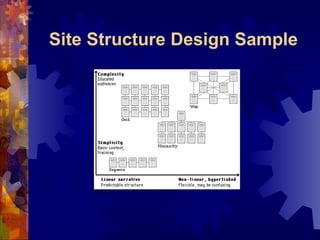
Site Structure Design Sample
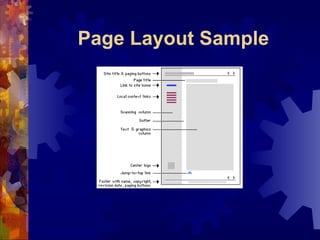
Page Layout Sample
Web as a Communication System  As any communication system, Web has 4 basic elements: - The Sender - The Message - The Channel - The Receiver There are some additional elements: - Feed Back - Environment Noise
Why Web Writing  again ?!   Mostly, Web Reader is under pressure on the Web, whereas after getting over the problem of searching and finding the needed information he/she still under pressure and face difficulties, such as: - Cost - Bandwidth Limitations - Information Quantity - Difficulties of reading on Computer screens for a long time.
“ How to Write for the Web ” Empirical Studies   On the basis of that, and towards a better Web User Experience, the need to Web Usability Studies becomes a necessity.
Web Reader’s Characteristics   -  Users don’t read on he Web; instead they scan the page - Users don’t like long, scrolling pages: they prefer short and to the point text - Users detest marketing language, and prefer factual information.
Common Online & Offline Writing Guidelines   -    Organizing the information -    Using   words and categories that make sense to the audience -    Limiting each paragraph to one main idea -    Providing the right amount of information
Exclusive Web Writing Guidelines   - Text should be Scannable   - Text should be Concise   - Hypertext should be Well-Linked  - Graphics and text should complement one another
Web Writing Terms:  Web Paragraph   -  For efficient online reading, paragraphs should be kept shorter than is typical in many kinds of offline writing. - As general rule, average paragraph length on the Web should be no longer than 50 words. - Each paragraph deals with one single thought.
Web Writing Techniques:  Inverted pyramid Technique -  In that technique, news and conclusions are presented first, followed by details and background information   -  - Web Readers prefer Inverted Pyramid Technique, it helps them to find the main point quickly, from the first line.
Questions & Comments   Your Questions and Comments are most welcomed !
Thank you All

Web Content Writing

  • 1.
    Web Content WritingStyle Guidelines
  • 2.
    Presentation Outlines: Why Web Writing ?! Web Content Writing in the Context of Web design Web as a Communication System Why Web Writing again ?! “ How to Write for the Web ” Empirical Studies Web Reader’s Characteristics Common Online & Offline Writing Guidelines Exclusive Web Writing Guidelines Web Writing Terms: Web Paragraph Web Writing Techniques: Inverted pyramid Technique Questions & Comments
  • 3.
    Why Web Writing?! Writing for the Web is not the same as writing for print; because people read differently on the Web !!
  • 4.
    Web Content Writingin the Context of Web Design There are three levels of Web design : - Site Design - Page Design - Content Design .
  • 5.
  • 6.
  • 7.
    Web as aCommunication System As any communication system, Web has 4 basic elements: - The Sender - The Message - The Channel - The Receiver There are some additional elements: - Feed Back - Environment Noise
  • 8.
    Why Web Writing again ?! Mostly, Web Reader is under pressure on the Web, whereas after getting over the problem of searching and finding the needed information he/she still under pressure and face difficulties, such as: - Cost - Bandwidth Limitations - Information Quantity - Difficulties of reading on Computer screens for a long time.
  • 9.
    “ How toWrite for the Web ” Empirical Studies On the basis of that, and towards a better Web User Experience, the need to Web Usability Studies becomes a necessity.
  • 10.
    Web Reader’s Characteristics - Users don’t read on he Web; instead they scan the page - Users don’t like long, scrolling pages: they prefer short and to the point text - Users detest marketing language, and prefer factual information.
  • 11.
    Common Online &Offline Writing Guidelines -    Organizing the information -    Using words and categories that make sense to the audience -    Limiting each paragraph to one main idea -    Providing the right amount of information
  • 12.
    Exclusive Web WritingGuidelines - Text should be Scannable - Text should be Concise - Hypertext should be Well-Linked - Graphics and text should complement one another
  • 13.
    Web Writing Terms: Web Paragraph - For efficient online reading, paragraphs should be kept shorter than is typical in many kinds of offline writing. - As general rule, average paragraph length on the Web should be no longer than 50 words. - Each paragraph deals with one single thought.
  • 14.
    Web Writing Techniques: Inverted pyramid Technique - In that technique, news and conclusions are presented first, followed by details and background information - - Web Readers prefer Inverted Pyramid Technique, it helps them to find the main point quickly, from the first line.
  • 15.
    Questions & Comments Your Questions and Comments are most welcomed !
  • 16.

Editor's Notes

  • #2 Welcome for our first lecture in the Web writing