

By Anirban Sen Chowdhary
There are often question raised on deploying and running Web
application in Mule.
People often ask “is it possible to deploy and run Web application in
Mule “ ??
And the answer is Yes
Before we start how, I like to have a overview on the similarities and
difference between Mule server and a Web application server
Similarities
• They both allow you to run multiple applications simultaneously.
• They both provide an application container. What that means is,
they both provide an environment in which an application can run,
acting as an intermediary between application code and the
operating system, and providing database access, easier
communication over the network, memory management, lifecycle
management, and other services.
• They both allow us to manage your applications at runtime.
Source : MuleSoft
Differences
Mule specializes in three things:-
• It acts as a platform for applications that move data from one place
to another and often transform that data along the way so that it is
readable at the other end
• It exports services to other applications
• It provides orchestrating services
Source : MuleSoft
Now, the question is it possible to deploy a Web application in Mule
server which can interact or integrate with Mule application running on
the server ???
Yes .. It is possible …… Let’s see how ….
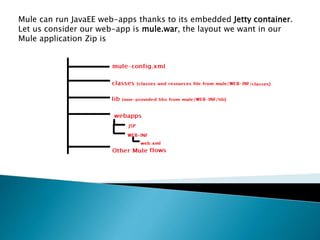
Mule can run JavaEE web-apps thanks to its embedded Jetty container.
Let us consider our web-app is mule.war, the layout we want in our
Mule application Zip is
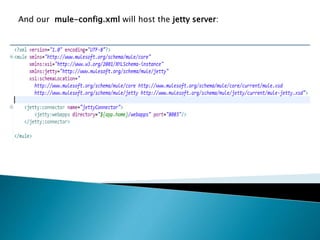
And our mule-config.xml will host the jetty server:
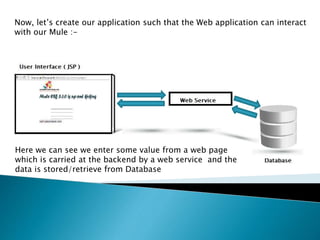
Now, let’s create our application such that the Web application can interact
with our Mule :-
Here we can see we enter some value from a web page
which is carried at the backend by a web service and the
data is stored/retrieve from Database
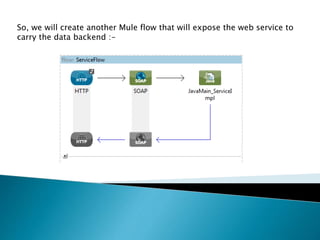
So, we will create another Mule flow that will expose the web service to
carry the data backend :-
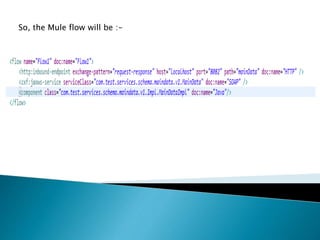
So, the Mule flow will be :-
.
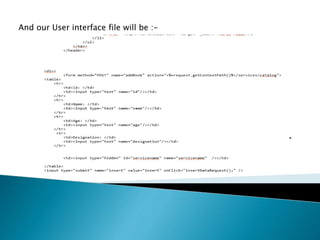
And our User interface file will be :-
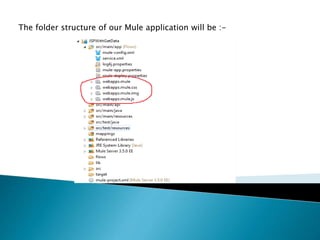
The folder structure of our Mule application will be :-
.
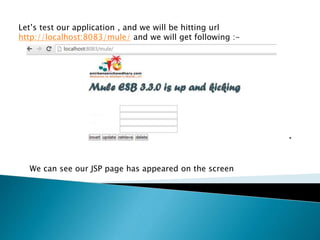
Let’s test our application , and we will be hitting url
http://localhost:8083/mule/ and we will get following :-
We can see our JSP page has appeared on the screen
.
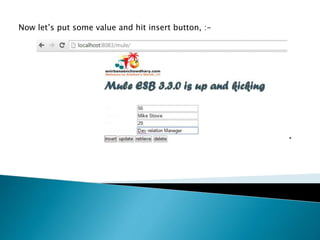
Now let’s put some value and hit insert button, :-
.
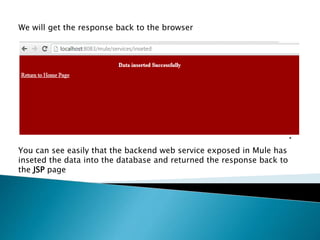
We will get the response back to the browser
You can see easily that the backend web service exposed in Mule has
inseted the data into the database and returned the response back to
the JSP page
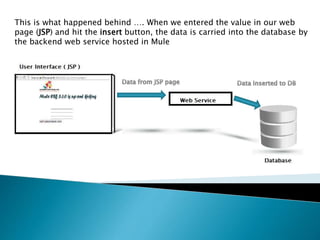
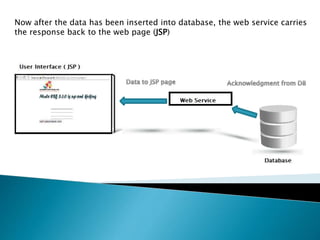
This is what happened behind …. When we entered the value in our web
page (JSP) and hit the insert button, the data is carried into the database by
the backend web service hosted in Mule
Now after the data has been inserted into database, the web service carries
the response back to the web page (JSP)
So, we can see that Mule can host the web application using Jetty
connector and we can interact with the web application with our other
Mule flows easily, ad we have done here with a web service from our
Mule flow which carried all the data to and from the web page .
Hope you liked this small tricks in Mule.
If you have any similar tricks in Mule, please do share it with all and let
our Mule community grow
Happy coding 
Web application with mule

Web application with mule

  • 1.
    By Anirban SenChowdhary
  • 2.
    There are oftenquestion raised on deploying and running Web application in Mule. People often ask “is it possible to deploy and run Web application in Mule “ ?? And the answer is Yes
  • 3.
    Before we starthow, I like to have a overview on the similarities and difference between Mule server and a Web application server Similarities • They both allow you to run multiple applications simultaneously. • They both provide an application container. What that means is, they both provide an environment in which an application can run, acting as an intermediary between application code and the operating system, and providing database access, easier communication over the network, memory management, lifecycle management, and other services. • They both allow us to manage your applications at runtime. Source : MuleSoft
  • 4.
    Differences Mule specializes inthree things:- • It acts as a platform for applications that move data from one place to another and often transform that data along the way so that it is readable at the other end • It exports services to other applications • It provides orchestrating services Source : MuleSoft
  • 5.
    Now, the questionis it possible to deploy a Web application in Mule server which can interact or integrate with Mule application running on the server ???
  • 6.
    Yes .. Itis possible …… Let’s see how ….
  • 7.
    Mule can runJavaEE web-apps thanks to its embedded Jetty container. Let us consider our web-app is mule.war, the layout we want in our Mule application Zip is
  • 8.
    And our mule-config.xmlwill host the jetty server:
  • 9.
    Now, let’s createour application such that the Web application can interact with our Mule :- Here we can see we enter some value from a web page which is carried at the backend by a web service and the data is stored/retrieve from Database
  • 10.
    So, we willcreate another Mule flow that will expose the web service to carry the data backend :-
  • 11.
    So, the Muleflow will be :-
  • 12.
    . And our Userinterface file will be :-
  • 13.
    The folder structureof our Mule application will be :-
  • 14.
    . Let’s test ourapplication , and we will be hitting url http://localhost:8083/mule/ and we will get following :- We can see our JSP page has appeared on the screen
  • 15.
    . Now let’s putsome value and hit insert button, :-
  • 16.
    . We will getthe response back to the browser You can see easily that the backend web service exposed in Mule has inseted the data into the database and returned the response back to the JSP page
  • 17.
    This is whathappened behind …. When we entered the value in our web page (JSP) and hit the insert button, the data is carried into the database by the backend web service hosted in Mule
  • 18.
    Now after thedata has been inserted into database, the web service carries the response back to the web page (JSP)
  • 19.
    So, we cansee that Mule can host the web application using Jetty connector and we can interact with the web application with our other Mule flows easily, ad we have done here with a web service from our Mule flow which carried all the data to and from the web page .
  • 20.
    Hope you likedthis small tricks in Mule. If you have any similar tricks in Mule, please do share it with all and let our Mule community grow Happy coding 