WEB APPENDIX 5A
CALCULATING BETA COEFFICIENTS
5A-1
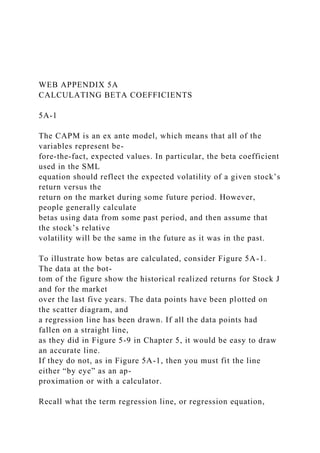
The CAPM is an ex ante model, which means that all of the
variables represent be-
fore-the-fact, expected values. In particular, the beta coefficient
used in the SML
equation should reflect the expected volatility of a given stock’s
return versus the
return on the market during some future period. However,
people generally calculate
betas using data from some past period, and then assume that
the stock’s relative
volatility will be the same in the future as it was in the past.
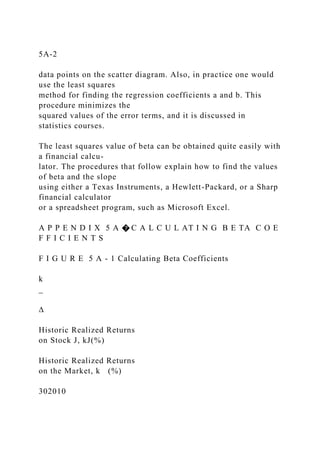
To illustrate how betas are calculated, consider Figure 5A-1.
The data at the bot-
tom of the figure show the historical realized returns for Stock J
and for the market
over the last five years. The data points have been plotted on
the scatter diagram, and
a regression line has been drawn. If all the data points had
fallen on a straight line,
as they did in Figure 5-9 in Chapter 5, it would be easy to draw
an accurate line.
If they do not, as in Figure 5A-1, then you must fit the line
either “by eye” as an ap-
proximation or with a calculator.
Recall what the term regression line, or regression equation,
means: The equation Y �
a � bX � e is the standard form of a simple linear regression. It
states that the de-
pendent variable, Y, is equal to a constant, a, plus b times X,
where b is the slope co-
efficient and X is the independent variable, plus an error term,
e. Thus, the rate of
return on the stock during a given time period ( Y ) depends on
what happens to the
general stock market, which is measured by X � k
–
M.
Once the data have been plotted and the regression line has been
drawn on graph
paper, we can estimate its intercept and slope, the a and b
values in Y � a � bX. The
intercept, a, is simply the point where the line cuts the vertical
axis. The slope coef-
ficient, b, can be estimated by the “rise-over-run” method. This
involves calculating
the amount by which k
–
J increases for a given increase in k
–
M. For example, we ob-
serve in Figure 5A-1 that k
–
J increases from �8.9 to �7.1 percent (the rise) when k
–
M
increases from 0 to 10.0 percent (the run). Thus, b, the beta
coefficient, can be mea-
sured as follows:
Note that rise over run is a ratio, and it would be the same if
measured using any two
arbitrarily selected points on the line.
The regression line equation enables us to predict a rate of
return for Stock J,
given a value of k
–
M. For example, if k
–
M � 15%, we would predict k
–
J � �8.9% �
1.6(15%) � 15.1%. However, the actual return would probably
differ from the pre-
dicted return. This deviation is the error term, eJ, for the year,
and it varies randomly
from year to year depending on company-specific factors. Note,
though, that the
higher the correlation coefficient, the closer the points lie to the
regression line, and
the smaller the errors.
In actual practice, monthly, rather than annual, returns are
generally used for k
–
J
and k
–
M, and five years of data are often employed; thus, there would
be 5 � 12 � 60
b � Beta �
Rise
Run
�
∆Y
∆X
�
7.1 � 1�8.92
10.0 � 0.0
�
16.0
10.0
� 1.6.
A P P E N D I X 5 A � C A L C U L AT I N G B E TA C O E
F F I C I E N T S
5A
App5A_SW_Brigham_778312 1/23/03 5:41 AM Page 5A-1
5A-2
data points on the scatter diagram. Also, in practice one would
use the least squares
method for finding the regression coefficients a and b. This
procedure minimizes the
squared values of the error terms, and it is discussed in
statistics courses.
The least squares value of beta can be obtained quite easily with
a financial calcu-
lator. The procedures that follow explain how to find the values
of beta and the slope
using either a Texas Instruments, a Hewlett-Packard, or a Sharp
financial calculator
or a spreadsheet program, such as Microsoft Excel.
A P P E N D I X 5 A � C A L C U L AT I N G B E TA C O E
F F I C I E N T S
F I G U R E 5 A - 1 Calculating Beta Coefficients
k
_
∆
Historic Realized Returns
on Stock J, kJ(%)
Historic Realized Returns
on the Market, k (%)
302010
aJ = Intercept = – 8.9% k = 8.9% + 7.1% = 16%
= 10% b =
Rise
Run
= =
16
10
= 1.6J
M
J
J
–10 0
–20
–10
10
20
30
40
7.1
Year 3
Year 4
Year 5Year 1
= aJ + bJkM + eJ
= – 8.9 + 1.6k M + eJ
k J _
__
Year 2
_
_
M
_
M
∆
k
_
∆
k
_
∆
YEAR MARKET (k
_
M) STOCK J (k
_
J)
1 23.8% 38.6%
2 (7.2) (24.7)
3 6.6 12.3
4 20.5 8.2
5 30.6. .. 40.1....
Average k
_
14.9% 14.9%
�k
_ 15.1% 26.5%
App5A_SW_Brigham_778312 1/23/03 5:41 AM Page 5A-2
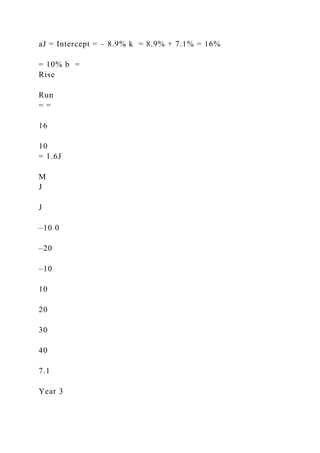
5A-3
T E X A S I N S T R U M E N T S BA- I I P L U S
1. Press until “STAT” shows in the display.
2. Enter the first X value ( k
–
M � 23.8 in our example), press , and then enter
the first Y value ( k
–
J � 38.6) and press .
3. Repeat Step 2 until all values have been entered.
4. Press to find the value of Y at X � 0, which is the value of
the Y inter-
cept (a), �8.9219, and then press to display the value of the
slope (beta),
1.6031.
5. You could also press to obtain the correlation coefficient, r,
which is
0.9134.
Putting it all together, you should have this regression line:
k
–
J � �8.92 � 1.60k
–
M.
r � 0.9134.
H E W L E T T - PA C K A R D 1 0 B I I 1
1. Press to clear your memory registers.
2. Enter the first X value ( k
–
M � 23.8 in our example), press , and then
enter the first Y value ( k
–
J � 38.6) and press . Be sure to enter the X variable
first.
3. Repeat Step 2 until all values have been entered.
4. To display the vertical axis intercept, press 0 . Then �8.9219
should
appear.
5. To display the beta coefficient, b, press . Then 1.6031 should
appear.
6. To obtain the correlation coefficient, press and then to get
r � 0.9134.
Putting it all together, you should have this regression line:
k
–
J � �8.92 � 1.60k
–
M.
r � 0.9134.
S H A R P E L - 7 3 3
1. Press until “STAT” shows in the lower right corner of the
display.
2. Press to clear all memory registers.
3. Enter the first X value (k
–
M � 23.8 in our example) and press . (This is the
RM key; do not press the second F key at all.) Then enter the
first Y value
(k
–
J � 38.6), and press . (This is the M� key; again, do not press
the
second F key).
4. Repeat Step 3 until all values have been entered.
DATA
(x,y)
CA2nd F
Mode2nd F
SWAPx̂ ,r
SWAP
ŷ,m
∑�
INPUT
Clear all
Corr2nd
x � y
b/a2nd
∑�
x � y
Mode2nd
A P P E N D I X 5 A � C A L C U L AT I N G B E TA C O E
F F I C I E N T S
1 The Hewlett-Packard 17B calculator is even easier to use. If
you have one, see Chapter 9 of the Owner’s
Manual.
App5A_SW_Brigham_778312 1/23/03 5:41 AM Page 5A-3
5A-4
5. Press a to find the value of Y at X � 0, which is the value of
the Y
intercept (a), �8.9219, and then press to display the value of
the slope
(beta), 1.6031.
6. You can also press to obtain the correlation coefficient, r,
which is
0.9134.
Putting it all together, you should have this regression line:
k
–
J � �8.92 � 1.60k
–
M.
r � 0.9134.
M I C R O S O F T E X C E L
1. Manually enter the data for the market and Stock J into the
spreadsheet as
shown below.
2. Access Microsoft Excel’s Regression tool from the Data
Analysis package in the
Tools menu (Tools � Data Analysis � Regression). If you do
not have the
Data Analysis package, you will have to add the Analysis
ToolPak, by accessing
Tools � Add-Ins.
The regression dialog box that appears requires you to input the
Y and X
variable ranges, and it has additional options pertaining to the
output that is to
be produced and where it shall be displayed. In this example
regarding Stock J,
the “Input Y Range:” prompt requires cells C2:C6 be entered as
the dependent
variable of the regression. Similarly, the “Input X Range:”
prompt requires
cells B2:B6 be entered as the independent variable.
r2nd F
b2nd F
a2nd F
A P P E N D I X 5 A � C A L C U L AT I N G B E TA C O E
F F I C I E N T S
App5A_SW_Brigham_778312 1/23/03 5:41 AM Page 5A-4
5A-5
For the purposes of this example, none of the additional options
are chosen,
and the regression output relies upon the default selection,
which is to be dis-
played on an additional worksheet.
3. Select “OK” to perform the indicated regression.
4. A section of the output generated from the regression of
Stock J’s return on the
market return is shown below:
In this simple regression, the multiple R statistic is equivalent
to the correla-
tion coefficient obtained in the other regression procedures
described. Hence,
the correlation coefficient, r, is 0.91339175.
5. In the last section of the output, it is found that the intercept
of the regression
line is �0.0892194, and the beta coefficient is 1.60309159.
These results agree
with those obtained previously with financial calculators,
except that the inter-
cept is �0.089219 instead of �8.9219. The reason for this
difference is that the
returns were entered as whole numbers in the calculator, but
were expressed as
percentages in the spreadsheet. It is simply a matter of scale and
does not have
a real effect on results.
6. The remainder of the regression output concerns the
reliability of the estimates
made and these additional data are more fully explained in
statistics courses.
Putting it all together, you should have this regression line:
k
–
J � �8.92 � 1.60k
–
M.
r � 0.9134.
As illustrated, spreadsheet programs yield the same results as a
calculator, however
the spreadsheet is more flexible and allows for a more thorough
analysis. First, the
file can be retained, and when new data become available, they
can be added and a
new beta can be calculated quite rapidly. Second, the regression
output can include
graphs and statistical information designed to give us an idea of
how stable the beta
coefficient is. In other words, while our beta was calculated to
be 1.60, the “true
beta” might actually be higher or lower, and the regression
output can give us an idea
of how large the error might be. Third, the spreadsheet can be
used to calculate
A P P E N D I X 5 A � C A L C U L AT I N G B E TA C O E
F F I C I E N T S
App5A_SW_Brigham_778312 1/23/03 5:41 AM Page 5A-5
5A-6
returns data from historical stock price and dividend
information, and then the re-
turns can be fed into the regression routine to calculate the beta
coefficient. This is
important, because stock market data are generally provided in
the form of stock
prices and dividends, making it necessary to calculate returns.
This can be a big job
if a number of different companies and a number of time
periods are involved.
P R O B L E M S
You are given the following set of data:
H I S T O R I C A L R A T E S O F R E T U R N ( k
_
)
YEAR STOCK Y (k
_
Y) NYSE (k
_
M)
1 3.0% 4.0%
2 18.2 14.3
3 9.1 19.0
4 (6.0) (14.7)
5 (15.3) (26.5)
6 33.1 37.2
7 6.1 23.8
8 3.2 (7.2)
9 14.8 6.6
10 24.1 20.5
11 18.0... 30.6
Mean 9.8% 9.8%
�k
_ 13.8 19.6
a. Construct a scatter diagram graph (on graph paper) showing
the relationship between re-
turns on Stock Y and the market as in Figure 5A-1; then draw a
freehand approximation of
the regression line. What is the approximate value of the beta
coefficient? (If you have a
calculator with statistical functions or a computer, use it to
calculate beta.)
b. Give a verbal interpretation of what the regression line and
the beta coefficient show about
Stock Y’s volatility and relative riskiness as compared with
other stocks.
c. Suppose the scatter of points had been more spread out but
the regression line was exactly
where your present graph shows it. How would this affect (1)
the firm’s risk if the stock
were held in a 1-asset portfolio and (2) the actual risk premium
on the stock if the CAPM
held exactly? How would the degree of scatter (or the
correlation coefficient) affect your
confidence that the calculated beta will hold true in the years
ahead?
d. Suppose the regression line had been downward sloping and
the beta coefficient had been
negative. What would this imply about (1) Stock Y’s relative
riskiness and (2) its probable
risk premium?
e. Construct an illustrative probability distribution graph of
returns (see Figure 5-7) for port-
folios consisting of (1) only Stock Y, (2) 1 percent each of 100
stocks with beta coefficients
similar to that of Stock Y, and (3) all stocks (that is, the
distribution of returns on the mar-
ket). Use as the expected rate of return the arithmetic mean as
given previously for both
Stock Y and the market, and assume that the distributions are
normal. Are the expected re-
turns “reasonable”— that is, is it reasonable that k̂ Y � k̂ M �
9.8%?
f. Now, suppose that in the next year, Year 12, the market
return was 27 percent, but Firm Y
increased its use of debt, which raised its perceived risk to
investors. Do you think that the
return on Stock Y in Year 12 could be approximated by this
historical characteristic line?
k̂ Y � 3.8% � 0.62(k̂ M) � 3.8% � 0.62(27%) � 20.5%.
A P P E N D I X 5 A � C A L C U L AT I N G B E TA C O E
F F I C I E N T S
5A-1
Beta coefficients and rates
of return
App5A_SW_Brigham_778312 1/23/03 5:41 AM Page 5A-6
5A-7
g. Now, suppose k
_
Y in Year 12, after the debt ratio was increased, had actually
been 0 per-
cent. What would the new beta be, based on the most recent 11
years of data (that is, Years
2 through 12)? Does this beta seem reasonable— that is, is the
change in beta consistent
with the other facts given in the problem?
You are given the following historical data on market returns, k
_
M, and the returns on Stocks
A and B, k
_
A and k
_
B:
YEAR k
_
M k
_
A k
_
B
1 29.00% 29.00% 20.00%
2 15.20 15.20 13.10
3 (10.00) (10.00) 0.50
4 3.30 3.30 7.15
5 23.00 23.00 17.00
6 31.70 31.70 21.35
kRF, the risk-free rate, is 9 percent. Your probability
distribution for kM for next year is
as follows:
PROBABILITY kM
0.1 (14%)
0.2 0
0.4 15
0.2 25
0.1 44
a. Determine graphically the beta coefficients for Stocks A and
B.
b. Graph the Security Market Line, and give its equation.
c. Calculate the required rates of return on Stocks A and B.
d. Suppose a new stock, C, with k̂ C � 18 percent and bC � 2.0,
becomes available. Is this
stock in equilibrium; that is, does the required rate of return on
Stock C equal its ex-
pected return? Explain. If the stock is not in equilibrium,
explain how equilibrium will be
restored.
A P P E N D I X 5 A � C A L C U L AT I N G B E TA C O E
F F I C I E N T S
5A-2
Security Market Line
App5A_SW_Brigham_778312 1/23/03 5:41 AM Page 5A-71

WEB APPENDIX 5ACALCULATING BETA COEFFICIENTS5A-1The .docx

  • 1.
    WEB APPENDIX 5A CALCULATINGBETA COEFFICIENTS 5A-1 The CAPM is an ex ante model, which means that all of the variables represent be- fore-the-fact, expected values. In particular, the beta coefficient used in the SML equation should reflect the expected volatility of a given stock’s return versus the return on the market during some future period. However, people generally calculate betas using data from some past period, and then assume that the stock’s relative volatility will be the same in the future as it was in the past. To illustrate how betas are calculated, consider Figure 5A-1. The data at the bot- tom of the figure show the historical realized returns for Stock J and for the market over the last five years. The data points have been plotted on the scatter diagram, and a regression line has been drawn. If all the data points had fallen on a straight line, as they did in Figure 5-9 in Chapter 5, it would be easy to draw an accurate line. If they do not, as in Figure 5A-1, then you must fit the line either “by eye” as an ap- proximation or with a calculator. Recall what the term regression line, or regression equation,
  • 2.
    means: The equationY � a � bX � e is the standard form of a simple linear regression. It states that the de- pendent variable, Y, is equal to a constant, a, plus b times X, where b is the slope co- efficient and X is the independent variable, plus an error term, e. Thus, the rate of return on the stock during a given time period ( Y ) depends on what happens to the general stock market, which is measured by X � k – M. Once the data have been plotted and the regression line has been drawn on graph paper, we can estimate its intercept and slope, the a and b values in Y � a � bX. The intercept, a, is simply the point where the line cuts the vertical axis. The slope coef- ficient, b, can be estimated by the “rise-over-run” method. This involves calculating the amount by which k – J increases for a given increase in k – M. For example, we ob- serve in Figure 5A-1 that k – J increases from �8.9 to �7.1 percent (the rise) when k –
  • 3.
    M increases from 0to 10.0 percent (the run). Thus, b, the beta coefficient, can be mea- sured as follows: Note that rise over run is a ratio, and it would be the same if measured using any two arbitrarily selected points on the line. The regression line equation enables us to predict a rate of return for Stock J, given a value of k – M. For example, if k – M � 15%, we would predict k – J � �8.9% � 1.6(15%) � 15.1%. However, the actual return would probably differ from the pre- dicted return. This deviation is the error term, eJ, for the year, and it varies randomly from year to year depending on company-specific factors. Note, though, that the higher the correlation coefficient, the closer the points lie to the regression line, and the smaller the errors. In actual practice, monthly, rather than annual, returns are generally used for k –
  • 4.
    J and k – M, andfive years of data are often employed; thus, there would be 5 � 12 � 60 b � Beta � Rise Run � ∆Y ∆X � 7.1 � 1�8.92 10.0 � 0.0 � 16.0 10.0 � 1.6. A P P E N D I X 5 A � C A L C U L AT I N G B E TA C O E F F I C I E N T S 5A App5A_SW_Brigham_778312 1/23/03 5:41 AM Page 5A-1
  • 5.
    5A-2 data points onthe scatter diagram. Also, in practice one would use the least squares method for finding the regression coefficients a and b. This procedure minimizes the squared values of the error terms, and it is discussed in statistics courses. The least squares value of beta can be obtained quite easily with a financial calcu- lator. The procedures that follow explain how to find the values of beta and the slope using either a Texas Instruments, a Hewlett-Packard, or a Sharp financial calculator or a spreadsheet program, such as Microsoft Excel. A P P E N D I X 5 A � C A L C U L AT I N G B E TA C O E F F I C I E N T S F I G U R E 5 A - 1 Calculating Beta Coefficients k _ ∆ Historic Realized Returns on Stock J, kJ(%) Historic Realized Returns on the Market, k (%) 302010
  • 6.
    aJ = Intercept= – 8.9% k = 8.9% + 7.1% = 16% = 10% b = Rise Run = = 16 10 = 1.6J M J J –10 0 –20 –10 10 20 30 40 7.1 Year 3
  • 7.
    Year 4 Year 5Year1 = aJ + bJkM + eJ = – 8.9 + 1.6k M + eJ k J _ __ Year 2 _ _ M _ M ∆ k _ ∆ k _ ∆ YEAR MARKET (k _ M) STOCK J (k
  • 8.
    _ J) 1 23.8% 38.6% 2(7.2) (24.7) 3 6.6 12.3 4 20.5 8.2 5 30.6. .. 40.1.... Average k _ 14.9% 14.9% �k _ 15.1% 26.5% App5A_SW_Brigham_778312 1/23/03 5:41 AM Page 5A-2 5A-3 T E X A S I N S T R U M E N T S BA- I I P L U S 1. Press until “STAT” shows in the display. 2. Enter the first X value ( k – M � 23.8 in our example), press , and then enter the first Y value ( k – J � 38.6) and press .
  • 9.
    3. Repeat Step2 until all values have been entered. 4. Press to find the value of Y at X � 0, which is the value of the Y inter- cept (a), �8.9219, and then press to display the value of the slope (beta), 1.6031. 5. You could also press to obtain the correlation coefficient, r, which is 0.9134. Putting it all together, you should have this regression line: k – J � �8.92 � 1.60k – M. r � 0.9134. H E W L E T T - PA C K A R D 1 0 B I I 1 1. Press to clear your memory registers. 2. Enter the first X value ( k – M � 23.8 in our example), press , and then enter the first Y value ( k – J � 38.6) and press . Be sure to enter the X variable
  • 10.
    first. 3. Repeat Step2 until all values have been entered. 4. To display the vertical axis intercept, press 0 . Then �8.9219 should appear. 5. To display the beta coefficient, b, press . Then 1.6031 should appear. 6. To obtain the correlation coefficient, press and then to get r � 0.9134. Putting it all together, you should have this regression line: k – J � �8.92 � 1.60k – M. r � 0.9134. S H A R P E L - 7 3 3 1. Press until “STAT” shows in the lower right corner of the display. 2. Press to clear all memory registers. 3. Enter the first X value (k – M � 23.8 in our example) and press . (This is the RM key; do not press the second F key at all.) Then enter the
  • 11.
    first Y value (k – J� 38.6), and press . (This is the M� key; again, do not press the second F key). 4. Repeat Step 3 until all values have been entered. DATA (x,y) CA2nd F Mode2nd F SWAPx̂ ,r SWAP ŷ,m ∑� INPUT Clear all Corr2nd x � y b/a2nd ∑� x � y
  • 12.
    Mode2nd A P PE N D I X 5 A � C A L C U L AT I N G B E TA C O E F F I C I E N T S 1 The Hewlett-Packard 17B calculator is even easier to use. If you have one, see Chapter 9 of the Owner’s Manual. App5A_SW_Brigham_778312 1/23/03 5:41 AM Page 5A-3 5A-4 5. Press a to find the value of Y at X � 0, which is the value of the Y intercept (a), �8.9219, and then press to display the value of the slope (beta), 1.6031. 6. You can also press to obtain the correlation coefficient, r, which is 0.9134. Putting it all together, you should have this regression line: k – J � �8.92 � 1.60k – M.
  • 13.
    r � 0.9134. MI C R O S O F T E X C E L 1. Manually enter the data for the market and Stock J into the spreadsheet as shown below. 2. Access Microsoft Excel’s Regression tool from the Data Analysis package in the Tools menu (Tools � Data Analysis � Regression). If you do not have the Data Analysis package, you will have to add the Analysis ToolPak, by accessing Tools � Add-Ins. The regression dialog box that appears requires you to input the Y and X variable ranges, and it has additional options pertaining to the output that is to be produced and where it shall be displayed. In this example regarding Stock J, the “Input Y Range:” prompt requires cells C2:C6 be entered as the dependent variable of the regression. Similarly, the “Input X Range:” prompt requires cells B2:B6 be entered as the independent variable. r2nd F b2nd F a2nd F A P P E N D I X 5 A � C A L C U L AT I N G B E TA C O E F F I C I E N T S
  • 14.
    App5A_SW_Brigham_778312 1/23/03 5:41AM Page 5A-4 5A-5 For the purposes of this example, none of the additional options are chosen, and the regression output relies upon the default selection, which is to be dis- played on an additional worksheet. 3. Select “OK” to perform the indicated regression. 4. A section of the output generated from the regression of Stock J’s return on the market return is shown below: In this simple regression, the multiple R statistic is equivalent to the correla- tion coefficient obtained in the other regression procedures described. Hence, the correlation coefficient, r, is 0.91339175. 5. In the last section of the output, it is found that the intercept of the regression line is �0.0892194, and the beta coefficient is 1.60309159. These results agree with those obtained previously with financial calculators, except that the inter- cept is �0.089219 instead of �8.9219. The reason for this difference is that the returns were entered as whole numbers in the calculator, but were expressed as percentages in the spreadsheet. It is simply a matter of scale and does not have
  • 15.
    a real effecton results. 6. The remainder of the regression output concerns the reliability of the estimates made and these additional data are more fully explained in statistics courses. Putting it all together, you should have this regression line: k – J � �8.92 � 1.60k – M. r � 0.9134. As illustrated, spreadsheet programs yield the same results as a calculator, however the spreadsheet is more flexible and allows for a more thorough analysis. First, the file can be retained, and when new data become available, they can be added and a new beta can be calculated quite rapidly. Second, the regression output can include graphs and statistical information designed to give us an idea of how stable the beta coefficient is. In other words, while our beta was calculated to be 1.60, the “true beta” might actually be higher or lower, and the regression output can give us an idea of how large the error might be. Third, the spreadsheet can be used to calculate
  • 16.
    A P PE N D I X 5 A � C A L C U L AT I N G B E TA C O E F F I C I E N T S App5A_SW_Brigham_778312 1/23/03 5:41 AM Page 5A-5 5A-6 returns data from historical stock price and dividend information, and then the re- turns can be fed into the regression routine to calculate the beta coefficient. This is important, because stock market data are generally provided in the form of stock prices and dividends, making it necessary to calculate returns. This can be a big job if a number of different companies and a number of time periods are involved. P R O B L E M S You are given the following set of data: H I S T O R I C A L R A T E S O F R E T U R N ( k _ ) YEAR STOCK Y (k _ Y) NYSE (k _ M)
  • 17.
    1 3.0% 4.0% 218.2 14.3 3 9.1 19.0 4 (6.0) (14.7) 5 (15.3) (26.5) 6 33.1 37.2 7 6.1 23.8 8 3.2 (7.2) 9 14.8 6.6 10 24.1 20.5 11 18.0... 30.6 Mean 9.8% 9.8% �k _ 13.8 19.6 a. Construct a scatter diagram graph (on graph paper) showing the relationship between re- turns on Stock Y and the market as in Figure 5A-1; then draw a freehand approximation of the regression line. What is the approximate value of the beta coefficient? (If you have a calculator with statistical functions or a computer, use it to calculate beta.) b. Give a verbal interpretation of what the regression line and the beta coefficient show about Stock Y’s volatility and relative riskiness as compared with other stocks. c. Suppose the scatter of points had been more spread out but the regression line was exactly where your present graph shows it. How would this affect (1)
  • 18.
    the firm’s riskif the stock were held in a 1-asset portfolio and (2) the actual risk premium on the stock if the CAPM held exactly? How would the degree of scatter (or the correlation coefficient) affect your confidence that the calculated beta will hold true in the years ahead? d. Suppose the regression line had been downward sloping and the beta coefficient had been negative. What would this imply about (1) Stock Y’s relative riskiness and (2) its probable risk premium? e. Construct an illustrative probability distribution graph of returns (see Figure 5-7) for port- folios consisting of (1) only Stock Y, (2) 1 percent each of 100 stocks with beta coefficients similar to that of Stock Y, and (3) all stocks (that is, the distribution of returns on the mar- ket). Use as the expected rate of return the arithmetic mean as given previously for both Stock Y and the market, and assume that the distributions are normal. Are the expected re- turns “reasonable”— that is, is it reasonable that k̂ Y � k̂ M � 9.8%? f. Now, suppose that in the next year, Year 12, the market return was 27 percent, but Firm Y increased its use of debt, which raised its perceived risk to investors. Do you think that the return on Stock Y in Year 12 could be approximated by this historical characteristic line? k̂ Y � 3.8% � 0.62(k̂ M) � 3.8% � 0.62(27%) � 20.5%.
  • 19.
    A P PE N D I X 5 A � C A L C U L AT I N G B E TA C O E F F I C I E N T S 5A-1 Beta coefficients and rates of return App5A_SW_Brigham_778312 1/23/03 5:41 AM Page 5A-6 5A-7 g. Now, suppose k _ Y in Year 12, after the debt ratio was increased, had actually been 0 per- cent. What would the new beta be, based on the most recent 11 years of data (that is, Years 2 through 12)? Does this beta seem reasonable— that is, is the change in beta consistent with the other facts given in the problem? You are given the following historical data on market returns, k _ M, and the returns on Stocks A and B, k _ A and k _ B:
  • 20.
    YEAR k _ M k _ Ak _ B 1 29.00% 29.00% 20.00% 2 15.20 15.20 13.10 3 (10.00) (10.00) 0.50 4 3.30 3.30 7.15 5 23.00 23.00 17.00 6 31.70 31.70 21.35 kRF, the risk-free rate, is 9 percent. Your probability distribution for kM for next year is as follows: PROBABILITY kM 0.1 (14%) 0.2 0 0.4 15 0.2 25 0.1 44 a. Determine graphically the beta coefficients for Stocks A and B. b. Graph the Security Market Line, and give its equation. c. Calculate the required rates of return on Stocks A and B. d. Suppose a new stock, C, with k̂ C � 18 percent and bC � 2.0,
  • 21.
    becomes available. Isthis stock in equilibrium; that is, does the required rate of return on Stock C equal its ex- pected return? Explain. If the stock is not in equilibrium, explain how equilibrium will be restored. A P P E N D I X 5 A � C A L C U L AT I N G B E TA C O E F F I C I E N T S 5A-2 Security Market Line App5A_SW_Brigham_778312 1/23/03 5:41 AM Page 5A-71