Web 2.0: new definition of web by Neeraj Kumar Singh Assistant Librarian Panjab University, Chandigarh
Website Bunch of web pages  Click and browse  Couldn't interact on it Familiar with HTML coding  Websites started springing up like mushroom life became rather boring on the Internet
Web 2.0 O’Reilly Media 2004 It is Second generation of services available on the Web that lets people collaborate and share information online set of technologies  Transition from static HTML Web pages to a more dynamic Web  Key concepts are participation and dynamic interaction.  Open communication & open sharing of information
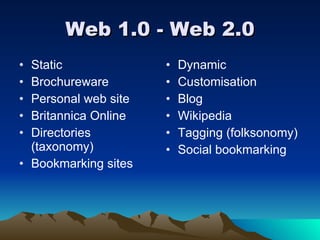
Web 1.0 - Web 2.0 Static Brochureware Personal web site Britannica Online Directories (taxonomy) Bookmarking sites Dynamic Customisation Blog Wikipedia Tagging (folksonomy) Social bookmarking
Web 2.0 Services/Applications Blog Wikis Web Feed RSS Atoms Tags, Folksonomy, and Tag Clouds  Social Networking
What is a Blog? Is a journal or diary (Blog, 2006) Usually displayed in a reverse chronological order. A commentary or news on a particular subject blogs are  primarily  textual… they sometimes contain; photographs (photoblog) videos (vlog) audio (podcasting) Are part of the social network / media
What is a wiki? A Web site that allows visitors to add, remove, and edit content. Without the need for registration. An effective tool for collaborative authoring. On-line encyclopedias such as Wikipedia.
Wikis http://www.ictlogy.net http://www.wikipedia.org http://k12wiki.wikispaces.com/
RSS RSS is acronym for Really Simple Syndication or Rich Site Summary RSS is an XML format for distributing news  headlines on the web Initially RSS was restricted to News Headlines. Common uses for RSS include: - Blog   - Newsletters - Weather Alerts  - Press Announcements - Specials or Discounts - Calendars
RSS RSS feeds can be read two different ways. Desktop RSS feed reader or news aggregator like Feed demo Web based RSS feed reader like FeedScout , Active Web Reader
Atom Atom is a format quite similar to RSS. It was created by people who felt that RSS could be improved upon. The basic difference is that while Atom is somewhat more complex (for  producers  of Atom feeds), it is also able to carry more complex information, and it is consistent across the syndication, storage, and editing of information.  Almost everything regarding RSS applies equally well to Atom.
Tags Tags   are keywords added to articles in blogs or Web pages via social page tag tools such as del.icio.us Technorati, and Yahoo’s My Web. Tags are also known as labels, and the process of creating tags is known as tagging.  Tagging is also used to great effect on photo sharing site  flickr:
Folksonomy   Folksonomy is a tagging system, a manual indexing of the Web. Tagging systems allow users to annotate digital resources with tags (keywords) and share their annotations with other users. It’s also known as social tagging, social indexing, collaborative tagging or social classification
Advantages User participation Adaptability Vocabularies Lower cost Flexible Take into account different perspectives
Social Networking Kind of application which helps interconnection amongst users Myspace.com Fourth most popular English Website 95 million members, with 500,000 new members each week Bought by News Corp (Rupert Murdoch) for US$580 Million in June 2005 orkut.com  40 million members, daily traffic is said to be more than 5, 00,000.
Applications Movies, Music, Books, TV Shows 􀁹  List your favourites 􀁹  See your friends’ favourites 􀁹  Discuss, post reviews, take quiz etc. 􀁹  Peer- driven web 􀁹  Likeness – find out which friend/celebrity you look like 􀁹  Name Analyzer – what does your name mean? 􀁹  Chess - play in real-time and make new friends 􀁹  New common API: Google OpenSocial
Web2.0: Technologies AJAX   API   Mash-ups   Flash M-paper technology   R/W Web for collective intelligence
What is AJAX? Asynchronous JavaScript and XML Available on all major browsers Removes the need to reload entire web page each time the user makes a change. Increase the web page's interactivity, speed, and usability. XML is used as the format for transferring data between the server and client. XML files may be created dynamically by some form of server-side scripting The Ajax technique uses a combination of:  XHTML  and CSS, JavaScript, XMLHttpRequest /IFrame object
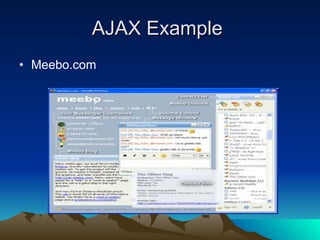
AJAX Example  Meebo.com
API Application Programming Interface (API)  set of routines, protocols, and tools for building software applications. Good for users and programmer Google Maps a good example of Open Source API programming.
Mash-up A  mashup  is a website or web application that uses content from more than one source to create a completely new service. small box on your personal homepage showing you the local weather forecast and another box showing you news headlines are forms of mash-up.
Problems Security - Many attack vectors for Javascript - New technology - Not applicable as initially intended - Cross site javascripting Privacy - Companies might have policies against    outside mails, documents, etc. - Trust the provider of the service
Problems Scalability - Closer to the desktop - slower - Backend must extend to thousand of    users 􀁹  Interoperability - Javascript   -  cross browser behaviour - cross platform behaviour  (handheld vs desktop)
Solutions Security - Use Firefox with the No Script add-on, only allows sites you trust Privacy - Data between server - browser has to be  encrypted - Users must be taught not to use online  tools for sensitive information
Conclusion Web 3.0 Emphasis on APIs and data accessibility Mobile Devices Semantic Web Better security Ensuring privacy
Thank You

Web 2.0: new definition of web

  • 1.
    Web 2.0: newdefinition of web by Neeraj Kumar Singh Assistant Librarian Panjab University, Chandigarh
  • 2.
    Website Bunch ofweb pages Click and browse Couldn't interact on it Familiar with HTML coding Websites started springing up like mushroom life became rather boring on the Internet
  • 3.
    Web 2.0 O’ReillyMedia 2004 It is Second generation of services available on the Web that lets people collaborate and share information online set of technologies Transition from static HTML Web pages to a more dynamic Web Key concepts are participation and dynamic interaction. Open communication & open sharing of information
  • 4.
    Web 1.0 -Web 2.0 Static Brochureware Personal web site Britannica Online Directories (taxonomy) Bookmarking sites Dynamic Customisation Blog Wikipedia Tagging (folksonomy) Social bookmarking
  • 5.
    Web 2.0 Services/ApplicationsBlog Wikis Web Feed RSS Atoms Tags, Folksonomy, and Tag Clouds Social Networking
  • 6.
    What is aBlog? Is a journal or diary (Blog, 2006) Usually displayed in a reverse chronological order. A commentary or news on a particular subject blogs are primarily textual… they sometimes contain; photographs (photoblog) videos (vlog) audio (podcasting) Are part of the social network / media
  • 7.
    What is awiki? A Web site that allows visitors to add, remove, and edit content. Without the need for registration. An effective tool for collaborative authoring. On-line encyclopedias such as Wikipedia.
  • 8.
  • 9.
    RSS RSS isacronym for Really Simple Syndication or Rich Site Summary RSS is an XML format for distributing news headlines on the web Initially RSS was restricted to News Headlines. Common uses for RSS include: - Blog - Newsletters - Weather Alerts - Press Announcements - Specials or Discounts - Calendars
  • 10.
    RSS RSS feedscan be read two different ways. Desktop RSS feed reader or news aggregator like Feed demo Web based RSS feed reader like FeedScout , Active Web Reader
  • 11.
    Atom Atom isa format quite similar to RSS. It was created by people who felt that RSS could be improved upon. The basic difference is that while Atom is somewhat more complex (for producers of Atom feeds), it is also able to carry more complex information, and it is consistent across the syndication, storage, and editing of information. Almost everything regarding RSS applies equally well to Atom.
  • 12.
    Tags Tags are keywords added to articles in blogs or Web pages via social page tag tools such as del.icio.us Technorati, and Yahoo’s My Web. Tags are also known as labels, and the process of creating tags is known as tagging. Tagging is also used to great effect on photo sharing site flickr:
  • 13.
    Folksonomy Folksonomy is a tagging system, a manual indexing of the Web. Tagging systems allow users to annotate digital resources with tags (keywords) and share their annotations with other users. It’s also known as social tagging, social indexing, collaborative tagging or social classification
  • 14.
    Advantages User participationAdaptability Vocabularies Lower cost Flexible Take into account different perspectives
  • 15.
    Social Networking Kindof application which helps interconnection amongst users Myspace.com Fourth most popular English Website 95 million members, with 500,000 new members each week Bought by News Corp (Rupert Murdoch) for US$580 Million in June 2005 orkut.com 40 million members, daily traffic is said to be more than 5, 00,000.
  • 16.
    Applications Movies, Music,Books, TV Shows 􀁹 List your favourites 􀁹 See your friends’ favourites 􀁹 Discuss, post reviews, take quiz etc. 􀁹 Peer- driven web 􀁹 Likeness – find out which friend/celebrity you look like 􀁹 Name Analyzer – what does your name mean? 􀁹 Chess - play in real-time and make new friends 􀁹 New common API: Google OpenSocial
  • 17.
    Web2.0: Technologies AJAX API Mash-ups Flash M-paper technology R/W Web for collective intelligence
  • 18.
    What is AJAX?Asynchronous JavaScript and XML Available on all major browsers Removes the need to reload entire web page each time the user makes a change. Increase the web page's interactivity, speed, and usability. XML is used as the format for transferring data between the server and client. XML files may be created dynamically by some form of server-side scripting The Ajax technique uses a combination of: XHTML and CSS, JavaScript, XMLHttpRequest /IFrame object
  • 19.
    AJAX Example Meebo.com
  • 20.
    API Application ProgrammingInterface (API) set of routines, protocols, and tools for building software applications. Good for users and programmer Google Maps a good example of Open Source API programming.
  • 21.
    Mash-up A mashup is a website or web application that uses content from more than one source to create a completely new service. small box on your personal homepage showing you the local weather forecast and another box showing you news headlines are forms of mash-up.
  • 22.
    Problems Security -Many attack vectors for Javascript - New technology - Not applicable as initially intended - Cross site javascripting Privacy - Companies might have policies against outside mails, documents, etc. - Trust the provider of the service
  • 23.
    Problems Scalability -Closer to the desktop - slower - Backend must extend to thousand of users 􀁹 Interoperability - Javascript - cross browser behaviour - cross platform behaviour (handheld vs desktop)
  • 24.
    Solutions Security -Use Firefox with the No Script add-on, only allows sites you trust Privacy - Data between server - browser has to be encrypted - Users must be taught not to use online tools for sensitive information
  • 25.
    Conclusion Web 3.0Emphasis on APIs and data accessibility Mobile Devices Semantic Web Better security Ensuring privacy
  • 26.