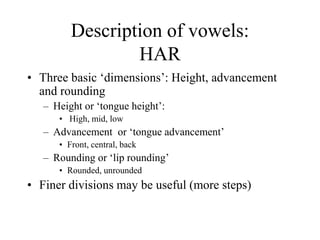
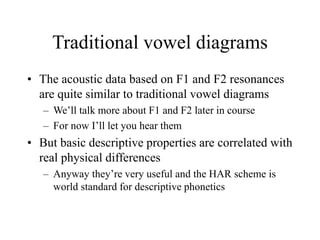
The document introduces English vowels, focusing on three dimensions: height, advancement, and rounding, with reference to the standard phonetic representation. It outlines the simple and diphthong vowels in General American and Canadian English, along with variations in their transcription. The importance of acoustic data and traditional vowel diagrams is emphasized, highlighting their correlation with phonetic properties.

![The key (‘point’) vowels [i a u]
Real vowels http://www.ling.yale.edu:16080/ling120/Gestural_structure/MRI_Vowels/
Artist’s conception
Graphics unavailable.
Similar images at :
http://www.ling.yale.edu/ling120/Gestural_structure/MRI_Vowels/index.html
Graphics unavailable.
For similar drawings, see Rogers 2000 p 28 29 30, figures 2.5 2.8 and 2.9](https://image.slidesharecdn.com/wbengvowelsintro-240605014143-87de1a77/85/WBEngVowelsIntrobbbbbbbbbbbbbbbbbbbbbbbb-ppt-3-320.jpg)
![The Simple Vowels of GeneralAmerican (GA)
• The ‘simple’ vowels
Front Central Back*
[i] ‘beat’ [u] ‘boot’ higher high
[I] ‘bit’ [U] ‘book’ lower high
([e]) ( [o]) higher mid
[E] ‘bet’ [´] ‘sofa’ [ç] ‘bought’ lower mid
[√] ‘but’
[Q] ‘bat’ [A] ‘Bob’ (lower) low
* Back vowels except [A] are rounded; the rest are unrounded](https://image.slidesharecdn.com/wbengvowelsintro-240605014143-87de1a77/85/WBEngVowelsIntrobbbbbbbbbbbbbbbbbbbbbbbb-ppt-9-320.jpg)
![The Simple Vowels W. Canadian (WCE)
• The ‘simple’ vowels
Front Central Back*
[i] ‘beat’ [u] ‘boot’ higher high
[I] ‘bit’ [U] ‘book’ lower high
([e]) ( [o]) higher mid
[E] ‘bet’ [´] ‘sofa’ lower mid
[√] ‘but’
[Å] (higher) low
[Q] ‘bat’ ‘Bob, bought’ (lower) low
*All back vowels including [Å] are rounded; the rest are unrounded
Note: The ‘official’ IPA description of /ʌ/ is a lower mid back unrounded vowel, but it we will call it a central vowel,
since that is how the vowel symbol is used in English. (Strict IPA would have us use the symbol /ɐ/ for the vowel
in ʼbutʼ.)](https://image.slidesharecdn.com/wbengvowelsintro-240605014143-87de1a77/85/WBEngVowelsIntrobbbbbbbbbbbbbbbbbbbbbbbb-ppt-10-320.jpg)
![Diphthongs of GA (and WCE)
• The ‘simple’ vowels
Front Central Back
[ej] ‘bait’ [ow] ‘boat’ (higher) mid
[aj] ‘tide’ [aw] ‘loud’ low](https://image.slidesharecdn.com/wbengvowelsintro-240605014143-87de1a77/85/WBEngVowelsIntrobbbbbbbbbbbbbbbbbbbbbbbb-ppt-11-320.jpg)
![Variations on transcribing second
part of diphthongs
• Vowel in ‘hide’ variously transcribed
• [aj ] [aI] [aj] [aiª]
• They all mean pretty much the same thing
• We’ll use Roger’s convention
– I may slip up and use [aI]](https://image.slidesharecdn.com/wbengvowelsintro-240605014143-87de1a77/85/WBEngVowelsIntrobbbbbbbbbbbbbbbbbbbbbbbb-ppt-12-320.jpg)
![The low back vowel in W. Cdn
• Rogers’ p. 124 uses [A] for Cdn vowel in
‘Bob’ or ‘bought’
– But he notes variation
– Local pronunciation seems closer to [Å]
– You can choose either symbol for broad
transcription
• I may vary on board](https://image.slidesharecdn.com/wbengvowelsintro-240605014143-87de1a77/85/WBEngVowelsIntrobbbbbbbbbbbbbbbbbbbbbbbb-ppt-13-320.jpg)
![Next couple of weeks…
• We’ll be concentrating on consonant sounds
• Transcription part of first quiz will include
broad transcription of all English
consonants
• Only the three ‘point vowels’ [i A u]](https://image.slidesharecdn.com/wbengvowelsintro-240605014143-87de1a77/85/WBEngVowelsIntrobbbbbbbbbbbbbbbbbbbbbbbb-ppt-14-320.jpg)


