Planet of Slums By: Stayce Tate
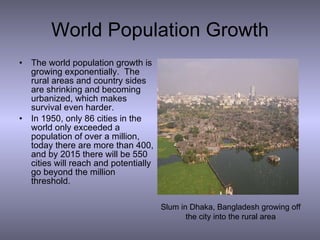
World Population Growth The world population growth is growing exponentially.  The rural areas and country sides are shrinking and becoming urbanized, which makes survival even harder. In 1950, only 86 cities in the world only exceeded a population of over a million, today there are more than 400, and by 2015 there will be 550 cities will reach and potentially go beyond the million threshold. Slum in Dhaka, Bangladesh growing off the city into the rural area
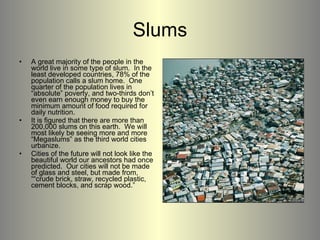
Slums A great majority of the people in the world live in some type of slum.  In the least developed countries, 78% of the population calls a slum home.  One quarter of the population lives in “absolute” poverty, and two-thirds don’t even earn enough money to buy the minimum amount of food required for daily nutrition. It is figured that there are more than 200,000 slums on this earth.  We will most likely be seeing more and more “Megaslums” as the third world cities urbanize. Cities of the future will not look like the beautiful world our ancestors had once predicted.  Our cities will not be made of glass and steel, but made from, ““crude brick, straw, recycled plastic, cement blocks, and scrap wood.”
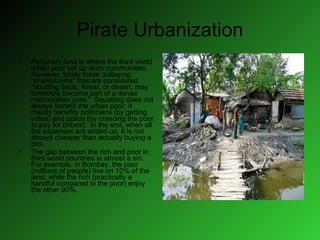
Pirate Urbanization Periphery land is where the third world urban poor set up slum communities.  However, today these outlaying “shantytowns” that are considered “abutting fields, forest, or desert, may tomorrow become part of a dense metropolitan core.”  Squatting does not always benefit the urban poor; it mainly benefits politicians (by getting votes) and police (by coercing the poor to pay for bribes).  In the end, when all the expenses are added up, it is not always cheaper than actually buying a plot.  The gap between the rich and poor in third world countries is almost a sin.  For example, in Bombay, the poor (millions of people) live on 10% of the land, while the rich (practically a handful compared to the poor) enjoy the other 90%.
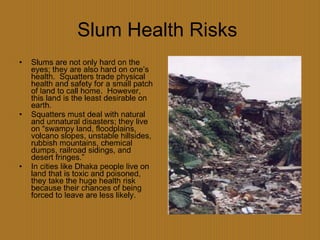
Slum Health Risks  Slums are not only hard on the eyes; they are also hard on one’s health.  Squatters trade physical health and safety for a small patch of land to call home.  However, this land is the least desirable on earth.  Squatters must deal with natural and unnatural disasters; they live on “swampy land, floodplains, volcano slopes, unstable hillsides, rubbish mountains, chemical dumps, railroad sidings, and desert fringes.”  In cities like Dhaka people live on land that is toxic and poisoned, they take the huge health risk because their chances of being forced to leave are less likely.
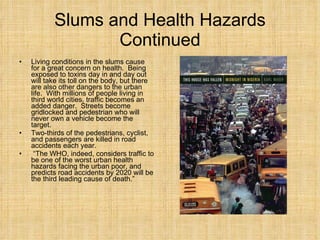
Slums and Health Hazards Continued Living conditions in the slums cause for a great concern on health.  Being exposed to toxins day in and day out will take its toll on the body, but there are also other dangers to the urban life.  With millions of people living in third world cities, traffic becomes an added danger.  Streets become gridlocked and pedestrian who will never own a vehicle become the target.  Two-thirds of the pedestrians, cyclist, and passengers are killed in road accidents each year.  “ The WHO, indeed, considers traffic to be one of the worst urban health hazards facing the urban poor, and predicts road accidents by 2020 will be the third leading cause of death.”
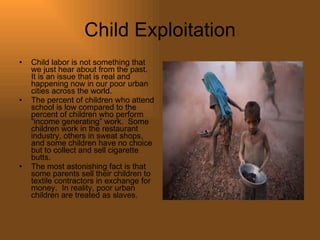
Child Exploitation Child labor is not something that we just hear about from the past.  It is an issue that is real and happening now in our poor urban cities across the world.  The percent of children who attend school is low compared to the percent of children who perform “income generating” work.  Some children work in the restaurant industry, others in sweat shops, and some children have no choice but to collect and sell cigarette butts. The most astonishing fact is that some parents sell their children to textile contractors in exchange for money.  In reality, poor urban children are treated as slaves.

Planet of slums

  • 1.
    Planet of SlumsBy: Stayce Tate
  • 2.
    World Population GrowthThe world population growth is growing exponentially. The rural areas and country sides are shrinking and becoming urbanized, which makes survival even harder. In 1950, only 86 cities in the world only exceeded a population of over a million, today there are more than 400, and by 2015 there will be 550 cities will reach and potentially go beyond the million threshold. Slum in Dhaka, Bangladesh growing off the city into the rural area
  • 3.
    Slums A greatmajority of the people in the world live in some type of slum. In the least developed countries, 78% of the population calls a slum home. One quarter of the population lives in “absolute” poverty, and two-thirds don’t even earn enough money to buy the minimum amount of food required for daily nutrition. It is figured that there are more than 200,000 slums on this earth. We will most likely be seeing more and more “Megaslums” as the third world cities urbanize. Cities of the future will not look like the beautiful world our ancestors had once predicted. Our cities will not be made of glass and steel, but made from, ““crude brick, straw, recycled plastic, cement blocks, and scrap wood.”
  • 4.
    Pirate Urbanization Peripheryland is where the third world urban poor set up slum communities. However, today these outlaying “shantytowns” that are considered “abutting fields, forest, or desert, may tomorrow become part of a dense metropolitan core.” Squatting does not always benefit the urban poor; it mainly benefits politicians (by getting votes) and police (by coercing the poor to pay for bribes). In the end, when all the expenses are added up, it is not always cheaper than actually buying a plot. The gap between the rich and poor in third world countries is almost a sin. For example, in Bombay, the poor (millions of people) live on 10% of the land, while the rich (practically a handful compared to the poor) enjoy the other 90%.
  • 5.
    Slum Health Risks Slums are not only hard on the eyes; they are also hard on one’s health. Squatters trade physical health and safety for a small patch of land to call home. However, this land is the least desirable on earth. Squatters must deal with natural and unnatural disasters; they live on “swampy land, floodplains, volcano slopes, unstable hillsides, rubbish mountains, chemical dumps, railroad sidings, and desert fringes.” In cities like Dhaka people live on land that is toxic and poisoned, they take the huge health risk because their chances of being forced to leave are less likely.
  • 6.
    Slums and HealthHazards Continued Living conditions in the slums cause for a great concern on health. Being exposed to toxins day in and day out will take its toll on the body, but there are also other dangers to the urban life. With millions of people living in third world cities, traffic becomes an added danger. Streets become gridlocked and pedestrian who will never own a vehicle become the target. Two-thirds of the pedestrians, cyclist, and passengers are killed in road accidents each year. “ The WHO, indeed, considers traffic to be one of the worst urban health hazards facing the urban poor, and predicts road accidents by 2020 will be the third leading cause of death.”
  • 7.
    Child Exploitation Childlabor is not something that we just hear about from the past. It is an issue that is real and happening now in our poor urban cities across the world. The percent of children who attend school is low compared to the percent of children who perform “income generating” work. Some children work in the restaurant industry, others in sweat shops, and some children have no choice but to collect and sell cigarette butts. The most astonishing fact is that some parents sell their children to textile contractors in exchange for money. In reality, poor urban children are treated as slaves.