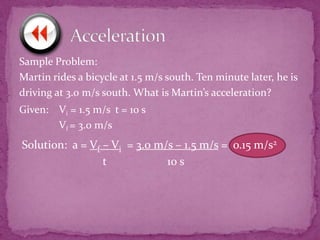
Sample Problem:
Martin rides a bicycle at 1.5 m/s south. Ten minute later, he is
driving at 3.0 m/s south. What is Martin’s acceleration?
Given: Vi = 1.5 m/s t = 10 s
Vf = 3.0 m/s

Solution: a = Vf – Vi = 3.0 m/s – 1.5 m/s = o.15 m/s2
t
10 s
 Describe each characteristics of

waves;
 Relate amplitude, frequency
wavelength and wave velocity;
 Analyzing situations involving
characteristics of waves;
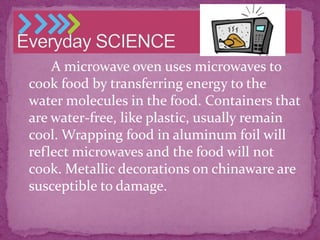
A microwave oven uses microwaves to
cook food by transferring energy to the
water molecules in the food. Containers that
are water-free, like plastic, usually remain
cool. Wrapping food in aluminum foil will
reflect microwaves and the food will not
cook. Metallic decorations on chinaware are
susceptible to damage.
Is a disturbance traveling through a medium
or a vacuum.
Wave pulse is a single unrepeated
disturbance
Wave train is a succession of
periodic disturbances
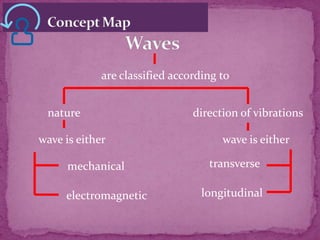
are classified according to
nature

wave is either
mechanical

electromagnetic

direction of vibrations

wave is either
transverse

longitudinal
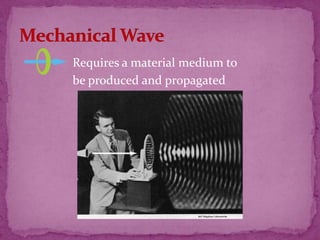
Requires a material medium to
be produced and propagated
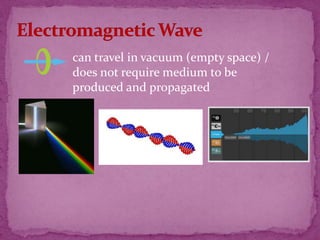
can travel in vacuum (empty space) /
does not require medium to be
produced and propagated
How do mechanical waves
differ from
electromagnetic waves?
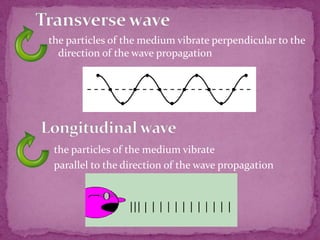
the particles of the medium vibrate perpendicular to the
direction of the wave propagation

the particles of the medium vibrate
parallel to the direction of the wave propagation
How do transverse waves
differ from longitudinal
waves?
What
Are the
Valuable points and applications that
you have learned?
Express your insight/learning to the
class.
How do you go through
the waves of life?

Wave

  • 2.
    Sample Problem: Martin ridesa bicycle at 1.5 m/s south. Ten minute later, he is driving at 3.0 m/s south. What is Martin’s acceleration? Given: Vi = 1.5 m/s t = 10 s Vf = 3.0 m/s Solution: a = Vf – Vi = 3.0 m/s – 1.5 m/s = o.15 m/s2 t 10 s
  • 4.
     Describe eachcharacteristics of waves;  Relate amplitude, frequency wavelength and wave velocity;  Analyzing situations involving characteristics of waves;
  • 5.
    A microwave ovenuses microwaves to cook food by transferring energy to the water molecules in the food. Containers that are water-free, like plastic, usually remain cool. Wrapping food in aluminum foil will reflect microwaves and the food will not cook. Metallic decorations on chinaware are susceptible to damage.
  • 6.
    Is a disturbancetraveling through a medium or a vacuum. Wave pulse is a single unrepeated disturbance Wave train is a succession of periodic disturbances
  • 7.
    are classified accordingto nature wave is either mechanical electromagnetic direction of vibrations wave is either transverse longitudinal
  • 8.
    Requires a materialmedium to be produced and propagated
  • 9.
    can travel invacuum (empty space) / does not require medium to be produced and propagated
  • 10.
    How do mechanicalwaves differ from electromagnetic waves?
  • 11.
    the particles ofthe medium vibrate perpendicular to the direction of the wave propagation the particles of the medium vibrate parallel to the direction of the wave propagation
  • 12.
    How do transversewaves differ from longitudinal waves?
  • 13.
    What Are the Valuable pointsand applications that you have learned? Express your insight/learning to the class.
  • 14.
    How do yougo through the waves of life?