JOHN BROADUS
WATSON
Theory of Behaviorism
Presented By: Ms. Garcia, Mary Akima Gwen
Ms. Giting, Azumi
OVERVIEW
1
Introduction
Two types of
conditioning
4 Principles
Little Albert Experiment
Concept of Behaviorism
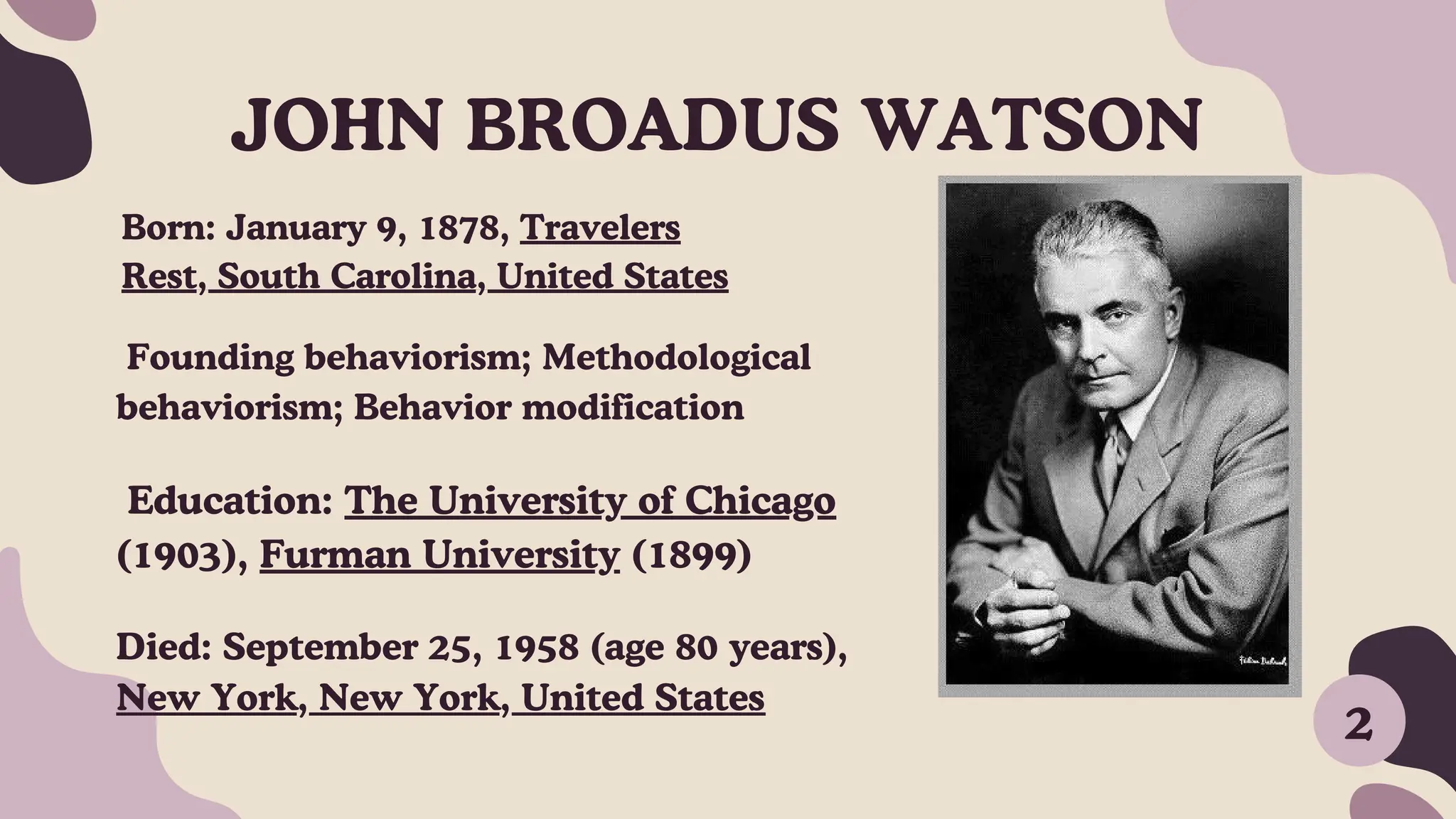
JOHN BROADUS WATSON
2
Born: January 9, 1878, Travelers
Rest, South Carolina, United States
Died: September 25, 1958 (age 80 years),
New York, New York, United States
Founding behaviorism; Methodological
behaviorism; Behavior modification
Education: The University of Chicago
(1903), Furman University (1899)
Behavior is observable and measurable
Environment shapes behavior
According to Watson, the only meaningful data in
psychology is behavior that can be observed and
measured objectively
Watson believed that behavior is the result of the
environmental factors that influence an
individual's learning and experience.
4 PRINCIPLES
13
Learning is a process of conditioning
Behavior can be predicted and controlled
Watson's theory of behaviorism posits that
all behavior is learned through a process of
conditioning..
Because behavior is learned through
conditioning, it can be predicted and controlled
by manipulating the environmental factors that
influence learning 13
TWO MAJOR TYPES OF
CONDITIONING
Classical conditioning
Operant conditioning
is a technique used in behavioral training in which a
naturally occurring stimulus is paired with a
response.
Operant conditioning (sometimes referred to as
instrumental conditioning) is a method of learning
that occurs through rewards and punishments for
behavior
6
LITTLE ALBERT EXPERIMENT
One of his most famous experiments was the Little
Albert experiment, which explored classical
conditioning using a nine month-old baby boy. In
the experiment, Watson demonstrated that Little
Albert could be conditioned to fear something, like
a white rat, when no such fear existed initially.
8
Men are "biological machines" whose minds do not
have any influence on their actions.
Behaviorism teaches that we are not responsible for our
actions..
According to Skinner, the mind and mental processes are
"metaphors and fictions" and that "behavior is simply part
of the biology of the organism
Since men are mere machines, then anything
done by men is inevitable 6
CONCEPT OF BEHAVIORISM
Behaviorism predicts and controls human behavior
by controlling rewards and punishment. One can
shape the behavior of another individual.
Behaviorism is manipulative
7
THANK YOU

John Watson’s Theory of Behaviorism .pdf

  • 1.
    JOHN BROADUS WATSON Theory ofBehaviorism Presented By: Ms. Garcia, Mary Akima Gwen Ms. Giting, Azumi
  • 2.
    OVERVIEW 1 Introduction Two types of conditioning 4Principles Little Albert Experiment Concept of Behaviorism
  • 3.
    JOHN BROADUS WATSON 2 Born:January 9, 1878, Travelers Rest, South Carolina, United States Died: September 25, 1958 (age 80 years), New York, New York, United States Founding behaviorism; Methodological behaviorism; Behavior modification Education: The University of Chicago (1903), Furman University (1899)
  • 4.
    Behavior is observableand measurable Environment shapes behavior According to Watson, the only meaningful data in psychology is behavior that can be observed and measured objectively Watson believed that behavior is the result of the environmental factors that influence an individual's learning and experience. 4 PRINCIPLES 13
  • 5.
    Learning is aprocess of conditioning Behavior can be predicted and controlled Watson's theory of behaviorism posits that all behavior is learned through a process of conditioning.. Because behavior is learned through conditioning, it can be predicted and controlled by manipulating the environmental factors that influence learning 13
  • 6.
    TWO MAJOR TYPESOF CONDITIONING Classical conditioning Operant conditioning is a technique used in behavioral training in which a naturally occurring stimulus is paired with a response. Operant conditioning (sometimes referred to as instrumental conditioning) is a method of learning that occurs through rewards and punishments for behavior 6
  • 7.
    LITTLE ALBERT EXPERIMENT Oneof his most famous experiments was the Little Albert experiment, which explored classical conditioning using a nine month-old baby boy. In the experiment, Watson demonstrated that Little Albert could be conditioned to fear something, like a white rat, when no such fear existed initially. 8
  • 8.
    Men are "biologicalmachines" whose minds do not have any influence on their actions. Behaviorism teaches that we are not responsible for our actions.. According to Skinner, the mind and mental processes are "metaphors and fictions" and that "behavior is simply part of the biology of the organism Since men are mere machines, then anything done by men is inevitable 6 CONCEPT OF BEHAVIORISM
  • 9.
    Behaviorism predicts andcontrols human behavior by controlling rewards and punishment. One can shape the behavior of another individual. Behaviorism is manipulative 7
  • 10.