Solid Waste Problem in Puerto Rico’s
Urban Areas
By: Gretchen Villali, Khiry Maynard, Clifford Villaflor
Professor Linda Commander
Science
What is Solid Waste
Solid waste means any garbage, refuse, sludge from a wastewater
treatment plant, water supply treatment plant, or air pollution control
facility and other discarded materials.
Including solid, liquid, semi-solid, or contained gaseous material,
resulting from industrial, commercial, mining and agricultural
operations, and from community activities.
Does not include solid or dissolved materials in domestic sewage, or
solid or dissolved materials in irrigation return flows or industrial
discharges.
Allen, B., & inc.(1996)
Examples of Solid Waste
Waste tires
Septage
Scrap metal
Latex paints
Furniture and toys
Domestic refuse (garbage)
Discarded appliances and vehicles
Uncontaminated used oil and anti-freezeempty aerosol cans, paint
cans and compressed gas cylinders
Construction and demolition debris, asbestos
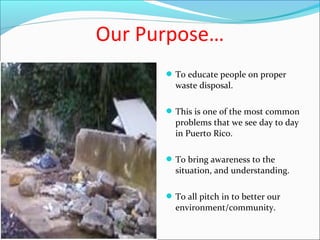
Our Purpose…
To educate people on proper
waste disposal.
This is one of the most common
problems that we see day to day
in Puerto Rico.
To bring awareness to the
situation, and understanding.
To all pitch in to better our
environment/community.
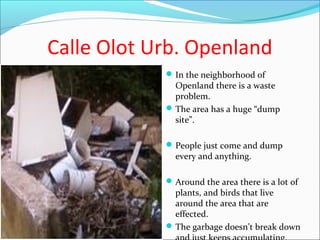
Calle Olot Urb. Openland
In the neighborhood of
Openland there is a waste
problem.
The area has a huge “dump
site”.
People just come and dump
every and anything.
Around the area there is a lot of
plants, and birds that live
around the area that are
effected.
The garbage doesn’t break down
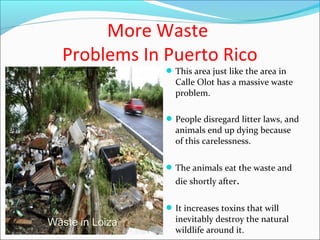
More Waste
Problems In Puerto Rico
This area just like the area in
Calle Olot has a massive waste
problem.
People disregard litter laws, and
animals end up dying because
of this carelessness.
The animals eat the waste and
die shortly after.
It increases toxins that will
inevitably destroy the natural
wildlife around it.
Waste in Loiza
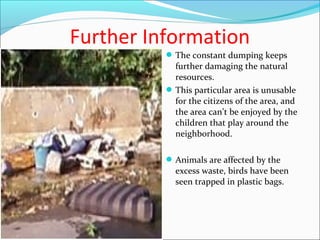
Further Information
The constant dumping keeps
further damaging the natural
resources.
This particular area is unusable
for the citizens of the area, and
the area can’t be enjoyed by the
children that play around the
neighborhood.
Animals are affected by the
excess waste, birds have been
seen trapped in plastic bags.
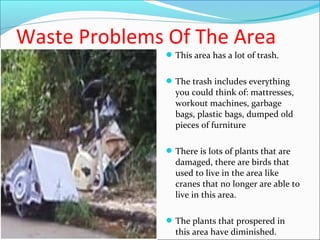
Waste Problems Of The Area
This area has a lot of trash.
The trash includes everything
you could think of: mattresses,
workout machines, garbage
bags, plastic bags, dumped old
pieces of furniture
There is lots of plants that are
damaged, there are birds that
used to live in the area like
cranes that no longer are able to
live in this area.
The plants that prospered in
this area have diminished.
What kinds of Solid Waste is
Present?
There is also pieces of construction that gets dumped
off at this area.
They have to keep bringing in construction
machinery to remove the waste that repeatedly gets
dumped.
This causes further irreparable damage with the
vegetation in the area.
Why We Should Help..
• To maintain garbage control.
• If the problem of waste isn’t taken care of it becomes a serious health
hazards.
• If the problem isn’t regularly taken care of a lot of problems
manifests.
• The garbage and waste invite a large number of insect like flies,
mosquitoes that spread illness.
• Scavengers such as stray dogs, rats which spread dangerous diseases.
It also causes bad odors and not to mention causes pollution.
What Can Be Done
Take pride in your area, don’t trash it to begin with.
Cut back on the amount of waste by using and throwing out less in
the first place.
One of the major sources of the waste problem is paper and
plastics, it accounts for approximately one-third of all the garbage,
so recycle.
Recycle it works, and it does so in several ways. It reduces the
environmental costs of land filling and incineration. It substitutes
used materials for virgin materials.
by reducing the demand for natural resources. It conserves energy.
And it creates jobs in the community.
EPA. (2009).
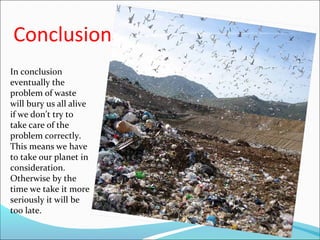
Conclusion
In conclusion
eventually the
problem of waste
will bury us all alive
if we don’t try to
take care of the
problem correctly.
This means we have
to take our planet in
consideration.
Otherwise by the
time we take it more
seriously it will be
too late.
Bibliography
 Green. (2009, January 30). How does landfill and litter affect
our wildlife? |NowPublic.com | The News is NowPublic.
Retrieved October 21, 2010, from
http://www.nowpublic.com/environment/how-does-landfill-and-litter-
 EPA. (2009). Waste Prevention. Waste WI$e Tip Sheet, 1.
Retrieved October 20, 2010, from the EPA database
 Hickman, H. (1971). a case study of federal- state partnership.
state solid waste planning , 1. Retrieved October 19, 2010,
from the EPA database.
 Allen, B., & inc.. (1996). Definition of Solid Waste and
Hazardous Waste Recycling. RCRA, Superfund & EPCRA Hotline
Training Module, 2. Retrieved October 20, 2010, from the EPA
database

Waste in pr

  • 1.
    Solid Waste Problemin Puerto Rico’s Urban Areas By: Gretchen Villali, Khiry Maynard, Clifford Villaflor Professor Linda Commander Science
  • 2.
    What is SolidWaste Solid waste means any garbage, refuse, sludge from a wastewater treatment plant, water supply treatment plant, or air pollution control facility and other discarded materials. Including solid, liquid, semi-solid, or contained gaseous material, resulting from industrial, commercial, mining and agricultural operations, and from community activities. Does not include solid or dissolved materials in domestic sewage, or solid or dissolved materials in irrigation return flows or industrial discharges. Allen, B., & inc.(1996)
  • 3.
    Examples of SolidWaste Waste tires Septage Scrap metal Latex paints Furniture and toys Domestic refuse (garbage) Discarded appliances and vehicles Uncontaminated used oil and anti-freezeempty aerosol cans, paint cans and compressed gas cylinders Construction and demolition debris, asbestos
  • 4.
    Our Purpose… To educatepeople on proper waste disposal. This is one of the most common problems that we see day to day in Puerto Rico. To bring awareness to the situation, and understanding. To all pitch in to better our environment/community.
  • 5.
    Calle Olot Urb.Openland In the neighborhood of Openland there is a waste problem. The area has a huge “dump site”. People just come and dump every and anything. Around the area there is a lot of plants, and birds that live around the area that are effected. The garbage doesn’t break down
  • 6.
    More Waste Problems InPuerto Rico This area just like the area in Calle Olot has a massive waste problem. People disregard litter laws, and animals end up dying because of this carelessness. The animals eat the waste and die shortly after. It increases toxins that will inevitably destroy the natural wildlife around it. Waste in Loiza
  • 7.
    Further Information The constantdumping keeps further damaging the natural resources. This particular area is unusable for the citizens of the area, and the area can’t be enjoyed by the children that play around the neighborhood. Animals are affected by the excess waste, birds have been seen trapped in plastic bags.
  • 8.
    Waste Problems OfThe Area This area has a lot of trash. The trash includes everything you could think of: mattresses, workout machines, garbage bags, plastic bags, dumped old pieces of furniture There is lots of plants that are damaged, there are birds that used to live in the area like cranes that no longer are able to live in this area. The plants that prospered in this area have diminished.
  • 9.
    What kinds ofSolid Waste is Present? There is also pieces of construction that gets dumped off at this area. They have to keep bringing in construction machinery to remove the waste that repeatedly gets dumped. This causes further irreparable damage with the vegetation in the area.
  • 10.
    Why We ShouldHelp.. • To maintain garbage control. • If the problem of waste isn’t taken care of it becomes a serious health hazards. • If the problem isn’t regularly taken care of a lot of problems manifests. • The garbage and waste invite a large number of insect like flies, mosquitoes that spread illness. • Scavengers such as stray dogs, rats which spread dangerous diseases. It also causes bad odors and not to mention causes pollution.
  • 11.
    What Can BeDone Take pride in your area, don’t trash it to begin with. Cut back on the amount of waste by using and throwing out less in the first place. One of the major sources of the waste problem is paper and plastics, it accounts for approximately one-third of all the garbage, so recycle. Recycle it works, and it does so in several ways. It reduces the environmental costs of land filling and incineration. It substitutes used materials for virgin materials. by reducing the demand for natural resources. It conserves energy. And it creates jobs in the community. EPA. (2009).
  • 12.
    Conclusion In conclusion eventually the problemof waste will bury us all alive if we don’t try to take care of the problem correctly. This means we have to take our planet in consideration. Otherwise by the time we take it more seriously it will be too late.
  • 13.
    Bibliography  Green. (2009,January 30). How does landfill and litter affect our wildlife? |NowPublic.com | The News is NowPublic. Retrieved October 21, 2010, from http://www.nowpublic.com/environment/how-does-landfill-and-litter-  EPA. (2009). Waste Prevention. Waste WI$e Tip Sheet, 1. Retrieved October 20, 2010, from the EPA database  Hickman, H. (1971). a case study of federal- state partnership. state solid waste planning , 1. Retrieved October 19, 2010, from the EPA database.  Allen, B., & inc.. (1996). Definition of Solid Waste and Hazardous Waste Recycling. RCRA, Superfund & EPCRA Hotline Training Module, 2. Retrieved October 20, 2010, from the EPA database