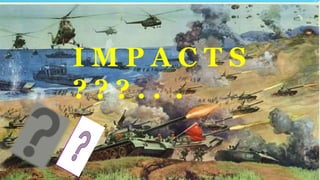
I M P A C T S
? ? ? . . .
 Progression in weapons also has an extensive
effect on the environment. New technology
means more invention and more utilization.
 Upgrading technology will expand the
manufacture of weapons, and atomic bombs
when these weapons will be confirmed and used;
then the environment will get poisoned.
 With the improvement of technology there is also
improvement in the field of war through the
designed atomic bombs and weapons that can
destroy a certain area.
 I am not impressed with the advancement of it
because it means one thing, Earth maybe
destroyed by a highly technological bombs that is a
product of science.
The machine gun emerged as one of the
decisive technologies during world war
1 (1941-1918)
.Reflected a trend toward industrialism
and the application of mass production
methods to weapons and to the
technology of warfare in general.
 The outbreak of World War II was in many ways an
unprecedented crisis for Socialist organizations.
Democratic Socialists had traditionally been anti-war
to the point of pacifism, while revolutionary Socialists
had opposed wars waged by openly capitalistic
regimes on the basis that the only violence worth
pursuing was rooted in the class struggle, not
between opposing groups of capitalists.
 The first wave of transformation began when
some prescient person about 10,000 years
ago, probably a
woman, planted and nurtured a seed. The
age of agriculture began; it’s significance
was that people moved from nomadic
wandering and
hunting and began to cluster into
villages and develop culture.
 The second wave was an expression of
machine muscle. The Industrial Revolution
began in the 1700s and gathered steam after
America’s Civil
War. People began to leave the peasant
culture of farming to come
to work in city factories.
It culminated in the Second
World
War, a clash of smokestack
juggernauts, and the
explosion of the atomic
bombs over Japan.
 Third wave, based not on muscle but on
mind. It is what we variously call the
information or knowledge age, and while it is
powerfully driven by information technology,
it has co-drivers as well, among them social
demands
worldwide for greater freedom and
individuation.
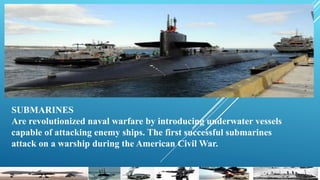
SUBMARINES
Are revolutionized naval warfare by introducing underwater vessels
capable of attacking enemy ships. The first successful submarines
attack on a warship during the American Civil War.
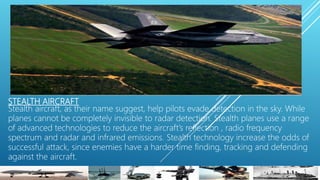
STEALTH AIRCRAFT
Stealth aircraft, as their name suggest, help pilots evade detection in the sky. While
planes cannot be completely invisible to radar detection. Stealth planes use a range
of advanced technologies to reduce the aircraft’s reflection , radio frequency
spectrum and radar and infrared emissions. Stealth technology increase the odds of
successful attack, since enemies have a harder time finding, tracking and defending
against the aircraft.
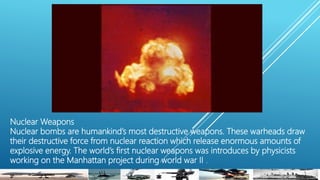
Nuclear Weapons
Nuclear bombs are humankind’s most destructive weapons. These warheads draw
their destructive force from nuclear reaction which release enormous amounts of
explosive energy. The world’s first nuclear weapons was introduces by physicists
working on the Manhattan project during world war II .
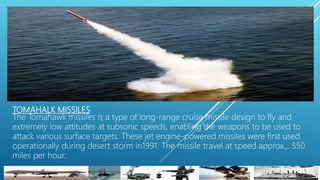
TOMAHALK MISSILES
The Tomahawk missiles is a type of long-range cruise missile design to fly and
extremely low attitudes at subsonic speeds, enabling the weapons to be used to
attack various surface targets. These jet engine-powered missiles were first used
operationally during desert storm in1991. The missile travel at speed approx.,. 550
miles per hour.
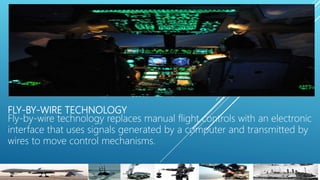
FLY-BY-WIRE TECHNOLOGY
Fly-by-wire technology replaces manual flight controls with an electronic
interface that uses signals generated by a computer and transmitted by
wires to move control mechanisms.
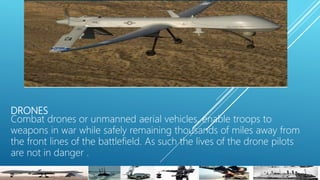
DRONES
Combat drones or unmanned aerial vehicles, enable troops to
weapons in war while safely remaining thousands of miles away from
the front lines of the battlefield. As such the lives of the drone pilots
are not in danger .
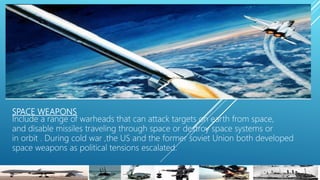
SPACE WEAPONS
Include a range of warheads that can attack targets on earth from space,
and disable missiles traveling through space or destroy space systems or
in orbit . During cold war ,the US and the former soviet Union both developed
space weapons as political tensions escalated.
Ready for a QUIZ?
Get a piece of paper silently …
Cheating is a crime 
Prepared by :
MA. SOPHIA AJAN MALVAS

War, Science and Technology (impacts)

  • 2.
    I M PA C T S ? ? ? . . .
  • 6.
     Progression inweapons also has an extensive effect on the environment. New technology means more invention and more utilization.  Upgrading technology will expand the manufacture of weapons, and atomic bombs when these weapons will be confirmed and used; then the environment will get poisoned.
  • 7.
     With theimprovement of technology there is also improvement in the field of war through the designed atomic bombs and weapons that can destroy a certain area.  I am not impressed with the advancement of it because it means one thing, Earth maybe destroyed by a highly technological bombs that is a product of science.
  • 8.
    The machine gunemerged as one of the decisive technologies during world war 1 (1941-1918) .Reflected a trend toward industrialism and the application of mass production methods to weapons and to the technology of warfare in general.
  • 9.
     The outbreakof World War II was in many ways an unprecedented crisis for Socialist organizations. Democratic Socialists had traditionally been anti-war to the point of pacifism, while revolutionary Socialists had opposed wars waged by openly capitalistic regimes on the basis that the only violence worth pursuing was rooted in the class struggle, not between opposing groups of capitalists.
  • 11.
     The firstwave of transformation began when some prescient person about 10,000 years ago, probably a woman, planted and nurtured a seed. The age of agriculture began; it’s significance was that people moved from nomadic wandering and hunting and began to cluster into villages and develop culture.
  • 12.
     The secondwave was an expression of machine muscle. The Industrial Revolution began in the 1700s and gathered steam after America’s Civil War. People began to leave the peasant culture of farming to come to work in city factories.
  • 13.
    It culminated inthe Second World War, a clash of smokestack juggernauts, and the explosion of the atomic bombs over Japan.
  • 14.
     Third wave,based not on muscle but on mind. It is what we variously call the information or knowledge age, and while it is powerfully driven by information technology, it has co-drivers as well, among them social demands worldwide for greater freedom and individuation.
  • 16.
    SUBMARINES Are revolutionized navalwarfare by introducing underwater vessels capable of attacking enemy ships. The first successful submarines attack on a warship during the American Civil War.
  • 17.
    STEALTH AIRCRAFT Stealth aircraft,as their name suggest, help pilots evade detection in the sky. While planes cannot be completely invisible to radar detection. Stealth planes use a range of advanced technologies to reduce the aircraft’s reflection , radio frequency spectrum and radar and infrared emissions. Stealth technology increase the odds of successful attack, since enemies have a harder time finding, tracking and defending against the aircraft.
  • 18.
    Nuclear Weapons Nuclear bombsare humankind’s most destructive weapons. These warheads draw their destructive force from nuclear reaction which release enormous amounts of explosive energy. The world’s first nuclear weapons was introduces by physicists working on the Manhattan project during world war II .
  • 19.
    TOMAHALK MISSILES The Tomahawkmissiles is a type of long-range cruise missile design to fly and extremely low attitudes at subsonic speeds, enabling the weapons to be used to attack various surface targets. These jet engine-powered missiles were first used operationally during desert storm in1991. The missile travel at speed approx.,. 550 miles per hour.
  • 20.
    FLY-BY-WIRE TECHNOLOGY Fly-by-wire technologyreplaces manual flight controls with an electronic interface that uses signals generated by a computer and transmitted by wires to move control mechanisms.
  • 21.
    DRONES Combat drones orunmanned aerial vehicles, enable troops to weapons in war while safely remaining thousands of miles away from the front lines of the battlefield. As such the lives of the drone pilots are not in danger .
  • 22.
    SPACE WEAPONS Include arange of warheads that can attack targets on earth from space, and disable missiles traveling through space or destroy space systems or in orbit . During cold war ,the US and the former soviet Union both developed space weapons as political tensions escalated.
  • 23.
    Ready for aQUIZ? Get a piece of paper silently … Cheating is a crime 
  • 24.
    Prepared by : MA.SOPHIA AJAN MALVAS