Gaitskellism Vs. Bevanism
Labour divisions 1951-64
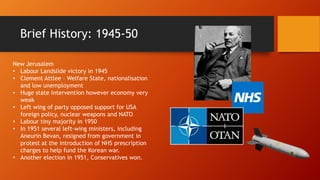
Brief History: 1945-50
New Jerusalem
• Labour Landslide victory in 1945
• Clement Attlee – Welfare State, nationalisation
and low unemployment
• Huge state intervention however economy very
weak
• Left wing of party opposed support for USA
foreign policy, nuclear weapons and NATO
• Labour tiny majority in 1950
• In 1951 several left-wing ministers, including
Aneurin Bevan, resigned from government in
protest at the introduction of NHS prescription
charges to help fund the Korean war.
• Another election in 1951, Conservatives won.
Main Party Divisions
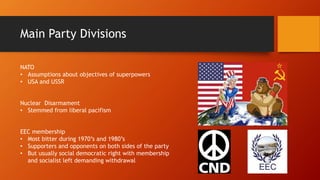
NATO
• Assumptions about objectives of superpowers
• USA and USSR
Nuclear Disarmament
• Stemmed from liberal pacifism
EEC membership
• Most bitter during 1970’s and 1980’s
• Supporters and opponents on both sides of the party
• But usually social democratic right with membership
and socialist left demanding withdrawal
Party Split: 1951 - onwards
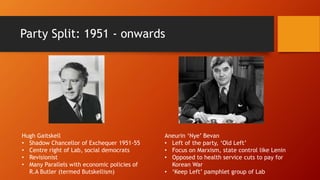
Hugh Gaitskell
• Shadow Chancellor of Exchequer 1951-55
• Centre right of Lab, social democrats
• Revisionist
• Many Parallels with economic policies of
R.A Butler (termed Butskellism)
Aneurin ‘Nye’ Bevan
• Left of the party, ‘Old Left’
• Focus on Marxism, state control like Lenin
• Opposed to health service cuts to pay for
Korean War
• ‘Keep Left’ pamphlet group of Lab
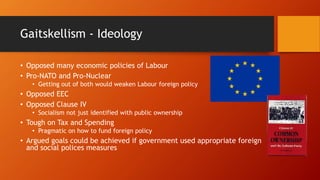
Gaitskellism - Ideology
• Opposed many economic policies of Labour
• Pro-NATO and Pro-Nuclear
• Getting out of both would weaken Labour foreign policy
• Opposed EEC
• Opposed Clause IV
• Socialism not just identified with public ownership
• Tough on Tax and Spending
• Pragmatic on how to fund foreign policy
• Argued goals could be achieved if government used appropriate foreign
and social polices measures
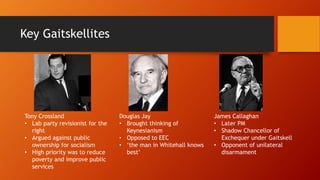
Key Gaitskellites
Tony Crossland
• Lab party revisionist for the
right
• Argued against public
ownership for socialism
• High priority was to reduce
poverty and improve public
services
Douglas Jay
• Brought thinking of
Keynesianism
• Opposed to EEC
• ‘the man in Whitehall knows
best’
James Callaghan
• Later PM
• Shadow Chancellor of
Exchequer under Gaitskell
• Opponent of unilateral
disarmament
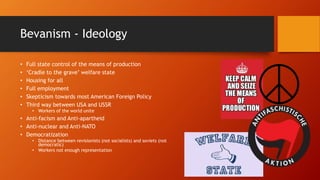
Bevanism - Ideology
• Full state control of the means of production
• ‘Cradle to the grave’ welfare state
• Housing for all
• Full employment
• Skepticism towards most American Foreign Policy
• Third way between USA and USSR
• Workers of the world unite
• Anti-facism and Anti-apartheid
• Anti-nuclear and Anti-NATO
• Democratization
• Distance between revisionists (not socialists) and soviets (not
democratic)
• Workers not enough representation
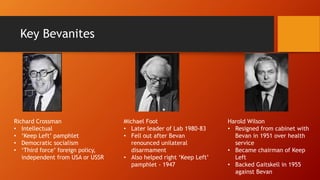
Key Bevanites
Michael Foot
• Later leader of Lab 1980-83
• Fell out after Bevan
renounced unilateral
disarmament
• Also helped right ‘Keep Left’
pamphlet - 1947
Harold Wilson
• Resigned from cabinet with
Bevan in 1951 over health
service
• Became chairman of Keep
Left
• Backed Gaitskell in 1955
against Bevan
Richard Crossman
• Intellectual
• ‘Keep Left’ pamphlet
• Democratic socialism
• ‘Third force’ foreign policy,
independent from USA or USSR
Revisionism – Anthony Crosland
‘In my view Marx has little to offer the
contemporary socialist either in respect of
practical policy, or of the correct analysis of
our society, or even of the right conceptual
tools or framework’
-Crosland 1956
Capitalism of C19th no longer existed, with presence of:
• Progressive taxation
• Welfare Reforms
• State enterprise
• Trade Unions
So no need for traditional Labour policies such as clause IV
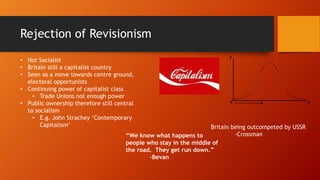
Rejection of Revisionism
Britain being outcompeted by USSR
-Crossman“We know what happens to
people who stay in the middle of
the road. They get run down.”
-Bevan
• Not Socialist
• Britain still a capitalist country
• Seen as a move towards centre ground,
electoral opportunists
• Continuing power of capitalist class
• Trade Unions not enough power
• Public ownership therefore still central
to socialism
• E.g. John Strachey ‘Contemporary
Capitalism’
Criticisms of the ‘Old Left’
U-turn on nukes
• See to reduce nukes, not get rid of
• Without them a future British foreign secretary would
be going ‘naked into the conference chamber’
• Michael Foot disagreed, major part of Labour
manifesto 1983
Poor Leadership
• Bevan died in 1960
• Only a figurehead organization
• Bevan had no coherent or consistent strategy
Evaluation of Gaitskellism
• Never know how good a PM Hugh would have been
• Problems of fixed exchange rates, which hampered the
Labour government in 1964-70
• Never failing
• EEC membership good example
• Current Labour do well in looking how he modernised the
party
• Use of media to reach electorate, including Tony Benn
using TV
• Would have utlised social media and current labour are
doing
• After his death in 1960, formation of Campaign for
Democratic Socialists (CDS)
• Provided for the moderates
• But later became the vanguard for the SDP
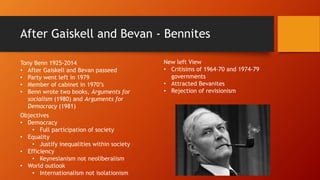
After Gaiskell and Bevan - Bennites
Tony Benn 1925-2014
• After Gaiskell and Bevan passeed
• Party went left in 1979
• Member of cabinet in 1970’s
• Benn wrote two books, Arguments for
socialism (1980) and Arguments for
Democracy (1981)
New left View
• Critisims of 1964-70 and 1974-79
governments
• Attracted Bevanites
• Rejection of revisionism
Objectives
• Democracy
• Full participation of society
• Equality
• Justify inequalities within society
• Efficiency
• Keynesianism not neoliberalism
• World outlook
• Internationalism not isolationism
Summary
• After Attlee governemnt split over future of Labour and socialism
• Gaitskell– revisionist
• Key Gaitskellites
• Tony Crosland
• Douglas Jay
• James Callaghan
• Bevan – classic Marxist
• Key Bevanites
• Richard Crosman
• Michael Foot
• Harold Wilson
• Capitalism no longer the suppressive society of Marx
• Still a rejection of revisionism as not ‘true socialism’
• Later Gaitskellites left labour and formed SDP
• Later Bevanites rallied around Tony Benn
Practice Questions
• Why has the Labour left always ultimately lost out to the Labour
right and what consequences has this had for the party?
• To what extent did the ‘Old left’ influence labour policy from
1951-64?
Sources
https://en.wikipedia.org/wiki/Gaitskellism
https://en.wikipedia.org/wiki/Bevanism
http://www.progressonline.org.uk/2012/08/15/reintroducing-gaitskell/
R. Leach, Political Ideology in Britain, Basingstoke : Palgrave Macmillan, 2009

Gaitskellism vs. Bevenism

  • 1.
  • 2.
    Brief History: 1945-50 NewJerusalem • Labour Landslide victory in 1945 • Clement Attlee – Welfare State, nationalisation and low unemployment • Huge state intervention however economy very weak • Left wing of party opposed support for USA foreign policy, nuclear weapons and NATO • Labour tiny majority in 1950 • In 1951 several left-wing ministers, including Aneurin Bevan, resigned from government in protest at the introduction of NHS prescription charges to help fund the Korean war. • Another election in 1951, Conservatives won.
  • 3.
    Main Party Divisions NATO •Assumptions about objectives of superpowers • USA and USSR Nuclear Disarmament • Stemmed from liberal pacifism EEC membership • Most bitter during 1970’s and 1980’s • Supporters and opponents on both sides of the party • But usually social democratic right with membership and socialist left demanding withdrawal
  • 4.
    Party Split: 1951- onwards Hugh Gaitskell • Shadow Chancellor of Exchequer 1951-55 • Centre right of Lab, social democrats • Revisionist • Many Parallels with economic policies of R.A Butler (termed Butskellism) Aneurin ‘Nye’ Bevan • Left of the party, ‘Old Left’ • Focus on Marxism, state control like Lenin • Opposed to health service cuts to pay for Korean War • ‘Keep Left’ pamphlet group of Lab
  • 5.
    Gaitskellism - Ideology •Opposed many economic policies of Labour • Pro-NATO and Pro-Nuclear • Getting out of both would weaken Labour foreign policy • Opposed EEC • Opposed Clause IV • Socialism not just identified with public ownership • Tough on Tax and Spending • Pragmatic on how to fund foreign policy • Argued goals could be achieved if government used appropriate foreign and social polices measures
  • 6.
    Key Gaitskellites Tony Crossland •Lab party revisionist for the right • Argued against public ownership for socialism • High priority was to reduce poverty and improve public services Douglas Jay • Brought thinking of Keynesianism • Opposed to EEC • ‘the man in Whitehall knows best’ James Callaghan • Later PM • Shadow Chancellor of Exchequer under Gaitskell • Opponent of unilateral disarmament
  • 7.
    Bevanism - Ideology •Full state control of the means of production • ‘Cradle to the grave’ welfare state • Housing for all • Full employment • Skepticism towards most American Foreign Policy • Third way between USA and USSR • Workers of the world unite • Anti-facism and Anti-apartheid • Anti-nuclear and Anti-NATO • Democratization • Distance between revisionists (not socialists) and soviets (not democratic) • Workers not enough representation
  • 8.
    Key Bevanites Michael Foot •Later leader of Lab 1980-83 • Fell out after Bevan renounced unilateral disarmament • Also helped right ‘Keep Left’ pamphlet - 1947 Harold Wilson • Resigned from cabinet with Bevan in 1951 over health service • Became chairman of Keep Left • Backed Gaitskell in 1955 against Bevan Richard Crossman • Intellectual • ‘Keep Left’ pamphlet • Democratic socialism • ‘Third force’ foreign policy, independent from USA or USSR
  • 9.
    Revisionism – AnthonyCrosland ‘In my view Marx has little to offer the contemporary socialist either in respect of practical policy, or of the correct analysis of our society, or even of the right conceptual tools or framework’ -Crosland 1956 Capitalism of C19th no longer existed, with presence of: • Progressive taxation • Welfare Reforms • State enterprise • Trade Unions So no need for traditional Labour policies such as clause IV
  • 10.
    Rejection of Revisionism Britainbeing outcompeted by USSR -Crossman“We know what happens to people who stay in the middle of the road. They get run down.” -Bevan • Not Socialist • Britain still a capitalist country • Seen as a move towards centre ground, electoral opportunists • Continuing power of capitalist class • Trade Unions not enough power • Public ownership therefore still central to socialism • E.g. John Strachey ‘Contemporary Capitalism’
  • 11.
    Criticisms of the‘Old Left’ U-turn on nukes • See to reduce nukes, not get rid of • Without them a future British foreign secretary would be going ‘naked into the conference chamber’ • Michael Foot disagreed, major part of Labour manifesto 1983 Poor Leadership • Bevan died in 1960 • Only a figurehead organization • Bevan had no coherent or consistent strategy
  • 12.
    Evaluation of Gaitskellism •Never know how good a PM Hugh would have been • Problems of fixed exchange rates, which hampered the Labour government in 1964-70 • Never failing • EEC membership good example • Current Labour do well in looking how he modernised the party • Use of media to reach electorate, including Tony Benn using TV • Would have utlised social media and current labour are doing • After his death in 1960, formation of Campaign for Democratic Socialists (CDS) • Provided for the moderates • But later became the vanguard for the SDP
  • 13.
    After Gaiskell andBevan - Bennites Tony Benn 1925-2014 • After Gaiskell and Bevan passeed • Party went left in 1979 • Member of cabinet in 1970’s • Benn wrote two books, Arguments for socialism (1980) and Arguments for Democracy (1981) New left View • Critisims of 1964-70 and 1974-79 governments • Attracted Bevanites • Rejection of revisionism Objectives • Democracy • Full participation of society • Equality • Justify inequalities within society • Efficiency • Keynesianism not neoliberalism • World outlook • Internationalism not isolationism
  • 14.
    Summary • After Attleegovernemnt split over future of Labour and socialism • Gaitskell– revisionist • Key Gaitskellites • Tony Crosland • Douglas Jay • James Callaghan • Bevan – classic Marxist • Key Bevanites • Richard Crosman • Michael Foot • Harold Wilson • Capitalism no longer the suppressive society of Marx • Still a rejection of revisionism as not ‘true socialism’ • Later Gaitskellites left labour and formed SDP • Later Bevanites rallied around Tony Benn
  • 15.
    Practice Questions • Whyhas the Labour left always ultimately lost out to the Labour right and what consequences has this had for the party? • To what extent did the ‘Old left’ influence labour policy from 1951-64?
  • 16.